
InspectAPedia® FREE Encyclopedia of Building & Environmental Construction, Diagnosis, Maintenance & Repair |
Question? Just ask us! InspectAPedia
|
 Guide to Heating Oil Burner Fire Safety Valves
- POST a QUESTION or COMMENT about heating oil control valves and fusible link safety valves
Guide to OSVs - Oil Line Safety Valves: this article describes check valves and fusible link oil safety valves used on oil piping at heating appliances as both a fire safety device and to assist in oil burner servicing.
We explain the purpose of OSVs, which way to turn the OSV or oil line safety valve to open or close it, and we describe common oil line valve installation or use mistakes.
How & Where do We Install a Fusible-Link Firomatic™ Type Oil Safety Valve? This article series explains the installation & use of OSBs, or Fusible Link Oil Safety Valves. We describe and explain the differences in function and use among fusible link fire safety valves (OSVs) like the Firomatic®, vacuum operated OSVs like the Webster OSV and Suntec PRVs, oil line check valves, Tiger Loop and other oil system air removing devices, and oil delay valves or quick-stop valves that are also referred to as oil safety valves.
We explain where each valve is installed and what it does. We include oil safety valve and check valve troubleshooting advice, and we describe defects in heating oil piping & control valves.
InspectAPedia tolerates no conflicts of interest. We have no relationship with advertisers, products, or services discussed at this website.
- Daniel Friedman, Publisher/Editor/Author - See WHO ARE WE?
What is an OSV & How & Where do We Install a Fusible-Link Firomatic™ Type Oil Safety Valve?
 What are Fusible-Link Oil Safety Valves (OSVs) - definition
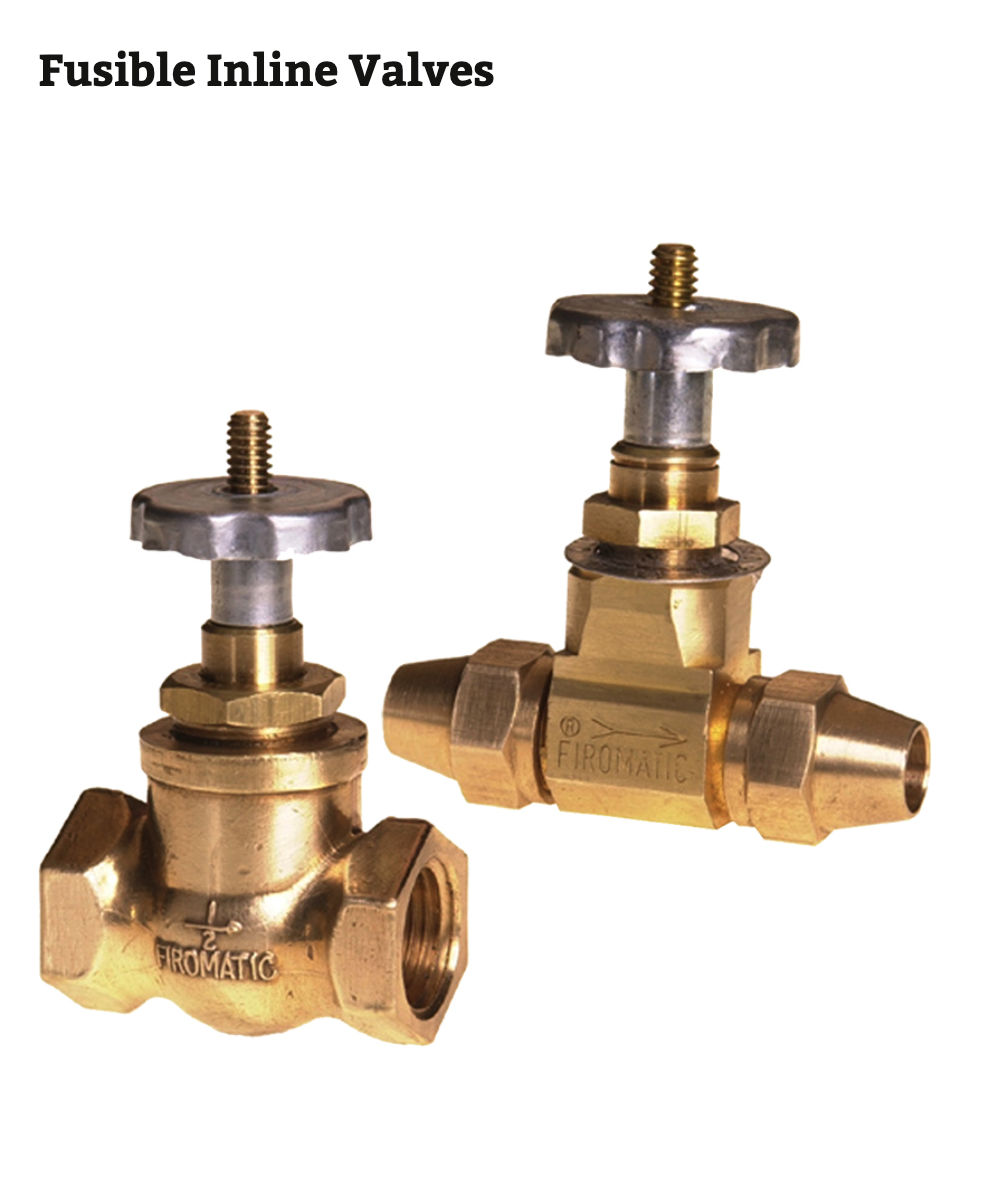
The OSV or oil safety valve controls flow of fuel oil to the oil burner of oil-fired heating boilers, furnaces, and water heaters. This inline oil valve is intended to close automatically and thus stop the flow of oil in the oil line in the event of a fire.
[Click to enlarge any image]
Some suppliers use other names for this valve including the "Firomatic" valve (R.W. Beckett) or the "Oil Safety Valve OSVA-38" (Capital City Tool, Inc.).
Fusible Fire Safety Valves are designed to reduce fire damage by shutting off the flow of oil from the oil tank in the event of a fire.
These valves conform to UL/ULC 842 and are listed in the US and Canada. They are required by code in residential oil heating installations in conformance with NFPA 31. - R.W. Beckett [4a]
When the oil safety valve is open to permit heating oil to flow its movable stem and thus its internal stop valve are under spring tension.
Because the valve includes a fusible link (a lead or other soft metal core), in event of a fire the fusible link melts and the internal spring pushes the valve stem down, closing the valve and stopping oil flow.
Closing the oil valve or OSV means that we stop feeding oil to the oil burner in the event of a fire in the area.
Article Contents:
- DEFINITION of Fusible-Link Oil Safety Valves (OSVs) - just above on this page
- LOCATION of OSVs
- OPEN or SHUT POSITION of OSVs
- OIL LINE SAFETY VALVE HAZARDS, MISTAKES
- FIRE SAFETY for OSVs on 2-LINE OIL PIPING SYSTEMS
- TWO LINE OIL PIPING VALVE & CHECK VALVE
- WHERE to BUY OSVs - manuacturer list
- OIL SUPPLY LINE SAFETY VALVE TURN DIRECTION to OPEN or SHUT - separate article
Where are Oil Line Safety Valves (OSVs) usually Installed?
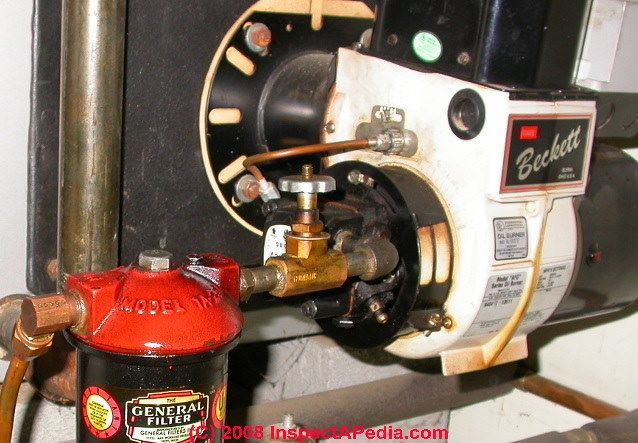
 Usually the OSV is installed close to the oil burner both for safety reasons (close to heating equipment means close to a more likely fire source) and also for service convenience (minimizes oil spillage and maximizes convenience for the heating service tech working on the burner or oil filter).
In our photo you can see from left to right the OSV, an oil filter, and the fuel unit (oil pump) and air intake for the oil burner.
That vertical pipe below the fuel unit is the return line - so we know this is a two-pipe or two line heating oil set-up.
Sometimes additional stop valves or OSVs may be installed at other locations (such as at the outlet of an above ground oil storage tank), but the critical location is at the oil burner since that's a more likely location at which a fire may occur.
Watch out: the Firematic™ fusible-link automatic oil line shutoff valve (photo at left) should only be present on the oil supply line. We explain below
at FIRE SAFETY for OSVs on 2-LINE OIL PIPING SYSTEMS
that installing an OSV on the return line of a two pipe oil system can lead to disaster. Instead, where it is necessary to prevent leakage from the return oil line during oil burner servicing we can install a simple one-way check valve on the oil return line (if the oil burner's fuel unit manufacturer permits.)
Our photo at below left shows an example of a Firematic™ safety valve right at the oil burner. Synonyms people use for this valve include OSV, fire safety valve, oil line valve, Fire-o-Matic valve, Fusible link valve, oil line shutoff valve, oil safety valve, and Fireomatic valve.
Location of Fire Safety Controls at the Oil Filter
In particular, the OSV shown here is installed between the oil filter canister and the fuel unit intake port.
That means that it would be impossible to service the oil filter without spilling heating oil unless the service technician finds another oil line shutoff valve somewhere between the oil tank and the inlet side of the oil filter.
With the shutoff valve between the filter canister and the oil burner (above right), changing the oil filter in the canister will require the service tech to go to the more distant oil tank to find and close a valve in that location (if one is even present).
Fortunately at this property there was another OSV installed right at the above ground oil storage tank.
The OSV shown above should have been installed on the inlet side of the oil filter rather than on the filter outlet side.
Below we show the same oil burner after it was converted to a two-line oil piping system (when the oil storage tank was replaced).
The technician moved the Fire-o-matic OSV to its proper location at the inlet side of the oil filter, and he also installed a Firomatic oil line check valve between the oil filter and the oil burner.
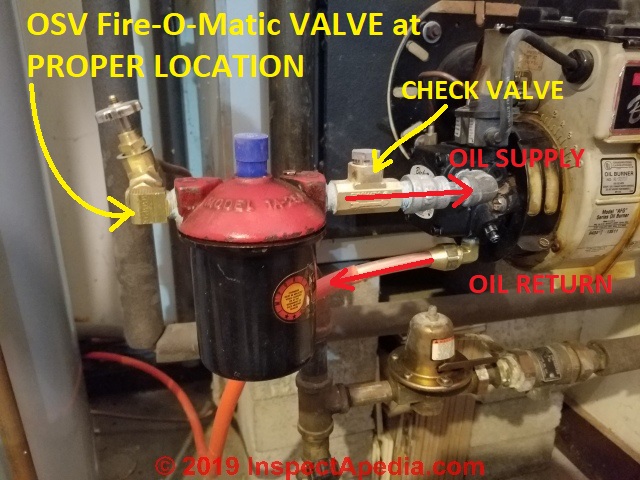
Watch out: Notice that there is no valve or shut-off of any kind installed on the return line from the oil pump (fuel unit) to the oil tank.
This is an important fire-safety detail as in event of a fire a closed valve on the return line (if it closes before the OSV on the supply line) could cause blowing seals on the oil pump or a blown oil line fitting, spewing fuel oil over the building fire.
In sum, the proper place for the fusible link oil valve (Fire-o-Matic Safety Valve™ for example) is on the oil supply line just before the inlet to the oil filter canister (red arrow, below left), not between the canister and the oil burner as shown at below right (orange arrow).
This allows the service tech to shut off oil just before the filter canister in order to open the canister and change the oil filter cartridge.
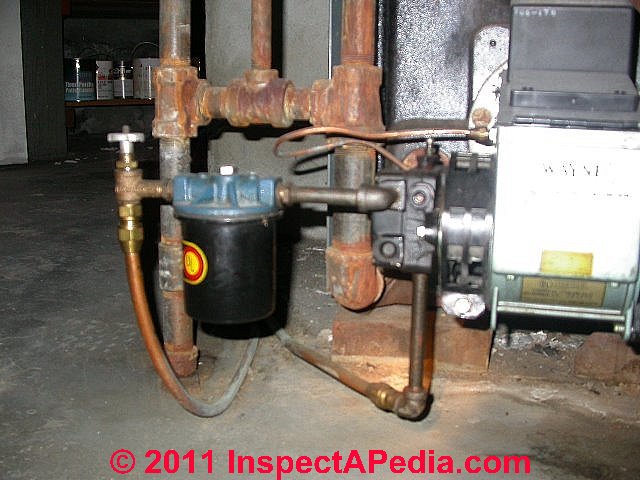
Below is another two-line oil system showing the OSV on the inlet side of the fuel filter canister just ahead of the oil burner and the oil return line exiting from the bottom of the fuel unit.
11 May 2015 NHFireBear said:
Regarding "the best location of an oil filter", NFPA 31 (2011): 7.5.8, for indoor tanks up to 330 gallons, requires that a thermally activated shutoff valve be placed inline as close as practical to the outlet from a tank and that a proper filter or screen be installed downstream and WITHIN SIX INCHES of the required thermally actuated valve. If it's required in the code, it doesn't have to "the best" - it just has to comply with the code.
Discussion:
With respect, Firebear, it is a fundamental error to suggest that "complying with code" is all that we need to think about in building and mechanical systems. Building codes specify the minimum requirements for acceptable practice. Often there are powerful reasons to do a better job than the bare minimum that's required.
Many oil heat technicians sensibly want to install a fusible-link oil supply line valve at the oil burner, not only because this makes servicing the oil burner easier but because it also recognizes that the most-likely location of a fire is at the oil burner rather than possibly at a more distant oil storage tank.
The photograph above shows the right location for this safety device: at the input end of the oil filter. This permits the service technician to conveniently turn off the oil supply inorder to change the oil filter cartridge.
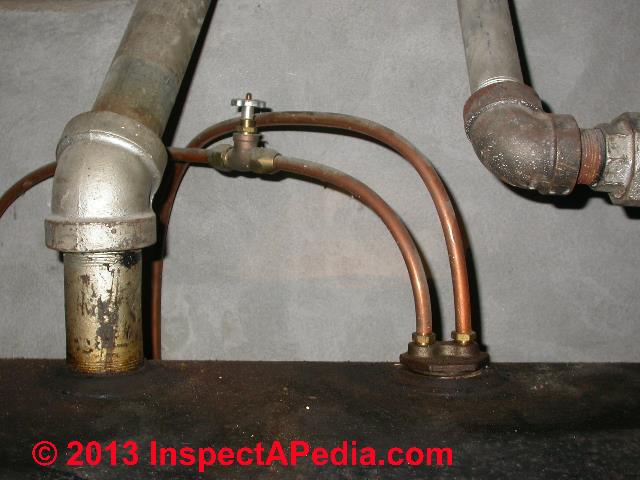
This photo shows an OSV installed on the supply line of a 2-pipe oil tank piping system at the tank top outlet.
The writers of NFPA 31 (2011) 7.5.8 as specified above were focused on safety including wanting to avoid oil spills from the tank, but they might also have recognizede that putting an oil filter at the oil tank protects the oil line (between tank and oil burner) from sludge-clogging.
Some heating service techs agree with NFP31.
(Jan 23, 2014) oilman said: Your info is wrong. The filter belongs on the tank so it also protects the oil line. If you must install at the burner, it must be piped at least 12" from the pump. Hence why they make 12" flexible oil lines.
Reply: We agree that there is an advantage to protecting the oil line. However some HVAC instructors (including mine) teach that if the filter is not installed by the burner it is too often forgotten at service time.
Also putting the filter at the burner means there is a convenient shutoff valve location and air bleeder location outside the fuel unit.
When the oil tank is a bit more remote - across the garage and buried by the homeowner's stored surfboards and hiking boots and boxes of tax receipts, the service tech enjoys being able to find the oil burner.
Having inspected several thousand heating systems, my [DF] experience is that most of the time the OSV and filter are installed where they are convenient for service - which is usually close to the burner, notwithstanding the very good reasons for locating a filter at the inlet end of the oil line.
Our OPINION [DF] is that if the technician installs an OSV at the oil burner (and ahead of a filter if one is installed there), s/he should install a second OSV on the same oil supply line at the outlet from the oil tank, particularly if the oil tank outlet piping exits at the tank bottom, and ahead of the oil filter (if that's where it's installed).
Watch out: do not install an additional OSV on the return line of a 2-line oil piping system.
See FIRE SAFETY for OSVs on 2-LINE OIL PIPING SYSTEMS
The discussion above appeared originally at OIL FILTERS on HEATING EQUIPMENT.
How to Tell if the Firomatic Oil Line Safety Valve (OSV) is OPEN or SHUT
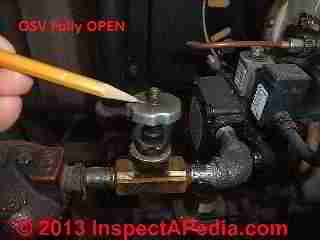
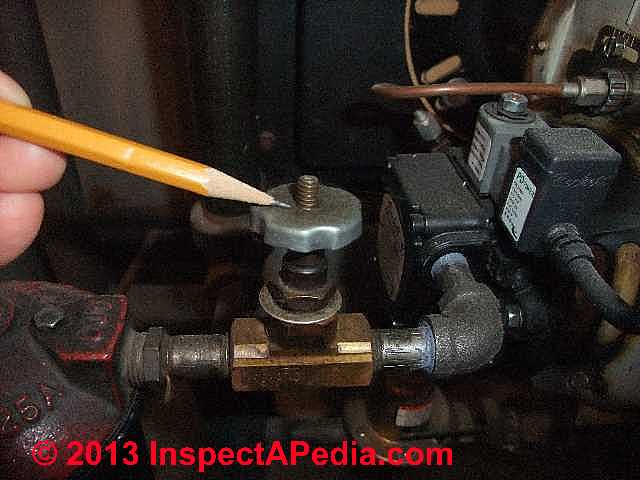
In our OSV photos below, the first photo (below left) shows the oil line safety valve in the OPEN position - oil will flow when the threaded portion of the valve shaft extends fully up through the rotatable knob pointed to by my pencil. [Click any image to see an enlarged version. Thanks to reader Bernie Daraz for pointing out the need for these two photos]
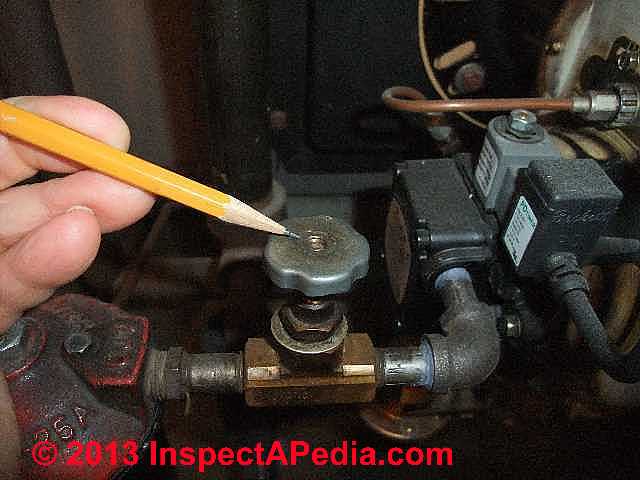
In our heating oil line valve photo at above right the valve has been manually CLOSED - no oil will flow. The threaded valve stem has disappeared down into the valve body and has shut off the valve and oil flow.
Watch out: if (for example in case of a fire) the fusible link inside of an OSV has melted permitting the spring to close the valve, then from outside the valve may look as if it is in the open position - the threaded stem will still be poking out - but the valve has snapped and closed internally.
Most likely you'll know this also because there will have been a fire or other horrible event that melted the OSV fusible link.
Which Way do I Turn the Oil Line Valve to Open or Close it to Permit or Shut Off Oil Flow?
- OPEN: if the OSV is turned fully CCW (left to right) to Open Position = oil can flow
- CLOSED: if the OSV is turned fully CW (right to left) to Closed Position = oil cannot flow
Details about exactly how to operate and which way to turn an OSV or oil line safety valve or Firematic valve are provided
at OIL SUPPLY LINE SAFETY VALVE TURN DIRECTION to OPEN or SHUT
Oil Line Safety Valve Hazards, Mistakes, Problems
Other Oil Safety Valve SNAFUS & Warnings
Watch out: A simple oil line shutoff valve may not be a fusible-link safety valve. The simple shutoff valve might be any plumbing valve that can manually stop oil flow in the line, but it is not a safety device.
Make sure you've installed a fusible-link safety valve at each location where it's most needed - at each oil burner. Even when one of these valves is installed at the oil tank the proper place for this protection is on the fuel oil supply line
right at the burner as well. Why?
In the event of a fire, if the return oil line valve closes before the supply line oil valve your oil burner pump may burst the oil line or it may cause a fuel pump gasket or seal to fail, leading to uncontrolled oil flow and perhaps worse, spray heating oil everywhere, possibly feeding the building fire.
Thanks to Dave Ferris for this fire safety tip and thanks to reader Rick Johnston for adding clarification. (Note that not oil burners use both an oil supply and oil return line between the oil tank and oil burner.)
Suntec points out in their installation literature for fuel units (oil pumps for oil burners) that pressures over 10 psi on an oil inlet line (normally running at a vacuum) may damage the shaft seal on the pump - i.e., leak heating oil.
See OIL TANK PIPING & PIPING DEFECTS for a table of normal running vacuum levels in heating oil piping installations.
Watch Out: If the oil line fire safety valves are missing or are not at the right location, we recommend immediate installation of a Fire-o-matic™ type oil line safety valve on the oil line at the burner.
- Recommended (red arrow, photo above left): an automatic oil line shutoff valve on the oil supply line right at each and every individual oil burner:
(a type that will shut off oil supply to the heating equipment in the event of a fire, such as a Fire-o-Matic™ valve) is shown in our photo at left.
By every oil burner, we mean for example that if your heating system and also your hot water heater each has its own oil burner then each burner should have an oil safety valve. (As in our photo above left). - Oil-Tank-Only Valves are Not Recommended
A common but poor practice is to install an oil valve just at the oil tank or perhaps installing a single oil safety valve at the oil burner for the heating boiler but omitting the oil safety valve for the oil fired water heater in the same building. - A second oil line shutoff valve
on the oil supply line at the oil tank (photo above right) is ok as long as you have also provided the first oil safety valve at the oil burner(s).
Some service technicians install a second oil safety valve at the oil tank or at another remote location away from the oil burner, such as at the building wall where an outdoor oil tank line enters the building, or right at the oil tank (photo at above right - this oil tank valve is leaking).
This second valve is helpful if it becomes necessary to replace the oil line between oil tank and oil burner. Although our photo above shows a fusible link oil valve at the oil tank, the oil line shutoff valve at the oil tank or at a location remote from the oil burner or other more likely fire sources can be a normal plumbing stop valve. - A second OSV right at the burner,
on the return oil line is unsafe, as we explain
at FIRE SAFETY for OSVs on 2-LINE OIL PIPING SYSTEMS - i
Multiple OSVs are also not recommended: i n typical instructions manufacturers warn: Operation of OSV valves in parallel or in series is not recommended. (Webster 2011).
However a common exception we see in the field is an OSV at the oil burner and a second OSV (or perhaps a simple shutoff valve, not thermally linked) at the oil tank end of the oil line.
- Teflon tape at OSV
threaded oil line or fuel unit connections: Webster's instructions and some other manufacturers also specifically warn: Do Not Use Teflon Tape. Use of teflon tape voids all warranties. (Webster 2011) - OSV too high:
some instructions warn: Do not mount the OSV more than three feet above the burner fuel pump inlet, or more than three feet above the lowest point in the fuel line connecting the OSV to the burner fuel pump. In-line mounting with the burner fuel pump inlet is recommended.
Failure to observe the above caution may result in siphoning action in the event of failuire of the fuel line between the burner fuel pump and the OSV.
Fire Safety for Two-Line Oil Piping Systems
 Watch Out: If two oil lines are used to supply an oil burner, Do NOT install an automatic oil line shutoff on the return oil line between the oil burner and the oil tank.
The concern is that should a fire occur in the building, and should an OSV on the oil return line close before the OSV on the supply line, the fuel unit may over-pressurize the oil lines, causing a burst oil line that then sprays high-pressure oil into the fire, increasing its size and spread-rate.
Use an oil line check valve instead. Or if the heating equipment manufacturer recommends against using a check valve in the oil piping system (Suntec prohibits, Webster recommends) then leave it out.
The automatic oil line shutoff valve should only be present on the oil supply line.
Further explanation of the use or prohibition of check valves in oil piping systems is
at OIL SUPPLY LINE CHECK VALVES.
Our photo (left, red arrow) illustrates this hazard: you will see fusible link safety valves on both the oil feeder line (blue arrow, left side of photo before the oil filter canister) and the oil return line (red arrow, right side of the photograph).
Watch Out: If oil line valves are missing or are not at the right location there is risk of system malfunction, oil leaks, and fire damage.
We recommend installation of a Firematic™ fusible link (Fire-o-matic)™ type oil line safety valve on the oil supply line at the burner. This valve controls flow of fuel oil to the burner, and has a lead core which melts and shuts the valve, stopping the flow of oil in event of a fire in the building.
Even when a fusible link oil line valve is installed at the oil tank, the proper place for this fire protection is right at the ol burner as well. A valve in that location also makes servicing the heating equipment easier, faster, and cleaner.
Oil Line Check Valve Safety Warnings
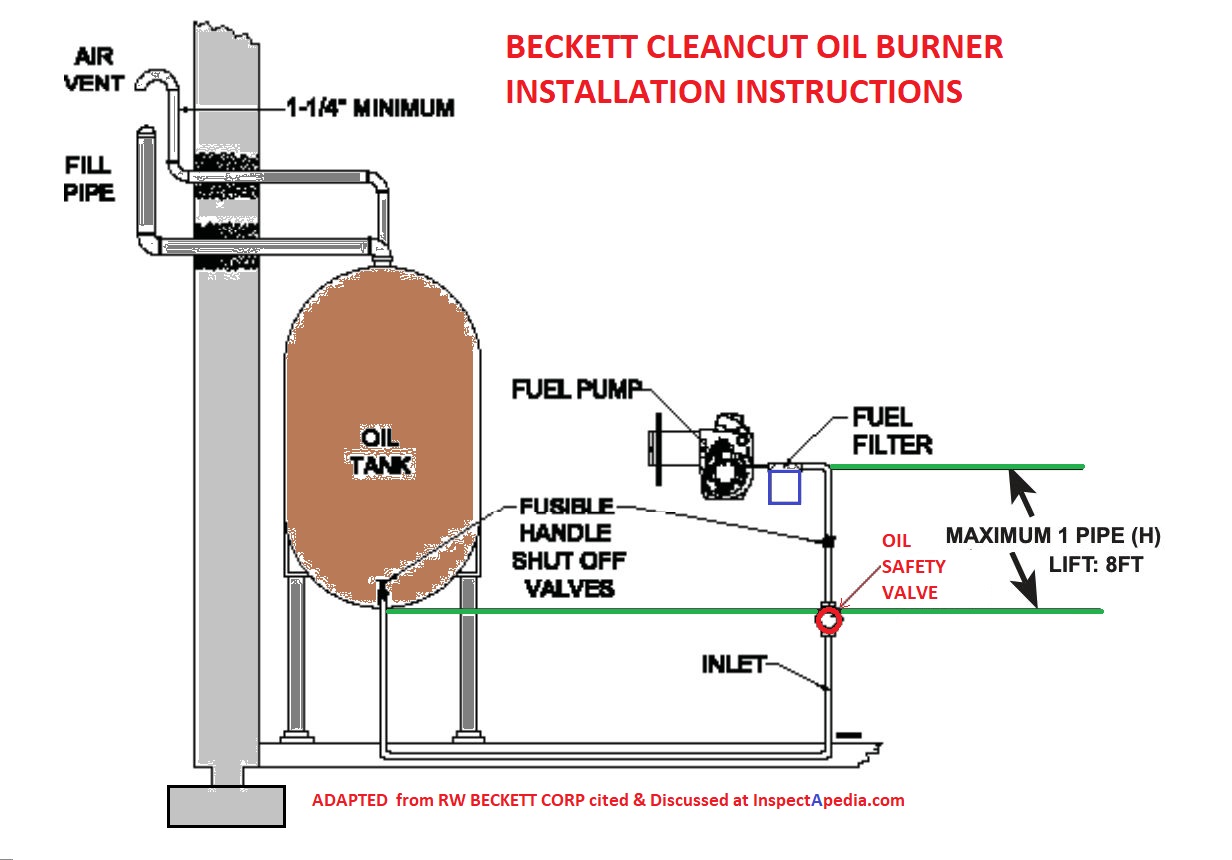 Watch out: some manufacturers such as Beckett warn against using check valves on oil piping as follows:
- Do not use a check valve in the inlet line of a 1-pipe system (with or w/o a boost pump), or in the return line of a 2-pipe system.
- NFPA 31-25, 8.5 states that ‘A return line from a burner or pump to a supply line shall have no valves or obstructions and shall enter the top of the same tank.’
- Check valve flow restriction in a return line can elevate pressures and damage the fuel unit seals.
- Dangerous thermal expansion of oil trapped by an inlet
line check valve can create extreme pressures that damage
fuel unit seals, line fittings, inlet filters, gauges and other
components.
A properly installed vacuum safety valve, such as Suntec PRV-38, having accumulator effect and pressure relief to tank is acceptable in the inlet line. - Do not use teflon tape or compression fittings.
Source: Beckett, BECKETT CLEANCUT INSTALLATION INFORMATION [PDF] (2007) R.W. BECKETT CORPORATION
U.S.A.: P.O. Box 1289 Elyria, Ohio 44036
Canada: R.W. Beckett Canada, Ltd. · Unit #3, 430 Laird Road · Guelph,
Ontario N1G 3X7, retrieved 2019/10/09 original source: https://www.beckettcorp.com/wp-content/uploads/2015/06/61583_CleanCutInstallationInstructions.pdf
Vacuum-Activated Oil Safety Valves, OSVs & PRVs (Webster & Suntec)
 A vacuum-operated Webster OSV™ provides both oil line pressure protection & oil line leak protection but is not a fire protection device.
Details about vacuum-operated OSVs and the Suntec PRV that combines the vacuum-operated valve with an oil filter are
at OIL SUPPLY LINE VACUUM-ACTIVATED OSVs & PRVs.
Here is a brief summary:
Unlike a fusible link OSV that shuts in response to high temperature to provide fire protection at the oil burner, a vacuum operated OSV opens only in response to a "sustained vacuum" created at its outlet end when the oil burner's fuel unit pump is drawing oil from the supply.
Vacuum-operated safety valves offer protection against oil line leaks and against overpressure conditions on the supply side of the fuel unit. They are not a fire-safety valve.
Protection against over-pressure from the supply piping prevents leaks at the fuel pump inlet or seals that might occur when the fuel pump is not operating but the supply piping is under pressure from the oil source.
Oil Piping Check Valves - Non Return Valves

Details about check valves used (or not to be used) on heating oil piping systems are
at OIL SUPPLY LINE CHECK VALVES. Excerpts are here.
If two oil lines are used to supply an oil burner,
(a supply and a return) install an oil safety valve or OSV or fusible link oil line shutoff valve only on the oil supply line at the oil pump on the oil burner.
Do NOT install an automatic oil line shutoff on the return oil line between the oil burner and the oil tank.
If a protection against oil back-flow at the return line is a concern, and if the manufacturer recommends it, use a check valve instead.
Check valves like this one permit oil to flow just in one direction. They do not close down in event of a fire. Installed on the oil return line a check valve permits oil to flow from the oil pump in one direction only: back to the oil tank.
[Click to enlarge any image]
Where do I Install a Tigerloop™ or similar oil line de-aerator/prime-protection device?
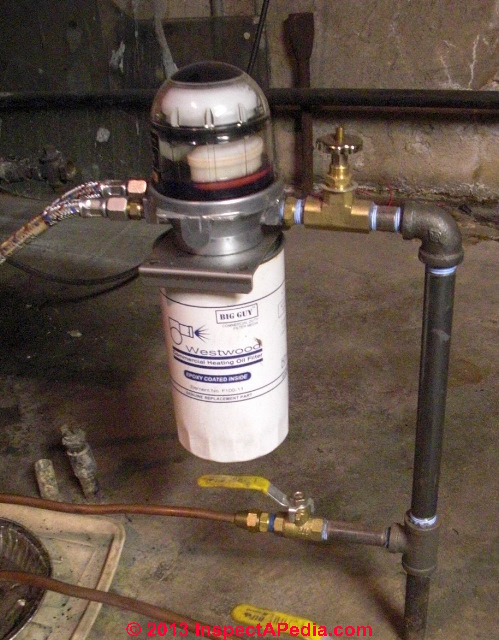 Watch out: Tigerloop™ warns that you should never install an oil line shutoff device between the de-aerator device and the oil pump.
Or as reader T.R. clarifies:
... I've been reading about TigerLoop oil fuel line de-aerators.
When they are used, the manufacturer recommends that the fusible valve near the burner be attached at the inlet of their de-aeration device.
Typically the oil line de aerator device such as the Tigerloop is installed at the same location as the oil filter - just before oil enters the fuel unit (oil pump), as shown in our photograph at left, provided courtesy of reader E.I..
- Details about this oil line air removing device are found
at TIGERLOOP and other Oil Line Devices to Maintain Prime and Simplify Oil Piping - Details about a suspected leak in oil line piping where a de-aerator or oil line air removal device is installed are in a Q&A discussion found
at OIL SUPPLY LINE PIPING LEAKS
Our photo, left, shows a Tigerloop™ installed at a property discussed in the Q&A link given just above.
Gas Line Safety Valves
Fire safety valves for gas fuel lines that can shut off fuel supply in the event of a fire are also available - see our separate discussion
at GAS SHUTOFF VALVES, LP or NATURAL or select a topic from the closely-related articles below, or see the complete ARTICLE INDEX.
Oil Line Safety Valve Manufacturers List - where to buy an OSV & OSV Installation Instructions
 The standard oil safety valve used at the oil burner and often found also at the oil tank is the Firomatic™ fusible link safety valve.
The Firomatic® oil line valve can be installed in ANY position - (vertical, horizontal, upside down) at least that's what we were taught and what we have seen - the valve is spring loaded.
The standard oil safety valve used at the oil burner and often found also at the oil tank is the Firomatic™ fusible link safety valve.
The Firomatic® oil line valve can be installed in ANY position - (vertical, horizontal, upside down) at least that's what we were taught and what we have seen - the valve is spring loaded.
In a fire the fusible link, a lead core, melts at 165°F and a spring in the valve assembly snaps the valve shut to assure that the heating system does not feed oil to a building fire. It has to work in any orientation.
This list provides some of the companies produce fusible-link inline oil safety valves (OSVs). The footnote links point to the companies' contact information in ourReferences or Citations section, but generally you would purchase an OSV from your local heating equipment supplier or plumbing supplier.
- AFL Industries, AFL OIL STOP VALVE PRODUCT BULLETIN [PDF] AFL Industries, 1101 West 13th St., Riviera Beach FL 33404 USA, Tel: 561-844-5200 includes OSV installation instructions for the contractor.
- Afrisco Mitco FLOW CONTROL 3/K1 OPERATING INSTRUCTIONS [PDF] Afrisco Euro Index Meß-,Regel-,Überwachungs- geräte für Heizungstechnik, Industrie und Umweltschutz Meß-, 74363 Güglingen Tel. ++49(0)7135-102-0 Fax ++49(0)7135-102-147 Internet: www.afriso.de e-mail: info@afriso.de
- ASCO, Fusible link oil line control valves for commercial equipment: ASCO products by Emerson Industrial Automation, P.O.Box 160, 17 Airport Road Brantford, Ontario Canada N3T 5M8 Tel: (519) 758-2700 Fax: (519) 758-5540 http://www.ascovalve.ca/
- Beckett, FIRE SAFETY VALVES, CHECK VALVES & THERMAL SWITCHES [PDF] R.W. BECKETT CORPORATION U.S.A.: P.O. Box 1289 · Elyria, Ohio 44036 Canada: R.W. Beckett Canada, Ltd. · Unit #3, 430 Laird Road · Guelph, Ontario N1G 3X7,
- Beckett, FIROMATIC FIRE SAFETY VALVES PRODUCT SHEET [PDF]
- Beckett, BECKETT CLEANCUT INSTALLATION INFORMATION [PDF] (2007) Op. Cit. retrieved 2019/10/09 original source: beckettcorp.com/wp-content/uploads/2015/06/61583_CleanCutInstallationInstructions.pdf
- Bursey, Charles, "The Oil Safety Valve (Service)", Charles Bursey, Sr., Fuel Oil News, February 2006 (Still trying to get the full article - October 2008 - DF) Charles W. Bursey Sr. can be reached at F.W. Webb Co. www.fwwebb.com/
- Cleanburn Energy CLEANBURN MULTI-OIL FURNACE OPERATORS MANUAL [PDF] (2009) Clean Burn Energy Systems, CLEAN BURN, INC. 34 Zimmerman Road Leola, PA 17540 U.S.A. includes Oil Safety Valve Installation Instructions
- R.W. Beckett (U.S. & Canada) Firomatic Fire Safety Valves Beckett Corporation produces /distributes a wide range of oil burners & oil burner accessories * equipment including the oil safety valve (OSV) referred to as Firomatic® fusible fire safety valves, oil line check valves, and fusible link thermal switches
See FIREMATIC FUSIBLE ELECTRICAL SWITCH - Website: www.beckttcorp.com
Beckett's Firomatic® OSVs are provided in both 3/8" and 1/2' sizes and in flare and threaded designs. OSVs are provided designed for installation at the oil burner and in a different model at the oil storage tank.- Beckett Corporation describes the Firomatic® fire safety valve as follows:
Fusible fire safety valves are designed to reduce fire damage by shutting off the flow of oil from the oil tank in the event of a fire. These valves conform to UL/ULC 842 and are listed in the U.S. and Canada. They are required by code in residential oil heating installations in conformance with NFPA 31.
All [Firomatic® fire safety] valves are embossed with the direction of oil flow and include unique part number identification ring on each valve. The seal stem uses a double seal washer/o-ring system with high grade Viton® equivalent materials suitable for No. 2 fuel oil, kerosene, and jp to 205 biodiesel blend.
- Beckett Corporation describes the Firomatic® fire safety valve as follows:
- ISP Automation (Firematic)
- Suntec Model A-7400 Fuel Unit Solenoid Dumping Pump,
Suntec Industries Inc., 60 Aberdeen Drive - PO Box 5000
Glasgow, KY 42142-5000 - USA
Tel : 270 651 7116 - Fax : 270 651 9276
e-Mail : info@suntecpumps.com and
Suntec Industries France, 1 Rue Lavoisier - B.P. 102 F-21603 LONGVIC Cedex - FRANCE Tel : +33 (0)3 80 70 60 70 - Fax : +33 (0)3 80 70 61 11 e-Mail : information@suntec.fr, [copy on file as /heating/Oil pumps fuel units/Sunted_Solenoid_DumpingPPump.pdf]
Suntech_Solonoid_Safety_Valves.pdf (brochure) web search 4/19/12, original source: http://www.suntecpumps.com/Suntecus/PDFs/Form%202740%20 -%20Solenoid%20Dumping%20Pump.pdf - Suntec Model PRV-38 OIL SAFETY VALVE INSTALLATION INFORMATION [PDF]Suntec Industries Inc., 60 Aberdeen Drive - PO Box 5000
Glasgow, KY 42142-5000 - USA
Tel : 270 651 7116 - Fax : 270 651 9276
e-Mail : info@suntecpumps.com and
Suntec Industries France, 1 Rue Lavoisier - B.P. 102 F-21603 LONGVIC Cedex - FRANCE Tel : +33 (0)3 80 70 60 70 - Fax : +33 (0)3 80 70 61 11 e-Mail : information@suntec.fr, [copy on file as /heating/Oil pumps fuel units/Form 2155 - PRV-38 Installation.pdf].
Except:
Oil under pressure or vacuum is supplied to the inlet of the PRV valve. Vacuum is required at the outlet of the PRV valve to open it and to allow oil to flow. When a burner starts, the pump will supply the vacuum necessary to open the valve. Any leak in the system which prevents vacuum from being exerted on the outlet port of teh valvewill prevent oil from flowing. - ISP Automation, Firomatic Globe Type Oil Line Valves & Lever Type Fusible Link Control Valves: ISP Automation, Inc., 1035 Old Georges Road, North Brunswick, NJ 08902, Phone: 866-383-3481, FAX 866-383-3482, Email: support@ispautomation.com http://www.ispautomation.com/
- Webster "Service Technician's Handbook, Webster Fuel Pumps & Valves" [handbook]. Webster Fuel Pumps & Valves, Capitol City Tool, Inc., http://www.websterfuelpumps.com/ , Division of Capital City Tool, Inc., Op. Cit.
- Webster, WEBSTER OIL SAFETY VALVE (OSV) TECHNICAL INSTALLATION BULLETIN [PDF] Webster Fuel Pumps & Valves, 219 Hahn Road Frankfort, Ky. 40601, Tel: (800) 766-1233 Email: czahalka@cctoolinc.com (Curtis Zahalka Sales Mgr/Mkt /Cust Service/Tech Support/Webmaster )
- Webster, OSV SERIES OIL SAFETY VALVES DIMENSIONS & SPECIFICATIONS [PDF] Fuel oil safety valves, Webster Fuel Pumps & Valves, web search 10/12/2011 original source http://www.websterfuelpumps.com/pdffiles/osv1.pdf
- Webster, "Dimensions & Specifications, OSV Series Oil Safety Valves, OSVA 38, OSVA 50", Webster Fuel Pumps & Valves, (1980), Op. Cit. retrieved 2/24/2014, original source: http://www.websterfuelpumps.com/pdffiles/osv1.pdf
- Westwood, Tigerloop: oil line de-aerator devices, Westwood Products Inc., 330 William St., PO Box 610, South River, NJ 08882-0610 - (732) 651-7700 http://www.westwoodproducts.com/tigerloop.htm
- Also see more citations and credits atReferences or Citations
The current fusible link valve product properly named Firomatic is so widely also called "Firematic" and "Fireomatic" that we include those terms to assist readers in finding this information. Who manufactures the Firomatic fusible link valve? R.W. Beckett. Who manufactures vacuum-operated OSVs? Webster & Suntec (the PRV). We explain the differences among these products in this article series.
See OIL TANK PIPING & PIPING DEFECTS for a table of normal running vacuum levels in heating oil piping installations.
Watch out: Beckett Fire Safety Valve Recall Notice
- RW BECKETT RECALL for FIROMATIC 1/2" FEMALE PIPE THREAD FUSIBVLE SAFETY VALVE [PDF] P/N 12130 - the stem may not travel far enough to shut off the flow of fuel if exposed to trip point temperature. Posted until 4/1/2017, retrieved 2019/10/09 original source: https://static.globalindustrial.com/site/pdf/RW_Beckett_Firomatic_Female_Pipe_Thread_Recall.pdf
Excerpt: Recently, we became aware of a design deficiency in our ½” ‘Firomatic’ Fusible Safety Valve part number 12130. This bulletin covers ONLY the ½” FPT version p/n 12130, previous p/n B200F.
Under certain conditions, if the valve is exposed to temperatures exceeding the handle’s temperature rating and the valve ‘fires’ or actuates, the stem may not travel far enough to properly seat the valve and shut off the flow of fuel.
This could result in a dangerous situation if there is a ruptured fuel line downstream of the valve.
There have been no reports of this situation arising, but the potential for this issue to occur does exist. This does not affect the valve’s operation when used as a manual shut off valve.
The current design of the 12130 – ½” FPT valve and handle assembly was in production prior to R W Beckett’s acquisition of the Firomatic® product line.
We have been unable to determine exact dates for any changes made to the design by previous manufacturers.
Therefore this bulletin covers all Firomatic® ½” FPT valves, whether using our part number 12130 or the obsolete part number B200F, used by Highfield Manufacturing.
Suspect valves can be identified by the name ‘Firomatic’ cast into the body of the valve. See illustration below.
A re-design of the 12130 valve will be available pending agency approvals and manufacturing process lead times. We are anticipating the re-designed valve to be available by January 1, 2017. - RW BECKETT RECALL for FIROMATIC 1/2" FEMALE PIPE THREAD FUSIBVLE SAFETY VALVE [PDF] P/N 12130 - OLDER COPY - the stem may not travel far enough to shut off the flow of fuel if exposed to trip point temperature. Posted until 4/1/2017, retrieved 2019/10/09 original source: https://static.globalindustrial.com/site/pdf/RW_Beckett_Firomatic_Female_Pipe_Thread_Recall.pdf
...
Reader Comments, Questions & Answers About The Article Above
Below you will find questions and answers previously posted on this page at its page bottom reader comment box.
Reader Q&A - also see RECOMMENDED ARTICLES & FAQs
On 2019-10-09 by (mod) - does the direction arrow on an oil safety valve really matter?
 Chris
Chris
It might matter tremendously which way your OSV or oil safety valve is installed and in any event we ought to follow the manufacturer's instructions including the flow arrow.
Here's just one example. Some OSVs such as sold by Webster include a pressure-isolating feature that protects the fuel unit (the oil pump) from additional pressures that might come from the oil feed such as from an overhead oil feed line or even an elevated oil tank.
Typically codes specify that the input pressure from the oil delivery piping ahead of the burner's fuel unit not exceed 3 psi.
Those Webster OSVs include an internal valve that is designed to OPEN in RESPONSE to the FUEL UNIT OPERATION. So if the valve is installed backwards that feature will not work and the fuel unit may not pump oil properly to the burner nozzle.
R.W. Beckett Corporation, website: http://www.beckettcorp.com, 38251 Center Ridge Rd.
North Ridgeville, OH 44039,
Phone:
440-327-1060,
Fax:
440-327-1064,
Email:
sales@beckettcorp.com
Quoting:
Fusible Fire Safety Valves are designed to reduce fire damage by shutting off the flow of oil from the oil tank in the event of a fire. These valves conform to UL/ULC 842 and are listed in the US and Canada.
They are required by code in residential oil heating installations in conformance with NFPA 31.
All valves are embossed with the direction of oil flow and include unique part number identification ring or each valve.
The seal stem uses a double seal washer/ o-ring system with high grade Viton® equivalent materials suitable for No. 2 fuel oil, Kerosene and up to 20% Biodiesel blend.
Shown here: Fire-o-Matic Fire Safety Valves from Beckett show the directional arrow of fuel flow.On 2019-10-09 by ChrisA
What are the risks, or does it matter at all, if the directional flow arrow is pointed in the wrong direction?
I have shut off at the tank that is pointed in the correct direction and a second shut off at the burner end that is pointed in the wrong direction. it works properly as a shut off but will it work propoerly incase of fire? if it doesn't matter then whats the purpose of the arrow?
On 2017-03-04 by (mod) -
You're right, Gene.
If turning the knob doesn't release the stem to fall into the valve then the valve is perhaps stuck "open" and should be replaced.
Watch out: That's because in the event of a fire a lead core in the valve is intended to melt to allow the valve to close - to stop feeding oil to a possible building fire. So if the valve is jammed it's unsafe.
On 2017-03-04 by Gene
My concern is the stem does not go back into the valve or come out of it any further than it currently is no matter which direction I turn the valve or how many turns I make. Since the valve does not STOP turning in either direction, I'm concerned the valve is faulty.
On 2017-03-03 by (mod) -
If the stem pokes up out of the valve handle you've screwed the valve "down" and it is "open" to pass oil. Remember that these valves are threaded opposite of most others.
On 2017-03-03 by Gene
The knob on my OSV does not tighten up no matter how many times I turn it in either direction. The threaded stem in the center is protruding out about 2mm so I'm not sure if the valve is fully opened or closed. Is there a fix for this or do I need to replace the OSV?
On 2015-09-05 by Joe
Can a tiger loop be in installed when the oil tank is above ground and the burner in the basement
Question: Freeing up a stuck oil line control valve?
I think I have a valve that doesn't seem to turn off when fully turned counter clockwise. Any idea why? - P.C.
Reply:
If you have a fusible link valve that doesn't seem to turn off you might try tapping the exposed end of the valve stem.
I have found a stuck, or slow to close OSV on a few rare occasions
. A gentle tap, not hard enough to damage threads, loosens it after which I open and close the valve a few times to convince myself it now moves freely. A burr on the brass interior or more likely internal sludge or debris could be the culprit.
Because at the oil burner the OSV is likely to be used at least once a year during service, that's a good opportunity to discover if the valve is not closing fully.
Question: OK to paint an Oil Safety Valve?
(Sept 22, 2012) Mike Stitt said:
Will painting a fusable link render it inoperative ?
Reply: NO
Mike
In my opinion painting a fusible link is potentially unsafe - paint may interfere with mechanical operation of the valve. Most likely the manufacturer will agree, though they may not have imagined that event.
Question: my firematic valves work backwards
(Nov 29, 2012) Rick said:
there must be an exception to the rule. my firematic valves open counter-clockwise and close clockwise and are definitely firematic valves because of their construction. they are just like the photos above but turn in the opposite direction you describe
Reply:
Rick, see OIL SUPPLY LINE SAFETY VALVE TURN DIRECTION to OPEN or SHUT
Question: O rings & seals for Fire Safety Valves
(Nov 30, 2012) chris said:
I have a Themopride oil furnace that loses prime over night when the thermostat is lowed. It has a tigerloop installed. Why is there oil in the tigerloop if it loses prime?
Also, how do you recommend trouble shooting this? There are several valve one at each end of the supply line and one before the tigerloop that I could close for a few hours and see if it solves the problem (that would atleast narrow it down to a few fittings)
(May 12, 2014) mike said:
On a manual 1" fireomatic valve where the bonnett section joins the valve body, is that a brass on brass fit or is there suppose to be an o-ring or gasket? Does the OEM (Fireomatic) permitt valve disassembly for installation purposes? Thanks.
Reply:
Mike I've installed these valves but have not tried disassembling one. If your unit is from Beckett, who currently provides the Fireomatic oil safety valve as well as the "New England Safety Switch" that uses a similar mechanism, then you might give them a call to ask.
Contact
Beckett Corporation
38251 Center Ridge Rd.
North Ridgeville, OH 44039
Phone:
440-327-1060
Fax:
440-327-1064
Email:
sales@beckettcorp.com
Question: ok to use an OSV on a gasoline line?
09/12/2014 Bryan said:
Is there a inspection protocol for these valves like Morrison has on there fusible link valves (some quarterly inspections some yearly) and are they fine to use on gasoline lines I see only oil mentioned.
Reply: No!
Bryan
Watch out: do not use an oil line safety valve in ANY application other than those listed by UL and by the manufacturer - in this case, on heating oil supply lines.
The company installation literature describes installing and inspecting the valve but not an 'inspection protocol". I'd suggest
- Inspect for evidence of oil leaks out
- Inspect for evidence of air leaks in (burner malfunction can be a clue or a vacuum test may be necessary)
- Inspect for physical or mechanical damage to the valve
- Close the vave and confirm that it fully stops oil flow
- Open the valve and check for proper burner operation and oil flow
...
Continue reading at OIL SUPPLY LINE SAFETY VALVE TURN DIRECTION to OPEN or SHUT or select a topic from the closely-related articles below, or see the complete ARTICLE INDEX.
Or see these
Recommended Articles
- OIL BURNER FUEL UNIT
- OIL TANK INSPECTION & TROUBLESHOOTING
- OIL TANK PIPING & PIPING DEFECTS - home
- OIL LINE AIR REMOVAL PROCEDURE
- OIL LINE BUZZ & VIBRATION CURE
- OIL SUPPLY & RETURN LINE CONTROLS & VALVES
- OIL SUPPLY LINE CHECK VALVES
- OIL LINE CLOGGING FIX
- OIL SUPPLY & RETURN LINE DE-AERATORS Tigerloop™
- OIL SUPPLY LINE PIPING LEAKS
- OIL LINE PIPING LEAK CAUSES
- OIL LINE QUICK STOP VALVES
- OIL SUPPLY LINE SAFETY VALVES, OSVs
- OIL SUPPLY LINE SAFETY VALVE TURN DIRECTION to OPEN or SHUT
- OIL LINE VACUUM & PRESSURE TESTS
- OIL SUPPLY LINE VACUUM-ACTIVATED OSVs & PRVs
- OIL or GAS FUELED HEATING EQUIPMENT SHUTOFFS
Suggested citation for this web page
OIL SUPPLY LINE SAFETY VALVES, OSVs at InspectApedia.com - online encyclopedia of building & environmental inspection, testing, diagnosis, repair, & problem prevention advice.
Or see this
INDEX to RELATED ARTICLES: ARTICLE INDEX to HEATING OIL, OIL BURNERS, OIL FIRED HEATERS, OIL TANKS
Or use the SEARCH BOX found below to Ask a Question or Search InspectApedia
Ask a Question or Search InspectApedia
Try the search box just below, or if you prefer, post a question or comment in the Comments box below and we will respond promptly.
Search the InspectApedia website
Note: appearance of your Comment below may be delayed: if your comment contains an image, photograph, web link, or text that looks to the software as if it might be a web link, your posting will appear after it has been approved by a moderator. Apologies for the delay.
Only one image can be added per comment but you can post as many comments, and therefore images, as you like.
You will not receive a notification when a response to your question has been posted.
Please bookmark this page to make it easy for you to check back for our response.
IF above you see "Comment Form is loading comments..." then COMMENT BOX - countable.ca / bawkbox.com IS NOT WORKING.
In any case you are welcome to send an email directly to us at InspectApedia.com at editor@inspectApedia.com
We'll reply to you directly. Please help us help you by noting, in your email, the URL of the InspectApedia page where you wanted to comment.
Citations & References
In addition to any citations in the article above, a full list is available on request.
- [1]AUDELS OIL BURNER GUIDE, INSTALLING, SERVICING, REPAIRING, [PDF online copy of this book] Frank D. Graham, Theo. Audel & Co., New York 1946, 1947, 1955 (out of print, copies occasionally available from antique book dealers and on EBay). Use THIS LINK to read a free online copy of this helpful classic textbook.
- [2] Beckett Model SR Oil Burner Instruction Manual, R.W. Beckett Corporation, PO Box 1289, Elyria OH 44036 and R.W. Beckett Canada, Ltd., 430 Laird St., Guelph, Ontario, Canada N1G 3x7
- [2a] "Beckett Cleancut Installation Information, Single Stage Fuel Unit PN 21844 & 2-Stage Fuel Unit PN 21941", R.W. Beckett Corporation, (2007) op .cit.,
- [4] Beckett Model SF Oil Burner Instruction Manual, op .cit.
- [5] Sunstrand Corporation - Sunstrand Fuel Units, 4949 Harrison Avenue P.O. Box 7003 Rockford, Illinois 61125-7003 U.S.A. Telephone: (815) 226-6000 Fax: (815) 226-5399 http://www.sundstrand.com,
- [6] Sunstrand Transmission Service Manual, May 1974, web search 08/19/2011, original source: http://www.cushmantrackster.com/pay-pdfs/sundstrand.pdf - Sunstrand Series 15 hydrostatic transmissions
- [8] Suntec Industries, 5000 Glasgow KY, 42142-5000, Tel: 270-651-7116, Website: www.suntecpumps.com, Email: info@suntec.com
- [15] "Installation Information for Suntec A-2000, A-7000 Single Stage and B-8000 two stage fuel units"Suntec Industries, 60 Aberdeen Drive, Glasgow KY 42141, 270-651-7116 (1725 rpm black label, 3450 rpm white label)
- [17] Newmac Furnaces & Boilers, "Installation, Operating, and Service Manual, Oil Fired Boiler Model NBR-2001 NBR 2002", (2007) Newmac Manufacturing, Inc., Debert Air Industrial Park, Lancaster Crescent, PO Box 9, Debert, Nova Scotia, BOM 1GO Canada, Tel: 902-662-3840, retrieved 2/23/2014
- Dave Ferris - M&S Environmental Systems, Dutchess County, New York. Mr. Ferris was an HVAC expert. Personal communication to DJF 1987. Remove the firematic or fusible oil supply line valve on return oil-line side - in case of fire if this one closes first the pump continues to run, blows its seal, and sprays oil all over the fire. Proper installation is to have a fusible link valve only on the supply side, and to install a check valve on the return line to prevent back-siphonage from the tank.
- Thanks to Rick Johnston for pointing out that the more likely cause of a fire safety valve in the return oil line is a burst seal on the fuel unit 4/6/2009
- Thanks to reader Bernie Daraz for suggesting the need for clear photographs illustrating the OSV or oil line safety valve in the open and closed positions. Personal correspondence 2/15/2013.
- Thanks to reader T.R. for suggesting clarity on where oil safety valves should or should not be installed and for discussing the proper hook-up location for the Tigerloop and similar oil line prime protection & air removal devices. April 2011.
- Thanks to reader Anonymous by request 2/23/2014, for requesting clarification of the safety hazards involved in placing an OSV on the return line of a two-pipe oil system.
- Our recommended books about building & mechanical systems design, inspection, problem diagnosis, and repair, and about indoor environment and IAQ testing, diagnosis, and cleanup are at the InspectAPedia Bookstore. Also see our Book Reviews - InspectAPedia.
- In addition to citations & references found in this article, see the research citations given at the end of the related articles found at our suggested
CONTINUE READING or RECOMMENDED ARTICLES.
- Carson, Dunlop & Associates Ltd., 120 Carlton Street Suite 407, Toronto ON M5A 4K2. Tel: (416) 964-9415 1-800-268-7070 Email: info@carsondunlop.com. Alan Carson is a past president of ASHI, the American Society of Home Inspectors.
Thanks to Alan Carson and Bob Dunlop, for permission for InspectAPedia to use text excerpts from The HOME REFERENCE BOOK - the Encyclopedia of Homes and to use illustrations from The ILLUSTRATED HOME .
Carson Dunlop Associates provides extensive home inspection education and report writing material. In gratitude we provide links to tsome Carson Dunlop Associates products and services.
 | HOME | ABOUT | ASK a QUESTION | CONTACT | CONTENT USE POLICY | DESCRIPTION | POLICIES | PRIVACY | |
| © 2024 - 1985 Publisher InspectApedia.com - Daniel Friedman | |||||||||