
InspectAPedia® FREE Encyclopedia of Building & Environmental Construction, Diagnosis, Maintenance & Repair |
Question? Just ask us! InspectAPedia
|
 Cleaning & Prevention of Algae, Fungus, Lichens, Moss on Brick, Stone or Stucco
Tombstones, Graves, Walls, Sidewalks, TSP Substitutes
- POST a QUESTION or COMMENT about the best methods to clean stone surfaces
How to clean building stains & algae, fungus, lichens & moss from exterior surfaces:
This article describes cleaning, and preventing future algae, moss, lichens, or fungal growth that occurs on stone, brick, and other surfaces such as buildings, gravestones, sidewalks, stone walls, walks, roadways and in nature.
We discuss how to identify, remove, & prevent algae, lichens, or moss growth on graves, tombstones, stone walls, sidewalks. Photographs of Algae, lichens, moss, mold help identify these substances in nature and on buildings. Photos & text to distinguish among algae, lichens, moss and mold growths on any surface.
We include links to references & research useful in the identification & control of algae, moss, lichens, and mold.
InspectAPedia tolerates no conflicts of interest. We have no relationship with advertisers, products, or services discussed at this website.
- Daniel Friedman, Publisher/Editor/Author - See WHO ARE WE?
Methods for Cleaning Algae, Fungus, Lichens, Moss from Stone, Brick, or Concrete Surfaces
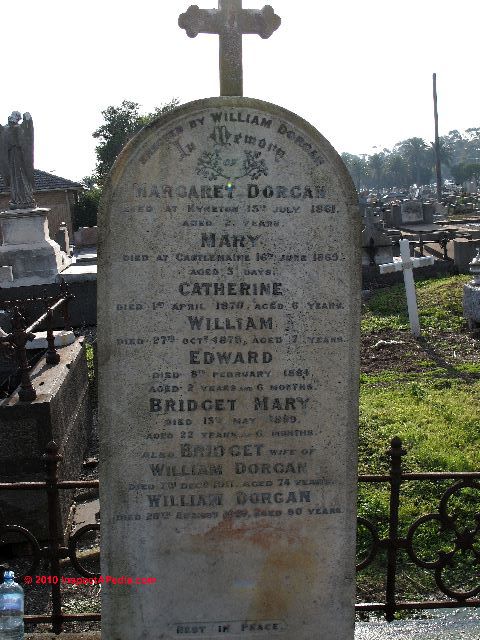
Especially if you are restoring artifacts, art works, tombstones, or graves, avoid any aggressive cleaning methods that might damage the roof surface.
Mechanical Cleaning of Brick, Stone or Concrete Surfaces
The gravestone that was shown at the top of this page and appears below in "before and after" photos was successfully cleaned using simply a soft bristle brush and plain water. Here is what Patrick Walsh said about the cleaning procedure:
I only used regular cold tap water, no soap, and a soft bristled dish-brush.
You should wet down and rub in water on the stone by hand (the growths were oily, and repelling water!).
Then brush in circular pattern to break down the lichens, moss, or algae, using plenty of water for lubrication. Hand wipe the gravestone down before it dries again.
Start cleaning the tombstone at the top and work down.
That way you won't have to re-scrub the run-off. This was a 7-foot high grave stone including the cross.
All told, (minus the cross) it took me about 45 minutes (I started on the back, so I would be inspired to do the rest and in case I found a problem.
Then I cleaned the gravestone's sides and top. The front surface was cleaned last.

Whatever cleaning is done on a stone or masonry surface, make sure the process does not cause more harm than good to the artifact and to the environment around it.
Algae, Fungi, Lichens, Moss: Chemical Cleaning of Brick, Concrete, or Stone Surfaces
Watch out: don't try any cleaners or preservative treatments on a valuable cultural artifact or art work without first discussing options with a professional art conservator. If you are proceeding to use any cleaning procedure or chemical, try it first on a small, unobtrusive area of your artifact or surface.
A comprehensive survey prepared by Caltrans ( 2011) examined studies by various U.S. states concerned with the control of moss growth on pavement.
Those experts examined a wide range of methods used to remove moss growth as well as to control or prevent its recurrence, yielding advice on the effectiveness and costs as well as safety of various approaches from which we include excerpts here.
The Caltrans information is followed by advice from the USDA on controlling sooty molds appearing on exterior surfaces.
These moss cleaning & control methods studied for application on roadways in the U.S. may be applicable in whole or part to treatment & control of algae, lichens, moss and even fungi on exterior surfaces such as masonry or stone walls, walks, and monuments outdoors.
Treatment Options for Algae, Fungal, or Moss Growth on Stone & Masonry Surfaces |
||
| Moss Treatment Method | Description | Comments Links |
| Synthetic moss growth control products | Wet & Forget. This commercial product can be used in residential and commercial applications. Marketed as non caustic, non acidic and safe for all outdoor surfaces, the product’s active ingredient is alkyl dimethyl benzyl ammonium chloride |
Environmental concerns; |
Glyphosate. Two applications per year of this herbicide should be adequate to kill the moss. Glyphosate is the active ingredient in commercial herbicides such as Roundup® |
May not be suitable for areas of animal or human occupancy or direct-contact; Environmental concerns; | |
| Natural-based moss growth control products | Acids: acetic acid, citric acid, pelargonic acid, cloveoil, corn glugen meal were cited by Caltrans as under study, generally less effective and more costly than the synthetic alternatives. |
|
Baking soda, vinegar, biodegradable fatty acids. Certain kinds of soap and borax are also recommended. |
||
Electrolyzed water: Identified as a cost - effective and environmentally friendly alternative that can be used as a contact fungicide on plant surfaces and for general sanitation in greenhouses. A cell electrolyzes water, resulting in two types of water possessing different properties: An electrolyzed basic solution that has strong reducing potential and can be used as a cleaning solution. An electrolyzed acid solution with a strong oxidation potential that can be used as an alternative to chlorine - based compounds for killing bacteria. |
Recent procedure, uses water and saturated salt (sodium chloride) to create an electrolyzed acid used as a contact fungicide on plant surfaces | |
| Mechanical moss removal methods | High - pressure, low - volume power washer. A small - scale test of this mechanical method involves the use of a portable power washer to determine how much pressure is needed to remove moss when moving along at a reasonable rate of speed (that is, 10 mph). |
Watch out: as we also cite at STAINS on STONE, STUCCO DIAGNOSE & CURE, Grimmer (1992), - Schierhorn ret. 2014) and other experts warn about using abrasives to clean stone exteriors of buildings or stone cultural artifacts. . |
Brooming - sweeping has been used on roadways. |
||
Moss cutting machine. This machine, used by an irrigation district in Oregon to remove moss from canals, applies similar technology |
||
| Light & Heat to kill, remove or prevent moss growth | Infrared heaters. An infrared heater is used to direct a propane flame at a ceramic or metal plate, which radiates heat onto the moss. Other applications use water and intense heat in an enclosed space |
|
| UV light: shielded high-intensity ultraviolet light has been used to treat moss growth on roadways. | Widely used in water treatment & in forensic investigation. |
|
| Coatings to retard moss or algae growth on surfaces | Fog line paint: Caltrans observed that the paint used to provide white fog lines along roadways appeared to be a moss growth retardant in areas where otherwise moss appeared along roadway sides and suggested the paint might be moss-retarding. In our [DF] opinion an error in this consideration was the omission of the moisture-absorption effects of the fog line painted along roadways. By coating the roadway surface the pavement will surely absorb less moisture and perhaps fewer spores as well, acting thus as a moss growth retardant in an effect beyond the biocidal effect of the paint itself. This observation suggests that where other conditions permit, periodic coating of some stone surfaces with moisture repellents such as Thompson's water seal may retard moss, algae, lichens and even fungal growth on those areas. However in our personal experience those silicone-based coatings are not durable and may need annual re-application, making them not cost-effective for some cases. And on hard surfaces such as walkways there may be slip hazards as well. |
Paints including fungicides may use elemental zinc or other metals or chemicals. Not suited for artifacts, most building exteriors, most walkways, masonry stairs, etc See |
| Laser Cleaning of Sandstone or Stone Surfaces | Building & stone artifact conservators have researched and used lasers as a method for cleaning some stone surfaces. See
|
See additional sandstone cleaning citations at |
Notes to the table above
Adapted to include excerpts from
- CTC & Associates LLC, "Environmentally Friendly Elimination of Moss from Open-Graded Asphalt Pavement", Requested by Deborah Harmon, Caltrans District 1 April 14, 2011, retrieved 3/28/2014, original source: http://www.dot.ca.gov/newtech/researchreports/preliminary_ investigations/docs/elimination_of_moss_pi_04142011.pdf
- Powers, Robert M., Substitute Materials: REPLACING DETERIORATED SERPENTINE STONE with PRE-CAST CONCRETE [PDF] (1988) Preservation Tech Notes, U.S. NPS, Masonry No. 1, retrieved 2022/10/10, original source: https://www.nps.gov/tps/how-to-preserve/tech-notes/Tech-Notes-Masonry01.pdf
- Striegel, Mary F., & Frances Gale, Jason Church and Debbie Dietrich-Smith, PRESERVING GRAVE MARKERS
IN HISTORIC CEMETERIES [PDF] Preservation Brief No. 48, US NPS, US DOE, retrieved 2022/10/09, original source: https://www.nps.gov/tps/how-to-preserve/briefs/48-preserving-grave-markers.htm
Excerpt:
While cemeteries are often considered to be perpetual, their most prominent feature—the grave markers—are not. They weather, naturally decay, often are poorly maintained and repaired and, on occasion, are vandalized.
Grave markers are usually noteworthy not only for their inscriptions but also for their craftsmanship.
Exceptional markers are considered works of art.
This Preservation Brief focuses on a single aspect of historic cemetery preservation—providing guidance for owners, property managers, administrators, in-house maintenance staff, volunteers, and others who are responsible for or are interested in preserving and protecting grave markers.
Besides describing grave marker materials and the risk factors that contribute to their decay, the Brief provides guidance for assessing their conditions and discusses maintenance programs and various preservation treatments.
Not all roadway moss control measures in the original source are included in the table above. For example we exclude "Pavement mix selection" as a means of moss control as it pertains more narrowly to roadways not to other outdoor surfaces such as stone walls and brick structures.
Using UV light in a wide range of applications inculding the control of bacteria, mold, and algae or moss growth is also discussed at
The USDA has published How to Recognize & Control Sooty Molds. That publication includes suggestions for removing sooty black molds (the author considers Cladosporium sp. and Aureobasidium sp. as sooty black molds though they may in fact be brown or black and may not easily wipe off as "sooty" molds). Excerpting & commenting on the USDA advice for controlling sooty molds on surfaces: :
Sooty molds can be indirectly controlled by reducing populations of sucking insects that excrete honeydew.
Outdoor furniture can be hosed down with water during periods of honeydew excretion, particularly during drought.
The growth of sooty mold fungi is inhibited by preservatives used in treated wood in rustic outdoor furniture. Here is the recipe for a good cleaning solution for removing sooty molds from plastic or painted surfaces:
USDA Stone Cleaning Agent Formula |
|
| Powdered household detergent | 1/3 cup |
| Household liquid bleach | 1 quart |
| Trisodium phosphate | 2/3 cup [note: for environmental reasons TSP is no longer used, try a TSP substitute] |
| Water | 3 quarts |
Notes to the table above
Watch out: Be sure to wear rubber gloves when cleaning with this solution. [Note that trisodium phosphate is no longer used as a cleaning agent because it is an environmental contaminant.
However substitute products may be available. Be careful not to add a cleaning agent to bleach that can cause production of toxic chlorine gas.
Power Washing Brick, Stone, Concrete Surfaces to Remove Algae, Fungi, Lichens, Moss
Power washing, using plain water or perhaps a deck cleaner can be very effective for cleaning off stone, concrete, or masonry sidewalks and some building surfaces where valuable artifacts are not involved. First be sure that the surface to be cleaned is sound and secure - both to avoid causing serious damage and to avoid rocketing a piece of stone or brick into someone's eye during power-washing.
We have had some trouble with this method, however, when power-washing dry-laid brick and stone walks.
The power washer wanted to also remove sand between the bricks or even to lift them out of place. Work carefully, and at a high angle to the surface to be cleaned if you have this problem.
Watch out: don't power-wash antique brick without first testing your procedure. If you sand-blast or use high pressure washing on soft brick or other masonry surfaces you may cause irreparable damage.
In freezing climates, blasting the original glaze off of a brick surface means that it will absorb more water, grow more moss or lichens faster, and suffer more freeze damage than ever.
Also be careful when power-washing not to blast water into building wall or roof cavities where you risk cosmetic or even costly mold damage.
Do-it-yourself Cleanup for Algae or Fungal Stains on Stone, Brick, Concrete or Stucco Surfaces
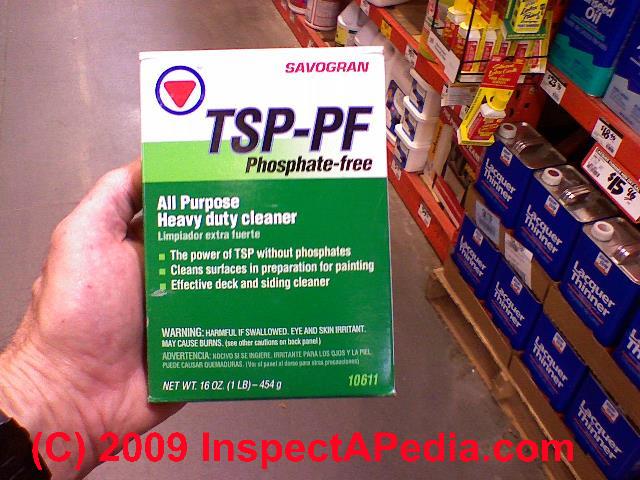 1 teaspoon of trisodium phosphate equivalent + 8 tbsp bleach in 1-1/2 cups water. (Oxygen bleach is readily available [Sodium percarbonate], which can be mixed with about anything that is not reactive to oxygen and it is not toxic.)
In greater proportions, reader Norman reports using 1 cup of trisodium phosphate, one gallon bleach and 4 gallons water on his own roof and ... "it has worked just fine, spraying it on lightly, then rinsing thoroughly with water about 15 minutes later."
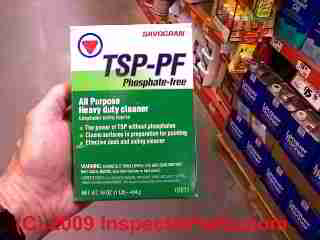
Don't use the original TSP (tri-sodium phosphate) cleaner - it is an environmental contaminant. TSP substitutes such as the product shown (at left) are available at building supply stores and hardware stores.
Some deck cleaning sprays such as Stainhandle® roof and deck cleaner are also sold for use as cleaning solutions for stained roofs and might work on other surfaces - check with the manufacturer.
We discuss removing stains from roofs separately
at BLACK STAIN REMOVAL & PREVENTION
Using TSP-Substitute Cleaners & Disposing of Stone or Masonry Cleanup Waste
Question: how do I dispose of TSP substitute waste & paint debris?
I have used TSP Substitute on a painted basement floor. We have a private septic system with a field drain.
What is the proper disposal technique for used TSP substitute with paint residue? - Anonymous by private email 2018/02/05
Reply:
Here is information for an example TSP substitute:
- SAVOGRAN LIQUID TSP SUBSTITUTE CLEANER [PDF] The Savogran Company, PO Box 130, Norwood, MA 02062 USA Tel: 1-800-225-9872 Web: www.savogran.com www.sclsterling.com Email:info@savogran.comretrieved 2018/02/05, original source http://www.savogran.com/pdfs/TSP_Liq_Sub_PD.pdf
The company notes that their cleaner does not harm vegetation.
But the company does not address disposing of residue that contains paint. I don't know how to address that question either, as you'd probably need to know what sort of paint, contaminants, presence or absence of lead, and importantly the liquid or physical volume of the substance that is to be disposed-of.
This excerpted note might help:
In most states all waste from lead abatement jobs must be tested to see if it is hazardous waste. Hazardous waste is liquid or solid waste that could poison people if it is not disposed of correctly.
That typically means closing up your liquid waste in safe tight containers and delivering it to an approved receiving station near where you live
If you don't know what's in your cleaning and paint waste you should treat it as presumed to be toxic. Don't assume that no lead paint means no toxics. For example some acrylic paints contain toxic heavy metals.
Also in some cleanup jobs or paints toxic solvents or residues could be present such as methylene chloride.
It would be best not to dispose of any significant volume of liquid waste into a septic system if the waste contains
- toxic substances of any kind (such as lead, solvents, acids)
- substances that kill bacteria in the septic tank or drainfield - unless the level of dilution is great enough that there is not likely to be any measurable effect.
Earth911.com can give you "toxic waste" disposal rules in your area in response to your zip code presuming you're in the U.S.
The other place to check for disposal regulations for cleaning waste is with your local DEP/DEC or if you live where there is no department of environmental protection coverage check with your local building department or city, town, or county or province.
For example, if your paint contained lead you'd want to see this US EPA guidance
- LEAD ABATEMENT CHAPTER 8, CLEANUP, DISPOSAL, and CLEARANCE [PDF] education from the US EPA, retrieved 2018/02/05, original source: https://www.epa.gov/sites/production/files/documents/wkrch8_stu_eng.pdf
And this additional guidance
- LEAD CLEAN UP, DISPOSAL, and CLEARANCE [PDF], Center for Construction Research and Training, 8484 Georgia Avenue, Suite 1000
Silver Spring, MD 20910 USA, Tel: 301- 578-850 E-mail: cpwrwebsite@cpwr.com retrieved 2018/02/05, original source:
https://www.cpwr.com/sites/default/files/training/lead/Lead%2010.pdf
In the U.S. most states also offer specific guidance. For example here's a note for Wisconsin residents (we don't know where you are located)
- DISPOSING of HAZARDOUS WASTE: PAINT & OTHER HOME IMPROVEMENT PRODUCTS [PDF], Fond-du-Lac, Wisconsin, University of Wisconsin Cooperative Extension, retrieved 2018/02/05, original source: https://fonddulac.uwex.edu/files/2012/01/Paint-and-Other-Home-Improvement-Products.pdf
So if your waste is not hazardous, though it's not precisely on point but you might want to also see this EPA note on disposing of other household waste
- HOUSEHOLD HAZARDOUS WASTE DISPOSAL (HHW), [PDF] U.S. EPA, retrieved 2018/02/05, original source: https://www.epa.gov/hw/household-hazardous-waste-hhw
Guides for Removing Stains from Brick, Concrete, Limestone, Sandstone, Stone or Stucco
- BRICK STAIN REMOVAL GUIDES - specifically for cleaning stains off of brick surfaces
- MARBLE CLEANING METHODS - separate article with procedures for cleaning marble surfaces in or on buildings
- Grimmer, Anne E. KEEPING IT CLEAN: REMOVING EXTERIOR DIRT, PAINT, STAINS AND GRAFFITI FROM HISTORIC MASONRY BUILDINGS [PDF] Washington, D.C. Preservation Assistance Division, National Park Service, U.S. Department of the Interior, 1988. - retrieved 2022/10/08, original source: https://www.nps.gov/tps/how-to-preserve/preservedocs/Keeping-It-Clean.pdf
Excerpt:
The purpose of this technical report is to provide information on removing dirt, stains, paint and related coatings, graffiti, and other disfiguring or potentially harmful substances from exterior masonry. - Pieper, Richard, The MAINTENANCE, REPAIR & REPLACEMENT of HISTORIC CAST STONE [PDF] (2001) Preservation Brief No. 42, Preservation Assistance Division, National Park Service, U.S. Department of the Interior - retrieved 2022/10/08, original source: https://www.nps.gov/tps/how-to-preserve/briefs/42-cast-stone.htm
Excerpt:
Cast stone was just one name given to various concrete mixtures that employed molded shapes, decorative aggregates, and masonry pigments to simulate natural stone.
The basic mixtures included water, sand, coarse aggregate, and cementing agents. Natural cements, portland cements, oxychloride cements, and sodium silicate based cements were all used as binding agents.
The differences in the resulting products reflected the different stone aggregates, binding agents, methods of manufacture and curing, and systems of surface finishing that were used to produce them.
Versatile in representing both intricately carved ornament and plain blocks of wall ashlar, cast stone could be tooled with a variety of finishes. During a century and a half of use in the United States, cast stone has been given various names.
While the term "artificial stone" was commonly used in the 19th century, "concrete stone," "cast stone," and "cut cast stone" replaced it in the early 20th century.
In addition, Coignet Stone, Frear Stone, and Ransome Stone were all names of proprietary systems for pre-cast concrete building units, which experienced periods of popularity in different areas of the United States in the 19th century.
These systems may be contrasted with "Artistic Concrete," decorative molded concrete construction, both precast and cast-in-place, which made little effort to simulate natural stone.
 Figure 1 from Powers, cited below.
In 1989, just prior to the onset of the
rehabilitation project, the Widener Building
was showing the effects of 75 years of
exposure to an urban environment. Note the
lighter color of the left side of the building
regularly washed by rain. Photo: John Milner
Associates.
- Powers, Robert M., WATER SOAK CLEANING of LIMESTONE [PDF] (1992) Preservation Tech Notes, Masonry, No. 3, U.S. Department of the Interior, National Park Service, Preservation Assistance Division, retrieved 2022/10/07, original source: https://www.nps.gov/tps/how-to-preserve/tech-notes/Tech-Notes-Masonry03.pdf
Excerpt:
The rehabilitation of historic buildings often incl udes the cleaning of the masonry.
Removal of the deleterious deposits of particulate matter from the stone's surface generally enhances the appearance of an historic building and in the case of calcareous stones, furthers the long-term preservation of the masonry by eliminating whatever is damaging the fabric.
Since the Widener Building had been subjected 2 to seventy-five years of exposure to an urban/industrial environment and had never been cleaned, the masonry surfaces were heavily coated with typical deposits of air-borne particulates of soot, fly ash, tar and clay matter as well as localized areas of organic matter.
These deposits in conjunction with sulfur oxides accelerate the decay process of the calcareous stones such as limestone by forming non-stable, highly soluble and chemically-reactive crusts that increase the stone's surface area and ultimately leave the stone more vulnerable to damage from continuing deposition attack.
In addition, before an accurate survey and assessment could be made of the condition of the masonry, the stone needed to be cleaned to observe cracks, surface defects, areas of active movement and required repointing.
Once the decision had been made by the new owners to clean the masonry , an appropriate cleaning system had to be selected, taking into consideration potential problems and liabilities associated with each method.
Adequate testing had to be carried out to ensure that the process did not damage or alter the masonry, or adjacent buildings, and that it did not adversely impact tenants working in the building or pedestrians and vehicles passing below. - Mack, Roberty C., FAIA & John P. Speweik, REPOINTING MORTAR JOINTS IN HISTORIC MASONRY BUILDINGS [PDF] (1998) U.S. National Park Service, Technical Preservation Services, retrieved 2022/10/02 original source: https://www.nps.gov/tps/how-to-preserve/briefs/2-repoint-mortar-joints.htm
- Streigel, Mary F., Frances Gale, Jason Church & Debbie Dietrich-Smith, PRESERVING GRAVE MARKERS in HISTORIC CEMETERIES [PDF] (2022) Preservation brief 48, US National Park Service, retrieved 2022/06/30, original source: https://www.nps.gov/tps/how-to-preserve/briefs/48-preserving-grave-markers.htm This version saved as latest, color PDF by InspectApedia
- Striegel, Mary F., & Frances Gale, Jason Church and Debbie Dietrich-Smith, PRESERVING GRAVE MARKERS IN HISTORIC CEMETERIES [PDF] (2016) - FULL VERSION - Preservation Brief No. 48, US NPS, US DOE, retrieved 2022/10/09, original source: https://www.nps.gov/tps/how-to-preserve/preservedocs/preservation-briefs/48Preserve-Brief-GraveMarkers.pdf
- US GSA CLEANING DARKENED OR DISCOLORED TRAVERTINE [PDF] U.S. General Services Administration, retrieved 2020/12/14
Excerpt:
This procedure includes guidance on cleaning darkened or discolored travertine. Travertine naturally darkens over time. The iron compounds in the stone, when combined with oxygen, eventually produce a dark reddish-brown tone. Travertine may also darken from accumulations of particulate dirt. - US GSA CLEANING INTERIOR LIMESTONE WALLS [PDF] U.S. General Services Administration, retrieved 2020/12/14
- US GSA GENERAL CLEANING of EXTERIOR LIMESTONE [PDF] U.S. General Services Administration, retrieved 2020/12/14
- U.S. GSA Making a Solution for Removing Beverage, SOOT, TAR and Other Stains from CONCRETE [PDF] retrieved 2020/12/14
- US GSA POULTICING RUST STAINS FROM LIMESTONE AND MARBLE [PDF] U.S. General Services Administration, retrieved 2020/12/14
Excerpts:
This procedure includes guidance on removing rust stains from limestone and marble by poulticing using different chemical solvents or by using a paste containing a commercial rust remover.
Metallic stains from iron or steel have the appearance of rust. This type of staining is often caused by the run-offfrom flashing, gutters, statuary and fasteners. The source of the rusty runoff should be determined and cause abated.
Cleaning should be undertaken after rectifying deficiencies causing the rusting. Following cleaning, the surfaces should be inspected after several episodes of precipitation to confirm success of repairs or other treatments. - U.S. GSA REMOVAL of SOILING from SANDSTONE Prior to Repointing [PDF] U.S. General Services Administration, retrieved 2020/12/14
Excerpt:
This procedure includes guidance on removing biological growth, surface dirt and efflorescence from sandstone surfaces prior to repointing. - US GSA REMOVING COPPER/BRONZE STAINS FROM LIMESTONE & MARBLE [PDF] U.S. General Services Administration, retrieved 2020/12/14
Excerpt:
This procedure includes guidance on removing copper and bronze stains from limestone and marble. Several methods are described.
Copper stains appear as green or muddy-brown discolorations and result from the action of moisture on nearby or embedded bronze, copper and/or brass items. - US GSA Removing DIRT From STONE MASONRY By PRESSURE WASHING [PDF] U.S. General Services Administration, retrieved 2020/12/14
Except:
This procedure includes guidance on removing dirt build-up on masonry by pressure washing with water and mild detergents. This technique is effective for removal of light to moderate atmospheric and organic staining. It may also be used to remove any residual traces of chemicals used in other cleaning treatment
Water washing of stone masonry may be used periodically to remove dust, dirt, accumulations of grime or airborne pollutants which settle on the stone and do not get washed off by the natural action of wind-driven rainwater. - US GSA Removing DIRT From STONE MASONRY by STEAM CLEANING [PDF] U.S. General Services Administration, retrieved 2020/12/14
Excerpt:
This procedure includes guidance on removing dirt build-up on stone masonry by steam cleaning.
Advantages of Steam Cleaning:
Is effective in cleaning heavily deteriorated ornate masonry that can not withstand pressure washing or abrasive cleaning techniques.
Allows use of the mildest possible cleaning agents and rinsing pressures for removal of severe carbon encrustations on calcareous surfaces.
Effective in removing organic growth from the masonry surface. There is less of a chance of staining as compared to other cleaning methods. - US GSA Removing DIRT From STONE Masonry Using The WATER-SOAK Method [PDF] U.S. General Services Administration, retrieved 2020/12/14
Excerpts:
This procedure includes guidance on removing dirt build-up on masonry using the water-soak method. Prolonged saturation with water will cause the dirt to expand and contract at a much faster rate than the stone, causing it to crack away from the surface.
Water washing of stone masonry may be used periodically to remove dust, dirt, accumulations of grime or airborne pollutants which settle on the stone and do not get washed off by the natural action of wind-driven rainwater.
Advantages of the Water-Soak Method:
Effective for cleaning heavily deteriorated ornate masonry that can not withstand pressure washing or abrasive cleaning techniques. It allows use of mild cleaning agents and techniques for effective removal of severe carbon encrustations.
Limitations of the Water-Soak Method:
EFFECTIVE ONLY ON CALCAREOUS STONE SUCH AS LIMESTONE--NOT RECOMMENDED FOR CLEANING BRICK, TERRA COTTA, GRANITE, SANDSTONE, BROWNSTONE AND MANY OTHER NON CALCAREOUS SURFACES.
This is an expensive, time-consuming process.
It is not the most practical method for cleaning an entire building facade. It is most appropriate for use on small surface areas.
Thorough testing is required. Prolonged exposure to water may result in oxidation of natural components of the masonry and may transport deleterious salts deep into the masonry. Thoroughly saturated masonries may take several months to dry.
Water soaking procedures must be scheduled when there is no threat of freezing temperatures throughout the cleaning and drying process. Cascading water used in this process may result in erosion of the wash surfaces.
Scaffolding and rigging requirements for this procedure are more elaborate. Prolonged exposure to water may result in damage to interior surfaces, furnishings and equipment. - U.S. GSA REMOVING BIOLOGICAL GROWTH FROM EXTERIOR MASONRY AND STUCCO [PDF] (2018) U.S. General Services Administration, retrieved 2020/12/14
Excerpt:
This procedure includes guidance on removing biological growth such as lichens, algae, mold and mildew from masonry and stucco.
B. Biological growths such as lichens, algae, moss and fungi growing on masonry walls is usually an indication that there is excess moisture in or around the masonry.
These growths should be removed, as they attract moisture to the masonry surface and hold it there, which can lead to more serious problems. Lichens and mosses in particular, produce oxalic acid which can damage certain types of historic masonry. - U.S. GSA REMOVING COPPER-BASED STAINS FROM BRICK, CONCRETE AND LIMESTONE [PDF] (2018) U.S. General Services Administration, retrieved 2020/12/14
Excerpt:
This specification provides guidance on removing copper staining on exterior brick, concrete and limestone.
Remove soiling, stains and crusts from the limestone and granite without damaging underlying material and to give all stone a clean, uniform appearance without blotches, streaks or other irregularities. Use the gentlest means to meet the cleaning objective.
If the exterior masonry has been previously subjected to inappropriately harsh and uneven cleaning, it is expected that the cleaning will reveal the original colors and textures of the brick, but that it will not completely correct the differential effects of the previous cleaning.
Clean brick to remove soiling, stains and crusts to the extent feasible without further damaging the brick. - U.S. GSA REMOVING OLD SULPHATED LIMEWASH FROM MASONRY [PDF] (2018) U.S. General Services Administration, retrieved 2020/12/14
Excerpt:
This procedure includes guidance on removing old sulphated limewash from masonry by poulticing with hydrochloric acid.
It is very difficult to remove old sulphated limewash from masonry without causing damage to the surface below. Therefore, limewashes should only be removed when it is absolutely desirable and should only be performed by a trained professional. - U.S. GSA REMOVING PAINTED GRAFFITI FROM MASONRY [PDF] (2018) U.S. General Services Administration, retrieved 2020/12/14
Excerpt:
This procedure includes guidance on removing painted graffiti from historic masonry (this includes spray paint and paint-based felt-tipped markers).
Successful removal of graffiti from masonry is dependent upon the type and surface texture of the masonry as well as the particular substance applied. - U.S. GSA REMOVING CLIMBING PLANTS AND CREEPERS FROM MASONRY [PDF] (2018) U.S. General Services Administration, retrieved 2020/12/14
Excerpt:
This procedure includes guidance on removing climbing plants from masonry.
It is important to remove heavy vegetative growth from masonry, as its presence can pose many problems, such as holding moisture against the masonry surface, blocking gutters and downspouts, scouring soft wall surfaces, eroding mortar and hindering or limiting access for maintenance inspections and repairs.
- U.S. GSA REMOVAL OF FERROUS STAINING FROM BRICK, GRANITE, CONCRETE AND LIMESTONE [PDF] (2018) U.S. General Services Administration, retrieved 2020/12/14
Excerpt:
This procedure includes guidance on removing ferrous staining from exterior brick, concrete and limestone surfaces.
Remove soiling, stains and crusts from the limestone and granite without damaging underlying material and to give all stone a clean, uniform appearance without blotches, streaks or other irregularities. Use the gentlest means to meet the cleaning objective.
If the exterior masonry has been previously subjected to inappropriately harsh and uneven cleaning, it is expected that the cleaning will reveal the original colors and textures of the brick, but that it will not completely correct the differential effects of the previous cleaning.
Clean brick to remove soiling, stains and crusts to the extent feasible without further damaging the brick. - U.S. GSA Removing DIRT Build-Up from SANDSTONE [PDF] U.S. General Services Administration, retrieved 2020/12/14
Excerpt:
This procedure includes guidance on cleaning selected areas of dirt-build-up on sandstone by washing with an alkaline cleaner (for calcareous sandstone), or by washing with a hydrofluoric acid-based cleaner (for most other sandstones). - U.S. GSA Removing PAINTED GRAFFITI from SANDSTONE [PDF] U.S. General Services Administration, retrieved 2020/12/14
Excerpts:
The cleaning or removal of stains from stone may involve the use of liquids, detergents or solvents which may run off on adjacent material, discolor the stone or drive the stains deeper into porous stones. Use the products and techniques described here only for the combinations of dirt/stain and stone specified.
Products containing chemicals known to present health or environmental hazards should be used only as a last resort, where permissible, in accordance with manufacturer's directions and government requirements. Test milder formulations for effectiveness before proceeding to stronger alternatives.
This specification provides guidance on the removal of paint-based graffiti from sandstone using a chemical paint stripper or poultice.
Latex paints tend to remain primarily on the surface of stone materials as opposed to oil based paints, which tend to penetrate into the stone and remain there. - US GSA REMOVING CREOSOTE STAINS from CONCRETE [PDF] (2017) U.S. General Services Administration, retrieved 2020/12/14 original source: https://www.gsa.gov/ real-estate/historic-preservation/ historic-preservation-policy-tools/ preservation-tools-resources/technical-documents?Form_Load=88502
Excerpt:
The cleaning or removal of stains from concrete may involve the use of liquids, detergents or solvents which may run off on adjacent material, discolor the concrete or drive the stains deeper into porous concrete. Use the products and techniques described here only for the combinations of dirt/stain and concrete specified. - US GSA REMOVING SALTS / EFFLORESCENCE from BRICK & STONE MASONRY [PDF] U.S. General Services Administration, retrieved 2020/12/14 original source: https://www.gsa.gov/ technical-procedures/ making-solution-removing-beverage-soot-tar-and-other-stains-concrete?Form_Load=885
- US GSA Removing SMOKE STAINS From BRICK MASONRY [PDF] U.S. General Services Administration, retrieved 2020/12/14
- US GSA REMOVING SOLUBLE SALTS from LIMESTONE [PDF] U.S. General Services Administration, retrieved 2020/12/14 original source: https://www.gsa.gov/ technical-procedures/ making-solution-removing-beverage-soot-tar-and-other-stains-concrete? Form_Load=88075
- US GSA REMOVING SOLUBLE SALTS from WITHIN BRICK & STONE MASONRY [PDF] U.S. General Services Administration, retrieved 2020/12/14
- US GSA REMOVING STAINS from LIMESTONE [PDF] found in "Limestone: Characteristics, Uses And Problem", retrieved 2020/12/14 original source: https://www.gsa.gov/technical-procedures/ making-solution-removing-beverage-soot-tar-and-other-stains-concrete? Form_Load=88341
- US GSA Historic Preservation Technical Documents - a complete index is found at https://www.gsa.gov/technical-procedures/making-solution-removing-beverage-soot-tar-and-other-stains-concrete#Masonry as retrieved 2020/12/14
- Bruhns, Harry R., Philip Steadman, Horace Herring, Sarah Moss, and Peter A. Rickaby. "Types, numbers, and floor areas of nondomestic premises in England and Wales, classified by activity." Environment and Planning B 27, no. 5 (2000): 641-666.
- Christopher, D. "Exterior Cleaning of Sandstone Buildings in Edinburgh: Technical and Aesthetic Considerations: Submitted for the Degree of Master of Science [Architectural Conservation]." PhD diss., School of Architecture, Edinburgh College of Art/Heriot-Watt University, Edinburgh, 1990.
- Clifton, JR, ASTM STP935 Cleaning Stone and Masonry, Abstract:
January 1986STP935-EB - Describes modern techniques, methods and materials for restoration cleaning of building facades. 9 peer-reviewed papers examine cleaning practices in the U.S., the selection of appropriate cleaning materials and methods, methods for determining the effectiveness and possible damage caused by cleaning, and cleaning case studies.
Available from https://www.astm.org - Dajnowski, A. "Laser cleaning of the Nickerson Mansion: The first building in the US entirely cleaned using laser ablation." In Lasers in the Conservation of Artworks: Proceedings of the International Conference Lacona VII, Madrid, Spain, 17-21 September 2007, vol. 3, p. 209. CRC Press, 2008.
- Griffin, P. S., N. Indictor, and R. J. Koestler. "The biodeterioration of stone: a review of deterioration mechanisms, conservation case histories, and treatment." International Biodeterioration 28, no. 1 (1991): 187-207.
- Grimmer, Anne E. KEEPING IT CLEAN: REMOVING EXTERIOR DIRT, PAINT, STAINS AND GRAFFITI FROM HISTORIC MASONRY BUILDINGS [PDF] Washington, D.C.: Preservation Assistance Division, National Park Service, U.S. Department of the Interior, 1988. - retrieved 2022/10/08, original source: https://www.nps.gov/tps/how-to-preserve/preservedocs/Keeping-It-Clean.pdf
- Grimmer, Anne E. DANGERS OF ABRASIVE CLEANING TO HISTORIC BUILDINGS [PDF] (1979) Preservation Brief No. 6, U.S.Department of the Interior, Heritage Conservation and Recreation Service [Office of Archeology and Historic Preservation], Technical Preservation Services Division, 1979.
- Halim, Al-Hafzan Abdullah, Siti Norlizaiha Harun, and Md Yusof Hamid. "DIAGNOSIS OF DAMPNESS IN CONSERVATION OF HISTORIC BUILDING." Journal of Design+ Built 5, no. 1 (2012).
- Hui, Sam CM, and Anfernee HM Leung. "Sustainable building services systems for historic buildings." In Proceedings of the Joint Symposium 2004: Servicing Dense Built Environments, vol. 16, pp. 133-142. Organising Committee of the Symposium., 2004.
- Lazzarini, Lorenzo, and Marisa Tabasso Laurenzi. Il restauro della pietra. Cedam. Casa editrice dott. Antonio Milani, 1986.
- Lisci, Marcello, Michela Monte, and Ettore Pacini. "Lichens and higher plants on stone: a review." International biodeterioration & biodegradation 51, no. 1 (2003): 1-17.
- Lynch, Michael F. and William J. Higgins. "(The) Maintenance and Repair of Architectural Sandstone." New York Landmarks Conservancy, 1982.
- Mack, Robert C. "(The) Cleaning and Waterproof Coating of Masonry Buildings." Preservation Briefs #1. Washington, D.C.: U.S. Department of the Interior, 1975.
- MIA, Marble Institute of America, GUIDE to CARE & CLEANING of NATURAL STONE [PDF], MIA, Marble Institute of America, 28901 Clemens Road, Suite 100, Cleveland, Ohio 44145 USA Tel: 440-250-9222, E-mail: MIAinfo@marble-institute.com, Website: www.marble-institute.com. retrieved 2019/08/16, original source: https://www.naturalstoneinstitute.org/default/assets/File/stone-professionals/commercial_care_clean.pdf
- Park, Sharon C. "Moisture in historic buildings and preservation guidance'." Moisture Control in Buildings 18 (1994).
- Piervittori, R., O. Salvadori, and A. Laccisaglia. "Literature on lichens and biodeterioration of stonework. I." The Lichenologist 26, no. 02 (1994): 171-192.
- Preston, John. "The surface restoration of buildings–An investment in the present as well as in the future." Structural Survey 7, no. 4 (1989): 450-460.
- Prudon, Theodore. "Removing Stains From Masonry." The Old-House Journal, May 1977, pp. 58-59
- Richardson, B. A. "Control of microbial growths on stone and concrete." In Biodeterioration 7, pp. 101-106. Springer Netherlands, 1988.
- Sáiz-Jiménez, Cesáreo. "Biogeochemistry of weathering processes in monuments." Geomicrobiology Journal 16, no. 1 (1999): 27-37.
- Sargent, Karen. "Exterior sandstone restoration of Alexander Hall." In Preservation and restoration of cultural heritage: proceedings of the 1995 LCP Congress, Montreux, 24-29 September 1995= Conservation et restauration des biens culturels: actes du congresLCP 1995, Montreux, 24-29 septembre 1995, pp. 231-234. Laboratoire de conservation de la pierre, 1996.
- Schierhorn, Carolyn. "Sandstone." [PDF] retrived 9/23/2014, original source: http://www.masonryconstruction.com/Images/
Sandstone_%20Earth%27s%20Vivid%20Palette_tcm68-1375439.pdf - Schnabel, Lorraine. "The treatment of biological growths on stone: a conservator's viewpoint." International biodeterioration 28, no. 1 (1991): 125-131.
- Staehli, Alfred M. "Appropriate Water Pressures For Masonry Cleaning - What Do the Numbers Mean?" APT Bulletin, Vol. XVIII, No. 4, 1986, pp. 10-17.
- Tiano, Piero. "Biodegradation of cultural heritage: decay mechanisms and control methods." In Seminar article, New University of Lisbon, Department of Conservation and Restoration, pp. 7-12. 2002. [PDF]
- Unterwurzacher, Michael, Ulrich Obojes, Roland Hofer, and Peter W. Mirwald. "Petrophysical properties of selected Quaternary building stones in western Austria." Geological Society, London, Special Publications 333, no. 1 (2010): 143-152.
- Wakefield, R. D., M. Young, K. Tonge, and D. Urquhart. "Effects and efficacy of some masonry biocides applied to Scottish sandstone in the control of biological growths: current studies." In Conservation science in the UK: preprints of the meeting held in Glasgow, May 1993, pp. 15-19. James & James Science Publishers Ltd., 1993.
- Weaver, Martin E., REMOVING GRAFFITI FROM HISTORIC MASONRY [PDF] (1995) Preservation Brief 38, US National Park Service, retrieved 2022/06/30 original source: https://www.nps.gov/tps/how-to-preserve/briefs/38-remove-graffiti.htm saved as updated PDF in latest, color version by InspectApedia
- Whitford, Maurice J. Getting Rid of Graffiti: A practical guide to graffiti removal and anti-graffiti protection. New York: Van Nostrand Reinhold, Inc., 1992.
Preventing Algae, Lichens, Mold Growth on Gravestones & Other Stone, Stucco, Brick, or Concrete Surfaces
Trim back trees whose branches overshadow the stone surface if it is possible to do so without compromising the aesthetics of the site. Keep the flat or low-slope stone surfaces clean of organic debris like leaves or pine needles which may collect in valleys or at other roof locations.
Chemical sealants or treatments may be permitted for some stone surfaces outdoors, though where we have tried clear silicone water-resistant coatings outdoors they were not very long-lasting.
The New York Times reported that for the Angkor Wat historic Hindu temple, Dr. Warscheid devised a biocide "melange d'Angkor" that was to be used to whiten parts of the temple and to retard the blackening effect of the cyanobacteria or fungi causing the blackening of that stonework.
Watch out: Don't put slippery sealants or coatings on a walking surface.
OPINION-DF: for some artifacts it may be possible to reduce, prevent, and even "kill off" existing algae, fungal growth, or lichens on stone surfaces by installing a zinc or copper strip or cap in a position that sends dissolved copper salts down the surface in wet weather.
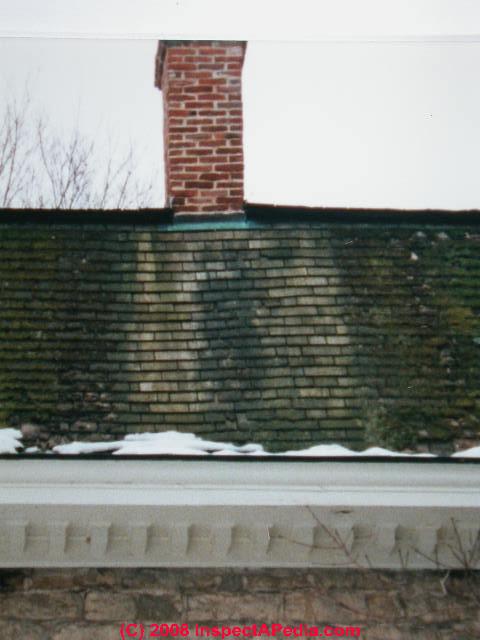
We have seen the success of this approach on building roofs where copper flashing was installed (photo of copper-flashed chimney on an otherwise mossy wood shingle roof at left), or where anti-fungal/moss/lichens metal strips were added.
Watch out: don't try any cleaners or preservative treatments on a valuable cultural artifact or art work without first discussing options with a professional art conservator.
Also, as the Times reported in 2008, there was no point in coating the entire Hindu Temple of Angkor Wat with biocide, since within a decade experts anticipated that the fungi or cyanobacteria present would simply adapt to the chemistry of the biocide treatment. Rather, routine cleaning and maintenance were called-for.
This article series tells readers how to identify, evaluate, remove or prevent stains on building surfaces.
Using UV Light to Prevent Moss & Algae or Mold Growth on Masonry Surfaces
Reader Question: How to control moss growth in a historic building tunnel
I hope you may be able to help me.... I've been speaking to a client who has a very old historic building and they lit the tunnels beneath the structure a few years ago (not by me).
They are experiencing growth on the stone walls (sample photo attached) which is causing them concern and we think is related to the lighting, which is LED.
It could be also down to the fact that there is now a lot of human traffic passing through the tunnels (thus creating moisture I guess). I'm not a plant expert (or anything even remotely like one!) but
I understand that while plant growth can be stimulated using a combination of far red and UV lighting - hence the High Pressure Sodium lighting used for the purpose, that UV can be utilised to kill algae (or prevent growth).
The chap on site says it's more like a moss than an algae but I think moss is different, so really I'm wondering if you know of any ways of preventing moss growth using artificial lighting.
It's a Listed Building so it can't be treated with chemicals, we just need to prevent any additional growth if possible and ideally, kill whatever is there.
Sorry, I realise this might take a combination of my knowledge of lighting and yours on horticulture but my Googling hasn't come up with any answers! Thanks very much in advance. Best regards - L.P., West Yorkshire, England 3/28/14
Reply:
At STAINS on STONE, STUCCO DIAGNOSE & CURE we discuss moss and algae on stone as well as other "stains" such as from fungi and in this article above STONE CLEANING METHODS we discuss methods that can be used to clean and remove such materials while respecting the surface or artifact being cleaned.
I don't agree that because a building is historic that no steps whatsoever can be taken to address moss growth on its surfaces; conservators have dealt with these problems for a very long time and have advice on least-invasive methods that still clean and protect the surface.
In this article I'm adding some helpful citations found by my research in an effort to answer your question, from which I excerpt the following:
Of several surface treatment methods used to control moss growth there are these that you might consider
1. Wet & Forget.
This commercial product can be used in residential and commercial
applications. Marketed as noncaustic, non-acidic, and safe for all outdoor surfaces, the
product'sactive ingredient is akyl dimethyl benzyl ammonium chloride
2. Natural based products
including products that contain citric, acetic or pelargonic acid; clove oil;
and corn gluten meal have been included in trials conducted by other agencies.
Results, where available, indicate that these products are generally less effective than synthetic alternatives and tend to be more costly to apply.
3. Electrolyzed water.
This relatively new process uses water and a saturated sodium
chloride solution to create an electrolyzed acid solution that can be used as a contact
fungicide on plant surfaces
Also listed but not something I'd try indoors or in a traffic area is Glyphosate. Two applications per year of this herbicide should be adequate to kill the moss. Glyphosate is the active ingredient in commercial herbicides such as Roundup
Two mechanical methods are listed for removing and controlling future moss growth on surfaces such as the stone tunnel that you describe, two of which might work in the case you mention:
1. Power washing
or use of a "moss cutting machine" (not useful for your case)
2. Shielded high - intensity ultraviolet light.
This light source might burn off moss or
delay its growth by triggering a negative phototrophic response. This method is used
to treat recirculating water in greenhouses to remove algae and fungi.
Heat is also listed as a moss control measure:
1. Infrared heater.
An infrared heater is used to direct a propane flame at a ceramic or
metal plate, which radiates heat onto the moss. Other applications use water and
intense heat in an enclosed space.
It seems to me that an initial effort to clean and treat the surfaces combined with UV light might be the approach of choice.
If it were possible to add heat and reduce the moisture level in the tunnel I'm reasonably confident that the moss problem will be controlled.
If we are not able to make the tunnel more dry, that is if it stays cool and wet, I suspect that a combination of UV lighting and some environmentally-friendly topical treatment may be needed.
Some of the "environmentally-friendly" methods discussed by Caltrans were not economically feasible for highway roadside moss control is needed but might be economically acceptable in a smaller more controlled area such as the tunnel you describe.
Keep us posted, as what we learn will assist others. DF
How to Remove Paint From Stone Surfaces
Please see BRICK SURFACE PAINT REMOVAL as those methods pertain also to stone surfaces.
...
Reader Comments, Questions & Answers About The Article Above
Below you will find questions and answers previously posted on this page at its page bottom reader comment box.
Reader Q&A - also see RECOMMENDED ARTICLES & FAQs
Question: how best to remove these extensive stains on stone & stucco

I love your website. It has been my go-to to get the answers I needed. But I’ve run into a stone-like surface that I can’t seem to solve or find on your site. Please see attached photo.
This “stone” material is all over the church property. I have since cleaned what could be cleaned, but the black stains in the stone remain unchanged. I would love your expert assessment as to what this could be and how we could remove it.
Thank you in advance! I really appreciate you guys!
PS – Based on your reply… I’ll take some before & after photos for you in case you can use them.
PSS – Here’s a cleaning project for an AT&T building in Houston.

You can see what was dirty and what we’ve already cleaned so far. We did 46 of these! I have lots of photos like this for a multitude of buildings and structures. I would send any you want/need.
In return, I’d LOVE a link back to my website : ) - Private email, 2022/06/29, from Steve Lawrence Klein Pressure Washing Fully Insured & BBB-Accredited A+ Spring, TX 77379 USA, Tel: (281) 990-3043 Office (281) 770-4343 Cell Email: kleinpressurewashing.com
Moderator reply:
Often we can make a lucky or smarter guess at removing black stains from stone like in your attached photo (the one with the white arrows) by guessing at the stain constituents and cause.
I think that removing black algae can be more successful with an oxidizing cleanser while removing black soot or industrial smog deposits may require an acid cleaner.
What have you seen about the location and pattern of stains on the building that might tell us something: sun exposure, weather exposure, vs shade, vs more-dry, more-wet, vs what possible black particle sources might be nearby ( a tire burning plant or a factory are examples)?
What have you tried: just water pressure or with what cleaners?
A more-complete list of stone cleaning suggestions than I can make-up from memory is in our article above on this page.
If the stucco on the ATT building is ever to be painted, I'd consider adding an algecide/fungicide to the paint. If you do that, or if someone else does, take care to work with adequate PPE, as the mold or algae-resisting chemical additves are often toxic.
On the stone surfaces of the church, are you considering steam cleaning? In niether case would you use an abrasive media blasting.
Let us know what you use, how well it works, and show us new photos of the results - that will help other readers too.
- Daniel
Question: how to remove stains from a standstone or limestone fireplace hearth
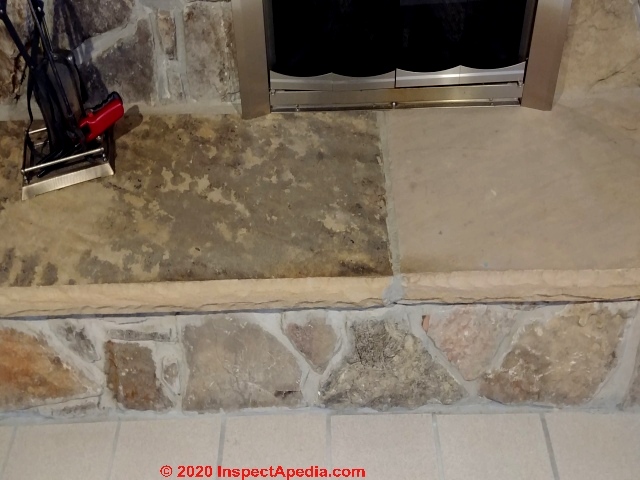
See photos of stained limestone/sandstone Hearth extension. How do I clean this? - Anonymous by private email 2020/12/05
[Click to enlarge any image]
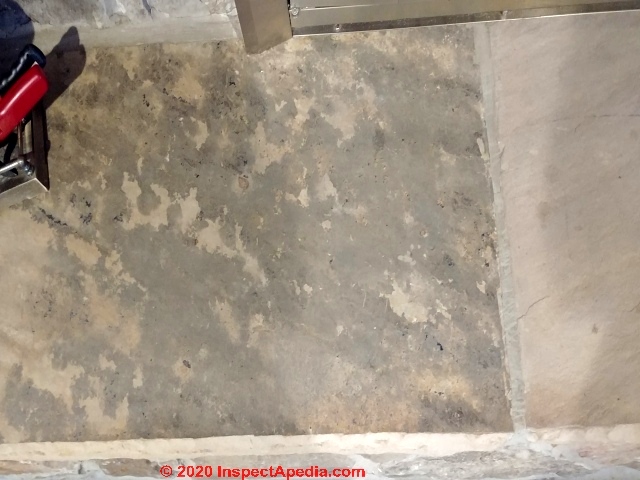
Moderator reply:
Anon: did you see our article on removing stains from stone surfaces [above on this page]?
Be sure to step through the GUIDES for REMOVAL of STAINS from STONE Materials
Reader follow-up:
Yes but the article did not address interior stains on fireplace hearth
Moderator reply:
Right, but stain removal from any surface needs to be informed by
- the type of stone surface and what cleaners work,
- an effort to determine the type or cause of stain itself.
The only significance of it being a fireplace are the chances of creosote or soot as the stain source.
While I don't absolutely rule out creosote or ash or fireplace soot (organic stains) on your fireplace hearth, the fact that we see many blotched dark stains on just the left stone in the photos and nothing on the right stone surface, both of which are in front of the fireplace opening, suggests that the stained stone is suffering from a different source than fireplace emissions.
It is possible that there is a fungus or other contaminant that came in already in or on the stone, perhaps becoming more visually apparent over time due to changes in the stone's environment: moisture, spills, temperature or something else.
Can you tell us
- For sure that the left hand stone is the one of concern and that these stains are "new"
- How old is the home
- What are its country, city, climate, history of leaks, fireplace use, items stored on the hearth (firewood, boxes, other)
- What cleaners you've tried, including those recommended by the article above - and if so, what happened to the stains: better, worse, un-changed
Armed with that information we can research and suggest further steps.
- US GSA STANDARD TESTING SEQUENCE FOR REMOVING UNKNOWN STAINS FROM CONCRETE [PDF] as though it's formulated for concrete this approach outlines what you may need to do to choose the proper stain removal process for your fireplace hearth.
Watch out: while below I include some sources of detailed procedures for removing creosote and other stains from stone or concrete, I do not recommend that you leap to try these before we have a more-accurate guess at the type of stain on your fireplace hearth.
On 2020-06-07 by (mod)
Elaine
I definitely would not attempt to remove lichens from trees or other living plants but if you have a masonry or stone exterior with lichens on it some suggestions are in the article above
On 2020-06-06 by Elaine Bock
Wasn't sure what it was, but an article in Watertown Daily Times newspaper today showed a tree with the same substance and the writer wrote about lichen.
We live in a limestone house and there seems to be the same substance (blotches) on the outsidesills. What to do.
On 2020-05-22 by (mod)
Gloria you may need to use mechanical scrubbing, power washing, and even a masonry cleaner such as muriatic acid -
Watch out: working with any acid is dangerous to people, other animals, plants; follow the manufacturer's instructions for safe use.
On 2020-05-18 by Gloria
We have white lichen all over our granite cobblestone walk. Tried spray and forget. No luck. Any suggestions?
On 2019-06-18 by (mod) - solution sprayed on grave markers to prevent moss, algae, lichens
A short answer is I don't know of such a product but I will look further. A longer answer includes the thoughts that I'll post below.
If you look at the article titled algae and mold stains found in the more reading links above, you'll find a discussion of algaecides that retard or even prevent algae growth on roofs.
Typically these involve use of a metal strip or sprinkle powder or type of roof shingle that retards organic growth. Most likely none of those is going to be a good fit for a gravestone.
If you spray stone with a masonry waterproofing agent, typically those are silicone-based, it may do no harm and it would reduce the tendency to grow algae and lichens by improving the water resistance of the Stone.
(I use Thompson's Water Seal).
The downside of that approach is that in my experience you have to be spraying every gravestone every year as maintenance program.
I'm not sure that's a reasonable approach. A third direction of thought is to look at shade. Sometimes some judicious tree trimming can improve the level of sunlight without making a cemetery ugly by having had some fool run with a chainsaw cutting down everything in sight.
On 2019-06-17 by Tim
Is there a solution that can be sprayed on grave markers after cleaning to prevent the return of moss, algae, lichens etc. how applications mixed?
...
Continue reading at LICHENS on STONE SURFACES or select a topic from the closely-related articles below, or see the complete ARTICLE INDEX.
Or see STONE SURFACE CLEANING METHOD FAQs - questions & answers posted originally at the end of this page.
Or see these
Recommended Articles
- ALGAE & MOLD STAINS on EXTERIORS
- EFFLORESCENCE SALTS & WHITE DEPOSITS
- EFFLORESCENCE & BROWN DEPOSITS
- EFFLORESCENCE REMOVAL & PREVENTION
- EFFLORESCENCE: WHITE DEPOSITS on ROOFS
- RED STAINS on BRICK - RUST?
- STAIN DIAGNOSIS on BUILDING EXTERIORS - home
- STAINS on SANDSTONE, DIAGNOSE & CURE
- STAINS on STONE, STUCCO DIAGNOSE & CURE
- VINES & SHRUBS on BUILDING WALLS, CHIMNEYS
Suggested citation for this web page
STONE, STUCCO & BRICK CLEANING METHODS at InspectApedia.com - online encyclopedia of building & environmental inspection, testing, diagnosis, repair, & problem prevention advice.
Or see this
INDEX to RELATED ARTICLES: ARTICLE INDEX to BUILDING STAINS
Or use the SEARCH BOX found below to Ask a Question or Search InspectApedia
Ask a Question or Search InspectApedia
Try the search box just below, or if you prefer, post a question or comment in the Comments box below and we will respond promptly.
Search the InspectApedia website
Note: appearance of your Comment below may be delayed: if your comment contains an image, photograph, web link, or text that looks to the software as if it might be a web link, your posting will appear after it has been approved by a moderator. Apologies for the delay.
Only one image can be added per comment but you can post as many comments, and therefore images, as you like.
You will not receive a notification when a response to your question has been posted.
Please bookmark this page to make it easy for you to check back for our response.
IF above you see "Comment Form is loading comments..." then COMMENT BOX - countable.ca / bawkbox.com IS NOT WORKING.
In any case you are welcome to send an email directly to us at InspectApedia.com at editor@inspectApedia.com
We'll reply to you directly. Please help us help you by noting, in your email, the URL of the InspectApedia page where you wanted to comment.
Citations & References
In addition to any citations in the article above, a full list is available on request.
- Eric Galow, Galow Homes, Lagrangeville, NY. Mr. Galow can be reached by email: ericgalow@gmail.com or by telephone: 914-474-6613. Mr. Galow specializes in residential construction including both new homes and repairs, renovations, and additions.
- Mark Cramer Inspection Services Mark Cramer, Tampa Florida, Mr. Cramer is a past president of ASHI, the American Society of Home Inspectors and is a Florida home inspector and home inspection educator. Contact Mark Cramer at: 727-595-4211 mark@BestTampaInspector.com 11/06
- In addition to citations & references found in this article, see the research citations given at the end of the related articles found at our suggested
CONTINUE READING or RECOMMENDED ARTICLES.
- Carson, Dunlop & Associates Ltd., 120 Carlton Street Suite 407, Toronto ON M5A 4K2. Tel: (416) 964-9415 1-800-268-7070 Email: info@carsondunlop.com. Alan Carson is a past president of ASHI, the American Society of Home Inspectors.
Thanks to Alan Carson and Bob Dunlop, for permission for InspectAPedia to use text excerpts from The HOME REFERENCE BOOK - the Encyclopedia of Homes and to use illustrations from The ILLUSTRATED HOME .
Carson Dunlop Associates provides extensive home inspection education and report writing material. In gratitude we provide links to tsome Carson Dunlop Associates products and services.
 | HOME | ABOUT | ASK a QUESTION | CONTACT | CONTENT USE POLICY | DESCRIPTION | POLICIES | PRIVACY | |
| © 2025 - 1985 Publisher InspectApedia.com - Daniel Friedman | |||||||||