
InspectAPedia® FREE Encyclopedia of Building & Environmental Construction, Diagnosis, Maintenance & Repair |
Question? Just ask us! InspectAPedia
|
 Class A Metal Chimneys & Flues
Installation Manuals,
Inspection, Diagnosis, Cleaning & Repair Guide
- POST a QUESTION or COMMENT about Class A Metal Chimneys & Flues
Metalbestos or Class A Chimney Installation & Inspection:
This article describes how to select, install, and inspect Class-A insulated metal chimneys such as the Insulated Double Wall MetalBestos™ manufactured metal chimney, also called a zero clearance chimney.
These articles on chimneys and chimney safety provide detailed suggestions describing how to perform a thorough visual inspection of chimneys for safety and other defects. Chimney inspection methods and chimney repair methods are also discussed.
InspectAPedia tolerates no conflicts of interest. We have no relationship with advertisers, products, or services discussed at this website.
Class A Chimneys - Insulated Double Wall MetalBestos™ type
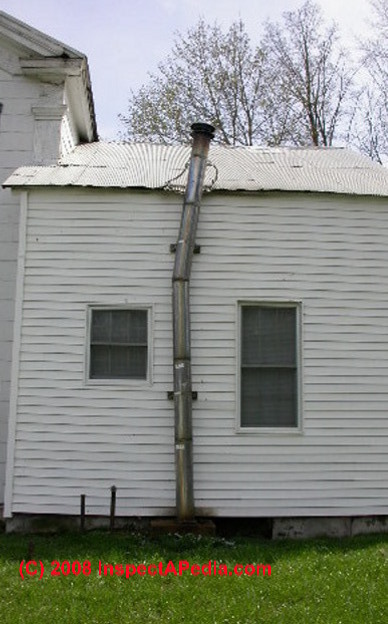
Improper metal chimney installation: As you can see from our photo ( above left), even this superb product can be reduced to shambles when installed by an idiot. The chimney in this photo was not supported, is falling and is unsafe.
See CHIMNEY COLLAPSE RISKS, REPAIRS.
This unfortunate collapsing Class-A type metal chimney was the replacement for the abandoned masonry chimney under the corrugated metal roof we show
at ABANDONED CHIMNEYS, OUTDOORS
and that whose remains we showed
at ABANDONED CHIMNEYS. It looks as if more than one generation of inexpert chimney installers worked in Dover, NY.
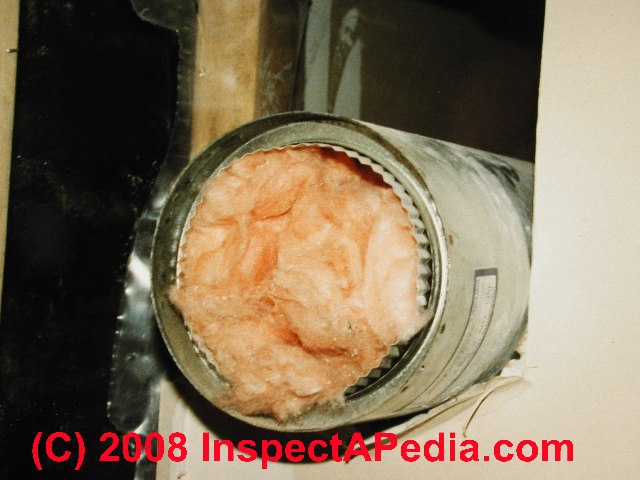
Our photo at above right shows an end view of a section of Metalbestos SS All Fuel Chimney™. The fiberglass insulation is not part of the product and was just left stuffed in that opening.
Class-A Insulated double wall all-fuel chimneys such as the MetalBestos model SS All-Fuel Chimney™ are constructed of double walled stainless steel (usually) and include an insulating material
(originally asbestos) between the two metal layers. Class A chimneys have been replaced in some jurisdictions with Super Chimneys
or SUPER CHIMNEYS, 629 CHIMNEYS (also called Type 650 C chimneys) which we discuss below.
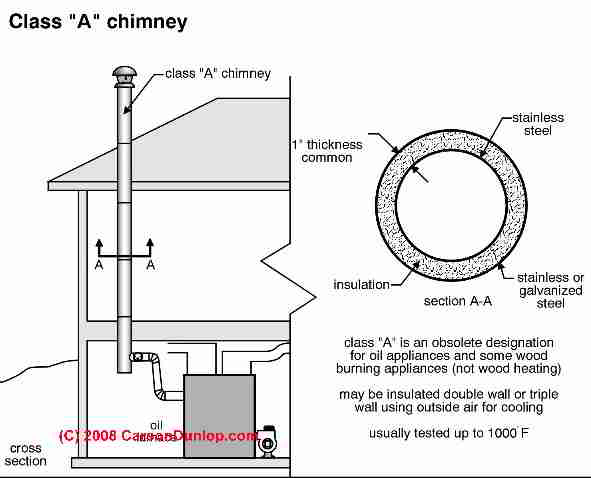 Carson Dunlop Associates [at REVIEWERS] sketch at left shows a Class "A" chimney, of which our photos are an example.
Metalbestos™ type chimneys are available in different diameters, lengths, and with elbows, caps, and supporting base kits. These chimneys are used often to vent oil fired heating equipment as well as woodstoves and zero-clearance or built-in fireplaces. Our photograph at above left shows an installation leaving the insulated metal chimney exposed on the home exterior.
While these insulated chimneys may be rated for zero clearance from combustibles by the manufacturer, many building codes require at least a one-inch clearance between the chimney and any combustible materials.
Our photo at CHIMNEY CHASE CONSTRUCTION hows a wood-framed chimney chase that might enclose an insulated metal chimney or a Type-B Gas vent chimney.
Class A Chimney Height Requirements
Complete details about chimney height requirements on buildings including Class A Chimneys are now located
at CHIMNEY HEIGHT & CLEARANCE CODE
Class A Chimney Fire Clearance Details
Complete details about Class-A chimney fire clearances indoors can now be read
at FIRE CLEARANCES, METAL CHIMNEYS
Should an Insulated or "Air Cooled" Metal Chimney Be Replaced After a Chimney Fire has Occurred?
Question: What Kind of Inspection Is Required After a Metal Chimney Fire?
I was looking for information on chimney fires, specifically, on how to inspect double wall pipe after such an event. The outside of the outer pipe had paper stickers on it that were not burnt or discolored, so I am assuming the pipe did its job. However the top of the chimney run did catch on fire, presumably from the heat generated from the chimney fire. Anyway, I was looking for a category on how to inspect double wall pipe after a fire. - K.M.
Reply: Inspect for visible flue damage, color changes, movement, cracks; but to be safe: in our opinion you should replace the chimney
After a chimney fire (such as from igniting creosote in a metal flue), a competent onsite chimney inspection by an expert usually finds additional clues that help accurately diagnose a problem. That said, we add the following opinion:
In sum: in our opinion after a chimney fire in an insulated metal chimney or an air-insulated metal chimney the chimney should be replaced entirely in order to be safe and to assure that maximum fire protection for the building is maintained. In addition you should inspect for heat or fire damage to surrounding building components. Details follow.
Some chimney repair companies and building codes cite that "metal chimneys must be inspected after a fire for possible need for replacement". We speculate that the chimney inspector will look for deformed, cracked, metal components, movement, color changes in the stainless steel, or signs of overheating or damage to surrounding building components.
If the metal chimney liner and metal exterior of a multi-wall insulated metal chimney are undamaged, one might think that the internal chimney insulation of a multi-wall insulated metal chimney or flue was intact. But that may not be true. In addition there may be subtle damage to surrounding building components such as pyrolysis that could lower the combustion point and increase the risk of a future fire in nearby wood materials.
See FIRE STOPPING in BUILDINGS
Some sources point out that
Stainless Steel turns blue at 900 degrees causing the chemical makeup of chromium carbide to migrate. After this, the stainless steel will rust and cause corrosion. Stainless Steel really should be replaced after chimney fires over 900 degrees. -References or Citations
We have observed steel flues that turned blue and also black after a fire.
A "be safe" approach requires that insulated chimneys are replaced after a fire.
We believe that this makes sense because because during a chimney fire the internal temperatures can be extremely high and thus can damage the flue in both obvious and less obvious ways that may not be visible and no one wants to take a chance.
Furthermore, the "after 900 degrees" rule is impractical: - who is actually measuring chimney temperature during a fire? The 900 deg F number in our OPINION is not helpful.
Most chimney sources point out that it's common for a chimney fire to reach 2000 deg F! Who wants to risk an unsafe flue after a fire when a new fire could still occur and could meet less protection.
A similar example is with earthquake-resistant construction: the construction is designed to keep the building from collapsing and killing the occupants, but it is not expected to prevent any damage whatsoever to the building. So after a quake repairs are going to be needed.
Class A Insulated Metal Chimney Manuals, Codes, Safety References
- 2006 ICC MECHANICAL CODE, CHAPTER 8, CHIMNEYS and VENTS [PDF], International Mechanical Code as adopted by Virginia, retrieved 2018/02/12 original source: https://www2.iccsafe.org/states/Virginia/Mechanical/PDFs/Chapter%208_Chimneys%20and%20Vents.pdf
- BRITISH STANDARD BS 5440 CHIMNEY INSTALLATION CLEARANCES MAINTENANCE [PDF] (2000) Installation and
maintenance of flues
and ventilation for gas
appliances of rated
input not exceeding
70 kW net (1st, 2nd and
3rd family gases) — Part 1: Specification for installation and maintenance of flues - CHIMNEY CODES & STANDARDS - complete list of Chimney & Vent codes & standards
- Dura-Vent Chimney Installation Instructions for the company's various models can be found at https://duravent.com/installation-instructions/ (2021/05/19), including the company's products listed below. Note that a number of these (like the DuraVent DirectVentPro are NOT intended for wood burning or other heating appliances that require use of a multi-walled insulated metal chimney.
CVS® DirectVent® Pro, DuraBlack®, DuraChimney® II, DuraFlex® Aluminum, DuraFlex® Stainless Steel, DuraLiner®, DuraPlus®, DuraSeal®, DuraStack®, DuraStack® Pro, DuraTech® 5"-8", DuraTech® 10"-24", DuraTech® Canada, DuraTech® Premium, DVL®, FasNSeal®, FasNSeal® 80/90, FasNSeal® Flex, FasNSeal® W2, PelletVent® for Multi-Fuel, PelletVent Pro®, PolyPro®, PolyPro® Flex, Type B Gas Vent, Ventinox® - DuraVent, DURACHIMNEY® INSTALLATION INSTRUCTIONS [PDF] Air-Cooled, All-Fuel Chimney for Fireplaces, DuraVent Co., Tel: : 800-835-4429 Website: www.duravent.com
- GAMA - Gas Appliance Manufacturers' Association has prepared venting tables for Category I draft hood equipped central furnaces as well as fan-assisted combustion system central furnaces.
- ICC Chimneys, Excel FACTORY BUILT CHIMNEY INSTALLATION & MAINTENANCE INSTRUCTIONS [PDF]Industrial Chimney Company 400, boulevard J-F Kennedy St-Jérome (Québec) Canada, J7Y 4B7 T. (450) 565-6336 Wrbsite: icc-rsf.com retrieved 2020/02/21 original source: https://icc-chimney.com/c/icc/file_db/docs_document.file_en/XLUSA-II_2012-01.pdf
- Metal-Fab TEMP/GUARD CHIMNEY INSTALLATION & MAINTENANCE INSTRUCTIONS [PDF] Metal-Fab Inc., 3025 May Street Wichita, Kansas 67213 USA, Tel: 1-800-835-2830 FAX: 316-943-2717 Email: info@mtlfab.com Website: https://www.mtlfab.com/ retrieved 2020/02/21 original source: https://www.mtlfab.com/media/TempGuard_All-Fuel_Chimney_Instructions_6-12_USA-L944.pdf
- National Fuel Gas Code, an American National Standard, 4th ed. 1988 (newer edition is available) Secretariats, American Gas Association (AGA), 1515 Wilson Blvd., Arlington VA22209, and National Fire Protection Association (NFPA), Batterymarch Park, Quincy MA 02269. ANSI Z223.1-1988 - NFPA 54-1988. WARNING: be sure to check clearances and other safety guidelines in the latest edition of these standards.
- Fire Inspector Guidebook, A Correlation of Fire Safety Requirements Contained in the 1987 BOCA National Codes, (newer edition available), Building Officials and Code Administrators International, Inc. (BOCA), Country Club HIlls, IL 60478 312-799-2300 4th ed. Note: this document is reissued every four years. Be sure to obtain the latest edition.
- Hart & Cooley, CHIMNEY RAIN CAP, FLASHING, STORM COLLAR, SPARK ARRESTER INSTALLATION INSTRUCTIONS [PDF] (2013) - retrieved 2022/06/15, original source: https://www.ameri-vent.com/assets/files/15h/8513591.pdf
- NFPA 211 - Standards for Chimneys & Fireplaces, NFPA 211: Standard for Chimneys, Fireplaces, Vents, and Solid Fuel-Burning Appliances, 2006 Edition (older editions and standards are found at the same bookstore)
- NFPA #211-3.1 1988 - Specific to chimneys, fireplaces, vents and solid fuel burning appliances.
- NFPA # 54-7.1 1992 - Specific to venting of equipment with fan-assisted combustion systems.
- Selkirk, S-3 METAL CHIMNEY CAP, FLASHING, STORM COLLAR INSTALLATION INSTRUCTIONS [PDF] Selkirk, 5030 Corporate Exchange Blvd. SE, Grand Rapids, MI 49512 USA, Tel: 1-800-992-VENT (8368), - retrieved 2022/06/15, original source: https://www.selkirkcorp.com/literature/S3_Round_Top _Flashings _Storm_Collar _Spark_Arrester_and_Roof_Brace_Kit.pdf
- SUPER VENT 2100 & SUPER PRO 2100 INSTALLATION INSTRUCTIONS & MAINTENANCE GUIDE [PDF] FACTORY-BUILT 650° C INSULATED CHIMNEY
GUIDE Tested To
CAN/ULC-S629 & UL103 Type HT, retrieved 2018/02/12, original source: http://www.selkirkcorp.ca/~/media/selkirk/reference-documents/common/file/installation/chimney/superpro-2100-alt/2100-installation-instructions.pdf
Contact the Selkirk company at 800.992.8368 or by Email: info@selkirkcorp.com Selkirk Corporation, 5030 Corporate Exchange Blvd. SE, Grand Rapids, MI 49512 USA
orSelkirk Canada Corporation, P.O. Box 526, Depot 1, Hamilton, ON L8L 7X6 Tel: 888.SELKIRK (735.5475)
- Uniform Mechanical Code - UMC 1991, Sec 913 (a.) Masonry Chimneys, refers to Chapters 23, 29, and 37 of the Building Code.
- New York 1984 Uniform Fire Prevention and Building Code, Article 10, Heating, Ventilating, and Air Conditioning Requirements
- New York 1979 Uniform Fire Prevention & Building Code, The "requirement" for 8" of solid masonry OR for use of a flue liner was listed in the One and Two Family Dwelling Code for New York, in 1979, in Chapter 9, Chimneys and Fireplaces, New York 1979 Building and Fire Prevention Code:
Reader Comments, Questions & Answers About The Article Above
Below you will find questions and answers previously posted on this page at its page bottom reader comment box.
Reader Q&A - also see RECOMMENDED ARTICLES & FAQs
On 2020-12-25 - by (mod) -
Yes maybe;
The concern, Tom, is that the 8" chimney may be too cool and too large for a gas-fired water heater to develop sufficient draft; without enough draft such a water heater is unsafe as it risks spilling flue gases and dangerous carbon monoxide into the building interior.
It might be possible to use a power vent or draft booster. Check with the water heater's manufacturer or with the installation manual for your heater brand and model.
Let me know if you have further questions, details, opinions.
On 2020-12-25 by Tom
Can a water heater with a 4" vent be vented into to an existing 8" steel chimney? There are no other structures that would vent into the chimney
On 2020-10-10 - by (mod) -
Gary
Thank you for the interesting fuel conversion chimney question.
I would not change fuels in a chimney without first having the existing flue cleaned of creosote deposits in order to reduce a future fire or corrosion hazard.
At that point if you want to wind the existing chimney with a smaller gas flu that sounds like an interesting possibility. I would not proceed to actually buy the equipment to do that before checking with the manufacturer.
On 2020-10-10 by Gary
I have a class A chimney that I used for a freestanding wood stove. I purcashed a used Osburn free standing natural gas stove and would like to know if I can use the chimney. The Osburn asks for a Simpson Duravent direct vent number DV-GS.
I was thinking of running a 4" chimney up the middle of the class A 6" ,it runs vertical through the center of the house.
So the 4" would vent the waste and the surrounding area would be freach air. Is this possible/?
I talked to a HVAC guy and he didnt think it was a bad idea... but...The class A passed all inspections and I burned wood in it for several years.
Question: ok (safe) to vent a corn furnace (in the basement) with an external steel flue that runs in front of a window
(Sept 17, 2014) Craig Swindell said:
Thank you for posting all this great information!\
(Nov 3, 2014) Anonymous said:
is it ok (safe) to vent a corn furnace (in the basement) with an external steel flue that runs in front of a window on the 1st floor of a home.
Reply: No NFPA 211(2010):8.1.1 does not permit use of single-wall metal chimneys or unlisted metal chimneys inside or outside a one- or two-family dwelling.
(Nov 11, 2014) NH Fire Bear said:
NFPA 211(2010):8.1.1 does not permit use of single-wall metal chimneys or unlisted metal chimneys inside or outside a one- or two-family dwelling.
Even where permitted, an unshielded metal chimney must be no less than 2 ft from any window, door or walkway. 8.2.2.1.4. Locally adopted or amended codes may differ.
...
Continue reading at FIRE CLEARANCES, METAL CHIMNEYS or select a topic from the closely-related articles below, or see the complete ARTICLE INDEX.
Or see these
Recommended Articles
- CHIMNEY INSPECTION DIAGNOSIS REPAIR - home
- CHIMNEY DRAFT & PERFORMANCE
- CHIMNEY FIRE ACTION / PREVENTION
- CHIMNEY FLUE INSPECTION CAMERA
- CHIMNEY RE-LINING CHOICES
- CHIMNEY SAFETY, WOOD BURNING - CPSC
- CHIMNEY TYPES & MATERIALS
- CLASS A CHIMNEYS, MetalBestos™
- FIRE CLEARANCES, METAL CHIMNEYS
- FIREPLACE INSERTS INSTALL, INSPECT, REPAIR
- FIREPLACE INSPECTION PRE-FAB
- MANUFACTURED CHIMNEYS - definition
- METAL CHIMNEY FLUE SEPARATION CODES
- METAL CHIMNEYS & FLUES - home
Suggested citation for this web page
CLASS A CHIMNEYS, MetalBestos™ at InspectApedia.com - online encyclopedia of building & environmental inspection, testing, diagnosis, repair, & problem prevention advice.
Or see this
INDEX to RELATED ARTICLES: ARTICLE INDEX to CHIMNEYS & FLUES
Or use the SEARCH BOX found below to Ask a Question or Search InspectApedia
Ask a Question or Search InspectApedia
Try the search box just below, or if you prefer, post a question or comment in the Comments box below and we will respond promptly.
Search the InspectApedia website
Note: appearance of your Comment below may be delayed: if your comment contains an image, photograph, web link, or text that looks to the software as if it might be a web link, your posting will appear after it has been approved by a moderator. Apologies for the delay.
Only one image can be added per comment but you can post as many comments, and therefore images, as you like.
You will not receive a notification when a response to your question has been posted.
Please bookmark this page to make it easy for you to check back for our response.
Our Comment Box is provided by Countable Web Productions countable.ca
Citations & References
In addition to any citations in the article above, a full list is available on request.
- Roger Hankeyis principal of Hankey and Brown home inspectors, Eden Prairie, MN, technical review by Roger Hankey, prior chairman, Standards Committee, American Society of Home Inspectors - ASHI. 952 829-0044 - hankeyandbrown.com
- NFPA 211 - Standards for Chimneys & Fireplaces, NFPA 211: Standard for Chimneys, Fireplaces, Vents, and Solid Fuel-Burning Appliances, 2006 Edition (older editions and standards are found at the same bookstore)
- NFPA #211-3.1 1988 - Specific to chimneys, fireplaces, vents and solid fuel burning appliances.
- NFPA # 54-7.1 1992 - Specific to venting of equipment with fan-assisted combustion systems.
- GAMA - Gas Appliance Manufacturers' Association has prepared venting tables for Category I draft hood equipped central furnaces as well as fan-assisted combustion system central furnaces.
- National Fuel Gas Code, an American National Standard, 4th ed. 1988 (newer edition is available) Secretariats, American Gas Association (AGA), 1515 Wilson Blvd., Arlington VA22209, and National Fire Protection Association (NFPA), Batterymarch Park, Quincy MA 02269. ANSI Z223.1-1988 - NFPA 54-1988. WARNING: be sure to check clearances and other safety guidelines in the latest edition of these standards.
- NFPA 211 - Standards for Chimneys & Fireplaces, NFPA 211: Standard for Chimneys, Fireplaces, Vents, and Solid Fuel-Burning Appliances, 2006 Edition (older editions and standards are found at the same bookstore)
- NFPA 211 - 3-1.10 - Relining guide for chimneys
- NFPA 211 - 3-2 - Construction of Masonry Chimneys
- NFPA 211 - 3-3 - Termination Height for chimneys
- NFPA 211 - 3-4 - Clearance from Combustible Material
- NFPA 54 - 7-1 - Venting of Equipment into chimneys
- Brick Institute of America - Flashing Chimneys
Brick Institute of America - Proper Chimney Crowns
Brick Institute of America - Moisture Resistance of Brick - American Gas Association - New Vent Sizing Tables
- Chimney Safety Institute of America - Chimney Fires: Causes, Effects, Evaluation
- National Chimney Sweep Guild - Yellow Pages of Suppliers
- NFPA 211 - 3-1.10 - Relining guide for chimneys
- NFPA 211 - 3-2 - Construction of Masonry Chimneys
- NFPA 211 - 3-3 - Termination Height for chimneys
- NFPA 211 - 3-4 - Clearance from Combustible Material
- NFPA 54 - 7-1 - Venting of Equipment into chimneys
- Brick Institute of America - Flashing Chimneys
Brick Institute of America - Proper Chimney Crowns
Brick Institute of America - Moisture Resistance of Brick - American Gas Association - New Vent Sizing Tables
- Chimney Safety Institute of America - Chimney Fires: Causes, Effects, Evaluation
- National Chimney Sweep Guild - Yellow Pages of Suppliers
- In addition to citations & references found in this article, see the research citations given at the end of the related articles found at our suggested
CONTINUE READING or RECOMMENDED ARTICLES.
- Carson, Dunlop & Associates Ltd., 120 Carlton Street Suite 407, Toronto ON M5A 4K2. Tel: (416) 964-9415 1-800-268-7070 Email: info@carsondunlop.com. Alan Carson is a past president of ASHI, the American Society of Home Inspectors.
Thanks to Alan Carson and Bob Dunlop, for permission for InspectAPedia to use text excerpts from The HOME REFERENCE BOOK - the Encyclopedia of Homes and to use illustrations from The ILLUSTRATED HOME .
Carson Dunlop Associates provides extensive home inspection education and report writing material. In gratitude we provide links to tsome Carson Dunlop Associates products and services.
 | HOME | ABOUT | ASK a QUESTION | CONTACT | CONTENT USE POLICY | DESCRIPTION | POLICIES | PRIVACY | |
| © 2024 - 1985 Publisher InspectApedia.com - Daniel Friedman | |||||||||