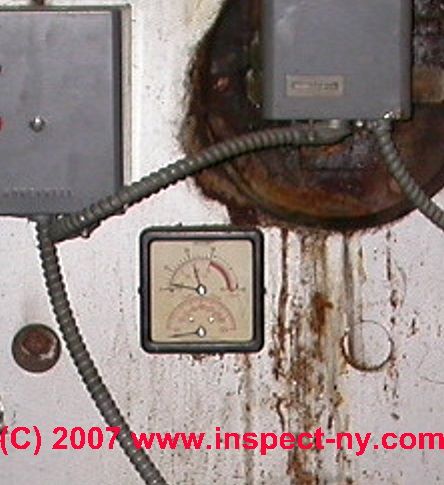
 Heating System Gauge FAQs

- POST a QUESTION or COMMENT about heating equipment gauges such as indicators found on steam boilers and on hot water (hydronic) heating systems; how to read heating system pressure and temperature, what are the normal system pressure and temperature? Boiler gauge leaks, replacement, repair.
Questions & answers on troubleshooting heating boiler pressure & temperature gauges:
Frequently-asked questions about gauges found on hot water (hydronic) heating boilers, steam boilers, and other heating equipment can help diagnose & repair operating problems with these systems.
This article series provides an inspection and repair guide to Heating System Gauges: Pressure and Temperature Gauges on Heating Boilers. We also describe the normal operating pressures for hot water hydronic heating boilers and for residential steam boilers.
InspectAPedia tolerates no conflicts of interest. We have no relationship with advertisers, products, or services discussed at this website.
- Daniel Friedman, Publisher/Editor/Author - See WHO ARE WE?
Heating System Pressure Gauges & Normal Steam or Hot Water Boiler Pressure Ranges
These questions & answers about pressure and temperature gauges found on heating boilers were posted originally
at GAUGES ON HEATING EQUIPMENT - you will want to review that data too.
If residential steam boilers run under 2 psi why do I see a 30 psi scale in this gauge photo?
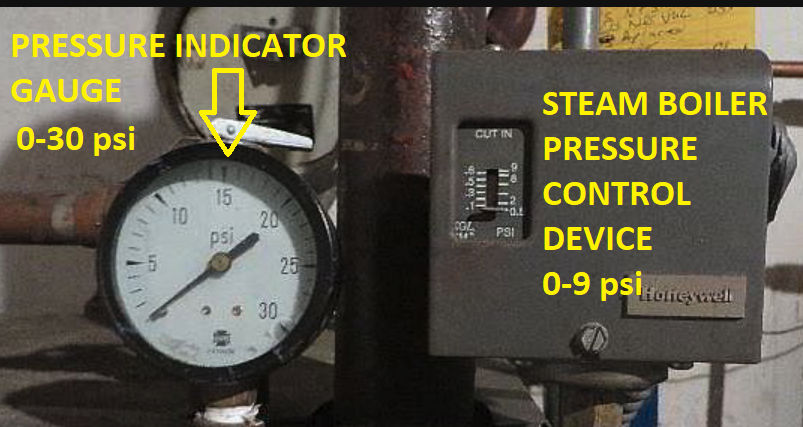 If the pressure of the steam boiler shouldn't be above 2 PSI, why do I see pressure gauge scaled out all the way to 30 psi in this picture ? On 2019-09-23 by Mike
by (mod) - Compare gauge pressure scale with the pressure control device scale - sure the gauge isn't the best one for a steam boiler
Thanks for asking, Mike.
There are two parts in my answer to why you see a pressure gauge scaled all the way up to 30 psi on a residential steam boiler that should not normally operate above 2 and usually just around 0.2 psi.
1. The black ROUND gauge in the photo whose scale runs between 0psi and 30 psi is NOT the CONTROL it is a generic PRESSURE READING gauge reading boiler pressure.
And its 5 tick marks between 0 and 5 allow a homeowner or service technician to see that the pressure is indeed in the very low end of the proper range - under 2 psi means that the gauge won't run much above that first tick mark.
2. The gray rectangular gauge at the right of the photo (which is an enlargement of a photo given earlier on this page) is the PRESSURE CONTROLLER for the residential steam boiler. You will see that the scale on its gauge runs from 0 to just 9 psi, and it gives very clear reading tick marks along the left indicating 0.1 0.2 (no number) 0.3 0.4 (no number) and 0.5.At higher pressures you'd read the same control along its right hand scale that runs from 0.1 up to 9 psi.
General Remarks about Pressure Control and Pressure Gauge Scales and Ranges
The reason you might see a pressure gauge or control that scales above the proper and safe pressure for a residential (home) steam boiler (or some other specific applicatio) is simply that the manufacturer has designed the device for use on a wider range of equipment and systems. For example some commercial / industrial steam boilers may run at considerably higher pressures.
An example of high pressure steam boilers and their operation is at STEAM BOILERS GENERATORS CONTROLS, PRATT inspectapedia.com/heat/Steam_Systems_Pratt_Milster.php
However the manufacturer's recommended pressure for a mountain bike might be just 25 psi
Still you've asked an important question in another regard, Mike. SOME pressure reading gauges or pressure controls may be inaccurate at the low end of its scale if the device is designed specifically for high pressure range operation.
For example I would not use a gauge scaled for high pressure refrigerant to measure the low side pressure because the gauge may be inaccurate in that range.by Mike
Thank you for your prompt answer Dan
That makes sense. Looks like I am going to replace that 30 PSI gauge with 5 or 10 PSI gauge for more accuracy and easier reading in my boiler.
My gauge currently doesn't work - either is damaged or the pigtail might be clogged - but this will be the opportunity to swap it to a better gauge.
Thanks a lot again.Reply by (mod) - choose a low-range scale boiler pressure gauge to read with more accuracy
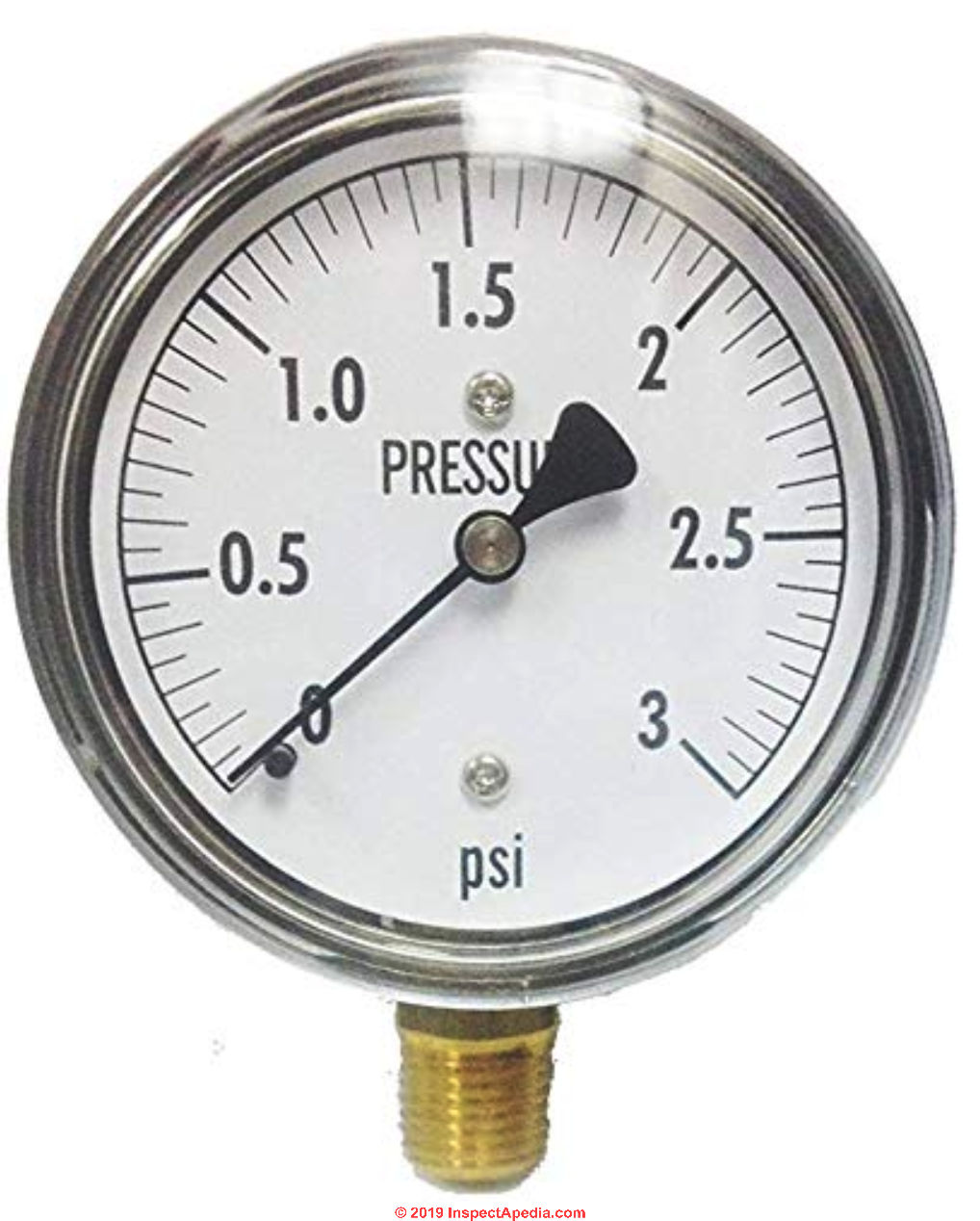
kodiak-low-range-pressure-gauge-kc25-3
Here is a low pressure analog water pressure gauge operating in the 0-3 psi range, the Kodiak Controls KC25-3# (Under $30. U.S.)
from
Kodiak Controls, Inc. Phone: 630-629-3733 Fax: 630-629-3544 kodiak@kodiakcontrols.com
InspectAPedia is an independent publisher of building, environmental, and forensic inspection, diagnosis, and repair information for the public - we have no business nor financial connection with any manufacturer or service provider discussed at our website. We very much welcome critique, questions, or content suggestions for our web articles.
Watch out: I would not install a pressure gauge on a system whose operating and safety controls could permit the system pressure to ever exceed the pressure gauge maximum working pressure range - the risk is that you blow the gauge, flood the building, or blow up the boiler.I like that idea of a more-accurate pressure gauge too; it's not easy to find a gauge reading just in the low range; the market is dominated by the 0-30 psi range products.
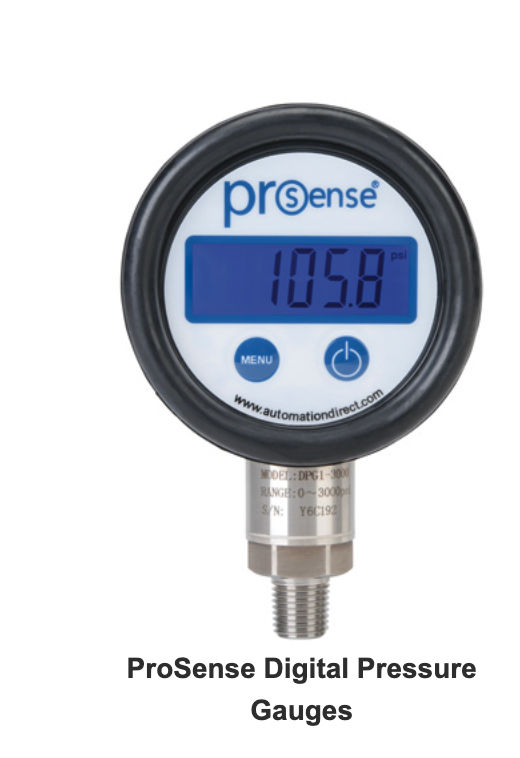
There are digital pressure gauges that are (or claim to be) accurate in low-range but they're pricey, around $100. U.S.Kodiak Controls offers a low pressure analog pressure gauge KC25-3# in the 0-3 psi range for under $30.- shown in the photo above.
The ProSense digital pressure gauge DPG1-15 is +/- 5% accurate and can be obtained in the 0-15 psi range - shown below.
by Mike
Wonderful - Thank you for the idea.
I just wonder how much pressure abuse such 3 PSI would take before blowing out and flooding the building - hopefully at least 30 PSI (or at least below 15 PSI relief valve).Reply by (mod) -
You'd need to ask Kodiak; they sell gauges under their own brand as well as gauges produced by other manufacturers; but none of the online data sheets for the KC25 mention a maximum safe pressure exposure.
I would not assume that a low pressure gauge that is rated to read up to 3 psi can tolerate much higher pressures safely.
by Mike
Just spoke to Kodiak and they told me the following is true for their KC25-3# gauge.
- over-pressure rating (pressure beyond which gauge would get damaged) is 25% or the reading so in this case it would be: 3.75 psi.
- rupture pressure rating (pressure where it would blow out and flood the area) is 250% of the reading - in this case it would be 7.7 psi.
correction - rapture rating is 7.5 psi in this case (250% of 3 psi).
by (mod) - choosing an accurate low-range pressure gauge for residential steam heating systems
MIke
THank you for the follow-up about gauge tolerance for over-pressure; that will help other readers.
Landlord lowered my hot water pressure because the steam boiler was running too much - what's up?
Landlord lowered hot water pressure due to steam furnace constantly running.
Now there’s not enough hot water pressure to use my dishwasher. Does this make sense, because it doesn’t to me. I’ve been here for 4 years and this never happened before. What’s my landlord up to? On 2019-03-22 by Anonymos
by (mod) - steam boiler pressure independent of building hot water supply pressure to plumbing fixtures
Anon
I'm confused, which is itself confusing as I'm the one writing a reply to your question.The operating pressure inside or of a steam boiler used to heat a building has nothing to do with the flow rate or "pressure" of hot water supplied to sinks, tubs, showers in a building.
Typical residential steam boiler internal pressure is less than 1 psi.
However your landlord may have given a confused explanation of why hot water supply pressure to plumbing fixtures is less.For example, she could have resticted hot water flow rate to the building tenants simply by partly closing a main hot water supply valve (I am guessing as I have no idea what she did).
One would do that to slow the rate of use of hot water as a way to reduce the cost of supplying hot water to a building.
OR
Your steam boiler also has a tankless coil for making domestic hot water. Partly closing a hot water supply valve would slow your use of hot water and save some water heating money - maybe.
Burnham Series 2 (model B) boiler TPR valve leaks
 Hello, I have a Burnham Series 2 (model B) boiler around 17 years old.
I replaced the old sidebar domestic water heater and also replaced the backflow valve, the feed pressure valve, the relief pressure valve, the bladder expansion tank and rebuilt the Spirovent over the tank.
Boiler pressure cold is around 15psi and rises to around 23psi when firing.
I notice that there is a discharge from the relief pressure valve every morning but when I observe the boiler the pressure never comes close to 30psi.
Could I have a new pressure relief valve that is defective? Thanks, Ted On 2018-01-29 by Ted Sillox
Reply by (mod) -
Yes you could have a leaky pressure relief valve, or there could be an external cause such as water hammer.
See the full list of reasons a boiler temperature / pressure relief valve might leak
at
Why is our boiler gauge staying at 20 psi?
I have a pressure gauge before circulating pump and one on the boiler. The boiler reads 20 psi, when circulating pump is running gauge before circ pump reads 12 psi but when boiler shuts down gauge before circ pump drops to zero but boiler gauge remains at 20 psi? On 2017-01-21 by Don B
by (mod) - check for a stuck pressure gauge first
Interesting, Don.
I am not sure exactly where on the hot water circuit your pressure gauge is installed.First: try tapping that gauge. Often boiler gauges stick and then may not be showing the true boiler pressure.
In general, the boiler pressure will range between 12 psi cold and somewhere in the high 20's psi when the boiler is at its hottest - if measured right at the boiler.
Measuring pressure on the inlet side of a circulator pump may show lower psi because on the inlet side the pump is in effect "sucking" on the hot water pipe, causing pressure to drop on the pump's inlet side.
Measuring in that same location when the circulator has stopped might indeed register a low or even 0 psi if a check valve (typically a Flo-Control valve found on each zone where hot water leaves the boiler) is installed and working.That valve closes to keep hot water from circulating through the system by natural convection (circulator is off) when there is no call for heat.
Search InspectApedia.com for FLOW CONTROL VALVE to see details.by Don B
The pressure gauge is located on the return piping before circulating pump and it reads approx 12-14 psi when pump starts up then slowly drops to zero when pumps shuts down. Boiler pressure gauge stays constant at 22psi.
Supply line goes from boiler thru expansion tank and scoop to zone valve manifold. My question is, if it's a closed loop how can that gauge be zero should it not be same as boiler. Forgive me I'm just a carpenter!
Questions about the pressure/temperature relief valve on commercial / power plant steam generator
1) How to size the safety valve for a boiler with no stamp?
2) What are the overall conditions responsible for the damage of superheater coils?
3) Why is deaerated water not used in boiler at the time of boiler hydraulic testing?
- Mohnish
Reply:
Mohnish:
Size or rating of the pressure/temperature relief safety valve on steam boilers & missing data tags
If the data tag identifying the safety valve has been lost, and considering that this is such an important safety device, and considering the importance of installing a valve of adequate capacity, I'd just replace a valve that was in question for any reason whatsoever.
We're talking about a residential part price of $20. U.S. (or less).
In some jursidictions even on residential steam heating boilers and certainly on a commercial or power plant steam generator in particular, I wouldn't be surprised if regulations and maintenance guidelines would view a missing steam boiler pressure/relief valve data tag as a safety violation.
Also see RELIEF VALVE, TP VALVE, STEAM BOILER
Superheater coils on steam boilers, sources of damage
I presume you are referring to super heater coils that are used in a steam-heat system boiler to generate saturated steam. The super heater coils are specially used in Boilers of Power plant. These are not residential heating system components, and with respect, are beyond our expertise.
In my OPINION an important consideration is to assure that the proper safety pressure/relief valves are mounted at the proper locations and are in good working condition on superheater coils as well.
SeeReferences or Citations for superheater coils and super heater coil damage. [1]
Use deareated water in steam boilers during testing?
That question too is not pertinent to residential steam systems. Deareated water is water used in commercial or power generating boilers from which dissolved oxygen or other gases is removed to avoid corrosion in the system.
(Oxygen and other gases are removed during deaeration to a level as low as feasible - it won't quite be to zero. typically oxygen is removed down to about 7ppb during deaeration of water for steam systems. [2]
OPINION: it may seem reasonable to test a steam generating boiler with deaerated water, arguing that you're trying to duplicate the in-service condition.
However I speculate that
- The corrosive effects of a brief hydraulic pressure test of a steam generating system are perhaps very low or even below measurement thresholds, as compared with in-service use water, perhaps moreso if performed at low temperature
- The focus in steam generating boiler testing is on pressure tolerance and leak detection over a short interval nothing like the in-service life over which hot water in a steam generating boiler, if not deaereated, would be expected to have very corrosive effects.
Take a look at Steam: Its Generation and Use for details. [3]and see our articles on residential and light commercial steam boilers beginning
Relief valve popped - did the repair person do something wrong?
I had no heat and my oil nozzle was replaced on my boiler, less than an hour later there is water gushing out the pipe that is on the tank that holds the water. I was told the relief valve popped due to the pressure, did The person that worked on the boiler fail to do something when restarting the boiler? (Feb 27, 2014) Kevin
Reply:
Kevin,
I don't have a clear idea of what happened to your system nor what is "the tank that holds the water".
But if the water spillage that you saw was coming out of a pressure/temperature relief valve, that is indeed a response to an unsafe pressure OR an unsafe temperature in the heating system (depending on the type of relief valve they're called TP valves or Temperature & Pressure Relief Valves).
JUST changing an oil burner nozzle would not normally cause a heating system over-pressure condition. An over-sized nozzle (burning too much oil, making a too-big flame) might overheat a boiler but the boiler's primary control or limit control ought to turn off the burner in that case.
And if the oil burner adjustment were improper, still the boiler's primary control unit has a high-temperature limit that is intended to shut off the burner when temperatures exceed the HIGH LIMIT.
Therefore it sounds as if there was a different problem. Some possibilities include:
- the boiler's expansion tank was waterlogged (most likely)
- the primary control high temperature limit was improperly set too high
- the relief valve failed or was left open manually
- something else I can't speculate on as I don't know a thing about your system
Keep us posted, what we learn will help other readers.
Gushing water sound through heating pipes
there is sounds of water gushing through all the pipes that run through the baseboard heaters,sometimes its really load. Mar 29, 2014) Anonymous said:
Sorry I have a boiler furnace and the hotwater that runs through the baseboard pipes sometimes sounds as waters GUSHING through all the pipes. WHY? Mar 29, 2014) Anonymous said:
its very loud at times that my daughter lives right next door where the boilerroom is can hear it too...WHY??? ment to put loud not load... angelafernan1972@gmail.com
Reply:
Sounds like air in the heating pipes. See
What are the standard temperature and pressure for heating systems
What is the standard temperature and pressure ranges for a heating boiler? (Apr 12, 2014) jonathan said:
Reply:
Jonathan, the normal temperature and pressure ranges for heating equipment vary by type: hot water vs. steam
You can read these in GAUGES ON HEATING EQUIPMENT under the headings
What Are the Normal Hot and Cold Operating Pressures of Residential Hydronic (hot water) Heating Boilers?
and
What Are the Normal Hot and Cold Operating Pressures of Residential Steam Heating Boilers?
If any of that is unclear please just ask and I'll answer further.
Thanks
Daniel
What are the proper boiler gauge pressure readings?
Automatic flow valve to filler boiler (bell/gossett) SET AT 12PSI. On hydronic system gauge on boiler reflects 5 lbs on when boiler is cold.
Should the gauge be reading 12lbs like the flow valve?
Is 5lbs enough pressure for a cold boiler and how high should pressure go when boiler temp. reads 120 degrees or more. (Dec 11, 2016) Mike
Reply:
Mike, the pressure in standard residential hot water heating boilers in buildings that are no more than 3 stories including basement would be typically 12 psi cold and somewhere under 30 psi when the boiler is hot. 5 psi may not be enough pressure to get heat to upper floors.
Is it ok to run boiler if water pressure is low?
Is it safe to still run the oil boiler while the water pressure is so low, just a trickle of water at this time. (Dec 31, 2014) Ronald
Reply:
Ronald
If the boiler or heating system is full of water and not leaking it should be ok to run.
Watch out: If boiler water is Lost it can't be run without damage.
Assuming you have hot water heat, if just some water were lost you'd probably note that the boiler was running but some baseboards or radiators are cold.
Tell me how to fix water hammer noise at a Weil McLain gas boiler with gauge at 30 psi
HI, Thank you for the article.
MY Weil McLain gas boiler has water hammer issue and also pressure relieve dripping water issue.
Now I turned off the boiler and also the hot water storage, but I see that it still dripping water, the water pressure reaches 30 pounds, even the water is cold.
Do you know what problem this is? (Apr 3, 2016) Anonymous
Reply:
Anon:
Please search InspectApedia for WATER HAMMER NOISE DIAGNOSE & CURE to see how to diagnose and cure that problem.
Indeed water hammer can cause leaks at the relief valve.
BUT
30 psi cold is abnormally high for a residential boiler.
Typically the cold water pressure (boiler is cold) will be 12psi or maybe a bit higher for taller homes. If you verify (using an independent pressure gauge) that the pressure really is 30 psi, then there may be a problem with the water feeder-pressure reducer valve for the boiler
The temperature pointer on my boiler gauge stays out of range and never moves
I have a P/T gauge on my MiniGas MG50 boiler which in a weird condition when I moved in the house: the pressure is around 10 PSI which is in a working condition. The temperature is out of range and the pointer stay out of range and never fall back to work area.
Do you think I can find a way to put(reset?adjust?) it back to the normal position to make it work or need to be replaced? Thank you! On 2012-12-14 by John Langley
Reply by (mod) -
John,
Tap gently on the gauge; if it doesn't drop and work freely it probably needs to be replaced;
Sometimes crud in the boiler water clogs the gauge sensor port but given the time and trouble to remove the gauge to try to clean it, not wanting to do the job twice, I'd replace it.Oh but first: make sure you're not just looking at an indicator or gauge pointer that's marked or set on a gauge to indicate a temperature or pressure limit - don't confuse that with the moving needle.
What should the temperature heated floors. In our unit we have a stand alone boiler.
The boiler has two gauges. One reads 80 and one reads almost 100. Our temp set on thermostat is 85 and our unit never gets warmer than 67 degrees. We use space heaters to compensate.
The boiler and pipes are corroded. The first boiler leaked they replaced it with this one. The pump or something on this replacement started making noise this past Oct. so a technician came in and primed it.
The previous technician stated that there was so much corrosion in the lines the place needed a complete overhaul. He has since retired.
My landlord gets by with this because they don't think we'll ever find out the answer to my previous question. I have taken pictures. I can't call anyone in town because we have but one plumber-he gets all this places emergency no heat calls so he isn't going to answer me honestly.
He is making a fortune. I think our boiler is defective. Our floors aren't even warm. Can you tell me what those gauges are supposed to read? I'd be happy to send you photos. Thanks in Advance,Kim On 2012-01-21 by Kim
by Mod
Kim, I'm only speculating, with so little information about what your heater gauges are reading and how your radiant floor heat was installed.
Typically one temp gauge may give the boiler temperature and the other the (lower) temperature of water that is circulating through the radiant heat floor tubing.
There may also be a gauge showing temperature in and temperature out of the radiant floor system. If your heat is not sufficient the first question that occurs to me is - has this always been the case (suggesting a design or installation problem) or has something changed ( indicating a repair or maintenance issue).
A noisy pump and having to "re prime it" suggests the system could be airbound - which would prevent hot water from circulating. Air may have entered the system and not been adequately purged during boiler replacement.
Corrosion visible on the exterior of heating piping does not quite tell me the condition of the piping interior nor if it needs replacement.See details
by Kim
Thanks for the response. There are two gauges-one blue and one red.
They each have two sets of numbers but no where on the dial is the letters PSI. On the blue the higher number is 91 and the lower number is 34. The red dial the higher number is 100 and the lower number 40.
The system has a Taco Cartridge Circulation box and a pump encased. The pump is too hot to touch. There are two water lines coming in the top one has a valve closure and the metal part of the pipe is full of yellowish deposits so much so the shape of the pipe itself is hard to make out. The second line below it is connected to the pump.
That line also has a valve closure. In spring we are told to close both the valves and turn off the call switch.
And of course shut off our thermostat. Last winter the old boiler which had leaked for 2 yrs and never been fixed quit. That boiler was covered in deposit and the technician said the lines were filled with corrosion and that's what killed it. The lines have not been purged. Their fix was to replace that part which this winter needed priming.
The technician was a new guy he opened it up, claimed he primed it, and was in and out in 15 minutes. Before he primed it the pump was making noises and the gauges both read past 120 in the big numbers.
My belief is that if they haven't purged the lines of the deposits that this problem will never be solved.
The first technician that serviced it and stated it needed purging was the same man who installed it 15 years ago. He claimed at that time the system had never been maintained.
...
...
Continue reading at GAUGES ON HEATING EQUIPMENT - topic home, or select a topic from closely-related articles below, or see our complete INDEX to RELATED ARTICLES below.Or see these
Heating System Gauge Articles
- BOILER CONTROLS & SWITCHES
- BOILERS, HEATING - home
- EXPANSION TANKS
- GAUGES ON HEATING EQUIPMENT
- PRESSURE & TEMPERATURE SETTINGS, CONTROLS
- STEAM BOILER PRESSURE
- STEAM BOILER TEMPERATURE
- STEAM BOILER SIGHT GLASS
- STEAM HEATING SYSTEMS & CONTROLS
Suggested citation for this web page
BOILER GAUGE FAQs at InspectApedia.com - online encyclopedia of building & environmental inspection, testing, diagnosis, repair, & problem prevention advice.
Or see this
INDEX to RELATED ARTICLES: ARTICLE INDEX to HEATING BOILERS
Or use the SEARCH BOX found below to Ask a Question or Search InspectApedia
Ask a Question or Search InspectApedia
Share this article:Search the InspectApedia website
Need to make a private comment? Email editor@inspectApedia.com. We welcome email with your website content critique, corrections, suggestions or questions. Email is monitored daily but our workload may prevent an immediate reply. For immediate results, we hope you'll first try asking your question using the search box just above.
Citations & References
In addition to any citations in the article above, a full list is available on request.
- In addition to citations & references found in this article, see the research citations given at the end of the related articles found at our suggested
CONTINUE READING or RECOMMENDED ARTICLES.
- Carson, Dunlop & Associates Ltd., 120 Carlton Street Suite 407, Toronto ON M5A 4K2. Tel: (416) 964-9415 1-800-268-7070 Email: info@carsondunlop.com. Alan Carson is a past president of ASHI, the American Society of Home Inspectors.
Thanks to Alan Carson and Bob Dunlop, for permission for InspectAPedia to use text excerpts from The HOME REFERENCE BOOK - the Encyclopedia of Homes and to use illustrations from The ILLUSTRATED HOME .
Carson Dunlop Associates provides extensive home inspection education and report writing material. In gratitude we provide links to tsome Carson Dunlop Associates products and services.
 |
HOME | ABOUT | ASK a QUESTION | CONTACT | CONTENT USE POLICY | DESCRIPTION | POLICIES | PRIVACY | |
| © 2026 - 1985 Publisher InspectApedia.com - Daniel Friedman | |||||||||