 Indoor Chimney & Flue Inspection, Diagnosis, Cleaning & Repair Guide
- POST a QUESTION or COMMENT about chimney inspection procedures for indoors - key steps
Chimney inspection procedures for the building interior:
This article describes procedures for inspecting the condition of chimneys and flues from inside of a building. We begin in the building attic (or on the building's highest floor) and continue downwards through the building with text and photographs describing chimney damage or chimney hazards for which the building owner, inspector, or service technician should be alert.
These articles on chimneys and chimney safety provide detailed suggestions describing how to perform a thorough visual inspection of chimneys for safety and other defects. Chimney inspection methods and chimney repair methods are also discussed.
InspectAPedia tolerates no conflicts of interest. We have no relationship with advertisers, products, or services discussed at this website.
- Daniel Friedman, Publisher/Editor/Author - See WHO ARE WE?
Inspecting Chimneys from Inside a Building Attic

Interior basement and attic inspections will reveal corrosion at the cleanout door, connector problems and flashing leaks. And close inspection of chimney surfaces or walls covering chimneys will often disclose evidence of dangerous chimney conditions such as holes, gaps, and cracks in the chimney structure.
Other chimney defects & hazards visible from inside the building are found
at Attic Chimney Inspection and
Indoors inspect any visible areas of the exterior of the chimney
while you are inside the building. Attic access to a chimney or basement access, may provide key inspection points since there the chimney is likely to be directly accessible and there may be cleanout or other access ports to check the condition of the chimney interior.
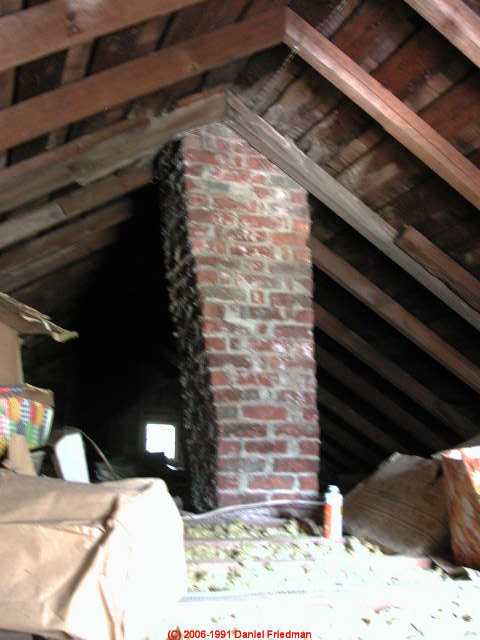
In this photo the exterior of this chimney, visible in an attic, was in very poor condition, with soft spalling bricks.
Worse, there was an immediate fire and gas hazard since there were actual openings at the base of this chimney where it passes through the attic floor framing. This is a serious fire hazard and a flue gas leak hazard. T
his flue is unsafe.
Inspect the entire route of the chimney through all building areas. Even if the chimney is not directly visible you may find evidence of leaks, movement, or old chimney penetrations, say for a woodstove, that may not have been safely closed.
Holes in Masonry Chimneys - Missing Bricks
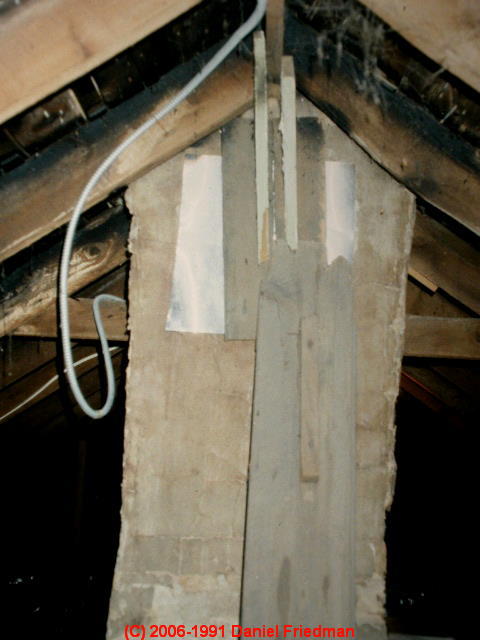
Missing chimney bricks:
this photo shows a homeowner "repair" involving putting aluminum sheet metal over a hole in their chimney to make it "safe" - removing the metal disclosed a nice hole where bricks were missing. We asked the homeowner where s/he thought those bricks had gone?

This was a very unsafe chimney.
The second photo (above) shows the chimney hole with the sheet metal removed.
The bricks had fallen down and blocked this flue, creating a potentially fatal carbon monoxide (CO Gas) hazard which was first noticed by the homeowners as a basement water problem - water was condensing and running down basement walls.
...
Continue reading at CHIMNEY CLEANOUT DOORS or select a topic from the closely-related articles below, or see the complete ARTICLE INDEX.
Or see these
Recommended Articles
- FLUE VENT CONNECTORS, HEATING EQUIPMENT
- CHIMNEY INSPECTION, FLUE INTERIOR
- FIRE CLEARANCES INDOORS
- HOLES in MASONRY CHIMNEY
- METAL CHIMNEY & VENT INDOOR HAZARDS
- STAINS on CHIMNEYS
- CHIMNEY INSPECTION DIAGNOSIS REPAIR - home
Suggested citation for this web page
CHIMNEY INSPECTION INDOORS at InspectApedia.com - online encyclopedia of building & environmental inspection, testing, diagnosis, repair, & problem prevention advice.
Or see this
INDEX to RELATED ARTICLES: ARTICLE INDEX to CHIMNEYS & FLUES
Or use the SEARCH BOX found below to Ask a Question or Search InspectApedia
Ask a Question or Search InspectApedia
Share this article:Questions & answers or comments about chimney inspection procedures for indoors - key steps.
Search the InspectApedia website
Need to make a private comment? Email editor@inspectApedia.com. We welcome email with your website content critique, corrections, suggestions or questions. Email is monitored daily but our workload may prevent an immediate reply. For immediate results, we hope you'll first try asking your question using the search box just above.
Citations & References
In addition to any citations in the article above, a full list is available on request.
- Roger Hankeyis principal of Hankey and Brown home inspectors, Eden Prairie, MN, technical review by Roger Hankey, prior chairman, Standards Committee, American Society of Home Inspectors - ASHI. 952 829-0044 - hankeyandbrown.com
- Ceramic Roofware, Hans Van Lemmen, Shire Library, 2008, ISBN-13: 978-0747805694 - Brick chimneys, chimney-pots and roof and ridge tiles have been a feature of the roofs of a wide range of buildings since the late Middle Ages. In the first instance this ceramic roofware was functional - to make the roof weatherproof and to provide an outlet for smoke - but it could also be very decorative. The practical and ornamental aspects of ceramic roofware can still be seen throughout Britain, particularly on buildings of the Victorian and Edwardian periods. Not only do these often have ornate chimneys and roof tiles but they may also feature ornamental sculptures or highly decorative gable ends. This book charts the history of ceramic roofware from the Middle Ages to the present day, highlighting both practical and decorative applications, and giving information about manufacturers and on the styles and techniques of production and decoration. Hans van Lemmen is an established author on the history of tiles and has lectured on the subject in Britain and elsewhere. He is founder member and presently publications editor of the British Tiles and Architectural Ceramics Society.
- Chimney Inspection Checklist, Carson Dunlop, Associates, Toronto, Ontario
- Chimney & Stack Inspection Guidelines, American Society of Civil Engineers, 2003 - These guidelines address the inspection of chimneys and stacks. Each guideline assists owners in determining what level of inspection is appropriate to a particular chimney and provides common criteria so that all parties involved have a clear understanding of the scope of the inspection and the end product required. Each chimney or stack is a unique structure, subject to both aggressive operating and natural environments, and degradation over time. Such degradation may be managed via a prudent inspection program followed by maintenance work on any equipment or structure determined to be in need of attention. Sample inspection report specifications, sample field inspection data forms, and an example of a developed plan of a concrete chimney are included in the guidelines. This book provides a valuable guidance tool for chimney and stack inspections and also offers a set of references for these particular inspections.
- Fireplaces, a Practical Design Guide, Jane Gitlin
- Fireplaces, Friend or Foe, Robert D. Mayo
- NFPA 211: Standard for Chimneys, Fireplaces, Vents, and Solid Fuel-Burning Appliances, (2024) at the NFPA Bookstore, (Older NFPA editions and standards are found at the same bookstore)
- Principles of Home Inspection: Chimneys & Wood Heating, in (Principles of Home Inspection), Carson Dunlop, Associates, Toronto, Ontario
- U.S. vs. Canadian Unlined Masonry Chimney Flue Requirements & Case Study
- NFPA 211 - 3-1.10 - Relining guide for chimneys
- NFPA 211 - 3-2 - Construction of Masonry Chimneys
- NFPA 211 - 3-3 - Termination Height for chimneys
- NFPA 211 - 3-4 - Clearance from Combustible Material
- NFPA 54 - 7-1 - Venting of Equipment into chimneys
- Brick Industry Association (Website) [Previously the Brick Institute of America] 12007 Sunrise Valley Drive Suite 430, Reston, VA 20191 USA, provides articles giveing details for Flashing Chimney, Proper Chimney Crown, and Moisture Resistance of Brick.
See the BIA Technical Notes Index [PDF] (BIA Website) for free downloads from the BIA's extensive library - American Gas Association - New Vent Sizing Tables
- Chimney Safety Institute of America - Chimney Fires: Causes, Effects, Evaluation
- National Chimney Sweep Guild [Website] 1255 SW Prairie Trail Pkwy Ankeny, Iowa 50023 USA, Tel: +1 (317) 837-1500 Email: office@ncsg.org NCSG certifies chimney sweep (cleaning) professionals.
- In addition to citations & references found in this article, see the research citations given at the end of the related articles found at our suggested
CONTINUE READING or RECOMMENDED ARTICLES.
- Carson, Dunlop & Associates Ltd., 120 Carlton Street Suite 407, Toronto ON M5A 4K2. Tel: (416) 964-9415 1-800-268-7070 Email: info@carsondunlop.com. Alan Carson is a past president of ASHI, the American Society of Home Inspectors.
Thanks to Alan Carson and Bob Dunlop, for permission for InspectAPedia to use text excerpts from The HOME REFERENCE BOOK - the Encyclopedia of Homes and to use illustrations from The ILLUSTRATED HOME .
Carson Dunlop Associates provides extensive home inspection education and report writing material. In gratitude we provide links to tsome Carson Dunlop Associates products and services.
 |
HOME | ABOUT | ASK a QUESTION | CONTACT | CONTENT USE POLICY | DESCRIPTION | POLICIES | PRIVACY | |
| © 2026 - 1985 Publisher InspectApedia.com - Daniel Friedman | |||||||||