
InspectAPedia® FREE Encyclopedia of Building & Environmental Construction, Diagnosis, Maintenance & Repair |
Question? Just ask us! InspectAPedia
|
 Well Yield
Definition & Measurement of Well Yield,
Well Flow Rate & Water Quantity
- POST a QUESTION or COMMENT about well yield, well flow rate, well recovery rate, and how these water well performance numbers change over time.
Well yield, flow, well recovery rate & well water quantity:
Here we define and describe how to measure water well yield, safe well yield, the water delivery rate of a well, or well recovery rate, and we explain how to measure or calculate this critical number.
We explain why a well flow rate is actually comprised of multiple flows at various depths, and we describe how those rates are found & tested.
We define the difference between well pumping rate and well recovery rate. We show how to calculate the actual flow rate of a water well, and we point out a critical difference between an instantaneous well flow rate and the well's 24-hour flow rate.
We also explain how & why a water well's flow rate will change over time, and we define the safe yield number for a water well. We will address these topics and questions:
How much water is in the well? How long will the water well last? What is the well recovery rate? Well flow rate the water flow rates into a well & inflowing water quality vary at different well depths: using drill stem testing. Well recovery rate vs pumping rate difference between well recovery rate or well flow rate & well pumping rate.
Well flow rate calculation formulas. Well flow rate times definition of well flow rate in gallons per minute & 24 hour flow rate. Well flow rate changes does a well's flow rate change over time?. Definition of safe yield for a water well.
InspectAPedia tolerates no conflicts of interest. We have no relationship with advertisers, products, or services discussed at this website.
- Daniel Friedman, Publisher/Editor/Author - See WHO ARE WE?
Well Yield: Well Water Delivery Rate - the Well Recovery Rate or Well Flow Rate
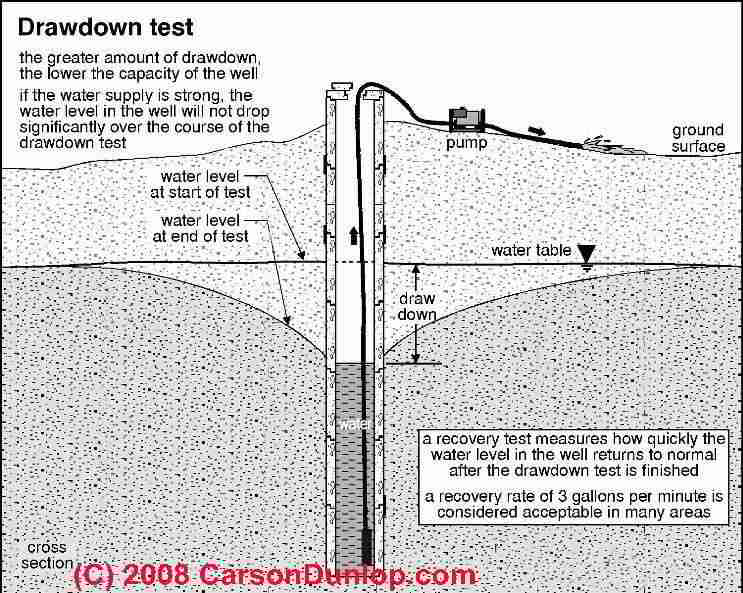
This article series describes how we measure the amount of water available and the water delivery rate ability of various types of drinking water sources like wells, cisterns, dug wells, drilled wells, artesian wells and well and water pump equipment. The sketch at page top, courtesy of Carson Dunlop Associates, outlines what happens during a well drawdown test or well flow test procedure.
Article Contents
- DEFINE WELL YIELD, Recovery Rate, Flow Rate
- DEFINITION of REQUIRED WATER WELL YIELD - or Flow Rate functional use or to obtain a mortgage
- WELL FLOW RATE - the water flow rates into a well & inflowing water quality vary at different well depths: using Drill Stem Testing
- WELL RECOVERY RATE vs PUMPING RATE - Difference Between Well Recovery Rate or Well Flow Rate & Well Pumping Rate
- WELL FLOW RATE CALCULATION
- WELL FLOW RATE TIMES - Definition of Well Flow Rate in Gallons per Minute & 24 Hour Flow Rate
- WELL FLOW RATE CHANGES - Does A Well's Flow Rate Change Over Time?
To determine the well yield we need to know how much water flows into the well from surrounding rock or soil in a given amount of time. In a simple example given here, we start with a dry empty well (it was just pumped dry), we wait a known period of time, and then we measure the depth of water that appears in the well.
That's all we need to calculate the STATIC HEAD of Water in the Well and then the actual well yield (explained in this article).
In a companion article, WELL FLOW TEST PROCEDURE, we describe both valid and questionable ways people measure well yield, and we offer some simple steps any home owner or home buyer can take to check the adequacy of water pressure and water quantity at a building.
Definition of Well Recovery Rate = Well Flow Rate
Well Recovery Rate is the rate at which water runs into the well from the rock fissures and openings into the lower portion of the well below the steel casing, while we're pumping water out of the well.
Some other terms for well recovery rate include well yield, well flow rate, and well water quantity.
Since the "recovery rate" of a well describes the rate at which water runs into the well, a well recovery rate also defines the rate at which water can be pumped out of a well without pumping the well down so far that the pump "runs dry".
Typical numbers for well recovery rates (if measured honestly over a 24-hour period) run from a fraction of a gallon per minute (a terribly poor well recovery or flow rate) to 3 gallons a minute of water flow (not great but usable) to 5 gallons per minute (just fine for residential use) to more than 10 gpm (a great well recovery rate for residential use).
What is the Required Well Yield or Flow Rate in GPH?
Minimum Acceptable Water Well Yield in GPM over 5 to 24 hour test interval
The minimum acceptable true well yield (properly measured as we describe herein) varies by regulations where you live, by various lenders' requirements, and of course by the anticipated need based on the type and number of water users that the well is to serve.
That said, a typical minimum acceptable well yield is 3 gallons per minute, or in some jurisdictions, 5 gpm.
Most authoriteis will agree that a well yield of 5 gallons per minute of sustained flow (measured over 24 hours or over 5 hours in some standards) is considered adequate for a one family residence. - NYS DOH
Some authorities or lenders will accept lower well yields, down to 2 gpm provided that 1,500 gallons or a similar quantity of on-site water storage is also provided.
Watch out: if your "well yield test" report does not describe how the test was conducted, the test method (how water was pumped out of the well and measured, and the duration of that test, then it's uncertain how to interpret the well yield test results; the correctly-measured water well yield over 5 hours or over 24 hours could be less than the yield reported to you.
FHA well Yield Requirements
Home buyers seeking an FHA-mortgage will have to show that their water well yield is between 3 and 5 gpm. "Each home must simultaneously be assured of at least 3 GPM, (5 for proposed construction), over a continuous 5 hour period."
Supporting Well Yield Standards & Research
- NYS DOH, INDIVIDUAL WATER SUPPLY WELLS - Fact Sheet #2", NY State DOH, retrieved 2021/02/27, original source www.health.ny.gov/ environmental/water/drinking/regulations/ fact_sheets/fs2_water_storage.htm
- NC DEP, WELL CONSTRUCTION RECORD [PDF] North Carolina
- NC WELL CONSTRUCTION SETANDARDS, SUBCHAPTER 02C - WELL CONSTRUCTION STANDARDS
SECTION .0100 - CRITERIA AND STANDARDS APPLICABLE TO WATER-SUPPLY
15A NCAC 02C .0110 WELL TESTS FOR YIELD [PDF] - NC WELL TEST STANDARDS FOR WELL YIELD [PDF] North Carolina NC 15A NCAC 02C .0110
Water flow rates into a well & inflowing water quality vary at different well depths: using Drill Stem Testing
A drilled well, especially a deep well, often passes through more than one aquifer level in the earth. As geological conditions and rock properties vary at these various depths, and as the properties of aquifers themselves will vary, the total flow rate of a water well is the sum of all of the individual flow rates through which the drilled well opening (below the bottom of the well casing) pass.
Drill Stem Testing (DST) described by AGE Developments in Australia describes well stimulation and well testing. [13]
Drill stem testing allows the well driller to identify and evaluate the multiple aquifers through which a well may have been drilled.
A submersible well pump (an electric submersible pump or an airlift submersible pump unit) and piping system that includes two inflatable seals is lowered into the well to a desired test depth. By inflating seals above and below the pump itself, when the pump is operated, it draws only water flowing into the well casing in the depth between the upper and lower well casing seal.
Drill stem testing is thus able to isolate and test the water flow rate within each different well segment (at different depths) of the well in order to diagnose and evaluate the overall well flow rate as well as to target areas for hydro-fracturing.
DST also permits identification of undesirable water flow into a well at certain depths. For example if one aquifer provides water high in contaminants (sulphur for example) that aquifer can be isolated and sealed, to exclude water from that aquifer when the water well is put into use.
Difference Between Well Recovery Rate or Well Flow Rate & Well Pumping Rate
The well flow rate or recovery rate is not equal to the well pumping rate: that is, most water pumps can pump water out of a well faster than water runs in unless the well has a great recovery rate. For wells with modest recovery rates of say 2-3 gpm, some well installers or plumbers design the pump so that it cannot pump faster than this rate, thus avoiding pumping the well dry and possibly damaging the water pump itself.
The well pumping rate is limited by the horsepower of the well pump, pump type, pump location, and other factors.
The maximum well pumping rate set by the pump is normally a number stamped on the data tag attached to the well pump itself. The well pumping rate defines how fast in gallons per minute (GPM) the pump can deliver water if it has an infinite quantity available.
The well flow rate, as we discuss in this article, is the rate that water flows into the well itself from the surrounding soils. The well flow rate is the true limit on a well's ability to deliver a sustained water flow to its users.
So you could pump water out of a well very fast pumping rate, say at 10 or even 15 gpm. But if the well recovery rate is less than the well pumping rate, you're going to run out of water. How soon you run out of water depends on how much water was in the well casing when you started pumping (the static head), and ultimately on the well recovery rate.
We explain this in more detail at definition of
We offer a more detailed (and more confusing) equation used to calculate the details of a well recovery rate in our discussion
at DRILLED WELLS, STEEL CASINGS.
But it's easier to simply pull water out of a well at a given rate and see how long we can do so. That's about what a well driller does to determine the effective well flow rate when a new well is drilled.
Pulling water out of the well (using a variable-rate pump running at a rate set by the well test professional) integrates all of the different rock fissure flow rates into a single quantity of water.
Example of Calculating the Flow Rate of a Well
The following example of calculating a well flow rate uses well data from a dug well described in detail
Question: I'm digging a well, not yet in the driest part of our dry season. I'm at about 10 meters depth, well diameter about 1.4 meters. At 4 pm when the digger stops for the day (by hand hammering through rock with a mallet and chisel), he drains the water
. At 9 am the next day the well has 1.6 meters of water in it. I intend to complete digging further into the dry season.
However, based on the above data, how many liters of water can the well produce in a 24 hour period? -- A. Starkman, Oaxaca, Mexico. [Note that this is a hand dug well -
see HAND DUG WELLS for more about that type of water source. But the calculations of well flow rate are the same for any round drilled well or hand dug well.]
Answer: We can calculate the well flow rate from the reader's example above, using the formula for the volume of a cylinder and a constant to convert between volume of well water in cubic meters and liters or gallons.
This well water flow rate calculation case provides exactly what we need to calculate the quantity of water in a well from direct measurements of the well diameter, depth, and water depth, presuming that the well, a dug well in this case, is round. We just need the depth of water and the diameter of the cylinder formed by the well.
Then we use the formula for volume of a cylinder - which in turn means we calculate the area of the circle formed by the bottom of the well (or the well's cross-sectional area) and we just multiply that area by the height (or depth) of the water.
WELL FLOW TEST PROCEDURE describes how we test well flow rate and quantity when the well is already built, is covered or sealed, and we can't conveniently make well diameter and water depth measurements.
So for this real-life example of a dug well for which we want to calculate the well water volume and the well flow rate:
Well Diameter D = 1.4 Meters
Well Radius r = 1/2 of diameter or .7 meters
Depth of water in the well (reported after a specific time interval discussed below) = 1.6 Meters
How to calculate the volume of water in a cylinder and thus the volume of water in a round well
For round wells, that is a drilled or dug well that is circular in its cross-section, we use the following formula:
Volumecylinder = pi x r2 x h
where pi = 3.1416,
r is the radius of the circle formed by the cylinder, and
h is the height of the cylinder
Area of a circle = pi x radius squared (radius = 1/2 of the diameter)
For our dug well example under discussion, our diameter is 1.4m so the radius is .7m.
Area of the well in cross-section or bottom = 3.1416 x (.7 x .7)
Volumecylinder = 3.1416 x .72 x 1.6
Volumecylinder = 2.46 cubic meters - that's the volume of water found in the well after the overnight waiting period.
Notice that we're being sure to use the same units of measurement for both diameter (or radius) and depth - in this case, we are working in meters.
Watch out: there is a difference between the volume of the whole well bore and the volume of water inside the bore - normally water extends from the well bottom to some level short of the very top of the well. So measuring the water in the well when it is at rest, the well's static head, measures just the water not the whole well volume.
See WELL DYNAMIC HEAD & STATIC HEAD DEFINITION
How to Convert Cubic Meters to Liters or Gallons - Other Common Measures of Water Volume
Convert Cubic Meters of Water in the Well to Liters
Liters: one cubic meter contains 1000 liters.
So for our example well, the well cylinder of water contains (2.46 x 1000) = 2460 liters of water
Convert Liters of Water to Gallons of Water
Gallons: 1 gallon contains 3.7854 Liters
So we can divide the liters, above, by 3.7854 to convert water volume in liters to water volume in gallons.
The example well water volume contains (2460 / 3.7854) = 650 gallons of water.
How to Compute Well Flow Rate in Gallons per Hour
Now we can also obtain the well flow rate - the rate at which water is flowing in to the well - though this will change seasonally as well as change if the well is dug further or other steps are taken that affect well yield.
At the time of our reader's observations, from 4PM on a given day to 9AM the next day (that's a total of 17 hours on the clock) the new well collected 650 gallons of water.
Well Flow Rate = gph
The Well Flow Rate for a water well of any type is normally expressed in gallons per hour or gph that water enters the well from surrounding soils. We calculate a well's flow rate measured in gph by dividing the quantity of water in the well (we calculated that just above, right?) by the number of hours it took for that water to enter the well.
Well Flow Rate = Gallons / Hours - or gph, gallons per hour or water flow rate into the well, provided that no one is taking water out of the well during this same interval.
Our reader made it easy by telling us that the well was pumped dry at 4PM. He measured the water depth and well diameter and kept track of how much time had passed (17 hours).
From our well volume formulas above we know that starting with zero water, after 17 hours the well contained 650 gallons of water.
For this example, 650gallons / 17hours = 38 gallons per hour - this is the well flow rate for a 17 hour period for this particular well.
Definition of Well Flow Rate in Gallons per Minute & 24 Hour Flow Rate
The most common measure of a well's ability to deliver water, that is the answer to "how much water can we get out of a well" is the measurement or calculation of the well flow rate per minute - the water flow rate into the well expressed in gallons of inflow per minute. gpm.
In our example above, 38 gallons an hour might look like a huge flow rate, by the way, but it's not when we convert the flow rate in gallons per hour into flow rate in gallons per minute - the standard unit of measure of well yield.
The well flow rate in gpm defines the maximum rate at which water can be drawn out of the well over a sustained period. Actually we can temporarily draw water out of a well faster than the gpm flow rate, because the well pump has available to it the reservoir of water already in the well when it starts pumping - the well's "static head"
. But once that static head of water has been exhausted, gpm is the absolute limit of further water delivery rate possible.
For our well flow rate calculation example above, we found that this well had a water in-flow rate of 38 gph or 38 gallons per hour.
Gallons per hour (gph) divided by 60 (the number of minutes in an hour) = well flow rate per minute in gpm.
Well Flow Rategpm = Well Flow Rategph / 60
For our dug well example, 38 gph / 60 = 0.63 gpm - this is the measured well flow rate in gallons per minute.
In this case that's a weak, marginal well flow rate - just over half a gallon per minute. In the U.S. most building or health departments who must approve a private well water supply when issuing a final certificate of occupancy for new construction want to see 3 to 5 gallons per minute or 3-5 gpm.
Watch out: if you install a pump whose pumping rate exceeds the well yield or flow rate (see WELL YIELD DEFINITION), the pump may run dry and be damaged.
The risk of pump damage is greater in a well that has a small static head (see STATIC HEADS of WATER in the WELL) or in conditions under which the pump is left running for long periods so that the static head is likely to be exhausted.
If you have this risk or this problem on a well, see the advice on protecting pumps given at WELL PIPING TAIL PIECE.
Is This Really the 24-hour Well Flow Rate?
Is 38 gph or 0.63 gpm really the true well flow rate? Maybe. Maybe not.
The property owner's observation was that from "an empty well" at 4 PM on a given day, the well water level rises to 1.6 meters of depth by 9AM the following day.
So what was observed was a flow rate of 38 gallons per hour over a 17 hour period. Not a 24-hour period. Will the well water level continue to rise past the 17 hour period. Maybe, maybe not.
While a hand dug (or drilled) water well fills as water flows into it, the well water in-flow rate will slow down and eventually stop.
This is true except for artesian wells.
That's because eventually the pressure exerted on the well sides by water in the well equals the pressure of water in rock fissures or passages from which water is trying to enter the well.
When the water pressure exerted on the well sides and bottom by water inside the well itself equals the water pressure exerted by water trying to enter the well, at that point water flow into the well will stop. The well water level won't change much until someone draws water out of the well, thus lowering its in-well water level back down and allowing more water to flow in.
Well flow rates will vary by season, weather conditions, and other factors such as well age and history of usage. The well flow rate may also be affected by the chemistry of the water itself - if water is high in minerals, over time the rock fissures through which water flows into the well become mineral clogged and the well flow rate may diminish.
How to Determine the True 24-hour Well Flow Rate
So the owner will want to either measure the well depth again after 24 hours, repeating our calculation from above with the well depth measured at the end of 24 hours, with water only flowing into the well, that is, no one draws any water out of the well during that period.
We prefer to simply measure the water in the well at the end of 24 hours and calculate the 24-hour flow rate. When the well is a drilled well rather than a hand-dug well, the well driller may measure the well flow rate by use of a well pump whose output is adjustable.
The well driller measures the well draw down rate in the well opening while the well pump is running, and compares that to the rate at which the pump is removing water from the well.
But a true well flow rate, whether obtained by simple observation or by use of a calibrated pump, should be measured over a 24 hour period, not a shorter interval.
See details at WELL FLOW RATE.
Measure Well Flow Rate After You Determine the Well's Static Head?
Alternatively the owner might want to watch the well water level increase until the water level has stopped rising in the well. It might take longer than 24 hours for the water in flow to stop.
When the water level has stopped rising on its own in the well, the depth of water in the well is measured and is referred to as the static head - the amount of water in the well when the well is fully recovered and at rest.
Does A Well's Flow Rate Change Over Time?
The flow rate of a drilled well, driven point well, or dug well can certainly change dramatically over time. But other water wells continue to produce water at the same rate for decades. A 27 foot deep well at our office has delivered the same flow rate without change from 1920 to 2010.
When the flow rate of a well varies the underlying causes might include the following:
- Seasonal water table variations - during the dry season the water table may drop surrounding the well.
The result is that some of the rock fissures or soil passages that previously fed water into the well may not be producing.
Other (typically lower) rock fissures or soil passages may still be delivering water into the well. The effect is that the total well inflow-rate is reduced. - Permanent water table variations - pumping from a large number of wells in a given area can permanently lower the water table, often dramatically, particularly when the aquifer that has been tapped was one that built-up over eons or during weather conditions that no longer are common.
We anticipate that some areas will be affected by global warming to have dramatically lowered water tables while others may actually see their water table increased - it may depend on local weather trends. - Drilling of other wells nearby can lower the water table and thus reduce the well recovery rate for an existing water well.
- Age, usage of the well, combined with water high in mineral content can reduce the well flow rate as minerals in the water flowing into the well precipitate out as solids that clog rock fissures that were feeding the well.
- The well pump itself may be damaged, worn, or well piping may have leaks that appear to lower the well flow rate when the problem is with the equipment.
See WATER PRESSURE LOSS DIAGNOSIS & REPAIR.
...
Reader Comments, Questions & Answers About The Article Above
Below you will find questions and answers previously posted on this page at its page bottom reader comment box.
Reader Q&A - also see RECOMMENDED ARTICLES & FAQs
Questions & answers about well yields, flow rates, water quantity, posted originally at this article
Reader Question: My well seems to run out of water; the well contractor thinks it's the pressure tank and we don't need to hydro frak the well.
I have a interesting scenario. We have lived in our single family house for a little over 3 years now, we came from municipal water so please bear with my descriptions as we can't seem to wrap our heads around this issue. My first sign of water issue was when I had hooked up a simple garden water hose to a lawn sprinkler (I have no auto irrigation system).
I was able to run the sprinkler for about 45mins before I had NO water whatsoever. Long story short, when I had to have my well chlorinated, the well contractor said that should not be the case.
Based upon the copies of documentation from my local city hall, my well spec's are the following: well depth = 220', pump size = 1/2 hp 5gpm, depth: 140', pre pumped static water level 10'4".
The well contractor who chlorinated my well tried to sell my a hydro frak. We went for a second opinion and the well contractor #2 believed it should not be a hydro frak.
He ran some diagnostics and believed it was the pressure tank as it was not holding pressure. Also, he noticed (from documentation) the previous owners replaced the previous pump with a 3/4 hp 10 gpm pump.
The well contractor figured that a flow restrictor to draw only 5gpm and a new pressure tank was a good solution and we went forward and replaced the pressure tank and put a flow restrictor on as well. This past Saturday when the weather was warm, I ran the sprinkler for about 20 minutes before I went to take a shower. No more than 10 minutes later I was out of water again.
The well contractor told me to test and run the kitchen sink for 30 minutes and see if we lost water. I did that and we still had water. When I ran the kitchen sink AND a bathroom sink at the same time, we ran out of water in about 30 minutes I let me contractor know and waiting to hear back from him.
My question is, what should be the next step? We are really tight on finances as my wife lost her job and has not found a new one yet and we cannot really afford a huge repair right now. - Dave 4/16/12
Reply:
Dave,
Poor well flow rate, poor recovery rate, poor well yield: while an equipment problem can be involved, you're describing a well with a poor flow rate, poor recovery rate, small static head, small onsite water storage. Hydro-Fracturing is a process that can work to improve well yield, and is sometimes provided with a guarantee of results.
(See How to Get More Water From a Well)
A pressure tank that is defective, or a bad pump switch can burn up a pump or control, but a bad pressure tank doesn't make your well itself run out of water.
A well flow restrictor slows the rate that you are able to take water out of the well - a good idea to protect the pump from damage.
Larger water storage tank: If you combine a flow restrictor with a large enough storage tank you can probably defer attempts to improve well yield and live with the low-yield well for some time.
That is, you can live with a very poor well yield or flow rate IF you have enough storage of water that the pump and well can recover whatever you used during the day by running slowly, for many hours.
If your usage rate exceeds the storage quantity you're out of business and the first guy was right - you need to try to increase well yield or give up and take a worse chance on the cost of a whole new well. I'd try both improving yield and improving storage.
On 2017-09-19 - by (mod) -
Shruthi,
Well Yield - how much water do we get out of a well - is not quite a number that we (usually) "calculate" - rather we measure it by determining, typically using a variable speed pump - the well recovery rate- the rate at which water runs into the well from surrounding soil or rock. That rate, which is not a simple number, determines how much water you can take out of the well - its yield.
At the start of this article we explain:
Well Recovery Rate is the rate at which water runs into the well from the rock fissures and openings into the lower portion of the well below the steel casing, while we're pumping water out of the well.
Some other terms for well recovery rate include well yield, well flow rate, and well water quantity.
Since the "recovery rate" of a well describes the rate at which water runs into the well, a well recovery rate also defines the rate at which water can be pumped out of a well without pumping the well down so far that the pump "runs dry".
Typical numbers for well recovery rates (if measured honestly over a 24-hour period) run from a fraction of a gallon per minute (a terribly poor well recovery or flow rate) to 3 gallons a minute of water flow (not great but usable) to 5 gallons per minute (just fine for residential use) to more than 10 gpm (a great well recovery rate for residential use).
Now for some detail: in a typical dug or drilled well, water runs into the well from underground passages in surrounding soil and rock at different depths, at different rates, and for different durations. For example water might run into a well at depth D1 at 10 gpm for 1 minute, then fall to 5 gpm for 30 minutes, then fall off to 1 gpm as a constant rate for the ensuing 24 hours of a test.
Meanwhile at depth D2, perhaps a meter lower in the ground, we might get entirely different numbers.
To try to measure each of those and calculate an overall yield would be much too much trouble and cost.
So what we do is pump water from close to the bottom of the well for some specified period of time. 24 Hours is normally long enough that we reach the "final" or "stable" inflow rate at each of the water inflow points. Some well yield tests are done for shorter time periods and thus might not give the same result as if you pumped and tested longer.
The well driller or expert who is actually measuring well yield will adjust the pump's output rate in gpm or Lpm such that she doesn't run the well dry, but also such that the water in the well doesn't just keep rising in the well bore; that permits us to measure the actual well output over the test period.
We offer a more detailed (and more confusing) equation used to calculate the details of a well recovery rate in our discussion at DRILLED WELLS, STEEL CASINGS at https://inspectapedia.com/water/Drilled_Wells.php
On 2017-09-19 by Shruthi
How to calculate yield for a well
On 2017-05-19 - by (mod) -
Interesting, thanks for the follow-up, Dennis. Do let us know how this installation performs as that information will certainly help other readers.
On 2017-05-18 by Dennis
I should add, that they hit the fine sand squifer between 249 and 257 feet. Before that, it was clay and gravel. The well is 30 feet deeper than the neighboring farm.
On 2017-05-18 by Dennis
They think its over kill to put the pump deeper. I agree with you that it makes sence to place the pump 10 feet off the bottom. However, they feel it would require a larger pump and bigger piping, and a lot more money. If the well flow tate is really as good as they think it is, than a pump putting out 14 gpm at 110 feet should nevrr run out of water if the 40 gpm flow rate is true. . This is my last post, i will follow their recomendations. Thank you for your imput.
On 2017-05-17 - by (mod) -
That depth for the pump sounds quite credible, given what you've added and particularly since you've got a fantastic flow rate at that depth. A question is why on earth someone drilled an additional 147 feet - that couldn't have been done for free.
On 2017-05-17 by Denis
The well report shows that the 40gpm was found at 110 feet. Since the well is 257 feet deep, and 110 is the best flow rate, that is where they want to put the pump. Since the water comes from the bottom of the pipe, how in the hell can they say 110 is better than say 210? Im more confused than ever before. Static level is reported at 75 feet. Please help!
On 2017-05-17 by (mod) re: choosing the depth at which to set a well pump
Dennis,
It's true that setting the pump deeper in the well increases the head or lift that the pump has to overcome, thus reducing its water delivery rate in GPH (not pressure per se), but generally people put the well 5-15 feet off the well bottom so as to have as much water as possible.
The 40 GPM flow rate you cite is superb, but, then, a true flow rate, more-technically, is a much more complex number: it's the sum of the water flow rate into the well bore at various depths (below the end of the solid, un-perforated well casing). So if you set the pump higher that points at which water flows into the well you may see an effective reduction in the flow rate.
I'm not as expert on this as your experienced well driller, so I'd ask her opinion; if I knew nothing else I'd set the pump at 15 feet off the bottom, reasoning that the original well driller wouldn't have gone the full 257 feet unless he found it was necessary to get a good-enough flow rate.
On 2017-05-17 by Dennis
Using a 1 hp sub. Pump, 6 inch well casing, well at 257 feet, static at 75 feet, 1 inch piping, how deep can i set the pump for adequate water and pressure? Well has a 40 gpm flow rate.
On 2017-05-16 by Anonymous
I agree with you, but how deep can i place a 1hp. Submersible
Pump with 1 inch piping?
On 2017-05-13 by (mod) re: usual well pump depth in the casing
Dennis,
I'm not as smart as your pump installer nor do I know what she may know about local site conditions. But typically we place the pump 10-15 feet from the bottom of the well - that gives the largest static heat - most water - from the well.
IF your well has a fabulous flow rate AT THE DEPTH or above 110 feet, say 10-15 pm or more, you might not require the full capacity afforded by the full well depth.
But consider this:
If the original well driller went to 257 feet, that's 147 feet deeper than your well driller's suggested pump location.
Usually the driller would have drilled to that depth because the water flow rate into the well at higher elevations (less depth) was not adequate.
147 feet in a 6 inch casing is about 300 gallons of water that you're giving up.
So I'd go to near the well bottom but enough off bottom to avoid mud and sediment.
On 2017-05-13 by Dennis
1hp pump, 1 inch piping.
Well flow rate 40 gpm , well depth 257 feet. Static water depth 75 feet. What depth should i set the pump? Pump installer suggests setting the pump at 110 feet. Is this correct?
On 2016-09-14 by (mod) re: well pump placed 10 meters down in an 80 meter well
Karl,
These numbers don't add up for me. If after 1 hour the well has only recovered 50 liters of water then the flow rate is 50 liters per hour. That is a much smaller number than what you're well driller found.
You can install an electric pump but if the pump rate is greater than the true well flow rate pump will also run dry - damaging the pump unless protection equipment is also installed..
The amount of water that you can draw from your well is the combination of the amount of water in the static head - that's the column of water that is inside of the well casing when the wheel is at rest - and the water that flows into the well while you were taking water out. If your well casing is 6 inches in diameter then you can figure you have about 1.5 gallons per foot
On 2016-09-11 by Karl Ivar Dahl
We have an 80m deep well with a hand pump at our cabin. The hand pump only draws water from 10 meters. I can pump this well "dry" after 150litres. One hour later I can draw another 50litre. The contractor said the flow rate was 130litres per hour. The question is: have I measured the real flow rate? Does the last meter of water rise slower than the first meter, so that by installing an electrical pump at a greater depth, my measured flow rate will improve?
On 2016-04-30 by (mod) re: well yield test
RG
A yield test will tell you how much water each well can currently deliver over a 24-hour period. It's another way to describe the well flow-rate: the rate at which water is flowing into the well. The reason we test for 24 hours is that the actual in-flow rate of water is not a constant; often, for example, the initial flow rate during the first few minutes of a pump running or even the first hour, may be much greater than later-on.
All of these measurements (add static head too) are a way of determining if the well (or wells in your case) are adequate to supply the needs of the people using them.
On 2016-04-30 by RGSubramanyam
We have 2 bore wells.The static water level in one is 12 m and in another 91 m.What information would I get by conducting yield test to enable me to decide to deepen them.Both are more than 95 m deep
Question: bore well suffered drastic decrease in water supply
(Mar 6, 2014) mohd iqbal said:
We have a 4 1/2 bore well since three years it is working fine but in the fourth year we have drastically decrease in water as water is coming less than a minute or two before it we have a 10-15 minute water with a heavy pressure and we can fill a 500 liters tank very easily
now it is very hard to see the water what could be the reason we have clean and service our summersable pump also now what is the reason please help?
Reply:
Mohd I think you might want to take a look at our "water pressure loss diagnostics" beginning with the article
as you describe now "hard to see the water" I suspect your well water level has dropped significantly. That can happen for a variety of reasons including nearby drilling, geological changes, blasting, or simply clogging of rock fissures by mineral salts.
Or of course the water table may have dropped for other more basic reasons. But usually if the well water level drops dramatically and suddenly, I suspect either nearby drilling, blasting, or water shifts in an area of Karst formations such as Florida in the U.S. where sinkholes open or close overnight. IN other areas of the world (you don't say where you are) we have reported similar geological concerns.
(Mar 15, 2014) Mohd iqbal said:
Thank you - one more question related to my well as you said might be some blasting, or drilling nothing has been happen near by my area secondary there used to be an open land opposite to my house which has been constructed last year and there is no open lad available near my area for rainwater harvesting, or rain that can suck by land all over roads with concrete build cement based.
Reply:
Mr. Iqbal, the text of the article above discusses how to increase well yield - which can be necessary for a myriad of reasons. You might want to read the related WELL FLOW RATE articles in the list above - which will be more helpful than a speculative guess about a system for which we have no data.
Question: water just stopped running - during a "flow test" conducted by the home inspector.
(May 2, 2014) Anonymous said:
We are yet prying to sell our home and during the inspection, the water stopped running after 40 minutes. We don't know how many faucets were on but are assuming at least two. We have never had a problem running out of water.
We have three children, so between showers for all of us, dishes, dishwasher and LAUNDRY we use a lot of water during the day.
We haven't seen the report but our realtor told us the potential buyer is concerned over the fact that it stopped during the inspection which I get but how can we show that under normal daily use, there are no problems?
Reply:
Anon,
At the top of this article is a link to WELL FLOW TEST PROCEDURE where we describe how well capacity is measured.
But you should start by finding out how much water the inspector ran. Let me know.
Question: relationship between well flow rate and the level of water in the well bore
(July 9, 2014) William said:
Does the rate at which water flows into a well vary depending on whether the well is 'full' or 'empty'. In other words, will lowering the pump help increase the recovery rate, or simply add to the static quantity?
Reply:
William,
Yes the well flow rate into a well does vary in relation to the level of water that is already inside the well bore (or dug well).
We explain the concept of well flow rate in detail at
In sum, water flow into at least deeper wells and even some shallow wells from a variety of water passages, typically rock fissures, that occur at various depths in relation to the well bore. The total well flow rate is the sum of all of these smaller individual flows.
Even more complex, not all of the individual flows into a well flow at the same rate, nor do they necessarily flow continuously at a fixed rate over time. For example
Fissue A may flow at 7 gpm for 20 minutes then diminsh to 2 gpm for a longer or even indefinite interval, while fissure B may flow at 3 gpm foir 12 minutes, then fall to 0.5 gpm for a longer interval.
When the well bore is "full" - that is up to its normal static head top level, water stops flowing into the well bore because the pressure of the water in the bore is sufficient to stop inflow at the various water entry points along its height (I'm using the term "fissures" or water flow passages as usually there is more than one).
An exception are artesian wells whose aquifer feeds into the well bore at sufficient pressure to actually push water out at the well top and even to higher levels.
Question: cleaning the bore screen
(Sept 4, 2014) john blades said:
I have a bore screen that needs cleaning, what is a method I could use or do
Reply:
Pressurized hydrojetting or pull and replace it.
There are also well cleaning chemicals that can dissolve mineral scale - with concerns for contaminating the water supply or difficulty in flushing the chemicals out of the well if not used exactly as the manufacturer recommends.
See details at WELL CLEANING PROCEDURES
Question: hand dug well went dry
(Nov 10, 2014) Nancy said:
I have an old hand dug well about 3 ft. in diameter and 25 ft. deep. It went dry for 2 months 12 yrs. ago when many wells went dry in my area due to a prolonged drought. It has now gone down to a 2 ft. depth of water. Is it possible that there is a build up of silt that needs to be removed that could lower the depth and allow more water to be available and if so is it a matter of getting down in the well and lifting buckets of silt out?
Reply:
Sometimes deepening a hand dug well increases yield as do probes into the well sides. Watch out for well collapse and finding yourself buried - we don't know how your well is constructed. Check with neighbors or local well diggers or drillers about current position of the water table in general in your area.
Question: troubleshooting shut down pump on a high-yield drilled well
24 Feb 2015 delroy said:
My water well was drilled about 5 years ago and tested at 250 gpm. A submersible pump was employed and after 2 years the yield dropped. The pumpwas changed and a deep well pump engaged. Suddenly when the pump is turned on it run for about 10 secs and shut down.No water comes out. Water level was checked during that 10 secs and this did not move at all. What is the problem.??
Reply:
Delroy
I can't say from just the information in your note. But there are some helpful diagnostics that can get this figured out.
In the ARTICLE INDEX , please see
WATER PRESSURE DIAGNOSIS, PRIVATE WELL
Question: how to increase the water reservoir in a dug well
(Nov 18, 2012) colin said:
How can I ad some more holding capicity to my dug well {15feet]. Could not go any deeper due to water flowing in from a good seam in the ground, which was caving in the gound around the hole. The first 1.1/2 well tiles sank out sight in the soft ground. I tried to use a trash pump to remove some of the mud from the bottom of the well, but a sink hole started on the ouside of the well casing. any ideas?
Reply:
Colin,
You can add a larger water pressure tank or storage tank to increase the reservoir of holding capacity of a well or you could increase the well diameter as you can't go deeper. Y
Watch out: your well collapse details sound very dangerous - do not attempt this work without expert help.
Question: reduced well static head, well driller proposes chlorination.
(Dec 1, 2012) David Blistein said:
We have a 300' well. About 1gpm. Static height was 20'. Just the two of us. Worked fine for 10 years. Suddenly ran out of water a couple of times. Well company came out. Said static height had lowered. Probably vein slowly clogging since we have hard water. They want to go down, clean, and chlorinate. They say more hydrofracking not necessary, but what they want to do still costs $2000+. What to do?
Reply:
David,
I have not found any reports that chlorination or well shocking will remove mineral deposits that are clogging the rock fissures through which water flows. It *might* reduce an algae or bacterial clog problem.
The lowering of the static head tells us that your local water table, at least locally or at least seasonally, has fallen, also reducing the inflow rate into the well.
I'd consider hydrofracking or I'd certainly want to hear an undertsandable explanation of why their $2000. job is likely to help one iota. In my opinion it won't .
Question: why won't my pump keep up with my lawn sprinklers for any more than 10 min
(Aug 15, 2014) jim said:
why won't my pump keep up with my lawn sprinklers for any more than 10 min. at a time then be good 15 min. later but again only for 10 min. No problems in the house.
Reply:
Jim most likely you are pumping water out of your well faster than it can recover.
Definition of Safe Yield for a Well
Moved to WELL YIELD, SAFE LIMITS
...
Continue reading at WELL YIELD IMPROVEMENT or select a topic from the closely-related articles below, or see the complete ARTICLE INDEX.
Or see these
Recommended Articles
- DEPTH of a WELL, HOW TO MEASURE
- WATER FLOW RATE CALCULATE or MEASURE - how much water is delivered at a plumbing fixture
- WATER PRESSURE MEASUREMENT - water pressure in the system, dynamic & static
- WATER PUMP CAPACITIES TYPES RATES GPM
- WATER PUMP DRAWDOWN VOLUME & TIME
- WATER QUANTITY IMPROVEMENT
- WELL CLEANING PROCEDURES
- WELL CLEANING & RESTORATION by GLYCOLIC ACID
- WELL FLOW RATE - how much water can the well deliver
- WELL DYNAMIC HEAD & STATIC HEAD DEFINITION - how much water is in the well
- WELL FLOW TEST PROCEDURE - valid vs. questionable
- WELL FLOW TEST for WATER QUANTITY - how to test the well
- WELL LIFE EXPECTANCY - how long will the well last?
- WELL PIPING TAIL PIECE
- WELL YIELD DEFINITION - required well yield & safe well yield
- WELL YIELD IMPROVEMENT - get more water
- WELL YIELD, SAFE LIMITS - safe total well yield, causes of flow rate change
- WELL WATER PRESSURE DIAGNOSIS
- WELLS CISTERNS & SPRINGS - home
Suggested citation for this web page
WELL YIELD DEFINITION at InspectApedia.com - online encyclopedia of building & environmental inspection, testing, diagnosis, repair, & problem prevention advice.
Or see this
INDEX to RELATED ARTICLES: ARTICLE INDEX to WATER SUPPLY, PUMPS TANKS WELLS
Or use the SEARCH BOX found below to Ask a Question or Search InspectApedia
Ask a Question or Search InspectApedia
Try the search box just below, or if you prefer, post a question or comment in the Comments box below and we will respond promptly.
Search the InspectApedia website
Note: appearance of your Comment below may be delayed: if your comment contains an image, photograph, web link, or text that looks to the software as if it might be a web link, your posting will appear after it has been approved by a moderator. Apologies for the delay.
Only one image can be added per comment but you can post as many comments, and therefore images, as you like.
You will not receive a notification when a response to your question has been posted.
Please bookmark this page to make it easy for you to check back for our response.
IF above you see "Comment Form is loading comments..." then COMMENT BOX - countable.ca / bawkbox.com IS NOT WORKING.
In any case you are welcome to send an email directly to us at InspectApedia.com at editor@inspectApedia.com
We'll reply to you directly. Please help us help you by noting, in your email, the URL of the InspectApedia page where you wanted to comment.
Citations & References
In addition to any citations in the article above, a full list is available on request.
- Mark Cramer Inspection Services Mark Cramer, Tampa Florida, Mr. Cramer is a past president of ASHI, the American Society of Home Inspectors and is a Florida home inspector and home inspection educator. Mr. Cramer serves on the ASHI Home Inspection Standards. Contact Mark Cramer at: 727-595-4211 mark@BestTampaInspector.com
- John Cranor [Website: /www.house-whisperer.com ] is an ASHI member and a home inspector (The House Whisperer) is located in Glen Allen, VA 23060. He is also a contributor to InspectApedia.com in several technical areas such as plumbing and appliances (dryer vents). Contact Mr. Cranor at 804-873-8534 or by Email: johncranor@verizon.net
- Access Water Energy, PO Box 2061, Moorabbin, VIC 3189, Australia, Tel: 1300 797 758, email: sales@accesswater.com.au Website: http://www.accesswater.com.au/
Moorabbin Office: Kingston Trade Centre, 100 Cochranes Rd, Moorabbin, VIC 3189
Australian supplier of: Greywater systems, Solar power to grid packages, Edwards solar systems, Vulcan compact solar systems, water & solar system pumps & controls, and a wide rage of above ground & under ground water storage tanks: concrete, steel, plastic, modular, and bladder storage tanks. - Grove Electric, Typical Shallow Well One Line Jet Pump Installation [PDF], Grove Electric, G&G Electric & Plumbing, 1900 NE 78th St., Suite 101, Vancouver WA 98665 www.grovelectric.com - web search -7/15/2010 original source: http://www.groverelectric.com/howto/38_Typical%20Jet%20Pump%20Installation.pdf
- Grove Electric, Typical Deep Well Two Line Jet Pump Installation [PDF], Grove Electric, G&G Electric & Plumbing, 1900 NE 78th St., Suite 101, Vancouver WA 98665 www.grovelectric.com - web search -7/15/2010 original source: http://www.groverelectric.com/howto/38_Typical%20Jet%20Pump%20Installation.pdf
- [13] AGE water well equipment, including AGE Riserless Pump Systems, AGE Developments, 38 Harris Road Malaga WA 6090 Australia, Tel: (08) 9209 2844, Website: agedevelopments.com.au
- Our recommended books about building & mechanical systems design, inspection, problem diagnosis, and repair, and about indoor environment and IAQ testing, diagnosis, and cleanup are at the InspectAPedia Bookstore. Also see our Book Reviews - InspectAPedia.
- In addition to citations & references found in this article, see the research citations given at the end of the related articles found at our suggested
CONTINUE READING or RECOMMENDED ARTICLES.
- Carson, Dunlop & Associates Ltd., 120 Carlton Street Suite 407, Toronto ON M5A 4K2. Tel: (416) 964-9415 1-800-268-7070 Email: info@carsondunlop.com. Alan Carson is a past president of ASHI, the American Society of Home Inspectors.
Thanks to Alan Carson and Bob Dunlop, for permission for InspectAPedia to use text excerpts from The HOME REFERENCE BOOK - the Encyclopedia of Homes and to use illustrations from The ILLUSTRATED HOME .
Carson Dunlop Associates provides extensive home inspection education and report writing material. In gratitude we provide links to tsome Carson Dunlop Associates products and services.
 | HOME | ABOUT | ASK a QUESTION | CONTACT | CONTENT USE POLICY | DESCRIPTION | POLICIES | PRIVACY | |
| © 2025 - 1985 Publisher InspectApedia.com - Daniel Friedman | |||||||||