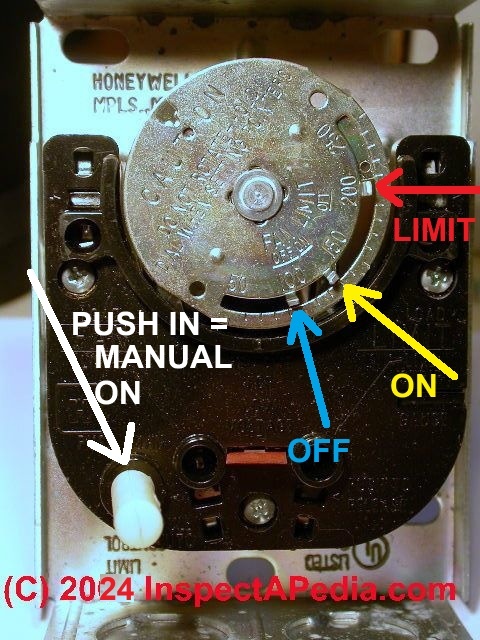
 Inspect & Test Combination Fan & Limit
- POST a QUESTION or COMMENT about diagnosing and repairing furnace fan limit switch controls
Fan limit switch troubleshooting diagnosis & repair:
Check this fan limit switch control if your furnace fan won't start (won't turn on) or won't stop (runs continuously). Guide to troubleshooting heating system furnace controls, limit controls, and fan controls.
This article describes in detail the testing and diagnosis of problems with warm air heating furnace combination controls, also commonly called the "fan limit switch" on warm air heating systems.
As a working example we examine the Honeywell combination fan and limit control type L4064B.
We also discuss the diagnosis & repair of common furnace operating troubles such as a blower assembly fan that runs continuously - it may be a simple switch setting.
The photo at the top of this page shows all of the controls and wiring terminals in a Honeywell combination fan and limit control type L4064B.
InspectAPedia tolerates no conflicts of interest. We have no relationship with advertisers, products, or services discussed at this website.
- Daniel Friedman, Publisher/Editor/Author - See WHO ARE WE?
Step by Step Photo Guide to Testing the Warm Air Furnace Combination Control- Fan Limit Switch
Fan Limit Switch Checkout Procedure
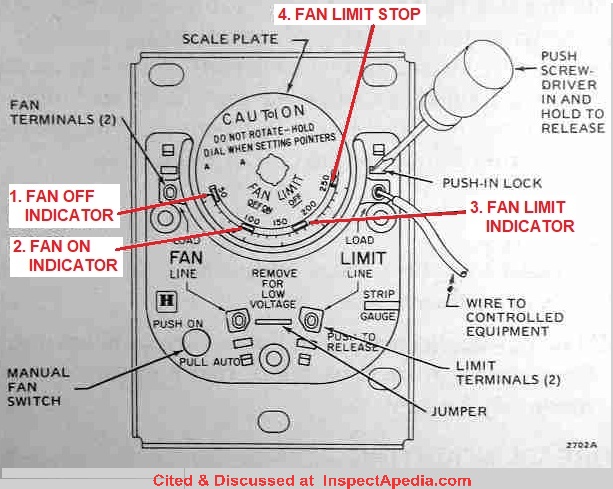
Honeywell provides a very simple fan limit switch checkout procedure to be used after the switch is installed:
When installation of a fan-limit switch is complete,
- Disconnect the fan motor circuit at the L4064.
- Turn on power and set thermostat to call for heat. Burner should come on and limit controller should shut burner off when plenum temperature reaches the limit set point.
- Turn off power, recconnect the fan switch, turn on power and again set thermostat to call for heat.
- Fan should come on when plenum temperature has reached fan-on setting. [1]
Here, extrapolating from that guidance and adding some field experience, we provide more detailed step by step procedures for troubleshooting and testing the heating furnace fan limit control switch.
This example is based on advice from the Honeywell Tradeline L4064B. Check the test specifications provided by the manufacturer of your particular control.
Honeywell suggests the following steps, which we have supplemented and photo-illustrated for clarity and safety.
The fan limit switch temperature settings (shown on the dial sketch) are discussed separately
at FAN LIMIT CONTROL SETTINGS.
How to Check the Furnace Fan Limit Control Switch Wiring
Assure that the control has been installed and wired in accordance with the manufacturer's installation instructions using the following procedures.
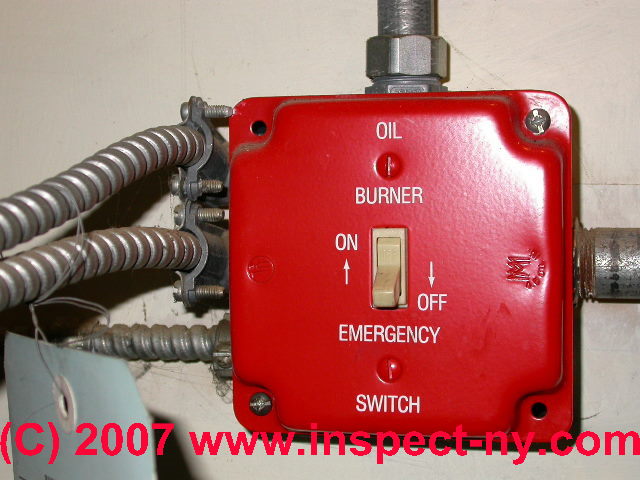
Turn off electrical power to the heating system
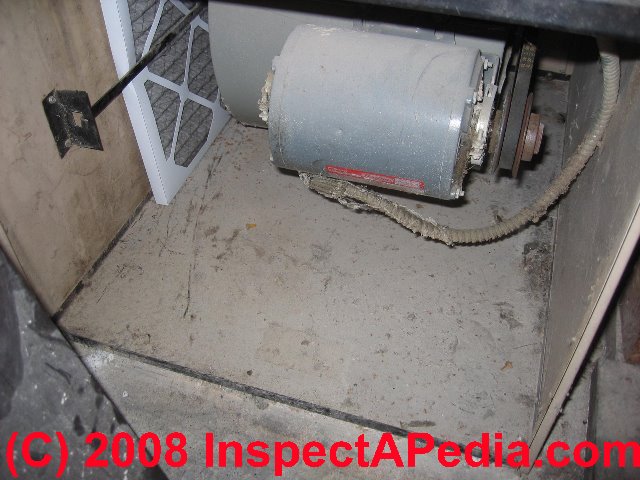
Disconnect the fan at the fan motor or at the FAN LIMIT control terminal
Turn on electrical power to the heating system
Call for heat: Set the building thermostat to call for heat - this means that the "set" temperature on the thermostat must be above the room temperature. For test purposes you can if you like, turn the thermostat all the way "up" to its highest position - temporarily for this test procedure.
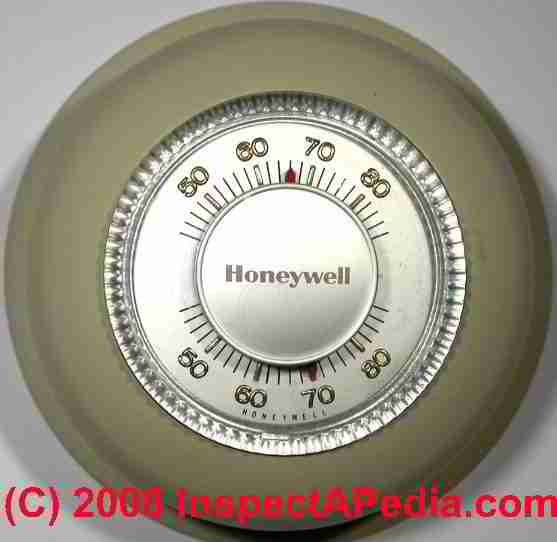
Don't forget to set the thermostat temperature back down to the desired level later.
Also if your thermostat has other switches such as "OFF", "HEAT", "COOL" - or "OFF" and "ON" be sure those switches are set to "ON" or "HEAT".
More examples and details of thermostat controls are
at THERMOSTATS
Watch the oil or gas burner:
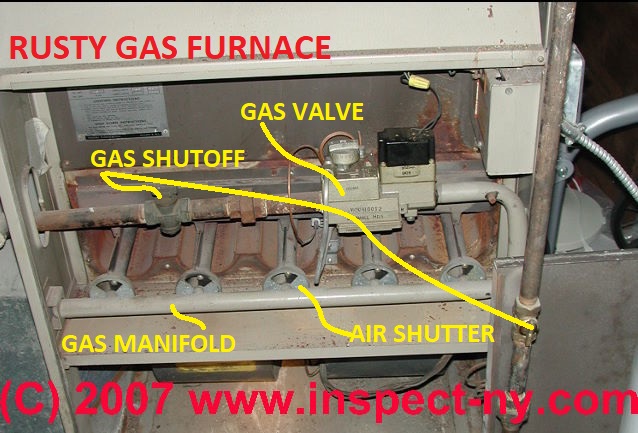 The furnace oil or gas burner should turn ON and subsequently the FAN LIMIT control should turn the burner back OFF when the temperature in the supply air plenum reaches the FAN LIMIT set point.
Watch the dial on the fan limit switch moving to confirm its operation.
IF the burner does NOT turn off as expected, QUICKLY turn off power to the heating system and order further diagnosis.
(This particular gas burner shows some rust marks and flame leakage worries).
Watch out: a mistake can ruin the furnace or cause a dangerous even fatal carbon monoxide leak. if the fan limit switch does NOT turn off the burner when temperature meets or exceeds the fan limit setting, IMMEDIATELY turn off the gas burner and power to the unit immediately so that you do not damage the heat exchanger by overheating it.
If the Fan Limit switch did NOT work normally, leave the system turned OFF and call for emergency heat service.
If the Fan Limit switch worked normally continue as follows:
- Turn off electrical power to the heating system
- Reconnect the fan motor where you previously disconnected it
- Turn on electrical power to the heating system
- Call for heat: Set the building thermostat to call for heat
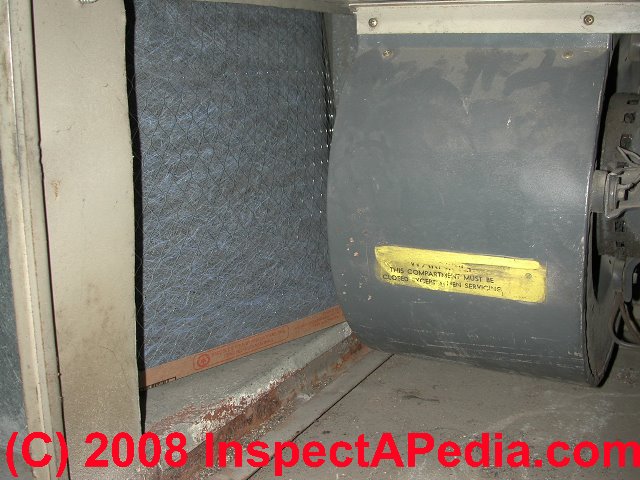 Watch the furnace blower fan:
The furnace blower FAN should come on when the plenum temperature has reached the FAN ON setting.
Again watch the dial move on the FAN LIMIT control.
The furnace blower FAN should turn OFF when the plenum has cooled down to the FAN OFF setting.
This may not happen until after the thermostat has been satisfied (or you turn it back down to a low setting) and the oil or gas burner has shut down.
(The particular furnace has a filter that is insecure in this photo and so the heating system is unsafe as the filter could be sucked into the blower assembly causing overheating and a possible motor or electrical fire.)
Blower Fan Won't Stop: What to Check if your Furnace Fan Runs Continuously - (the fan won't shut off on its own)
Details for diagnosing and fixing this problem are
at FAN WONT STOP - LIMIT SWITCH.
But first just take a look at the fan limit control switch. If the switch includes a control such as the white push-pull switch, depending on the position of this switch (pushed-in or pulled out) the fan may be on manual override - causing the fan motor to run continuously.
Details of how to check or set the manual FAN-ON switch at the fan limit control are found
at BLOWER FAN CONTINUOUS OPERATION.
How to Diagnose & Fix a Blower Fan That Keeps Cycling On/Off After Call for Heat Has Stopped
According to Honeywell, voltage transients or even other conditions around the limit switch that impact the temperatures to which it is exposed can affect the cut-on or cut-off temperature behaviors of the switch, but the company's instructions to not mention apparently excessive on-off cycling of the furnace blower fan traced to the limit switch itself.
Some conditions that cause unexpected furnace fan cycling on and off may be dangerous, risking overheating of the furnace heat exchanger which in turn risks cracks and even carbon monoxide leaks.
So it is worth checking out this problem promptly. We have several suggestions for things to check that can identify and fix problems with the heating system that cause post-heat fan cycling on and off.
Details for diagnosing and fixing a furnace blower fan that cycles on and off repeatedly after the call for heat has stopped, that is after the thermostat is satisfied, are found
at FURNACE FAN CYCLES AFTER HEAT.
How to Diagnose & Fix a Blower Fan that Cycles On/Off During the Heating Cycle - furnace short cycling
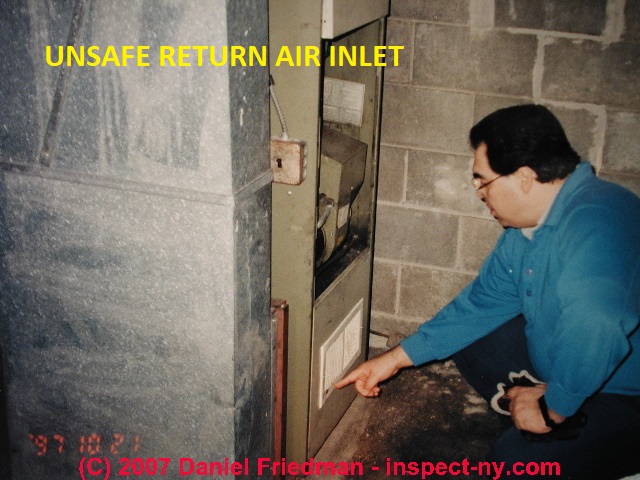 If your furnace seems to turn off and then back on repeatedly during the heating cycle the problem may be with the HVAC duct system or the problem could be in the heating burner itself or its controls.
Improper blower fan on and off cycling during a heating cycle may mean higher heating costs or even unsafe equipment.
There may be other explanations for this during-heat cycling on and off of the blower fan, but in most systems that cycling is not normal - you will want to find and fix the cause.
Details for troubleshooting a blower fan that cycles on and off unexpectedly during the heating cycle are given
at FURNACE FAN CYCLES DURING HEAT
How to Diagnose & Fix a Blower Fan that Stops Before Thermostat is Satisfied
On a call for heat on most warm air heating systems, the furnace heater turns on, the supply air plenum air heats up, the then the blower assembly runs and will often continue to run until the call for heat is satisfied.
Watch out: overheating the heat exchanger is dangerous. If this is going on your furnace should be checked by a professional.
Details for determining why the blower fan shuts off early and fixing this problem are found
How to Diagnose & Fix a Blower Fan that Blows Alternating Hot then Cold Air
In some forced air heating systems that are not working properly, when heat called for the furnace delivers blows cold air when it should not, or it alternates blowing cold, then warm air on and off.
The root problem may be traced to the ductwork, a dirty air filter, an improperly adjusted control (that may be unsafe) or other sources.
Details of diagnosing a force air heating system blower that blows cold air when warm air should be provided, or a blower that delivers alternating warm then cold air, are found
Diagnose & Fix a Blower Fan that Will Not Start
This diagnosis and repair procedure has moved to FAN WON'T START for blower fans or air handler fans that will not start or won't run in air conditioning or heating systems.
Diagnose a Blower Fan that Won't Run on AUTO - but will Run on FAN-ON / MAN
See FAN RUNS ONLY ON FAN-ON / MAN
Thank you to our readers for their generous comments
Thank you for this info, it was very helpful. On 2016-02-02 by Steve Beukema -
This was the best answer i have ever gotten, thank you so much On 2012-12-29 by Scott -
Thank you, My twentyone years old furnace is working find thinks to your topic on setting the limit switch. super step by step instructions.(AND FREE)BLESS YOU!
THANKS,MATT77 - On 2012-01-03 by MATT 77
Thank you,My twentyone years old furnace is working find thinks to your topic on setting the limit switch. super step by step instructions.(AND FREE)BLESS YOU!
THANKS, - On 2012-01-03 by Anonymous
This is exactly what I needed. My heating co set at 60 and 150...very frequent short cycles. - On 2012-12-02 by Dgeorge@georgegems.vom
Really good info here. im studing HVACR and there is amazing information on heating systems at InspectApedia. - On 2012-11-11 y Abimael Luciano
Excellent instructions! I followed them and easily replaced the Limit Control in our late 80's Whirlpool furnace (Heil Quaker / Honeywell switch 1149505). Never touched the inside of a furnace before but your directions were spot on. Thank you. - On 2011-12-03 by matt k.
Thanks, Very helpful and informative web site. keep up the great info work! - (Dec 11, 2011) K. Mapes
Very informative! thank you! (Jan 22, 2012) Anonymous
Reply:
Thanks for the nice note K.M. and anon and other readers; We welcome reader questions or comments - those help us see where our information may be lacking.
We are dedicated to making our information as accurate, complete, useful, and unbiased as possible: we very much welcome critique, questions, or content suggestions for our web articles.
Working together and exchanging information makes us better informed than any individual can be working alone.
...
...
Continue reading at FAN WONT STOP - LIMIT SWITCH or select a topic from the closely-related articles below, or see the complete ARTICLE INDEX.
Or see FAN LIMIT SWITCH TROUBLESHOOTING FAQs questions & answers posted originally at this article
Or see these
Recommended Articles
- AIR HANDLER / BLOWER UNITS - home
- FAN, AIR HANDLER BLOWER UNIT
- FAN, COMPRESSOR / CONDENSER UNIT
- FAN LIMIT SWITCH - home
- FAN LIMIT CONTROL SETTINGS
- FAN LIMIT SWITCH INSTALLATION & WIRING MANUALS
- FAN LIMIT SWITCH TROUBLESHOOTING
- FAN RUNS ONLY ON FAN-ON / MAN
- FAN WONT START
- FAN WONT STOP - LIMIT SWITCH
- FAN WONT STOP - THERMOSTAT SWITCH
- FURNACE BLOWS COLD AIR
- FURNACE FAN CYCLES AFTER HEAT
- FURNACE FAN CYCLES DURING HEAT
- FURNACE FAN STOPS EARLY
- FAN ON AUTO MAN THERMOSTAT SWITCH
- FAN ON SWITCH ADDITION
- FAN WONT STOP - THERMOSTAT SWITCH
Suggested citation for this web page
FAN LIMIT SWITCH TROUBLESHOOTING at InspectApedia.com - online encyclopedia of building & environmental inspection, testing, diagnosis, repair, & problem prevention advice.
Or see this
INDEX to RELATED ARTICLES: ARTICLE INDEX to HEATING FURNACES
Or use the SEARCH BOX found below to Ask a Question or Search InspectApedia
Ask a Question or Search InspectApedia
Share this article:Ask a Question or Search the InspectApedia website using the box just below.
Need to make a private comment? Email editor@inspectApedia.com. We welcome email with your website content critique, corrections, suggestions or questions. Email is monitored daily but our workload may prevent an immediate reply. For immediate results, we hope you'll first try asking your question using the search box just above.
Citations & Reviewers
In addition to any citations in the article above, a full list is available on request.
- [1] Honeywell Corporation, Minneapolis, MN 55408. Honeywell has sales offices in all principal cities in the world and has manufacturing facilities in Australia, Canada, Finland, France, Germany, Japan, Mexico, Netherlands, Spain, Taiwan, United Kingdom, U.S.A. Honeywell Form Number 60-0450 7-75, residential division. Honeywell's latest product data for this type of control can be found in English at http://customer.honeywell.com/Techlit/Pdf/69-0000s/69-0117.pdf or contact Honeywell at Automation and Control Solutions Honeywell International Inc. 1985 Douglas Drive North Golden Valley, MN, 55422 - honeywell.com/building/components 07/06 RB © Honeywell 2006 Printed in Canada 69-0117-3
- "Warm Air Heating Systems". Instructional Technologies Institute, Inc., 145 "D" Grassy Plain St., Bethel, CT 06801 800/227-1663 [home inspection training material] 1987
- Heating, Ventilating, and Air Conditioning Volume I, Heating Fundamentals,
- Our recommended books about building & mechanical systems design, inspection, problem diagnosis, and repair, and about indoor environment and IAQ testing, diagnosis, and cleanup are at the InspectAPedia Bookstore. Also see our Book Reviews - InspectAPedia.
- In addition to citations & references found in this article, see the research citations given at the end of the related articles found at our suggested
CONTINUE READING or RECOMMENDED ARTICLES.
- Carson, Dunlop & Associates Ltd., 120 Carlton Street Suite 407, Toronto ON M5A 4K2. Tel: (416) 964-9415 1-800-268-7070 Email: info@carsondunlop.com. Alan Carson is a past president of ASHI, the American Society of Home Inspectors.
Thanks to Alan Carson and Bob Dunlop, for permission for InspectAPedia to use text excerpts from The HOME REFERENCE BOOK - the Encyclopedia of Homes and to use illustrations from The ILLUSTRATED HOME .
Carson Dunlop Associates provides extensive home inspection education and report writing material. In gratitude we provide links to tsome Carson Dunlop Associates products and services.
 |
HOME | ABOUT | ASK a QUESTION | CONTACT | CONTENT USE POLICY | DESCRIPTION | POLICIES | PRIVACY | |
| © 2026 - 1985 Publisher InspectApedia.com - Daniel Friedman | |||||||||