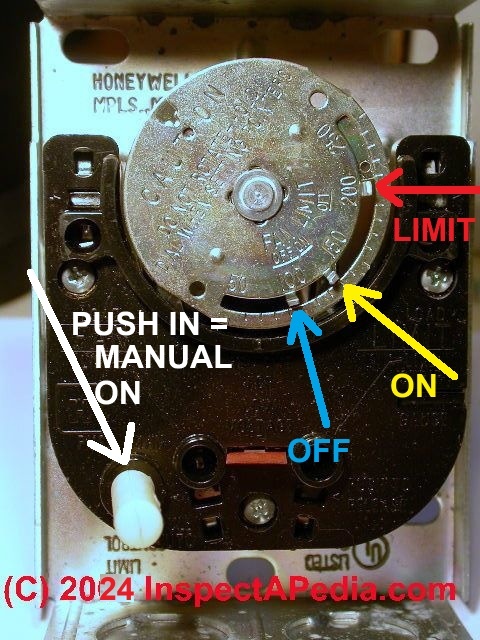
 Fan & Limit Switch Test FAQs

- POST a QUESTION or COMMENT about diagnosing and repairing furnace fan limit switch controls
Fan limit switch troubleshooting diagnosis & repair FAQs:
Frequently asked questions about how to test and diagnose a fan limit control.
This article series describes in detail the testing and diagnosis of problems with warm air heating furnace combination controls, also commonly called the "fan limit switch" on warm air heating systems. As a working example we examine the Honeywell combination fan and limit control type L4064B.
The photo at the top of this page shows all of the controls and wiring terminals in a Honeywell combination fan and limit control type L4064B.
InspectAPedia tolerates no conflicts of interest. We have no relationship with advertisers, products, or services discussed at this website.
- Daniel Friedman, Publisher/Editor/Author - See WHO ARE WE?
Q&A on Testing the Warm Air Furnace Fan Limit Switch
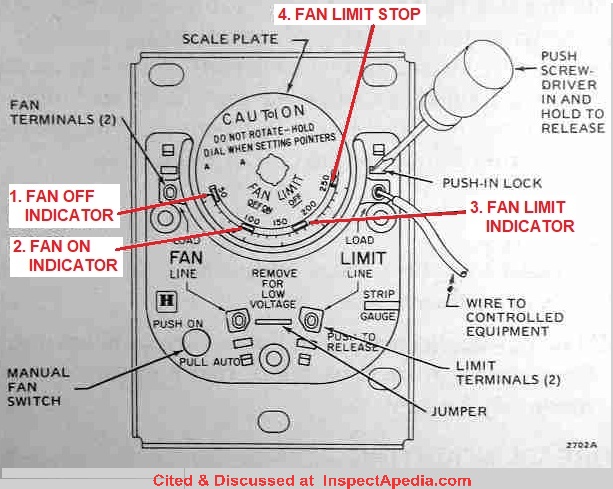 These questions & answers about testing the fan limit switch were posted originally
at FAN LIMIT SWITCH TROUBLESHOOTING - please be sure to see the fan limit control installation, diagnosis, and repair procedures given there.
Also see our index to all fan limit control switch questions & answers found at FAN LIMIT SWITCH FAQs
Below is our index to reader Q&A about furnace fan limit switch installation, wiring & testing.
Article Index
- FAN LIMIT SWITCH FAN MAN / AUTO ADD / REPLACEMENT FAQs - add or replace a missing or broken fan manual control button?
- FAN LIMIT SWITCH FAN MAN / AUTO BUTTON BROKEN - REPAIR FAQs - fix or replace the manual fan-on button/switch?
- FAN LIMIT SWITCH FAN MAN/AUTO SWITCH OPERATION FAQs - which way do we move the button to turn the fan on or to "auto"
- ROTATING DIAL DAMAGE on FAN LIMIT CONTROL FAQs - Watch out: manually rotating or even holding the dial can damage it and may make the heater unsafe
Also see our index to all fan limit control switch questions & answers found at FAN LIMIT SWITCH FAQs
...
Fan Limit Control Switch Dial Rotation Damage FAQs
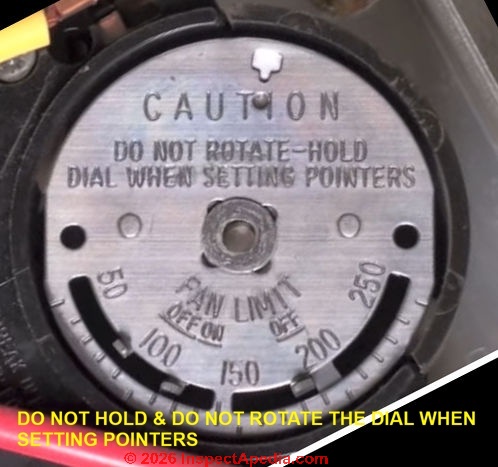 I Saw Videos of people manually rotating the temperature dial on fan limit control - is this OK?
My fan/limit switch (an old Delco unit) has the normal 'do not rotate' imprinted on the temperature dial.
Yet I see many videos of people 'testing' their fan/limit switch with an ohm meter by rotating the dial to verify the fan and limit switches are turning on and off as they should.
Is this a good way to check the switch?
Most have the wires disconnected when they are testing the switch. - On 2018-03-26 by ed -
Reply by (mod) - NO that is a very dangerous procedure: do not rotate nor holdthe fan limit switch dial - you could cause dangerous furnace overheating - fatal CO poisoning hazard
Ed
The manufacturers of fan limit controls know their equipment better than anybody else, and they also have a lot at stake in assuring that their controls are installed and operated safely. Take their advice.
Watch out: The videos you cite are examples of dangerous advice that might be offered by someone with a neat idea but who is not fully informed. It's a classic problem: smart people don't know that they don't know something important.
Rotating the dial on the fan limit switch by hand risks bending and thus de-calibrating the bimetallic spring that operates the switch in response to furnace supply plenum temperature.It is patently obvious that if we de-calibrate a temperature-sensing safety control then the control cannot be relied on to do what it's supposed-to.
For example bending the spring in the fan limit switch might result in an over-temperature in the furnace that in turn cracks the heat exchanger.
A cracked heat exchanger can send fatal carbon monoxide gas into the occupied space.
While not every uninformed trick we try has fatal consequences, that's the risk: bent switch = dead people. Don't do it.
How to slow the "rotation" of the fan limit switch?
I reset the limit switch 100 low, 150 high. It fixed the constant blower problem, but it seems like it rotates very quickly from 150 down to 100. Is that normal? Can I slow down the rotation.
Also I have a programmable Honeywell thermostat. It is set at 63, turns on at 62, off at 64, but it feels more like 75+ in the house. How do I know if i have the correct size thermostat. On 2020-10-28 by Pam
Reply by (mod) - the fan limit dial rotation speed is determined by the heat input rate of the furnace
Pam:
Watch out: take great care when fooling with the settings on the fan limit control; if you bend the spring in the control you force it out of calibration, making the system dangerous and risking heater damage or even carbon monoxide poisoning should the heat exchanger crack due to excessive temperatures.You can't slow the rate of rotation of the sensor in the fan limit switch directly, as that's determined by the rate of air flow through the plenum, the return air temperature, and the input BTU capacity of the burner that's trying to re-heat the air.
Indirectly, if the blower fan permits adjusting its speed you can set the speed lower (that may be a switch or a jumper on a control board), but of course you're also reducing the rate of delivery of warm air to the occupied space.
You might start by asking for help from your heating service tech to get to the underlying issue here.
If this has always been a problem then it may be that the house loses heat too fast, drafty or poorly insulated, or it may be that the ductwork or heater are not properly sized. An over-sized furnace will cause the fan to shut off quickly.
For a "Fan Won't Stop" problem you should be sure to read these diagnostic articles
FAN WONT STOP - topic home
FAN WONT STOP - THERMOSTAT SWITCH - switches right on the thermostat can force the fan to run
HEAT WON'T TURN OFF for other reasons that a heating system won't stop running
...
Furnace Fan Limit Control FAN AUTO / MAN-ON Button Repair
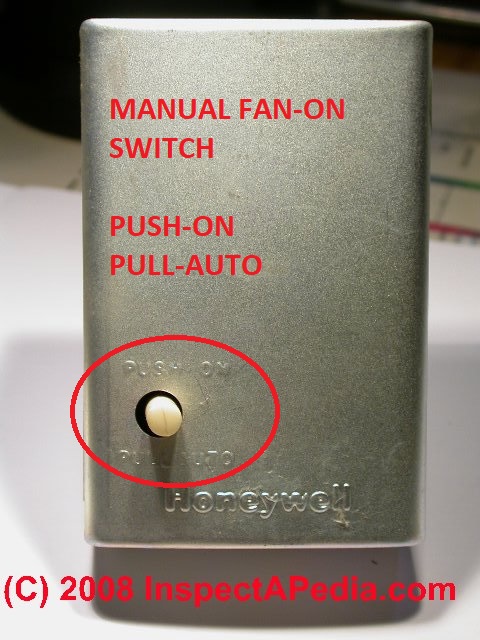 Fix for a Broken Fan Limit FAN-ON-AUTO Switch
My manual fan-on switch was pushed in and the part that sticks out broke off when removing the honeywell cover.
So it is stuck in the fan on mode and runs constantly (unless i turn off the breaker). There is no way to get at it to get it back to auto setting.
I don't want to replace the whole limit switch if I don't have to. Is there any way to get at it from inside or behind to at least get it to the pulled out setting and being automatic again? - 2017-09-24 by betsy
Reply by (mod) -
Betsy
On most fan limit switches that include this control pushing the button IN puts the fan in manual ON mode - just as you say. If you can't hook and pull out the broken off switch stub you will want to replace the switch.Disassembling the switch - which is not intended by its design, risks even slightly bending its temperature sensing movement that would render the switch unsafe.
Followup by Betsy
Thanks for the reply. After sending the question I had an idea to drill out the remaining plastic stub and try and hook the little bit of remaining plastic with a sharp dental tool. Amazingly it worked!
The furnace cycled on and off as it should.
And if I hadn't of thought of that, I would have tried something similar after reading your reply.
We've had snow already this year, so having the furnace working is a wonderful thing. Thanks again!
Reply by (mod) -
Well SUPER going. Especially as you managed to drill into a safety control without drilling too far and snagging it or getting zapped.
FAN switch broke in FAN-ON mode - how do I get back to Auto?
My manual override switch Honeywell broke in manual position. Is there a way I can set it back to auto? On 2017-11-28 by Ron Hupe -
Reply by (mod) -
Ron
Well I used to say no, just replace the switch, but a reader who is apparently somewhat a meticulous and careful worker, wrote to me that he drilled a tiny hole into the broken stub of the push pullswitch on the fan on switch on his limit control, then he inserted a little screw and used that to pull the button back out.
I can't officially recommend modifying any heating safety control since if you foul it up or damage it it is unsafe and could risk a building fire. Just sayin'
The White AUTO/MANUAL fan switch is broken off and stuck in MANUAL
Hi I have a limiter switch problem. The white auto/manual switch is broken off and stuck in the manual mode is there a way to pull it back out?
Can the switch split in half to fix or am I just hooped. On 2018-02-04 by Tom
by (mod) -
While the correct and safe repairs to replace the entire switch, some readers have made an emergency repair by carefully drilling with a small diameter bit into the center of the stub of the broken off push-pull switch.
That allows insertion of a small screw that will let you pull out the switch.
I can't pull out the FAN AUTO Button on my fan limit control.
I pushed the button in (manual) on my fan limit switch but I am unable to pull it out (auto) because there is not a white button on it.
Now when the thermostat is at the set temperature the burners do not go out. What can I use/do to switch it back to auto. (Feb 19, 2013) Carmen
Reply:
Carmen
I'm confused by your question because I don't know just what you pushed "IN" on your fan limit switch nor just which fan limit switch you have.
Pretty much ANY fan limit switch that includes a mechanical switch or button that is intended to turn the fan ON full time or to alternatively allow it to run in AUTO MODE (controlled by the furnace plenum temperature) has to work both ways - to switch between the two modes.
So perhaps your button is broken off?
Some fan limit switches do not include the FAN ON manual control.
In fact some furnaces don't use a fan limit switch, using instead a solid state "snap switch" that is much smaller and can be harder to spot.
Alternatively, also check your wall thermostat to see if there is a FAN-ON switch position there.
That is an alternative method that can be used to force the fan to run continuously when you want that condition.
See details of finding the fan MANUAL / AUTO button that may be present on your fan limit control
at FAN LIMIT CONTROL SWITCH LOCATION - where to find the limit switch on your furnace or air handler
How to fix a broken-off fan limit switch AUTO button
I accidentally broke off the fan limit switch (the white switch) and it's set on manual. the fan has been on for a few days. Is there anyway I can set it up to auto without having to replace it? (Nov 26, 2014) Sabrina said:
Reply:
Sabrina
Pending replacement of the broken switch (which I recommend, using a trained heating service tech), if the switch was pulled "out" to force the fan on (as is often the case) you may be able to push the remaining stub "in" to turn the "FAN-ON" state back to AUTO.
Most fan limit controls that have a manual fan-on control work as I described above.
But if your switch works backwards from the norm - that is it's pull for auto and push for "Manual On" - and if you can grasp and pull the switch out with insulated needle nose pliers that might work.
On rare occasions I've drilled a tiny hole in the stub of the broken-off switch, then screwed in a small sheet metal screw that allowed me to pull the FAN button back "out".
Also be sure that your room thermostat fan control is set to AUTO.
What to do if my fan manual / auto switch is broken
My manual/auto button the white on a Honeywell fan limit switch and I can't it to auto
Sorry it broke and I can't switch it to auto from manual (Dec 22, 2014) terry
Reply:
Terry,
You'll want to ask your heating service tech to replace the switch. I would not mess with it as if a spring is bent the whole system could be unsafe.
See an alternative at HOW TO ADD A FAN-ON SWITCH for the air handler
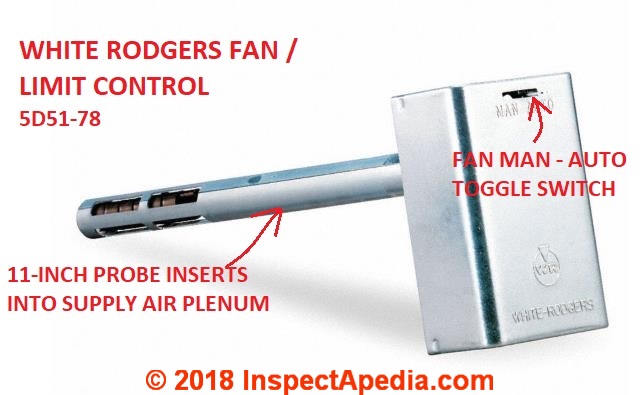
Above: a different manual FAN-ON switch is provided on some White Rodgers fan limit controls such as the WR SD51-78.
Our furnace fan only works on MANUAL not on AUTO
Why would by furnace work on manual but not auto? (Sept 30, 2014) Paul
Reply:
Check for shorted or broken thermostat wires or a thermostat not calling for heat.
I am going to replace our limit switch as the fan is continuously running
We just found out that we need to replace our limit switch as the fan is continuously running.
I have found one online and will be ordering it, but I have a question about the other limit switch.
The small button style one with two wires attached, the high temp limit thermostat.
When looking at the furnace for the source of our problem, I kind of broke the button one free of the built in frame.
I'm looking to replace that and am having no luck searching the part number located on it, but I have found one with the correct Limit of 300. The only difference is this one has a manual reset button in the center of it, which our current one does not. Is this really an issue?
Can I use the one with the manual reset in place of one without it? As long as the measurements are the same? 2014-12-09 by Amanda
Reply by (mod) -
Amanda
I am sorry to sound like a timid old maid, but if you understand the risks of giving a homeowner advice about heating safety controls you may appreciate that I'm nervous about this.Watch out: A mistake in installing a limit switch, or mis-handling the switch - say bending a sensitive spring on the dial for example - can put the switch out of proper order and could make the heating system quite unsafe.
For a bolt-on repair when I don't know the part number, I check the installation and maintenance guide for the heating system; if I don't have that document I note the brand, model, serial number and I give the manufacturer a call to ask for the proper part number. Or I might take the old part to my heating supplier for an in-kind replacement.
I would NOT just replace a button type switch based on measurements alone, as switches may look identical physically but may operate at different temperatures.
In general about fan limit switches, the units that do not have the push-pull button are omitting an extra control that let the owner or service tech set the fan for continuous operation rather than automatic.That's the chief difference.
I had to push and pull the white FAN ON button repeatedly on my fan limit control
Our furnace works perfectly sometimes - and sometimes not. Sometimes the fan runs constantly even when the temperature is very low.
I tried to turn the wheel to the on position then off again and sometimes it stops after a few tries.
And before i found that wheel to adjust the fan i had to pull and push the manual/auto button a lots of times to stop the fan. Any idea about that? On 2018-10-31 by Mart
by (mod) - manually turning the temperature dial on a fan limit control damages it and makes it unsafe!
Mart
Having to push/pull the white FAN ON - or MAN button on your furnace fan limit control repeatedly to turn the fan off might be normal and not a defect:If the furnace is hot then the limit switch will keep the fan running regardless of the position of the manual FAN-ON button.
But when the furnace has cooled down to room temperature, if the fan keeps running that button may be in the FAN-ON position.
So your description is incomplete. You need to take a closer look at the furnace temperature and tell me under what conditions the fan won't stop.\
But more important: If you maually rotated or turned the rotating temperature dial inside the the fan limit switch it probably needs replacement!
Watch out: Most fan limit switches will be destroyed and at the very least made unsafe if you turn that dial manually. That's because you bend and uncalibrated the bimetallic spring that operates the dial. If that's what you've done the safe thing would be to replace the control.
...
Add / Replace Fan Limit Switch FAN-ON / MAN Switch or BUtton FAQs
Is it possible for me to add a second switch in parallel with the override button outside the furnace - DO NOT DO THIS
I have a standard domestic gas furnace. The remote thermostat has only a 2 wire run back to the furnace.
I wish to run the furnace blower for long periods to circulate cooler air through the house during the summer.
I can push the manual over ride button in on the high limit switch, which achieves this.
Is it possible for me to add a second switch in parallel with the over ride button outside the furnace so that I don't need to open up the furnace to operate it? Is this a safe practice? On 2014-09-09 by Woolf
Reply by (mod) - No
No Woolf,
The push-pull switch on a limit switch used in furnaces is electro mechanical and is an integral part of the control.
Watch out: I would not modify a limit switch in any manner - even if the snafu risks are small it's just not worth the risk of malfunction that can result in killing the occupants or burning down the building.
What Honeywell Fan Limit Switch has no FAN push-pull button but has a wire and toggle switch?
Mod: what model of Honeywell combo fan limit switch has no white push or pull button to comtrol fan manually but istead has a wire coming from the limit to a toggle switch mounted on the outside of the large electrical cover to operate tje fan.
It is the same limit as shown in your sketches but where the white button would be a wire comes from it to an external switch and no small cover on the limit just a 5 inch wide 24 inch long to cover
all electrical all i have for a model # is this for an oil furnace
OLB53R100LB-5MC/BLR-5A
anb
OLR105A12C
thats all in model area and heres a poor pic of limit [shown above] On 2018-10-12 by Ken Martin
by (mod) - external FAN-ON switch on fan limit controllers? modifications may make the control unsafe
Ken
I've not see what you describe as a fan limit control model; possibly it's a home-made or site-rigged feature to provide the equivalent FAN ON control switch.Watch out: if that's so, the control may be unsafe.
Keep in mind that the manufacturer, scared that some one modifying their equipment may cause a fire, injury or worse, will not warrant their control if it has been field modified.
...
I can't turn the fan off ever as the blower will begin to rotate backwards which throws a saftey switch
My suites furnace has a common return with several others. Each suite has its own thermostat.
My problems is I can't turn the fan off ever as the blower will begin to rotate backwards which throws a saftey switch and can't be restarted without going to the basement ,removing the door , resetting the blower, replacing the door, each time.
The blower is too strong and loud to want on all the time. Is there a way to prevent this without reducting the entire system to a more normal setup? On 2016-03-28 by Mike Krueger -
by (mod) -
Mike:
This sounds like a questionable duct design: if multiple suites in a building are sharing return air that means that any contaminant, odor, etc. in any tenant's space will be blown into everyone else's space. It also means that any tenant who blocks return air can interfere with heat or cool air delivery to everyone else.
That gripe stated let me get to your question.
The backwards fan rotation is most likely due to the shared return air, as you suggest and as I already condemned.Other causes of an electric motor running backwards on its own are discussed at ELECTRIC MOTOR RUN DIRECTION
But backwards fan spinning also happens in larger HVAC systems that use multiple blower fans in one duct system.
And depending on the motor type, a fan motor that is OFF but has been spinning "backwards" may keep going backwards even when your thermostat calls for the fan to run. Not all motors will be damaged by this SNAFU but it means that the blower won't push heated or cooled air where it's needed.
It *might* be possible to change the squirrel cage fan cage itself to one that uses a different blade design to reduce the susceptability of the fan to be driven by duct airflow when its motor is off.
But I'd try a different idea that might totally stop the problem: ask your HVAC installer if it is possible to locate an electrically-opearated "automatic duct damper" near the inlet to your fan, or more normally, on the outlet side of your blower system.Your thermostat is wired to open the duct damper and then turn on the air handler for heating or cooling. With the damper closed air should be almost completely (except for small leaks) blocked from passing through common air return system and into your individual supply duct system.
That ought top stop the fan from blowing (mostly if the damper is on the supply or outlet side and entirely if the damper is installed on the inlet side of your blower)
Keep us posted.by Mike
Thanks I will look into that. It is definitely a goofy setup. I had thought maybe there was a blower designed to only rotate in one direction. The damper idea sounds promising. Thank you
...
...
Continue reading at FAN LIMIT SWITCH TROUBLESHOOTING or select a topic from the closely-related articles below, or see the complete ARTICLE INDEX.
Or see FAN LIMIT SWITCH TROUBLESHOOTING FAQs-2 - more-recent questions & answers about testing a fan limit controller.
Or see these
Recommended Articles
- FAN LIMIT SWITCH
- FAN ON AUTO MAN THERMOSTAT SWITCH
- FAN ON SWITCH ADDITION
- FAN WONT STOP - THERMOSTAT SWITCH
- UNDERSIZED RETURN DUCTS - not enough return air
Suggested citation for this web page
FAN LIMIT SWITCH TROUBLESHOOTING FAQs at InspectApedia.com - online encyclopedia of building & environmental inspection, testing, diagnosis, repair, & problem prevention advice.
Or see this
INDEX to RELATED ARTICLES: ARTICLE INDEX to HEATING FURNACES
Or use the SEARCH BOX found below to Ask a Question or Search InspectApedia
Ask a Question or Search InspectApedia
Share this article:Search the InspectApedia website
Need to make a private comment? Email editor@inspectApedia.com. We welcome email with your website content critique, corrections, suggestions or questions. Email is monitored daily but our workload may prevent an immediate reply. For immediate results, we hope you'll first try asking your question using the search box just above.
Citations & References
In addition to any citations in the article above, a full list is available on request.
- In addition to citations & references found in this article, see the research citations given at the end of the related articles found at our suggested
CONTINUE READING or RECOMMENDED ARTICLES.
- Carson, Dunlop & Associates Ltd., 120 Carlton Street Suite 407, Toronto ON M5A 4K2. Tel: (416) 964-9415 1-800-268-7070 Email: info@carsondunlop.com. Alan Carson is a past president of ASHI, the American Society of Home Inspectors.
Thanks to Alan Carson and Bob Dunlop, for permission for InspectAPedia to use text excerpts from The HOME REFERENCE BOOK - the Encyclopedia of Homes and to use illustrations from The ILLUSTRATED HOME .
Carson Dunlop Associates provides extensive home inspection education and report writing material. In gratitude we provide links to tsome Carson Dunlop Associates products and services.
 |
HOME | ABOUT | ASK a QUESTION | CONTACT | CONTENT USE POLICY | DESCRIPTION | POLICIES | PRIVACY | |
| © 2026 - 1985 Publisher InspectApedia.com - Daniel Friedman | |||||||||