
InspectAPedia® FREE Encyclopedia of Building & Environmental Construction, Diagnosis, Maintenance & Repair |
Question? Just ask us! InspectAPedia
|
 Chimneys, Flues & Vents
Home Page & Article Index
- POST a QUESTION or COMMENT about all aspects of residential chimneys: chimney types, installation, inspection, problem diagnosis, repair or replacement or re-lining, chimney safety & fire or flue gas or carbon monoxide hazards from unsafe chimneys, flues, vents, or flue vent connectors
This page provides an index to key articles on chimneys, flues, and vents, and on fireplaces & woodstoves. We explain how to inspect & detect defects and hazards in these heating systems & components.
We also provide chimney & fireplace repair advice along with chimney repair alternatives such as relining vs. replacement.
We discuss chimney and flue safety hazards such as carbon monoxide gas leaks, fire hazards, and chimney inspection procedures from inside and outside the building as well as flue inspection methods to find safety and other defects.
Chimney construction procedures, methods, and materials are discussed in these articles.
InspectAPedia tolerates no conflicts of interest. We have no relationship with advertisers, products, or services discussed at this website.
- Daniel Friedman, Publisher/Editor/Author - See WHO ARE WE?
Chimneys and Flues: Construction & Inspection Methods, Diagnosis, Safety, Repairs
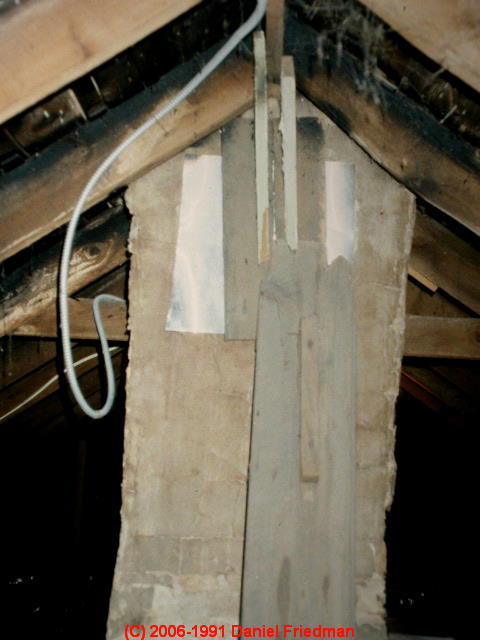
 In our page top photo, a single wythe brick flue had lost some of its bricks. The owner "fixed" this condition by
propping a board against a piece of aluminum flashing to cover the hole in the chimney.
In our page top photo, a single wythe brick flue had lost some of its bricks. The owner "fixed" this condition by
propping a board against a piece of aluminum flashing to cover the hole in the chimney.
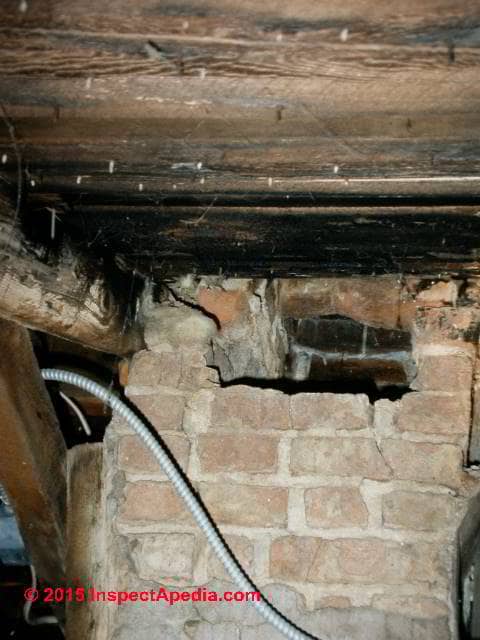
At left, we show what the chimney looked like when we moved the propped-up aluminum flashing: this chimney was venting dangerous flue gases into the building, the under-side of the roof decking was charred, and the chimney top itself had been blocked by a piece of slate.
Where do you think the missing bricks were?
They were not on the attic floor. I had been called to the building to investigate a basement water entry problem.
This is what we found: a single wythe brick chimney in a tall two story house with full basement. The water on basement walls was condensate from flue gas spillage from the gas fired heating boiler whose flue was totally blocked by the fallen bricks and debris.
This was a serious carbon monoxide hazard and a dangerous chimney.
The details of this case are presented
This chimney inspection article series describes and illustrates chimney inspection procedures and critical chimney defects which can be observed from outdoors at ground level, from the rooftop, from inside the building, and finally, by inspecting the interior of the chimney flue itself.
A complete index to chimney construction, inspection, diagnosis & repair articles is found at ARTICLE INDEX to CHIMNEYS & FLUES.
Chimney Components & Definitions
 We begin with some basic definitions of chimneys and chimney types.
When do Chimney Codes Apply to Existing Chimneys?
NFPA 54, the National Fuel Gas Code, recommends that when a new appliance is retrofitted into an existing installation, or an existing appliance is removed from a common vent, the entire venting system, which may include a masonry chimney, should conform to current codes.
Many houses inspected
have had higher efficiency appliances installed, some direct vented, and we
observe corroded vent connector pipes, corroded chimney cleanout doors and
disintegrated masonry at the cleanout.
Definition of Chimney: A chimney is a structure manufactured or constructed to form and enclose one or more vertical passages (flues) through which products of combustion pass to the outside atmosphere.
A masonry chimney needs to have a sound foundation to prevent settling and movement, and must be soundly constructed so as not to leak combustion gases as well as to prevent setting the building on fire.
See CHIMNEY TYPES & MATERIALS.
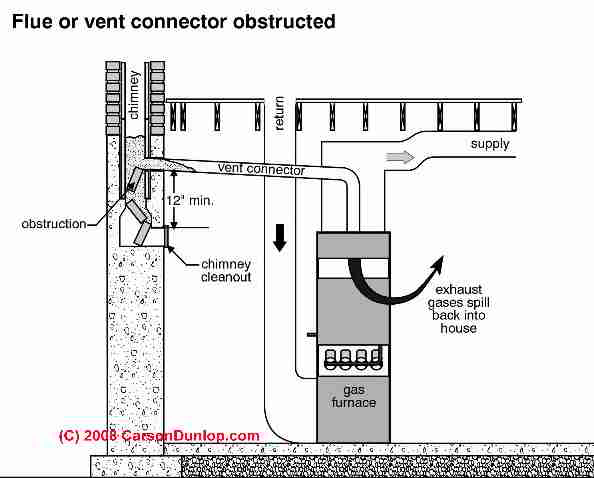
In Carson Dunlop Associates' sketch just below, the lower end of a masonry chimney structure is visible at the left of the photo.
Definition of Flue or Chimney Flue: A pipe or shaft for the passage of smoke, hot air and gas in a chimney. A single masonry chimney may contain more than one flue.
[Click to enlarge any image]
 There are important safety regulations about the construction, separation, and use of chimney flues within a chimney.
In general, chimney flues are not shared among devices on different floors, and sharing of flues among devices on a single floor is limited to certain heating equipment combinations.
See CHIMNEY INSPECTION, FLUE INTERIOR for details.
Also see our Q&A at CHIMNEY CAPS & TOPS
that defines chimney flue again and explains flutes that appear on pipe organs - nothing to do with heating appliance chimneys.
Carson Dunlop Associates' sketch at left shows a horizontal flue vent connector inserted into the chimney flue. The flue or chimney interior is shown in cross-section. In this example, debris has clogged and blocked the chimney - producing a dangerous condition.
Definition of Vent Connector or Flue Vent Connector: A vent is a manufactured product intended only to serve a specific type of appliance under narrowly defined conditions.
For example, the thin-walled metal pipe, typically 6" in diameter or larger and used to connect an oil-fired heating boiler or a gas-fired furnace to a metal or masonry chimney is properly called the flue vent connector. Lots of people call this component the "flue pipe" or "stack pipe".
There are important safety regulations about the components, installation, fire clearances, and fire ratings of flue vent connectors and their component parts.
See FLUE VENT CONNECTORS, HEATING EQUIPMENT for details about the inspection, installation, hazards, and repairs of flue vent connectors.
Chimney Types: Summary
A detailed guide to different types of chimney types and materials is found
We can describe at least the following categories of chimneys and flues:
- Chimney material: Masonry, Metal, Plastic, Transite-Asbestos
- Chimney construction approach & placement: Inside, Outside, Three-Sided, Bracket, Dead-end-flue, Angled flues, and of course "abandoned" chimneys
- Chimney venting application: Type of appliance being vented and fuel used, such as LP or natural gas, oil, wood, coal, multi-use
The articles in this series also describe types of chimney defects, approaches to chimney construction, chimney inspection methods, and fire or safety hazards associated with chimney defects such as cracks, movement, leaks, fire clearance hazards, obstructions, or inadequate draft.
Chimney defects and hazards also can be categorized by chimney fuel, construction, location, and materials.
Inside Chimneys
All chimneys whose construction is entirely internal to the building structure up to the roof line are considered inside chimneys.
Outside Chimneys
Chimneys with three walls exposed to the outdoors are considered outside chimneys.
Vents may experience continued condensation.
A "Type B" vent or a listed chimney lining system passing through an unused masonry chimney flue is not considered to be exposed to the outdoors, but a type B-vent or other metal chimney passing through an exterior wall chimney chase would also be considered an outside chimney.
Outside chimneys, because they are exposed to colder temperatures than a chimney that passes through the building interior, may have different draft and performance properties and in some circumstances may not provide adequate draft. We discuss examples of this concern
Three Sided Chimneys
A three-sided or "three walled chimney" is one which does not provide full masonry thickness or fire protection around all sides of the chimney flue.
Three sided chimneys can be a very serious fire risk because the chimney has been built close to or even directly against combustible building materials without the necessary fire clearance and masonry fire protection needed. See Three-Sided Chimneys: Outdoors for details.
The Functions of a Chimney Wall
 The chimney wall has two primary functions: structural and draft
inducing (thermal performance). Masonry chimney walls are generally built of brick,
stone or concrete masonry units.
The chimney wall has two primary functions: structural and draft
inducing (thermal performance). Masonry chimney walls are generally built of brick,
stone or concrete masonry units.
Codes dictate the thickness and mortar requirements.
All concrete products must be waterproofed and all mortar joints solid through the thickness. Masonry chimneys may not be supported on structural elements of the building.
Masonry chimneys must be fully self supporting.
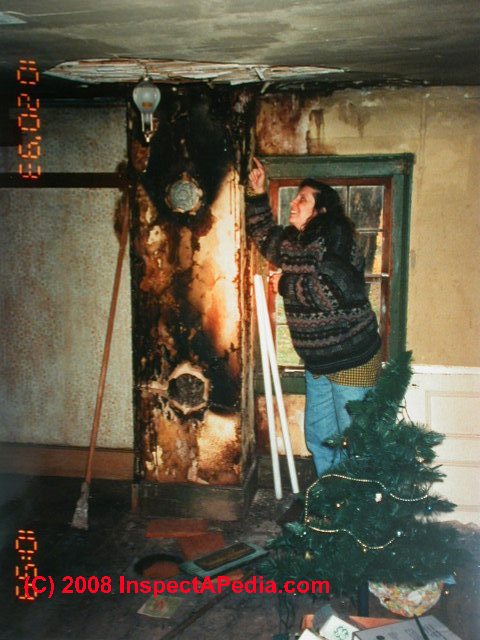
See BRACKET CHIMNEYS & GALLOWS BRACKETS below for an example of chimneys that are not self-supporting.Our photo (left) shows an unsupported chimney in the top floor of a pre-1900 home.
This chimney has it all (bad): the masonry chimney rests on floorboards between floor joists - it does not support its own weight.
The chimney is cracked, damaged, and has evidence of a fire. There are other defects as well. Notice the glass chemical fire extinguisher hanging from the ceiling? Will that be effective against a fire at the chimney? (And are its contents toxic?)
Abandoned chimneys that have been partially removed may also be structures that are no longer self supporting. Surprising to some people is the discovery that the lower portion of an internal masonry chimney has been removed in a building, leaving the inadequately-supported weight of remaining chimney sections in an attic or on upper building floors.
See ABANDONED CHIMNEYS, OUTDOORS,
then ABANDONED CHIMNEYS INDOOR INSPECTION
Also see STONE CHIMNEY FLASHING LEAKS
Inspection, Troubleshooting & Repair Procedures for Chimneys and Flues

Our metal chimney photo (left) illustrates a single-wall 1960's vintage fireplace chimney that was set into a solid masonry fireplace.
But this installation is no longer safe to use - it's too close to the second floor addition wall, and too short.
A chimney must be moisture and gas tight and convey the products of combustion to the outside atmosphere.
It sounds like a simple job, but it may not be simple, nor inexpensive.
Because chimneys are exposed to weather, high and low temperatures, water and moisture, squirrels, nest-building hornets and birds, corrosive gases, occasional incompetent builders or installers, combustible products, potentially fatal flue gases, and even sparks that could cause a fire, and because proper venting of flue gases is necessary for safe and efficient heating system operation, a periodic and careful chimney inspection is important.
Question: My neighbors noticed sparks coming from my chimney.
(Jan 17, 2018) Anonymous said:
My neighbors noticed sparks coming from my chimney. I have an oil boiler. I assume this is not normal. Any ideas?
This Q&A were posted originally
at OIL BURNER NOISE SMOKE ODORS
Reply:
(Jan 17, 2018) danjoefriedman (mod) said:
I agree, Anon, that sparks coming from an oil burner flue (chimney) is not normal and perhaps unsafe, risking a chimney fire, as well as loss of heat.
Your heating service tech (whom you should call right now) will check burner operation and she may need you to have the chimney inspected and cleaned - depending on where the problem is found to lie.
Watch out: If you suspect a fire, such as a chimney fire (roaring noise, plumes of smoke), turn off the heat, get out of the house, and call the fire department.
What makes for a reliable chimney inspection for safety and function?
 A combination of these three things:
- A chimney inspection procedure:
having an inspection procedure helps assure that no critical topic or chimney condition is ignored - Chimney & venting alertness:
the inspector cannot rely on a checklist or procedure to guarantee that a chimney inspection is complete and accurate.
While checklists and procedures help this process, no checklist and no procedure can list every possible chimney defect or unsafe condition.
Alertness includes attending to construction methods and materials or site conditions that might raise a concern about a chimney and might justify additional investigation, even when no problem is immediately visible. - Good knowledge of chimney construction:
as well as safety, venting requirements, various chimney materials and construction methods and what tends to go wrong with each method. This helps the inspector to recognize a chimney defect or safety hazard even if seeing it for the first time.
A naturally drafted chimney for natural gas or oil fuel appliances lasted many years because of the hot gases venting up through the clay flue.
Changes in the way chimneys are used, including changes from coal, wood, or oil heat to natural gas adds still more chimney problems, some of which are dangerous.
Outside, by attending to even minor clues, we might detect improper or unsafe heating system operation, collapse hazards, building leaks and water damage, and other concerns.
Of these, the most critical and life threatening problem for which a home inspector or homeowner should be alert is the risk of leaks of combustion products into the dwelling - gases which could contain the sparks of a fire or the threat of fatal carbon monoxide poisoning.
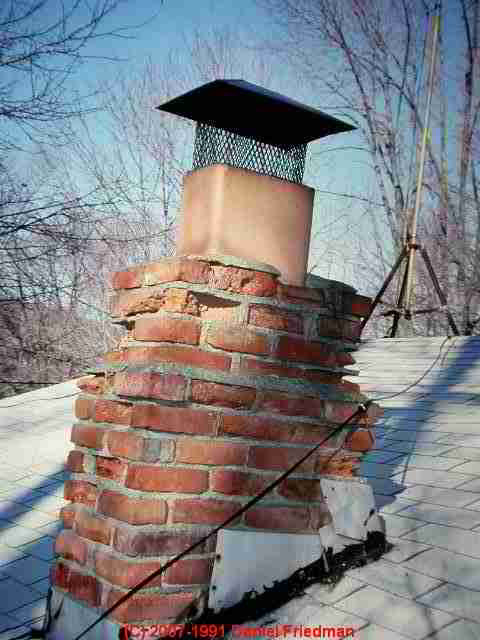
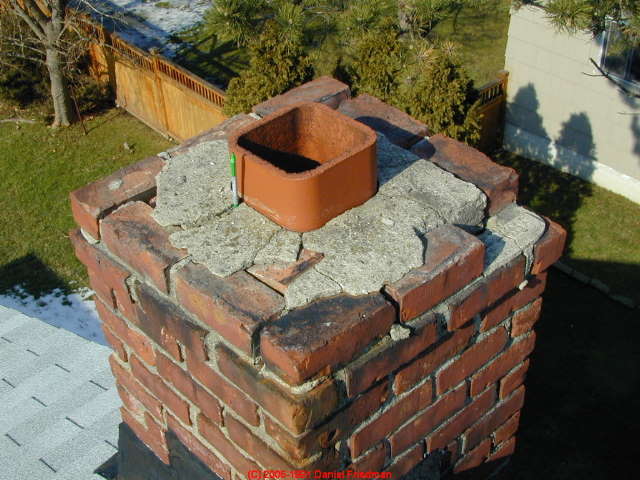
The photo at above left shows a cracked chimney top seal or "crown" and also that there is no chimney cap installed. Notice my green pen [DF] sticking right into the chimney masonry at the top?
Water and frost damage are risks for this flue. What else can we see on this chimney top?
The flue looks pretty clean - perhaps this is a gas-fired appliance. The top clay liner looks good - at least the part we can see in the photo, but don't assume anything about the rest of the flue before it's inspected.
See the individual chimney inspection procedures and defects that can be observed from outside and from inside of a building described
at CHIMNEY INSPECTION from GROUND and
at CHIMNEY INSPECTION at ROOFTOP.
Inside the building we may spot abandoned chimneys, unsafe chimneys, fire hazards and flue gas hazards. During the chimney inspection, we may see little clues which point to potentially serious concerns, like broken clay flue tile liner parts in the bottom of a chimney cleanout opening.
See CHIMNEY INSPECTION INDOORS for details.
Critical Chimney, Vent, & Flue Defects
 Life Safety Hazards at Chimneys include visual evidence of unsafe chimneys, fire hazards, flue gas and carbon monoxide hazards, missing or damaged safety devices (relief valves, emergency shutoffs),
and visual evidence of dangerous overheating or leaks. Life safety hazards also include collapsing chimneys.
Life Safety Hazards at Chimneys include visual evidence of unsafe chimneys, fire hazards, flue gas and carbon monoxide hazards, missing or damaged safety devices (relief valves, emergency shutoffs),
and visual evidence of dangerous overheating or leaks. Life safety hazards also include collapsing chimneys.
Responsibly conducted, an inspection of a gas-fired furnace, for example, might
discover that the furnace has been exposed to severe rust-producing conditions which risk an unsafe heat exchanger and a carbon monoxide hazard
which could be fatal to building occupants.
Even though the interior of a chimney or flue is not fully visible, the contextual clues around the
chimney, if they are visually obvious, should be translated into a level of concern by the inspector, and where appropriate, translated into
a recommendation for action.
This does not mean "failing" every chimney to be on the "safe side", it means responsible inspecting and reporting.
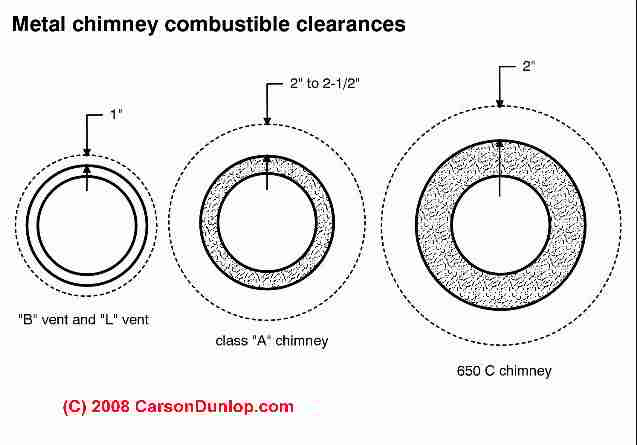
- Costly defects such as evidence of movement, damage to masonry flues, including chimney collapse, metal chimney & flue pitting or rust, leaks and damage to metal flues, and obvious gaps, openings, or lack of clearance to combustibles should be reported. Sketch showing the fire clearance requirements for metal chimneys (above), courtesy of Carson Dunlop Associates, a Toronto home inspection, education & report writing tool company [ carsondunlop.com ].
Watch out: at UNLINED FLUE INSPECTIONS we describe a scary story that happened when we identified an unsafe chimney and advised our client to have a chimney expert inspect and repair the condition. She called a chimney company listed in her local telephone book.
But the "expert" was so poorly informed about chimney safety that his "repairs" came close to killing the occupants of the house.
See CHIMNEY CLEANING ADVICE, PROCEDURES
Chimney Scam Warnings - Consumer Warning Notice
Watch out: for consumer fraud and scam operations that promise low-priced specials on chimney inspection, cleaning, re-lining, or repairs.
Readers have informed us of a variety of common chimney rip offs involving professional criminals who combine information about new home buyers and local business names with a telephone promise of various chimney services such as chimney cleaning for $39.95.
Homeowners attracted to this chimney deal may encounter scammers who arrive with a ladder, take a superficial look at a chimney, and claim that the chimney is unsafe, needs re-lining, or other treatment.
Details about chimney repair frauds and chimney cleaning scams are
Index to Chimney Inspection & Troubleshooting Articles
Here is an alphabetical list of chimney codes, chimney construction, chimney cleaning, chimney diagnosis & chimney repair articles found at InspectApedia.com.
Our complete index to chimney & flue construction, inspection, diagnosis & repair is
at ARTICLE INDEX to CHIMNEYS & FLUES.
Also try the SEARCH box found at the upper right of each of our pages or at the end of each article.
...
Reader Comments, Questions & Answers About The Article Above
Below you will find questions and answers previously posted on this page at its page bottom reader comment box.
Reader Q&A - also see RECOMMENDED ARTICLES & FAQs
On 2020-11-24 by (mod) - What is the chimney height and distance from a solid wall,
Celia
In the ARTICLE INDEX you will find an article on Chimney height requirements
On 2020-11-24 by Celia Curtis
What is the chimney height and placement ie from a solid wall, on a garage roof to stop all the smoke from a wood burning appliances flooding into my home? Me and my cat smell like kippers!
On 2020-11-15 by (mod) - what will it cost to replace an outdated gas fireplace chimney flue
Ted
With apologies I cannot know nearly enough about your building and chimney and requirements to give an accurate cost guess at the repairs needed.
I suggest getting a certified chimney installer or mason on site to inspect, diagnose, and tell you what's needed.
There are "snorkels" provided by some gas fireplace manufacturers to permit extending a gas fireplace exhaust upwards before it turns horizontal to vent outside through the building wall. Check with the manufacturer of your specific gas log fireplace brand and model.
You're welcome to attach more details, including photos (one per comment) that might let me comment further.
On 2020-11-1 by Ted
Have a masonry fireplace in the basement of our brick home that was built for a gas log. It’s built in the corner of the room and has a four-inch diameter metal single wall flue.
The flue is below ground and extends a foot above grade exhausting out to the side of the house. It's around 60 years old and the flue needs replacing.
What will it take to replace the outdated flue to code?
On 2020-10-25 by (mod) - What is the chimney height rule on a metal prefabricated barn/shop?
Dallas
We give common chimney height and top clearance distances
at CHIMNEY HEIGHT & CLEARANCE CODE
On 2020-10-25 b by Dallas carey
What is the chimney height rule on a metal prefabricated barn/shop?
On 2020-10-15 by (mod) - date of a home based on whether the chimneys are exterior or interior
Thanks CL for an interesting question.
I'm sorry to say that I cannot relate the year of construction of a home with inside or exterior chimneys, as I find both construction methods extending from time immemorial to the present.
There were some eras when an interior chimney was perhaps more popular, such as when fireplaces were the primary source of heat in a building; that'd date from before the development of the Franklin stove in the 1700s.
But all types of chimney continue to be built.
On 2020-10-15 by clfurlow@hotmail.com
Please share how to tell the date of a home based on whether the chimneys are exterior or interior to the structure.
On 2019-10-10 by (mod) - home made chimneys are unsafe
Justin
In somewhat of a stick-in-the-mud reply I must emphasize that ANY makeshift chimney that is therefore not UL listed and approved is a potential catastrophe: burning down the house or killing its occupants with CO.
Therefore my suggestion would be to look into
1. a direct-vent system that is designed to work with and ok'd by your particular heating boiler or furnace brand and model (check the IO manual or check with the manufacturer)
2. a metal chimney of the proper type for your fuel (gas or oil) - that is a listed, approved product. Such a chimney can be put up far more quickly than a masonry chimney and flue.
On 2019-10-10 by Justin
My chimney flue is deteriorating and i've decided to rebuild my entire chimney; however, it is starting to get into cold season and i will likely need to run my boiler heater during chimney repairs. Can i stack up flues to create a temporary chimney to keep the boiler active or what can i use as a temporary chimney?
Choices for Re-Lining Masonry Chimney Flues
This topic has moved to CHIMNEY RE-LINING CHOICES for details.
Damaged Chimney flues: cracks, holes, spalling
Spalled brickwork can be replaced brick by brick or the chimney can be rebuilt after tearing it down to a sound level.
This allows for new flue tiles to be installed if needed. Cracks need to be evaluated to identify the cause - a crack may indicate serious chimney movement, structural damage, risk of collapse, flue gas and fire hazards, or improper construction leading to thermal cracking.
See CHIMNEY CRACK DETECTION & DIAGNOSIS.
Metal Chimney Component Replacement
Metal components can be replaced and single-wall flue connectors, if corroded on the bottom of horizontal sections, can be replaced with Type B or L flues which will maintain the flue gas temperature and minimize condensation.
See REPLACEMENT PARTS for METAL CHIMNEYS for details
...
Continue reading at CHIMNEY TYPES & MATERIALS or select a topic from the closely-related articles below, or see the complete ARTICLE INDEX.
Or see CHIMNEY INSPECTION DIAGNOSIS FAQs
Or see these
Recommended Articles
- ABANDONED CHIMNEYS
- BRACKET CHIMNEYS & GALLOWS BRACKETS
- CHIMNEY & FIREPLACE CONSTRUCTION
- CHIMNEY DEFINITIONS
- CHIMNEY CAP & CROWN DEFINITIONS
- CHIMNEY CLEARANCE & CONDITION SAFETY
- CHIMNEY COMPONENT DEFINITIONS
- CHIMNEY CRACK DETECTION & DIAGNOSIS
- CHIMNEY DRAFT & PERFORMANCE
- CHIMNEY FLUE SIZE SPECIFICATIONS
- CHIMNEY HEIGHT & CLEARANCE CODE
- CHIMNEY INSPECTION DIAGNOSIS REPAIR - home
- ATTIC CHIMNEY INSPECTION
- CHIMNEY CLEANOUT DOOR INSPECTION
- CHIMNEY FLASHING MISTAKES & LEAKS
- CHIMNEY FLUE INSPECTION CAMERA
- CHIMNEY INSPECTION CHECKLIST
- CHIMNEY INSPECTION, FLUE INTERIOR
- CHIMNEY INSPECTION from GROUND
- CHIMNEY INSPECTION INDOORS
- CHIMNEY INSPECTION OUTDOORS
- CHIMNEY INSPECTION PROCEDURE SUMMARY
- CHIMNEY INSPECTION at ROOFTOP
- CHIMNEY TOP MASONRY DAMAGE
- FLUE TILE DAMAGE in CHIMNEY
- CHIMNEY LEANING, SEPARATION, MOVEMENT
- CHIMNEY RAIN CAP / RAIN COVER INSPECTION
- CHIMNEY RE-LINING CHOICES - choices among chimney lining alternatives when a flue liner is missing or damaged
- CHIMNEY REPAIR METHODS
- CHIMNEY STAINS & LEAKS
- DIRECT VENTS / SIDE WALL VENTS
- FIRE CLEARANCES INDOORS
- FIREPLACES & HEARTHS - home
- FLASHING, CHIMNEY Mistakes & Leaks
- MASONRY CHIMNEY GUIDE - home
- METAL CHIMNEYS & FLUES - home
- UNLINED FLUE INSPECTIONS
- WOOD STOVE OPERATION & SAFETY - home
Suggested citation for this web page
CHIMNEY INSPECTION DIAGNOSIS REPAIR at InspectApedia.com - online encyclopedia of building & environmental inspection, testing, diagnosis, repair, & problem prevention advice.
Or see this
INDEX to RELATED ARTICLES: ARTICLE INDEX to CHIMNEYS & FLUES
Or use the SEARCH BOX found below to Ask a Question or Search InspectApedia
Ask a Question or Search InspectApedia
Try the search box just below, or if you prefer, post a question or comment in the Comments box below and we will respond promptly.
Search the InspectApedia website
Note: appearance of your Comment below may be delayed: if your comment contains an image, photograph, web link, or text that looks to the software as if it might be a web link, your posting will appear after it has been approved by a moderator. Apologies for the delay.
Only one image can be added per comment but you can post as many comments, and therefore images, as you like.
You will not receive a notification when a response to your question has been posted.
Please bookmark this page to make it easy for you to check back for our response.
Our Comment Box is provided by Countable Web Productions countable.ca
Citations & References
In addition to any citations in the article above, a full list is available on request.
- Chimney Safety Institute of American, CSIA, CSIA Technology Center, 2155 Commercial Drive, Plainfield, IN 46168. CSIA directory of CISA certified chimney professionals: Website: http://www.csia.org/ Email: mmcsweeney@ncsg.org
- National Chimney Sweeps Guild, NCSG, 2155 Commercial Drive, Plainfield, IN 46168, Tel: 317) 837-1500, Website: http://www.ncsg.org/ , Email: mmcsweeney@ncsg.org
- Shick, W.L., and S. Konzo, CHIMNEYS & FIREPLACES [PDF] (1972) Small Homes Council, University of Illinois
- Konzo, S, J.Tt. Lendrum, K.H. Hinchcliff, W.S. Harris, CHIMNEYS & FIREPLACES [PDF] (1945) Small Homes Council, University of Illinois
- [1] Thanks to Mark Cramer, Tampa Florida, for assistance in technical review of the "Critical Defects" section and for the photograph of the deteriorating gray Owens Corning flex duct in a hot attic. Mr. Cramer is a Florida home inspector and home inspection educator.
- [4] Chimney Inspection Checklist, Carson Dunlop, Associates, Toronto, Ontario
- [5] Chimney & Stack Inspection Guidelines, American Society of Civil Engineers, 2003 - These guidelines address the inspection of chimneys and stacks. Each guideline assists owners in determining what level of inspection is appropriate to a particular chimney and provides common criteria so that all parties involved have a clear understanding of the scope of the inspection and the end product required. Each chimney or stack is a unique structure, subject to both aggressive operating and natural environments, and degradation over time. Such degradation may be managed via a prudent inspection program followed by maintenance work on any equipment or structure determined to be in need of attention. Sample inspection report specifications, sample field inspection data forms, and an example of a developed plan of a concrete chimney are included in the guidelines. This book provides a valuable guidance tool for chimney and stack inspections and also offers a set of references for these particular inspections.
- [6] Fire Inspector Guidebook, (selection of fire inspector guidebooks for various building codes and U.S. states) A Correlation of Fire Safety Requirements Contained in the 1987 BOCA National Codes, (newer edition available), Building Officials and Code Administrators International, Inc. (BOCA), Country Club HIlls, IL 60478 312-799-2300 4th ed. Note: this document is reissued every four years. Be sure to obtain the latest edition.
- [7] Principles of Home Inspection: Chimneys & Wood Heating, in (Principles of Home Inspection), Carson Dunlop, Associates, Toronto, Ontario
- [8] NFPA 211 - Standards for Chimneys & Fireplaces, NFPA 211: Standard for Chimneys, Fireplaces, Vents, and Solid Fuel-Burning Appliances, 2006 Edition (older editions and standards are found at the same bookstore)
- [9] NFPA #211-3.1 1988 - Specific to chimneys, fireplaces, vents and solid fuel burning appliances.[10] NFPA # 54-7.1 1992 - Specific to venting of equipment with fan-assisted combustion systems.
- [11] GAMA - Gas Appliance Manufacturers' Association has prepared venting tables for Category I draft hood equipped central furnaces as well as fan-assisted combustion system central furnaces.
- [12] GAMA - Gas Appliance Manufacturers' Association has prepared venting tables for Category I draft hood equipped central furnaces as well as fan-assisted combustion system central furnaces.
- [13] National Fuel Gas Code, an American National Standard, 4th ed. 1988 (newer edition is available) Secretariats, American Gas Association (AGA), 1515 Wilson Blvd., Arlington VA22209, and National Fire Protection Association (NFPA), Batterymarch Park, Quincy MA 02269. ANSI Z223.1-1988 - NFPA 54-1988. WARNING: be sure to check clearances and other safety guidelines in the latest edition of these standards.
- [14] Uniform Mechanical Code - UMC 1991, Sec 913 (a.) Masonry Chimneys, refers to Chapters 23, 29, and 37 of the Building Code.
- [15] New York 1984 Uniform Fire Prevention and Building Code, Article 10, Heating, Ventilating, and Air Conditioning Requirements
- [16] New York 1979 Uniform Fire Prevention & Building Code, The "requirement" for 8" of solid masonry OR for use of a flue liner was listed in the One and Two Family Dwelling Code for New York, in 1979, in Chapter 9, Chimneys and Fireplaces, New York 1979 Building and Fire Prevention Code:
- [17] "Top Ten Chimney (and related) Problems Encountered by One Chimney Sweep," Hudson Valley ASHI education seminar, 3 January 2000, contributed by Bob Hansen, ASHI
- [18] Chimney Inspection Checklist, Carson Dunlop, Associates, Toronto, Ontario
- [19] "Rooftop View Turns to Darkness," Martine Costello, Josh Kovner, New Haven Register, 12 May 1992 p. 11: Catherine Murphy was sunning on a building roof when a chimney collapsed; she fell into and was trapped inside the chimney until rescued by emergency workers.
- [20] "Chimneys and Vents," Mark J. Reinmiller, P.E., ASHI Technical Journal, Vol. 1 No. 2 July 1991 p. 34-38
- [21] "Chimney Inspection Procedures & Codes," Donald V. Cohen was to be published in the first volume of the 1994 ASHI Technical Journal by D. Friedman, then editor/publisher of that publication. The production of the ASHI Technical Journal and future editions was cancelled by ASHI President Patrick Porzio. Some of the content of Mr. Cohen's original submission has been included in this more complete chimney inspection article: CHIMNEY INSPECTION DIAGNOSIS REPAIR Copies of earlier editions of the ASHI Technical Journal are available from ASHI, the American Society of Home Inspectors.
- [22] Natural Gas Weekly Update: http://tonto.eia.doe.gov/oog/info/ngw/ngupdate.asp Official Energy Statistics from the U.S. Government
- [23] US Energy Administration: Electrical Energy Costs http://www.eia.doe.gov/fuelelectric.html
- [24] Wikipedia Web: https://www.wikipedia.org/ provided background information about some topics discussed at this website provided this citation is also found in the same article along with a " retrieved on" date. NOTE: because Wikipedia entries are fluid and can be amended in real time, we cite the retrieval date of Wikipedia citations and we do not assert that the information found there is necessarily authoritative.
Flutes - organ flutes, Wikipedia entry retrived 7/27/2012 http://en.wikipedia.org/wiki/Flue_pipe#Flutes - NFPA 211 - Standards for Chimneys & Fireplaces, NFPA 211: Standard for Chimneys, Fireplaces, Vents, and Solid Fuel-Burning Appliances, 2006 Edition (older editions and standards are found at the same bookstore)NFPA #211-3.1 1988 - Specific to chimneys, fireplaces, vents and solid fuel burning appliances. NFPA # 54-7.1 1992 - Specific to venting of equipment with fan-assisted combustion systems. GAMA - Gas Appliance Manufacturers' Association has prepared venting tables for Category I draft hood equipped central furnaces as well as fan-assisted combustion system central furnaces.
- National Fuel Gas Code, an American National Standard, 4th ed. 1988 (newer edition is available) Secretariats, American Gas Association (AGA), 1515 Wilson Blvd., Arlington VA22209, and National Fire Protection Association (NFPA), Batterymarch Park, Quincy MA 02269. ANSI Z223.1-1988 - NFPA 54-1988. WARNING: be sure to check clearances and other safety guidelines in the latest edition of these standards.
- Fire Inspector Guidebook, A Correlation of Fire Safety Requirements Contained in the 1987 BOCA National Codes, (newer edition available), Building Officials and Code Administrators International, Inc. (BOCA), Country Club HIlls, IL 60478 312-799-2300 4th ed. Note: this document is reissued every four years. Be sure to obtain the latest edition.
- Uniform Mechanical Code - UMC 1991, Sec 913 (a.) Masonry Chimneys, refers to Chapters 23, 29, and 37 of the Building Code.New York 1984 Uniform Fire Prevention and Building Code, Article 10, Heating, Ventilating, and Air Conditioning Requirements
- New York 1979 Uniform Fire Prevention & Building Code, The "requirement" for 8" of solid masonry OR for use of a flue liner was listed in the One and Two Family Dwelling Code for New York, in 1979, in Chapter 9, Chimneys and Fireplaces, New York 1979 Building and Fire Prevention Code:
- "Top Ten Chimney (and related) Problems Encountered by One Chimney Sweep," Hudson Valley ASHI education seminar, 3 January 2000, contributed by Bob Hansen, ASHI
- "Rooftop View Turns to Darkness," Martine Costello, Josh Kovner, New Haven Register, 12 May 1992 p. 11: Catherine Murphy was sunning on a building roof when a chimney collapsed; she fell into and was trapped inside the chimney until rescued by emergency workers.
- "Chimney & Woodstove Safety", State of Vermont, Division of Fire Safety, Code Information Sheet, January 2007, Office of the Fire Marshal & State Fire Academy, Berlin VT Telephone: 802-479-7561 www.vtfiresafety.org
- "Chimneys and Vents," Mark J. Reinmiller, P.E., ASHI Technical Journal, Vol. 1 No. 2 July 1991 p. 34-38.
- "Chimney Inspection Procedures & Codes," Donald V. Cohen was to be published in the first volume of the 1994 ASHI Technical Journal by D. Friedman, then editor/publisher of that publication. The production of the ASHI Technical Journal and future editions was cancelled by ASHI President Patrick Porzio. Some of the content of Mr. Cohen's original submission has been included in this more complete chimney inspection article: CHIMNEY INSPECTION DIAGNOSIS REPAIR Copies of earlier editions of the ASHI Technical Journal are available from ASHI, the American Society of Home Inspectors.
- Natural Gas Weekly Update: http://tonto.eia.doe.gov/oog/info/ngw/ngupdate.asp Official Energy Statistics from the U.S. Government"
- Building Codes for Chimneys, Fireplaces, & Solid Fuel Burning Appliances": NFPA 211-16 & Mechanical Code 2006 ed. International Mechanical CodeUS Energy Administration: Electrical Energy Costs http://www.eia.doe.gov/fuelelectric.html
- Ceramic Roofware, Hans Van Lemmen, Shire Library, 2008, ISBN-13: 978-0747805694
- Brick chimneys, chimney-pots and roof and ridge tiles have been a feature of the roofs of a wide range of buildings since the late Middle Ages. In the first instance this ceramic roofware was functional - to make the roof weatherproof and to provide an outlet for smoke - but it could also be very decorative. The practical and ornamental aspects of ceramic roofware can still be seen throughout Britain, particularly on buildings of the Victorian and Edwardian periods. Not only do these often have ornate chimneys and roof tiles but they may also feature ornamental sculptures or highly decorative gable ends.
This book charts the history of ceramic roofware from the Middle Ages to the present day, highlighting both practical and decorative applications, and giving information about manufacturers and on the styles and techniques of production and decoration. Hans van Lemmen is an established author on the history of tiles and has lectured on the subject in Britain and elsewhere. He is founder member and presently publications editor of the British Tiles and Architectural Ceramics Society. - Chimney Inspection Checklist, Carson Dunlop, Associates, Toronto, Ontario
- Chimney & Stack Inspection Guidelines, American Society of Civil Engineers, 2003 - These guidelines address the inspection of chimneys and stacks. Each guideline assists owners in determining what level of inspection is appropriate to a particular chimney and provides common criteria so that all parties involved have a clear understanding of the scope of the inspection and the end product required. Each chimney or stack is a unique structure, subject to both aggressive operating and natural environments, and degradation over time. Such degradation may be managed via a prudent inspection program followed by maintenance work on any equipment or structure determined to be in need of attention. Sample inspection report specifications, sample field inspection data forms, and an example of a developed plan of a concrete chimney are included in the guidelines. This book provides a valuable guidance tool for chimney and stack inspections and also offers a set of references for these particular inspections.
- Fireplaces, a Practical Design Guide, Jane Gitlin
- Fireplaces, Friend or Foe, Robert D. Mayo
- NFPA 211 - Standards for Chimneys & Fireplaces, NFPA 211: Standard for Chimneys, Fireplaces, Vents, and Solid Fuel-Burning Appliances, 2006 Edition (older editions and standards are found at the same bookstore)
- Principles of Home Inspection: Chimneys & Wood Heating, in (Principles of Home Inspection), Carson Dunlop, Associates, Toronto, Ontario
- U.S. vs. Canadian Unlined Masonry Chimney Flue Requirements & Case Study
- NFPA 211 - 3-1.10 - Relining guide for chimneys
- NFPA 211 - 3-2 - Construction of Masonry Chimneys
- NFPA 211 - 3-3 - Termination Height for chimneys
- NFPA 211 - 3-4 - Clearance from Combustible Material
- NFPA 54 - 7-1 - Venting of Equipment into chimneysBrick Institute of America
- - Flashing Chimneys Brick Institute of America
- - Proper Chimney Crowns Brick Institute of America
- - Moisture Resistance of BrickAmerican Gas Association - New Vent Sizing Tables
- Chimney Safety Institute of America - Chimney Fires: Causes, Effects, Evaluation
- National Chimney Sweep Guild - Yellow Pages of Suppliers
- In addition to citations & references found in this article, see the research citations given at the end of the related articles found at our suggested
CONTINUE READING or RECOMMENDED ARTICLES.
- Carson, Dunlop & Associates Ltd., 120 Carlton Street Suite 407, Toronto ON M5A 4K2. Tel: (416) 964-9415 1-800-268-7070 Email: info@carsondunlop.com. Alan Carson is a past president of ASHI, the American Society of Home Inspectors.
Thanks to Alan Carson and Bob Dunlop, for permission for InspectAPedia to use text excerpts from The HOME REFERENCE BOOK - the Encyclopedia of Homes and to use illustrations from The ILLUSTRATED HOME .
Carson Dunlop Associates provides extensive home inspection education and report writing material. In gratitude we provide links to tsome Carson Dunlop Associates products and services.
 | HOME | ABOUT | ASK a QUESTION | CONTACT | CONTENT USE POLICY | DESCRIPTION | POLICIES | PRIVACY | |
| © 2024 - 1985 Publisher InspectApedia.com - Daniel Friedman | |||||||||