
InspectAPedia® FREE Encyclopedia of Building & Environmental Construction, Diagnosis, Maintenance & Repair |
Question? Just ask us! InspectAPedia
|
 Wood Siding
Types,
Choices, Installation, Maintenance
- POST a QUESTION or COMMENT about choosing among types of wood siding
Wood siding materials, wood types, grades, moisture content, profile images:
This article discusses choices of wood siding materials for buildings: shingles, clapboards, and wood product grades and appearance profiles.
This article series discusses best practices construction details for building exteriors, including water and air barriers, building flashing products & installation, wood siding material choices & installation, vinyl siding, stucco exteriors, building trim, exterior caulks and sealants, exterior building adhesives, and choices and application of exterior finishes on buildings: paints, stains.
InspectAPedia tolerates no conflicts of interest. We have no relationship with advertisers, products, or services discussed at this website.
- Daniel Friedman, Publisher/Editor/Author - See WHO ARE WE?
Guide to Wood Siding Products on buildings: Choices, Installation, Maintenance
 Adapted/paraphrased with permission from Best Practices Guide to Residential Construction - Steve Bliss, J Wiley & Sons).
Solid wood siding materials (clapboards, drop-leaf or novelty siding, wood shingles, vertical wood siding, board and batten, etc.) have been used for hundreds of years and remain popular in many sections of the United States and other countries despite their need for regular refinishing.
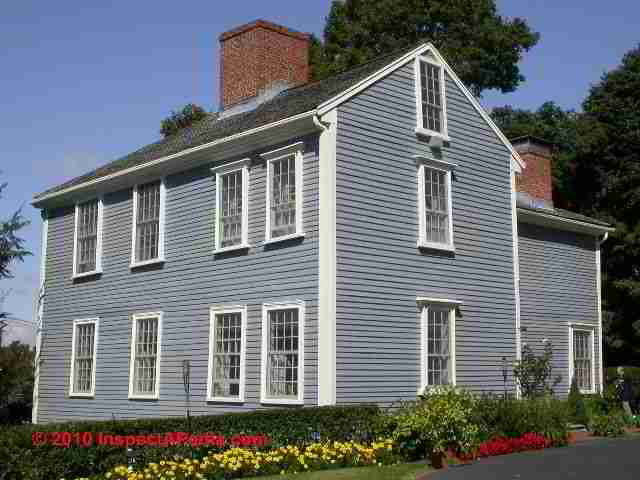
Our photo of a wood clapboard-sided home (left) shows the Daniel Vose house, referred to historically as the Suffolk Resolves historic home (1774) relocated to Milton MA.
[Click to enlarge any image]
(More about this building is at ARCHITECTURE & BUILDING COMPONENT ID.)
Article Contents
- BOARD & BATTEN SIDING
- CLAPBOARD SIDING drop siding, shiplap siding, novelty siding, bungalow siding and other clapboard products
- HARDBOARD SIDING Abatibi, Boise Cascade, JamesHardie, HardiePlank
- PLYWOOD & T111 SIDING
- WOOD SHINGLE SIDING TYPES, PATTERNS
- WOOD SPECIES CHOICES for Wood Siding: properties of Cypress, red cedar, redwood, pine, spruce siding/shingles
- GRADING METHODS for Wood Siding Products
- PREMIUM GRADES OF WOOD SIDING, codes, types, ratings
- KNOTTY GRADES OF WOOD SIDING
- MOISTURE CONTENT TARGETS for Wood Siding on buildings
- IMAGES OF WOOD SIDING PROFILES: Bevel, Rabbeted Bevel, Shiplap, Tongue & Groove, Channel Rustic,Board & Batten and a link to a complete catalog of siding profiles from WWPA
- WOOD SIDING DAMAGE TYPES
In the Northeastern U.S., the most popular wood siding profile remains a simple bevel siding, or “clapboard.” In the western states, heavier profiles such as channel rustic are more common.
Plywood building siding products such as "T-111" grooved siding products installed in 4' x 8' sheets has been widely used throughout the U.S. since the 1970's.
Board & Batten Siding
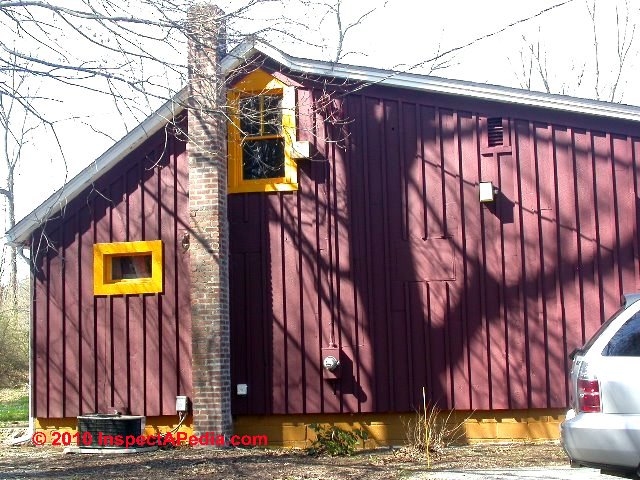
Above left, traditional board and batten siding (Pleasant Valley, NY) traditionally used on barns. Battens are nailed over gaps between vertical board siding, taking care to nail only on one side to avoid splitting.
Details about this siding method are
Clapboard Siding
Above: wood clapboards installed rough-side out for a more rustic look and one that according to some, may provide better paint adhesion.
See PAINT FALURE, DIAGNOSIS, CURE, PREVENTION
Above left, 1960's vintage aluminum siding installed over pre-1900 wood clapboard siding in a New York Home in the U.S.
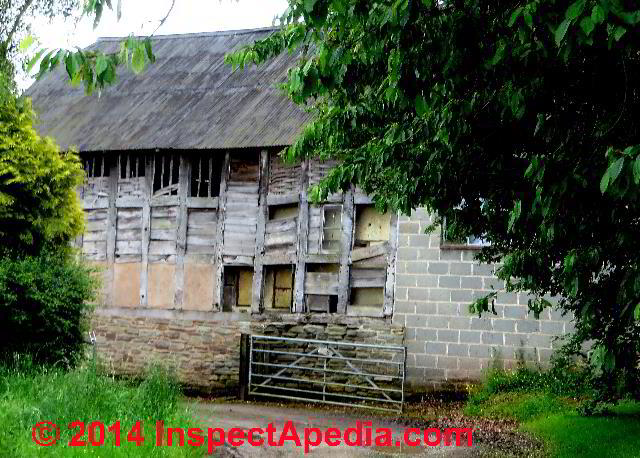
Above [click to enlarge] is an interesting use of wood clapboards on an antique barn in Herefordshire, England in the U.K. These clapboards are nailed to the interior side of vertical rough-hewn barn beams supporting the wall structure.
You can see that the original barn was expanded on its right side using concrete blocks.
Separately at SIDING, WOOD PROFILES & SOURCES you will find an extensive catalog of wood-board siding shapes or designs.
Plywood & T111 Siding
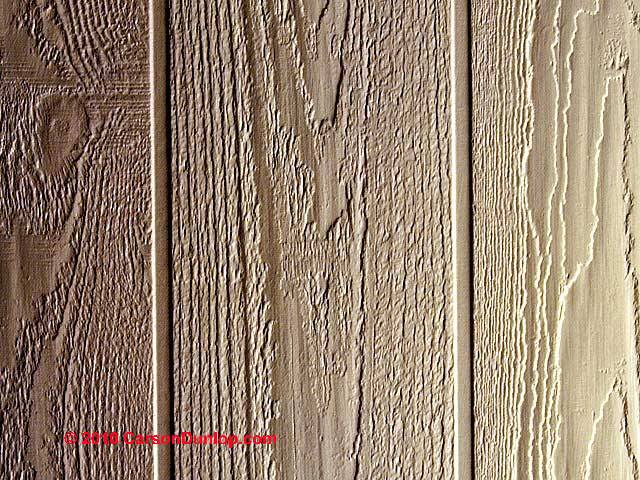
Our close up of T-111 type plywood siding (left) is provided courtesy of Carson Dunlop Associates, a Toronto home inspection, education, & report writing tool company.
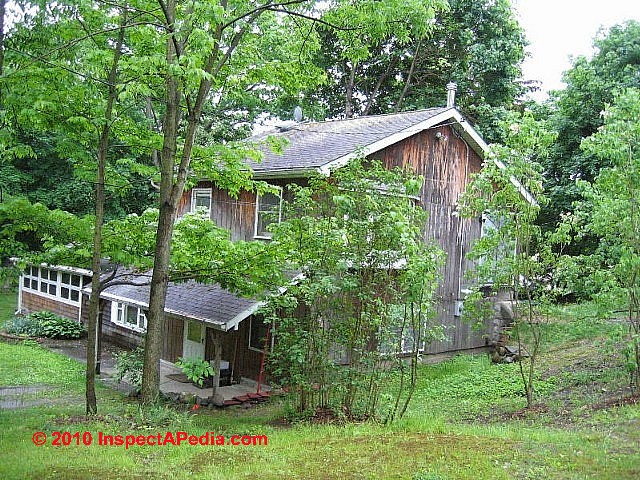
Above we show weathered plywood grooved siding (popularly called "T-111") on a 1980 constructed addition that by 2000 showed uneven weathering.
At BUILDING SHEATHING WRAP - HOUSE WRAP INSTALLATION, PURPOSES, GUIDE is a photo of this same building addition under construction twenty years previously.
Hardboard Siding: Abatibi, Boise Cascade, JamesHardie, HardiePlank,
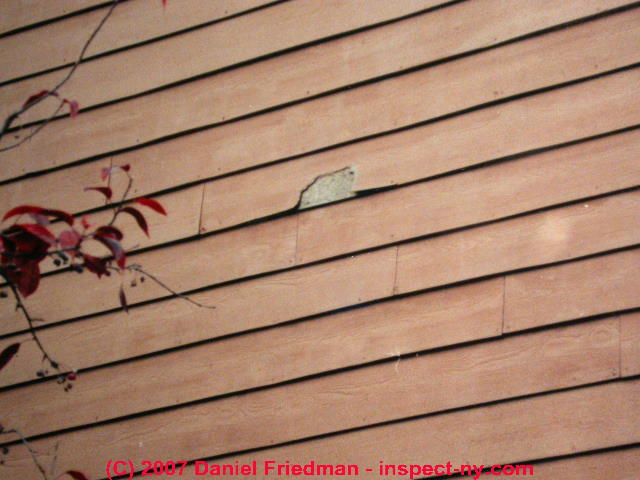
Above left, Masonite-type wood product siding: hardboard.
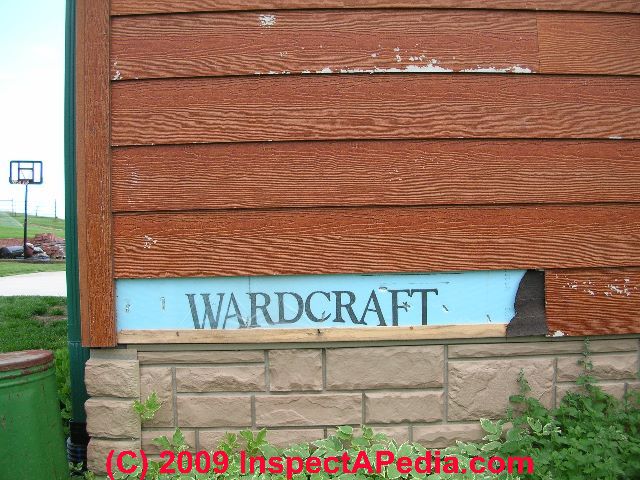
Above HardiePlank wood siding with some peeling stain concerns.
Details are at JAMES HARDIEPLANK® FC SIDING.
Also see
Wood Shingle Siding Types
Cedar Shingle Siding
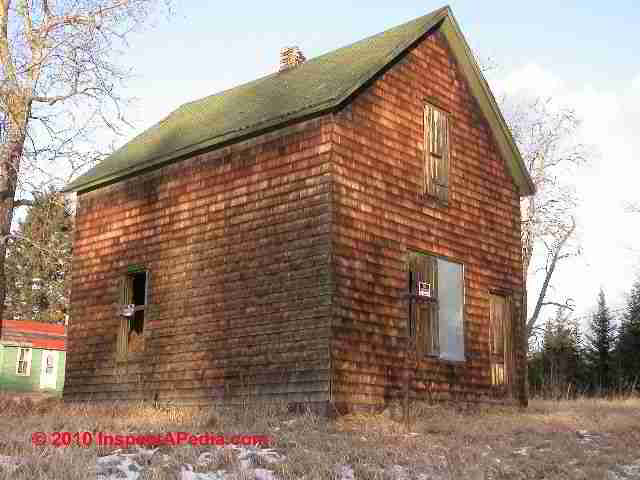
Above left, wood shingle siding, Two Harbors MN.
Brushed Wood Cedar Shingle Siding with Fiberboard Backer
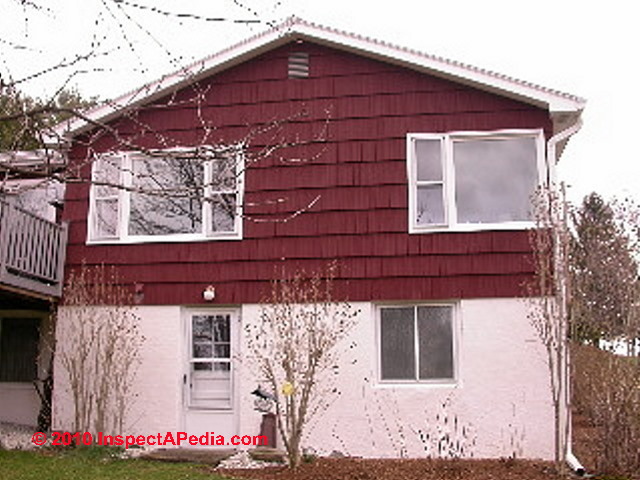
Above and below, this 1960's ranch home in New York was sided with brushed cedar shingle siding.
... 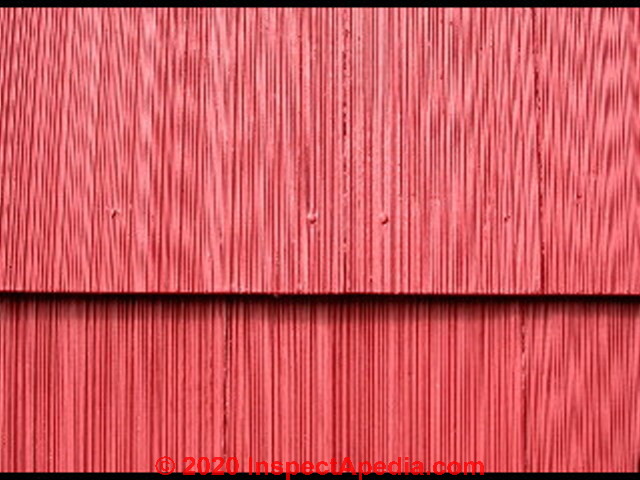
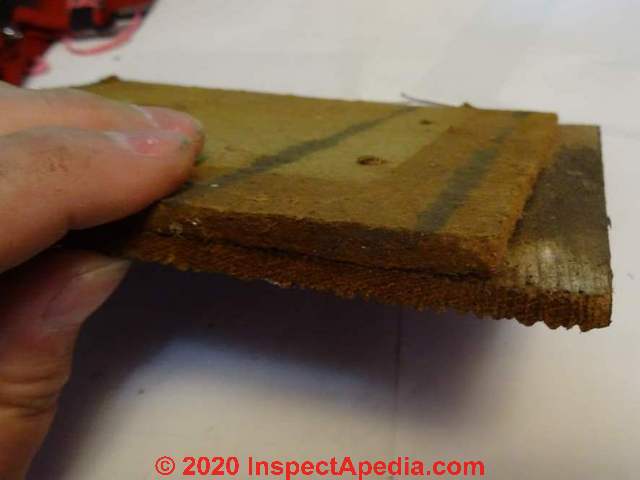
Often this brushed cedar shingle siding was manufactured as a thin product adhered to or nailed over a fiberboard backer as we illustrate below, courtesy of an anonymous InspectApedia.com reader.
... 
Details are
at SIDING WOOD SHINGLE BRUSHED CEDAR
Wood Species Choices for Wood Siding: properties of cypress, red cedar, redwood, pine, spruce siding/shingles

Red cedar remains the wood siding material of choice due to the natural decay resistance of the heartwood and its attractive appearance when stained or finished clear.
Other decay-resistant woods are popular in the regions where they are produced: for example, redwood on the West Coast and cypress in the Southeast and Gulf Coast.
On projects where premium wood species are not affordable, builders also use a wide variety of softwoods, including pine and spruce, which are not naturally resistant to decay.
While most suppliers of wood siding now recommend back-priming and priming of cut ends, these details are even more critical with the less decay-resistant species.
Our photograph of brushed wood cedar shingle siding (above) on a Canadian home was provided by Carson Dunlop Associates, a Toronto home inspection, education & report writing tool company [ carsondunlop.com ].
Grading Methods for Wood Siding Products
Since wood siding is a nonstructural application, grading is generally for appearance only and is not governed by building codes.
Most western species used for siding are graded according to one of the established grading agencies such as the Western Wood Products Association (WWPA).
Still, manufacturers are free to name the grades as they choose for marketing purposes.
So one company’s “Select” grade may be quite different from another’s. For this reason, it is best to examine the material before specifying or purchasing.
Premium Grades of Wood Siding
Western woods are generally labeled either premium or knotty grades. Premium grades have more heartwood and fewer defects and are typically kiln dried.
The highest grades of cedar are typically
- Clear VG (vertical grain)
- Heart and
- Clear Heart.
Premium grades for other western woods include
- C Select,
- D Select,
- Superior, and
- Prime.
Knotty Grades of Wood Siding
In general, “sound tight knots” or “select tight knots” (STK) indicates that there are no knots that will come loose or affect the performance of the siding.
Other common designations are Select Knotty, Quality Knotty, 2 & Better Common, 3 & Better Common, and NPS (no prior selection).
Since there are no uniform standards for these designations, an inspection of the material is important.
Moisture Content Targets for Wood Siding on buildings
Ideally, the siding should be installed at close to its equilibrium moisture content for the local climate (see Table 1-2 below). In general, unseasoned or green wood is shipped with a moisture content of greater than 19%. Air-dried or kiln-dried siding is shipped with a moisture content of 15 to 19%.
In western woods, dry has a different meaning for premium and knotty grades.

[Click to enlarge any image]
In premium wood siding grades, dry means that the siding has no more than 15% moisture content. In knotty grades, dry means that the moisture content does not exceed 19%. Dry siding stored on the site (stickered if possible) will usually acclimate to local conditions in a week to 10 days. Unseasoned wood may need 30 days or longer to acclimate.
Wood Siding Profiles
Bevel, Rabbeted Bevel, Shiplap, Tongue & Groove, Channel Rustic, Board & Batten, Cove Lap, Dutch Lap, German Lap Siding
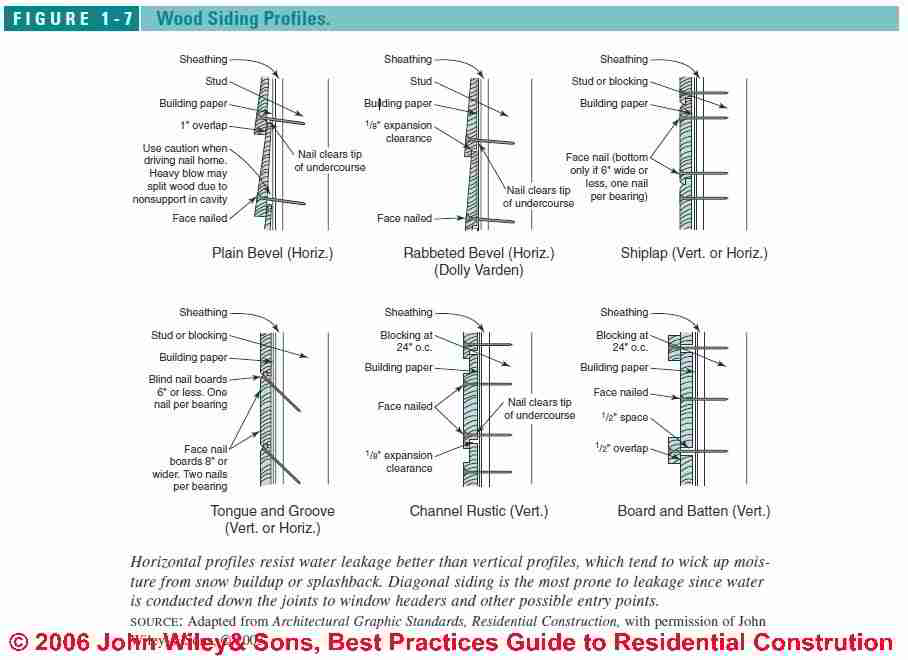
Because horizontal profiles naturally shed water, they resist water leakage better than vertical profiles.
Also vertical wood siding is prone to wick up moisture from the bottoms of the boards, particularly where there is snow buildup or splashback.
Diagonal siding is the most prone to leakage since water is conducted down the joints to window headers and other possible entry points. The most common profiles with typical installation details are shown in Figure 1-7 above.
[Click to enlarge any image]
- - Adapted with permission from Best Practices Guide to Residential Construction (Steve Bliss, J Wiley & Sons)
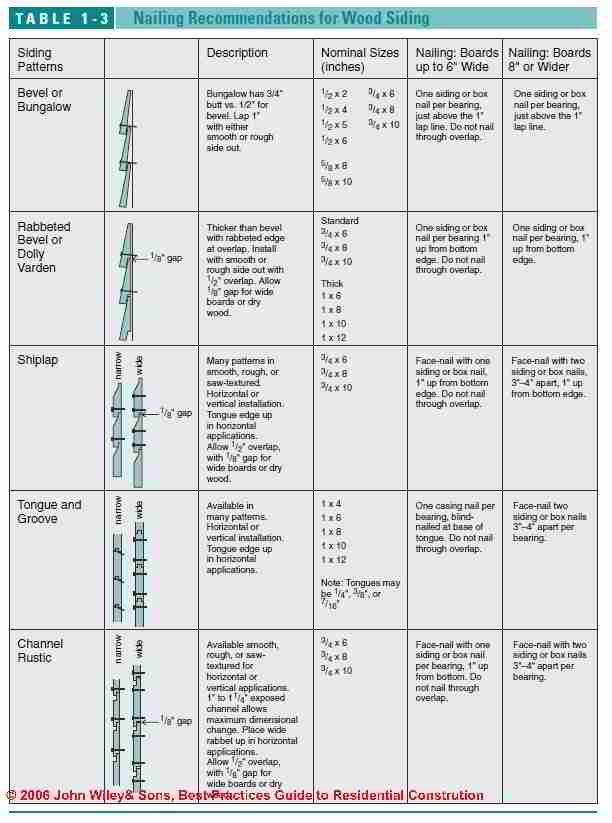
More wood siding profiles are illustrated in the siding nailing schedule Table 1-3 discussed at NAILING SCHEDULE for Building Siding Materials
Wood Siding Damage, Installation, Maintenance, Repair Research
Types of damage to wood siding & references / research on wood siding damage are listed here.
- ADC, USDA-APHIS. "WOODPECKERS."
- Biblis, Evangelos J. "Effect of weathering on surface quality and structural properties of six species of untreated commercial plywood siding after 6 years of exposure in Alabama." Forest Products Journal 50, no. 5 (2000).
- Cassens, Daniel L., and William C. Feist. Selection and Application of Exterior finishes for Wood. Vol. 135. Cooperative Extension Service, Purdue University, 1988.
- Feist, William C., and A. E. Oviatt. "Wood siding: installing, finishing, maintaining." [PDF] Home and garden bulletin 203. US Dept. of Agriculture, Forest Service. Forest Products Laboratory, 23 pages (1983).
- Messmer, Terry A., and Gerald W. Wiscomb. WOODPECKERS [DAMAGE MANAGEMENT] [PDF] Animal Damage Control, Utah State University, Wildlife Damage Management Series, w/ Utah Division of Wildlife Resources, USDA et als, (1998 - 2010) Retrieved 2019 09 27 original source https://digitalcommons.usu.edu/cgi/viewcontent.cgi?article=3302&context=wild_facpub
This article is widely reproduced including by the North Dakota State University, the USDA-APHIS Animal Damage Control, and others.
Excerpt:
For the most part, woodpeckers are beneficial birds because of the large numbers of insect pests they eat. However, when wood-sided buildings, wooden fences, power poles, and orchards become the focus of their attention, serious damage can occur. - NAVFAC, FINISH CARPENTRY, Wood, Plastics, and Composites, including product selection, installation, repair, maintenance [PDF] USACE / NAVFAC / AFCESA / NASA, UFGS-06-20 00 (2012)
- Powter, Andrew. "Keeping wood siding on historic buildings." Nuts and Bolts,[PDF] HÉRITAGE 10, no. 4 (2007): 40-47.
- Stayton, Charles L. "Painting the Exterior Wood of Your Home." [PDF] Leaflet/Texas Agricultural Extension Service; no. 984. (1990).
- USDA WOOD SIDING INSTALLING FINISHING MAINTAINING [PDF] United States Department of Agriculture (1975) retrieved 2019/09/27 original source: https://naldc.nal.usda.gov/download/CAT75667271/PDF
- U.S. Forest Products Laboratories, WOOD SIDING– INSTALLING, FINISHING, MAINTAINING [PDF] US FPL 1983, retrieved 2018/12/25, original source: https://www.fpl.fs.fed.us/documnts/usda/hgb203.pdf
- Wilson, Louis F., and Henry A. Huber. A Bird and Bee Problem in House Siding. [PDF] Research Note NC-209. St. Paul, MN: US Dept. of Agriculture, Forest Service, North Central Forest Experiment Station 209 (1976).
Abstract:
Plywood house siding made to simulate reverse board-and-batten design is sometimes attacked by woodpeckers because leaf-cuttlng bees, their prey, make nests in holes in the plywood core. The problem can be preVented by plugging the holes before nesting occurs. If nesting does occur, the nest should be destroyed and then the holes plugged. - Also see additional citations atReferences or Citations
...
Reader Comments, Questions & Answers About The Article Above
Below you will find questions and answers previously posted on this page at its page bottom reader comment box.
Reader Q&A - also see RECOMMENDED ARTICLES & FAQs
How Can I Paint or Stain a Building to Hide Dark Stains on Cypress Siding?
Hello, I am a 73 year old retiree living in Arkansas. I would like to find information on the care for our cypress home. I am not too good at computers and hope you can point us in the right direction to obtain help from your technical people or your website.
Our home is 7 years old and when we built we chose cypress external siding believing it was a very durable wood and would naturally turn a nice gray color and would not require a lot of maintenance. We elected not to seal it.
Needless to say we probably did not do the proper research. While the cypress siding is still in very good condition with no cracking and no warping the color is not what we had hoped for.
Some days it is ok but as weather and humidity changes some parts of the siding will turn into a blackish color but go away as weather changes again.
Also some areas have aged more than others. We are at somewhat of a loss as to what we should do. My basic questions are as follows.
- Will the unsightly appearance go away as it ages more or will it get worse?
- If the black coloring is a mold or mildew is it harmful to the wood and can it be treated?
- Should we go ahead and clean and seal the wood realizing the quite large expense will need to be repeated every 3-4 years. If so can you offer any good product choices.
We are retired (fixed income) and are searching for the best solution both for the cost and the proper maintenance of the cypress while hopefully also gaining a much better appreciation for the color and appearance.
Any help would be appreciated, best regards, - Anonymous,in Arkansas, by private email 2016/05/18
Reply: how cypress & other wood siding products weather & wear on a building
Thank you for the interesting question - it helps us realize where we need to work on making our text more clear or more complete.
A competent onsite inspection by an expert usually finds additional clues that would permit a more accurate, complete, and authoritative answer than we can give by email alone. You will find additional depth and detail in articles at our website including in some wood siding articles I'll recommend just below.
That said I wrote a detailed reply to you by email and now have repeated those comments with considerable additional information in a new article
at SIDING, WOOD CLEANERS, STAINS, PAINTS - please take a look at that material and let me know what questions remain.
If you use our page top or bottom CONTACT link to send me photos as I request in that article I can also comment further.
Please use the page top or bottom CONTACT link to send me photos of the problem areas of your siding, shown both from a distance (whole side of the building) and close-up views of the stained areas ( but in-focus please).
I'd also like to see photos of all sides of the home and to know directions faced as that helps understand the home's exposures and weathering conditions. With that data I can comment more specifically about your siding and its areas of discoloration.
Can you help me find a match for this rounded-edge double tear drop or double ogee type wood siding?
I'm having the hardest time finding this type of siding, it's rounded at the bottom and near the top. Any help appreciated.
1930s most likely but may be later. we have two houses in the Vero beach, Florida area with this siding. - Anonymous by private email 2017/10/28
Reply: Wood Siding / Lap Siding Pattern Names & Sources
Separately at SIDING, WOOD PROFILES & SOURCES we provide a complete catalog of wood siding shapes or designs, and we give sources for some hard-to-find wood siding profiles
There you will find examples of your siding pattern described as cove cut lap siding or tear drop lap siding. I include current sources for a very close match to this wood siding product.
Comment: than you for un-biased information about siding & its applications
(Jan 27, 2012) Moore Woodworks ccb 173756 Domi said:
Thank you for your detailed information on siding and proper applications, so much of the internet has become commercialized.
Reply:
Thank you Domi, we work hard on our information to make it useful and reliable, we welcome critique, and we are committed to having no conflicting interests. InspectApedia.com does not sell anything - no products, no services. - Daniel
...
Continue reading at WOOD SIDING INSTALLATION or select a topic from the closely-related articles below, or see the complete ARTICLE INDEX.
Or see these
Recommended Articles
- SIDING TYPES, INSTALLATION, DEFECTS - home
- ALGAE, FUNGUS, LICHENS, MOSS
- CAULKS & SEALANTS, EXTERIOR
- FLASHING SIDING DETAILS
- FLASHING WINDOW DETAILS
- HOUSEWRAP INSTALLATION
- MOISTURE CONTENT TARGETS for Wood Siding on buildings
- PAINT FALURE, DIAGNOSIS
- RAIN SPLASH-UP SIDING DAMAGE
- STAINS on RED CEDAR SIDING
- SIDING, WOOD CLEANERS, STAINS, PAINTS
- SIDING DAMAGE by SPLASHBACK
- SIDING LEAK DIAGNOSIS & REPAIR
- SIDING TYPES, INSTALLATION, DEFECTS - home
- SIDING, WOOD INSTALLATION
- SIDING WOOD, FAILURES OVER FOAM BOARD
- SIDING WOOD, FLASHING DETAILS
- SIDING, WOOD PRODUCT CHOICES
- SIDING, WOOD PROFILES & SOURCES
- SIDING WOOD SHINGLE BRUSHED CEDAR
- SIDING WOOD SHINGLE INSTALLATION
- STAIN DIAGNOSIS on BUILDING EXTERIORS
- TREES & SHRUBS, TRIM OFF BUILDING
- TRIM, EXTERIOR CHOICES, INSTALLATION
- VAPOR BARRIERS & CONDENSATION
- WALL SIDING TRIM & FINISHES
- WATER BARRIERS, EXTERIOR BUILDING
Suggested citation for this web page
SIDING, WOOD PRODUCT CHOICES at InspectApedia.com - online encyclopedia of building & environmental inspection, testing, diagnosis, repair, & problem prevention advice.
Or see this
INDEX to RELATED ARTICLES: ARTICLE INDEX to BUILDING SIDING
Or use the SEARCH BOX found below to Ask a Question or Search InspectApedia
Ask a Question or Search InspectApedia
Try the search box just below, or if you prefer, post a question or comment in the Comments box below and we will respond promptly.
Search the InspectApedia website
Note: appearance of your Comment below may be delayed: if your comment contains an image, photograph, web link, or text that looks to the software as if it might be a web link, your posting will appear after it has been approved by a moderator. Apologies for the delay.
Only one image can be added per comment but you can post as many comments, and therefore images, as you like.
You will not receive a notification when a response to your question has been posted.
Please bookmark this page to make it easy for you to check back for our response.
IF above you see "Comment Form is loading comments..." then COMMENT BOX - countable.ca / bawkbox.com IS NOT WORKING.
In any case you are welcome to send an email directly to us at InspectApedia.com at editor@inspectApedia.com
We'll reply to you directly. Please help us help you by noting, in your email, the URL of the InspectApedia page where you wanted to comment.
Citations & References
In addition to any citations in the article above, a full list is available on request.
- Best Practices Guide to Residential Construction, by Steven Bliss. John Wiley & Sons, 2006. ISBN-10: 0471648361, ISBN-13: 978-0471648369, Hardcover: 320 pages, available from Amazon.com and also Wiley.com. See our book review of this publication.
- STANDARD [WOOD SIDING] PATTERNS, [PDF], Western Wood Products Association, 522 SW Fifth Avenue, Suite 500, Portland, OR 97204-2122 Website: www.wwpa.org, Tel: 503-224-3930, Publications: 732-544-2876 retrieved 2017/10/29, original source: https://www.ecosupplycenter.com/assets/docs/WWPA_Pattern_Book.pdf
- Mark Cramer Inspection Services Mark Cramer, Tampa Florida, Mr. Cramer is a past president of ASHI, the American Society of Home Inspectors and is a Florida home inspector and home inspection educator. Mr. Cramer serves on the ASHI Home Inspection Standards. Contact Mark Cramer at: 727-595-4211 mark@BestTampaInspector.com
- John Cranor [Website: /www.house-whisperer.com ] is an ASHI member and a home inspector (The House Whisperer) is located in Glen Allen, VA 23060. He is also a contributor to InspectApedia.com in several technical areas such as plumbing and appliances (dryer vents). Contact Mr. Cranor at 804-873-8534 or by Email: johncranor@verizon.net
- Paul Galow [Website galowconsulting.com ] - technical consultant on networking, LAN design, applications support. Galow Consulting Services [Website galowconsulting.com ] , 914-204-1749, email: paulgalow@galowconsulting.com
- John Rudy, Advantage Home Inspections, Flemington N.J. 08822 home inspector, 908-806- 6364, Home, Radon & Termite Inspections, Central & Parts of North New Jersey, email: jonadvantage1@yahoo.com
- MASONITE WOODRUF® ROOFING OR MASONITE OMNIWOOD® SIDING LAWSUIT SETTLEMENT NOTICE - PDF file
- Decks and Porches, the JLC Guide to, Best Practices for Outdoor Spaces, Steve Bliss (Editor), The Journal of Light Construction, Williston VT, 2010 ISBN 10: 1-928580-42-4, ISBN 13: 978-1-928580-42-3, available from Amazon.com
- The Journal of Light Construction has generously given reprint permission to InspectAPedia.com for this article. All rights and contents are ©Journal of Light Construction and may not be reproduced in any form.
- In addition to citations & references found in this article, see the research citations given at the end of the related articles found at our suggested
CONTINUE READING or RECOMMENDED ARTICLES.
- Carson, Dunlop & Associates Ltd., 120 Carlton Street Suite 407, Toronto ON M5A 4K2. Tel: (416) 964-9415 1-800-268-7070 Email: info@carsondunlop.com. Alan Carson is a past president of ASHI, the American Society of Home Inspectors.
Thanks to Alan Carson and Bob Dunlop, for permission for InspectAPedia to use text excerpts from The HOME REFERENCE BOOK - the Encyclopedia of Homes and to use illustrations from The ILLUSTRATED HOME .
Carson Dunlop Associates provides extensive home inspection education and report writing material. In gratitude we provide links to tsome Carson Dunlop Associates products and services.
 | HOME | ABOUT | ASK a QUESTION | CONTACT | CONTENT USE POLICY | DESCRIPTION | POLICIES | PRIVACY | |
| © 2024 - 1985 Publisher InspectApedia.com - Daniel Friedman | |||||||||