 Water Pump Diagnosis & Repair FAQs
- POST a QUESTION or COMMENT about diagnosing problems with the well water pressure tank or water storage tank that show up as pump operating problems
Well water pump repair FAQs:
This article, third in a series of well and water pump troubleshooting & repair FAQs, provides frequently-asked questions and answers about how to diagnose problems with the water pump.
These questions will help sort out what's wrong.
InspectAPedia tolerates no conflicts of interest. We have no relationship with advertisers, products, or services discussed at this website.
- Daniel Friedman, Publisher/Editor/Author - See WHO ARE WE?
Questions & Answers about Repairing Water Pumps
These questions & answers about diagnosing and fixing problems with well pumps or water pumps were posted originally
at WATER PUMP REPAIR GUIDE - please check out the diagnosis and repair advice given there.
Also see our index to all Q&A about diagnosing and fixing well or water pump problems at WATER PUMP REPAIR FAQs.
Article Index
- CONTINUOUS USE WATER PUMP FAILS - irrigation or watering pumps burn up in continuous use
- OFF GRID WATER & WELL PUMPS
- WATER PUMP ELECTRICAL FAILURES & TESTS - trouble indicators, some may be very dangerous
- WATER PUMP MECHANICAL FAILURES
- WATER PUMP PARTS DEFINITIONS - what's a diffuser or an impeller?
...
Continuous Use or Long On-Cycle Water Pump Failure FAQs
Irrigation pump in continuous use keeps burning up
I use my water well for irrigation. My pump motor had to be replaced after about 6 years.
I open enough valves so when watering the pump runs continuously without turning off and on hoping to increase motor life, knowing that these motors are designed to start and stop over and over am I causing early pump failure by leaving it continuously running for hours at a time? On 2017-07-26 by Larry
by (mod) how to stop burning up the irrigation pump - use a pump rated for continuous duty
Larry,
You raise a common concern: I often hear from people having water equipment or well problems particularly for systems that are used in irrigation or lawn watering systems.
You'd need one of the following to avoid over-taxing the pump and perhaps burning it up:- a new pump motor with a duty cycle rated for continuous-on usage.
Such motors are designed to avoid overheating and to tolerate long on cycles. Look at irrigation pumps. Talk to the pump manufacturer if you can't find the usage duty cycle in the pump's specifications.
Irrigation pumps work harder than some of the continuous duty pond or sprinkler system pumps listed below like the Eco-Steady water pressure booster pump from RPS - a fact you'll see reflected in the pump price.
Examples of Continuous Duty Water Pumps
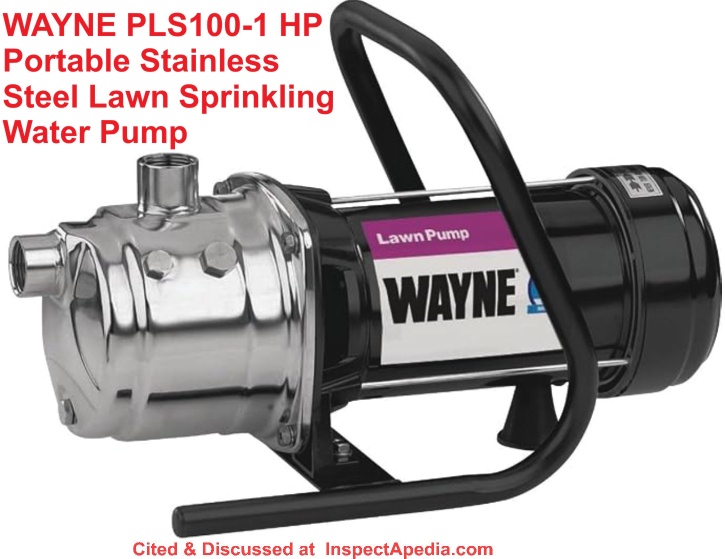
- WAYNE PLS100 1 HP Portable Stainless Steel Lawn Sprinkling Pump rated for continuous duty and capable of 20 ft lift and can pump up to 850 gallons per hour. (Shown above)
- AMT High Head Straight Centrifugal Pump - 4900-98, 118 GPM, 1.5" x 1.25", 3 HP, 230v, water pump is, according to the manufacturer's specs, rated for continuous duty. However the AMT pump is not self-priming and is not designed for application where a water lift-height is involved.
- Aquastrong 115V Shallow Well Garden Pump
- Grundfos (Website) makes water pumps for agricultural, livestock and similar applications but good luck jumping right to pump descriptions without contacting the company.
- RPS 3HP 220V Eco-Steady Continuous Pressure Booster Water Pump (Website) - recommended for high pressure sprinkler irrigation systems or as a full home residential or RV water pressure booster pump or as a shallow well jet pump, from RPS Pumps._
Note that the GPM rating of this pump (and most others) varies depending on the water lift height or "total head". At 10 psi and a 25 ft. head this pump can deliver 50 gpm while at 70 psi and a 160 ft. total head the pump will deliver only 3 gpm. - PSF Continuous Duty pond pump - 50PSF2.25S manufactured by Tsurumi, used in waterfall pond and fountains - the company offers 19 models of this pump
You probably need an irrigation pump or sprinkler system pump model that can lift your water.
- a restricted water flow rate + pressure tank that lets the pump stay off for 10-20 minutes at a shot
- a quite large water pressure tank and a pump that could get ahead of the water usage rate, fill the tank and then stay off for 10 or 20 minutes at a time.
...
Water / Well Pump Electrical Failure & Test FAQs
Crawl space has 6" of standing water and the well pump is smoking
Emergency
The noise of my water softener woke me up because it was so loud. I went to go look at it and there was water running out the bottom
I looked in the crawl space and there is about 6" of standing water and the well pump is smoking. I turned the water off at the water softener and it all stopped. What is the problem and how do I solve it? On 2017-05-27 by Marissa
by (mod)
Marissa,
Watch out: A "smoking" electric motor is most-likely badly overheated and damaged.
The risk is an electrical fire or shock from the equipment. So at the electrical panel turn the pump off immediately.Watch out: do not go into a wet crawl space where there is an electrical hazard like the one you describe. You could easily be shocked or killed.
Water was running out of the bottom of which component: the softener itself or its brine tank? Whichever, that will need replacement if, as you suggest, the tank itself is leaking.
It sounds as if your well pump was overheating dangerously, perhaps because the leak used so much water that the well ran dry - thus overheating the pump.
Leave water off for 4 hours or longer if you can.Put the water softener in bypass mode so that it is not in use and not connected to incoming water.
After waiting a time to allow a marginal-capacity well to recover,
AND after having the pump and its controls and wiring repaired by an electrician or pump service company you might have water.
You'll need help from a plumber to replace the damaged equipment.
by Marissa
All great suggestions and I will work on this asap. Again, thanks so much for taking the time to reply to my questions. I certainly do appreciate your suggestions.
Well pump stopped working, lights dim when it tries to start
My well just stopped pumping water this morning, it still tries to kick on and dims the lights but no water. On 2017-05-03 by Jeramiah
Answer by (mod) -
Jeremiah
Watch out: Be sure to leave the pump electrical power OFF - since you're describing a short circuit or a seized pump motor - we want to avoid an electrical fire.
Then you'll want to call a plumber who is experienced with pumps and pump diagnosis.
Why does my well pump trip the circuit breaker?
My well keeps flipping my breaker and when I try to flip the breaker back on, it flips it again. What is causing it to do this? 2017-05-11 by Carole
Reply by (mod) -
That sounds like either a seized pump impeller or pump motor or an electrical short circuit. I would leave the equipment turned off and call an electrician.
Tested pump pressure switch: control was clicking - no water
Lost water, tested pressure switch ( working ) control box was making clicking noise. Tested pump wires with Ohm meter as per instruction on here , pump has continuity ( 8 ohms /17 ohms ) . Turned off power replaced control box/ turned breaker on, new control box making same clicking then humming noise, but no water. On 2017-03-28 by SAM
Answer by (mod) -
Clicking in the pump control box may mean that you have a submersible pump and it's short cycling. That can burn up a pump motor (more likely for an above-ground pump).
by Sam
yes its a submersed pump. A new control box, any ideas ? thanks in advance
Answer by (mod) -
See WATER PUMP SHORT CYCLING - home to read about the causes - often it's a waterlogged pressure tank.
by Sam
Thanks, been reading to the point getting blurred vision. LOL. The pressure tank in empty, I opened a valve in the pump house that is just past pressure switch but before tank, and nothing
Reply by (mod) -
OK empty pressure tank - not waterlogged.
IF clicking in the control box is frequent I think that means the control is trying to turn the pump on and off too often - which I call short cycling. Other causes of that can include
- a bad relay in the control box
- a pressure switch that is debris clogged and stuck below the cut-in pressure - IE not sensing that system pressure is above the CUT-IN pressure setting
- a leak in well piping between house and pump (at the well piping bottom in the well)
- a pump that's defective and switching on and off on thermal overload (unusual)
This WATER PUMP SHORT CYCLING DIAGNOSIS TABLE may be easier for eyes that are tired of reading through text.Results of Ohmmeter tests on my well pump
Just ran a ohm test again Black-Yellow 3 ohms, Red-Yellow 14.1 ohms, switched control boxes, new to old and back to new nothing.
Closed shut off valve to house, opened valve next to pressure switch, ran pipe cleaner inside no debris or blockage, remaining water from pressure tank dripped out clear, tired gauged pressure tank 28 psi, pressure switch is 20psi on 40 psi off.
Ran volt test at pressure switch, and control box 237. I am at a loss. On 2017-03-28 20:00:41.964802 by Sam
Answer by (mod) -
Sam:
regarding "tired gauged pressure tank 28 psi, pressure switch is 20psi on 40 psi off. "
That's a problem.
Your tank pressure is ABOVE your switch CUT-IN pressure - the switch will never turn on the pump.
With the pump power OFF and the tank empty of water, drop your tank pressure to 18 PSI - always needs to be 2 psi below the switch cut-in pressure.by Sam
Sorry that was a typo on my part, is used a stick and a digital gauge, its 18psi. The pressure switch is closed sending power to box. With valve open next to the tank on a t, if the pump was on shouldn't I be getting water? I am heading to HD to buy a amp meter. thanks again, wish me luck.
Quoting an old movie " the quarter back is toast " bought auto scaling clamp on amp meter, replaced cover turn on breakers and 8.1 amps draw on red, 24.7 amps on yellow. don't know why breakers didn't throw, new Square D breaker box is an easy fix, new pump not so much. $200 bucks in ( new box / amp meter ), just to find out need new pump..... Oh well.
Thanks danjoefriedman (mod)
Unusually high electricity usage by well pump: what's wrong?
I am experiencing unusually high electrical consumption from my well pump. Here are the particulars:
1. Normal electrical usage is less than 20 KWh per day.
2. Usage now = 160+ KWh per day.
3. Electric meter has well pump, irrigation pump and metal barn florescent lights on that meter.
3. Irrigation pump is shut off.
4. Well pump is 5 hp and is not on.
5. Pressure switch recently replaced on well pump in May, 2017.
Consumption dropped to normal for 3 days then spiked back upward to 160+ KWh.
6. Well pump is 17 years old.
7. Well technician checked electric usage problem 10 days ago and the electricity usage plummeted to normal for 4 days - now electrical usage has spiked again.
8. Well technician checked today and the pressure is 70 psi, pump not running intermittently every 15 minutes or so.
9. Technician is the person who drilled and installed the well 17 years ago and is familiar with the well operation. I hope you can help me as this electric utility bill is tracking at $450 per month vs a normal $29 per month bill. What can be the problem? On 2017-06-21 by Pat Taylor
Answer by (mod) -
Pat,
Watch out: Because the situation you describe could include improper or unsafe electrical wiring I suggest asking a licensed electrician to take a look at the circuit and at the pump.
...
Water Pump Parts Definitions / Explanations
Does the diffuser turn with the impeller on a well pump.
Does the diffuser turn with the impeller on a well pump. On 2017-05-22 by Paul L. Allen
by (mod) - no; Here are descriptions of a well pump Impeller and Diffuser and how the Impeller(s) work
Thanks for the good question, Paul.
No, the diffuser is fixed in the pump housing. Adapting an explanation of centrifugal water pump parts from a Michigan State University course I'll cite below, the impeller and diffuser are indeed the two key parts of a water pump.The impeller "impels" water, that is, it moves it by spinning. Vanes on the impeller sling water or impart motion to the water as the impeller is spun by the pump motor, imparting velocity to the water in the pumping chamber.
Inside the same pump housing, the diffuser, often made of plastic, collects the liquid velocity of the water that has been moved by the impeller or "volute" (a synonym). Passages in the diffuser direct the flow of this moving water out of the pump chamber towards the entry into the piping system.
In some pumps that have multiple stages, water may be directed into a second impeller stage to get more water pressure. More stages in a centrifugal pump means that the pump can develop higher water pressure.The number of impellers, the size or diameter of the eye or round opening forming the water exit point at the center of the impeller, the water velocity that is developed by the impeller and diffuser design, and the pump shaft rotation speed determine the pump's output - or really the horsepower that is needed to operate those parts.
Original source: "Centrifugal Pump" [Operation], [MSWord .doc file], Michigan State University, retrieved 2017/05/22, original source https://msu.edu/course/tsm/431/PUMP%20BASICS.doc [Dead link in 2026 - Ed.] This nice concise document from an MSU course explains centrifugal pumps, jet pumps, and submersible pumps in just a few pages.
...
Off Grid Water & Well Pump Q&A
How to get my Off-Grid Well Pump Working Again
I have been trying for years to get my well fired up because I could not figure out the voltage. The main problem is that the 25KW Generator walked away years ago and my Dad has since passed away and I have no idea what the voltage is on the submersible pump.
The Magnetic Starter/Control Box is still in place.(I have pictures!). Here is what I know, it is a 10HP 3 Phase motor and the well pumps 100GPM, a few people have told me that it should be 208v or 230v or 240v while others say there is no way, I have had other people say it should be in the 416v to 440v volt range, which actually makes since if you see the manual I have for the pump(which has no name or manufacture, it is from the 70's).
After being convinced by a couple friends I finally rented a $200 generator to do a little test, which was successful, the well fired up with the switch on 220V 3 Phase, but only pushing out less than half of what it should be, I was to scared to switch the generator to 440V 3 Phase(I have pictures).
My question is, is there way to tell to what voltage this is without risking damage to my pump and motor? I want to figure this out before I purchase a very expensive generator. Any direction would be greatly appreciated. Thanks.
The Mobley Family
Off the Grid in the White Mountains of Arizona On 2017-05-17 by JMobley
Suggestions by (mod) -
JM
Usually we can find a data tag right on the pump motor. That data will give the specifications for the motor's input voltage and wiring.
It is essential to use the 3 phase wiring diagram shown on the pump motor's data tag or plate.
Leeson and others note that the common 60hz voltages for three-phase motors are 230 volt, 460 volt and 230/460 volt. The latter means that some motors can be wired to run under either voltage level. (What does your data tag indicate?)
Leeson also offered this helpful remark:
Motors rated 115/208-230 volt and 208-230/460 volt, in most cases will operate satisfactorily at 208 volts, but the torque will be 20% - 25% lower. Operating below 208 volts may require a 208 volt (or 200 volt) motor or the use of the next higher horsepower, standard voltage motor. - www.leeson.com/TechnicalInformation/electrical.html
That torque reduction could explain the reduced output from your pump, but so could other problems like:
- a clogged inlet strainer
- low flow rate into the well
- damaged or partly blocked pump impeller
Without data tag information I think you would need to take the motor to an electric motor repair shop to have the technician examine the connections and wiring of the motor.by JMobley
I guess that could be a major problem, I am told the motor and pump are at the bottom of the 340 foot deep well and pulling it would be a major undertaking, that's why I was wondering if there was any way to tell what the voltage is by going off of how the box is wired, i.e. jumper placement and other wiring placement
Reply by (mod) -
Sure
Start at the electrical panel, find the breakers; an electrician there can certainly tell what is being delivered on that circuit both by visual inspection in the panel and by using a VOM or DMM.
...
Water / Well Pump Mechanical Failures Q&A
Submersible water pump impeller keeps seizing
I have a small submersible pump I use to transfer water from a tote, so it's only used every other month or so. The impeller keeps seizing, but my neighbour is always able to un sieze it by hand. The impeller assembly is in a sealed case so I can't tear it down.
Any ideas how I can get this to spin, obviously I'm lacking the strength of my neighbour (who isn't here for a while) but I'm far from weak. On 2017-04-17 by Kim
Reply by (mod) -
Kim:
Once a pump impeller keeps seizing it's really best to replace it or the whole pump as it will continue to be unreliable. I suspect a bearing is shot.
Anon:
It sounds to me as if your pressure switch isn't responding to the pressure drop - often that's due to debris clogging.
...
Continue reading at WATER PUMP REPAIR GUIDE - home, or select a topic from the closely-related articles below, or see the complete ARTICLE INDEX.
Or see these
Recommended Articles
- WATER PRESSURE LOSS DIAGNOSIS & REPAIR - home
- WATER PRESSURE TABLE 1: PUMP WON'T RUN, WON'T STOP, or CYCLES
- WATER PRESSURE TABLE 2: PUMP RUNS, WEAK or NO WATER PRESSURE
- WATER PRESSURE TABLE 3: PUMP RUNS, NO WATER or INSUFFICIENT WATER
- WATER PUMP REPAIR GUIDE - home
Suggested citation for this web page
WELL PUMP REPAIR FAQs-4 at InspectApedia.com - online encyclopedia of building & environmental inspection, testing, diagnosis, repair, & problem prevention advice.
Or see this
INDEX to RELATED ARTICLES: ARTICLE INDEX to WATER SUPPLY, PUMPS TANKS WELLS
Or use the SEARCH BOX found below to Ask a Question or Search InspectApedia
Ask a Question or Search InspectApedia
Share this article:Search the InspectApedia website
Need to make a private comment? Email editor@inspectApedia.com. We welcome email with your website content critique, corrections, suggestions or questions. Email is monitored daily but our workload may prevent an immediate reply. For immediate results, we hope you'll first try asking your question using the search box just above.
Citations & References
In addition to any citations in the article above, a full list is available on request.
- In addition to citations & references found in this article, see the research citations given at the end of the related articles found at our suggested
CONTINUE READING or RECOMMENDED ARTICLES.
- Carson, Dunlop & Associates Ltd., 120 Carlton Street Suite 407, Toronto ON M5A 4K2. Tel: (416) 964-9415 1-800-268-7070 Email: info@carsondunlop.com. Alan Carson is a past president of ASHI, the American Society of Home Inspectors.
Thanks to Alan Carson and Bob Dunlop, for permission for InspectAPedia to use text excerpts from The HOME REFERENCE BOOK - the Encyclopedia of Homes and to use illustrations from The ILLUSTRATED HOME .
Carson Dunlop Associates provides extensive home inspection education and report writing material. In gratitude we provide links to tsome Carson Dunlop Associates products and services.
 |
HOME | ABOUT | ASK a QUESTION | CONTACT | CONTENT USE POLICY | DESCRIPTION | POLICIES | PRIVACY | |
| © 2026 - 1985 Publisher InspectApedia.com - Daniel Friedman | |||||||||