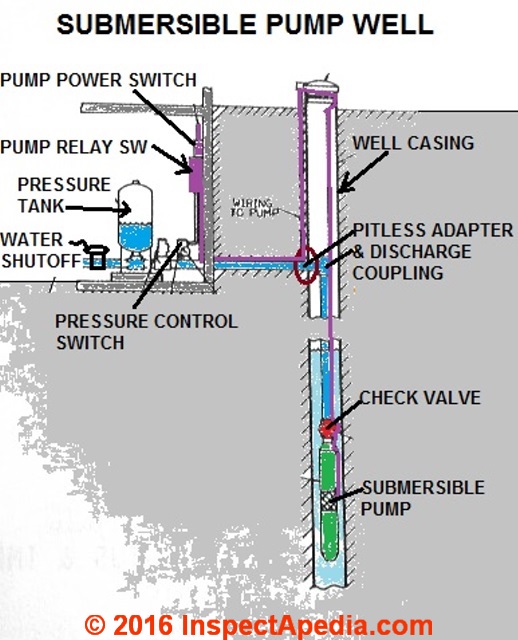
 Submersible Well Pump FAQs
- POST a QUESTION or COMMENT about submersible well pump & pump controls, their properties, installation, troubleshooting & repair
Submersible well pump diagnostic questions & answers:
This article provides a series of questions & answers that can help diagnose problems with submersible pumps used in water wells, including pump operation, loss of water pressure, pump noises, pump control problems, banging pipes, and what to do about floodwater contamination of a well.
This article series describes the components of a submersible well pump water system, how the pump, well and controls work, what the well pump components look like, and what they do. We give submersible well pump troubleshooting advice and invite questions.
InspectAPedia tolerates no conflicts of interest. We have no relationship with advertisers, products, or services discussed at this website.
- Daniel Friedman, Publisher/Editor/Author - See WHO ARE WE?
Submersible Water Pump Diagnostic FAQs
 Here we provide detail about the individual components and operating characteristics of drilled wells using a steel casing where a submersible water pump has been installed in the well to deliver water to the building.
These questions and answers about submersible well pumps (the pump is in the well) were posted originally
at PUMP, SUBMERSIBLE OPERATION - you will want to review the installation, troubleshooting, and repair advice organised there.
Also see our index to all submersible well pump Q&A at SUBMERSIBLE PUMP DIAGNOSTIC FAQs
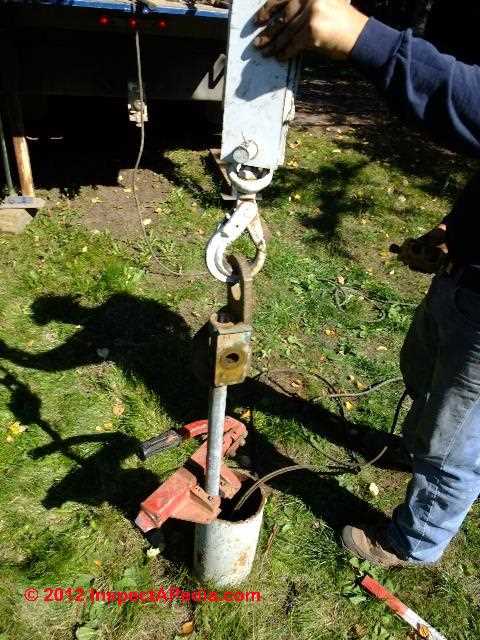
Our photo shows the process of pulling a well pipe and submersible pump.
Article Index
- SUBMERSIBLE PUMP CHECK VALVES
- SUBMERSIBLE PUMP CIRCUIT BREAKER Q&A
- SUBMERSIBLE PUMP FREEZE PROTECTION Q&A
- SUBMERSIBLE PUMP MOTOR TROUBLESHOOTING FAQS
- SUBMERSIBLE PUMP MUDDY WATER Q&A
- SUBMERSIBLE PUMP PRESSURE IS WEAK Q&A
- SUBMERSIBLE PUMP RENTAL SET-UP Q&A - what's involved in renting a temporary pump
- SUBMERSIBLE PUMP SHORT CYCLING - how frequently is too much
- SUBMERSIBLE PUMP SIZING FAQs
- SUBMERSIBLE PUMP USE DURING POWER OUTAGE - how can I get water with no electricity?
- SUBMERSIBLE PUMP WIRING
...
Why is the submersible pump giving muddy water?
Why are we seeing mud in the water from our submersible pump? On 2017-11-20 by Shiv
by (mod) - causes of mud in the water
Leak in through well casing or water level in well extremely low.
Sometimes we can fix this problem by raising the level of the submersible pump higher above the bottom of your well.
Mud and sand are causing overheating of our submersible pump motor
We frequently experience submersible pump failures due to over heating of the motor caused by excessive mud and sand inside the well covering the motor.
We want to know how to protect the motor from this over heating failure.
Are there safety devices that can be fixed inside the well to sense non cooling of the motor or to sense over heating of the motor.
Can we avoid this failure by installing the pump just above the deepest fracture level. On 2015-09-25 by Sirinanda
Suggestions by Anon & Mod
Options include
A deeper well and (easier) a raised pump to let sand and mud settle - keep the pump inlet at least two feet above the bottom of this well.If your pump is in a dug well, consider adding a sediment filter around the pit walls. - DF
...
What size well pump do I need
I have a 400' deep well and 100 feet from the pressure tank with a 1" line what size pump do I need? On 2017-05-07 by Anonymous
Answer by (mod)
1 to 1.5 hp. will work for you.
See this SUBMERSIBLE PUMP CAPACITY TABLE
...
Submersible Pump Water Delivery Problems: Surging or Weak Flow
Water pressure goes from fine to a trickle before the submersible well pump cuts on
4 Jan 2015 Miriam Johnston
I am having trouble keeping water pressure flow to my house Water pressure goes from fine to a trickle before pump cuts on.
Reply:
Check for a clogged pump pressure control switch sensor port or clogged tube conducting water pressure to the pressure switch.
What causes surging in variable speed submersible pump
I have a variable speed submersible well pump that is surging. Would this be a pump issue or could it be a pressure system issue? (Feb 24, 2015) Stuart
Reply:
I'm not certain how you're using the term surging. If you mean that a motor speed is varying, I'd ask my electrician to put a VOM on the circuit to see what the supply voltage itself is doing, then separately I'd ask for a current draw measurement on the pump circuit to look for abormality.
If you mean the pump is cycling on and off rapidly, that short-cycling is typically due to a waterlogged pressure tank.
In that case, see WATER PUMP SHORT CYCLING - home
Need advice for a borewell with low yield & pumping issues in India
Hi , I have drilled a borewell (1006 Feet - 2015 December) - i got water in two sources (2.5 inches) one at 550 Ft and the other at 750 Ft. Earlier i used to get water continuously even for 6-7 hours/day. but nowadays i am getting water continously only for 30 minutes , after that i am not getting water. i need to wait for 1:30 hrs to run the next cycle.. i placed the pump at 850 feet, (4HP 40 Stage/ AQUQ TeXMO - Model RF10A/40) -
so i am planning to lower the pump at 990 ft..so atleast will get water continuously for 1 to 1:30 hrs
1) As per local service center technician, he advised to add 10 more stages on the same pump (by changing some parts on the existing pump like shaft,impeller etc) - to support 1000 feet (approxi 1 stage = 22 ft)
Is it fine to proceed ? Will 4HP will support 50 stages ( i saw some brands including texmo(Aqua) , Texmo(Taro) have some models with 4HP 50 Stages)..
2) As per dealer he asked to purchase a new 50 stage pump (only) that will work with existing 4HP (RF Series) motor.. but this is again a new investment.. so please adivce which one is better 1 or 2...
Regards,
Sujan.
sujanindian@yahoo.co.in
Bengaluru - Karnataka - India On 2017-05-18
Comments by (mod) -
Sujan,
I agree that placing the pump pick-up point deeper into a well will tap into a larger total "static head" - but it sounds as if the well flow rate is still rather limited.I would not change the pump before understanding the actual current flow rate, since a pump that exceeds the flow rate will still runout of of water and risk being damaged. Also look into including a pump protection device to avoid that damage.
We have plenty of water but our submersible pump has stopped delivering good pressure
We have lots of water, however the submersible pump has a loss of pressure. The well depth is 24 feet. At the very top of the line we have lots of pressure but the pump pressure is not sufficient to operate the sprinklers that it has done so in the past. The water coming from the pump is clear so it does not seem to have any silt in the intake. Do you have any ideas. On 2011-08-02 by Irv
Answer by (mod) -
Irv, if you have good pressure at the well piping or supply piping coming from the well but poor pressure at your sprinklers I'd look for a clog or blockage in the piping or valves or sprinkler heads - somewhere between the main water supply and the sprinkler system.
by Irv
Thanks for your reply. I have gravity fed water through the same supply lines to the sprinkler heads so the lines are clear and the sprinklers work with the gravity feed. Is there the possibility that although the pump can deliver the water to the well piping with excellent pressure that it can no longer pump water through lines once it is under pressure?
by (mod) -
I think so, Irv, though we have to remember that by email or web forum we're flying a little blind here.
I don't have a clear picture of your setup. If a well pump delivers water "to the well piping" - do you mean you're pumping up into a tank or cistern or reservoir that then feeds everything else by gravity? I mean, I don't quite understand where you are dividing up your pump, piping, water pressure tank, and delivery piping to other fixtures.by Irv
Thanks again: The water comes into a cistern gravity fed from a dam we have on a creek. The pump in the cistern then pumps the water into the irrigation system and feeds 7 sprinkler heads. I took the gravity feed system and hooked it up to the irrigation system and it supplied water to 4 sprinkler heads
and that is how I determined that the lines were clear. Even when attaching the garden hose from the pump the water flows very slowly through the hose. If the submersible pump is not able to supply when under some kind of pressure, is there anything that can be done with the pump. The pumps is about 8 years old.
by (mod) -
Aha. Thanks Irv. Now I think I've got it. In the system you describe, you can feed various plumbing system components either by gravity from the cistern or by a pump that's immersed in the cistern. The gravity fed stuff suggests that pipes are not blocked. When you run the pump it's not supplying enough pressure. Or doesn't seem to.
Does your pump send water out of the cistern directly to piping (which I suspect) or is it connected first to a pressure regulating tank and pressure switch.
If you were using a tank and pressure control switch, it'd be easy to check (or install and check) what pressure the pump can deliver by noting the pressure at the tank.
Without that component, if your pump just chugs away sending water from the cistern right into various piping components, you can still check the pump output pressure by buying or making a pressure gauge that you can adapt or fit into the piping; install the gauge, close off the end of the piping system so the pump is just pressurizing the piping.Check the gauge. Don't leave the pump in this condition more than a moment unless your system also has a pressure relief valve, as the pump may cavitate, overheat, or, worse, if it's a submersible with any actual capacity, it could burst something - even be dangerous.
Pumps can lose their ability to develop pressure due to a damaged impeller, mineral crud in the impeller, blockage at the pump inlet or outlet. So even if the pump motor runs the pump may simply not be putting out much pressure.Other than trying to measure the pump's pressure delivery, to go further you'd need to pull the pump out of the cistern and examine it or test it out of the water. Assuming the pump motor is running at what seems normal speed, I'd start by looking at the pump inlet for blockage and then (with some disassembly) look at the impeller assembly
by Irv
Thanks very much for your imput. I will pull the pump and check out the impellers.
It could be crud in the impellers as we did have a surge of dirty silty water come into the cistern because of heavy run off this year in the creek. I do appreciate the time you have taken on my problem
Happy Trails
Irv
Lonestar submersible pump lost power
I have a lonestar pump and it seems its lost some its power, it turns but not under any stress. Is their a power pack or a capacitor that controls it that i can change. On 2017-05-05 by Raymond -
Answer by (mod) -
Raymond,
Check for or have your electrician check for low voltage to the pump (watch out for shock hazards).
The other causes for reduced pump power commonly include a damaged impeller assembly or low water in the well. For a complete list of diagnostics use the search box just above to search InspectApedia for
...
We lost water pressure until cycled the pump circuit breraker - is this a problem sign?
I have a below-ground cistern with a submersible pump to supply water and pressure to my house. Last night, there was no pressure so I cycled the breaker to the pump off/on and it immediately began working. This has never happened before and the breaker was not tripped.
Does this indicate a current or future problem? I have had this pump since 2009 without ANY prior problems. On 2015-12-21 by sbr1491@gmail.com
Reply by (mod) -
SBr
It probably indicates a developing problem with the pump motor - or an intermittent - say moisture-dependent - short circuit. That would be unsafe; If the problem recurs I'd ask for help from an electrician.
...
Why does my submersible pump motor fail when it gets up to speed but tests ok when disconnected
I connected my submersible pump directly to 240 voltage it should run constantly but it doesn't it runs for like 3 seconds an then it turns off for about 10 seconds on again for three off again and so on what is the problem I appreciate anybody's help On 2017-05-28 by Alex
Answer by (mod) -
Possibly a defective winding that opens when the motor gets up to speed - details are at ELECTRIC MOTOR DIAGNOSTIC GUIDE - home
and perhaps also ELECTRIC MOTOR CENTRIFUGAL SWITCH or PTC PRD will help solve the issue you describe.
...
Do submersibles pumps have a foot value
Do submeribles pumps have foot value? On 2017-02-01 by Anonymous
by (mod) - check valve, yes, foot valve, no.
A submersible pump ought to have no problem losing prime as it's under-water itself - so perhaps the pump is damaged or the well is dry or there's a piping leak.
Submersible pumps still want a check valve in the system to keep water from draining back into the well - else you'll be pushing excess air back into the water system at each pump-on cycle.
Also see SNIFTER & DRAIN BACK VALVES
...
How to install & secure the submersible pump electrical wire in the well
Can you tape the wire from the submersible well pump to the water line going up? On 2012-06-16 by Ken Richardson
Answer by (mod) -
Good question, Ken, thanks. When reinstalling a submersible well pump, tape the electrical wires at intervals to the well pipe. Also check that the edges of the well casing are smooth so that you don't damage the piping or wiring while lowering the pump back into the well.
Don't wrap the wire around the pipe, just run it straight up and tape it every few feet so it won't hang up on the pitless adapter nor abrade against the well casing sides.
Many well installers attach a safety line to the well pump to assure that it can be removed from the well even if the well piping breaks. If used, they also tape this rope to the well piping.
But I've read advice from well pump manufacturers who specifically recommend against the safety line, expressing the opinion that the line may serve as a source of water contamination, perhaps feeding bacteria.
To get a water test, can I hook up power to an old pump in a well we know nothing about?
I'm trying to get a water sample from a well, there is a pump in it. Can I hook a generator to the wires that are coming out of the casing?
I dropped a small piece of pipe with holes drilled in it tied to a rope and I can hear it hit something. When I bring it back up, all I have is mud on the bottom of my pipe. Is it hitting the pump On 2016-05-04 by Vern
by (mod) - No, don't hook up power to an unknown pump: safety & water test validity worries
Vern,
Mud suggests you're hitting well bottom.
I would hesitate to hook up wires to an unknown pump and unknown wiring and voltage. A mistake could kill someone.Watch out: You don't even know if this is a 120V or 240V or 3-phase pump. Wrong voltage would likely damage the equipment and may be unsafe as well.
Besides your water test is improper if you don't flush out the well. On an old unused well I'd consider
Disinfect, flush 24 hours, wait 5 days, confirm no more bkeach, flush 24 hours, then test.
That way I think I'm testing the water supply from the aquifer, not just old water stagnant in the well.
...
How to best get Freeze-Protection for submersible pump well in Vermont?
I just had a new pump installed in Northern Vermont. The old one allowed the water to drain from the line back into the well (but remain in the tank with a check valve just outside the tank) so the line/pipe would not freeze in the winter months.
(My cabin is on blocks with no basement). The new pump that was installed does not drain back into the well. The man that installed it told me they don't make those old style pumps anymore and that I would need to drain the system below 26 psi for the water to drain back.
He suggests when I am at the cabin to leave water trickling while I am there to prevent the line from freezing. Question is: Do you have any better suggestions or thoughts on this matter? Thank you, George On 2015-05-11 by George
(mod) - water trickling is a common but bad idea for freeze-proofing a well, pump, and pipes
George
Perhaps the new pump includes a built-in check valve? What kind of pump is it? 1 line or 2 line jet? Located above ground indoors? What is the brand and model - with that info perhaps we can offer something more useful.
The psi setting would not affect drain-back in a way that I understand.
I would not leave water trickling running- you're asking for a catastrophe: flooded septic fields, or a frozen burst drain line. I only use that trickling approach as a very temporary approach when people are in and watching the building.Detailed help is at
and atby George
Well guy came by this past Tuesday and put some sort of valve in the line (I assume a bleed back valve as you have described in this posting) so all looks good now.
The water drains back down to that valve every time the pump shuts off so I believe I am good for the winter months now. Thank you.
...
Sorry I did not reply earlier.
The invoice says 3200 SLIM LINE SERIES 7GPM 1/2 HP 2 WIRE PUMP, 1 1/4 " X 1" CHECK VALVE LF, BRASS MALE INSERT ADAPTER 1 LF, BRASS ROPE ADAPTER 1" LEAD FREE, 1" DRAIN FITTING AV-11.
The pump is submerged in the well. There is a check valve just outside of the tank indoors that keeps the water from draining out of the tank, with a snifter valve on that check valve......that used to let the water drain back out of the line into the well.The new pump apparently has a check valve in the pump.....and now the water is not draining back out of the line. I have been trying to get the well guy to come back (he did email me and tell me he ordered a part that is the same one that was on the old pump and he now has the part but he will not reply to me.
..to set up an appointment to come install this part). I don't know what the name of the new part is, but I believe it will replace the check valve that is in the pump....and allow the water to drain back. Since the well guy is not responding to me any longer..
.I need to get someone else to fix it. Any thoughts you have would be appreciated. Thanks, George
...
How to get water out of a submersible pump deep well during a power failure
I have a submersible well pump. In the event of a complete electrical failure could I manually pump water threwthe submersible into my house ? On 2015-04-07 by Fred
Suggestions by (mod) -
Fred:
I'm unclear just what you have in mind. Certainly because a submersible well pump is normally installed at depths greater than 25 feet, often hundreds of feet, the chances that one could use a simple hand pump to draw water from such a well are very smallIf you need water in event of a power failure you'll want a backup generator OR you'll want to store emergency water supplies where that source will be available.
...
Where can I hire a submersible pump in Australia?
Living in this Country for 30 years I cannot find an answer for this simple question - where to hire a submersible pump for a well described below. There is a 4" well 500' deep.
Nothing is known regarding its output. I try to help my friend to get it going (it is in a pretty remote part of Sydney, on the outskirts of the city - Blue Mountains area) - but I cannot find a soul to help us, or trace of Australian company (in Sydney area!) to be willing to get involved in the subject.
Sir! - Any suggestions? - We would be really grateful for for a help. You might have some "french connections" in this "little" country. Many thanks and regards from Down-Under Mark
Reply: Contact a local well driller for assistance. Or purchase a submersible pump - that is probably less costly than hiring (renting) a unit for any longer period
I am not familiar with the hiring of submersible pumps as in my experience, the pump is an item that people purchase and install for longer term use. One would not hire such a unit given its comparatively low purchase cost of a submersible pump compared with the much greater cost of actually installing the pump, piping, controls, etc. to provide a working water supply system.
An exception, and the one that appears to be your case, is the need to test a well flow rate capacity before attempting to connect it to a building's water supply system. Well drillers often employ a temporary pump unit that is used during the well drilling process and at the completion of well drilling to confirm the flow rate of the well.
There also are companies who specialise in well testing services using a portable, and completely self-contained well testing services, though we find these employed principally in the oil and gas industry not the water well industry.
And there are manufacturers who supply pre-packaged well stimulation and testing equipment "off the shelf". These are normally purchased by well drillers, but may be available for rental from a manufacturer or supplier in Australia.
For that purpose the driller has purchased a pump and necessary piping and controls, all of which are temporarily connected above ground just to test the well water flow, and are not connected to the building water supply piping.
If this is the sort of application that you need, you might be able to obtain that service for hire by contacting a well driller in your area. But even in this case, unless your need for a hired pump (we say "rented" in the U.S.), is needed for just 24- hours, it will still, most likely, be less costly to buy and assemble what's needed.
A more sophisticated version of a well-proving pump used to test flow rate involves a submersible pump installation whose pumping rate can be adjusted. A well driller uses this approach to find the actual rate of water in-flow into the well at different depths or to find the overall number. If I have misunderstood your application, please clarify and we can try again to be of assistance.
For determining the well flow rate using a temporary submersible pump, you will need:
- A 4-inch submersible pump.
Manufacturers include Goulds Pumps, Grundfoss, Flint & Walling, Wilo, and others listed in the reference section of this article. In selecting a pump for proving well flow, you may want to select a variable speed submersible pump such as those supplied by Grundfos or E-tech. Be sure to check the power requirements, as some of these operate on 3-phase power. - Well piping:
sufficient length of well piping, I presume you will use plastic for less weight, along with suitable fittings. - Well pipe centering devices:
You may need one or more well pipe centering devices to keep piping centered in the well. A similar device, a torque arrestor system, is used to secure a submersible pump installation inside the well casing against rotating movement each time the pump cycles on and off, reducing damage to piping, connections, pumps, and reducing the loss of well pumps in the well. AGE provides this equipment in Australia.[13] - Riserless Well Pump:
alternatively, if your well equipment supplier carries a riserless well pump, such as the AGE Riserless Pump System, you can omit the well piping entirely for simple well testing. A riserless well pump includes an inflatable packer seal surrounding the pump assembly.
The riserless water well pump is lowered into the well on a cable that also carries its electrical supply. The pump is sealed against the well casing walls. When the pump is turned on, it sends water from the pump intake near the pump bottom, through its internal passages, and out at the top of the well pump. This approach uses the well casing itself to deliver water from the well pump to the well casing top. AGE points out that by using the well casing itself instead of a riser pipe, the frictional head loss is reduced, thus reducing well pump power consumption. AGE is an Australian company so this may be a good lead for you to investigate.[13] - An electrical power supply -
a portable generator would suffice - A crane or winch
to raise and lower the well piping and pump to an appropriate depth - Clamps or other control tools
to prevent dropping the whole assembly down into the well and losing it during installation and removal of the set-up - A well cap,
if you do not already have one, to protect the well and casing from extraneous debris when the well testing step has been completed - Subsequent well installation:
And of course for using the well, additional components such as a pitless adapter, piping, water pressure tank, controls, will be required.
All of these are equipment that a well driller has on hand and regularly employs.
Our article WELL FLOW RATE may also be of assistance - a true well flow rate needs to be measured over a longer time period - usually 24-hours. You will also want to read WELL YIELD DEFINITION and since the properties of the well you are exploring will vary at different depths, take a look at Drill Stem Testing.
If I have misunderstood your application, please clarify and we can try again to be of assistance. Please keep me posted on how things progress in your own application, and send along photos or other details of what you are trying to do and of your well equipment if you can. Such added details can help us understand what's happening and often permit some useful further comment. What we both learn may help me help someone else.
...
What is "rapid" submersible well pump cycling & what does it mean?
We have a well with a submercible pump. The pump cycles 3 times with a 10 minute shower
Is this excessive? Range is 55psi to 20psi. Could their be a pipe leak or something like that? (June 23, 2014) Dave dow
Reply:
Dave
IF you are running about 3 gpm then in 3.33 minutes you're using about 9-10 gallons of water, which is not an unreasonable draw-down cycle for a typical home pump and tank system.
IF more fixtures are running you'll see the pump run more often, and if you begin to draw water faster than the pump and well can deliver it then the pump will run continuously during that time.
More useful might be to keep an eye (or ear) on the pump cycle frequency to see if it increases. If the pump begins to "short cycle" - turn on and off more and more often, you probably will need to add air to the pressure tank OR find another problem to fix.
...
Continue reading at SUBMERSIBLE PUMP - topic home or select a topic from the closely-related articles below, or see the complete ARTICLE INDEX.
Or see this
Submersible Well Pump Article Series Contents
- DIAGNOSTIC TABLE for WATER PUMPS
- SUBMERSIBLE PUMP - home
- SUBMERSIBLE PUMP OPERATION
- SUBMERSIBLE PUMP TORQUE PROBLEMS & SOLUTIONS
- WATER PRESSURE PROBLEM DIAGNOSIS TABLE
Suggested citation for this web page
SUBMERSIBLE PUMP DIAGNOSTIC FAQs-2 at InspectApedia.com - online encyclopedia of building & environmental inspection, testing, diagnosis, repair, & problem prevention advice.
Or see this
INDEX to RELATED ARTICLES: ARTICLE INDEX to WATER SUPPLY, PUMPS TANKS WELLS
Or use the SEARCH BOX found below to Ask a Question or Search InspectApedia
Ask a Question or Search InspectApedia
Share this article:Search the InspectApedia website
Need to make a private comment? Email editor@inspectApedia.com. We welcome email with your website content critique, corrections, suggestions or questions. Email is monitored daily but our workload may prevent an immediate reply. For immediate results, we hope you'll first try asking your question using the search box just above.
Citations & References
In addition to any citations in the article above, a full list is available on request.
- In addition to citations & references found in this article, see the research citations given at the end of the related articles found at our suggested
CONTINUE READING or RECOMMENDED ARTICLES.
- Carson, Dunlop & Associates Ltd., 120 Carlton Street Suite 407, Toronto ON M5A 4K2. Tel: (416) 964-9415 1-800-268-7070 Email: info@carsondunlop.com. Alan Carson is a past president of ASHI, the American Society of Home Inspectors.
Thanks to Alan Carson and Bob Dunlop, for permission for InspectAPedia to use text excerpts from The HOME REFERENCE BOOK - the Encyclopedia of Homes and to use illustrations from The ILLUSTRATED HOME .
Carson Dunlop Associates provides extensive home inspection education and report writing material. In gratitude we provide links to tsome Carson Dunlop Associates products and services.
 |
HOME | ABOUT | ASK a QUESTION | CONTACT | CONTENT USE POLICY | DESCRIPTION | POLICIES | PRIVACY | |
| © 2026 - 1985 Publisher InspectApedia.com - Daniel Friedman | |||||||||