 Submersible Well Pump FAQs
- POST a QUESTION or COMMENT about submersible well pump & pump controls, their properties, installation, troubleshooting & repair
Submersible well pump diagnostic questions & answers:
This article provides a series of questions & answers that can help diagnose problems with submersible pumps used in water wells, including pump operation, loss of water pressure, pump noises, pump control problems, banging pipes, and what to do about floodwater contamination of a well.
This article series describes the components of a submersible well pump water system, how the pump, well and controls work, what the well pump components look like, and what they do. We give submersible well pump troubleshooting advice and invite questions.
InspectAPedia tolerates no conflicts of interest. We have no relationship with advertisers, products, or services discussed at this website.
- Daniel Friedman, Publisher/Editor/Author - See WHO ARE WE?
Submersible Water Pump Diagnostic FAQs
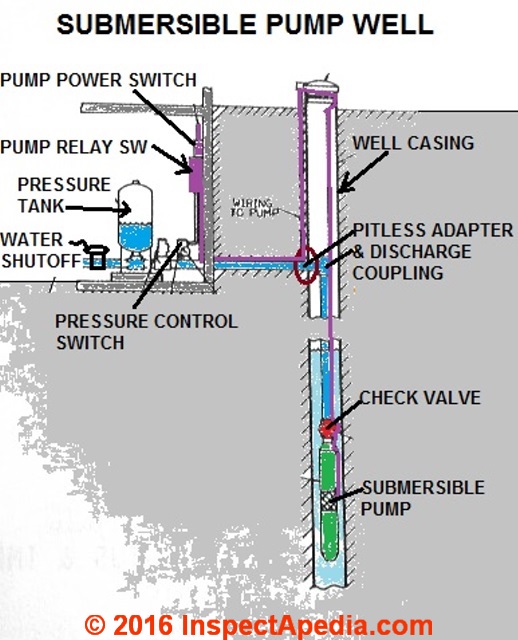
 Here we provide detail about the individual components and operating characteristics of drilled wells using a steel casing where a submersible water pump has been installed in the well to deliver water to the building.
These questions and answers about submersible well pumps (the pump is in the well) were posted originally
at PUMP, SUBMERSIBLE OPERATION - you will want to review the installation, troubleshooting, and repair advice organised there.
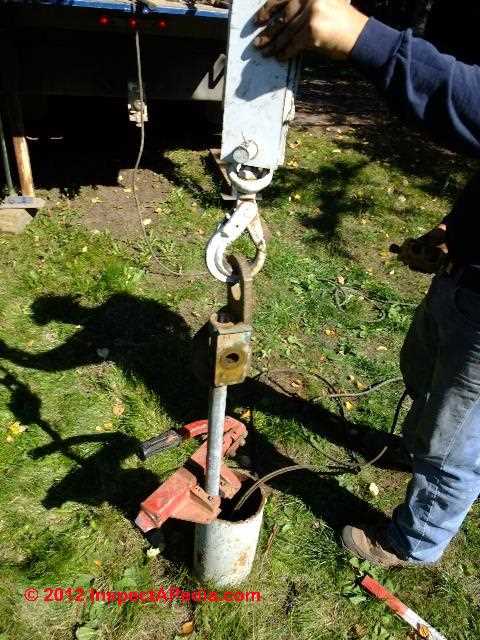
Our photo shows the process of pulling a well pipe and submersible pump.
Article Index
- SUBMERSIBLE PUMP CHECK VALVES
- SUBMERSIBLE PUMP CIRCUIT BREAKER Q&A
- SUBMERSIBLE PUMP FLOOD DAMAGE Q&A
- SUBMERSIBLE PUMP FREEZE PROTECTION Q&A
- SUBMERSIBLE PUMP INSTALLATION FAQs - flow rate, head, horsepower, weight, support, pump depth
- SUBMERSIBLE PUMP MOTOR TORQUE PROBLEMS - comes loose, needs support
- SUBMERSIBLE PUMP MOTOR TROUBLESHOOTING FAQS
- SUBMERSIBLE PUMP MUDDY WATER Q&A
- SUBMERSIBLE PUMP PRESSURE IS WEAK Q&A
- SUBMERSIBLE PUMP RENTAL SET-UP Q&A - what's involved in renting a temporary pump
- SUBMERSIBLE PUMP SHORT CYCLING - how frequently is too much
- SUBMERSIBLE PUMP SIZING FAQs
- SUBMERSIBLE PUMP USE DURING POWER OUTAGE - how can I get water with no electricity?
- SUBMERSIBLE PUMP WIRING - OK to hook up an old, unknown pump down in the well?
- SUBMERSIBLE PUMP WON'T RUN Q&A
...
Submersible Well Pump Won't Run FAQs
Submersible pump not working, humming noise at the breaker, no pumped water
We just replaced our pump a year ago. replace hot water heater same time and bladder tank two weeks ago had great water. Got up yesterday and there is no water in the house at all. When we turn the breaker on all you hear is humming but no water is entering the house. Every one is telling me to prim the pump but it is fifty feet in the ground.
There is no water coming in the house from the well out side pump was replaced two years ago we had great water and woke up to no water when i flip the house breaker i can here the humming but still no water entering the house. 18 August 2015 Sam malette
Reply:
Sam,
Watch out: if humming is really at an electrical switch or circuit breaker, turn it OFF immediately to avoid an electrical fire or other damage.
Obviously if the pump is a submersible you're not priming the pump - people are being a bit careless in speech.
The pump is under-water, in the well.It should be impossible for that system to lose prime since the pump primes itself and the pipe above when you turn it on.
Humming sounds as if the pump motor is seized or the switch is not turning on the pump.
See ELECTRIC MOTOR DIAGNOSTIC GUIDE - home to see how an electrician might check your pump to see if it's working. If the current draw is normal then the pump is probably working and the well piping has burst somewhere; if the current draw is high the pump is seized.
Submersible Water Pump won't run after having been turned off for months
I have a submersible water pump and my electricity has been off a little over 4 months. I got elec. back on but I cannot get any water. The pump is not running. What can I check? On 2018-01-02 by Susan
by (mod) -
First confirm that electrical power to the pump is switched on - there may be more that one on-off switch, such as at the electrical panel and at the pump.
Watch out: if you don't know how to do safe electrical work you could be shocked or killed. So hire a licensed electrician or pump installer if you're not trained to do this work.
Confirm that power is being delivered to the pump pressure control switch
Test the current draw giant the pump specs. High current draw may mean seized motor.
Low current draw (Amps) may mean no water or a broken impeller shaft.
More detailed diagnostic suggestions are at TABLE 1: PUMP WON'T RUN, WON'T STOP, or CYCLES
If the pump runs, and if it's an above-ground jet pump, the pump may need to be primed as we explain at WATER PUMP PRIMING PROCEDURE
...
Submersible Pump Installation Choices, Requirements
Well pipe diameter vs flow rate vs head vs pump horsepower
Does the diameter of the pipe affect the flow rate with 120 foot head and a endless supply of water on a 5hp. ?
single phase pump, while the pump has a 2 inch outlet and the pipe is 4 inch feeding a pond. what about the weight of the water trying to return down hill? (June 24, 2014) Mike T.
Reply:
Mike,
I agree that the head pressure in an uphill pumping system can be significant. That's why you may need a check valve on the line to avoid loss of prime when the pump stops.
The pumping rate of various well pumps is indeed given in more detail by a table or chart that shows the pump's output capacity as a function of the head or "lift" that the pump has to overcome.
Other key factors are the horsepower of the motor, voltage levels, and possibly piping constrictions.
Choosing Submersible vs Jet Pump for Well in the Phillipines
I'm in the Philippines and desperate for advice/info. 4-inch well drilled to depth of 250' (actual depth now at 242' due to gravel pack). No electricity at well site and well driller claimed output was 10 GPM and he never developed the well by doing a draw-down test.
Well has been idle for two years, site now has electricity, static water level is at 20' and I have no idea if I should get a twin-pipe self-priming jet surface pump or a submersible pump. I don't think I should trust the claimed 10 GPM output. Thank you in advance. (June 17, 2015) Theodore
Reply:
Theodore:
How did the well driller determine well flow rate? Normally I'd expect to see a 24-hour flow test using an adjustable rate pump.
If the static head is 20 ft below the surface you've got a 222 ft. x 4" ID volume of water (volume of a cylinder) as a static head.
At that depth you might prefer a submersible well pump.
I agree that I'd not assume anything about the well flow rate before it's actually tested. Remember to also test the water potability for safety as well.
In choosing a pump model you need to know the casing diameter (so that the pump will fit) as well as the well's flow rate and the water delivery requirements.
Theodore said:
Thanks for your response. Driller did not determine a well flow rate using any type of pump (which I didn't understand). Instead he used an air compressor to force water out of the borehole and stated that we had 10 GPM. That also didn't sit well, because I could not verify the source of the water. He caught some water in his hand and drank telling me it was cold, sweet-tasting with no salt.
After working in U.S. Navy medicine for over 24 years, this set off alarms, as water should never be consumed until tests for bacteria and heavy metals/pesticides have been performed.
But, this is the Philippines and these college-educated civil engineers will take advantage of a customers naivety whenever possible.
When I measured the depth of the well and distance to water, I noted a rotten egg odor in the water (hydrogen sulfide or hydrogen sulfate) and small black or dark-brown particles suspended in the water (decayed vegetation?). I hope after the well is pumped for awhile those two problems clear up.
I had been considering the Goulds GS and HS series sub pumps, but while reading the Instruction Manual for the 4" sub pumps I discovered a problem in regards to the 4" blue Schedule 40 PVC pipe the driller had used for the borehole casing. The OD on the pumps are 3.9" and the ID on the 4" Schedule 40 PVC pipe is 3.998".
That does not leave enough room around the pump for the water to flow properly into the pump intake.
The only other option for this size casing is a 3" sub pump which is not available here. So, now I am considering either a Goulds J+ Convertible Jet Pump or a EuroStar DPJ150 or a DPJ200 (made in Italy by Speroni).
Clearance between the the surface of well casing and surface of the submersible pump
What should be the minimum clearance between the the surface of steel casing and outer surface of the submersible pump On 2012-06-06 by belay
by (mod) - 1"
Belay,
Typical residential water well submersible pumps are 3" or 4" in diameter and are installed in a 6-inch diameter casing, giving a minimum of 1-inch of clearance around the pump;But because the pump has to pass by the pitless adapter fitting that protrudes a bit into the well casing, I'd consider 4" also a maximum diameter to be sure we can get the pump in and out past the pitless adapter.
What are the limits of height of water column above a submersible well pump?
Is there any limit for the water column above the submersible pump in a bore well. We have installed a 17.5 hP pump at 900 feeet depth in a 6 inch bore, where water is available at 500 feet depth.
The pump gets very much overloades. It takes 48 Amps instead of expected 26 amps. ( 415 v,50 Hz, 3 phase. the voltage at the pump point, when running, is around 380-400 volts). please calrify. (Sept 23, 2014) N.S.Sreenivasan
Reply:
NBS
The pump rated lift capacity is the vertical distance from the pump bottom or entry point or water pick-up point and the highest point in the well piping between pump and building's water pressure tank or point of use. Certainly there are submersible pumps designed to lift water from the depth of your well.
Keep in mind that "water available at 500 ft" probably defines the top of the static water column in the well, and your pup will be much closer to the well bottom, perhaps at 875 ft.
That distance is given regardless of the height of the water column or static head in the well at least in part because it's the water inside the well pipe that the pump has to lift or push up - almost always a higher point than the water column in the well casing.
See details at these two pages:
My submersible pump and well has a static head of just 2-3 feet!
I used a plumb bob to determine that my water table is at 35 feet. And I have a static head of only 2-3 feet. After a few months of enjoying a great flow of water, the static head is only 6-8 inches. It feels like the bottom is filling with sand and sediment.
I was wondering if there is a way to clear out the bottom to increase the static head depth? On 2011-08-23 by Scott
Answer by (mod) -
Scott, that static head is absolutely nothing - about 10 gallons. A well with such a small static head would need a terriffic well recovery rate or flow rate to keep up - or you'd need to add a cascade of water storage tanks.
Typically the well pump or foot valve is placed 2-3 feet above the very bottom of the well to avoid picking up sediment.
If your well was built that way, even using a suction pump and line to try to remove well bottom sediment is not going to give you a big static head - doubling from 10 to 20 gallons won't make a noticeable difference in well performance.
And it would be more unsual for sediment to collect in a well to great volumes, so I don't suspect your well bottom is far below the level you probed.
I can guess at two explanations:
The well could have collapsed, filling itself in to effectively raise the well bottom and reduce the water static head and maybe flow rate.
Or
I'm afraid the real problem is your well water table has dropped or the well flow rate has deteriorated.
I'd get some advice from an experienced well driller in the neighborhood. Let us know what you find - it will help other readers.
What is the importance of weight of the submersible well pump in installation?
How Important is the weight of a submersible pump?
Pump specification:
weight = 302 kg
head = 125 m
flow = 25 lit/sec
Does it work properly for a deep well? (June 15, 2015) Javid
Reply:
Javid: a typical submersible pump like the Red Lion .5 hp weighs about 25 lbs ( 11 KG).
A 302 kg pump would be incredibly heavy, well over 600 pounds. Something's wrong with the picture you paint.
...
Submersible Pump Installation Torque Problems
Submersible well pump keeps coming unscrewed from the well pipe
The submersible pump keeps unscrewing itself even after I gluded the threaded coupler.I have to pull it out a 3rd time now. How can I make sure this doesn't happen again. Or is there a more serious problem at hand?
It has great pressure and it works great but right about on the 3rd or 4th day the pump quits I'm sure it's the same thing. I'll know for sure when u pull it tomoryow OOn 2016-08-15 by Rodney
by (mod) - effects of water pump torque on piping leaks or breaks
Rodney:
I suspect that a torque produced when the pump starts is the cause of this un-screwing of the coupler.If your pump is short-cycling - starting more often than needed, the torque problem will be multiplied. You may have to use welded iron pipe.
Here is what Franklin Water says about pump torque:
During starting of a submersible pump, the torque developed by the motor must be supported through the pump, delivery pipe or other supports.
Most pumps rotate in the direction which causes unscrewing torque on right-handed threaded pipe or pump stages.
All threaded joints, pumps and other parts of the pump support system must be capable of withstanding the maximum torque repeatedly without loosening or breaking. Unscrewing joints will break electrical cable
and may cause loss of the pump-motor unit.Now for the kicker:
To safely withstand maximum unscrewing torques with a minimum safety factor of 1.5, tightening all threaded joints to at least 13.57 N-m per motor horsepower is
recommended (Table 2A). It may be necessary to tack or strap weld pipe joints on high horsepower pumps, especially at shallower settings.
Source: 50Hz Submersible Motors, Application, Installation, Maintenance [PDF], Franklin Electric Co, Tel: 800-348-2420, Retrieved 2016/08/15, original source: http://franklinwater.com/media/123156/50_HZ_AIM.pdf
...
Flood contaminated submersible pump & well problems: solutions in India
I live in INdia. WE just had a flood at my house. I have a deep borewell (more than 300 ft) with a submersible pump. Is it possible for the flood water to contaminate the well? The flood is gone, but the water has a bad taste. IT could be the overhead tank needing cleaning which we'll do, but I'm wondering if we should do anything to the well itself like chlorinate.
Reply:
Yes Stephen it is common for floodwaters to contaminate a drinking water well. And we've been following with concern reports of recent flooding in India - flooding in India has been widespread in 2015 beginning in July and most recently including in the Indian state of Maharashtra.
There is nothing you can do about that problem except find sanitary drinking water elsewhere until the floodwaters have subsided. Then you'll need to sanitize the well as well as house piping and water tank. See the following article:
WELL DISINFECTION PROCEDURE, POST FLOODING - and let me know what questions remain.
Also see DRINKING WATER - EMERGENCY PURIFICATION at inspectapedia.com/water/Drinking_Water_Purification.php
We introduced the different types of drilled wells and bored wells
at DRILLED WELLS, STEEL CASINGS. This article discvusses submersible in-well pumps - those water pumps located within the well bore or casing itself, typically close to the bottom of the well.
Rather than an in-well submersible water pump, other wells use a one line or two line jet pump (depending on well depth) - in those wells the pump is above ground rather than in the well. Those well types are discussed in more detail at
WATER PUMP, ONE LINE JET used in shallow wells
and
TWO LINE JET PUMP used in deep wellsWatch out: the water delivery rate at plumbing fixtures is determined by the water pump as well as building water supply piping and controls. But it is a number independent of the ability of the well itself to deliver a sustained water flow - the well yield. The water delivery rate is also independent of the total quantity of water that can be run before you run out.
See WELL FLOW RATE
Watch Out: Safety warnings are throughout any pump manufacturer's instructions. Because some pump models are capable of developing internal pressures of more than 100 psi, if your building piping, pressure relief valves, safety controls, wiring, and plumbing are not properly installed, very dangerous conditions including electrical shock, tank explosion, and leaks or floods can occur. 23 August 2015 Stephen Raisz
...
Continue reading at SUBMERSIBLE PUMP - topic home or select a topic from the closely-related articles below, or see the complete ARTICLE INDEX.
Or see SUBMERSIBLE PUMP DIAGNOSTIC FAQs-2 - more-recently posted questions and answers about troubleshooting a submersible water pump
Or see this
Submersible Well Pump Article Series
- DIAGNOSTIC TABLE for WATER PUMPS
- SUBMERSIBLE PUMP - home
- SUBMERSIBLE PUMP OPERATION
- SUBMERSIBLE PUMP TORQUE PROBLEMS & SOLUTIONS
- WATER PRESSURE PROBLEM DIAGNOSIS TABLE
Suggested citation for this web page
SUBMERSIBLE PUMP DIAGNOSTIC FAQs at InspectApedia.com - online encyclopedia of building & environmental inspection, testing, diagnosis, repair, & problem prevention advice.
Or see this
INDEX to RELATED ARTICLES: ARTICLE INDEX to WATER SUPPLY, PUMPS TANKS WELLS
Or use the SEARCH BOX found below to Ask a Question or Search InspectApedia
Ask a Question or Search InspectApedia
Share this article:Search the InspectApedia website
Need to make a private comment? Email editor@inspectApedia.com. We welcome email with your website content critique, corrections, suggestions or questions. Email is monitored daily but our workload may prevent an immediate reply. For immediate results, we hope you'll first try asking your question using the search box just above.
Citations & References
In addition to any citations in the article above, a full list is available on request.
- In addition to citations & references found in this article, see the research citations given at the end of the related articles found at our suggested
CONTINUE READING or RECOMMENDED ARTICLES.
- Carson, Dunlop & Associates Ltd., 120 Carlton Street Suite 407, Toronto ON M5A 4K2. Tel: (416) 964-9415 1-800-268-7070 Email: info@carsondunlop.com. Alan Carson is a past president of ASHI, the American Society of Home Inspectors.
Thanks to Alan Carson and Bob Dunlop, for permission for InspectAPedia to use text excerpts from The HOME REFERENCE BOOK - the Encyclopedia of Homes and to use illustrations from The ILLUSTRATED HOME .
Carson Dunlop Associates provides extensive home inspection education and report writing material. In gratitude we provide links to tsome Carson Dunlop Associates products and services.
 |
HOME | ABOUT | ASK a QUESTION | CONTACT | CONTENT USE POLICY | DESCRIPTION | POLICIES | PRIVACY | |
| © 2026 - 1985 Publisher InspectApedia.com - Daniel Friedman | |||||||||