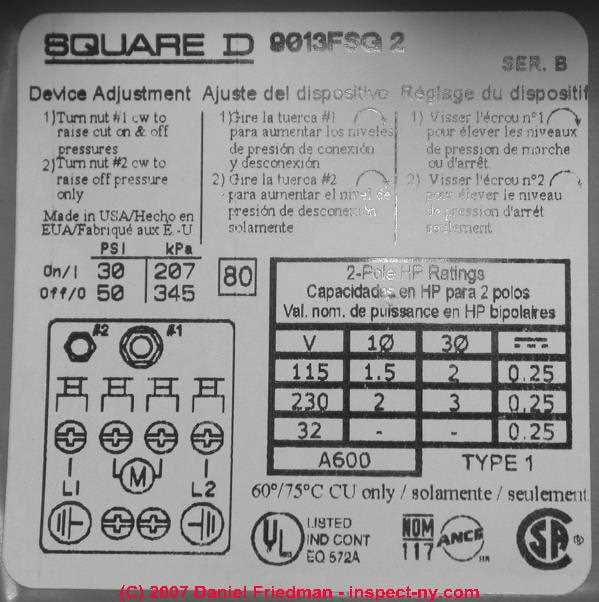
 Pump Pressure Control Switch
Adjustments
Pump Pressure Control Switch
Adjustments

- POST a QUESTION or COMMENT about Setting the Water Pump Pressure Switch and Improving Water Pressure
More Q&A on exactly how to adjust the pump pressure control switch - which way to turn the adjustment nut.
This article series describes how to adjust building water pressure by setting the water pump cut-in and cut-out pressure on the well water pump pressure control switch. We explain which adjustment nuts to turn and in which direction to change pump cut-in pressure or cut-our pressure settings.
InspectAPedia tolerates no conflicts of interest. We have no relationship with advertisers, products, or services discussed at this website.
- Daniel Friedman, Publisher/Editor/Author - See WHO ARE WE?
Pressure Control Switch Adjustment Nut FAQs
These questions and answers abouit how to adjust the control nuts in a water pressure control switch were posted originally
at WATER PRESSURE CONTROL SWITCH ADJUSTMENTS - topic home.
Also see our index to all water pump control switch FAQs at WATER PUMP PRESSURE SWITCH REPAIR FAQs
Article Index
...
Pressure Control Switch Calibration Q&A
Do I use a pressure gauge to set the pump cut-in and cut-out?
Do you use the pressure gauge to set the psi by what it shows when the switch kicks on and off?
It says to set at 28 psi.
But there are no numbers on the switch, how do you know what you are setting it at?
Having a problem, just replaced my water pressure tank. Have a submersible pump. Problem is that when running the water the pressure switch is short cycling. it will go off and on about 4 times real fast then stop about 20 seconds then do that again. How do I adjust it ? On 2018-10-16 by Teresa Jarrell
by (mod) - how to determine the pressures at which the pump control is turning ON and OFF
Teresa
You can use an independent pressure gauge Teresa or you can see what the pressure is on the gauge that's attached to your water system.To use an independent gauge - it's easy and inexpensive - see WATER PRESSURE MEASUREMENT - how to buy or make your own portable water pressure measurement gauge
When the pump STOPS and with NO water running in the building, read the water pressure system at the pressure gauge you'll find on or near the pump or water tank.
About the short cycling of your water pump, most likely your water tank has lost its air-charge.
But if the short cycling is extremely rapid I would look first for a closed valve on the outlet from the water system and second for problem with water not entering the tank. I've also found this problem when there is a water filter installed and the water filter is clogged.
Sometimes then a pressure tank the bladder can get stuck to the tank bottom and refuse to accept water. Both of those conditions can cause rapid short cycling.
See the diagnosis and repair steps at WATER PUMP SHORT CYCLING - home
Also see WATER PRESSURE GAUGE ACCURACY
...
Pressure Controls for Multiple Water Pumps in Tandem
Pressure control settings when using two water pumps on the same system: ok to have manual pump cut-off?
 I want to set our pressure switch settings for water
Pump #1 should be start on 4 kg/cm2 and stopped on 6 kg/cm2.
Pump #2 should start only 3 kg/cm2 and off manually - On 2018-02-08 by Abhimanyu Mishra
Suggestions by (mod) - each pump needs its own pressure control
Mishra
You cannot control two different pumps at different operating pressures using a single pump pressure control switch.
You need a dedicated pressure control for each water pump.
Then, if both pumps are feeding the same water system and tank, the controls need to be set to work consistently.
By your description, IF Pump #1 has adequate capacity and IF the water capacity is constant, then pressure will never fall below 4 kg/cm2 so Pump #2 would never run.
And when IF Pump #1 is capable of pumping to any pressure above its CUT-ON or CUT-IN pressure, Pump #3 will never run.
Details:
Although our pressure examples are in PSI, the principles and adjustments of a pressure switch are the same regardless of the units in which pressure is being reported.
4 kg/cm2 is about 57 psi and 6 kg/cm2 is about 85 psi (for other readers).
If your pump control switch works like the one shown in the article above you simply need to watch the pressure reading on your system's pressure gauge.
Run water, watch the pressure fall, note the pressure at which the pump starts. Adjust the switch to raise or lower the starting pressure accordingly. That's the "CUT IN" pressure.
You cannot however use the same control on the same single water system to operate at two different pressure ranges.
So I don't understand how your second pump control example would work unless you mean it's for a different system.
Watch out: In any event you should NOT set up a switch that will never turn the pump OFF since under some conditions the pump pressure could blow out a pressure tank or pipe that could in turn injure or even kill someone nearby.
...
...
Continue reading at WATER PRESSURE CONTROL SWITCH ADJUSTMENTS or select a topic from the closely-related articles below, or see the complete ARTICLE INDEX.
Or see these
Recommended Articles
- WATER PRESSURE CONTROL SWITCH ADJUSTMENTS - home for water pump pressure control switch
- WATER PUMP PRESSURE SWITCH NUT ADJUSTMENTS
- WATER PUMP PRESSURE SWITCH NUT ADJUSTMENTS
- WATER PUMP PRESSURE SWITCH DIFFERENTIAL NUT ADJUSTMENT
- WATER PUMP PRESSURE SWITCH RANGE NUT ADJUSTMENT
- WATER PUMP PRESSURE SWITCH SAFETY
- WATER PUMP PRESSURE SWITCH STANDARD (PSI) SETTINGS
- WATER PUMP PRESSURE SWITCH MAXIMUM PRESSURE SETTING
- WATER PUMP PRESSURE SWITCH SETTINGS TOO HIGH
- WATER PUMP PRESSURE SWITCH INSTALL / REPLACE
Suggested citation for this web page
PRESSURE SWITCH NUT ADJUSTMENT FAQs-2 at InspectApedia.com - online encyclopedia of building & environmental inspection, testing, diagnosis, repair, & problem prevention advice.
Or see this
INDEX to RELATED ARTICLES: ARTICLE INDEX to WATER SUPPLY, PUMPS TANKS WELLS
Or use the SEARCH BOX found below to Ask a Question or Search InspectApedia
Ask a Question or Search InspectApedia
Share this article:Search the InspectApedia website
Need to make a private comment? Email editor@inspectApedia.com. We welcome email with your website content critique, corrections, suggestions or questions. Email is monitored daily but our workload may prevent an immediate reply. For immediate results, we hope you'll first try asking your question using the search box just above.
Citations & References
In addition to any citations in the article above, a full list is available on request.
- In addition to citations & references found in this article, see the research citations given at the end of the related articles found at our suggested
CONTINUE READING or RECOMMENDED ARTICLES.
- Carson, Dunlop & Associates Ltd., 120 Carlton Street Suite 407, Toronto ON M5A 4K2. Tel: (416) 964-9415 1-800-268-7070 Email: info@carsondunlop.com. Alan Carson is a past president of ASHI, the American Society of Home Inspectors.
Thanks to Alan Carson and Bob Dunlop, for permission for InspectAPedia to use text excerpts from The HOME REFERENCE BOOK - the Encyclopedia of Homes and to use illustrations from The ILLUSTRATED HOME .
Carson Dunlop Associates provides extensive home inspection education and report writing material. In gratitude we provide links to tsome Carson Dunlop Associates products and services.
 |
HOME | ABOUT | ASK a QUESTION | CONTACT | CONTENT USE POLICY | DESCRIPTION | POLICIES | PRIVACY | |
| © 2026 - 1985 Publisher InspectApedia.com - Daniel Friedman | |||||||||