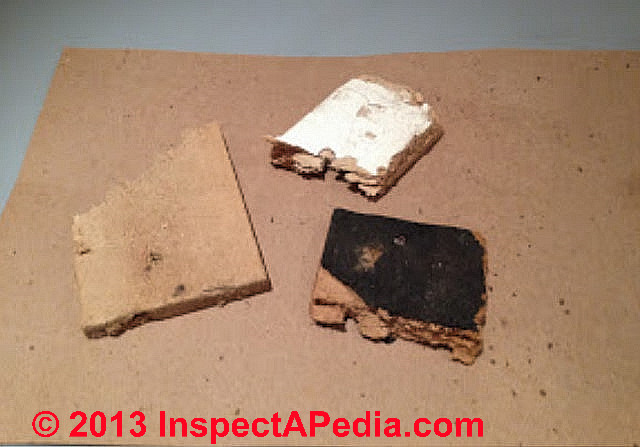
 Asbestos in Fiberboard Sheathing FAQs

- POST a QUESTION or COMMENT about fiberboard building sheathing: how to identify fiberboard products, fiberboard uses, fiberboard, Celotex, Homasote, Insulite & other brands, fiberboard ingredients, does fiberboard contain asbestos?
Q&A on the level of asbestos content of fiberboard sheathing products.
This article series discusses potential asbestos hazards for fiberboard panels, sheathing, insulating board & ceiling coverings or tiles.
InspectAPedia tolerates no conflicts of interest. We have no relationship with advertisers, products, or services discussed at this website.
- Daniel Friedman, Publisher/Editor/Author - See WHO ARE WE?
FAQs on Asbestos Content in Insulating Board Products
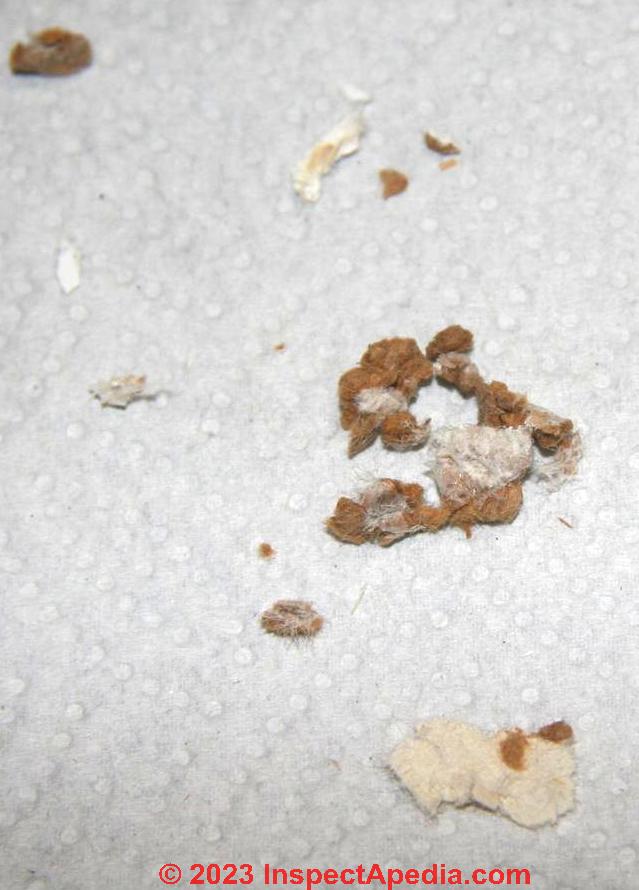 These questions & answers about the asbestos content of fiberboard sheathing products such as Beaverboard, Celotex, Gold Bond, Homasote, Insulite, Nu_Wood, were posted originally
at SHEATHING, FIBERBOARD ASBESTOS CONTENT - be sure to review the information given there.
Bulletin Board is fiberboard and unlikely to contain asbestos
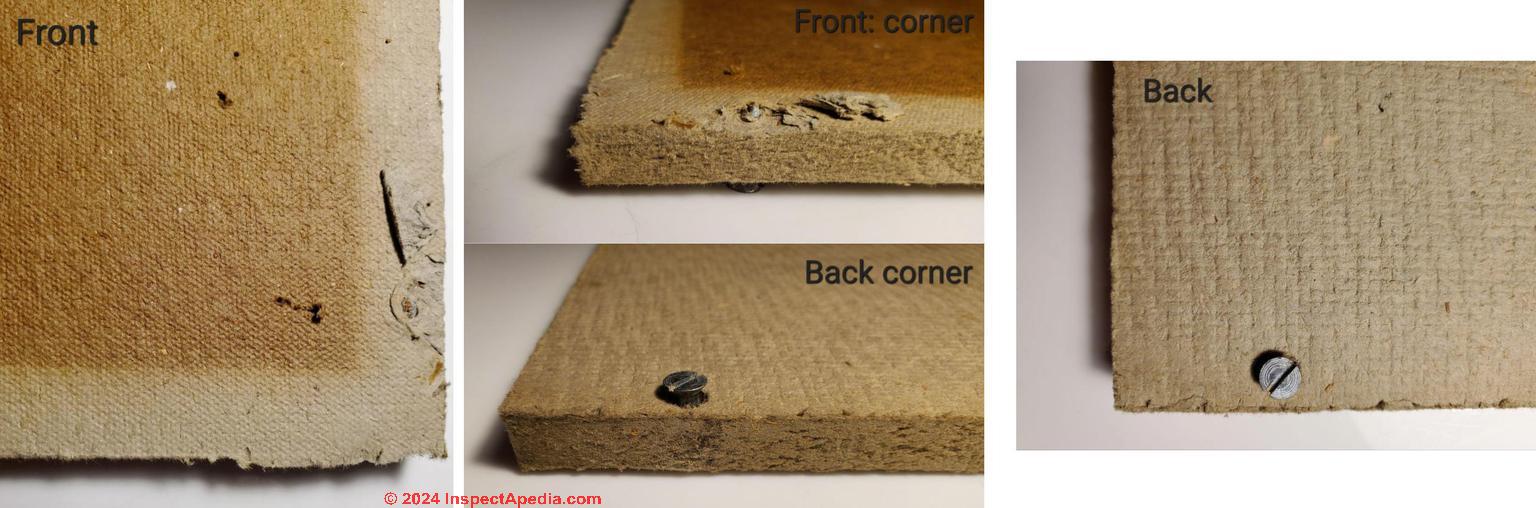
I Recently acquired an old bulletin board (likely produced in the late 60s through 70s in the United States) and am curious about the material it's composed of.
From some research, I'd guess it's standard fiberboard-- although it has no identifying marks or patterns to speak of. The "front" appears to be discolored, likely due to age and exposure. Any reason why I ought to be concerned about asbestos inclusion in the material? Thanks! 2025-10-07 by John M.
Mod reply:
@John M.,
I agree that that's a light colored fiberboard product.
From its color and texture you can rule out some of the manufacturers that we describe in these articles.
Most fiberboard products are plant-based.
So most likely you are bulletin board does not contain asbestos.
I'm sorry that I can't give an absolute answer as there were a few exceptions,
as we detail on this page.
OPINION: considering that the product is undamaged and provided that you are not doing anything to it that creates dust, if that were my case I would not be concerned about the asbestos question.
Daniel FriedmanFollow up:
@InspectApedia Publisher, Thank you! Based upon the color and general manufacturing process for fiberboard, I felt that it was unlikely that the material contains asbestos.
From further research, it seems most likely that it is Homasote, as it appears visually similar and was commonly used as a backing for bulletin boards around the same time. I'd certainly like to continue using it as a bulletin board, myself.
Reply:
@Anonymous,
On this page see. https://inspectapedia.com/structure/Fiberboard-Sheathing-Asbestos.php#Homasote
Multi-layered wall board
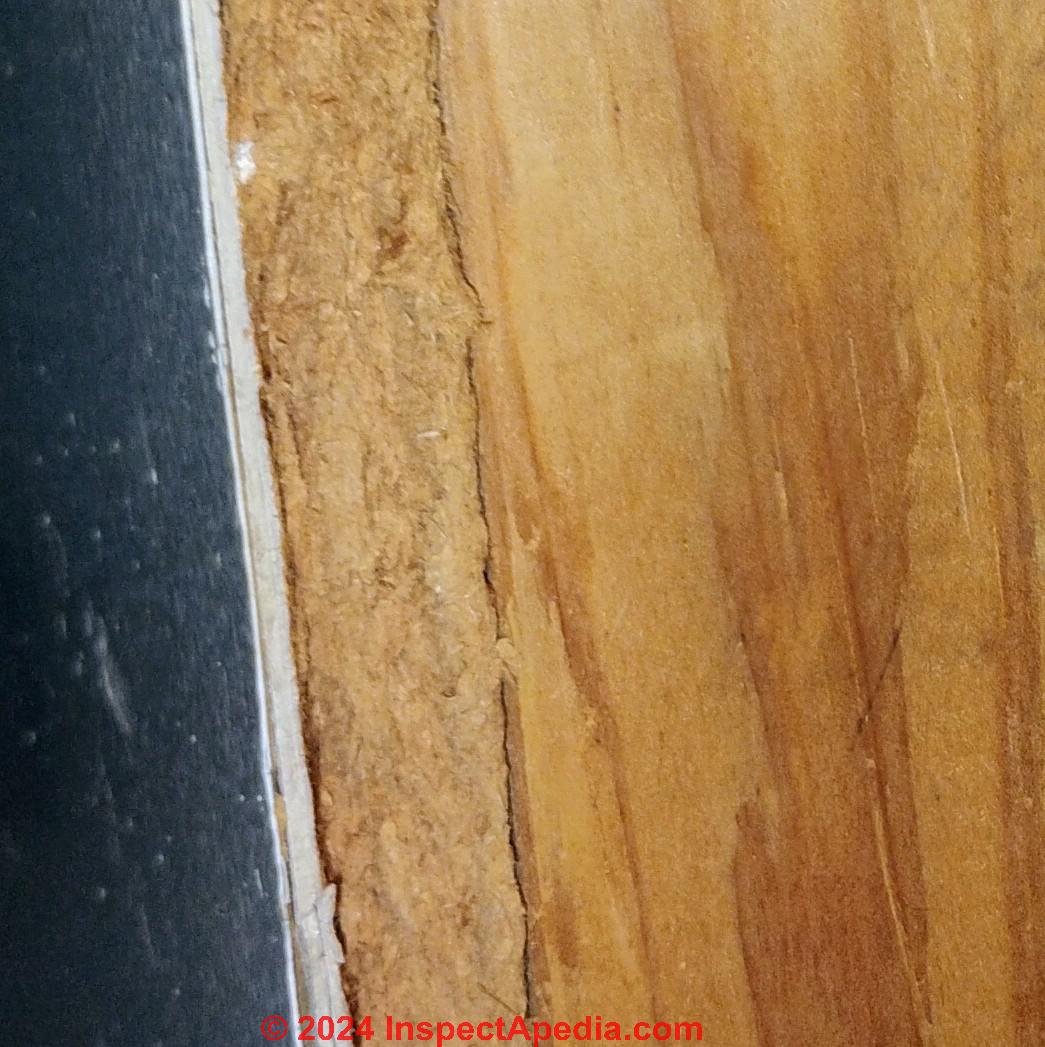
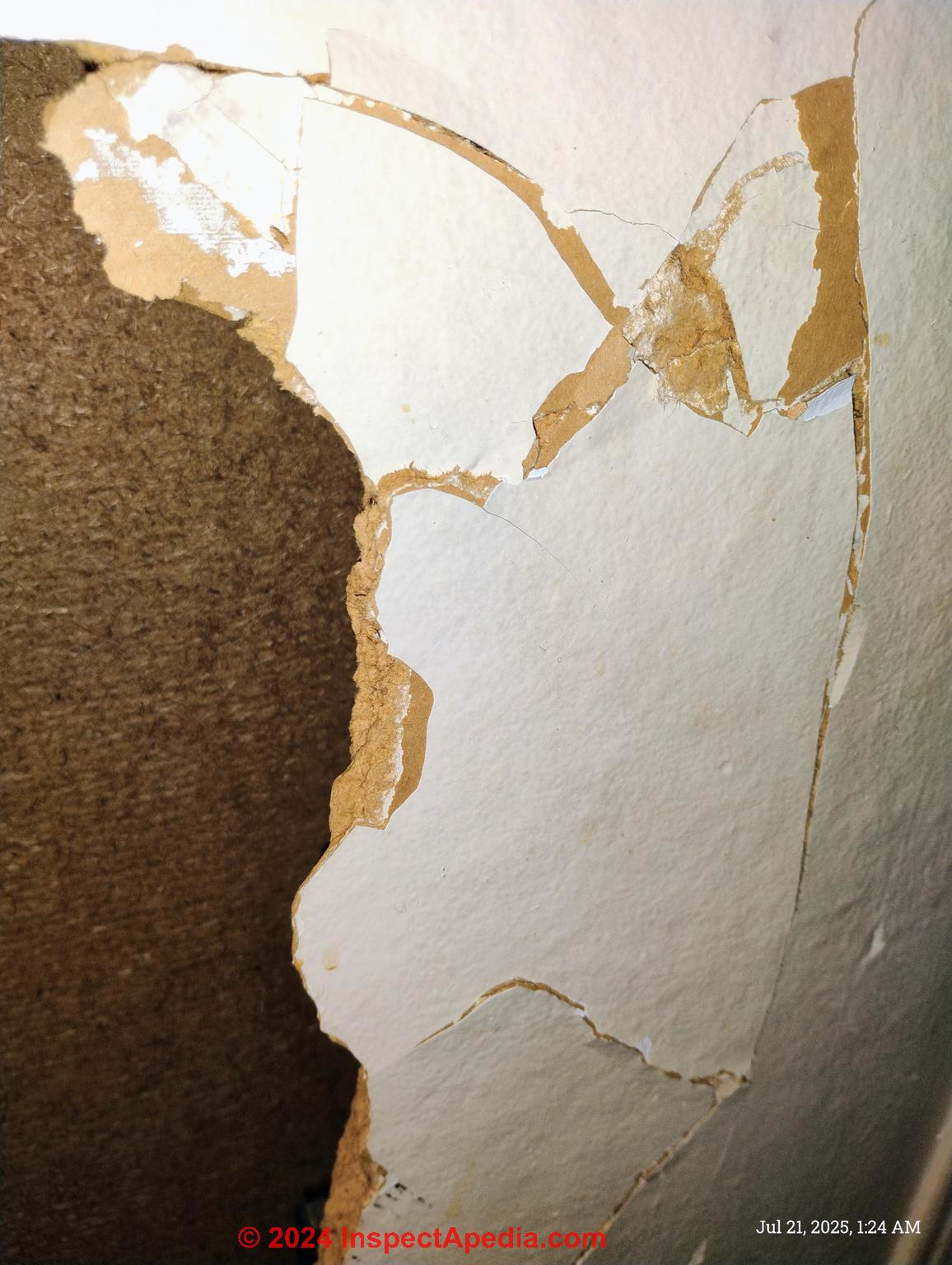
i had a question a hole got knocked in my wall and i discovered it wasn't drywall. is this asbestos?
I appreciate any help thank you. also if it helps i zoomed in and the one picture is what the back of the wall looks like the outer wall is painted. 2025-07-21 by Amanda
Reply:
@Amanda,
That inner layer is a brown plant product fiberboard. The outer layer or two layers look quite thin and because the photos have been boring I can't say for sure what they are. It could be wallpaper or a plastic laminate or something else.This photo has at least three layers. The innermost layer looks like a brown wood product fiberboard. I can't see clearly enough the outer layer to have an opinion about what they are.
DanielFollow up:
Ok maybe this one will help i did peel off a few layers of paint, just wanting to see what type of wall this is and if its asbestos? I think its just the same color as the inside stuff the paint came off fairly easy.
Reply:
@Amanda,
So it looks like a multi-layered wallboard atop fiberboard.
Also compare what you have with SACKETT BOARD https://inspectapedia.com/interiors/Sackett-Board-History.php
Daniel
Fiberboard Sheathing crumbles and is brittle: is it unsafe?
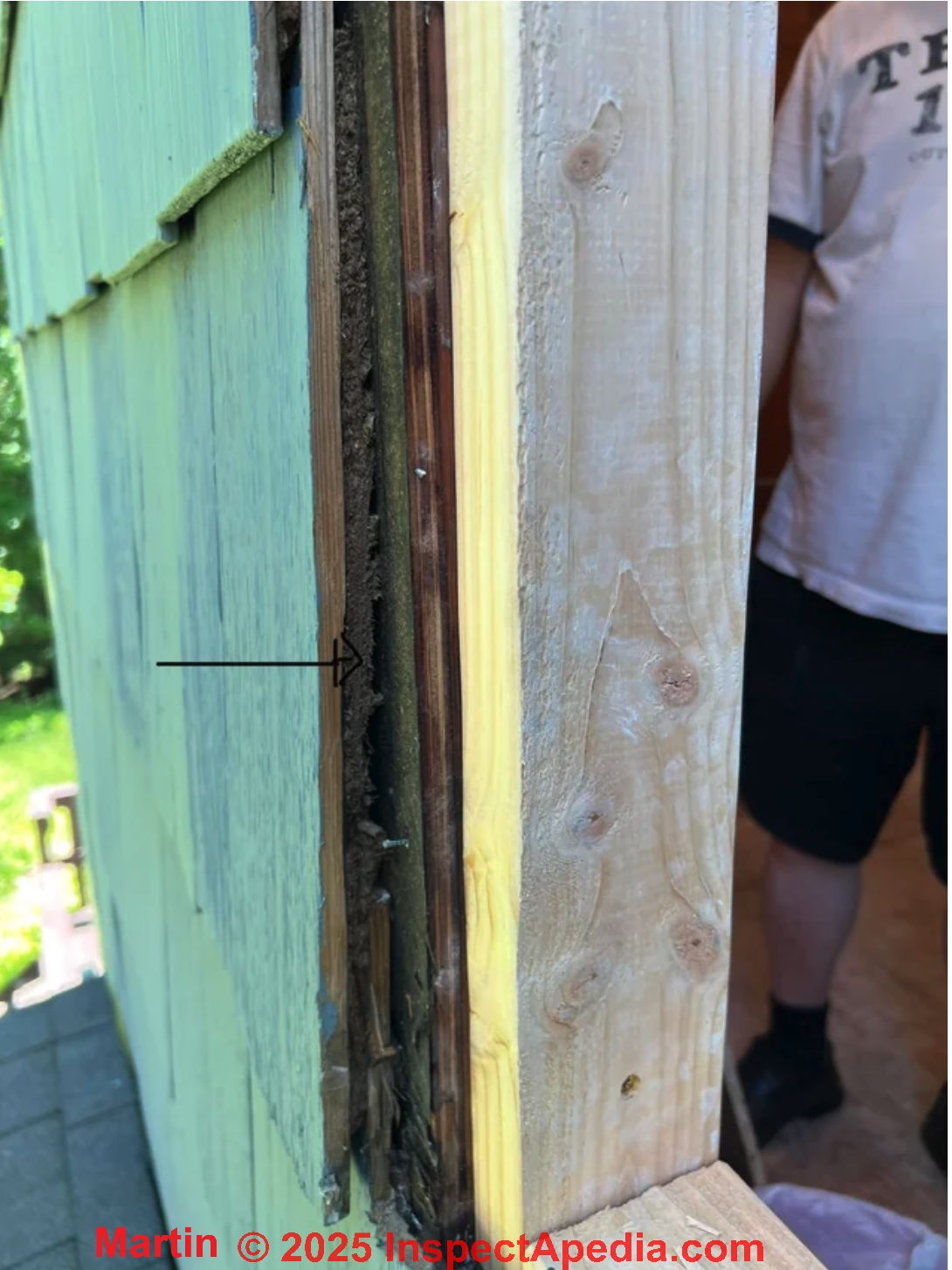
I've got material behind my wooden cedar shingle siding of my 1961 home, looks much like this photo (below - added by editor)
In my case too this probably works as a rain screen mat and attached a photograph of a sample that's come from behind my own shingles: it's about 3/8" thick with a brownish color and small black flecks. It's fairly brittle (crumbles to the touch) and I don't see any coarse fibers; looks like a regular wood fiber wax backer board to me (also based on other information found on your site), but I'd like a second opinion.
I don't have a brand name, but does this look like a known asbestos containing material? Thanks! On 2025-04-11 by Martin
Reply:
@Martin,
In your photo the arrow points to what looks to me like fiberboard sheathing.
See
FIBERBOARD SHEATHING IDENTIFICATION - recognize/identify Celotex®, Homasote®, Masonite® Nu-Wood® and other insulating fiberboard building sheathing products used as exterior wall sheathing and as interior wall & ceiling surfaces at InspectApedia.com
Daniel
Identify this 1976 Brown Insulating Board under Plywood Siding
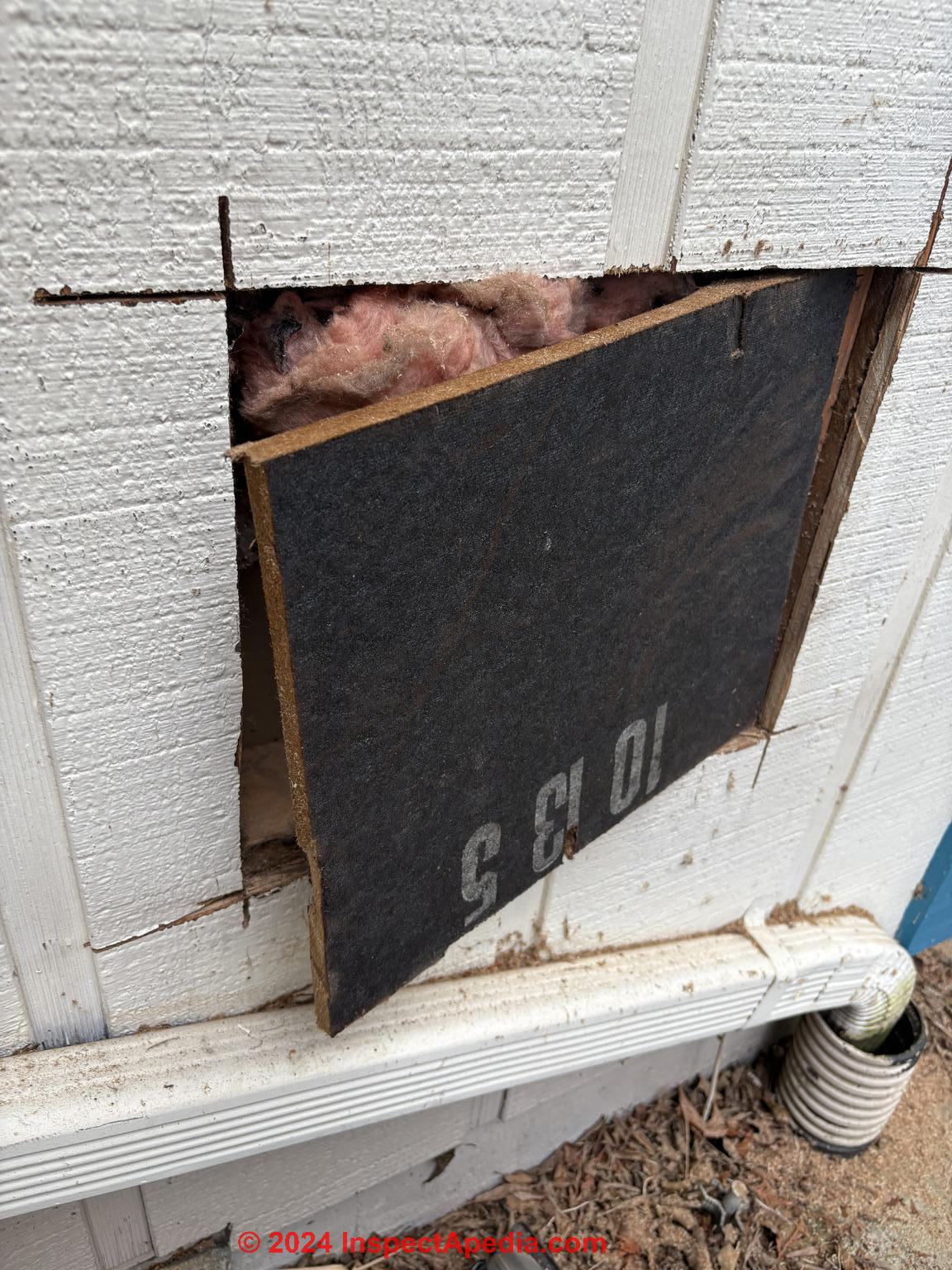
Found this under the siding on a 1976 built home in Washington State? Asbestos or no? Any idea who the manufacturer was? On 2025-02-20 by Eron Berg
Reply: Brown Fibers in fiberboard indicate plant-based product
@Eron Berg,
Brown fibers like that fiberboard material almost always mean it's a plant-based product. (not asbestos)
To identify the fiberboard see
FIBERBOARD SHEATHING IDENTIFICATION - recognize/identify Celotex®, Homasote®, Masonite® Nu-Wood® and other insulating fiberboard building sheathing products used as exterior wall sheathing and as interior wall & ceiling surfaces at InspectApedia.com
1967 New England school pegboard
I work in a school with pegboard that is brown with regular holes, as you show above, built in New England in 1967. Is color and hole orientation enough to go on to determine that it is masonite board and not the asbestos board? 2024-10-28 by Anonymous
Reply:
@Anonymous,
Yes, I think so,.
IF the board is brown and woody-looking and has hundreds of evenly-spaced holes and thus is being used as a pegboard or tool hanging board (wire supports are simply hooked into those holes) then it's a hardboard product.
Cement board - asbestos-cement board - or asbestos millboard is gray-white and cementious - it doesn't look like pegboard and won't be brown unless it was painted.
You can see Masonite (and similar hardboards based on plant material). at https://inspectapedia.com/structure/Masonite-Definition-History-Composition.php
HARDBOARD MASONITE™ & OTHER BRANDS
Tell me How to identify Transite Board Products
Hello, am providing an update about the painting on unidentified board that I had thought was something similar to Masonite because of the textured backing and thinness of the support (1/8 inch thick). I sampled the fibers and sent them for testing and asbestos (Chrysotile) was indeed identified.
The person who runs the company that provided the testing service (who has NOT seen the artwork in person) suggested that it might be "Transite", which I understand to be a cement-based material that was initially a brand name, but subsequently became a generic term for any number of similar products.
I'm seeing "fiber cement boards" and "cement wallboard" as other terms that might have been called Transite.
I can confirm that when I took the sample, the fibrous textured backing was not difficult to cut into, but I tapped the back of the board with the tip of my finger and realized that it does sound completely different than I would expect from something wood-based like Masonite
I could believe that it is something harder, but I didn't know that cement-based boards were even a thing until now so I'm not sure what to expect them to look like.
I wonder if you have any thoughts on Transite, especially considering the textured back and 1/8 inch thickness of the board-- even the illegible inscription on the back.
Are you aware of any specific products that might fit that description, or would you recommend searching more under any specific terms, like if "fiber cement boards" might be a good lede? Or any other material-- maybe it isn't actually cement, but something similarly hard?
Thanks for any additional thoughts about this!
2024-01-30 by Daniela
Reply:
@Daniela,
Transite is a *cement* asbestos material - it is cementious - very hard, gray, brittle, and you could not cut easily into it with a utility knife.
See this example of Transite
TRANSITE PIPE AIR DUCT ASBESTOS RISKS
So if your board was easy to cut-into, then it's some sort of softer fibrous material.
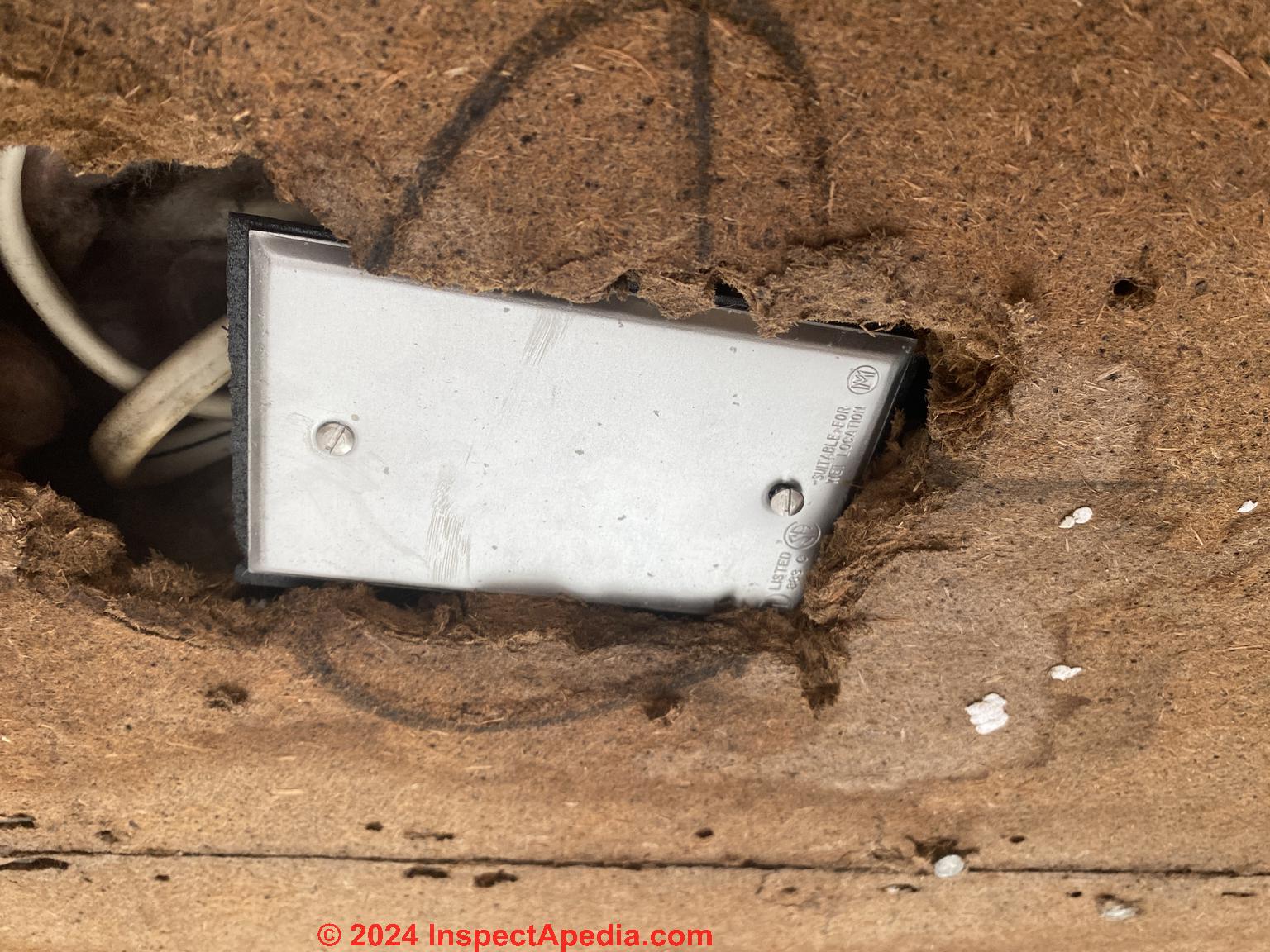
Does Johns Mansville Weathertite contain asbestos?
This is a fiberboard from John’s mansville. It’s called weathertite. Base on what I have read on your site it likely doesn’t have asbestos. Am I correct? 2024-01-14 by Concerned DIYer
Reply:
@Concerned DIYer,
That is generally correct.
Fiberboard is basically a plant-fiber based product.
There were reports of asbestos cross contamination in fiberboard made at the same site where asbestos containing products were made. Since Johns Manville produced a wide range of other products, some of which contained asbestos, you could see why or how the question arose.
See
FIBERBOARD SHEATHING INGREDIENTS
for details about the ingredients of your fiberboard.
1950s bungalow has what looks like fiber board which is a plant or wood-based product
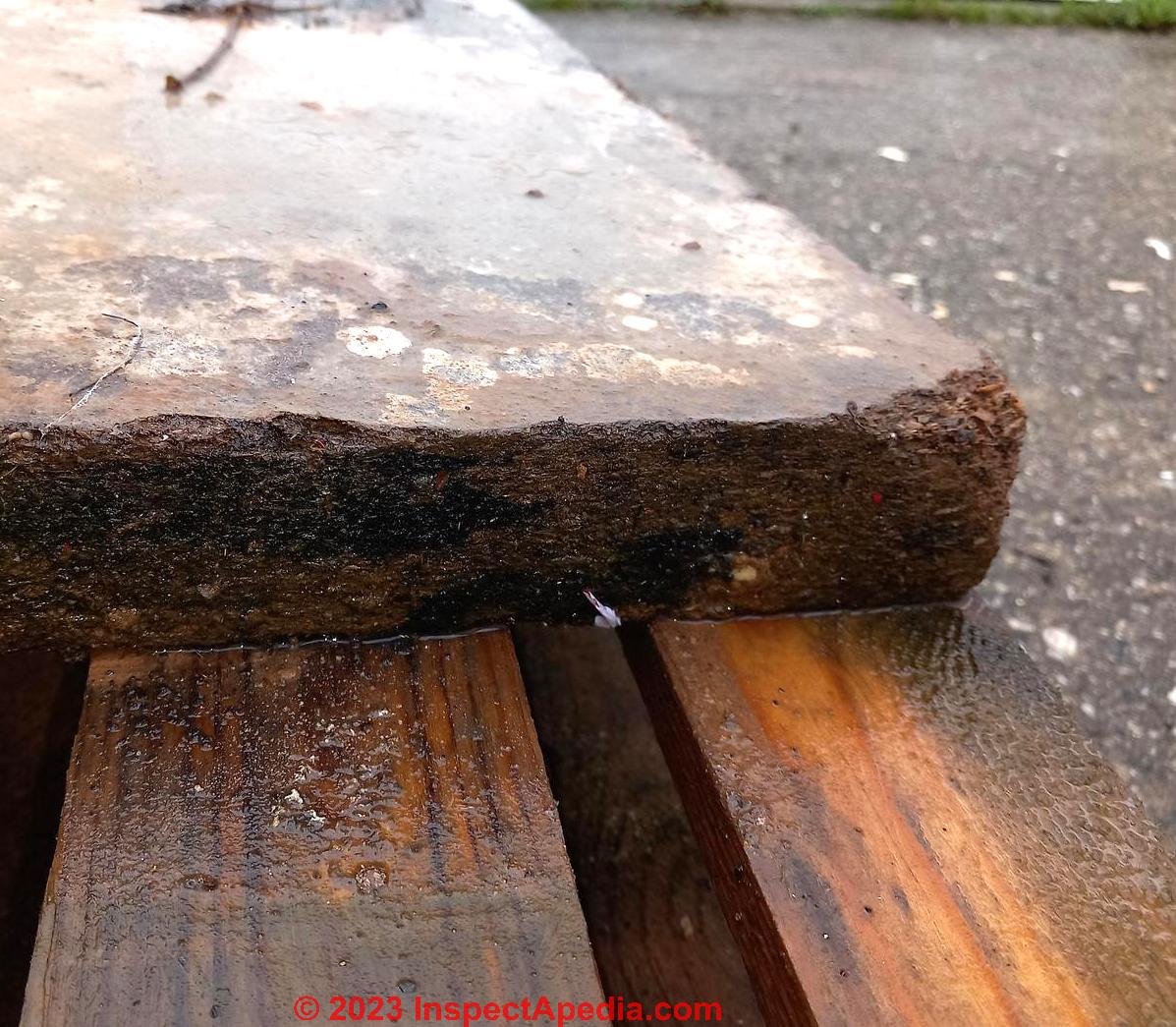
Can you please review the attached picture and assess if it may contain asbestos. This pictures is of a board found in the garage of 1950s bungalow. It appears to be fibrous and not containing asbestos. - On 2023-09-25 by Peter
Reply by InspectApedia Publisher -
@Peter,
That does look like fiber board which is a plant or wood-based product. If you're concerned about asbestos be sure to read
SHEATHING, FIBERBOARD ASBESTOS CONTENT
Which you can find by using our on page search box for that phrase.
Please help us do a better job by telling me why you posted this question on our homepage instead of searching for and posting on one of the fiberboard panel pages at this website?[Ed. note: this question was originally posted on our home page and moved to this relevant topic page.]
Paintings Conservator restoring 1950's painting on Fiberboard: worried about asbestos
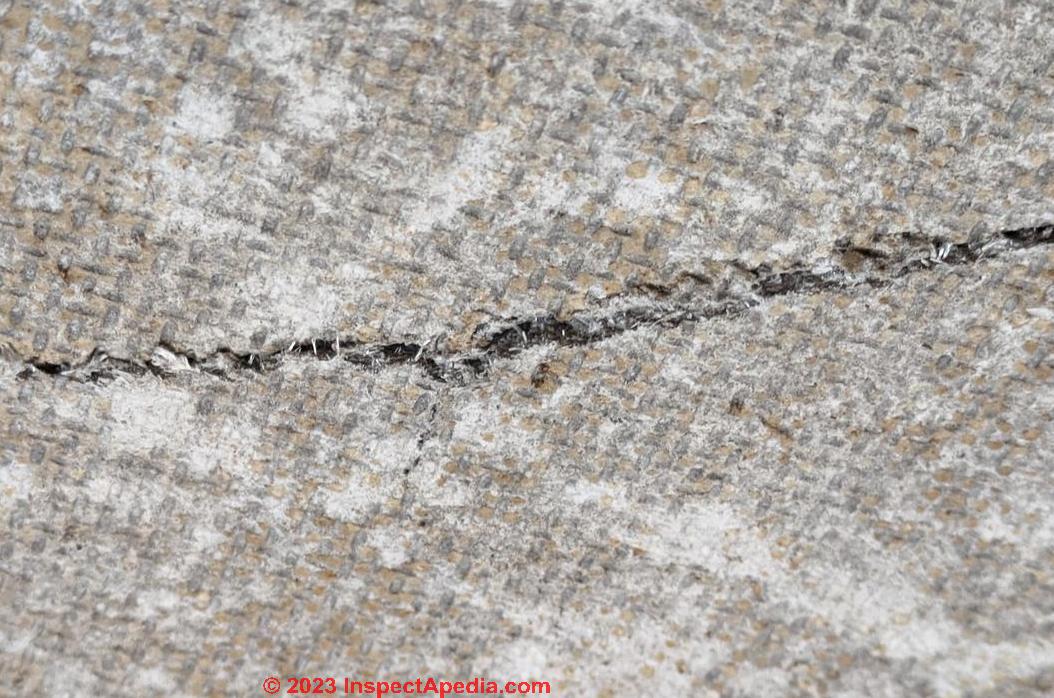
Hello, I am a paintings conservator who was asked to repair a painting from 1950 that has a break in the middle. It is executed on some kind of hardboard or similar that has fibers in it that I worry could be asbestos.
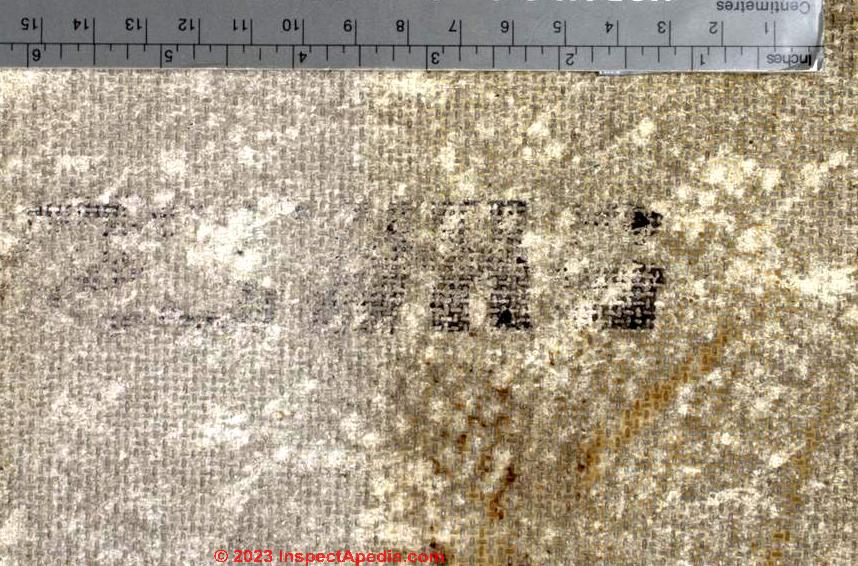
The board is about 1/8" thick and there is a stamp on the back that is barely legible, but I will add a picture in case it is recognizable from that. I appreciate any thoughts you might have! - On 2023-12-13 by Daniela
Reply by InspectApedia DF (mod)
@Daniela,
Most fiberboard is plant-based. I can't see the stamp - if you have an idea what you think it says that would be helpful.
From the color, maybe you've got Sundeala board
see
SUNDEALA BOARD COMPOSITION & HISTORYFollowup by Daniela
@InspectApedia DF, thank you for your reply. From the description of Sundeala I don't believe it can be that. My impression is that it is not a product made to be used by artists, it looks like repurposed construction material.
Were fabric fibers ever incorporated into the textured backs of Masonite or similar boards? (And just to be clear, this is definitely not a separate canvas attached to the back as is sometimes done for artists boards).
Please let me know if you have any further thoughts based on the other two images I included-- Thank you!
Here is a picture of the stamp. All that I can make out is maybe an "...RS" or an "...R'S" at the end of the word/name.
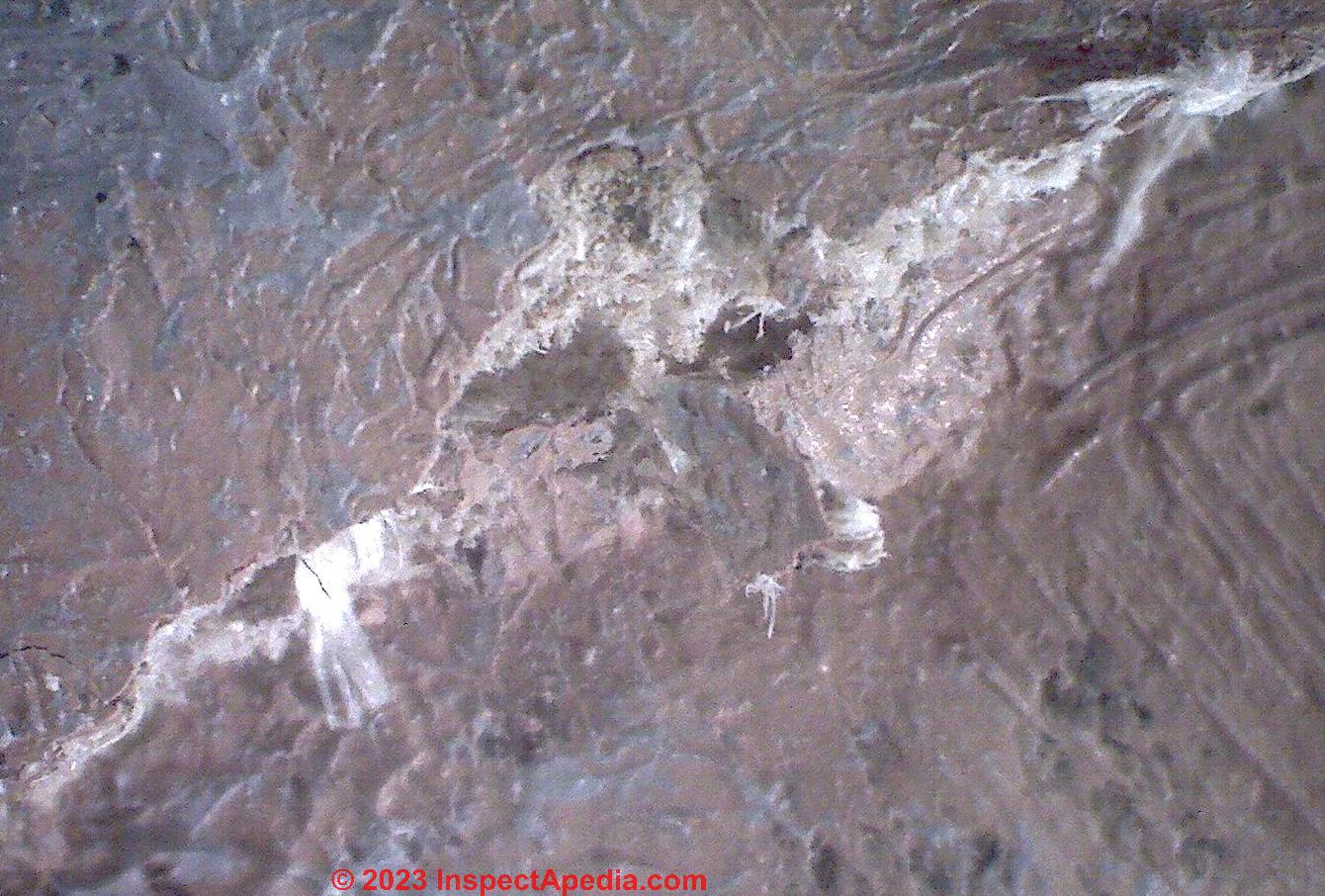
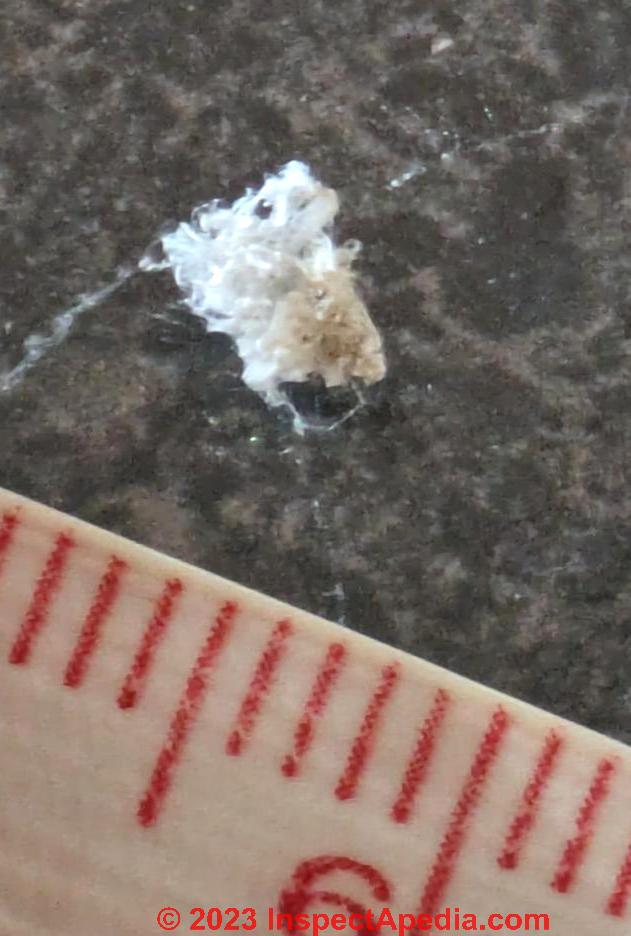
And here is a not great closeup of the front of the damage where the paint is cracked and a couple of white fibers are poking out of the exposed edge of the support.
Followup by Daniela
@InspectApedia-911, Thank you! I forgot that I also have this image I took of a little piece that came off when I unframed the work.
I didn't see exactly where it came from so it's not a guarantee that it is the same fibers as the other pictures I provided, but I teased it apart a little (thankfully, I didn't handle it without gloves, even though it hadn't yet occurred to me that maybe there's a chance it could be dangerous!) and it does have a fluffy kind of fibrous feel to it.
It doesn't look like the wood-based material that I think I'm seeing in other parts of the board.
Also, I noted in the Fiberboard section of "Twentieth-Century Building Materials: History and Conservation" (pg 90), that asbestos was one (of many) materials that were added to processed boards to affect various qualities (such as fire-resistance), but this is a very general description that could refer to any number of types of boards so it really doesn't help me at all in identifying this particular board.
Reply by InspectApedia DF (mod)
@Daniela,
We appreciate the question, photos, discussion; I'm not sure if your principal concern is an asbestos hazard (unlikely if you're not creating a dusty mess), or conservation, or simply board identification.
Keep in mind that you won't be able to actually identify asbestos fibers added to or in a fiberboard product by the naked eye. But if you're simply preserving or sealing or cleaning the board, normal dust control and PPE ought to be more than sufficient.The substantive hazard from an asbestos product comes when significant levels of dust are being made and disturbed.
It may be helpful to take a look at
FIBERBOARD SHEATHING IDENTIFICATIONFollowup by Daniela
@InspectApedia DF, thank you, I've saved the link to refer to. I am hoping to identify the board, but what first led me to your sight was the concern over asbestos because I posted my picture to an art conservation forum a couple of people raised the possibility that the fibers might be asbestos.
I am going to try to get a test done on a sample just for peace of mind because I expect I will have to have my face near the break when I try to repair the painting.
I thought that knowing the type of board might influence my decision-making-- for example, when choosing what type/concentration adhesive I think will work best in the break.And if it's a type of board that's still on the market then I'd have the option of making a mock-up to test on before attempting to repair the break on the original artwork. But ultimately it might not make a difference even if I can identify it.
Just to confirm, having exposed asbestos fibers (if I do receive a positive ID) at the outer edges of the painting is not at much risk of shedding material out? I'm thinking in terms of the safety of the family that owns the artwork.I could use a material like Paraloid B-72 to seal around the edges of the cut board if it was a risk to them. The painting has a shadowbox frame so the edges are not covered by the frame.
Reply by InspectApedia Publisher
@Daniela,
Thank you for that helpful clarification.
Bottom line:
In my OPINION normal conservation work on paintings on fiberboard should not present a significant risk of airborne asbestos fibers though there may be some board products that are an exception.
Details:
You're quite right to want to identify the fiberboard if you can, since that would narrow the asbestos hazard question considerably. Most fiberboard doesn't contain asbestos.
My OPINION (which is just that) is that from working on restoring paintings on MDF or softer fiberboard products typically means light cleaning and re-coating what are usually very tiny areas of damage, risking shedding a few fibers of what's principally plant material.
There were a few soft board products, more-often gray-white in color (yours?) that did contain asbestos. See Asbestos in Low Density Board (LDB) "Fiberboard" Products on this page.
As part of conservation work on paintings on fiberboard one might at the same time consider sealing the edges of the board - where my friend Ulrik Runeberg has pointed out the work is most often most damaged and hardest to preserve.
And my OPINION is that the volume of disturbed and then airborne material from such conservation work ought to be infinitesimal. But certainly if you're working on very fragile material you can increase your safety by wearing a HEPA respirator or even working under a draft hood. (I'm doubtful that it's really justified but that's just an opinon.)
The history of asbestos related illness suggests that the greatest hazard was at very high levels of exposure (workers in the shipyards in the 1940s when the air was opaque with asbestos insulation) either from chronic exposure or from acute exposure such as the 9/11 WTC terrorist attack and building collapse.
Most often when we consult a third party "expert" that person is, quite understandably where it's so difficult to get objective risk data, most likely (forgive my split infinitive) going to give very conservative advice that costs you, not them, time and money - I discuss this issue athttps://inspectapedia.com/home_inspection/Other_Peoples_Money.php OTHER PEOPLE's MONEY
My AIHA association (I'm now retired from that membership) has this article that focused more on asbestos in greater quantities, in higher concentrations in museums such as from asbestos insulation:
KATHRYN A. MAKOS AND MARGARET SKIMINA , Health and Safety in Museums and Art Galleries -
You'll want to see some other fiberboard painting conservation information organized at
HARDBOARD & MASONITE USED in WORKS OF ART
where we've done some forensic work ourselves and have worked for years with several conservators.
My OPINION also is that greater hazards in some artworks include lead in paint or other materials and very fine harmful dust in some pottery or ceramic projects.
I think that some other artworks that were painted not onto MDF fiberboard but onto asbestos cement board are in a similar risk category: that material is not friable but if cut or sawn or demolished, can create higher levels of dust that in turn may contain higher levels of airborne asbestos.
Thank you for the discussion; this is a long standing concern - in more general terms - of hazards to artists dating at least back to Ramazzi (1713).
cf:
- Franco, Giuliano. Prevention is far better than cure. Revisiting the past to strengthen the present: the lesson of Bernardino Ramazzini (1633-1714) in public health. Youcanprint, 2020. >
- Pérez, Nora A., Isabel López-Arvizu, Adrián Mejía-González, Pablo Aguilar-Rodríguez, Nuria Esturau-Escofet, Daniel Meléndez, Erik Perez-Ramirez, and Sandra Ramirez. Assessment of preservation coatings for fiber-cement panels used in XX century mural paintings in Mexico [PDF] Journal of Cultural Heritage 50 (2021): 13-24.
And be sure to read
Is Asbestos in Yellow Fibrous Materials in 1950's Garage Ceiling Panels?
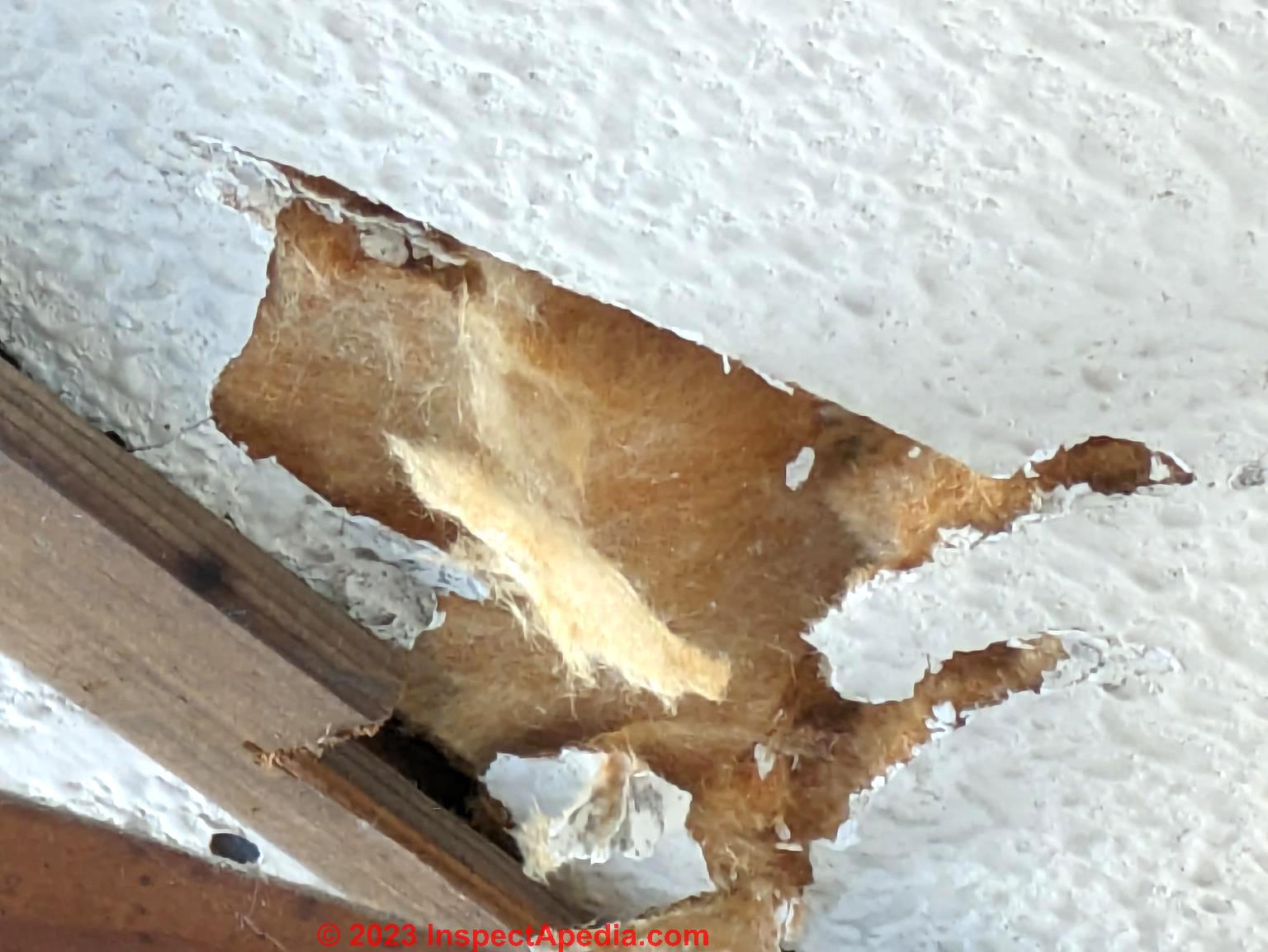
We are remodeling our garage of a house which was built in 1950s, and we notice that the ceiling of the garage is damaged, exposing brown - yellow fiber-like materials inside.
Could you please help me identify what kind of material is this (probably a wood fiberboard if I have to guess)? Is it likely to contain asbestos? Thanks!
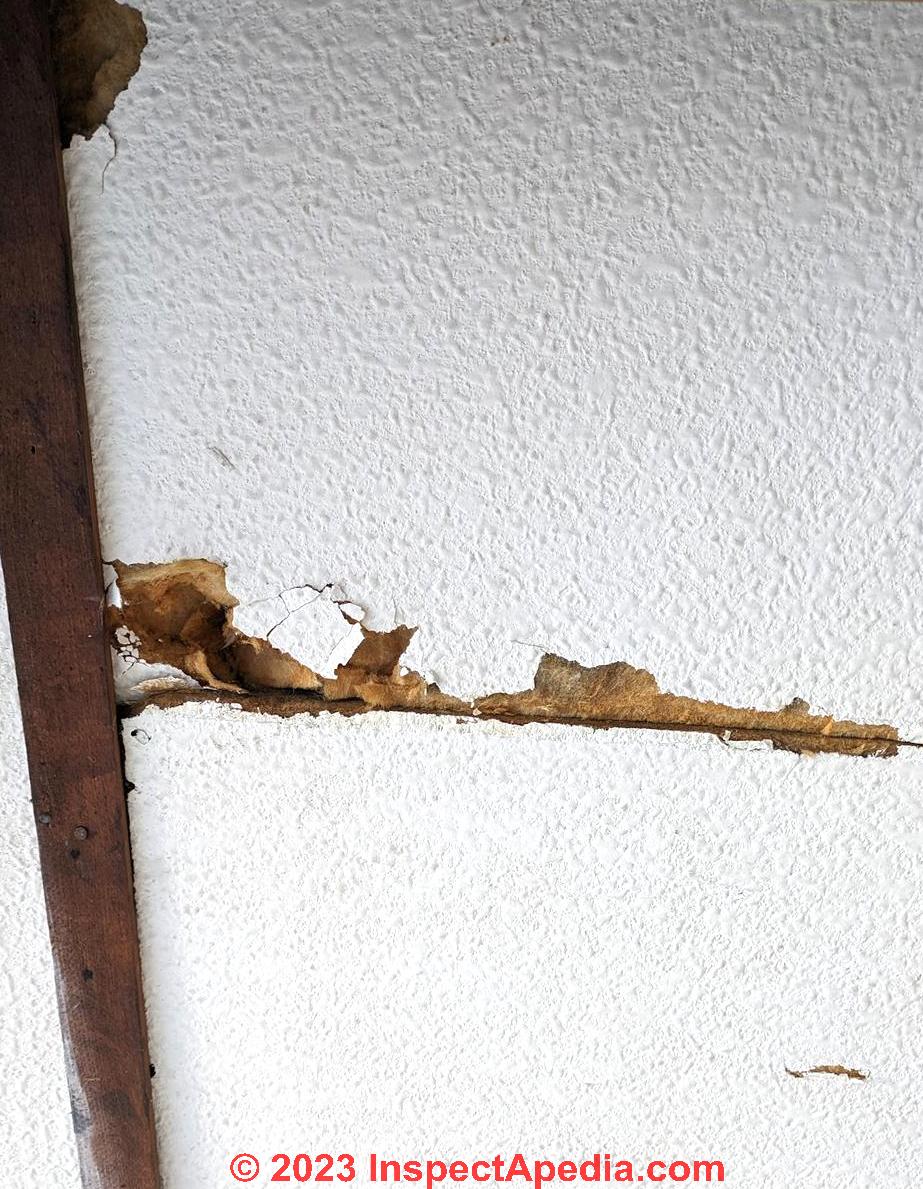 ...
...
- On 2023-09-25 by Aaron
Reply by InspectApedia Publisher
@Aaron,
The panels in your photos look to me like plastic covered fiberglass, or less-likely, mineral wool.Fiberglass and mineral wool are not an asbestos material.
If I'm mistaken and those are fiberboard, note that fiberboard doesn't normally contain asbestos, but if you're concerned at all be sure to read
FIBERBOARD SHEATHING ASBESTOS CONTENT
The live link is in the more reading articles suggested on this page.Followup by Aaron
@InspectApedia Publisher, thanks for the response. I sent the yellow-tan colored fiber to a lab, turns out it's mineral wool.
Reply by InspectApedia Publisher
@Aaron,
Thanks for that follow-up, that will be helpful to others.
Indeed to the naked eye, both fiberglass and mineral wool look very similar. And some people use those two terms a bit loosely, as the fibers are similar (not identical) microscopically.
Details and distinctions are at
FIBERGLASS vs MINERAL WOOL vs SLAG WOOL SEM IDENTIFICATIONMINERAL WOOL / "Rock Wool" COMPOSITION
and at
FIBERGLASS INSULATION IDENTIFICATION & PROPERTIES
Gold Bond fiber board as sheathing on 2" X 4" studsusable to support HardiePlank Siding?
Our two story colonial built in 1971 has Gold Bond fiber board as sheathing on 2" X 4" studs.
The original siding is face nailed 1/2" X 6" beveled western red cedar. If we were to remove the deteriorating cedar, can that structure support six inch HardiePlank lap siding as a replacement? - On 2023-09-16 by Anonymous -
Reply by InspectApedia DF (mod) - OK to install HardiePlank over fiberboard?
@Anonymous,
I'm embarrassed to have to duck and weave, but I don't know (I am, in fact, doubtful that soft fiberboard itself will adequately support any nailed-on plank siding, but you can still install that siding if you take care to find and nail to the wall studs.So you need to check:
- the spacing of your wall studs
- the presence or absence of corner bracing at all wall corners
- the condition of the wall framing studs, sills, top plates
SO we can give only a rather generic answer:
If your building was framed properly with the required diagonal bracing, let in bracing or solid sheathing bracing at its corners, then the fiberboard sheathing was not doing much at all to support the structure. It was there as an insulating board through which your original cedar siding was nailed.
In that case, sure, remove the deteriorated cedar siding, inspect and replace any bad insulating sheathing (you can use equivalent thickness of foam board or something else if you like), and after confirming that the walls are corner-braced, you're ready to install new lap siding.
Post some photos of the present condition, of the sheathing when you expose it, and of the bracing that you find (or don't) at the corners - so that we can comment further and be more confident about your situation.
One photo per comment.
Also, where is the building? What type? How tall?
Is this gray board "fiberboard"?
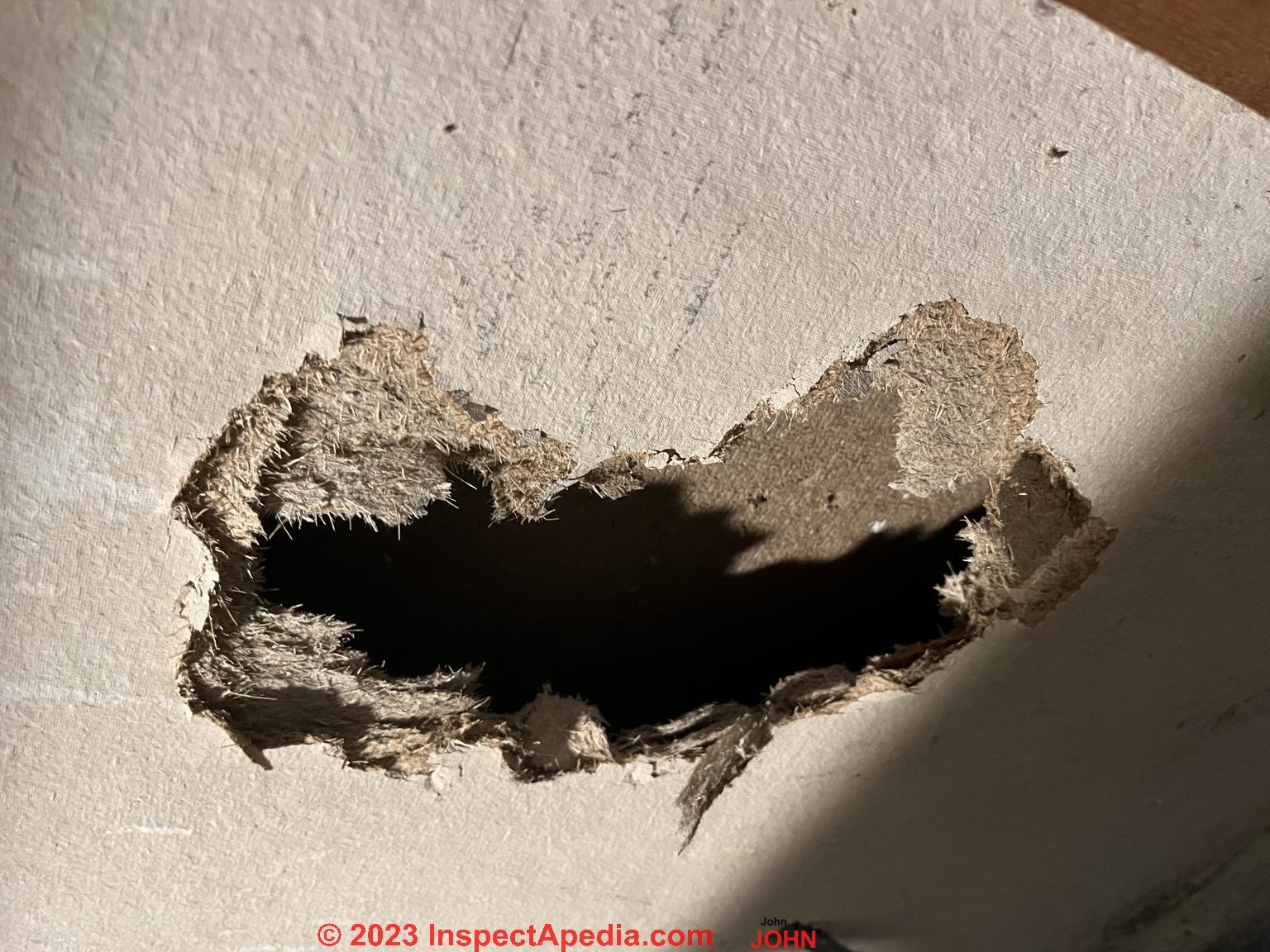
I started to punch a hole in my basement wall in search of a pipe. House was built in the 1950s but I don’t k is when these boards were put up. Please advise
Here is another picture of this gray papery board [paraphrased by mod]
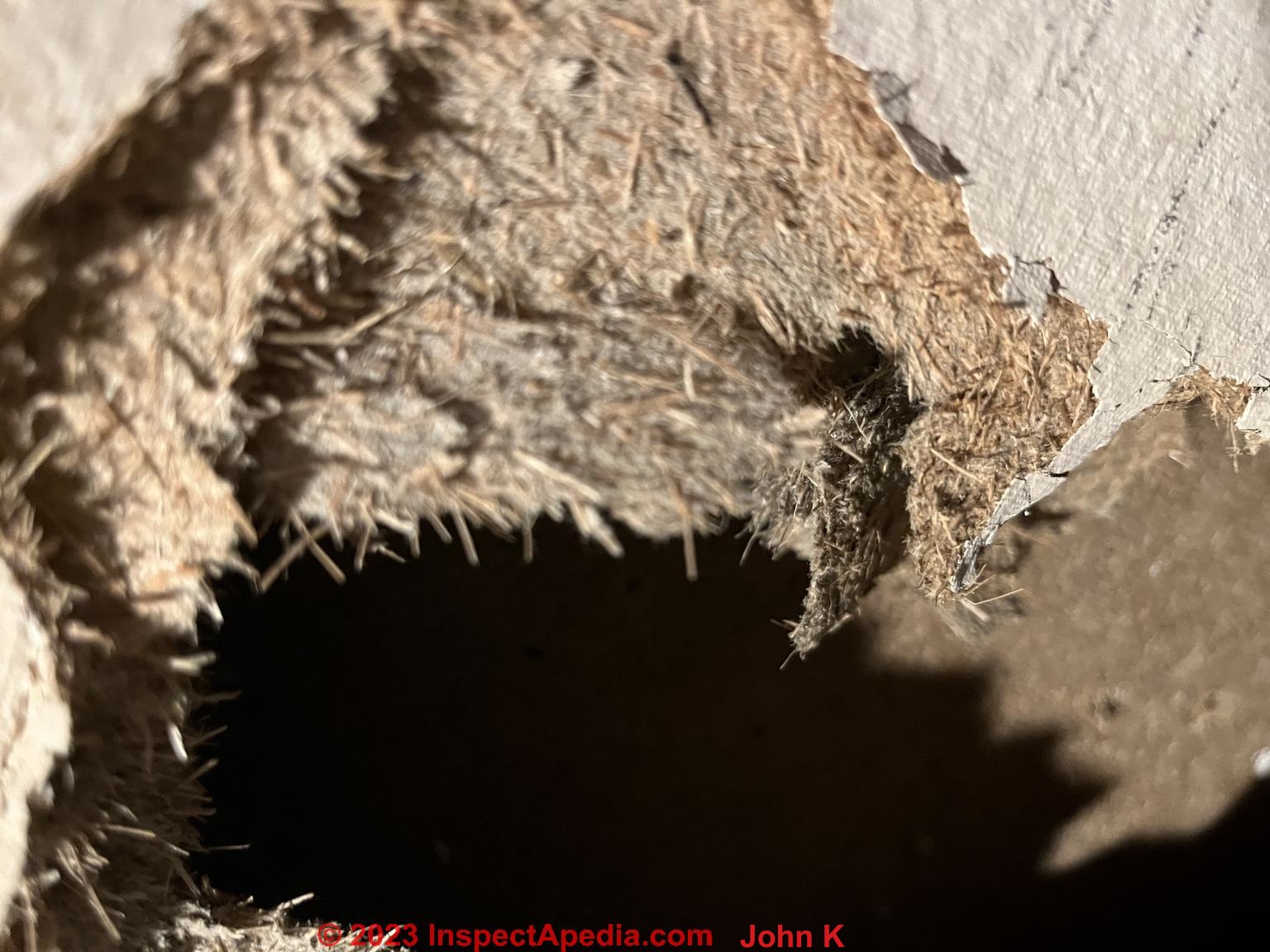
- On 2023-09-07 by John K
Reply by InspectApedia Publisher (mod)
@John K,
That looks like a fiberboard sheathing product.Some gray papery fiberboard contains asbestos. I'd avoid making a dusty mess or have a sample tested.
Does this Flintkote subflooring contain asbestos?
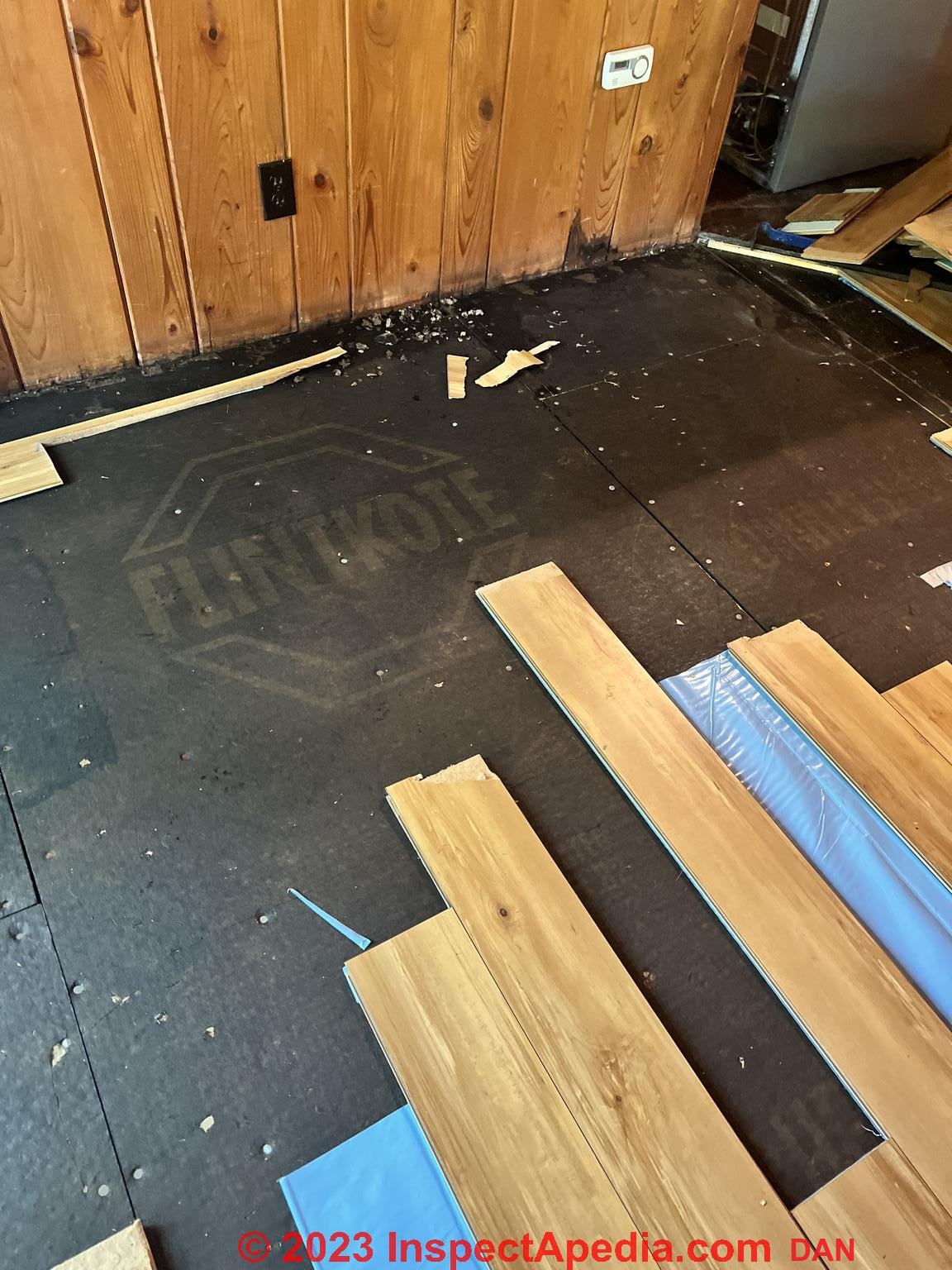
Has anyone come across this blackboard and know if it has asbestos? Thank you! - On 2023-07-18 by Dan
Reply by InspectApedia Publisher (mod)
@Dan,
Yes, for sure. That's Flintkote insulating blackboard - used as sub-flooring in this case, probably as a sound reduction measure.
First please read the opening paragraphs of the article above on this page. (No asbestos in general)
Then read and compare your product with
FLINTKOTE Stalwart™ SHEATHING ASBESTOS
https://inspectapedia.com/structure/Flintkote-Sheathing-Asbestos.php
Identify this multilayered light tan fiberboard in Quebec
This brown board, is installed as a ceiling in unfinished basement. The board has 4-5 sheets.
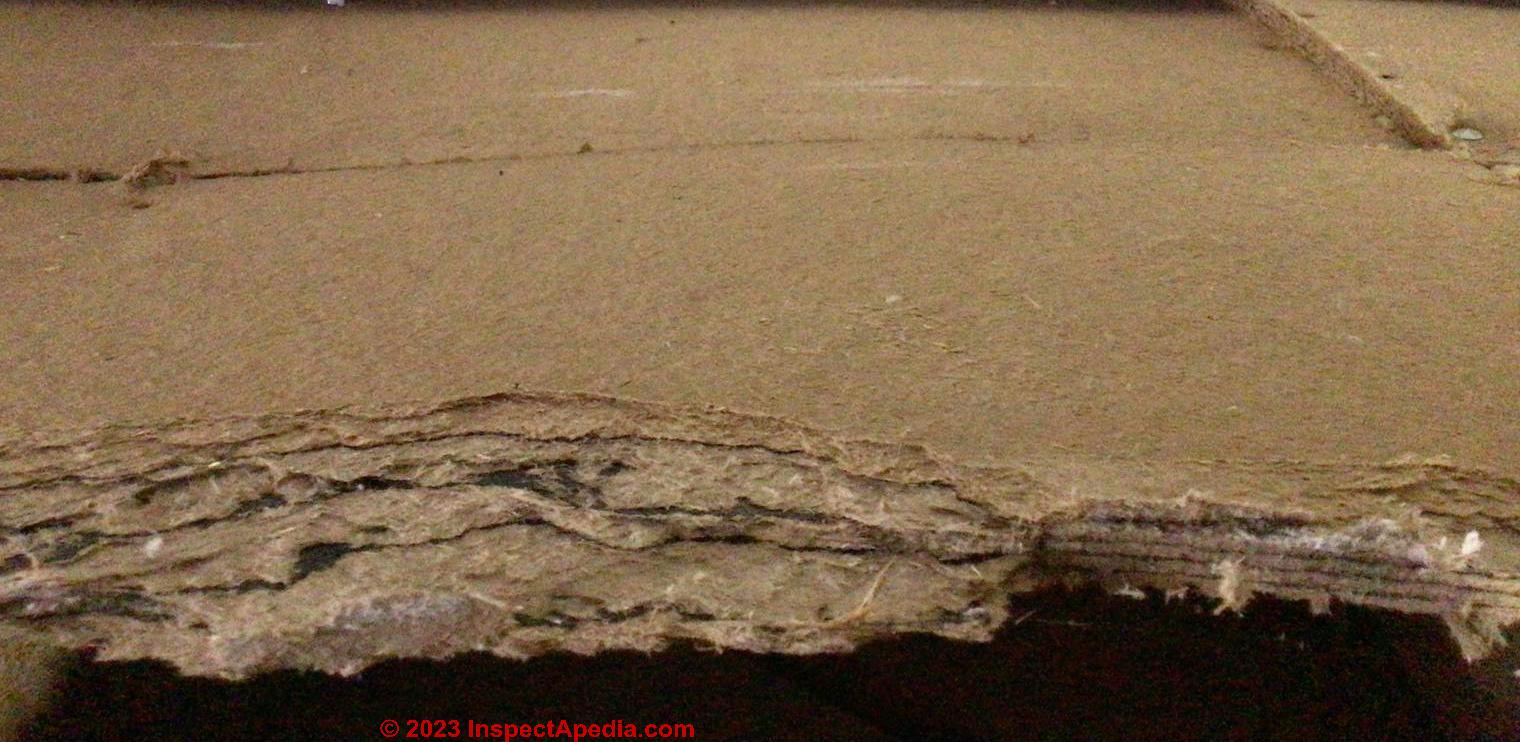
The Color is the same on both sides. The house was built in the 60’s. Do not know when these boards were installed.
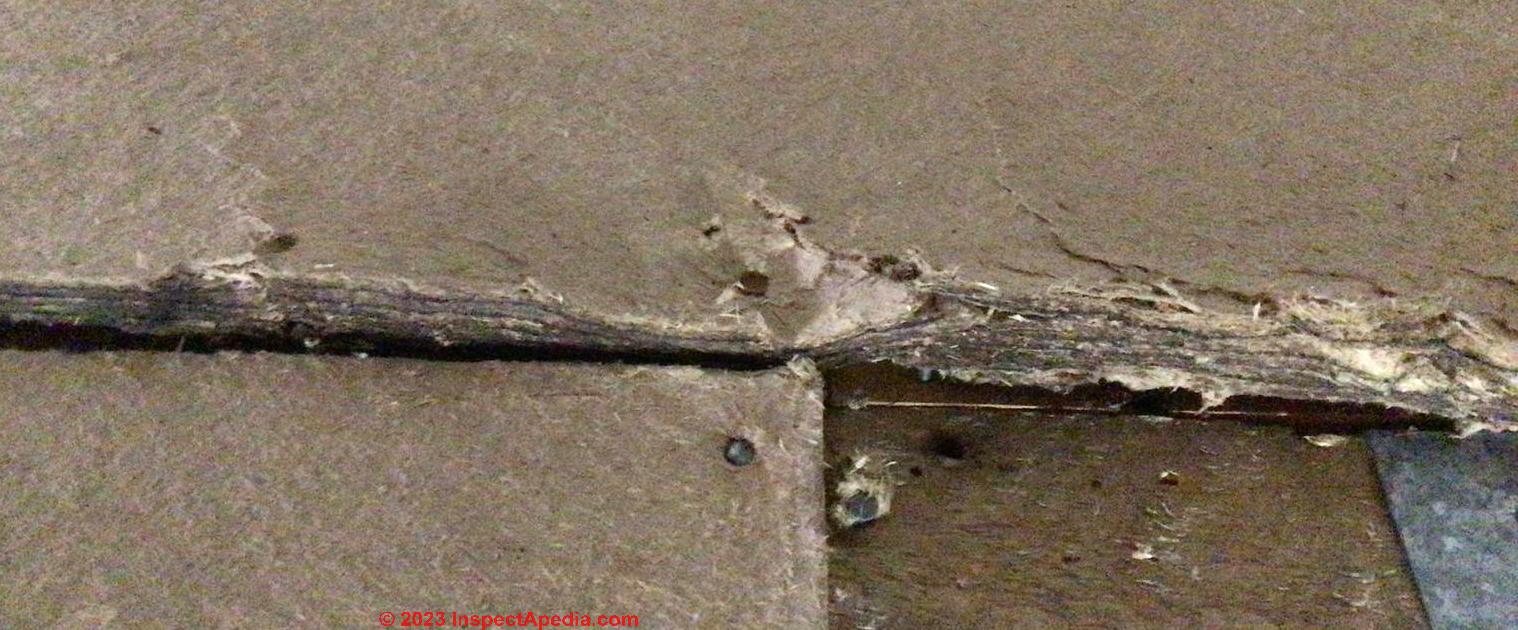
Here is the photo of an edge. No markings on boards. Home built in Val Morin, Quebec. Thank you. The white marks on the boards are from drywall hitting the ceiling.
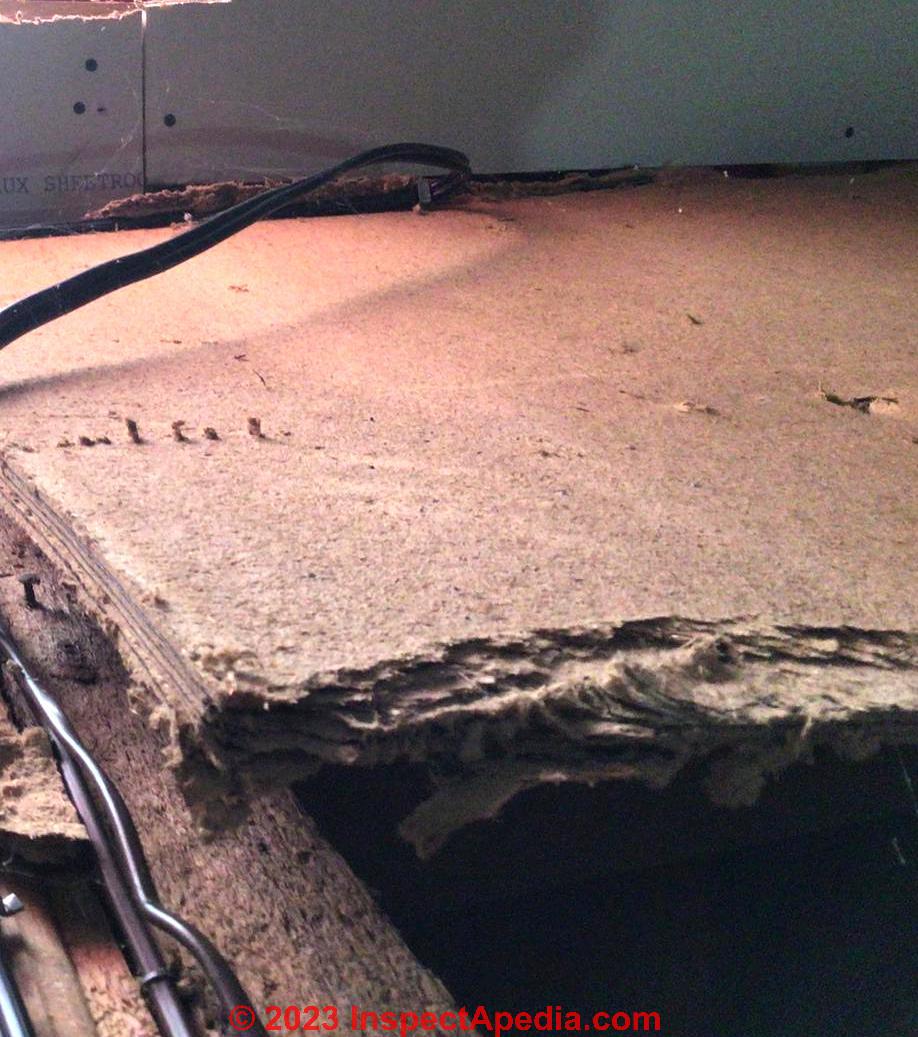
...
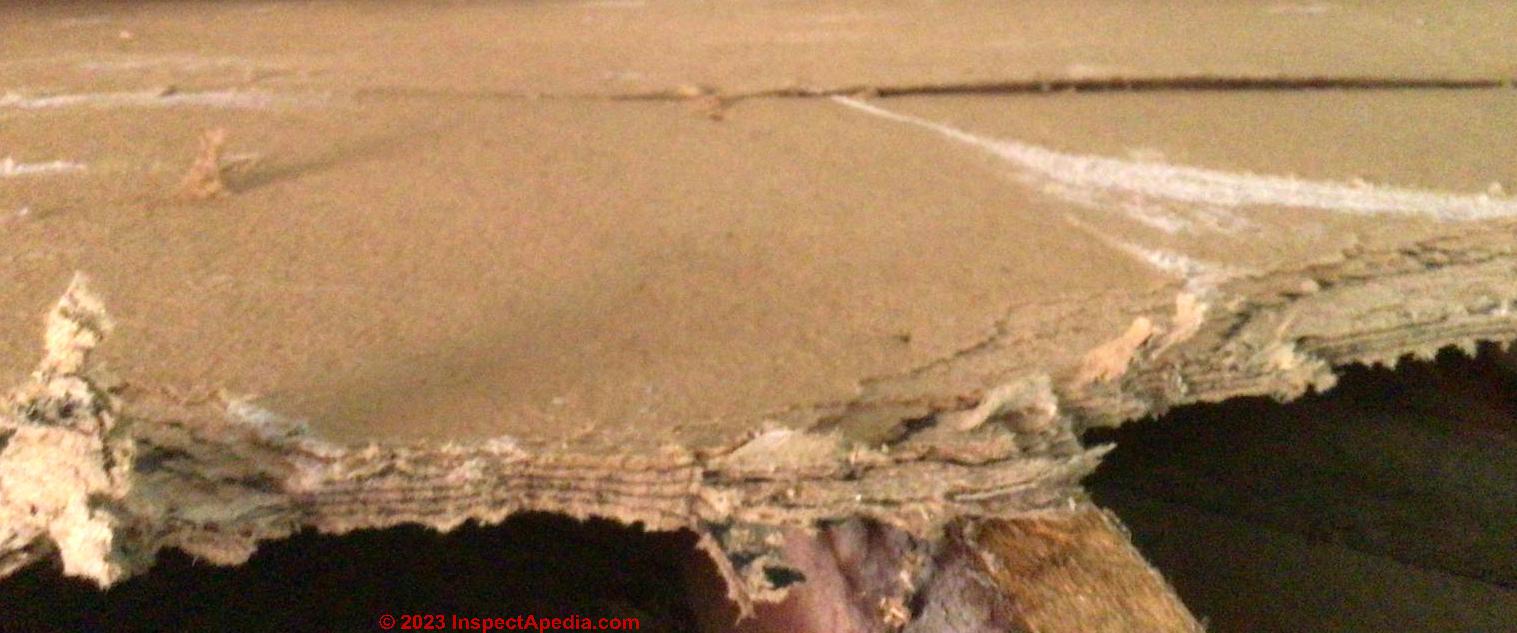
- On 2023-04-27 by Louise -
Reply by InspectApedia Editor -wallboard similar to Sackett board but perhaps later descendant
@Louise,
Excellent photo - helpful. That certainly looks like fiber board material.
That's a type of wallboard similar to Sackett board but probably later. Multiple layers of tan paper, and I don't see any gypsuym between the plies, though if you could take a closer look (do some peeling) that'd be helpful.
I'm not sure who made this product so do keep alert ford any stamps or markings - that would be invaluable.
You may be encountering an early form of wall or ceiling sheathing descendedfrom SACKETT BOARD - that product included layers of paper and plaster together.
There were other products that were in essence multiple layers of gray-brown thick paper with or without layers of gypsum.
OR a hybrid fiberboard product sandwiched between layers of cardboard.
Where is this 1960s building?
Are there any stamps or marks anywhere on the board?
Can you try getting a sharper photo of an edge view of the board? Your last photo is almost there. But I can't quite tell if I'm seeing a multiple-layered paper wallboard product or a layered wood based/plant-based fiberboard product.
Compare your product with the fiberboard versions shown at
FIBERBOARD SHEATHING
Also see this USDA article on fiberboard productsEARLY 20TH CENTURY BUILDING MATERIALS: FIBERBOARD AND PLYWOOD [PDF]
Asbestos in painted board box covering a radiator?
Looking at a (painted) insulation panel that is installed over top of the wooden box that houses a radiator.
It seems to resemble some of the panels that I’ve read could contain asbestos but the house was built in the mid/late 1930s (which is a bit early for the widespread use of asbestos, right?).
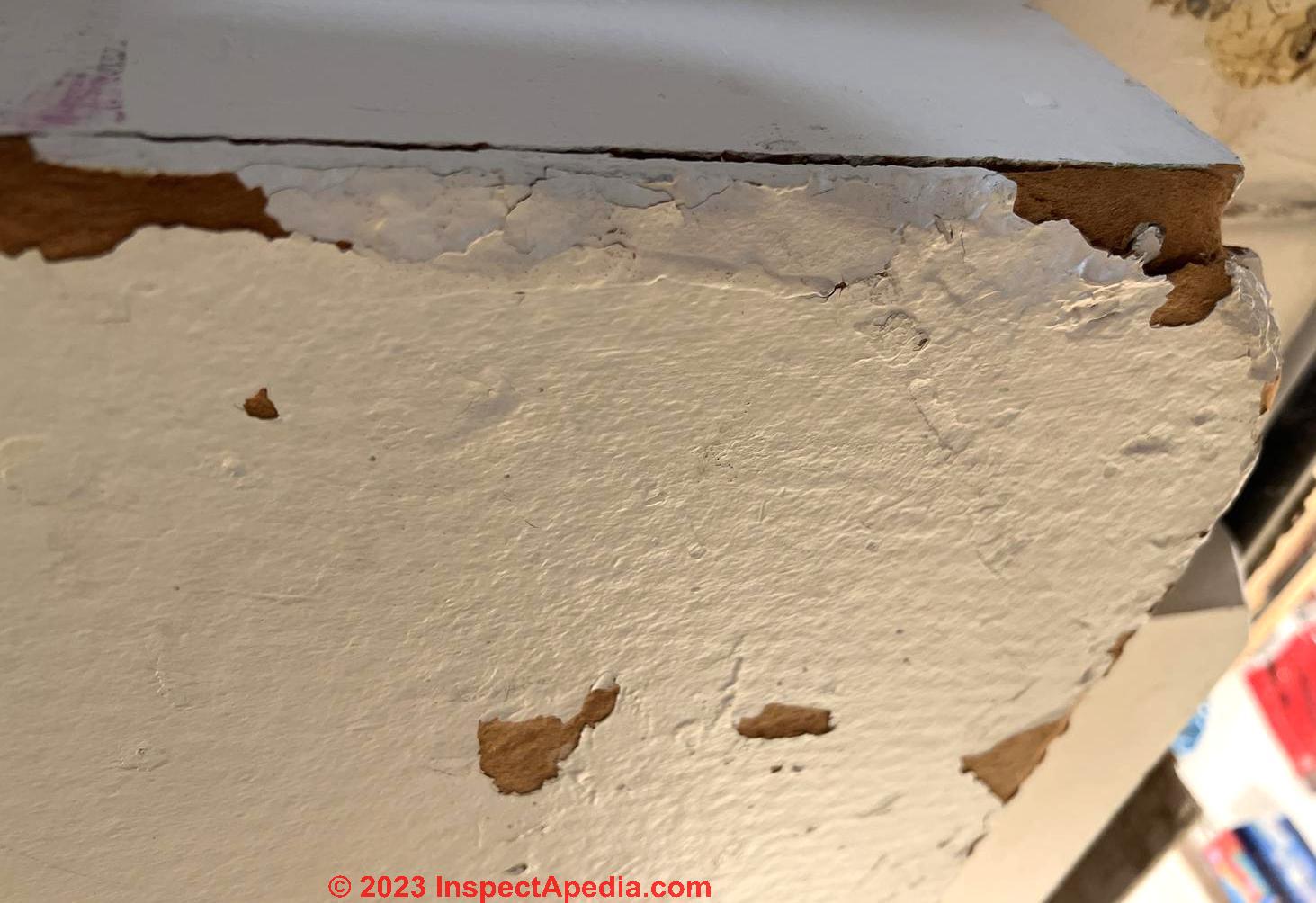
- On 2023-04-18 by Kevin Horahan
Reply by InspectApedia Editor - wood fiber insulation boards do not contain asbestos
@Kevin Horahan,
That looks like a brown wood or plant fiberboard product. You might want to take a lookat FIBERBOARD SHEATHING IDENTIFICATION
We do not agree that U.S. homes in the U.S. would not be likely to contain asbestos materials. The opposite is the case. '
But happily, brown wood fiber insulating board products generally were not an asbestos-containing material. Some less-likely exceptions to that rule are discussed above on this page.
What was the earliest date of use of asbestos in common products in the U.S.?
The U.S. began making commercial use of asbestos in various products in 1858 when Asbestos mining began at at Ward's Hill on Staten Island, New York. That first U.S. asbestos mining was by the Johns Corporation, predecessor to the more-famous Johns Manville Corporation.
By the mid 1860s asbestos was being used in the U.S. in insulation products, and by 1870 asbestos was used in boiler lagging or coating paste as well as on pipe joints.
Asbestos in this white chalky panel in a 1980's shed on our UK Property?
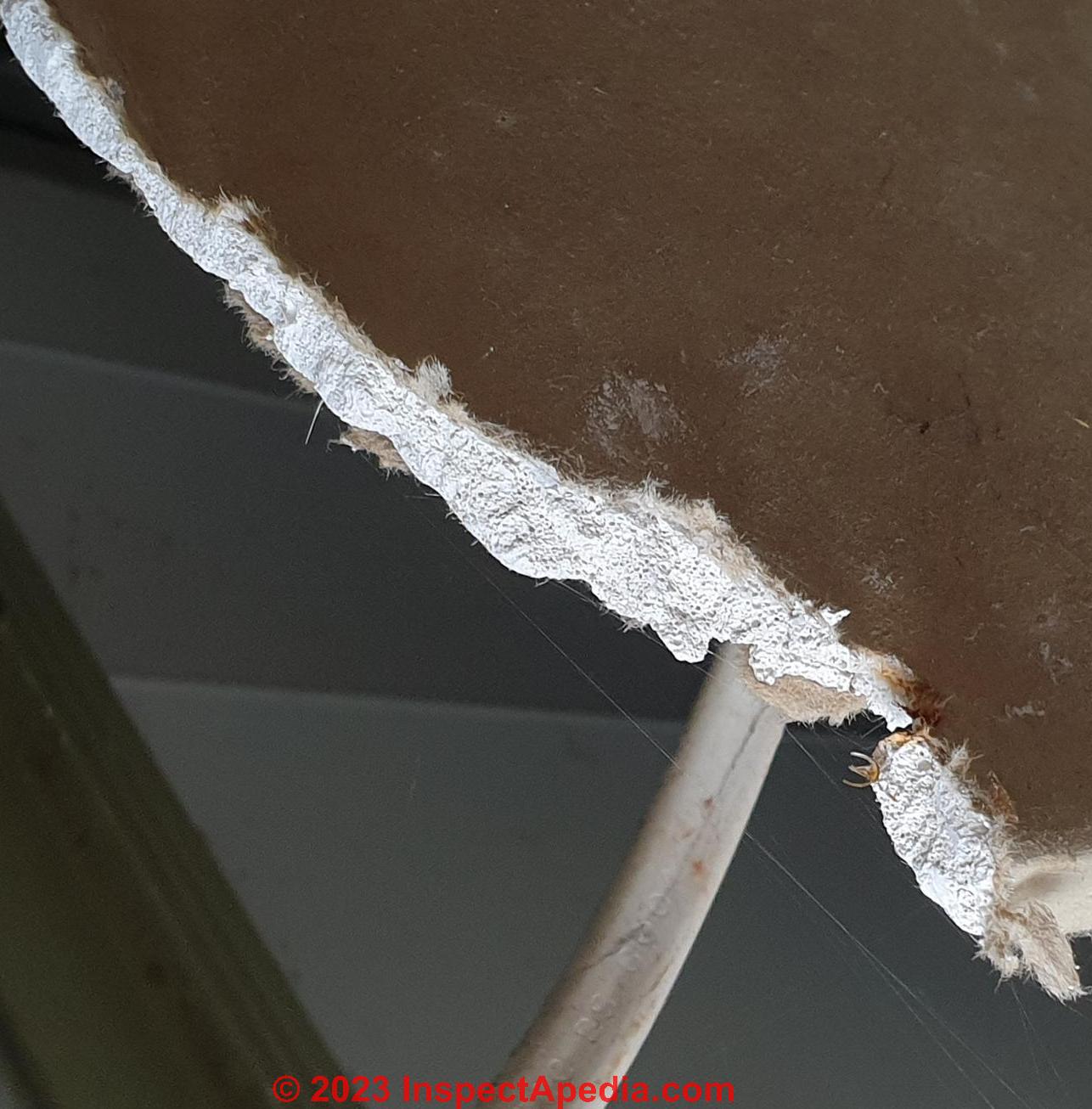
The panels in the picture are from the interior ceiling of a fairly heavy duty corrugated iron shed that has been on our UK property since we moved in c.8 years ago. The house was built in the late 1980s but I'd guess the shed is more modern than that.
The ceiling panels on one side of the shed have cracked down the middle, resulting in the interior ceiling falling in. I'm wondering if this material is anything potentially to be concerned about in terms of asbestos? Should I get a professional firm out to test / investigate?
When it first happened I swept up the debris without any thought to whether it could be dangerous, so I am feeling a little anxious having recently read that shed ceiling panels can sometimes contain asbestos. Any thoughts very gratefully received! Thanks in advance.
- On 2023-04-08 by GS-UK
Reply by InspectApedia Editor - don't confuse gypsum board or "drywall" with fiberboard products
@GS-UK,
I don't think that panel in your photo is fiberboard, which is what we are describing on this page.
That white core covered on both sides With what looks like paper would be drywall or gypsum board.
In the UK, gypsum board or drywall panels, such as those that I think are shown in your photo, would not be expected to contain asbestos if they were produced after the mid nineteen eighties.
Thank you for the photo and the question, let me know if I have misunderstood either of those.
Our topic home page for this question is
ASBESTOS in DRYWALL
---
For other readers:
No products made after 1999 and sold in the UK would be expected to contain asbestos.
Is this Light Tan Indoor Surface Fiberboard?
Is this fiber board, wood. Not sure. Wallpaper is covering some in our one room.
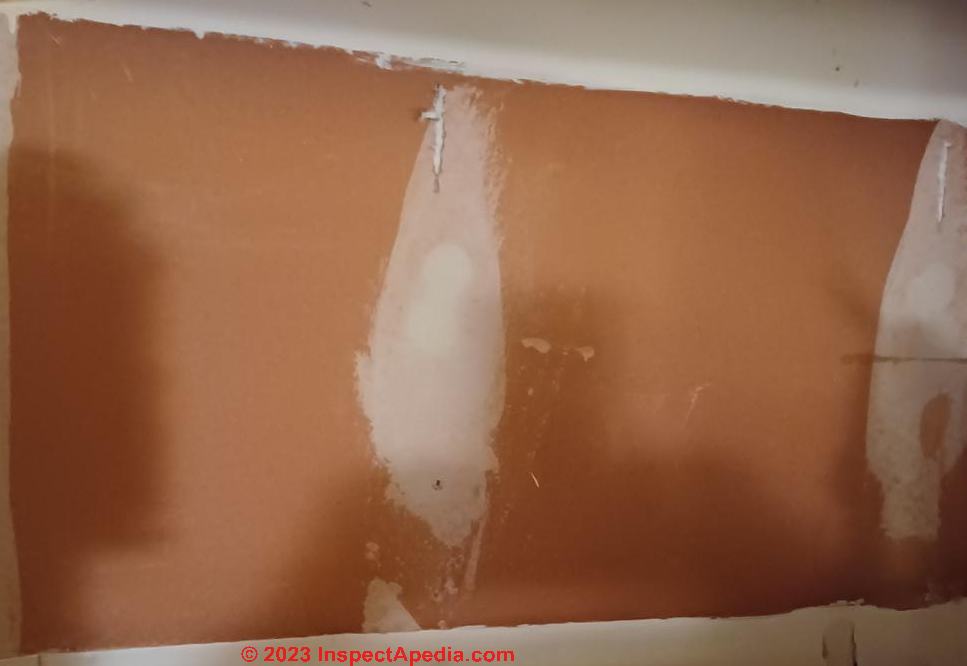
- On 2023-03-19 by Lynne
Reply by InspectApedia Editor - That photo is of gypsum board (drywall) not fiberboard
@Lynne,
The tan wallboard in your photo appears to show gouges that either expose or are filled with a white material such as joint compound.
That would almost certainly be gypsum board or "drywall" not fiberboard.
See details and more help in recognizing drywall at
DRYWALL, FIBERBOARD, PLASTER INTERIORS
Is this brown fibrous board asbestos?
Is this asbestos? My house was built in the 50s.
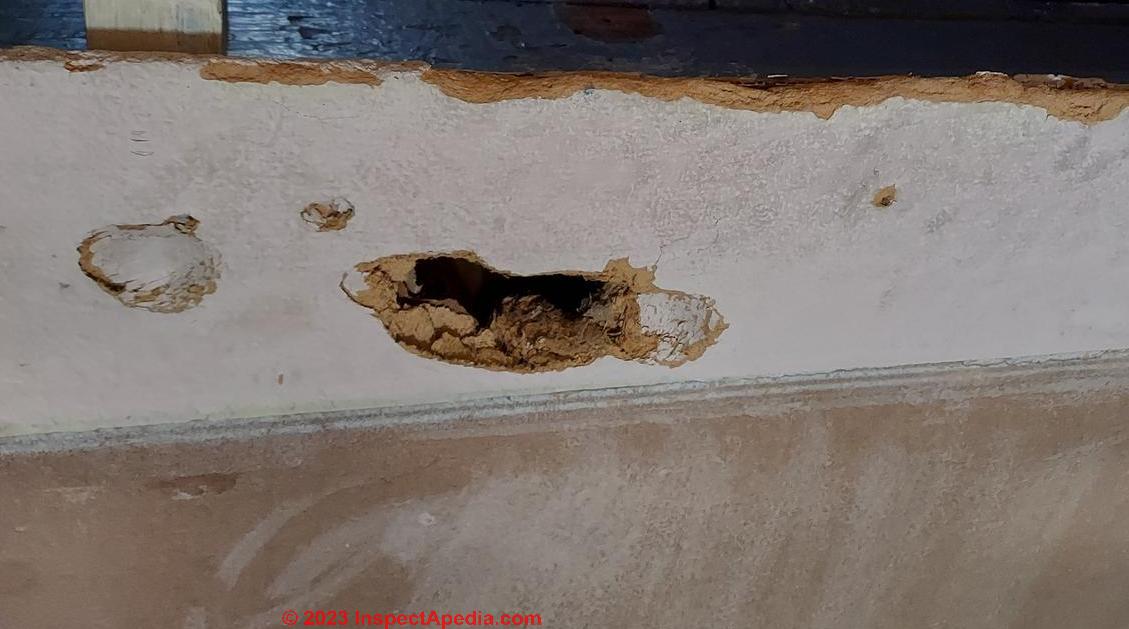
- On 2023-03-12 by Jade.koubek@gmail.com
Reply by InspectApedia Editor
@Jade koubek,
The photo looks like fiberboard. Not asbestos.
This 3mm thick woody soft board is in our home in Switzerland; I'm worried sick that this is asbestos.
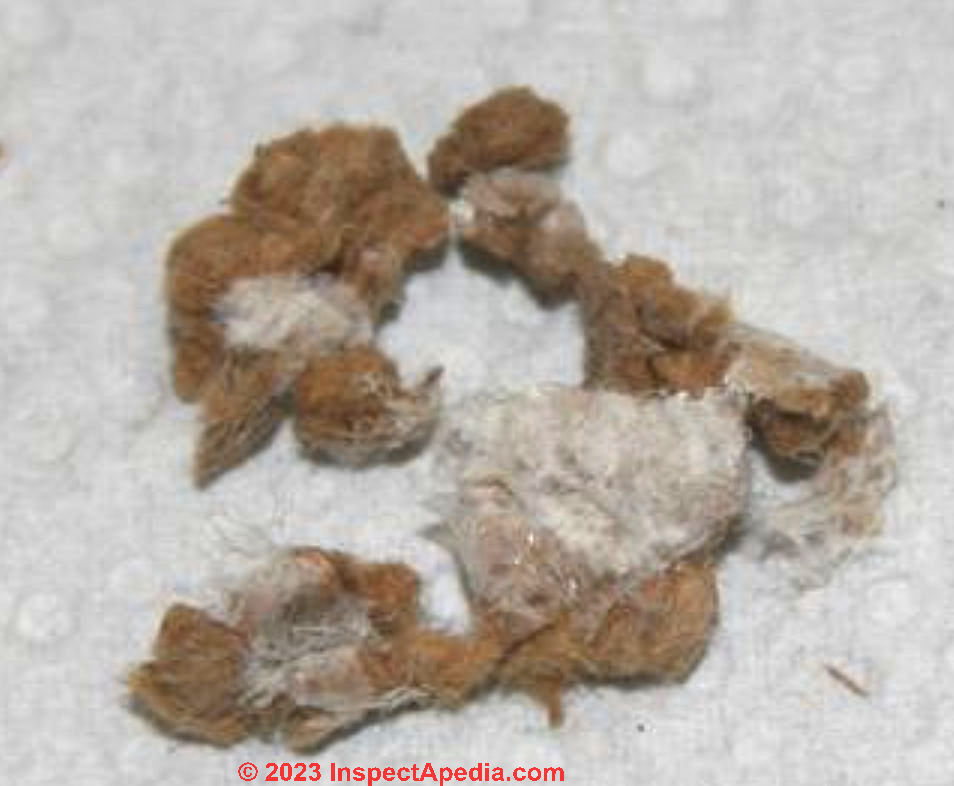
Hi, I am so glad I found this website. I am an expat currently living in Switzerland. We recently bought a house built in the 1950s. The main structure of the house is built out of cinder blocks. In two rooms there is some sort of wall covering that is painted over, and seems designed to be painted over.
It is mounted on the inside of the the east facing exterior walls of two bedrooms.
It is slightly squishy to the touch and 3 mm thick. I used a dull utility knife to cut off some piece to inspect for damp and mold
I am worried it is some type of asbestos. - On 2022-12-03 by Laura -
Reply by InspectApedia (Editor)
@Laura,
Usually brown fibrous material like that in your photo is plant based,but please do read SHEATHING, FIBERBOARD ASBESTOS CONTENT where we discuss the question of asbestos in fiberboard products, and let me know what you think.
Above I made an enlarged view of your photo.
Asbestos coating on wood-based fiberboard and/or in textured or popcorn paint that was applied?
How was insulating fiberboard panels applied to ceilings in the 50s and 60s? and did they ever contain any backings with asbestos? - On 2022-01-07 by barbara smith
This Q&A were posted originally
Reply by Inspectapedia Com Moderator
@barbara smith,
Fiberboard was nailed to the studs on walls or the ceiling joists on ceilings.
Usually the joint between individual fiberboard panels was covered by a wooden strip.
I'm not sure what do you have in mind by asbestos backing but in general I'm not aware of such a product.Followup by barbara smith - asbestos in fiberboard ceiling in mobile home?
@Inspectapedia Com Moderator, ok i have contacted a few asbestos inspectors about my mobile home ceiling with fiberboard and here is the response.
not in the fiberboard itself but if the fiberboard has any glue "mastic" ? some said if it has a backing on the fiberboard? and some said its been found in the paint of the fiberboard.
So my question since work has already been done and ceiling repaired but for future repairs is
1. would a large mobile home panel from the 60s have any glue when it was installed since it was not small tiles?
2. would it have any kind of asbestos backing as they are referring to in the fiberboard panels?
3. the paint on mine is a smoothe surface flat ceiling mobile home and not popcorn or any texture designs that i can see unless the paint through the years would have covered up a texture design as im not the first owner.so would asbestos be in regular paint or textured and popcorn only?
sorry for the confusion but this is the responses im getting as its not in the fiberboard but the catch is these other areas
Reply by Inspectapedia Com Moderator
@barbara smith,
Thanks for that added detail. What you were told is consistent with our information, as you'll see in the article SHEATHING, FIBERBOARD ASBESTOS CONTENT
It would be quite unusual for fiberboard ceiling or wall coverings to be glued-up with a mastic adhesive, but yes some of those adhesives contained asbestos - not in a friable form unless the mastic is being pulverized during remodeling or demolition.
Those details are at
ASBESTOS-CONTAINING ADHESIVES [web article]
About "asbestos paint" - in residential application the place you'd be most concerned about finding asbestos in paints would be in some older textured paints and in popcorn ceiling paint.It is possible but again uncommon to find those applied to wood fiberboard ceilings. (Is your fiberboard ceiling painted at all?).
The factory-applied thin white coating found on fiberboard ceiling and wall panels would not be an asbestos product.
See those details at
CEILING PAINT TEXTURED / POPCORN ASBESTOS [web article]
About an "asbestos-backing" on fiberboard ceiling or wall panels that's not a COMMON product for which we have found reports of use in residential construction. If you know of such a product that would be important information to share and would help our research.
There are research articles describing the use of asbestos in acoustic materials (in fibrous form it had good acoustic properties) and in some special coatings (not specific to fiberboard but perhaps confusing to some people) as we cite in the references section of this page.
- Sihabut, T., and N. Laemsak, SOUND ABSORPTION EFFICIENCY OF FIBERBOARD MADE FROM OIL PALM FROND [PDF] In FORTROP II International Conference, Bangkok, Thailand, vol. 185. 2008.
Excerpt:
In the past, asbestos was used as an acoustic material because of good sound absorption, fire retardant and low heat transfer characteristics. However, this material potentially causes adverse health effects to human, including lung cancer and mesothelioma (Nordmann, 1935; Wagner, 1960; Newhouse and Thompson, 1965; Ribak et al., 1988) and has been banned in many countries.
Note that this article does NOT cite the use of asbestos ON fiberboard itself.Another example is in
- DEVELOPMENT OF AN IMPROVED SYSTEM OF WOOD-FRAME HOUSE CONSTRUCTION [PDF], (1965) U.S. FPL
Again this does NOT cite use of asbestos backing on fiberboard.
Excerpt from roof covering products discussion:
Two planks were formed from one board. The exposed face and edge surfaces of the plank were covered with an asbestos-backed polyvinyl fluoride film providing a prefinished, long-lived face.
Gross, Daniel, and Joseph J. Loftus. FLAME SPREAD PROPERTIES OF BUILDING FINISH MATERIALS ASTM Bulletin 230 (1958): 56-59.
Excerpts:
… The test specimen, measuring 6 by 18 in., was placed in a metal holder and backed up with
… in degrees Fahrenheit over that observed with an asbestos-cement board specimen, and is
… obtained with these finish materials on a fiberboard base than on the other base materials. …- Robertson, A., BUILDING, VARIOUS WOOD-BASE. SURFACE FLAMMABILITY OF VARIOUS WOOD-BASE BUILDING MATERIALS [PDF]
Compares flame spread to asbestos millboard - NOT an asbestos coating on wood-based fiberboard.
and finally
- Radnofsky, M. I. OTHER NASA-DEVELOPED MATERIALS & SOME INDUSTRIAL APPLICATIONS (1971). [PDF]
Excerpt:
Mineral pigments in a wide variety of colors can be formulated into fluorocarbon-based paints. Panels fashioned of elastomer-backed nonflammable paper, to which decorative; patterns have been applied, have been manufactured.
The inclusion of asbestos in the backing provides insulating properties. Such a lightweight, fireproof sandwich affords much flexibility in decorative panel design. Elastomeric coatings can be applied to polyurethane foams and to cellulosic materials such as paper, wood, and sponge, thereby effectively fireproofing the materials for structural and insulative applications.
...
An asbestos foam has been developed by the Rex Asbestos Works of Germany. This material is marketed in batting and sheets, is inexpensive, and should be useful for general insulation applications.
...
Ceiling and WalUPPanels
Existing ceiling and wall panels have been coated with Fluorel impregnated fiberglass, with an overlay coating of transparent Kel-F applied for soil and stain resistance. The Fluorel surface can be furnished in an array of decorative designs. Panel backs have been coated with a mixture of 75 percent Fluorel/25 percent asbestos to prevent heat transfer as well as to provide fire protection.
Note that this is a fiberglass-based coating + asbestos, NOT wood based fiberboard.Conversely, other asbestos-backed or asbestos-impregnated or asbestos coated board products are described as using different materials such as
- Lamontagne, Jason. "A Boiler Jacket for WW&F Locomotive No. 9 Final Report."
Excerpt:
… of boiler jacket standoffs, to give the jacket sheets a firm backing. Originally, this backing was provided by stiff magnesia-asbestos fiber board insulation.
and
- Anderson, LeRoy Oscar. Construction of Nu-frame Research House:(utilizing New Wood Frame System). Vol. 88. Forest Products Laboratory, 1968.
Excerpt:
… They consist of thin, flat or beveled sections of redwood or cedar backed with low-grade …
Surface is covered with asbestosbacked polyvinyl-fluoride film. 5. Interior covering.--"Perm-…
A white polyvinyl-fluoride film with an asbestos mat backing was glued to the A face
Is there Asbestos in this layered wallboard in my 1910 Oregon Home?
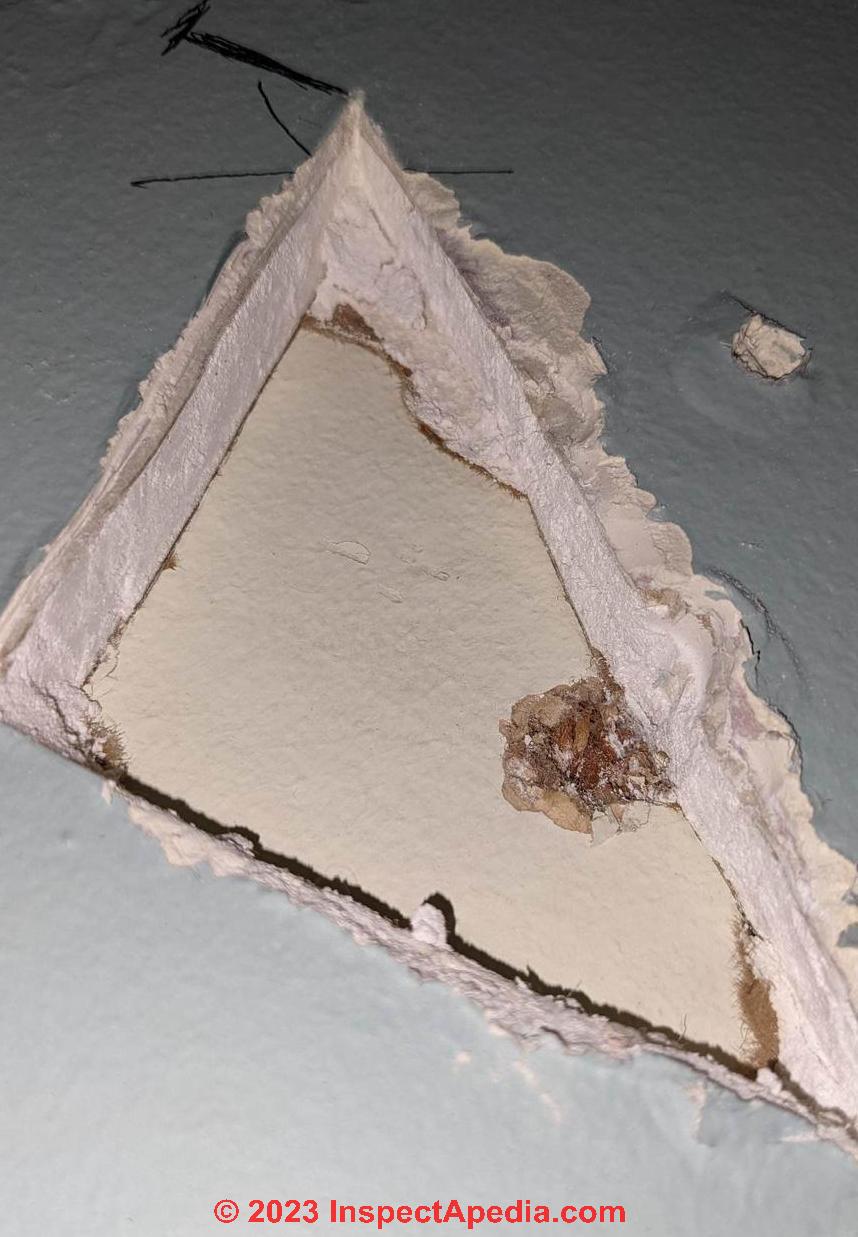
I have a home that was built approximately 1910. It looks like the previous owners(I purchased 2018) drywalled over a fiber-like wall that is painted.
It seems to have a paper layer on the outside. I want to make sure it is not asbestos containing before making bigger holes to add electrical into.
The home is in in Cascade Locks, OR US. That's northwestern Oregon . Other details I have is the ceiling has 2" boards between the drywall and joists. I'm under the assumption that the Boards of concern are just a wooden based fiberboard, but the responses on the site seem very educated so I am triple checking. It is very sturdy.
Unfilled cinderblock perimeter foundation as well with updated 4x4 posts throughout underneath running perpendicular under the floor joists. - On 2022-11-18 by Trevor Johnson -
Reply by InspectApedia (Editor) - laminate of gypsum board and fiberboard
@Trevor Johnson,
Looks like a laminate of gypsum board and fiberboard,
But trying to zoom in for a better look, the photo is a bit blurry.Followup by Trevor Johnson
@InspectApedia (Editor), maybe this picture will help. Sorry, working with poor lighting at the moment
Reply by InspectApedia (Editor)
@Trevor Johnson,
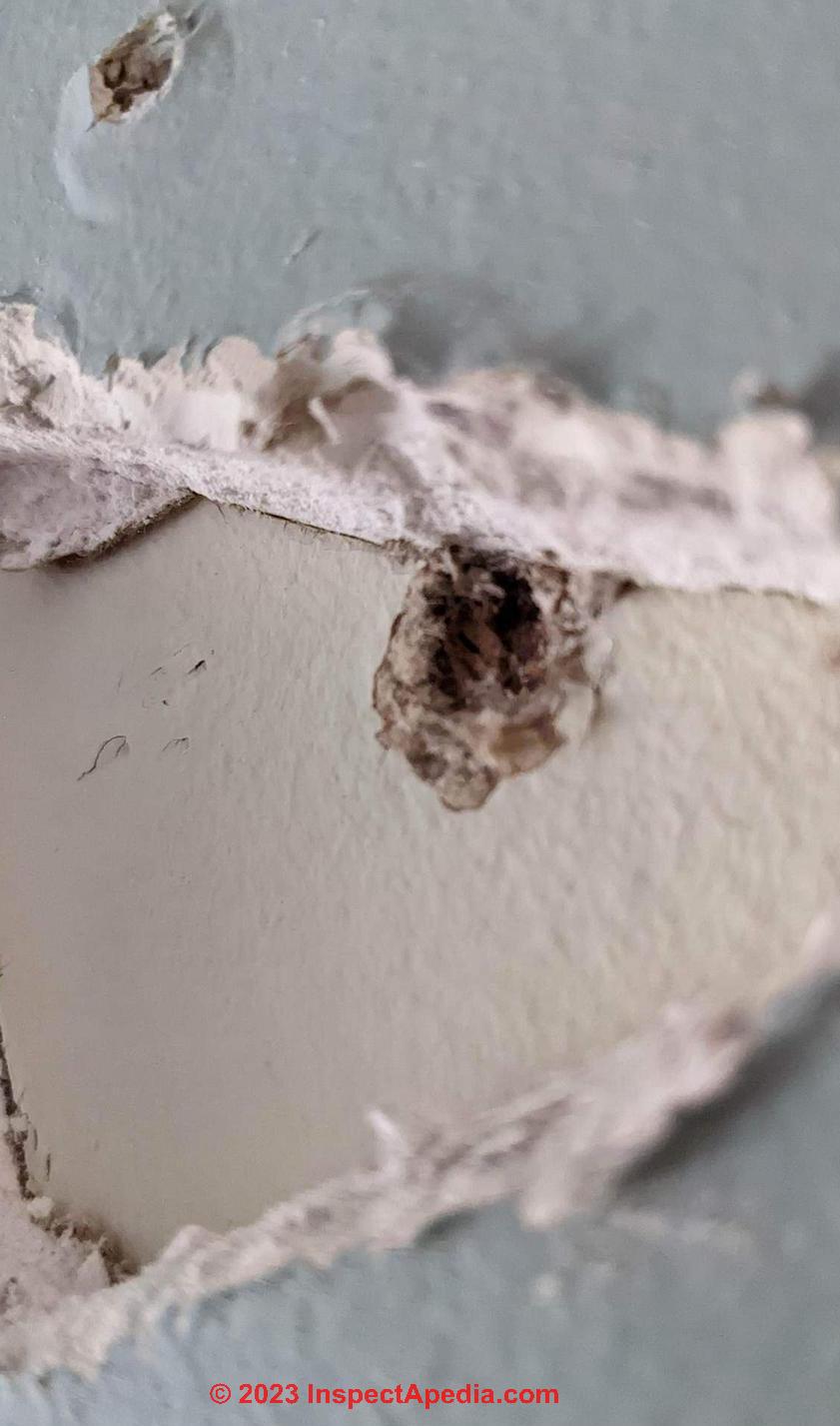
That's a bit baffling, a hole in what looks like part of a ceiling material is brown and looks like fiberboard or wood fiber material but the edges look like white fluffy material that I can't identify from the photo.Often people added a layer of drywall or gypsum board over the original fiberboard ceiling or wall sheathing in older homes.
Comment by Trevor Johnson - cloth material used over fiberboard?
@InspectApedia (Editor), Oddly enough, it is a cloth material that they used over the fiberboard?
It is in the walls and the ceiling as well(I just replaced light fixtures and had to cut out enough of this material to allow Pot Lights to grab the new drywall). It is also more of a brown color.
I think it looks white do to the dust from the Drywall. The Cloth is what is painted over.
Reply by InspectApedia (Editor) - hybrid of fabric and fiberboard?
@Trevor Johnson,
If it's actually a wood fiber or fiberboard that's a plant product. However if there's gypsum board or a layer of plasterboard that might contain asbestos as might any joint compound if some was used.This sounds like a hybrid or field modified product. I'd like to see some more detail as it may help us do some research.
You may be looking at an original fiberboard interior wall that was later coated with something else.
That would not be a surprise in a house built in 1910.I'm wondering if it may even be a woven/fabric wallpaper or lining.
If I get any better pictures of it later, I will update here. I will also try to see if I can find any print on the back of any of it. Thanks for the input!
On 2022-11-23 by InspectApedia (Editor) - also check out early forms of plasterboard or "drywall" that were layered
@Trevor Johnson,
Good I look forward to seeing what else you can find and to seeing some more photos.Regarding your observation of apparent "paper layers" be sure to read
Is this board material in our attic, behind fireplace bricks, asbestos?
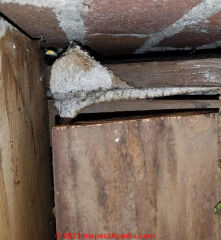
In the walk-in attic of our 1956 house there is some board that is breaking apart. This particular board is behind the bricks of the fireplace, but the same stuff my have been used to make the walls of the attic space.
What do you think this board is made of? Could it potentially be asbestos insulating boards? The board is about 1/2 inch thick and white or grey depending on the location. Thank you. - On 2023-02-12 by Valerie K
Reply by InspectApedia Editor
@Valerie K,
Are you able to see any markings anywhere you see this board?
See more of our discussion on this topic at SHEATHING, FIBERBOARD ASBESTOS CONTENTWith the variety of your questions for different types of products, we encourage you to use the page top or bottom SEARCH BOX as a quick way to find information you need. That will help direct you to a relevant page.
Fiberboard under my mobile home's floor is dark colored and falling to pieces: is this an asbestos product?
I have a mobile home built in the late 50s at my camp and underneath the floor and insulation at the bottom near the ground for the belly wrap material is some kind of dark colored board instead of the plastic used on the newer mobile homes.would this board have asbestos? I'm worried as its falling in pieces on the ground also. 2022-10-30 by Sheila Jackson
Mod reply: asbestos is not likely in fiberboard used in, on or under a mobile home floor. Replace fiberboard in bad condition.
@Sheila Jackson,
From a brief text message I'm reluctant to speculate so wildly as to guess at what a dark colored board is - but if it resembles the fiberboard sheathing shown at SHEATHING, FIBERBOARD ASBESTOS CONTENT that'd be a reasonable guess.Fiberboard is a plant based product not one that would normally contain asbestos.
Falling to pieces means it needs replacement - perhaps accompanied by some diagnosis of the cause: moisture, water leaks?Reader follow up - what about asphalt-fiberboard?
@InspectApedia-911
It was some kind of asphalt fiberboard for under the mobile home floor board used as a belly board.so does these kind have asbestos?
Reply - does the asphalt fiberboard under the mobile home floor contain asbestos?
@Sheila Jackson,
If the board was manufactured in the U.S. before 1986 there could be asbestos in the asphalt coating - the board itself is usually wood fibre.
See FIBERBOARD SHEATHING ASBESTOS CONTENT
In any event if it's disintegrating it needs to be replaced.Follow up - has asbestos ever been found in the fiberboard asphalt coating before?
@InspectApedia (Editor), ok so has asbestos ever been found in the fiberboard asphalt coating before?
Reply - has asbestos ever been found in the fiberboard asphalt coating?
@Sheila Jackson,
Quoting from the start of this page
Does or did Celotex® fiberboard or or Georgia Pacific® fiberboard or Homasote® or other fiberboard and insulating board products contain asbestos?
This article addresses worries about asbestos in fiberboard insulating sheathing - a question that comes up during building demolition and renovation.
The short answer is "no" for wood-based or plant-based products and "yes" for certain other (not plant-based) LDB or LDF products that were specifically described as asbestos board; the history is interesting. We include research citations and testing lab referrals for concerned readers.
Fiberboard sheathing and Insulating Board products that were cellulose-based (not asbestos) and that are discussed here include these brands and names: Beaverboard, Blackboard, Brownboard, Celotex insulating lumber, Georgia Pacific insulating board, Gold Bond insulating board panels, Homasote, Insulite, Nu-Wood Sta-Rite, and others.Of course my answer above doesn't exclude the possibility that someone, a worker or homeowner, might have bought an asphalt-asbestos roof flashing cement or similar product and then applied it to fiberboard sheathing (or elsewhere) on their home.
But in my OPINION that sort of add-on of an asbestos containing material would be obvious - irregular in application - and should not be mistaken for a factory-applied waterproofing treatment used by some manufacturers to treat fiberboard including using an asphalt based product.
I want to know if my apartment's ceiling tiles contain asbestos.
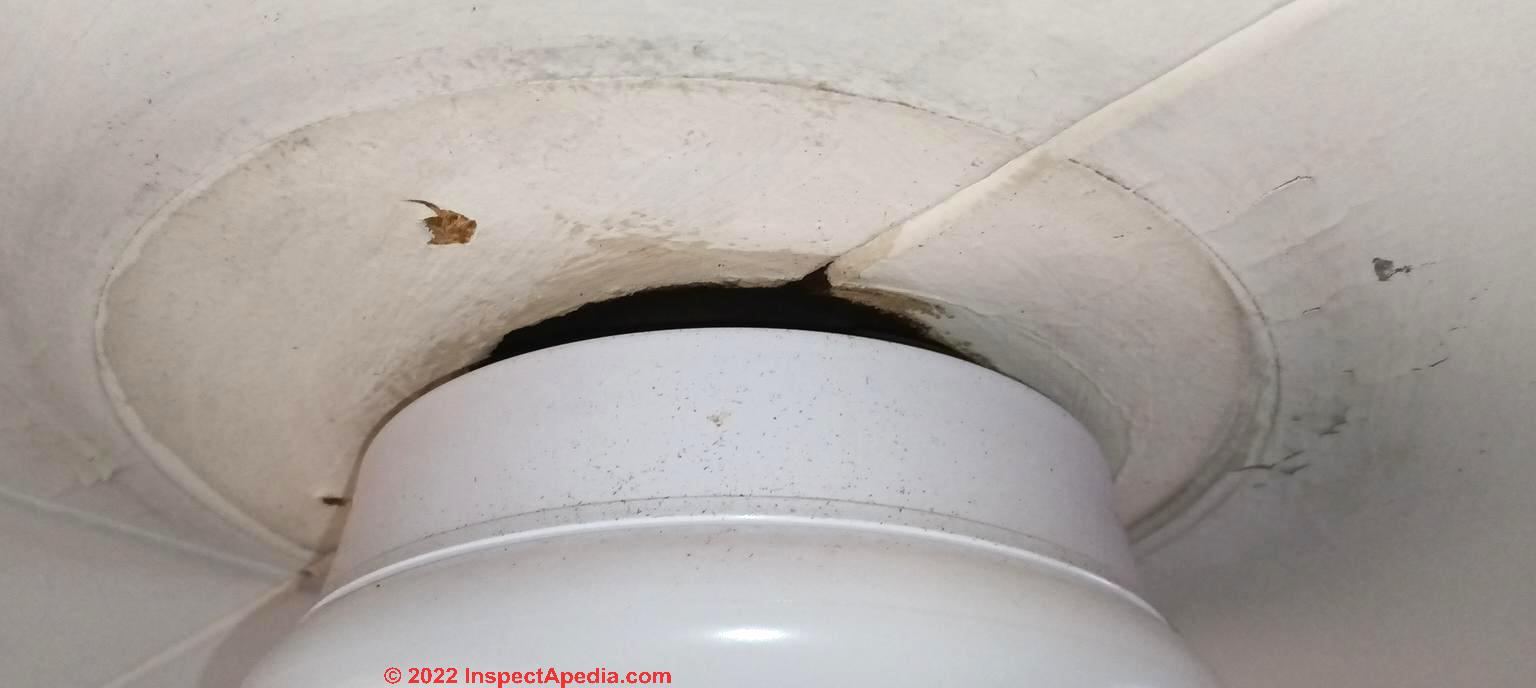
I can't tell if my apartment ceiling tiles have asbestos. They look painted over. Found lead paint in the apartment with a test.
However, I'm worried that since the tiles were cut, have water damage, and are exposed, they are releasing fibres into the air.
I'm on the second floor of a family home that was turned into apartments in central Maine. I saw that it was built in 1900, renovation listed in 1950. I can't determine the material or age of the tiles. Any help would be greatly appreciated! 2022-09-22 by Julia
Mod reply - do my painted over ceiling tiles contain asbestos?
@Julia,
Looks like 1950s fiber-based (plant) ceiling tiles though you'd need more information or an asbestos test to know for certain.
The ceiling, which appears to have been painted a time or two, if as it appears, is un-damaged, isn't hazardous if left intact, alone, un-disturbed.Your ceiling tiles might be plant based or fibrous, but they're not the fiberboard wall sheathing discussed on this page.
Please see:
DO THESE CEILING TILES CONTAIN ASBESTOS? - 5 Easy Steps to tell if CEILING TILES are likely to contain asbestos -
Our roof-ceiling sheet is water damaged: does it contain asbestos?
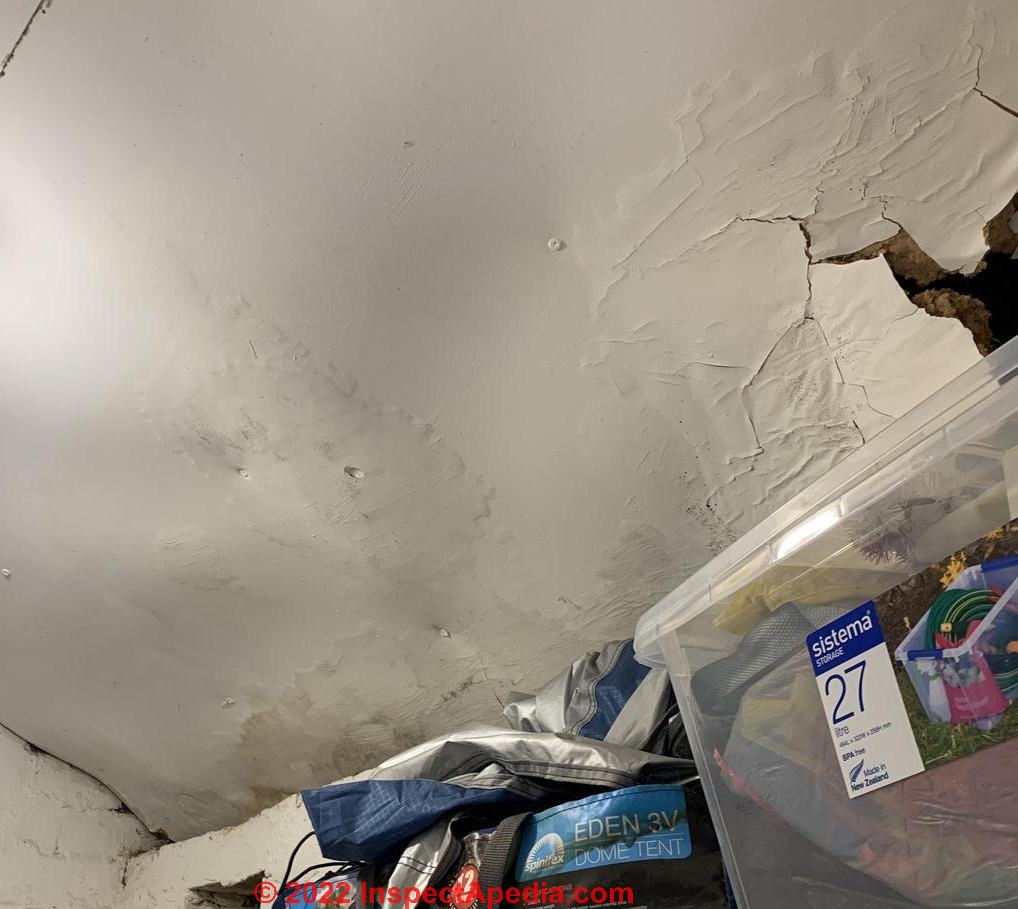
Hi there, this roof ceiling sheet in our laundry is severely water damaged and not sure whether or not to be worried if this contains asbestos?
I've attached a an image close up of the damaged area. as for the rest of the roof it is stained (by the water) & sagging in areas but no other broken bits. Hopefully you can put our mind at ease! 2022-07-07 by Dim
Mod reply - moldy panels will need to be replaced: drywall may contain asbestos; fiberboard - unlikely.
@Dim,
If you're sure that the ceiling panels are fiberboard such as that described at SHEATHING, FIBERBOARD ASBESTOS CONTENT then our most thorough explanation of the possibility of asbestos content is given there and I hope you'll take a look.If those panels are gypsum board or drywall and or have coating of joint compound on them it's also possible that that material could contain asbestos. If water damage, what, moldy those panels will need to be replaced.
I'm worried sick that this board contains asbestos
Hi there please can you help me? I’m worried sick, is this board absestos? 2022-05-08 by Julie
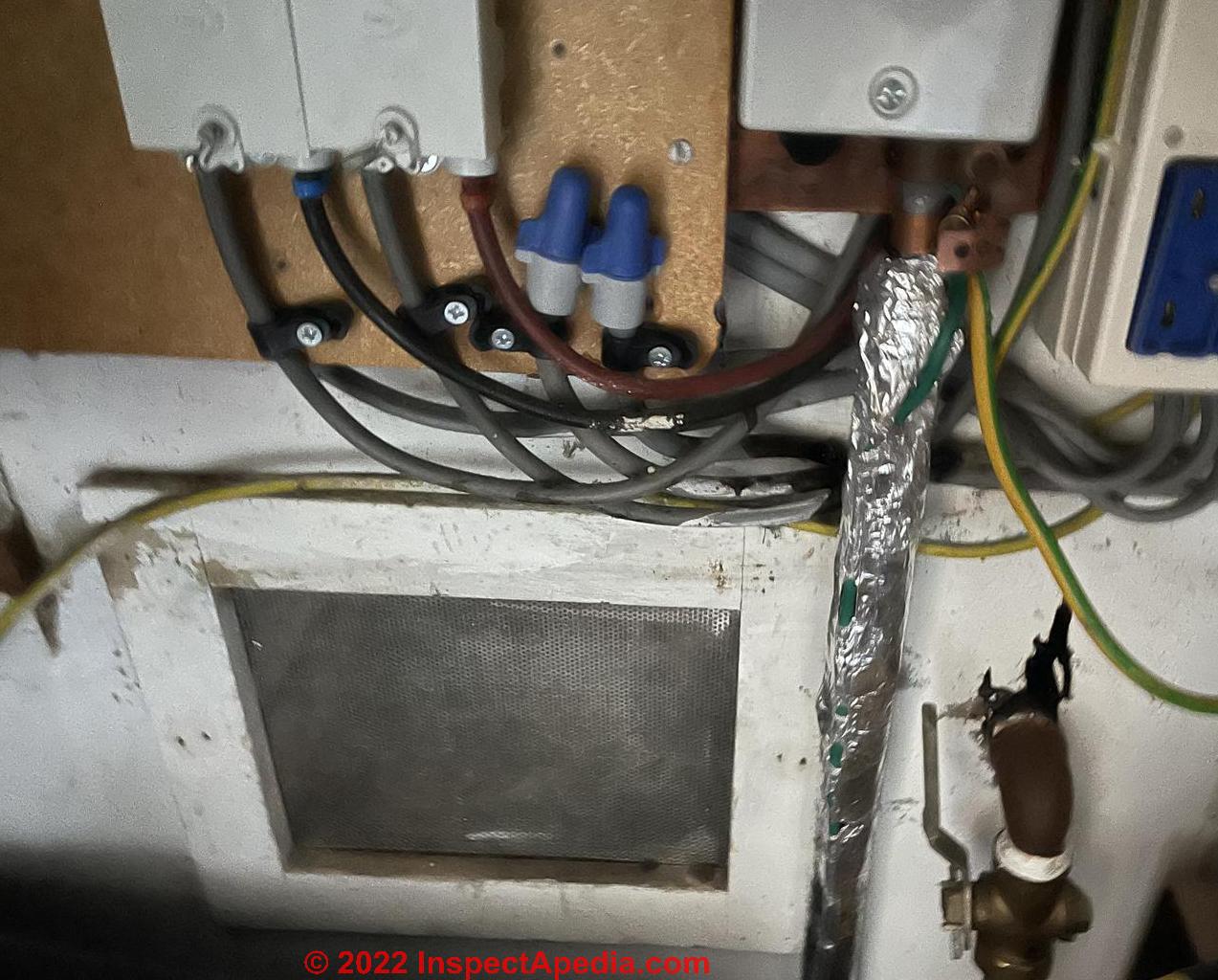
Mod reply:
@Julie,
That brown material in the upper part of your looks like a fiberboard product like those described at SHEATHING, FIBERBOARD ASBESTOS CONTENTBut from just this image I can't tell if it's a hardboard like Masonite or a softer fiberboard.
See:
HARDBOARD MASONITE™ & OTHER BRANDS if the board is hard - you can't push a pencil point into it
or
SHEATHING, FIBERBOARD ASBESTOS CONTENT - if the board is softer
Don't worry yourself sick - the worry is itself a greater health hazard than any of these products.
Is this asbestos fiberboard?
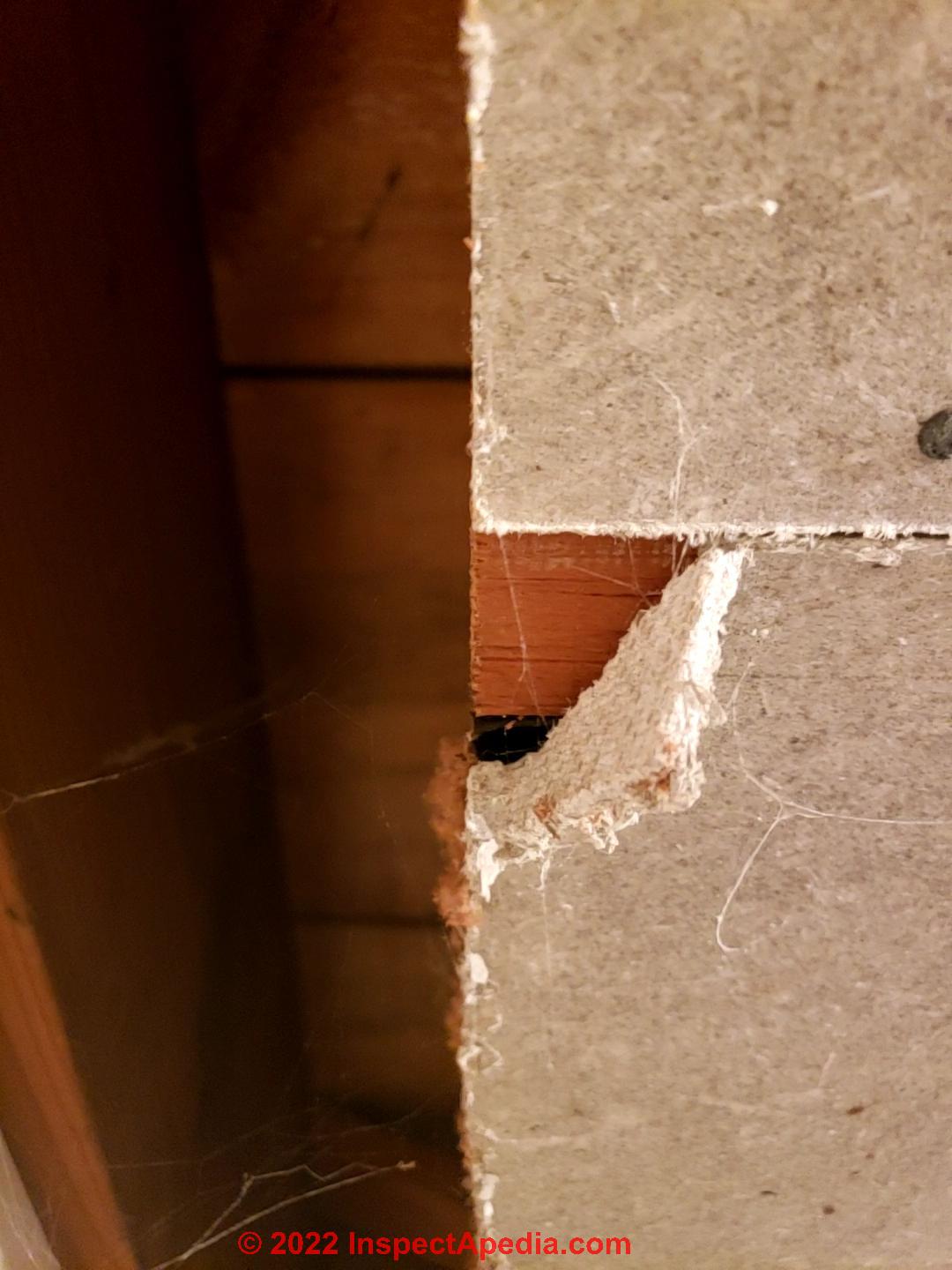
My garage ceiling,which was installed in the 60's I believe, is a gray, friable material with a "textured" back. It never occurred to me when we bought the house that it might be asbestos.
The owners before us, ripped some of it out to convert the 2 stall garage into a 1 stall. Needless to say, it is broken up in places and even the original seams look "frayed."
With the air drafts that move through the garage, it is certainly be disturbed. Is this likely to be asbestos or something else? I'm feeling quite anxious that I may have been exposing my family to this for years. 2022-01-09 by Katie
Mod reply - NO - that looks like asbestos millboard or cement board
That looks like it could be an asbestos millboard or cement board.
Take a look at ASBESTOS MILLBOARD where we'll repeat your questin and reply in more detail.
What's this gray and brown stuff in our school ceiling?
In a school ceiling. 2023-02-23 by Mark
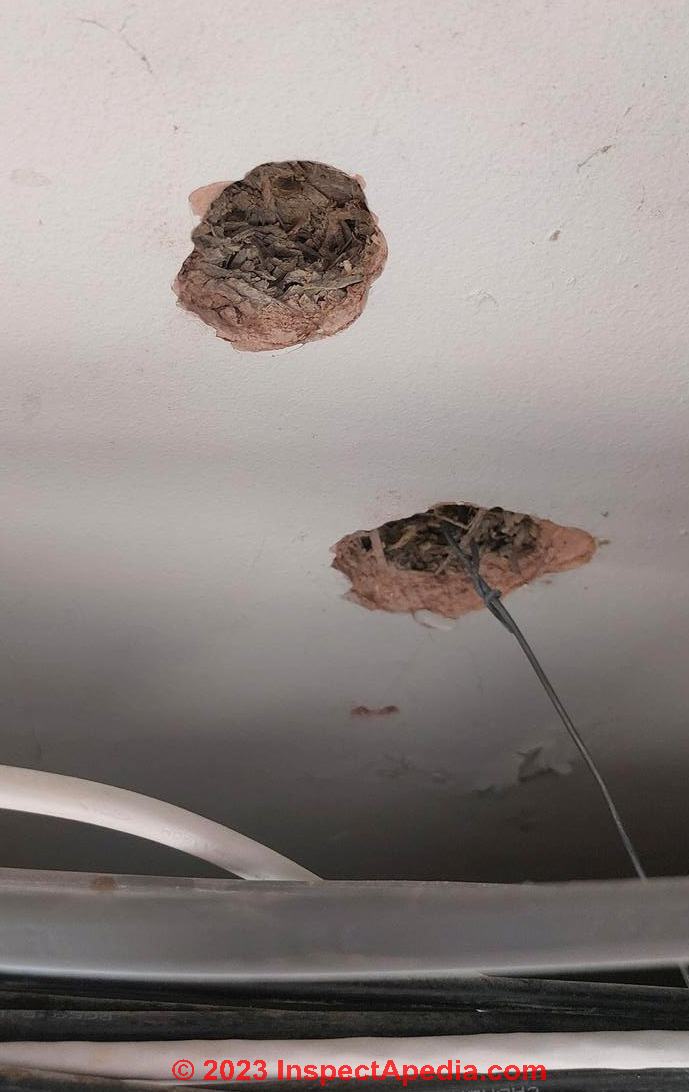
Mod reply - insulating panel with added insulation above in ceiling
@Mark,
Hard to tell from just a photo but it looks like some type of insulating panel or fiberboard used as a base for a ceiling system that has exposed a different type of insulation above it that almost looks like shredded paper.
Do you know the year of construction? And where is it located - state, country?
See more details at the home page for
SHEATHING, FIBERBOARD ASBESTOS CONTENT(You are on the FAQs page for that topic)
Most wood or plant-based fiberboard does not contain asbestos. If you want to be sure of any possible asbestos content, you can have a sample tested.You might also want to compare that upper insulation with our photos of mineral wool or rock wool, for which you can find our articles by using that phrase in the on page search box
Search for
Rock wool insulation to see if that gray material is simply exposed attic insulation.
Is this tan fibrous board in myt 1940s house asbestos?
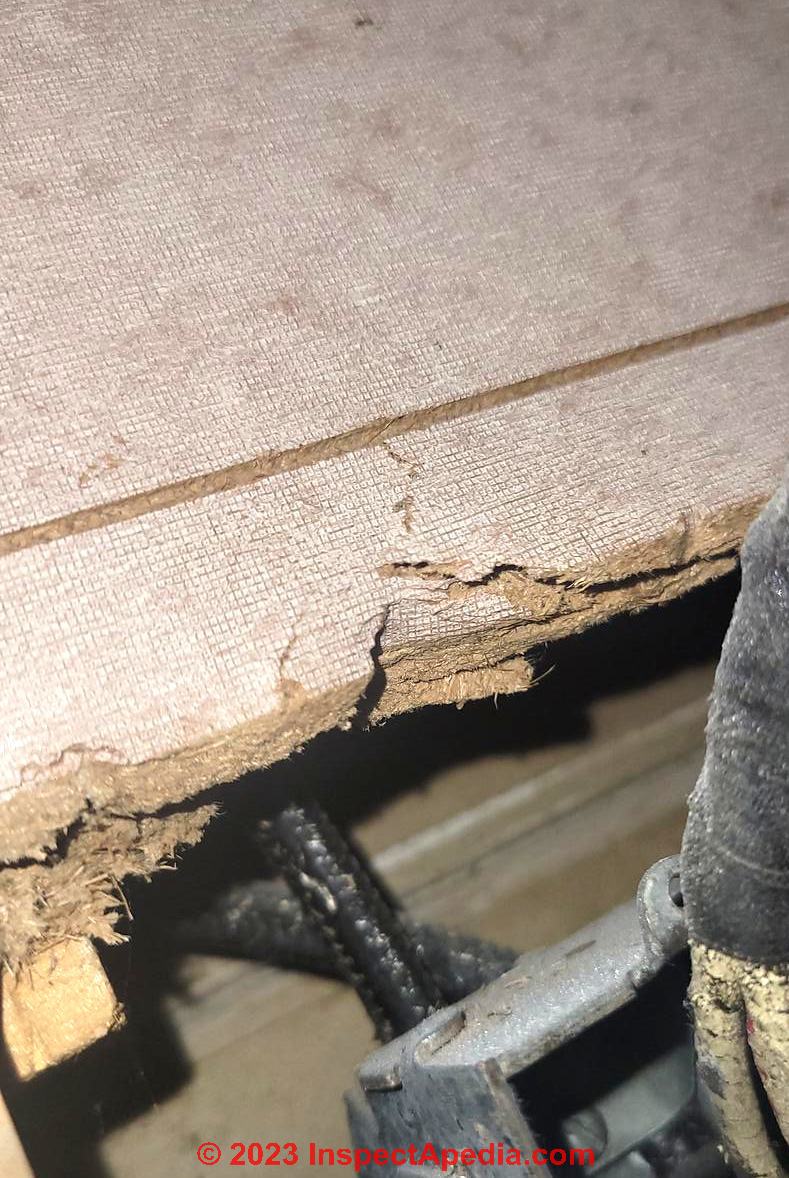
I'm wondering if this may have asbestos in it. My house was built in the 1940s and im assuming this paneling has been here since then. Can you tell me if this looks like it may contain asbestos? 2023-02-12 by Bloo
Mod reply:
@Bloo,
Asbestos is unlikely
Please read
SHEATHING, FIBERBOARD ASBESTOS CONTENT - home page for this topic
Worried about broken fibreboard-looking material under kitchen floor in a UK Home - exposed to asbestos?
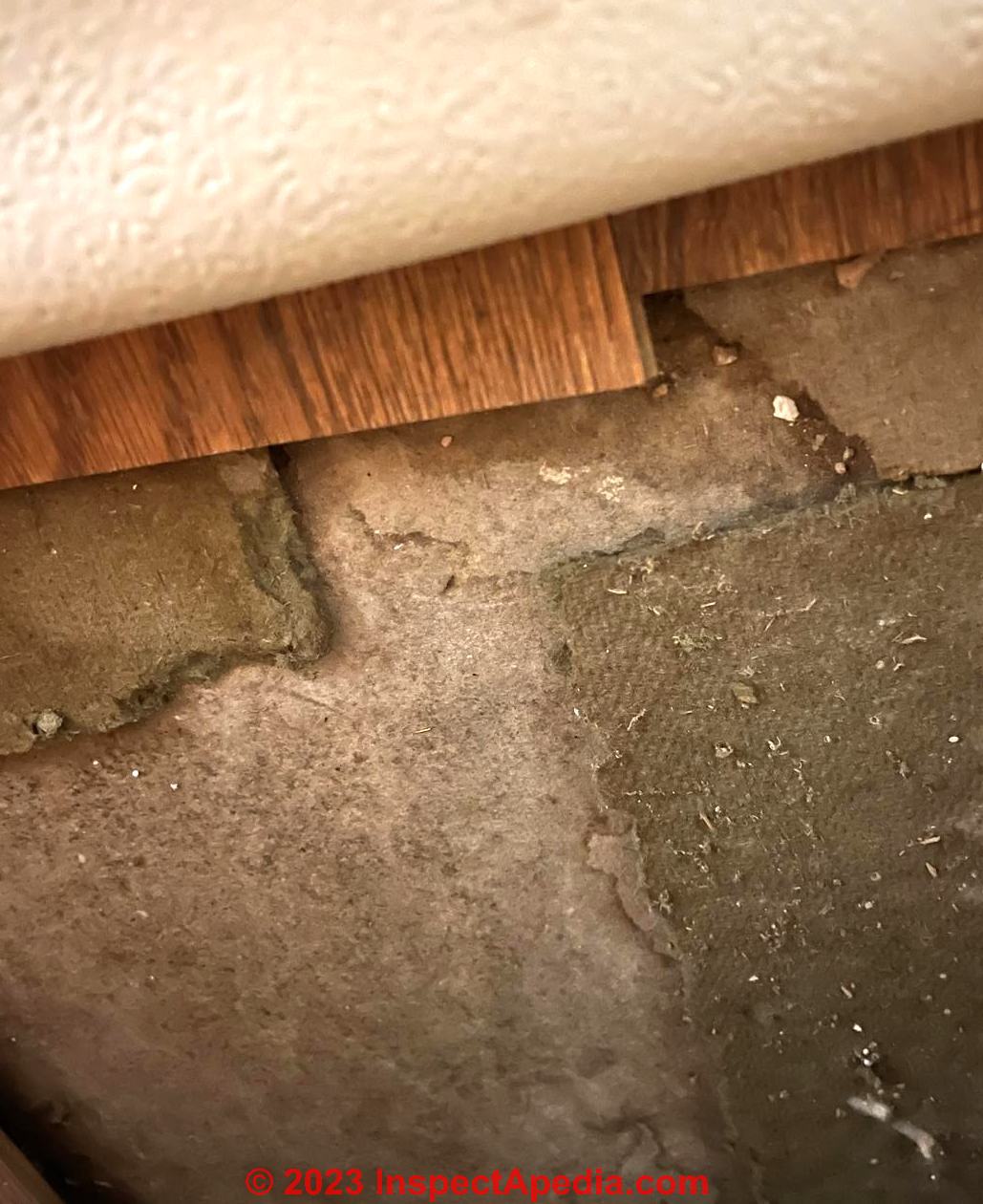
Hi. I am from UK - recently bought this house and found some broken "fibreboard-looking" materials under my kitchen sink floor. I am worried that we might have been exposed to asbestos.... Do these materials contain asbestos? Many thanks! 2022-08-15 by Tony
Mod reply:
@Tony,
Probably not, but do take a look at our home page article that addresses your question more fully:
SHEATHING, FIBERBOARD ASBESTOS CONTENT
https://inspectapedia.com/structure/Fiberboard-Sheathing-Asbestos.phpYour photo looks like a thin hardboard product like Masonite.
Reader follow up:
@InspectApedia-911,
Thank you so much for your reply! I was worried because this "fibreboard" has similar patterns on surface as the Low Density Board (LDB) "Fiberboard" Products shown in the article refereed (but the colours are different). Is there anything I can do to reconfirm it does not contain asbestos? Many thanks!Reply: where to find asbestos test labs in the UK
@Anonymous,
Yes, you can take a look through the article I suggested, and then see if you can identify your specific fiberboard product as one of those discussed there - by pattern or stamping.
Or have a sample tested
ASBESTOS TEST LABS in the UK
keep me posted
Did tearing off this fiberboard expose me to asbestos?
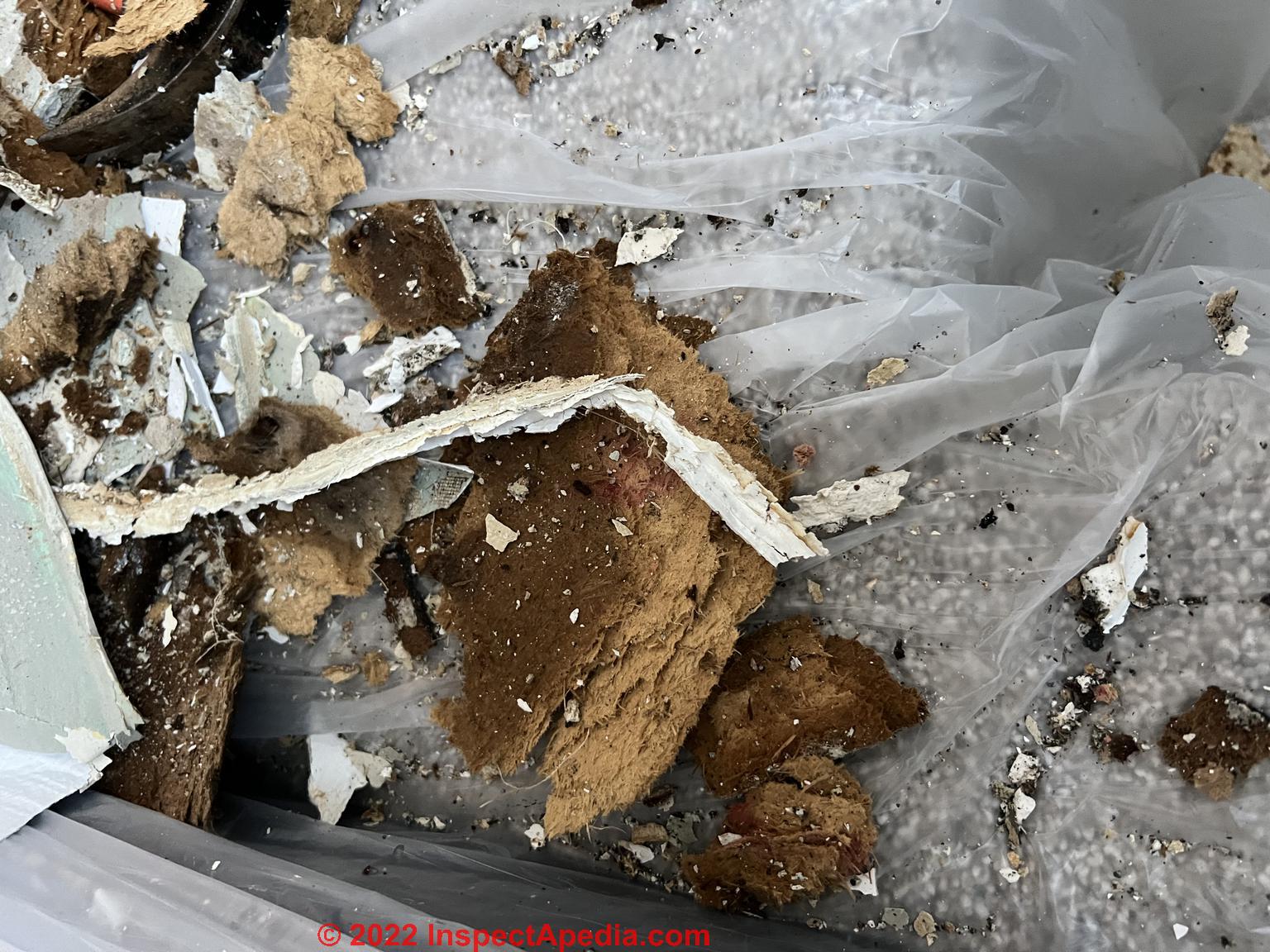
Had a roof leak and had to tear away some ceiling to get to it. The ceiling material turned out to be some sort of insulation board or particle board. My home was built in 1922 and I don’t know if this was an addition later on or what.
Either way, I’m concerned I may have exposed myself to asbestos and wanted to post a picture on this amazingly informative website to see if you had any input. I can find any markings on anything I’ve taken off but it looks quite similar to some of the other products you’ve posted. 2022-01-10 by Ben
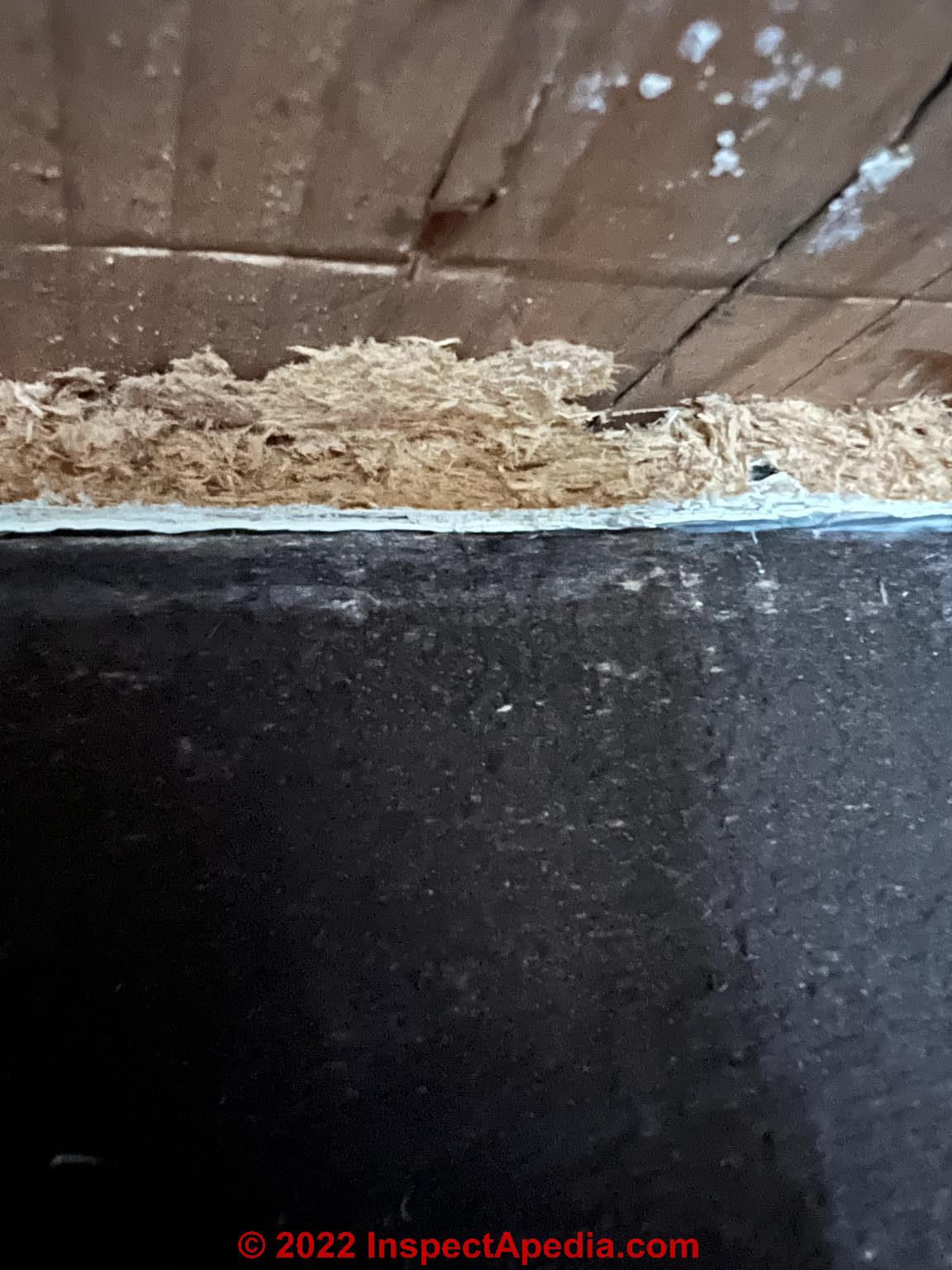
Mod reply:
@Ben,
Your photos (just above & below) looks like fiberboard - not usually an asbestos product - see details at
SHEATHING, FIBERBOARD ASBESTOS CONTENT - the home page for this topic
https://inspectapedia.com/structure/Fiberboard-Sheathing-Asbestos.php
If older fiberboard was cross-contaminated by asbestos can we tell by looking at it?
ok so if a old fiberboard would have gotton cross contaminated by asbestos,would the fiberboard look any different after being torn out of a wall or ceiling,like would the fiberboard still look tan or brown or appear white inside also or anything one could notice? 2021-12-29 by margie thaxton
Reply - No.
@margie thaxton, you won't see any visual difference in a product that has cross-contaminated particles of another substance such as asbestos. You'd have to have the product tested.
Fiberboard in a 1960s Garage in Wisconsin: Asbestos?
My grandparents garage in Wisconsin. Built in the 60s not sure what type of material and if it has asbestos. 2021-11-22 by Aaron
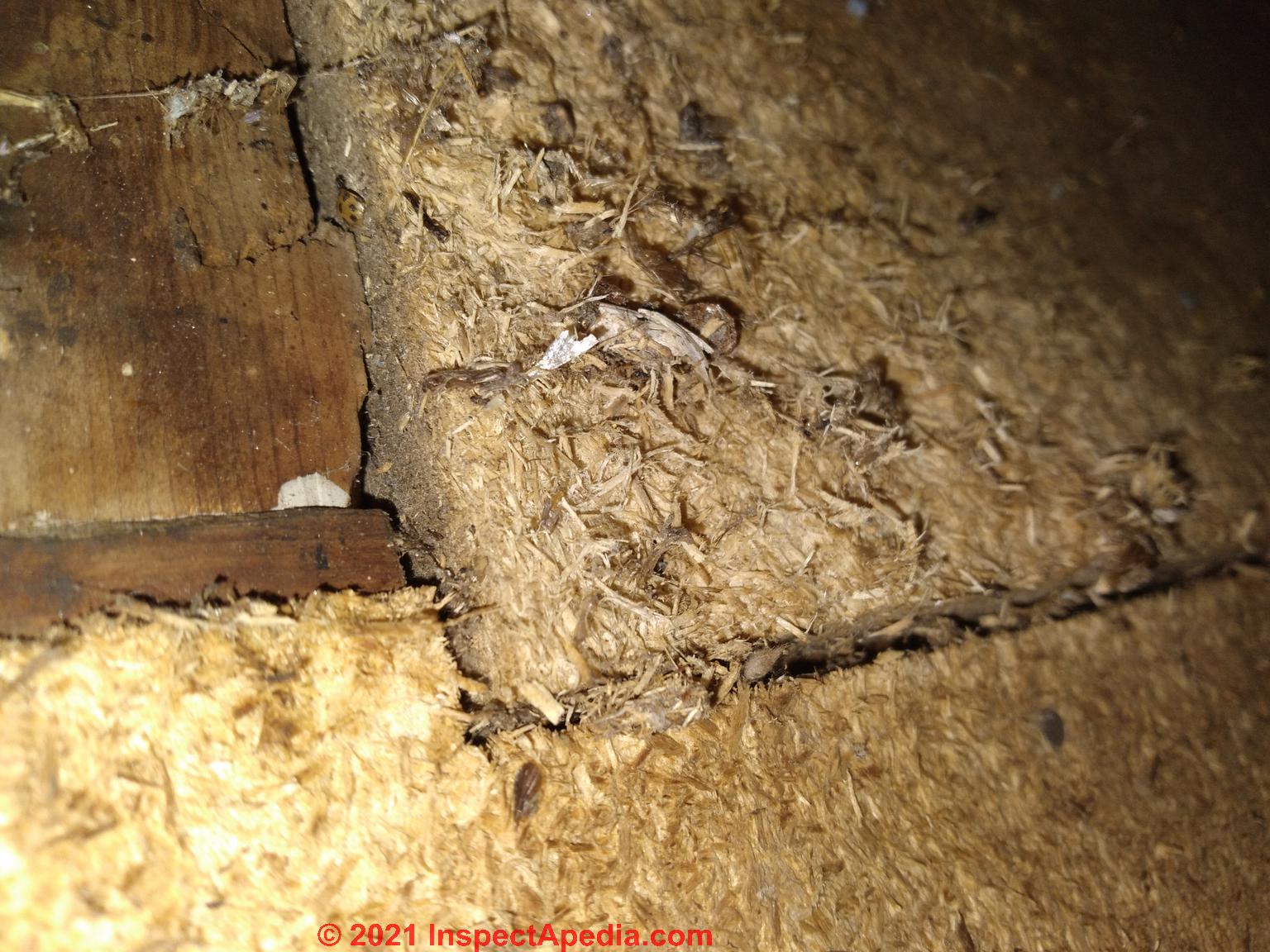
Reply:
@Aaron,
After reading the page above about asbestos in (though rarely) fiberboard,
Please also take a look at the examples given at
UNIDENTIFIED FIBERBOARD PRODUCTS
Photos of Build-Rite fiberboard used as ceiling tile material - any comment about asbestos?
Build rite used as ceiling tiles.
Any comments are welcome.
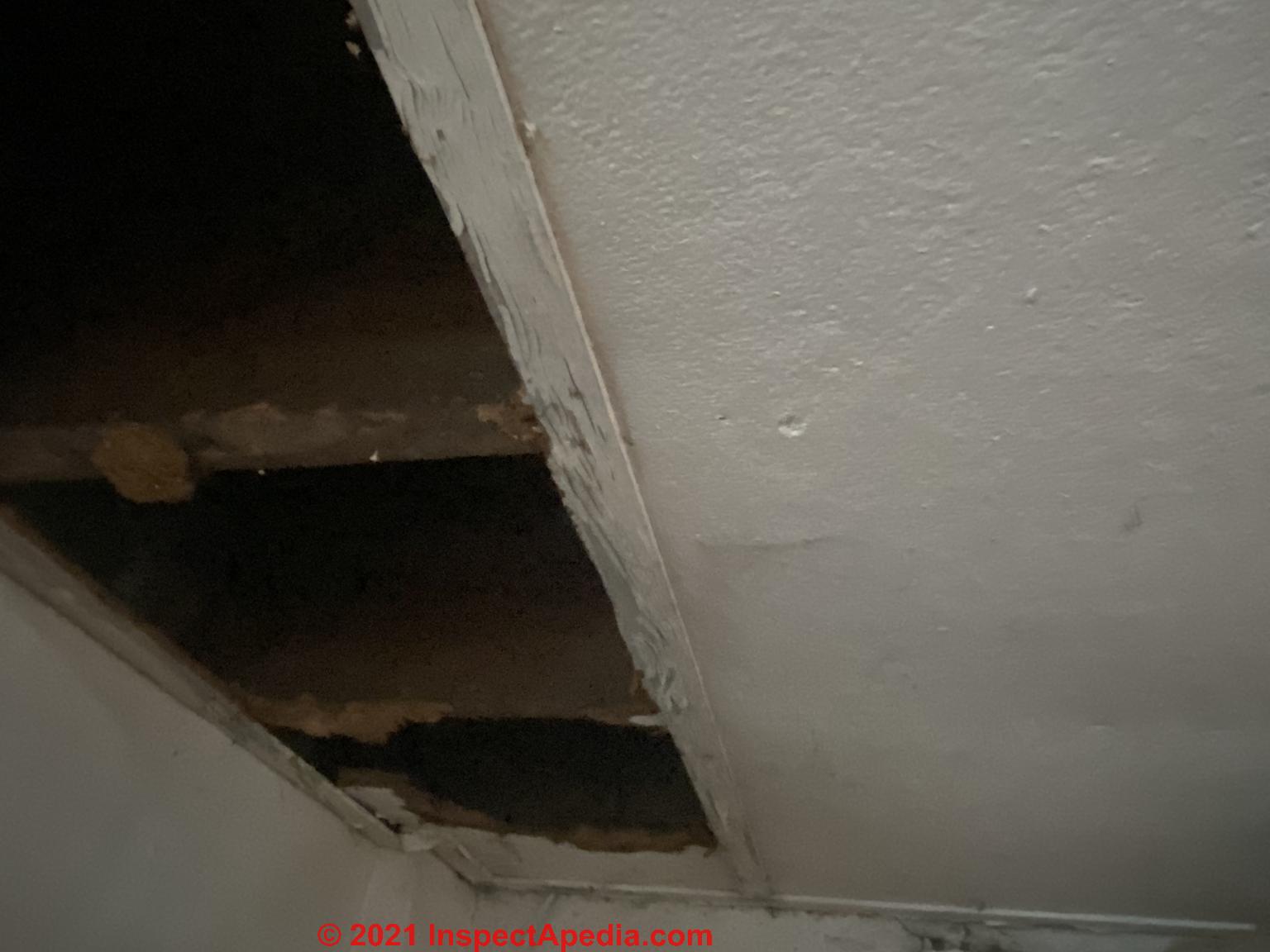
Follow up and closeup. Building is in Minnesota. We will test, but like an opinion as well. 2021-11-22 by Dan
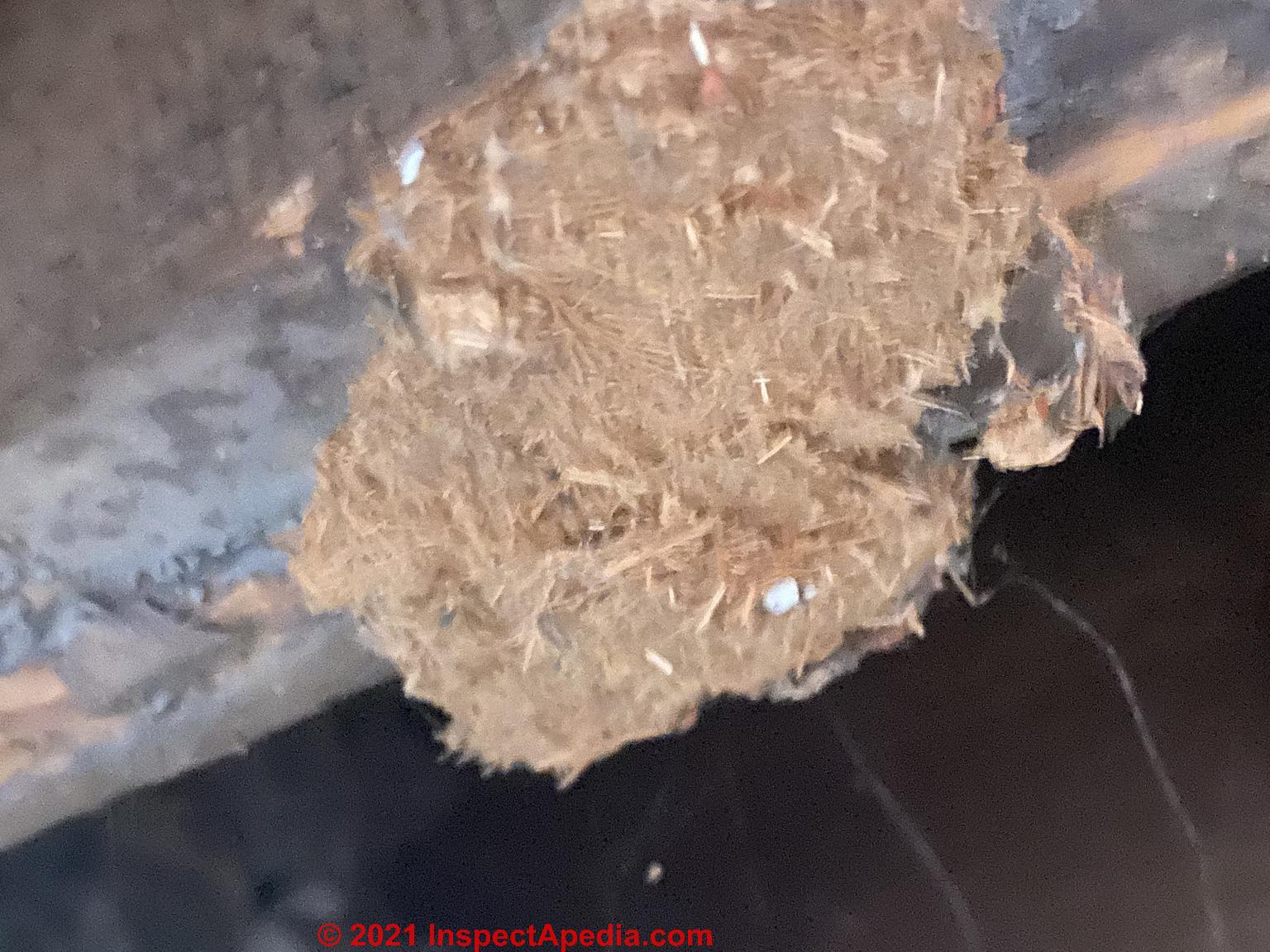
Reply:
@Dan,
Thanks Dan,
Where in Minnesota ? (we're usually in Two Harbors)
That looks like a wood fiber product - possible but not likely to contain asbestos.
Asbestos in fiberboard in 1980 house in Australia?
Thanks for this website, its a fantastic resource! We are renting a house in Australia that was built in 1980.
On this balcony wall where the wood has rotted away, the grey material at the corner of the board is exposed.
By looking at this photo, is it possible to tell if this board might contain asbestos? 2021-08-31 by MarkVansomething
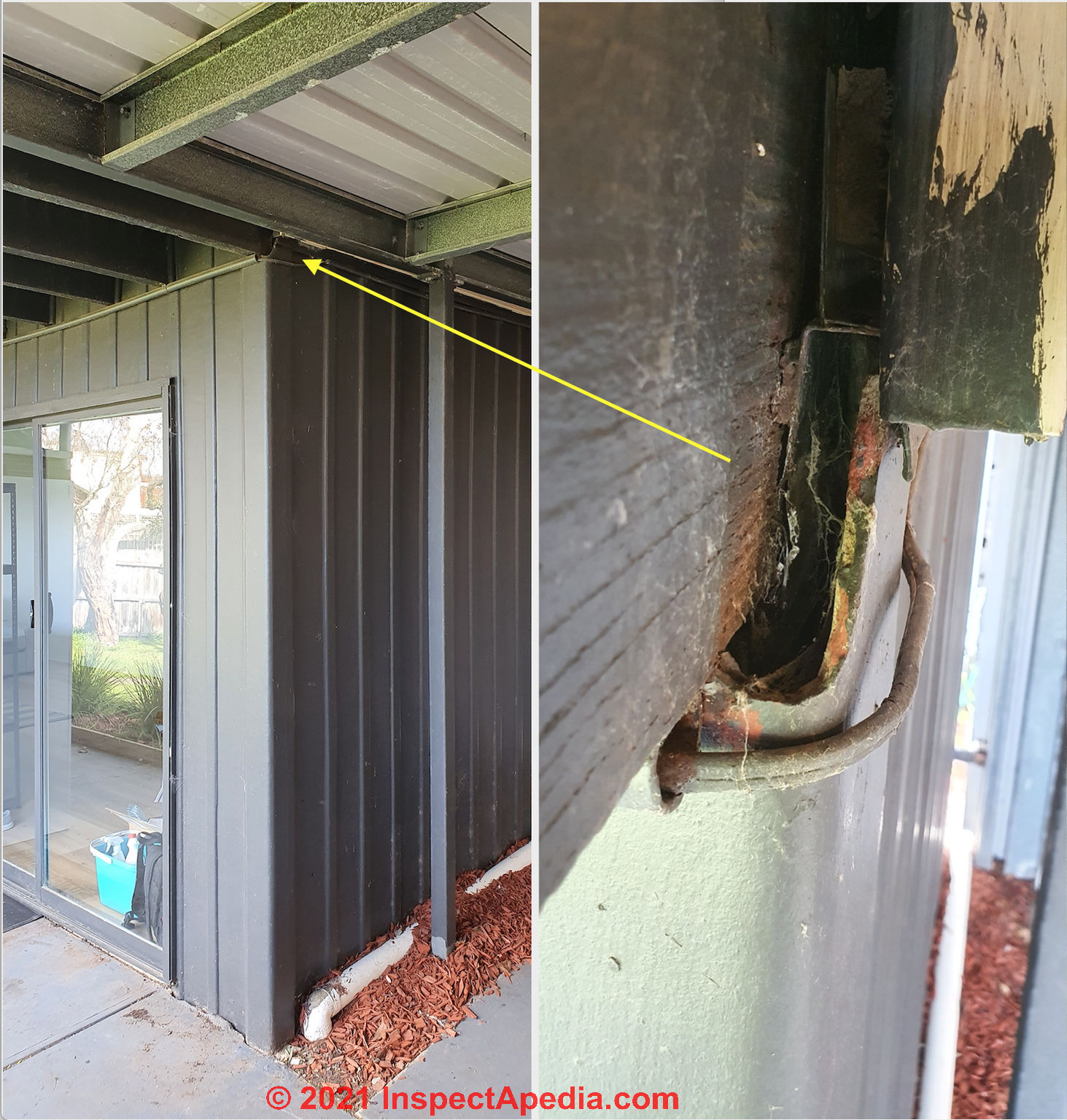
Mod reply:
@MarkVansomething,
That is a plant-product - fiberboard; your much greater concern here is extensive rot and the question of safety of the structure itself.
I suspect that the white material in your photo is a wood-rotting fungus.Reader follow up:
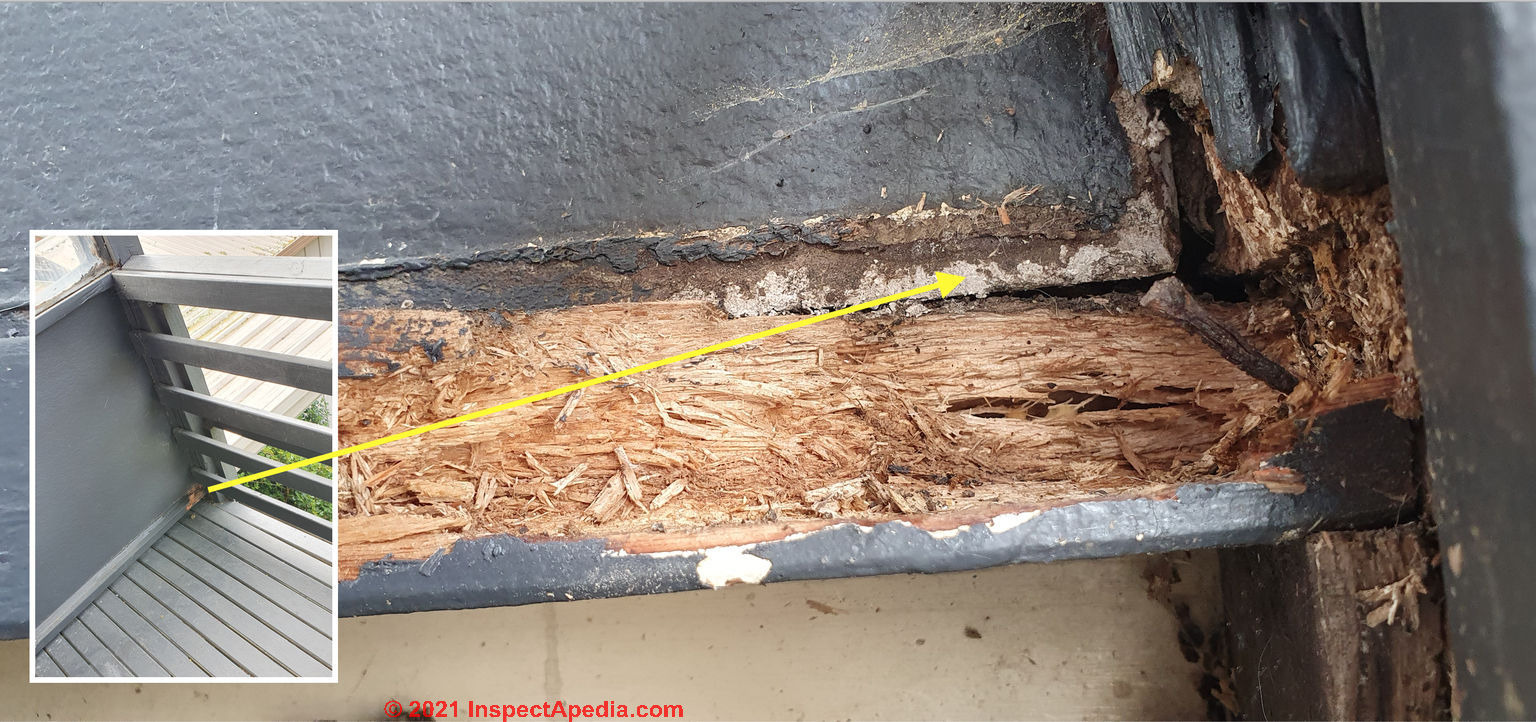
I am wondering if this exterior wall material might contain asbestos.
The corner section has a piece cracked off at the top, so wondering if it should be sealed.
The house was built in 1980 in Australia.
@inspectapedia.com.moderator, OK. Good to know. Thanks so much for your speedy answer! Cheers ! Mark
Reply:
@markvansomething,
Like your other photo this looks like a wood or plant-based product; in Australia that's often a cane-board.
But yes you want to find and fix the leak, inspect to be sure that there's not enough damage to warrant replacement, then paint/seal the area to protect it from further deterioration.Keep in mind that if the leak is from behind the board material that we can see, there will be some hidden damage there.

How can I get this fiberboard sheathing tested?
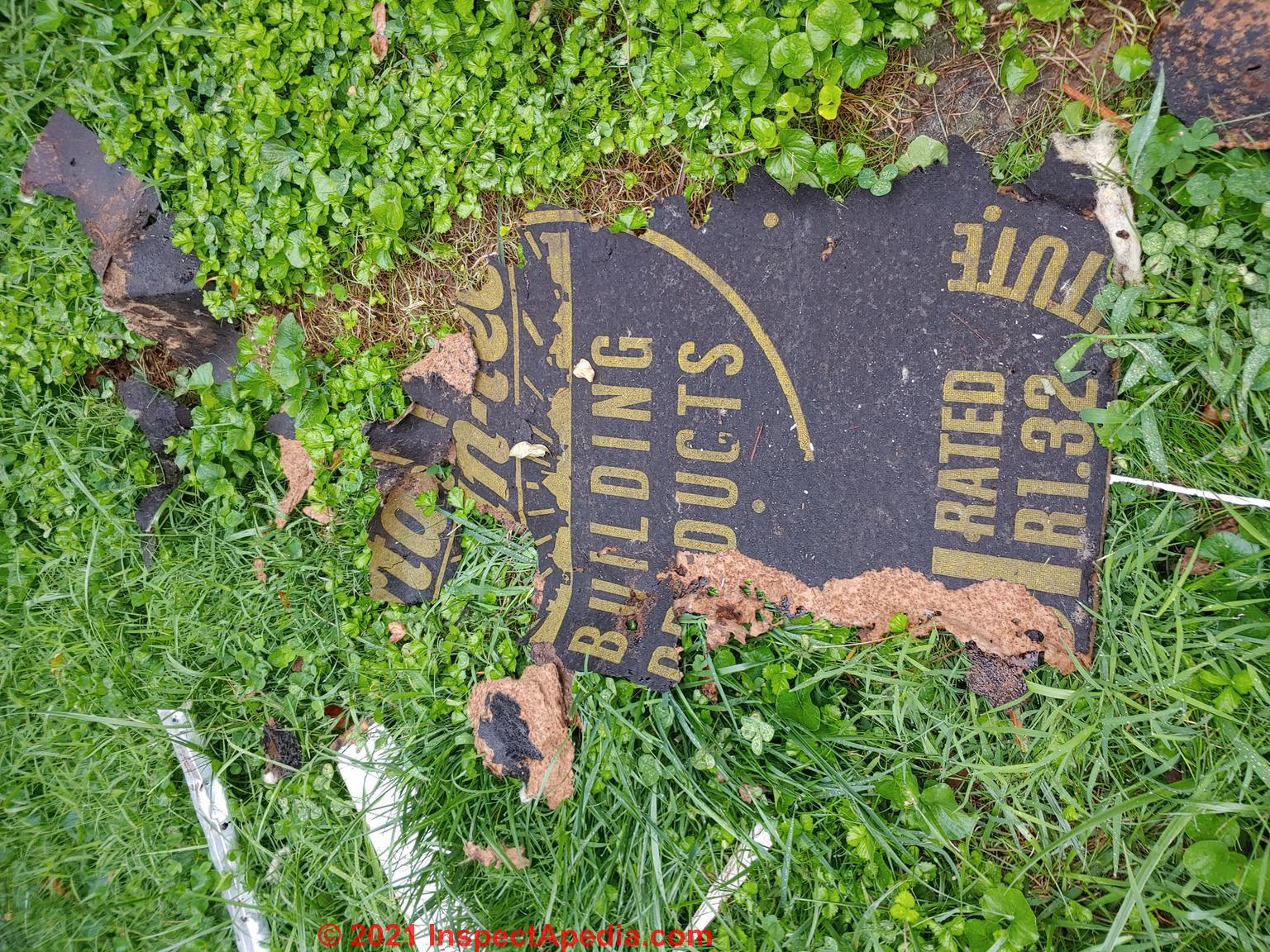
Can you please tell me what this is and of it contains asbestos?
My husband closed off our carport making our carport into an extra room and yesterday they pulled this off underneath the outdoor siding.
Thanks for your help in a bit worried because they pulled a good amount of this off. Thanks 2021-08-16 by Erin
Mod reply:
@Erin,
That is indeed a fiberboard sheathing product.
Please read the article at SHEATHING, FIBERBOARD ASBESTOS CONTENT where you'll see details including this statement answering your question:
... this article addresses worries about asbestos in fiberboard insulating sheathing - a question that comes up during building demolition and renovation.
The short answer is "no" but the history is interesting. We include research citations and testing lab referrals for concerned readers.Follow up:
@inspectapedia.com.moderator,
How could I go about sending you a sample to test?Reply:
@Erin,
First, I'm not sure testing that material is necessary other than as a "peace of mind" step for someone who'd rather pay a lab than read through the information on this topic. That said, you can certainly have a material sampled for asbestos.
But, I'm sorry that we cannot the lab testing service that you asked about. In order to absolutely assure our readers that we write and report without bias we do not sell any products nor do we have any business or financial relationships that could create such conflicts of interest.
After decades of field investigation and forensic lab work, with exception of a few pro-bono or research assignments, I have retired from field work and also from forensic laboratory analysis work to concentrate full time on pure research and writing for InspectApedia.com.
InspectAPedia.com provides building and environmental diagnostic and repair information.
InspectAPedia is an independent publisher of building, environmental, and forensic inspection, diagnosis, and repair information for the public - we have no business nor financial connection with any manufacturer or service provider discussed at our website.
ASBESTOS TESTING SAMPLE COLLECTION https://inspectapedia.com/hazmat/Asbestos-Testing.php
describes a simple, inexpensive method for collecting tape samples suitable for settled dust, mold or other particle examination tests to make a qualitative assessment of dust or particles and to identify frequent, unusual, or hazardous particles, spores, mold, dust.
Any forensic or environmental test lab of your choice can process these samples.
Some labs are listed at
ASBESTOS TESTING LAB LIST https://inspectapedia.com/hazmat/Asbestos_Test_Lab_Lists.php
More about us is at ABOUT InspectApedia.com https://inspectapedia.com/Admin/About_InspectApedia.php
RespectfullyFollow up:
@inspectapedia.com.moderator,
No I agree testing it's really not necessary I read the information articles that you suggested and I will take your advice.I was just asking if I ever needed in the future to have a sample tested. Sorry I misworded my question. Thanks so much you have put my mind at ease I really appreciate it.
Thanks again ErinReply:
@Erin,
No worries about mis-wording - happens to me too. Just doing my best to be accurate and ethical in these discussions.
Is this Ceiling Asbestos? How can I tell?
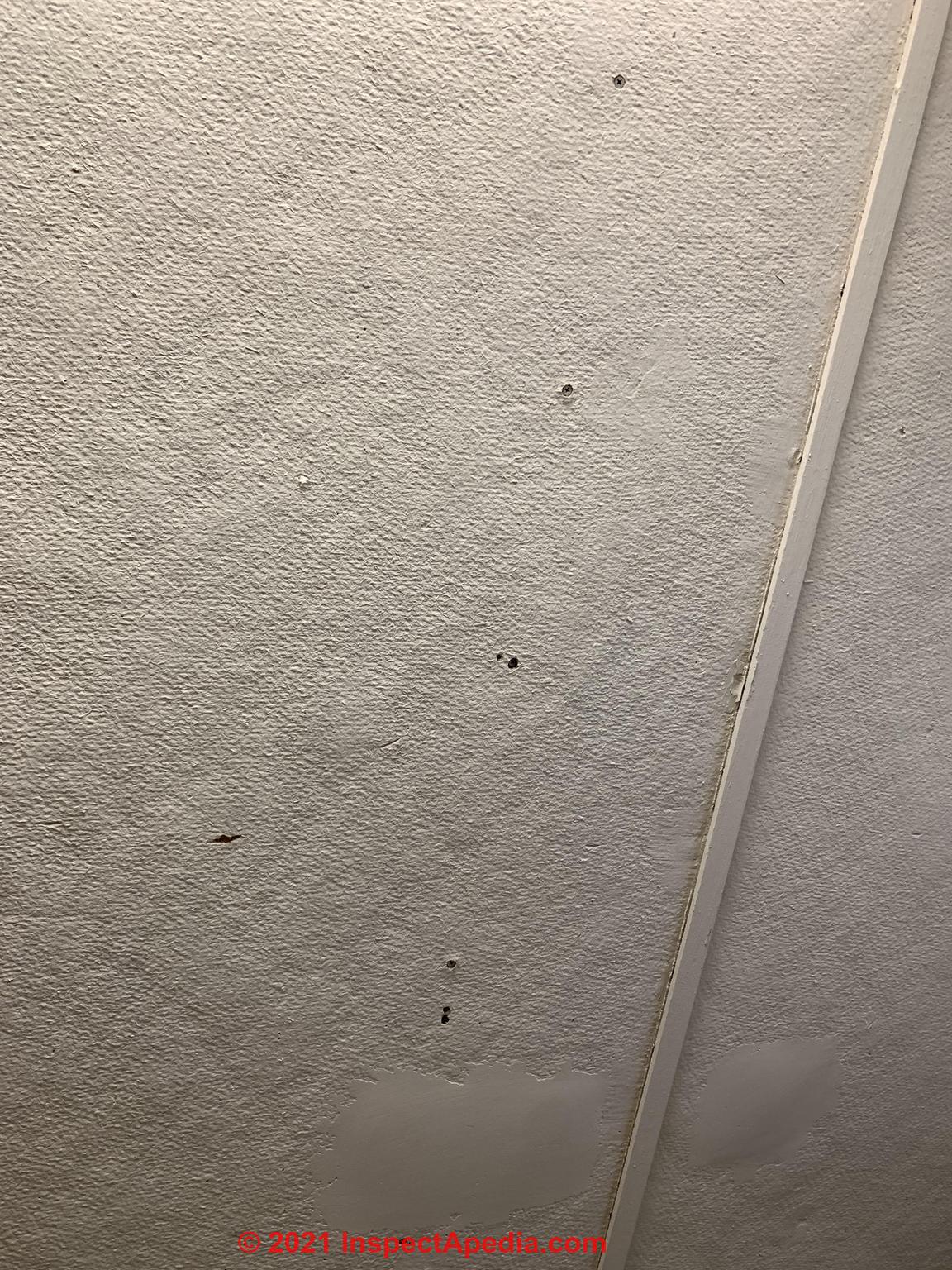
Hi there, does this appear to be asbestos? If yes/no - how can you tell? Thanks! On 2021-04-24 by scaredofasbestos >
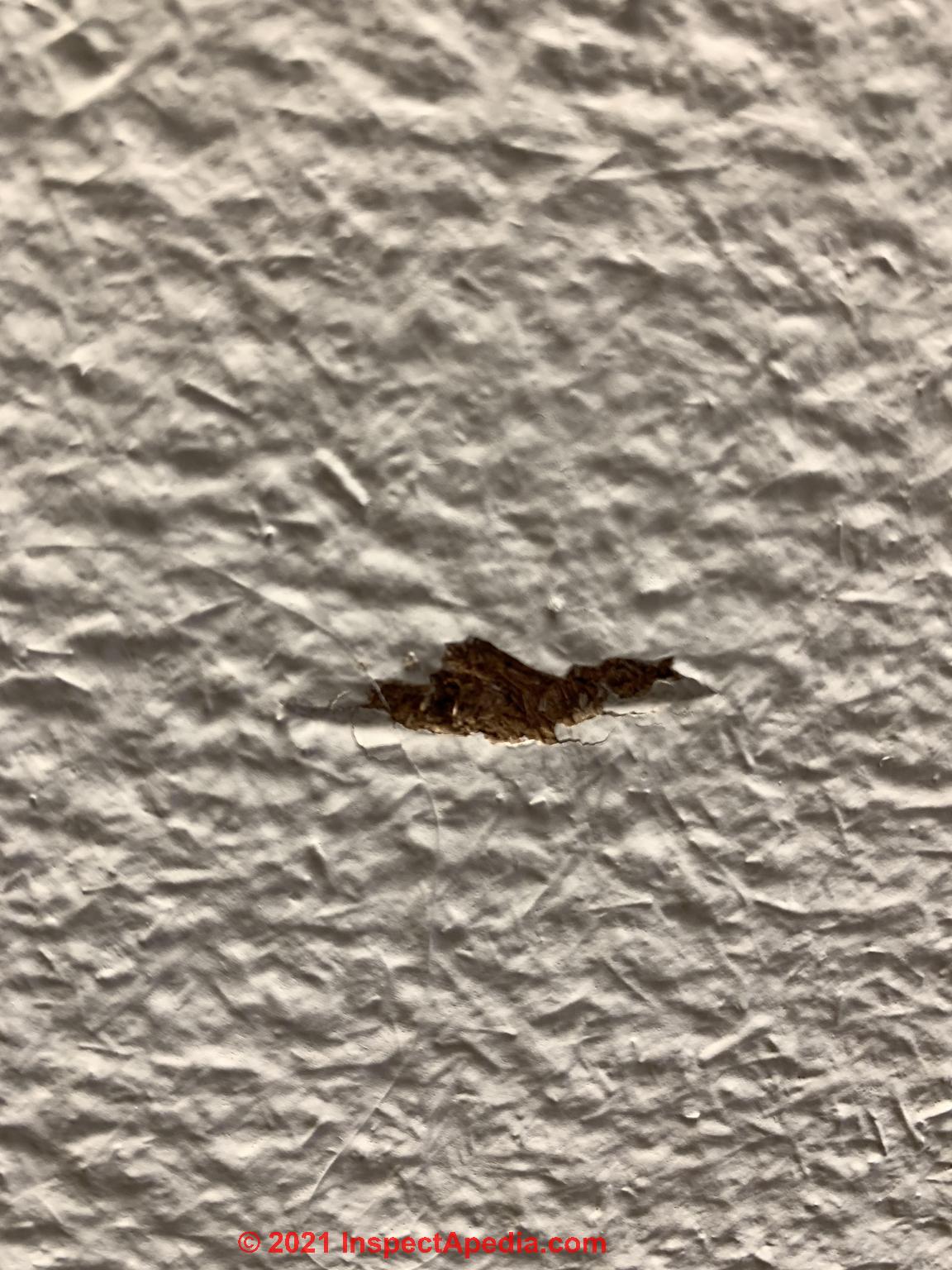
Explanation by (mod) -
@scaredofasbestos, that brown fibrous material is typically plant-based or cellulose;
Beyond that general observation, to understand how to identify asbestos materials, of which a few can be identified by visual inspection alone, and also to understand that there are many other ceiling materials that can be easily identified as NOT asbsstos by visual inspection alone,see ASBESTOS IDENTIFICATION IN BUILDINGS
and specifically for ceilings, see ASBESTOS CEILING TILE IDENTIFICATION - 5 Easy Steps to tell if CEILING TILES are likely to contain asbestos -
and for other materials besides ceilings in buildings
see DOES THIS MATERIAL CONTAIN ASBESTOS? - 5 easy questions to tell if a BUILDING MATERIAL probably contains asbestos -
Also you'll want to read the article SHEATHING, FIBERBOARD ASBESTOS CONTENT
Are these tiny white pebbles in material from our roof insulation asbestos?
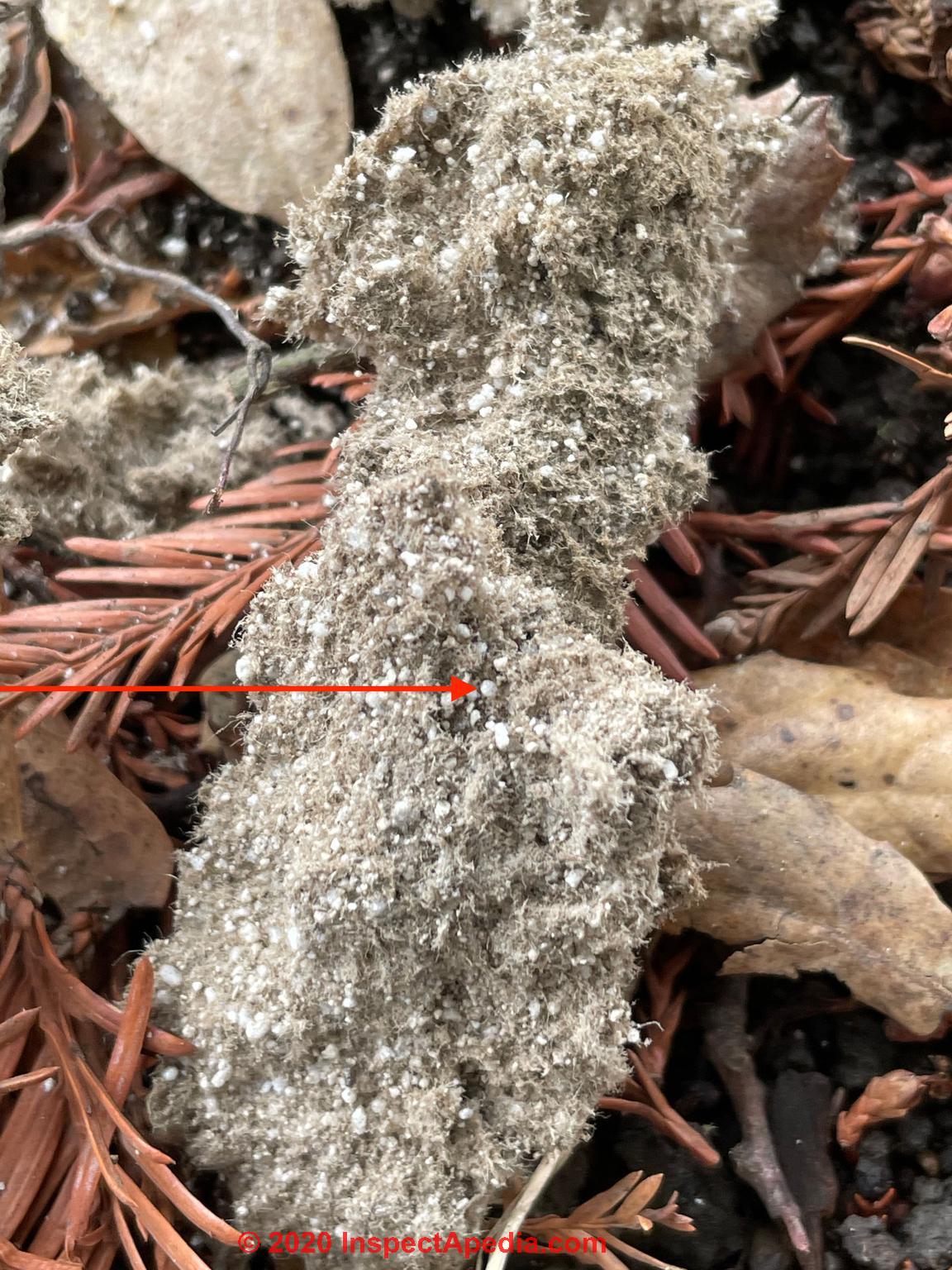
Hi, We are wondering what the hard white pebbles (red arrow pointing to [photo above] ) in this fiber board are?
The boards were on our roof as insulation. We are not sure what year they are from, maybe 50's or younger. Can it be asbestos? Thanks. On 2020-12-16 by Anonymous
Answer by (mod) - tiny white pebbles are more likely styrofoam
Anon
From context and appearance those white particles are not likely to be asbestos. Actually the material in your photo looks like a loose fill insulation but, then, I'm just seeing a scrap, out of context,
If it's from demolition, as I suspect, there could certainly be gypsum or plaster debris mixed-in, possibly even with a cellulose or paper based insulating product.Often we also find small rounded bits of styrofoam in some insulating products.
It would be of course helpful to know if that's actually a fiberboard material sc rap that looks as if it's on the ground outside, and it would be helpful to know the country and city of location and building age.
If you have photographs of the intact material from which that scrap was obtained, I would like to see those to see the edges of the material, the surfaces of the material, and any stampings or markings.
If the presence of that debris means that you face a potentially costly asbestos clean-up job,then of course we either need to find clear identifying information to rule the use of asbestos in or out in a product or you would need to have a sample tested.
If you don't face such cost then such testing is unnecessary and inappropriate.
Insurance company is saying the exterior walls of my home are asbestos
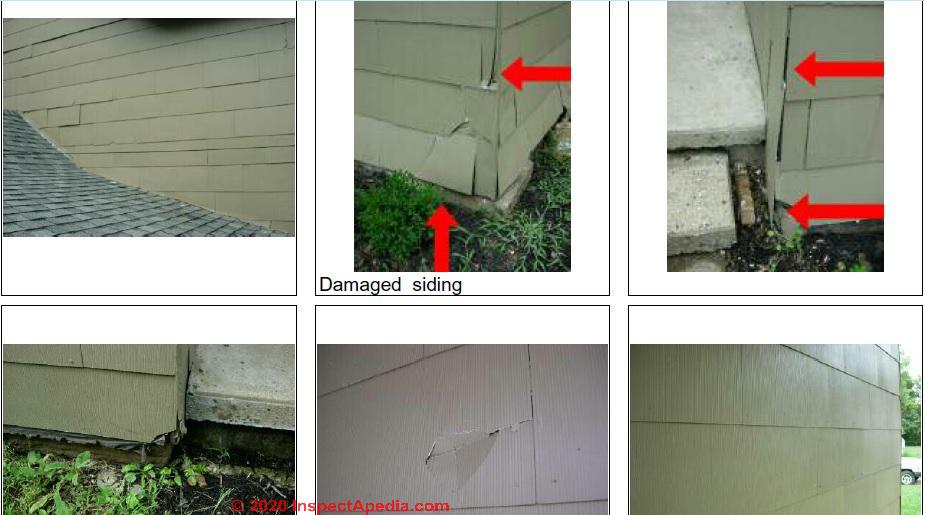
Hello. My current insurance company is saying the exterior wall of my home is asbestos. My inspection report when I purchased the home said fiberboard. The home was built in 1910, not sure if the siding was updated after, and is located in Newark, OH on 12th Street right next to the football stadium.
I added the images the inspector took back in August of 2018. Do you know if this is asbestos or not? Thank you. On 2020-08-01 by Andrew Christianson
by (mod) - How to identify asbestos-cement siding on buildings
Andrew
Nobody can tell by appearance alone if a cement-shingle siding contains asbestos or not. Not unless we have more information such as the age of the material or when it was bought or installed.We give details about recognizing asbestos-cement siding on buildings
In fact I have installed new non-asbestos fiber-cement shingles on homes to replace damaged older asbestos-cement shingles, such that the new shingles were an exact match in pattern and size and shape for the old ones.
The fiber cement shingles on your home might contain asbestos, depending almost entirely on when that siding was purchased (and installed). You would need to either have a reasonable guess at the date (before 1985) or you'd have a sample tested.
It's all cement+fiber (asbestos or other) shingle siding.
Older versions were referred to as asbestos-cement shingle siding, newer as fiber cement shingle siding.
The change was to the use of other fiber materials (typically fiberglass ) to replace asbestos as a strengthener and filler material.
IF we knew that your fiber cement siding was installed on a building in North America before the mid 1980s and certainly if, as is more-likely, it was installed in the 1960s or earlier,
AND IF we knew that none of it had been replaced with newer product,
THEN it's a safe bet that it contains asbestos as all of that earlier fiber-cement siding was so manufactured.
Blackboard plasterboard (fiberboard?) on my garage roof contain asbestos?
Has blackboard as discribed on the plasterbord in my garage got asbestos in the garage roof has 2 layers. On 2020-07-01 by PAUL Does
Answer by (mod) - asbestos in blockboard (blackboard) sheathing?
Possibly, Paul. Did you check out the
article SHEATHING, FIBERBOARD ASBESTOS CONTENT
"Blackboard" or fiberboard insulation is generally a cellulose-fiber product - discussed in that article and in more detail
at SHEATHING, FIBERBOARD ASBESTOS CONTENT
I'm not sure where your plasterboard is on the building nor if for sure we're discussing a plasterboard or a wood-fibre based fiberboard.
So you'll also want to see
ASBESTOS in DRYWALL where we discuss the use of asbestos in plasterboard or gypsum board in both interiors and on some building exteriors as sheathing.
Does Gypsum S-79-50 sheathing contain asbestos?
I own a home built in 1955 and am tearing off cedar shake siding. Beneath is Gypsum S-79-50 sheathing. i just want to know if it contains asbestos. On 2020-05-17 by mark
by (mod) - Possible, but unlikely
It's possible, Mark, though what I've read of exterior sheathing gypsum board don't mention asbestos.
Please also see SHEATHING, GYPSUM BOARD
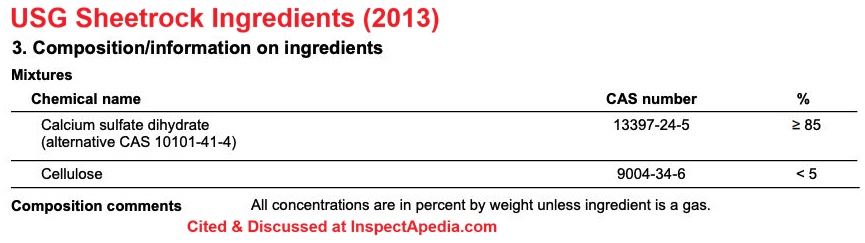
and post photos (1 per comment) of any labeling or markings so that I can research your question further.Here is a contemporary Safety Data Sheet for this product thy-e from US Gypsum:
USG Sheetrock Brand GYPSUM PANELS SDS [PDF] (2013)
Do you think this fiberboard in this Catskill NY home contains asbestos?
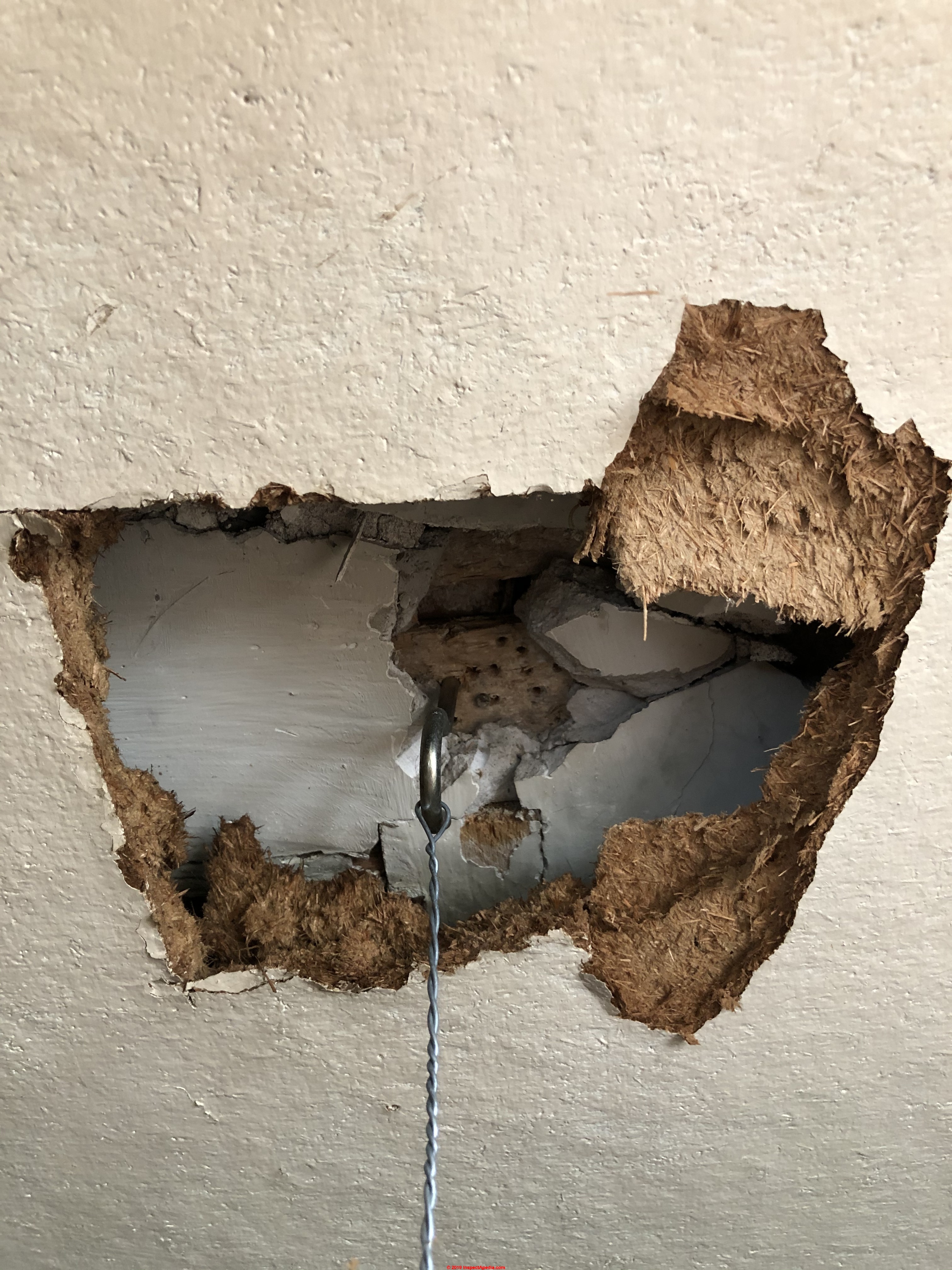
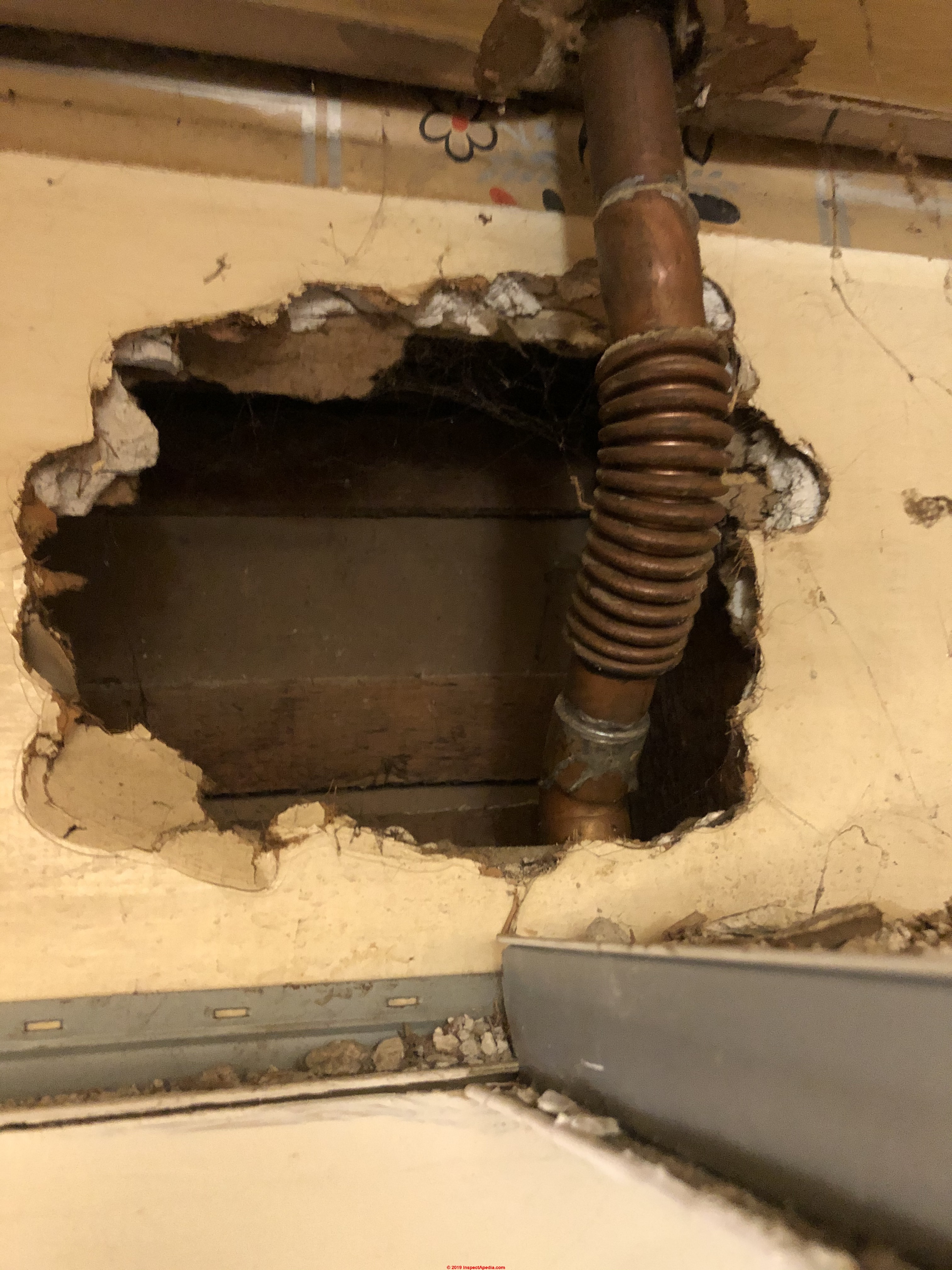
We are considering purchasing a house in Catskill, NY that was built in 1890. [See photos above and below]
Removal of drop ceilings throughout reveals fiberboard covered with plaster. See attached. We are wondering if the fiberboard might contain asbestos?
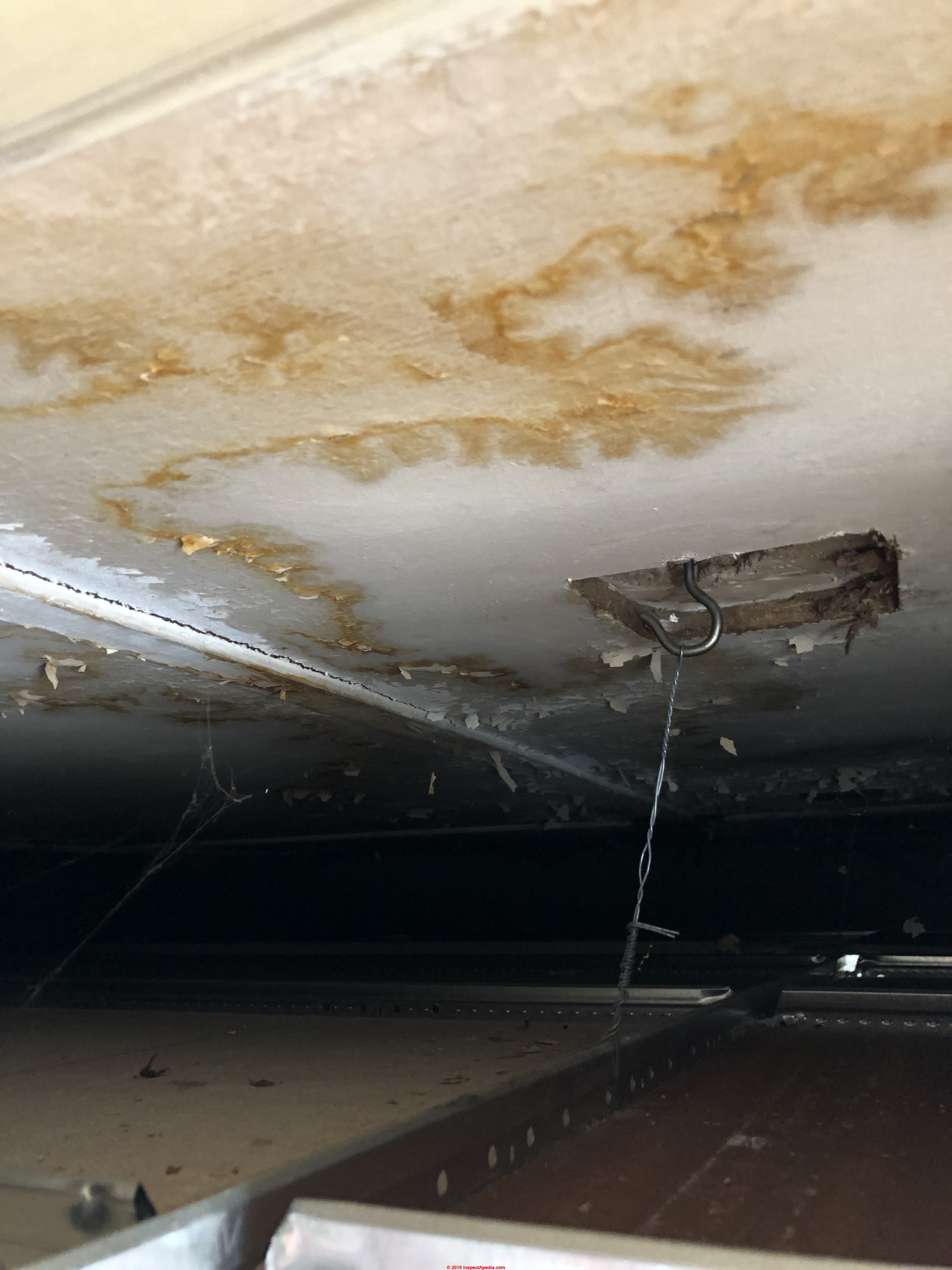
We will have it sent for testing but need to act fast with the house purchase so are trying to get a sense of the likelihood of asbestos in the materials!
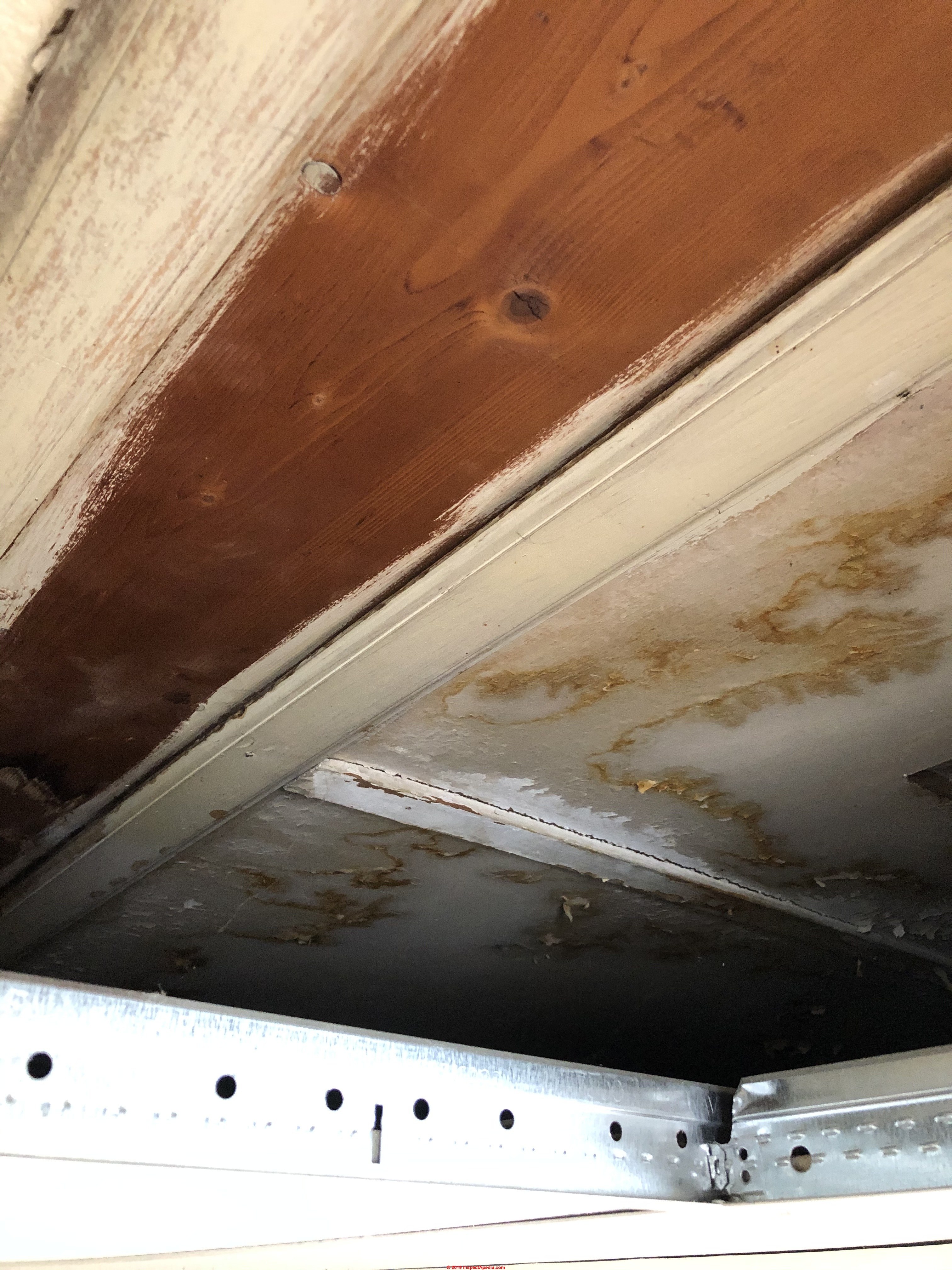
We think the fiberboard was possibly installed in the 1940s/1950s?
We will be doing renovation work ourselves so want to limit exposure, obviously! - Anonymous by private email 2020/01/23 Anonymous
Reply: probably not - here are your drywall asbestos risk management choices
Thanks for the good question and photos. I trust you understand that I'm not going to bet a big sum of your money on a wild guess by email.
I see multiple layers of ceiling material including plaster on lath, fiberboard (often added to cover plaster in poor condition), and a suspended ceiling below all of that; in your fourth photo I see what looks like gypsum board or "drywall".
I don't know the composition of these materials, though I can say that most wood or plant-based fiberboard that looks like yours does not contain asbestos.
At our website we have an article about some exceptions and we discuss the question of asbestos in fiberboard
at SHEATHING, FIBERBOARD ASBESTOS CONTENT.
Your choices are to take a chance, risking an added surprise expense
- Have a sample of the three or more ceiling materials tested for asbestos\
- Treat the material is presumed to contain asbestos, and plan for that,
- Imagine that you'll get lucky.
There are other reasons to cover over such a ceiling material or wall material if it's also in your walls. That's for fire safety.
As you may read at our website in our articles on this topic, it's safest to leave such materials in place and least expensive and not harmful to the cover it over.
That's certainly what I would consider - laminating on a layer of half-inch drywall.
Watch out: the ceiling stains indicate a history of leaks from above - something to investigate further.
Your last photo shows that plasterboard or drywall was used in the building. (Depending on age some of that product contains asbestos).
Reader follow-up: Test results: no asbestos in this fiberboard ceiling material
I wanted to let you know that we sent our ceiling samples for testing and $400+ later we confirmed that your suspicions were right--no asbestos!
The money is worth the peace of mind but I'm so thankful that I also wasn't too worried thanks to your advise. - Anonymous 2020/02/07
What's the R-value for1940's Mil-spec fiberboard
My house was built in 1948; 1st floor walls are plaster; 2nd floor walls are all beaver board (or some type of fiber board). I would like to take the beaver board down and replace with drywall after putting batting insulation between the studs.
But am curious if there any insulating value that beaver board provides? The upstairs is cold, as there is no plumbing run to the second floor for the radiant hot water heat the downstairs has. Oy. Thanks! On 2019-11-19 by Adia
On 2019-11-1 by (mod) -
Mil-spec fiberboard for finds a very small amount of insulation. But nothing compared with this benefit you would get by taking it down and insulating the wall cavities. Course you could leave it in place, insulate the walk have these by blowing into the cavities, and then still covering all of that with drywall.
However that's not a do-it-yourself project. If I were doing and I would pull it off insulate the walls with fiberglass Batts and put up a vapor barrier and then drywall
"Mil-spec fiberboard for finds a very small amount of insulation."
should have read
Typical 1/2" or thinner fiberboard sheathing affords a very small insulating value - about R 0.6
Details are at FIBERBOARD INSULATING VALUES
OK to use Black Celotex Fiberboard Sheathing if it got wet? Does it contain asbestos?
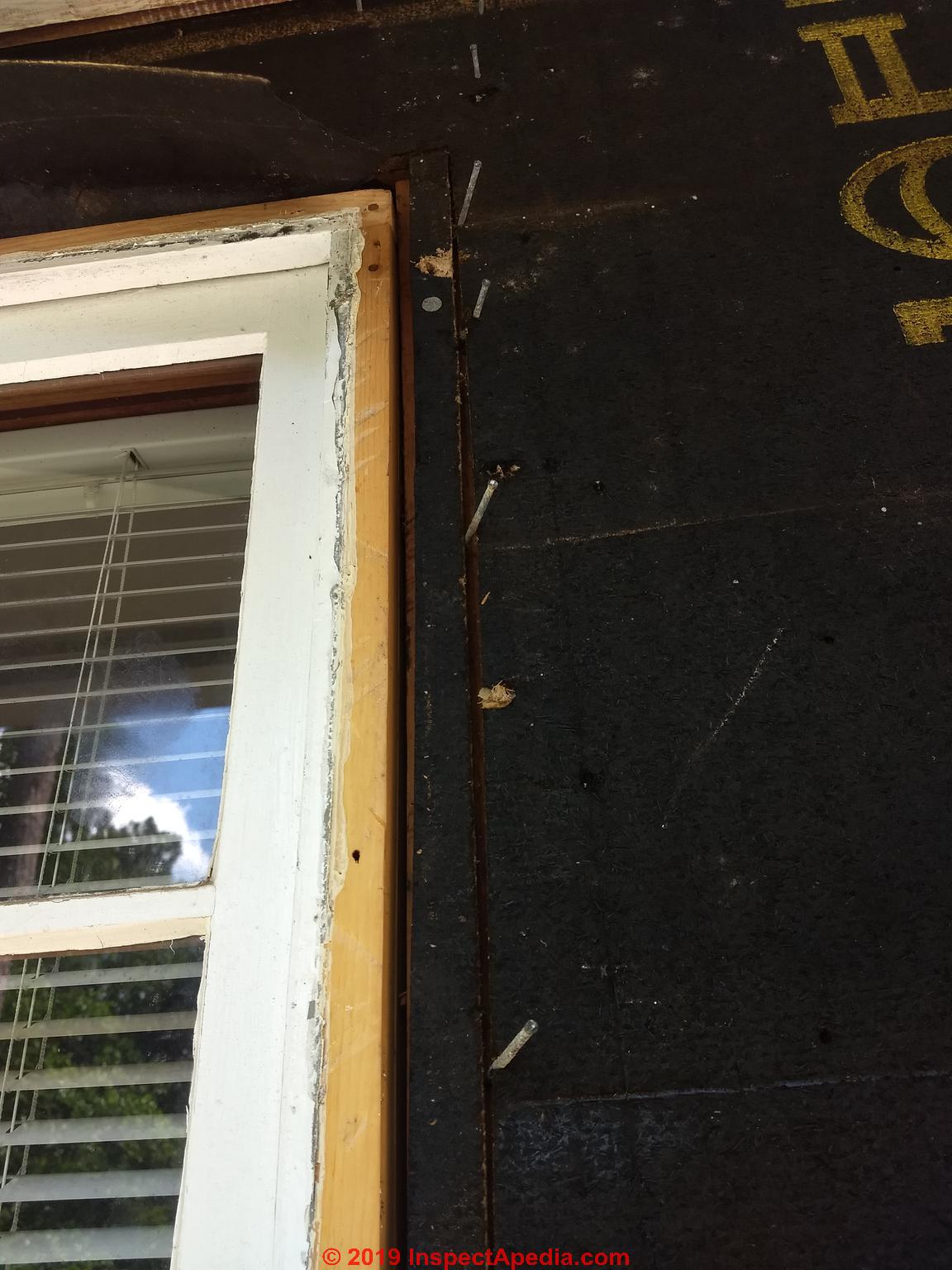 Found black Celotex 4x8 sheets were used on my house as exterior sheathing. They appear to have an puter layer of asphaltic coating but I'm not sure.
Can these get wet and still be OK to use? Do they get ruined by absorbing water if in the rain?
If made in the 1970s would these sheets have asbestos? On 2019-08-02 by Rick B
Reply by (mod) -
Rick the best data we have about the question of asbestos in Celotex 4x8 sheets is at CELOTEX IB ASBESTOS CONTENT
Please take a look there and then, ask away.
The asphalt- or wax-coating on insulating board is intended to resist moisture and wetting and can prevent the material from falling apart if exposed to the weather for a brief time.Make sure that the material is dry before re-installing (housewrap and) siding over it.
What is Manville Baseboard used in kit homes?
It is black and hard like danjoe wrote
Can anyone tell me what Manville Base Board is? Im siding a house that was built in 1966.
It was origionally a kit house. I pulled some shingles away and found the word Manville and this old sheathing is something I have never come across siding homes.
Im worried it could be asbestos paneling seeing it was made by Manville in the mid 20th century. Any info would be appreciated! On 2019-10-19 by Derek -
Answer by (mod) - that's a Johns Manville fiberboard / paper wallboard
Derek
See the series of fiberboard identification tips and photos startingat FIBERBOARD SHEATHING IDENTIFICATION
At a South Gate California facility, Johns Manville produced wallboard, blackboard sheeting, thincoat baseboard (4" wide), and plasters up to about February, 1966. That might describe your Manville Baseboard.
Also at a Newark California plant using gypsum, Johns Manville produced a fiberboard/paper wallboard to produce: wallboard, "blackboard", tongue and groove sheeting (24" wide), using raw materials from the Apex mine in Nevada, purchased by Johns Manville in 1967. - Source: Mineral Information Service, California DIvision of Mines and Geology, Vol. 20-22, January 1967, p. 199
Need data on 1940's Cementos decking
I am looking for structural info on Cementos decking that was used on our building in or around 1940. How much weigh can it support, etc. I can't seem to find any info online about the product. On 2019-04-01 by Rich
by (mod) -
Thanks for an interesting question Rich,
I'll be glad to do some research but first it'd help to know what we're discussing:
roof deck
deck boards
sheathing,
what?
Perhaps you can also post photos (one per comment) of the material in situ and of any labels or markings - that'd help too.Worth noting: for cement-based sheathing or decking made in Mexico the current company name was Cementos Mexicanos, now CEMEX.
Asbestos test Results: NEGATIVE for some insulating / wall board
Not sure where to post this, but thought I'd add the results of an asbestos test that was NEGATIVE for some insulating / wall board that I found in my kitchen when renovating. This was laid over the plaster wall, I assume to create a flat surface that was then wallpapered. Still don't understand why they hung it horizontally, but some things may be unknowable. The results of the test were:
65% CELLULOSE FIBER
15% MINERAL/GLASS WOOL
20% NON FIBROUS MATERIAL - On 2019-02-14 by Adam
by (mod) - asbestos test that was NEGATIVE for some insulating / wall board
Thank you Adam that's helpful information that would be even more helpful if we
Knew the age of material
Or
Age of building,
Country, city
And had photos of the material surfaces, edge, and any stamps or markings.
I think I have been endangered or harmed by exposure to OSB (Oriented Strand Board) Sheathing
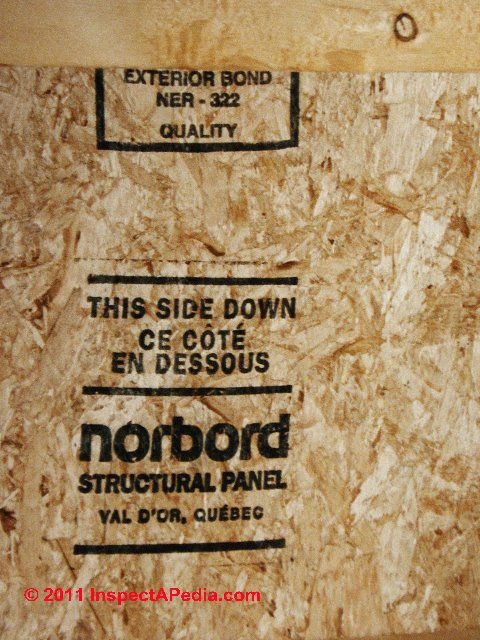
Do you know anywhere I can contact ? Because I was placed and subjected to a very harmful OSB BOARDS when I bought a home the HOA accused me of being in VIOLATIONS, not disclosed to me I placed all funds as my down payment on the home so I didn't want to be heavily fined by the HOA.
I find out later the DENIED SELLERS a PERMIT to have built a extra bedroom halfway wrong.
SELLERS ABANDONED HOME. I tried to do myself what HOA EXPECTED me and threatened me to finish and fix.
Unknowingly I had been getting extremely close to, and hammering next to, and painting it. OLD WEATHERED OSB BOARDS that pierced fine asbestos fibers and splinters everywhere in my flesh.
It's been over 3 years and it's still pouring and popping out of my skin including my entire FACE.
Pleading for anyone to help me.
All the DOCTORS at the ER HOSPITAL thinks I'm seeing things, and won't believe a word I say nor help me at all after 12 different visits the 1st by ambulance. On 2019-01-01 by Micky
by (mod) - Advice for reader frightened by OSB sheathing
OSB wafer board does not contain asbestos.
And OSB wafer board is not a fiberboard product but rather is made of wood chips and glue.
It's important for you to find a doctor whom you trust, discuss your concerns and hospital visits and any tests you had done, and then listen to that doctor's advice.
I recommend reading about MORGELLONS SYNDROMEDetails about OSB sheathing are found at SHEATHING, OSB and include OSB panel identification and ingredients.
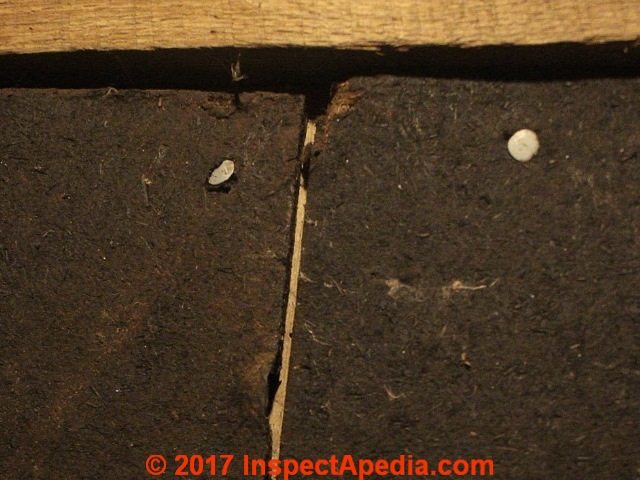
Asbestos or other hazards in orange-tan fiberboard sheathing
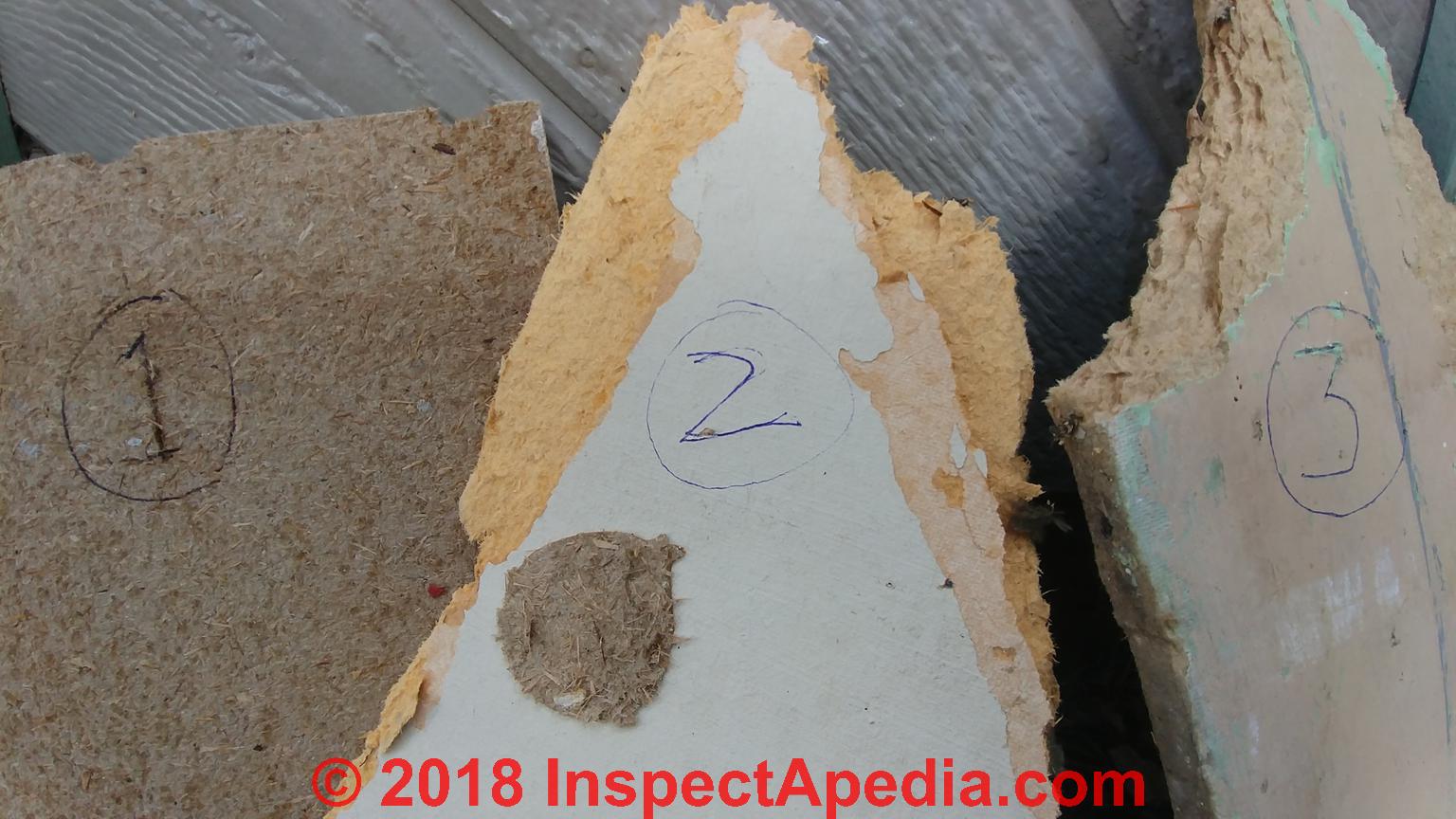 We have come across several different materials while preparing to remodel a 1930 home. I have three samples in the attached image and labeled with numbers.
I have done a lot of reading on this website and others, and will put my thoughts, but was hoping you could help determine if you feel any of these have asbestos.
1. Back side of 9" ceiling tile. F
rom my reading it seems that ceiling tiles in this timeframe should just be handled as if they do contain asbestos. Any thoughts?
2. Orangish type wallboard that was in kitchen.
Not sure this looks wood based. Thoughts?
3. Brownish fiberboard.
This looks like other images i have seen on the website that say they are wood based and most likely do not contain asbestos. This is installed on the walls around the fireplace and kitchen. Thoughts?
Thanks for any help. On 2018-08-19 by James
Reply by (mod) - examples of wood- or plant- based fiberboard
I agree with you on item #1, I think #2 is cellulosic - wood or another cellulose based product, but that's speculation as we can't see much, and I agree about #3.
See FIBERBOARD SHEATHING IDENTIFICATION for more identification tips and photos of similar materials.
If you find any stampings or markings that would be useful too.
Graylite Insulating Board - Insulite Board?
Hello, I am looking everywhere trying to find out if"Graylite insulation board " has asbestos in it. I have found a stack of it on my property, 60 sheets to be exact.
They are 4x8 sheets 3/4 " thick. Do you have any information on this product? Thank you for your time. On 2017-11-13 by Bradon Knox -
by (mod) - How to Identify Graylite as Insulite
Brandon,
If the board is gray in color perhaps it's Insulite who made an interior finish board called "Graylite"
Insulite was a cellulose-based (all wood fiber) insulating board or sheathing material
SeeInsulite - see IDENTIFY Insulite, cellulose fiber board product useful for plasterboard
Beaverboard company appears to have received shipments of ground vermiculite from Libby Montana
Reader OPINION: The NY Beaverboard company appears to have received shipments of ground vermiculite from Libby Montana, which is known to contain Tremolite, Winchite and Richterite amphibole asbestiforms (asbestos).
I have come across beaverboard with a gold reflective side which I suspect is the ground vermiculite adhered to the inside surface of the board.
As such, it seems that there is a possibility that these types of materials could contain some asbestos. On 2016-01-13 by Ethan W - NY
Does Allied Chemical/Barrett Division R-brace contain asbestos?.
Details are at ALLIED Chemical / Barrett Division R-brace Sheathing
...
Continue reading at SHEATHING, FIBERBOARD ASBESTOS CONTENT or select a topic from the closely-related articles below, or see the complete ARTICLE INDEX.
Or see these
Recommended Articles
- ASBESTOS IDENTIFICATION IN BUILDINGS - home
- ASBESTOS TESTING LAB LIST
- FIBERBOARD SHEATHING
- HARDBOARD MASONITE™ & OTHER BRANDS - home
- HARDBOARD Masonite™-like INGREDIENTS
- SHEATHING, EXTERIOR PRODUCT INDEX
Suggested citation for this web page
SHEATHING, FIBERBOARD ASBESTOS CONTENT FAQs at InspectApedia.com - online encyclopedia of building & environmental inspection, testing, diagnosis, repair, & problem prevention advice.
Or see this
INDEX to RELATED ARTICLES: ARTICLE INDEX to ASBESTOS HAZARDS
Or use the SEARCH BOX found below to Ask a Question or Search InspectApedia
Ask a Question or Search InspectApedia
Share this article:Search the InspectApedia website
Need to make a private comment? Email editor@inspectApedia.com. We welcome email with your website content critique, corrections, suggestions or questions. Email is monitored daily but our workload may prevent an immediate reply. For immediate results, we hope you'll first try asking your question using the search box just above.
Citations & References
In addition to any citations in the article above, a full list is available on request.
- In addition to citations & references found in this article, see the research citations given at the end of the related articles found at our suggested
CONTINUE READING or RECOMMENDED ARTICLES.
- Carson, Dunlop & Associates Ltd., 120 Carlton Street Suite 407, Toronto ON M5A 4K2. Tel: (416) 964-9415 1-800-268-7070 Email: info@carsondunlop.com. Alan Carson is a past president of ASHI, the American Society of Home Inspectors.
Thanks to Alan Carson and Bob Dunlop, for permission for InspectAPedia to use text excerpts from The HOME REFERENCE BOOK - the Encyclopedia of Homes and to use illustrations from The ILLUSTRATED HOME .
Carson Dunlop Associates provides extensive home inspection education and report writing material. In gratitude we provide links to tsome Carson Dunlop Associates products and services.
 |
HOME | ABOUT | ASK a QUESTION | CONTACT | CONTENT USE POLICY | DESCRIPTION | POLICIES | PRIVACY | |
| © 2026 - 1985 Publisher InspectApedia.com - Daniel Friedman | |||||||||