Exposure to Radio Frequency & Electromagnetic Fields
Research Citations

- POST a QUESTION or COMMENT about sources of authoritative information about EMF and RF electromagnetic field hazards, measurement procedures, reporting, & mitigation
Research references for EMF and RF exposure, hazards, & exposure measurements:
This article lists and provides links to useful articles explaining electromagnetic field (EMF) or electro-magnetic radiation EMR hazards and hazard measurement.
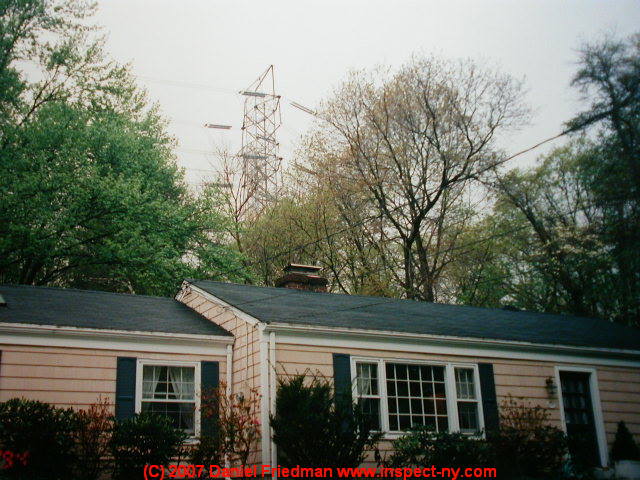
Page top photo: thie home is located less than 100 feet from a large electric power transmission line, has local power lines passing close over its roof, and has its own service entry cable running down the home's main left gable end.
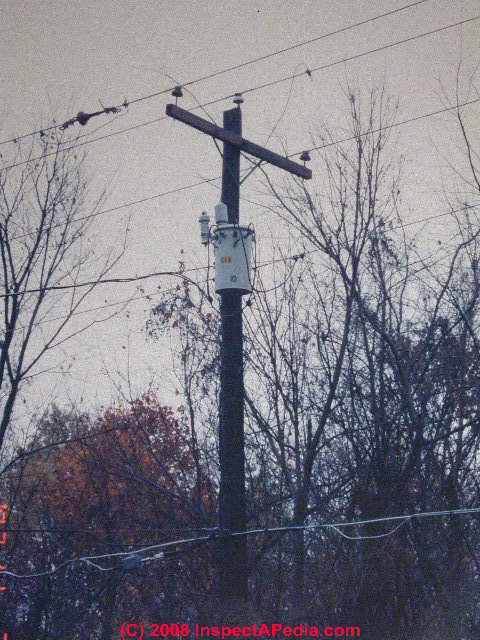
Which of these would be likely to produce significant electromagnetic fields affecting occupants inside the home?
InspectAPedia tolerates no conflicts of interest. We have no relationship with advertisers, products, or services discussed at this website.
- Daniel Friedman, Publisher/Editor/Author - See WHO ARE WE?
References & Research for Electromagnetic Fields and Cancer Risk/Carcinogenicity
- Ahlbom, Anders et als, "Long-Term Mobile Phone Use and Brain Tumor Risk", Stefan Lönn1, Anders Ahlbom1, Per Hall2, Maria Feychting1 and the Swedish Interphone Study Group, American Journal of Epidemiology 2005 161(6):526-535; doi:10.1093/aje/kwi091
1 Institute of Environmental Medicine, Karolinska Institutet, Stockholm, Sweden
2 Department of Medical Epidemiology and Biostatistics, Karolinska Institutet, Stockholm, Sweden
Correspondence to Stefan Lönn, Institute of Environmental Medicine, Karolinska Institutet, Box 210, S-171 77 Stockholm, Sweden (e-mail: Stefan.Lonn@imm.ki.se). Quoting from the article abstract:
Handheld mobile phones were introduced in Sweden during the late 1980s. The purpose of this population-based, case-control study was to test the hypothesis that long-term mobile phone use increases the risk of brain tumors.
The authors identified all cases aged 20–69 years who were diagnosed with glioma or meningioma during 2000–2002 in certain parts of Sweden. Randomly selected controls were stratified on age, gender, and residential area.
Detailed information about mobile phone use was collected from 371 (74%) glioma and 273 (85%) meningioma cases and 674 (71%) controls.
For regular mobile phone use, the odds ratio was 0.8 (95% confidence interval: 0.6, 1.0) for glioma and 0.7 (95% confidence interval: 0.5, 0.9) for meningioma. Similar results were found for more than 10 years' duration of mobile phone use.
No risk increase was found for ipsilateral phone use for tumors located in the temporal and parietal lobes. Furthermore, the odds ratio did not increase, regardless of tumor histology, type of phone, and amount of use.
This study includes a large number of long-term mobile phone users, and the authors conclude that the data do not support the hypothesis that mobile phone use is related to an increased risk of glioma or meningioma.
Case-control studies; cellular phone; glioma; meningioma - ANSI-C95.1, 1982, American National Standards Institute. American national standard safety levels with respect to human exposure to radiofrequency electromagnetic fields, 300 kHz to 100 Ghz. New York: IEEE. American National Standards Institute 1819 L Street, N.W., 6th Floor Washington, D.C. 20036 (202) 293-8020 http://www.ansi.org/
- Blakeslee, Sandra, "Electromagnetic Fields Are Being Scrutinized for Linkage to Cancer," Sandra Blakeslee, The New York Times, Medical Science section, April 2, 1991
- Broad, Willliam J., "Invisible Strike May Be Cause of Envoys' Ills, Suspecting Microwave Beams at Embassy", The New York Times, 2018/09/02 p. 1, retrieved 2018/09/04, original source: https://www.nytimes.com/2018/09/01/science/sonic-attack-cuba-microwave.html
Excerpt:
Doctors and scientists say microwave strikes may have caused sonic delusions and very real brain damage among embassy staff and family members. - Canada, Royal Society of Canada Expert Panel on Potential Health Risks of Radiofrequency Fields from Wireless Telecommunications Devices 283 Sparks Street Ottawa, Ontario K1R 7X9 Canada Telephone: (613) 991-6990
- Christensen, Helle Collatz et als, "Cellular Telephone Use and Risk of Acoustic Neuroma",
Helle Collatz Christensen1, Joachim Schüz2, Michael Kosteljanetz3, Hans Skovgaard Poulsen4, Jens Thomsen5 and Christoffer Johansen1, Am J Epidemiol 2004; 159:277-283.
1 Institute of Cancer Epidemiology, Danish Cancer Society, Copenhagen, Denmark.
2 Institute for Medical Biostatistics, Epidemiology and Informatics, University of Mainz, Mainz, Germany.
3 Neurosurgical Department, Neuroscience Centre, University Hospital of Copenhagen, Copenhagen, Denmark.
4 Department of Radiation Biology, Finsen Centre, University Hospital of Copenhagen, Copenhagen, Denmark.
5 Department of Otolaryngology–Head and Neck Surgery, Gentofte Hospital, University of Copenhagen, Hellerup, Denmark.
Despite limited evidence, cellular telephones have been claimed to cause cancer, especially in the brain. In this Danish study, the authors examined the possible association between use of cellular telephones and development of acoustic neuroma.
Between 2000 and 2002, they ascertained 106 incident cases and matched these persons with 212 randomly sampled, population-based controls on age and sex.
The data obtained included information on use of cellular telephones from personal interviews, data from medical records, and the results of radiologic examinations.
The authors obtained information on socioeconomic factors from Statistics Denmark. The overall estimated relative risk of acoustic neuroma was 0.90 (95% confidence interval: 0.51, 1.57).
Use of a cell phone for 10 years or more did not increase acoustic neuroma risk over that of short-term users.
Furthermore, tumors did not occur more frequently on the side of the head on which the telephone was typically used, and the size of the tumor did not correlate with the pattern of cell phone use.
The results of this prospective, population-based, nationwide study, which included a large number of long-term users of cellular telephones, do not support an association between cell phone use and risk of acoustic neuroma.
Case-control studies; cellular phone; ear neoplasms; neuroma, acoustic, - CMU, "Electric and Magnetic Fields from 60 Hertz Electric Power: What do we know about possible health risks?," Department of Engineering and Public Policy, Carnegie Mellon University, Pittsburgh, PA 15213 1989.
- Elliott P, Toledano MB, Bennett J, Beale L, de Hoogh K, Best N, Briggs DJ. Mobile phone base stations and early childhood cancers: case-control study [Website] British Medical Journal, 2010 Jun 22;340:c3077. doi: 10.1136/bmj.c3077. PMID: 20570865; PMCID: PMC3191724. copy on file as Elliot_BMJ_2010_Mobile_phone_base_stations_childhood cancers_ case-control study.pdf ]
Excerpt:
Conclusions There is no association between risk of early childhood cancers and estimates of the mother’s exposure to mobile phone base stations during pregnancy. - Harvard DEHS, CELL PHONE TOWERS and RADIOFREQUENCY (RF) RADIATION SAFETY [PDF], Harvard University Campus Services, Department of Environmental Health and Safety, (2015) retrieved 2017/12/25, original source: https://www.ehs.harvard.edu/sites/ehs.harvard.edu/files/CellphoneTowerFacts.pdf
- ICNIRP: International Commission on Non-Ionizing Radiation Protection. Health Issues related to the use of hand-held radiotelephones and base transmitters. Health Physics. 1996;70:587-593.
- IEEE-C95.1, 1991, Institute of Electrical and Electronics Engineers, Inc. Safety levels with respect to human exposure to radio frequency electromagnetic fields, 3 kHz to 300 Ghz. Piscataway, NJ: IEEE.
- IEEE: Institute of Electrical and Electronics Engineers, Inc. Human exposure to RF emissions from cellular radio base station antennas; Washington, DC: 1992.
- IEEE, Engineering in Medicine and Biology Society, Committee on Man and Radiation (COMAR), of the Institute of Electrical and Electronics Engineers http://ewh.ieee.org/soc/embs/comar/
- IJC, Environmental Causes of Brain Cancer in Children [PDF] (2003) International Joint Commission, Offices in Washington D.C. USA, Ottawa Canada, and Windsor Canada. Website: https://www.ijc.org/en/who/role
Excerpt: Despite the numerous studies investigating electromagnetic fields and childhood cancers, the strength of an association, and even its existence, is uncertain. Early epidemiological studies have been criticized for their lack of proper exposure assessment and the absence of biological plausibility.
Although initial studies found associations with leukemia and childhood brain tumors, results from recent studies are generally inconsistent [11]. - International Commission on Non-Ionizing Radiation Protection c/o Bundesamt fur Strahlenschutz Ingolstaedter Landstr.1 85764 Oberschleissheim Germany Telephone: 011 49 1888 333 2156 http://www.icnirp.de/
- IRPA, 1988, International Radiation Protection Association. Guidelines on limits of exposure to radio frequency electromagnetic fields. IEEE United States Activities, COMAR, Washington, DC.
- McKinley, Jesse, "San Francisco Law Will Make Cellphone Retailers List Radiation Rate", Jesse McKinley, The New York Times, 16 June 2010 p. A14.
- McManus, T., Department of Energy. 1988. ELECTROMAGNETIC FIELDS FROM HIGH VOLTAGE TRANSMISSION LINES [PDF] a report to Mr Michael Smith, T.D., Minister for Energy. Dublin: Department of Energy. Government of Ireland. Department of Energy, retrieved 2025/04/25 original source: https://www.lenus.ie/bitstream/handle/10147/575273/electromagneticfieldsenergyministerreport.pdf?sequence=1&isAllowed=y
Excerpts:
The potential adverse health effects of the electromagnetic fields produced by high vol~age electricity transmission lines have been investigated in the light of representations made to the Minister for Energy in connection with the 220 kV Carrickmines to Arklow power line.
The investigation comprised a detailed review of relevant, scientific literature. discussions with leading researchers in a number of national laboratories. a meeting with the ~orld Health Organisation. and visits to four North American power utilities who have undertaken major studies on the subject.
The main findings of this investigation are:
1) There is no widespread agreement among research workers that electromagnetic fields from power lines present a potential hazard to the health of people or animals.
2) What evidence there is of adverse health 'effects comes from a small number of epidemiological studies where an association has been observed between cancer in children and the proximity of their homes to concentrations of overhead electricity cables.
Many other epidemiological studies have observed no such association. - MIT, RADIATION, HOW MUCH IS CONSIDERED SAFE FOR HUMANS? [PDF] MIT News [Web Page], (1994), retrieved 2017/12/25, original source: http://news.mit.edu/1994/safe-0105
Watch out: "radiation" limits herea re not clearly defined by type.There may be other newer exposure standards for the U.S. and in other countries. Note as well that these are occupational [work place] exposure limits - Ed.
Excerpts:
Adult: 5,000 Millirems
The current federal occupational limit of exposure per year for an adult (the limit for a worker using radiation) is "as low as reasonably achievable; however, not to exceed 5,000 millirems" above the 300+ millirems of natural sources of radiation and any medical radiation.
Radiation workers wear badges made of photographic film which indicate the exposure to radiation. Readings typically are taken monthly. A federal advisory committee recommends that the lifetime exposure be limited to a person's age multiplied by 1,000 millirems (example: for a 65-year-old person, 65,000 millirems).
Minor: 500 Millirems
The maximum permissible exposure for a person under 18 working with radiation is one-tenth the adult limit or not to exceed 500 millirems per year above the 300+ millirems of natural sources, plus medical radiation.
This was established in 1957 and reviewed as recently as 1990. - NCI, National Cancer Institute study of possible environmental and genetic causes of malignant and benign brain tumors 2001, see http://www.cancer.gov/newscenter/cellphassoc
The study found no indication of higher brain tumor risk among persons who had used hand-held cell phones compared with those who had not used them. - NCI, MAGNETIC FIELD EXPOSURE AND CANCER: QUESTIONS AND ANSWERS [PDF] National Cancer Institute, U.S. National Institutes of Health (2005).
- NCRP, 1986, National Council on Radiation Protection. Biological effects and exposure criteria for radiofrequency electromagnetic fields. Report 86, (Bethesda, MD: National Council on Radiation Protection and Measurements) pp. 1-382.
- NYS, Biological Effects of Power Line Fields [PDF] New York State Powerline Project. Scientific Advisory Board Final Report, July 1, 1987. Local copy on file as Biological-Effects-of-Power-Lines-NYS.pdf
- Reuters, Large study finds no cell phone mast link to cancer [Website] Reuters News, 6/22/2010, retreived 8/6/12, original source http://www.reuters.com/article/2010/06/22/us-cancer-cellphones
-masts-idUSTRE65L6L520100622 [copy on file as Elliott_Cell_Phone_Reuters.pdf] - Rothman KJ, Chung-Kwang C, Morgan R, et al. Assessment of cellular telephone and other radio frequency exposure for epidemiologic research. Epidemiology. 1996;7:291-298.
- Sabagh, Hawear Saeid, STUDY OF THE CELL TOWERS RADIATION LEVELS IN RESIDENTIAL AREAS [PDF] Proceedings of the 2013 International Conference on Electronics and Communication Systems retrieved 2017/12/25 original source: http://www.inase.org/library/2013/rhodes/bypaper/ECS/ECS-10.pdf
- Seung-Kwon Myung et als, "Mobile Phone Use and Risk of Tumors: A Meta-Analysis", Seung-Kwon Myung, Woong Ju, Diana D. McDonnell, Yeon Ji Lee, Gene Kazinets, Chih-Tao Cheng, Joel M. Moskowitz, Journal of Clinical Oncology, Vol 27, No 33 (November 20), 2009: pp. 5565-5572,
Corresponding author: Seung-Kwon Myung, MD, MS, 111 Jungbalsan-ro, Ilsandong-gu, Goyang, Gyeonggi-do, 410-769, Republic of Korea; e-mail: msk@ncc.re.kr.
Purpose
Case-control studies have reported inconsistent findings regarding the association between mobile phone use and tumor risk. We investigated these associations using a meta-analysis.
Methods
We searched MEDLINE (PubMed), EMBASE, and the Cochrane Library in August 2008. Two evaluators independently reviewed and selected articles based on predetermined selection criteria.
Results Of 465 articles meeting our initial criteria, 23 case-control studies, which involved 37,916 participants (12,344 patient cases and 25,572 controls), were included in the final analyses.
Compared with never or rarely having used a mobile phone, the odds ratio for overall use was 0.98 for malignant and benign tumors (95% CI, 0.89 to 1.07) in a random-effects meta-analysis of all 23 studies.
However, a significant positive association (harmful effect) was observed in a random-effects meta-analysis of eight studies using blinding, whereas a significant negative association (protective effect) was observed in a fixed-effects meta-analysis of 15 studies not using blinding.
Mobile phone use of 10 years or longer was associated with a risk of tumors in 13 studies reporting this association (odds ratio = 1.18; 95% CI, 1.04 to 1.34). Further, these findings were also observed in the subgroup analyses by methodologic quality of study. Blinding and methodologic quality of study were strongly associated with the research group.
Conclusion
The current study found that there is possible evidence linking mobile phone use to an increased risk of tumors from a meta-analysis of low-biased case-control studies. Prospective cohort studies providing a higher level of evidence are needed.
Written on behalf of the Korean Meta-Analysis (KORMA) Study Group.
Supported in part by the Centers for Disease Control and Prevention through Cooperative Agreement No. U48/DP000033 (D.D.M., G.K., J.M.M.).
The contents of the article are solely the responsibility of the authors and do not necessarily represent the official views of the Centers for Disease Control and Prevention.
Authors' disclosures of potential conflicts of interest and author contributions are found at the end of this article. - Stewart, Harold F., Ph.D., Richard W. Peterson, M.S., Wilbur F. Van Pelt, M.S., MICROWAVE HAZARD EVALUATION (A Field Survey Form) [PDF] (1970) Southwestern Radiological Health Laboratory, U.S. Department of Health, Education and Welfare, Public Health Services for some old history on this topic.
- Swanson, Randel L., Stephen Hampton, Judith Green-McKenzie, Ramon Diaz-Arrastia, M. Sean Grady, Ragini Verma, Rosette Biester, Diana Duda, Ronald L. Wolf, and Douglas H. Smith. "Neurological manifestations among US government personnel reporting directional audible and sensory phenomena in Havana, Cuba." JAMA 319, no. 11 (2018): 1125-1133. Retrieved 2018/09/04, original source: https://jamanetwork.com/journals/jama/article-abstract/ 2673168?widget=personalizedcontent& previousarticle=2673164
Swanson, Randel L., Stephen Hampton, Judith Green-McKenzie, Ramon Diaz-Arrastia, M. Sean Grady, Ragini Verma, Rosette Biester, Diana Duda, Ronald L. Wolf, and Douglas H. Smith. "Neurological manifestations among US government personnel reporting directional audible and sensory phenomena in Havana, Cuba." JAMA 319, no. 11 (2018): 1125-1133. Retrieved 2018/09/04, original source: https://jamanetwork.com/journals/jama/article-abstract/ 2673168?widget=personalizedcontent& previousarticle=2673164
Conclusions
In this preliminary report of a retrospective case series, persistent cognitive, vestibular, and oculomotor dysfunction, as well as sleep impairment and headaches, were observed among US government personnel in Havana, Cuba, associated with reports of directional audible and/or sensory phenomena of unclear origin.
These individuals appeared to have sustained injury to widespread brain networks without an associated history of head trauma.
In this preliminary report of a retrospective case series, persistent cognitive, vestibular, and oculomotor dysfunction, as well as sleep impairment and headaches, were observed among US government personnel in Havana, Cuba, associated with reports of directional audible and/or sensory phenomena of unclear origin.
These individuals appeared to have sustained injury to widespread brain networks without an associated history of head trauma. - UK, Independent Expert Group on Mobile Phones http://www.iegmp.org.uk/
- US DEHS, RADIATION EMITTING PRODUCTS [PDF] U.S. Department of Health & Human Services, FDA U.S. Food and Drug Administration - web search 06/16/2010 - original source
http://www.fda.gov/Radiation-EmittingProducts/RadiationEmittingProductsandProcedures/
HomeBusinessandEntertainment/CellPhones/default.htm - US DEHS, FactSheet: MAGNETIC FIELD EXPOSURE AND CANCER: QUESTIONS AND ANSWERS [PDF] (2005) U.S. Department of Health and Human Services, NIH, National Institutes of Health National Cancer Institute, retrieved September 2010, original source: http://www.cancer.gov/cancertopics/factsheet/Risk/magnetic-fields, NIH link updated 2025/04/25 https://www.cancer.gov/about-cancer/causes-prevention/risk/radiation/electromagnetic-fields-fact-sheet
makes these five key points about EMF- Electric and magnetic fields (EMF) are areas of energy that surround any electrical device. EMFs are produced by power lines, electrical wiring, and appliances (see Question 1).
- Electric fields are easily shielded or weakened by walls and other objects, whereas magnetic fields are not. Since magnetic fields are more likely to penetrate the body, they are the component of EMFs that are usually studied in relation to cancer (see Question 1).
- Overall, there is limited evidence that magnetic fields cause childhood leukemia, and there is inadequate evidence that these magnetic fields cause other cancers in children (see Question 2).
- Studies of magnetic field exposure from power lines and electric blankets in adults show little evidence of an association with leukemia, brain tumors, or breast cancer (see Question 3).
- Past studies of occupational magnetic field exposure in adults showed very small increases in leukemia and brain tumors. However, more recent, well-conducted studies have shown inconsistent associations with leukemia, brain tumors, and breast cancer (see Question 4).
- US DOE, ELECTRICAL AND BIOLOGICAL EFFECTS OF TRANSMISSION LINES: A REVIEW [PDF] (1989) Jack M, Lee, Jr. (Chair), Vernon L. Chartier, David P. Hartmann, Gerald E. Lee, Katherine S. Pierce, Fay L. Shon, Rick D. Stearns, Michael T. Zeckmeister, US. Department of Energy, Environmental Section (EFBG) Bonneville Power Administration P.O. Box 3621 Portland, Oregon 97208 USA
[First version of this study was published in 1975 - Ed.]
Executive Summary: This review describes the electrical properties of a-c and d-c transmission lines and the resulting effects on plants, animals, and people. Methods used by BPA to mitigate undesirable effects are also discussed.
Although much of the information in this review pertains to high-voltage-transmission lines, information on distribution lines and electrical appliances is included.
The electrical properties discussed are electric and magnetic fields and corona: first for alternating-current (a-c) lines, then for direct current (d-c). - US EPA, EVALUATION OF POTENTIAL CARCINOGENICITY OF ELECTROMAGNETIC FIELDS [PDF] EPA Report #EPA/600/6-90/005B October 1990. EPA: 513/569-7562 also available from the US EPA NSCEP National Service Center for Environmental Publications
- US FCC, RF EXPOSURE PROCEDURES AND EQUIPMENT AUTHORIZATION POLICIES FOR MOBILE AND PORTABLE DEVICES [PDF] (2015) - Federal Communications Commission
Office of Engineering and Technology Laboratory Division, October 23, 2015, retrieved 2017/12/26, original source:
https://apps.fcc.gov/kdb/GetAttachment.html?id=f8IQgJxTTL5y0oRi0cpAuA%3D%3D&desc=447498%20D01%20General%20RF%20Exposure%20Guidance%20v06&tracking_number=20676 - US FCC, EVALUATING COMPLIANCE WITH FCC GUIDELINES FOR HUMAN EXPOSURE TO RADIOFREQUENCY ELECTROMAGNETIC FIELDS, OET65 , [PDF], Federal Communications Commission, Office of Engineering and Technology, US FCC OET Bulletin 65, Edition 97-01, August 1997, - Retrieved 2017/12/26 original source https://www.fcc.gov/general/oet-bulletins-line#65
- US FCC, Evaluating Compliance with FCC Guidelines for Human Exposure to Radiofrequency Electromagnetic Fields, Additional Information for Radio and Television Broadcast Stations, Supplement A (Edition 97-01) to OET Bulletin 65 (Edition 97-01) [PDF] ], Federal Communications Commission, Office of Engineering and Technology, US FCC, Supplement A (Edition 97-01) to OET Bulletin 65, Edition 97-01, August 1997, - Retrieved 2017/12/26 original source https://transition.fcc.gov/bureaus/oet/info/documents/bulletins/oet65/oet65a.pdf
- US FCC, Evaluating Compliance with FCC Guidelines for Human Exposure to Radiofrequency Electromagnetic Fields, Additional Information for Amateur Radio Stations, Supplement B, (Edition 97-01) to OET Bulletin 65 (Edition 97-01) - Retrieved 2017/12/26 original source https://transition.fcc.gov/bureaus/oet/info/documents/bulletins/oet65/oet65b.pdf
- US FDA GUIDANCE ON HAZARDS OF OPEN MICROWAVE OVEN DOORS [PDF] (1997), retrieved 4 June 2015, original source: http://www.fda.gov/downloads/MedicalDevices/DeviceRegulationandGuidance/GuidanceDocuments/UCM095341.pdf
- US FTC, QUESTIONS AND ANSWERS ABOUT BIOLOGICAL EFFECTS AND POTENTIAL HAZARDS OF RADIOFREQUENCY ELECTROMAGNETIC FIELDS [PDF] Federal Communications Commission, Office of Engineering and Technology, US FCC, OET Bulleting 56, 4th Edition, August 1999
Many consumer and industrial products and applications make use of some form of electromagnetic energy.
One type of electromagnetic energy that is of increasing importance worldwide is radiofrequency (or "RF") energy, including radio waves and microwaves, which is used for providing telecommunications, broadcast and other services.
In the United States the Federal Communications Commission (FCC) authorizes or licenses most RF telecommunications services, facilities, and devices used by the public, industry and state and local governmental organizations.
Because of its regulatory responsibilities in this area the FCC often receives inquiries concerning whether there are potential safety hazards due to human exposure to RF energy emitted by FCC-regulated transmitters.
Heightened awareness of the expanding use of RF technology has led some people to speculate that "electromagnetic pollution" is causing significant risks to human health from environmental RF electromagnetic fields.
This document is designed to provide factual information and to answer some of the most commonly asked questions related to this topic." - original source: U.S. Federal Communications Commission Office of Engineering and Technology, http://www.fcc.gov/Bureaus/Engineering_Technology/Documents/bulletins/oet56/oet56e4.pdf link updated by 4/2025 to https://transition.fcc.gov/Bureaus/Engineering_Technology/Documents/bulletins/oet56/oet56e4.pdf - US National Council on Radiation Protection and Measurements 7910 Woodmont Avenue, Suite 800 Bethesda, MD 20814-3095 Telephone: (301) 657-2652 http://www.ncrponline.org/
- US OTA, BIOLOGICAL EFFECTS OF POWER FREQUENCY ELECTRIC AND MAGNETIC FIELDS [PDF] background paper, prepared as part of OTA's assessment of "Electric Power Wheeling and Dealing: Technological Considerations for Increasing Competition," prepared for OTA by Indira Nair, M. Granger Morgan, H. Keith Florig, Department of Engineering and Public Policy, Carnegie Mellon University, Pittsburgh, PA 15213, - Also available from Princeton University
- Valberg PA. Radio frequency radiation (RFR): the nature of exposure and carcinogenic potential. Cancer Causes Control. 1997;8:323-332.
- WHO, "Extremely Low Frequency (ELF) Fields," Environmental Health Criteria 35. World Health Organization, Geneva, 1984.
- WHO, "Electric and Magnetic Fields at Extremely Low Frequencies: Interactions with Biological Systems. In: Non ionizing Radiation Protection, World Health Organization, Regional Office for Europe, Copenhagen, 1987.
- WHO, Electromagnetic fields and public health: base stations and wireless technologies. 2006. World Health Organization Accessed at www.who.int/mediacentre/factsheets/fs304/en/index.html on February 23, 2010.
- Wolf R, Wolf D. Increased incidence of cancer near a cell-phone transmitter station. Int J Cancer Prevention 2004;1:123-128.
...
...
Continue reading at EMF SURVEY PROCEDURE or select a topic from the closely-related articles below, or see the complete ARTICLE INDEX.
Or see these
Recommended Articles
- CELL PHONE RADIATION
- DEFINITIONS of EMF RF FIELD & FREQUENCY
- DEFINITIONS of HERTZ, KHz MHz GHz THz
- ELECTROMAGNETIC FIELD EMF ELF & RF DETECTION
- EMF ELECTROMAGNETIC FIELDS & HUMAN EXPOSURE
- EMF CANCER SCARE
- EMF CANCER RISK
- EMF/EMR MEASUREMENT OVERVIEW
- EMF HAZARD & MEASUREMENT REFERENCES
- EMF LOCAL SOURCES MAY EXCEED POWER LINE STRENGTH
- EMF MEASUREMENT DISTANCE AFFECTS STRENGTH
- EMF MEASUREMENT INSTRUMENTS
- EMF MEASUREMENT INSTRUMENT ACCURACY
- EMF MEASUREMENT INSTRUMENT USE TIPS
- EMF MEASUREMENT PROCEDURES
- EMF MEASUREMENT STEP BY STEP
- EMF SURVEY PROCEDURE
- EMF SURVEY REPORT INTERPRETATION
- EMF WORKSHEET for EMF MEASUREMENTS
- EMF WORKSHEET Example
- EMF WORKPLACE EXPOSURE
- ENVIRONMENTAL HAZARDS at BUILDINGS - home
- ENVIRO-SCARE - PUBLIC FEAR CYCLES
- HAZARD vs RISK
- RF RADIO FREQUENCY DETECTION METERS
Suggested citation for this web page
EMF HAZARD & MEASUREMENT REFERENCES at InspectApedia.com - online encyclopedia of building & environmental inspection, testing, diagnosis, repair, & problem prevention advice.
Or see this
INDEX to RELATED ARTICLES: ARTICLE INDEX to BUILDING ENVIRONMENT
Or use the SEARCH BOX found below to Ask a Question or Search InspectApedia
Ask a Question or Search InspectApedia
Share this article:Search the InspectApedia website
Need to make a private comment? Email editor@inspectApedia.com. We welcome email with your website content critique, corrections, suggestions or questions. Email is monitored daily but our workload may prevent an immediate reply. For immediate results, we hope you'll first try asking your question using the search box just above.
Citations & References
In addition to any citations in the article above, a full list is available on request.
- In addition to citations & references found in this article, see the research citations given at the end of the related articles found at our suggested
CONTINUE READING or RECOMMENDED ARTICLES.
- Carson, Dunlop & Associates Ltd., 120 Carlton Street Suite 407, Toronto ON M5A 4K2. Tel: (416) 964-9415 1-800-268-7070 Email: info@carsondunlop.com. Alan Carson is a past president of ASHI, the American Society of Home Inspectors.
Thanks to Alan Carson and Bob Dunlop, for permission for InspectAPedia to use text excerpts from The HOME REFERENCE BOOK - the Encyclopedia of Homes and to use illustrations from The ILLUSTRATED HOME .
Carson Dunlop Associates provides extensive home inspection education and report writing material. In gratitude we provide links to tsome Carson Dunlop Associates products and services.
 |
HOME | ABOUT | ASK a QUESTION | CONTACT | CONTENT USE POLICY | DESCRIPTION | POLICIES | PRIVACY | |
| © 2026 - 1985 Publisher InspectApedia.com - Daniel Friedman | |||||||||