
InspectAPedia® FREE Encyclopedia of Building & Environmental Construction, Diagnosis, Maintenance & Repair |
Question? Just ask us! InspectAPedia
|
 How Much Water Can the Well Deliver
Sustained Well Flow Rate, Well Yield, Drawdown Tests Explained
- POST a QUESTION or COMMENT about water well flow rate, well recovery rate, and well water quantity - does your well run out of water?
Well water quantity:
All about well flow rate, well yield, and water quantity: this article series describes how we measure the amount of well water available and the well flow rate - the water delivery rate ability of various types of drinking water sources like wells, cisterns, dug wells, drilled wells, artesian wells and well and water pump equipment.
We warn that the depth of a well does not by itself tell us how much water it can deliver, and in some cases a very deep well may indicate trouble.
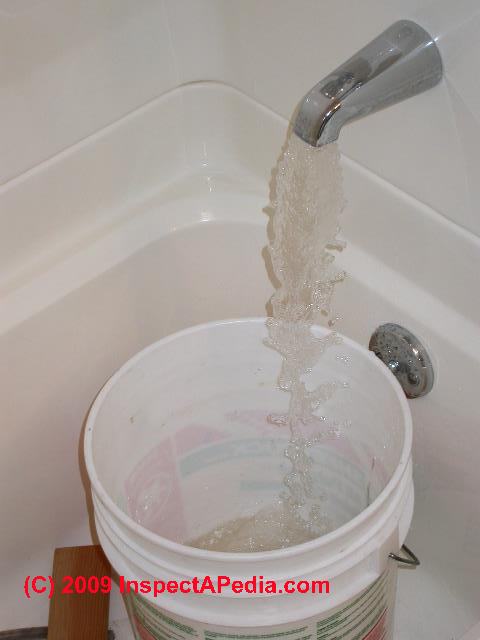
We explain the difference between total water quantity available and the actual well flow rate, and we describe both an actual well flow test and a rather bogus "in the building with a bucket" flow test.
InspectAPedia tolerates no conflicts of interest. We have no relationship with advertisers, products, or services discussed at this website.
- Daniel Friedman, Publisher/Editor/Author - See WHO ARE WE?
How Much Water is Actually In the Well and How Much Water Can Be Drawn Out of the Well for How Long?
Two Key Questions to Ask About the Well Itself When Buying a Property With a Private Water Well
If you are purchasing a property served by a private well of any sort, here are the critical questions to ask about the well itself:
- Where is the well located?
Is the well on the property being purchased? You'll also want to know where the well equipment are located: the pump, pressure control switch, pressure tank, any reservoir tanks, and any water treatment equipment. - What kind of well is it:
hand dug well, driven point well, drilled well, spring, stream, (these water source alternatives have implications for sanitation and water quantity as well as safety)
Article Contents
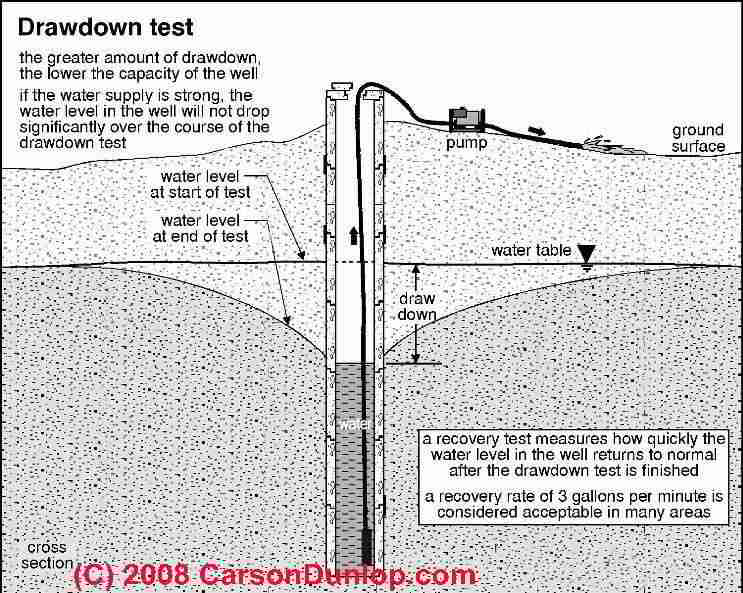
Sketch of a well drawdown test shown here was provided by Carson Dunlop Associates, a Toronto home inspection and education firm. [Click to enlarge any image]
Three Key Questions to Ask About the Water Provided from a Private Water Well
What we really need to know is the total quantity of water that can be drawn from the well and the quality of that water: is it potable, hard (mineral laden), smelly, dirty, requiring treatment for any aesthetic or health-concern contaminant?
There are three basic questions that must be asked about a private water supply provided from a well. It's helpful to state them since otherwise a property buyer may receive only answers to some of these questions, all of which are critical:
- Water Quantity from the Well:
how much water, in gallons or liters, can we draw out of the well before we run out, and how fast can we take it out? We discuss these questions in this document after this introduction.
Watch out: just knowing the depth of the well does not tell you how functional it is, how much water it delivers, nor how good the water may be.
WELL YIELD, SAFE LIMITS - explains the true volume of water that is available from a given well, the role of the static head, the flow rate, the pumping rate, storage tank reservoirs, and other factors that affect well life and changes in well yield. - Quality of water from the Well:
what's in the water? Is it sanitary? Are there contaminants that are a health threat?
That's water potability. But further, are there other water contaminants that are not a health threat but which are aesthetic or even functional concerns such as color, sediment, water hardness, or water odors? You can see that a simple bacteria test to "pass" or "fail" a water well won't address most of these questions.
See WATER TESTING GUIDE for a guide to selecting the appropriate tests to perform when purchasing or maintaining a property with a private water well. - Water Supply Functionality:
is there a good usable flow rate coming out of the water supply piping at every fixture?
The answers to this question usually describe the condition of the piping and well pump, not the condition of the well itself, though in some cases deliberate flow restrictors may have been installed at a building which is served by a well that has a very limited water quantity.
Definition of Well Flow Rate
Properly speaking, the flow rate of a well is usually defined as
the rate, in gallons per minute, that water can be extracted from or pumped out of a well
But an actual or true well flow rate is
the rate at which water flows into the well bore (also called the well recovery rate)
since that inflow rate ultimately sets the maximum rate at which water can be taken out of the well once any water reservoir in the well bore (the static head plus contents of any water storage tanks) has been consumed.
Typically for real estate transactions or for evaluating a newly drilled well, the flow rate is measured over a 24 hour period and is referred to as the well yield.
See WELL FLOW TEST PROCEDURE if you need to have an accurate well capacity test performed on your water well
See WELL YIELD DEFINITION for a complete, detailed explanation of the factors that go into a true measurement of the capacity of a well to deliver water.
Watch out: If you are given a well flow rate that was measured over some shorter interval or worse, over some un-specified interval, you cannot be sure how the well will perform in actual use. For example someone may measure a pseudo-well-flow rate by just measuring the well output at the pump for a few minutes, or at a bathtub spigot or an outdoor hose bib.
Because well flow rates for many water wells are not constant but rather may diminish from an initial maximum in gallons per minute to a lower but sustainable flow rate, these short well flow tests can be misleading.
Brief water flow tests may actually just be measuring the rate that the well pump draws water out of the well bore - pumping out of the water reservoir in the well bore itself. This static head pumpout is not the well's sustainable water delivery capacity.
The well quantity is the total amount that can be drawn out of a water well before running out -
Static Head: Well Water Starting Quantity - What is the Static Head of Water in the Well?
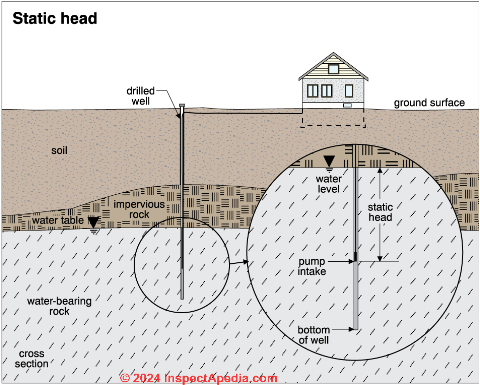
The static head inside a water well tells us how much water is available to the pump after the well has rested, water has risen to its maximum height inside the well, and the pump is about to turn on.
This sketch, courtesy of Carson Dunlop Associates offers a graphic explanation of well static head. The static head in a well is is not the total amount of water than can be pumped out of the well, it's just where we start. After all, we will also have to include the rate at which water runs in to the well while we're pumping water out.
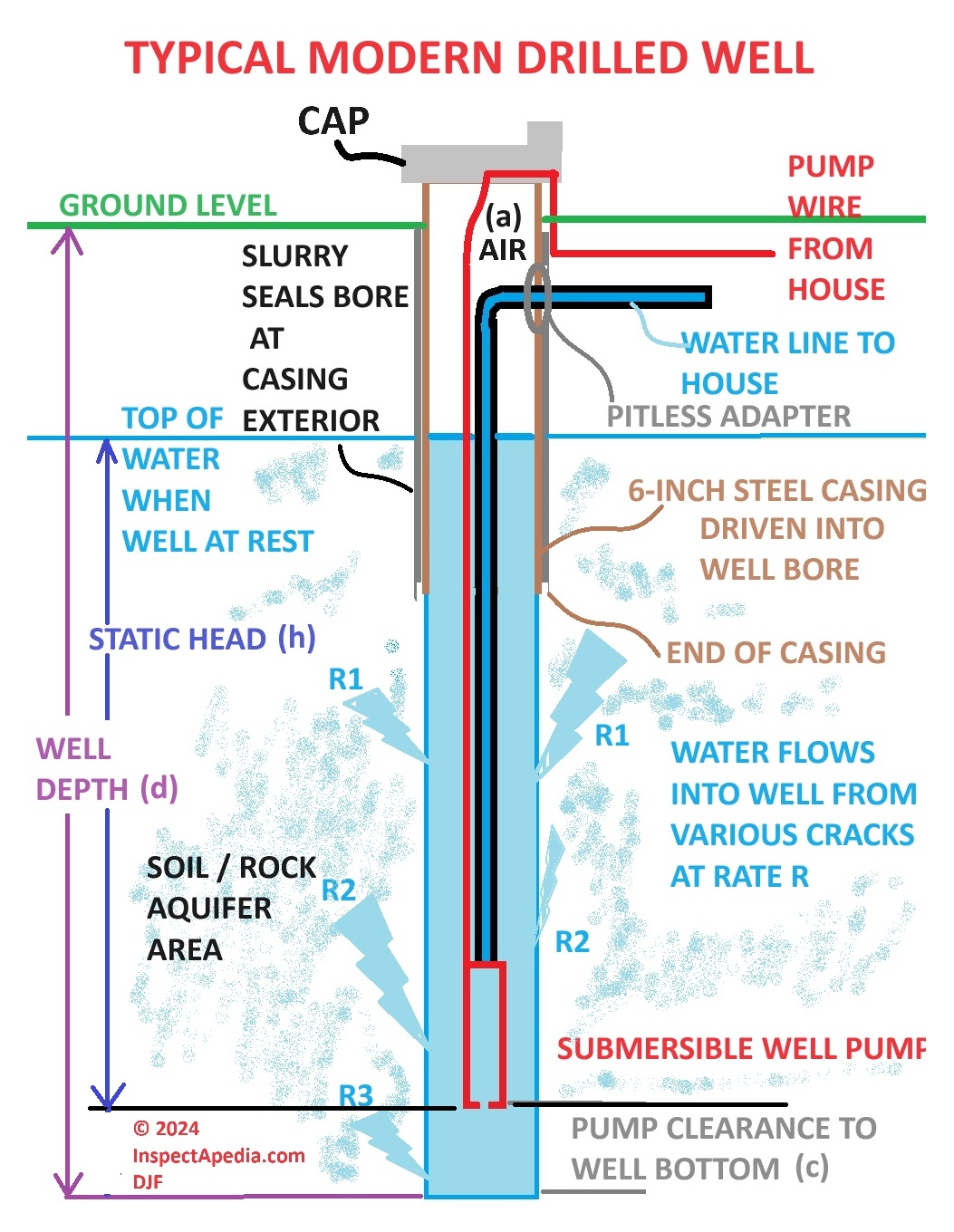
Looking at our rough well sketch below [click to enlarge] and repeated
at COMPONENTS of a DRILLED WELL with a Submersible Water Pump and just considering the vertical arrows at the left side, we see that we have
- total well depth (d)
- comprised of the air gap at the top of the well (a)
- the pump clearance at the bottom of the well (c)
- static head (h) which is the height of the column of water inside the casing which can be pumped out by the water pump when it operates.
For complete details about the definition, role & importance of the static head in a well
see STATIC HEAD in the WELL
How to calculate the gallons of water per foot of well casing
We have about 1.5 gallons of water per foot of depth of a well when we're using a standard residential 6" well casing. Below we show how the volume of a well casing is calculated.
If your well casing or dug well or other round well is larger than 6-inches in diameter just adjust the radius or r-figure to equal 1/2 of your well's diameter in inches.
Based on simple geometry & the formula for the volume of a cylinder: we calculate the area of a cross section, or top, or bottom of the cylinder, then multiply that area by the cylinder's height.
- Volume of a cylinder V = Pi r2 h where Pi = 3.1416, r = radius = 1/2 the diameter of the cylinder. h = height of the cylinder
- For a 6-inch well casing, gallons per foot (all dimensions in inches) is calculated as follows:
- 3.1416 pi x (3 inches radius)2 x 12 inches of height = 339 cu in per foot of well casing height
- Convert cubic inches to gallons, where 1 U.S. gallon = 231 in³
- 339 in³ / 231in³ = 1.46 gallons per foot of 6-inch well casing.
Watch out when estimating how much water is in the well. The depth of the well from bottom to top of the ground is usually not the height of actual water in the well.
The height of water column inside the well and available to the pump is less than the total well depth. Except in artesian walls the water column does not extend from the well bottom to the top of the ground.
Static head location in a well
In this sketch, distance (h) is the height of the "static head" = static head volume - the total volume of water available to the pump when the well has rested and fully-recovered.
The static head volume in a drilled well extends from the very bottom of the pump (since water can't jump up to the pump) upwards to the highest point that water reaches inside the well casing when the well has rested and reached its normal maximum height.
Well water quantity calculation at pump startup
- (a) air in top of the well casing: water rises only to a height somewhere below the very top of the well.
- (h) static head: explained above
- (c) well bottom clearance: our well pump or foot valve (if the pump is not in the well) was placed 5' off of the well bottom © in the sketch, a distance to avoid drawing mud into the pump
- (d) total well depth: measured from the top of the ground to the bottom of the well
Static head water quantity (h) = Total well depth (d) - Air (a) - Clearance at bottom (c)
Details for Calculating the volume of water or gallons of water stored in water piping
In some circumstances such as deciding how much water to flush out of a pipe for certain water tests, it is useful to know the volume of water required to fill well piping or water piping.
For long runs of well piping there may be a significant volume of water in the piping itself. Using 600' of plastic well piping as an example, we need simply to calculate the volume of a cylinder (the inside of a water pipe) into cubic inches per foot.
Below we are repeating the well casing volume calculation, just changing the diameter or radius number to the inside diameter of the piping, and for h or height we use the length of piping.
The volume of a cylinder V = pi x r2 x h
where pi = 3.1416,
r = cylinder radius (1/2 the diameter) and
h = the cylinder height or length of pipe in our case and
G = the volume of water in gallons = 0.004329 gallons per cubic inch
There is more water in long piping runs than one would have guessed.
To translate cubic inches of water inside of a pipe, 1 cu. in. is about 0.004329 gallons
- 1/2" internal diameter piping contains 2.35 cubic inches or (2.35 x 0.004329) = 0.01 gallons per linear foot:
.5 / 2 = r = .25", and h = 12" per foot,
V = (.25)2 x 3.1416 x 12 = 2.36 cu. in. per foot. Multiplying this by 0.004329 we obtain
G = 0.01 per linear foot of pipe - 3/4" internal diameter piping contains (.75)2 x 3.1416 x 12 x 0.004329 = 0.02 gallons per linear foot
- 1" internal diameter piping contains (1)2 c 3.1416 x 12 x 0.004329 = 0.04 gallons per linear foot
Well Yield: Well Water Delivery Rate - the Well Recovery Rate or Well Flow Rate
Details of this topic are
Excerpts are below
Definition of Well Recovery Rate - Well Flow Rate
Well Recovery Rate is the rate at which water runs into the well from the rock fissures and openings into the lower portion of the well below the steel casing, while we're pumping water out of the well.
Some other terms for well recovery rate include well yield, well flow rate, and well water quantity.
Since the "recovery rate" of a well describes the rate at which water runs into the well, a well recovery rate also defines the rate at which water can be pumped out of a well without pumping the well down so far that the pump "runs dry".
Typical numbers for well recovery rates (if measured honestly over a 24-hour period) run from a fraction of a gallon per minute (a terribly poor well recovery or flow rate) to 3 gallons a minute of water flow (not great but usable) to 5 gallons per minute (just fine for residential use) to more than 10 gpm (a great well recovery rate for residential use).
Difference Between Well Recovery Rate or Well Flow Rate & Well Pumping Rate
The well flow rate or recovery rate is not equal to the well pumping rate: that is, most water pumps can pump water out of a well faster than water runs in unless the well has a great recovery rate.
For wells with modest recovery rates of say 2-3 gpm, some well installers or plumbers design the pump so that it cannot pump faster than this rate, thus avoiding pumping the well dry and possibly damaging the water pump itself.
The well pumping rate is limited by the horsepower of the well pump, pump type, pump location, and other factors.
The maximum well pumping rate set by the pump is normally a number stamped on the data tag attached to the well pump itself.
The well pumping rate defines how fast in gallons per minute (GPM) the pump can deliver water if it has an infinite quantity available.
The well flow rate, as we discuss in this article, is the rate that water flows into the well itself from the surrounding soils.
The well flow rate is the true limit on a well's ability to deliver a sustained water flow to its users.
Watch out: So you could pump water out of a well very fast pumping rate, say at 10 or even 15 gpm. But if the well recovery rate is less than the well pumping rate, you're going to run out of water.
How soon you run out of water depends on how much water was in the well casing when you started pumping (the static head), and ultimately on the well recovery rate.
We explain this in more detail at Definition of
the TOTAL QUANTITY of WATER AVAILABLE from a WATER WELL.
We offer a more detailed (and more confusing) equation used to calculate the details of a well recovery rate in our discussion
at DRILLED WELLS STEEL CASINGS.
But it's easier to simply pull water out of a well at a given rate and see how long we can do so.
That's about what a well driller does to determine the effective well flow rate when a new well is drilled. Pulling water out of the well (using a variable-rate pump running at a rate set by the well test professional) integrates all of the different rock fissure flow rates into a single quantity of water.
Example of Calculating the Flow Rate of a Well
Question: I'm digging a well, not yet in the driest part of our dry season. I'm at about 10 meters depth, well diameter about 1.4 meters.
At 4 pm when the digger stops for the day (by hand hammering through rock with a mallet and chisel), he drains the water.
At 9 am the next day the well has 1.6 meters of water in it. I intend to complete digging further into the dry season. However, based on the above data, how many liters of water can the well produce in a 24 hour period? -- A. Starkman, Oaxaca, Mexico.
Answer: We can calculate the well flow rate from the reader's example above, using the formula for the volume of a cylinder and a constant to convert between volume of well water in cubic meters and liters or gallons.
This well water flow rate calculation case provides exactly what we need to calculate the quantity of water in a well from direct measurements of the well diameter, depth, and water depth, presuming that the well, a dug well in this case, is round. We just need the depth of water and the diameter of the cylinder formed by the well.
Then we use the formula for volume of a cylinder - which in turn means we calculate the area of the circle formed by the bottom of the well (or the well's cross-sectional area) and we just multiply that area by the height (or depth) of the water.
WELL FLOW TEST PROCEDURE describes how we test well flow rate and quantity when the well is already built, is covered or sealed, and we can't conveniently make well diameter and water depth measurements.
So for this real-life example of a dug well for which we want to calculate the well water volume and the well flow rate:
Well Diameter D = 1.4 Meters
Well Radius r = 1/2 of diameter or .7 meters
Depth of water in the well (reported after a specific time interval discussed below) = 1.6 Meters
Area of a circle = pi x radius squared (radius = 1/2 of the diameter)
Area of the well in cross-section or bottom = 3.1416 x (.7 x .7)
Area = 3.1416 x .49 .... or
Area = 1.54 meters
Volume of a cylinder (in this case a round, hand dug water well) = Area x depth
Volume the well = 1.54 m x 1.6m .... or
Volume of water observed inside this well = 2.46 cubic meters
WATER FLOW RATE CALCULATE or MEASURE describes measuring water flow rates at or in a building - which is not the same as a well flow test.
Converting Cubic Meters to Other Common Measures of Water Volume
Liters: one cubic meter contains 1000 liters.
So for our example well, the well cylinder of water contains (2.46 x 1000) = 2460 liters of water
Converting Liters of Water to Gallons of Water
1 gallon = 3.7854 Liters so we can divide the liters, above, by 3.7854 to convert to gallons.
The example well water volume contains (2460 / 3.7854) = 650 gallons of water.
How to State Well Flow Rate in Gallons per Hour for a Given Time Interval
Now we can also obtain the well flow rate - the rate at which water is flowing in to the well - though this will change seasonally as well as change if the well is dug further or other steps are taken that affect well yield. At the time of our reader's observations, from 4PM on a given day to 9AM the next day (that's a total of 17 hours on the clock) the new well collected 650 gallons of water.
Gallons / hours = gallons per hour or water flow rate into the well, provided that no one is taking water out of the well during this same interval.
Well Flow Rate Per Hour = WFh is normally expressed in gallons per hour or gph.
WFh = (Total Gallons of Water in The Well Starting from Empty) divided by Number of Hours of Elapsed Time between empty well and the observed water volume in the well.
WFh = Gallons / Hours = gph or gallons per hour
For this example, 650gallons / 17hours = 38 gallons per hour - this is the well flow rate for a 17 hour period. This is a huge flow rate, by the way.
Definition of Well Flow Rate in Gallons per Minute
The most common measure of a well's ability to deliver water, that is the answer to "how much water can we get out of a well" is the measurement or calculation of the well flow rate per minute - the water flow rate into the well expressed in gallons of inflow per minute. WFm.
The well flow rate in gpm defines the maximum rate at which water can be drawn out of the well over a sustained period.
Actually we can draw water out of a well faster than WFm, because the well pump has available to it the reservoir of water already in the well when it starts pumping - the well's "static head".
But once that static head of water has been exhausted, WFm is the absolute limit of further water delivery rate possible.
For our well flow rate calculation example above, we found that this well had a water in-flow rate of 38 gph or 38 gallons per hour.
Just divide this number by 60, the number of minutes in an hour to obtain the well flow rate per minute.
Well Flow Rate per Minute = WFm = gpm or gallons per minute
For this example, 38 gph / 60 = 0.6 gpm - this is the measured well flow rate in gallons per minute.
In this case that's a weak, marginal well flow rate. In the U.S. most building or health departments who must approve a private well water supply when issuing a final certificate of occupancy for new construction want to see 3 to 5 gallons per minute or 3-5 gpm.
Is This Really the 24-hour Well Flow Rate?
Is 38 gph or 0.6 gpm really the true well flow rate? Maybe. Maybe not.
The property owner's observation was that from "an empty well" at 4 PM on a given day, the well water level rises to 1.6 meters of depth by 9AM the following day.
So what was observed was a flow rate of 38 gallons per hour over a 17 hour period. Not a 24-hour period. Will the well water level continue to rise past the 17 hour period. Maybe, maybe not.
While a hand dug (or drilled) water well fills as water flows into it, the well water in-flow rate will slow down and eventually stop. This is true except for artesian wells.
That's because eventually the pressure exerted on the well sides by water in the well equals the pressure of water in rock fissures or passages from which water is trying to enter the well.
When the water pressure exerted on the well sides and bottom by water inside the well itself equals the water pressure exerted by water trying to enter the well, at that point water flow into the well will stop.
The well water level won't change much until someone draws water out of the well, thus lowering its in-well water level back down and allowing more water to flow in.
Well flow rates will vary by season, weather conditions, and other factors such as well age and history of usage. The well flow rate may also be affected by the chemistry of the water itself - if water is high in minerals, over time the rock fissures through which water flows into the well become mineral clogged and the well flow rate may diminish.
How to Determine the True 24-hour Well Flow Rate
So the owner will want to either measure the well depth again after 24 hours, repeating our calculation from above with the well depth measured at the end of 24 hours, with water only flowing into the well, that is, no one draws any water out of the well during that period.
We prefer to simply measure the water in the well at the end of 24 hours and calculate the 24-hour flow rate. When the well is a drilled well rather than a hand-dug well, the well driller may measure the well flow rate by use of a well pump whose output is adjustable.
The well driller measures the well draw down rate in the well opening while the well pump is running, and compares that to the rate at which the pump is removing water from the well.
But a true well flow rate, whether obtained by simple observation or by use of a calibrated pump, should be measured over a 24 hour period, not a shorter interval.
Determine the Well's Static Head
Alternatively the owner might want to watch the well water level increase until the water level has stopped rising in the well. It might take longer than 24 hours for the water in flow to stop.
When the water level has stopped rising on its own in the well, the depth of water in the well is measured and is referred to as the static head - the amount of water in the well when the well is fully recovered and at rest.
Why Can't we Just Measure the Flow Rate by Running Water Into a Bucket in the Building?
You can indeed measure water flow rate in a building by running one (or more) fixtures into a bucket, knowing the volume of the bucket and just watching how long it takes to fill the bucket. But this approach is usually wrong, as we explain at
WATER FLOW RATE CALCULATE or MEASURE - how much water is delivered at a plumbing fixture
Definition of the Total Quantity of Water Available From a Water Well
For the most complete discussion of this topic please see WELL YIELD, SAFE LIMITS.
People sometimes confuse things by describing what we call the well 'flow rate" as the "water quantity" available from a well.
They're different.
You could have a great well water flow rate - say 20 gallons per minute - but if it the water will only run at that rate for five minutes before you run out, the well has a very poor water quantity (5 minutes x 20 gpm = 100 gallons of water) and it's not a satisfactory well.
Watch out for errors or deliberate misrepresentation about well flow rate and water quantity - well capacity - when buying a property
A true well flow rate is not what we can measure in the building over five minutes, it's the ability of a well to deliver a sustained water flow rate over a longer period, usually measured over 24-hours.
When a local health department or building department approve the flow rate of a water well, that rate should have been measured by a plumber or well driller and should represent something more than a five minute test.
The standard period over which a well flow rate must be measured varies among communities. Find out what the standard is for your area.
Adding a More Powerful Well Pump Can Improve Pressure, Increase Flow Rate at Faucets ... and can Lead to Trouble
The amount of water that can be pumped out of a well at any given time is limited by the size of the static head and the well recovery or well flow rate, and of course by the pump rate the gallons per minute that the pump itself can or is set to deliver.
Well pumps are usually intended to pump water out of a well slowly enough that the pump and well don't run dry. Some pump systems have fittings that recycle the very last water in the well through the pump, ceasing delivery of it to the building, to protect the pump from overheating.
Watch out: For these reasons, we've occasionally found clients dissatisfied with their well after they install a new, more powerful water pump. The owners install a more powerful pump to increase water pressure in the home, but the effect may be also to draw water out of the well faster than ever before, thereby disclosing a marginal well flow rate that they had not understood.
For this reason it's a dangerous simplification to simply assert "we can put on a bigger pump" when water flow rate is poor in a building.
See WATER PRESSURE LOSS DIAGNOSIS & REPAIR for more diagnosis of bad water pressure.
Remember that water quantity (how much water we can obtain) is not the same thing as water pressure (how fast water comes out of the tap). Water quantity comes from what the well can deliver.
Water pressure is the amount of force with which the water pump can push water into the building piping and fixtures.
Higher water pressure does give us more gallons per minute flow but that's describing a condition at the plumbing fixture. It's not measuring how much water the well can deliver.
A Poor Flow Rate Well Might Seem to Work Acceptably
If our well has a huge static head, say 300 gallons of water, and considering that at most buildings, certainly at residential properties, most water usage occurs in two big surges, in the morning and in the evening (giving the well time to recover between), the well could have a terrible recovery rate, say 1/2 gallon a minute or less, but we might never notice it in the building.
We're always running off of the "reserve" or static head.
But over time, as minerals and debris clog those rock fissures that feed water into our well, and if we started with just a small recovery rate of less than a gallon, our well may not continue to deliver the water quantity we need.
A Good Flow Rate or Good Well Recovery Rate is Best
A well with a good recovery rate, flowing at say 5 gpm or more, is more likely to continue to give good service over time, and we might get by with a small static head if the flow rate is good enough.
These are the parameters that a well driller is considering when they decide how deep to go in drilling and how much well flow rate is going to be acceptable.
Well Flow Rates are Not a Simple Number, and Need to Be Measured Over Time
Because ground water typically flows into a drilled well through multiple rock fissures or other underground passages, and because these passages are at different depths, the actual total flow rate into a well is made up of flow from multiple individual openings. Each of these may have its own characteristic flow rate and also flow duration.
For example a fissure may flow at a high rate for 20 minutes and then drop to a slow rate or even stop entirely.
This is why the flow rate at a new well is typically measured over a long period, say 24 hours. If you measure the flow rate at a well for just a few minutes, you can have no idea of the well's actual ability to deliver water over any sustained time of usage.
Well Flow Rates Can Change
- Someone drilling a new well nearby can tap into the same water table causing it to drop
- Local blasting can change the level of a local water table. Local blasting can also change water quality.
The well at one of our properties gave seemingly limitless quantity from a shallow 29' deep drilled well from about 1920 up to about 1999.
Then the town was improving the nearby roadway and had to do some blasting.
The well quantity did not change but suddenly wells along this section of roadway had red silt in their water - it has remained a problem for some home owners in the area. - Seasonal water level variations: Local ground water table levels are often lower at different seasons (less in dry weather)
- Permanent water level shifts & Global Warming: Local ground water tables may drop permanently. In some areas of Florida so much water has been pumped from below ground that salt water has begun to intrude into the aquifer. Changing sea levels due to global warming can be expected to affect coastal drinking water wells by raising the level of salty water.
Watch out: Measurements like the
- WATER FLOW RATE CALCULATE or MEASURE - the flow rate of water at plumbing fixtures or faucets
- WATER PRESSURE MEASUREMENT - with what force does water exit at a fixture or faucet (dynamic water pressure), or what is the water pressure in a system when no water is being run (static water pressure)
- WELL DEPTH, HOW TO MEASURE - how deep is the well
- WELL FLOW RATE - the well recovery rate or how much water can we take out of the well in a given time period
are all useful, but taken by themselves some of these numbers can give a false reading about the basic question of how much water is in the well?
Before assuming that a water pressure, flow, or quantity problem is due to the well itself,
see WATER PUMP REPAIR GUIDE a specific case which offers an example of diagnosis of loss of water pressure, loss of water, and analyzes the actual repair cost.
...
Reader Comments, Questions & Answers About The Article Above
Below you will find questions and answers previously posted on this page at its page bottom reader comment box.
Reader Q&A - also see RECOMMENDED ARTICLES & FAQs
On 2022-06-17 by Brian - do we want high capacity well pump on a low-yield well?
We have a new well that was just completed - water fractures found at 350', drilled to 700' and found no other water. 1 GPM in 350' of granite (the top 350' was mostly sand), steel-cased to 420' with 6". So we're buying a cistern for the well pump to pump water in to.
We have gotten two quotes for the well pump, with differing opinions on size.
One provider recommended we pump at 1-2 GPM to avoid running the well dry.
The other provider said that with 350' of water on top of the pump when it starts, limiting that pump to only 1-2 GPM puts a lot of stress on the pump and it will suffer a much short life.
He suggested a 1.5 HP pump that would support 8 GPM initially, and 2 GPM before an automatic shutoff device would detect no water and shut the pump off.
It seems like letting gravity and the pressure help the pump do its job is a good idea, but if pumping the well dry increases the risk of damage to our very limited production well, then I'd rather trade pump life for well life.
Any suggestions on the above? We were planning on the cistern calling for water after 300 gallons or so, so if the well has fully replenished it would have 500 gallons, so in theory it wouldn't actually run dry.
Thank you for any thoughts or suggestions.
On 2022-06-18 by InspectApedia-911 (mod) - new well finds just 1 gpm. What sort of pump is wanted?
@Brian,
Thanks that's an interesting and helpful question. Before I wax eloquent and show off I'd like to be sure I understand the well data correctly.
I think you are saying that there is a well flow rate, that is the rate at which water flows into the borehole, of 1 gal per minute. I agree that is marginal.
But that 350 ft of water on top of the pump is a question. When the will has been at rest 4 hours or longer, to what height does water actually rise in the borehole?
That's the static head and that tells us approximately how much water can be pumped before the pump has to limit itself to the inflow rate.
In a 6 inch casing we have about a gallon and a half per foot.
350 x 1.5 = 525.
At 8 gallons a minute that means that you'll pump that water out in about an hour. What's your pump doing for the rest of the time? Waiting for Godot.And I'm a little worried that too-fast draw-down of a limited water-supply aquifer might actually damage the aquifer and reduce the well's recovery-rate. Frankly that's just arm-waving since it could go either way: we might help or we might harm the aquifer. We've no specifics about the size of your well's aquifer, its soil composition nearby, mineral levels, seasonal variation, history, etc.
Most water pumps are designed so that long on-cycles are not harmful to them, especially a submersible pump that's called by the surrounding water.I'm not sure there's a real advantage to putting in a high-capacity pump and such a load delivery well and there's some risk that a control fails and you run the pump dry which of course kills your pump almost immediately.
So let's start by getting clear on what is the static head in your well?On 2022-06-18 by Brian - high capacity well pump on a low-yield well?
@InspectApedia-911, lol - I thought the "punk" was a little harsh. I was like, we haven't even met and he already knows me. :-)
Thanks again for your thoughts!
@InspectApedia-911, Ah, perhaps my well is an oddity? The well driller hit 3 water fractures at 350', and kept going because they only measured 1 GPM (using blown air). After 350' more feet of drilling in granite, the recommended we stop drilling, as the well logs for the area didn't support drilling any deeper. They said they found no more water from 350' to 700'.
So the water is actually seeping in from 350', and falling in to what amounts to my 700' deep 525 gallon cistern.
We're steel cased 6" to 420', and 4" PVC lined from 10 to 700'. But they drilled the bore at 6" so that's the diameter in the granite.
One thing I read today on the Internet, so it must be true, is that it's best to keep the water at a constant level in your well, especially when it's steel cased. The water going below and then back up causes rust to flake off and fall to the bottom of the well.
Anyway, did that help clarify? I appreciate your thoughts!On 2022-06-18 by InspectApedia-911 (mod) - advice for new well with marginal or poor flow rate
@Brian,
More of these easy well volume calculations are at STATIC HEAD HEIGHT & RELATED DEFINITIONS https://inspectapedia.com/water/Well_Static_Head_Definition.php
There you'll see that a 4-inch well casing -which I now read as the effective diameter of the static head in your well because of that 4" "liner" (well perhaps I'm wrong but anyway)
"150 cu. in. or about 0.6 gal per Foot of Depth'
so 350 x .6= 210 gallons.
So in 26 minutes your 8 gpm well pump will exhaust the well. There is in my OPINION nothing at all gained by that high capacity well pump; It will run for less than 1/2 hour and then probably needs to be off for at least 3 1/2 hours to let the struggling well recover (at its 1 gpm flow rate).
I don't know nearly as much about well pumps as your onsite well pump expert. Still it seems to me that it's probably better for the well and the pump both to pump a little more-slowly and less dramatically.
You could pump a 1 gpm or less and fill that water storage cistern overnight and have a good water supply..
Watch out: as I argue in this article series, because we know that a well's flow rate usually will deteriorate over time (mineral clogging, water table dropping, global warming, pumping by neighbors tapped into the same aquifer), when we start out a new well with a really weak water flow rate, you need to be prepared for a reduced well life.
Question 1: is your well driller confident that we're not actually losing water by having drilled the well so deep down past the point where water flows into the well? I've seen that happen before: digging past the water entry point led to water leaking down and out. The installer ended up plugging the over-drilled well bottom to raise it back up.
Well drillers usually say it's better to drill deeper (too shallow, more contaminant risks), and so do other experts. But there are occasions when drilling deeper loses water that was available at a more-shallow depth.
Question 2: have you asked the local well experts if they've had success using techniques to increase well yield like hydrofracking?
See details at WATER QUANTITY IMPROVEMENT
Question 3: is the casing installation ideal for a low-yield well whose water-producing aquifer is a thin layer?
Here's a relevant opinion from
- LifeWater Canada, SOLUTIONS to DRILLING PROBLEMS [PDF] LifeWater Canada, 457 Heather Crescent Thunder Bay, ON P7E 5L1 Canada Tel:+1 807-622-4848 Email:info@lifewater.ca - original source: https://www.lifewater.ca/drill_manual/Appendix_G.htm
LifeWater Canada is a religious charity who describe their mission: as to provide safe drinking water and improve hygiene in Africa (Liberia, Nigeria, Kenya) and Haiti.
...
Donors in Canada, the U.S., and Europe sponsor water projects to keep them affordable for the local villages that contribute a token amount of money plus "sweat equity." We rely on in-country teams that we have trained and equipped to drill wells and repair broken pumps. The teams also train and equip local Well Caretakers, and host Health and Hygiene workshops to enable villagers to prevent water-related diseases.
G-9: Marginal Aquifer Encountered
Sometimes a very thin or relatively impermeable aquifer is encountered which must be developed to provide a reliable water supply.Ensure that the borehole penetrates the full thickness of the aquifer, extending as far below it as possible. Install the well screen adjacent to the entire aquifer thickness with solid casing installed above and below it.
After developing the well, install the pump cylinder as low as possible in the well.
If a well is being completed in a fine sand/silt aquifer within 15-22 m (50 - 75 ft) of ground surface, a 20 cm (8 in) reamer bit has sometimes been used (e.g. Bolivia). This makes it possible to install a better filter pack and reduces entrance velocities and passage of fine silt, clay and sand particles into the well.
Yield can be maximized by adding a small amount of a polyphosphate to the well after it has been developed using conventional techniques.The polyphosphate helps remove clays that occur naturally in the aquifer and that were introduced in the drilling fluid (see Footnote #3).
Enough time must be allowed between introduction of the polyphosphate and development, usually overnight, so the clay masses become completely desegregated (Driscoll, 1986).After the polyphosphate solution is surged into the screen (see Footnote #4), water should be added to the well to drive the solution farther into the formation.
See also
- Mechenich Christine & Byron Shaw, DO DEEPER WELLS MEAN BETTER WATER? [PDF] (1996) University of Wisconsin-Madison, Polk County Extension, - retrieved 2022/06/17 original source: https://polk.extension.wisc.edu/files/2010/12/Do-Deeper-Wells-Mean-Better-Water.pdf
- Sustainability of semi-Arid Hydrology & Riparian Areas (SAHRA). Arizona Wells Database. http://www.sahra.arizona.edu/wells
On 2021-09-16 by Sheila - high sodium count in new well, trouble passing a bacteria test, ran out of water in 15 minutes!
We have built a new home through a very well known builder. A well was installed and it has been found that there is over 8,000 something of sodium. The well company chlorinated the well 4 times to remove the bacteria. The county has not passed the water.
Also our GPMS was logged as 2 GPMS. Needless to say the water totally cut off after 15 minutes. Now the builder and well drilling company wants us to pay for a whole new well and they can not guarantee that they will not get the same result. We are hoping we have that there can be some resolution that will not cost us!!
On 2021-09-16 by inspectapedia.com.moderator (mod) - new well with poor water quality, contaminants, & very poor recovery rate or flow rate.
@Sheila,
2 GPMS ? Two gallons per second? Really? That would be a stunning flow rate of 120 gallons per minute!
I suspect you meant 2 GPM or two gallons per minute, that would also be unacceptable (insufficient) for most mortgage lenders and not so nice to live-with.
If that's the case you'd want to either take steps to try to increase the yield of the existing well or drill a new one at a different location.
While a geotechnical engineer or similar expert can sometimes map underground water tables, drilling a well is always a bit of a pig-in-a-poke: uncertain.
There's no free lunch, here; the well driller is in no position to promise you what they're going to find when drilling into the ground, nor can they keep drilling wells for free. So I'm not sure of an equitable way for you, the homeowner, to avoid that cost.
Discuss with your well driller the options of trying to improve the present well or drill a new one:
Which has the better chance of improving the well flow rate and at lesser total cost?
Your well driller may be expected to know from experience what water they've been finding at what depths and at what flow rates for wells in your area, but they can't guarantee any specific flow rate in advance.
Watch out: in my OPINON, if we force a contractor to guarantee what is basically an unknown, if the contractor is going to agree to do so, she will have no choice but to set a cost to you that can cover the absolute worst case and thus the most-expensive possible case. That higher cost is sometimes, but not usually, necessary.
Your financial plan for the home will also have to consider the possible cost of water treatment equipment to produce potable water.
You haven't given, and it would be helpful to know, the country and city/province/state of location of the well. You might then also look at the geological and water data for that area.
In our OPINION these well water quantity and quality concerns are only going to get worse in many areas that are becoming much more dry as a result of climate change.
On 2021-02-26 by Anonymous - should you walk from the purchase of a home that has a questionable water well?
Received an inspection report which I don’t understand as I’ve never had a well and the inspector has nothing responded to calls or emails since for help.
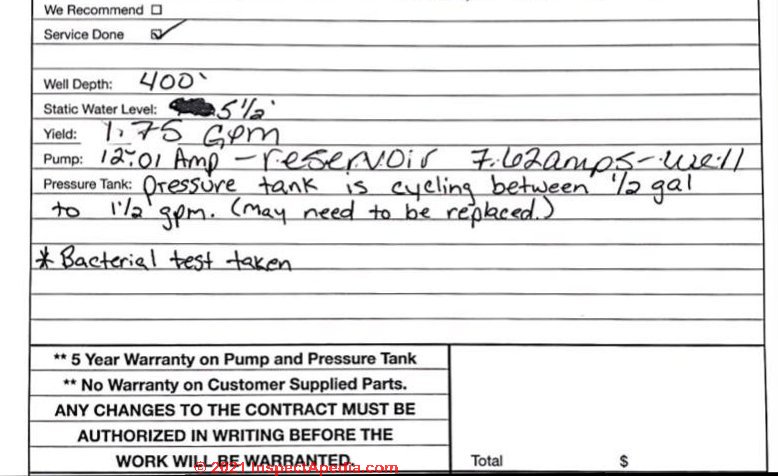
Trying to decide if I go through this this home purchase. It’s a 4 bed house with a shared well amongst 6 other homes and a lot. The only info I have is the well depth is 400, yields 1.75 GPM, static water level is 5.5, 12 amp reservoir 7.62 amps well. Help what does any of this mean?
On 2021-02-26 by (mod) - how to read a "well yield test" report
@Anonymous,
Sorry but the Add Image button only lets you post images, like .jpg or .img or .gif files.
Start by putting a stop payment on your check or leaving your "well inspector" a message that you will meet her or him in small claims court as s/he is doing nothing to earn the fee charged. Throwing an incomprehensible report over the wall to you is unconscionable and in my opinion worse than worthless as the person got paid for it.
Without details I can but speculate based on your limited information
1. 1.75 GPM is not adequate for most purposes, and won't meet well flow rate minimum requirements of at least some lenders; that can be a hurdle in buying or later selling a property and more-practically it means that at normal usage levels you
- are going to run out of water from time to time
- in time of drought or over longer periods as the water table falls your well is more-likely to run dry
- you may need to take the short term step of a large onsite water storage tank
- you may want to discuss means of increasing well yield with your well driller
In my OPINION a 400 foot deep well that only has a 1.75 gpm yield is less than marginally usable.
The "amperage" readings are not directly useful but are intended, probably, to tell us if the pump is working normally, and in the hands of an expert, can tell us if the pump is moving water or is running dry (under less load, current drops).
A static water level of 5.5 would make me laugh the "well inspector" right out of town. 5.5 what? 5.5 inches, feet, yards, gallons, parsecs?
If it's 5.5 feet then your well is practically dry and useless now as you have both a very weak flow rate (of water into the well) and a close to zero reserve of water in the well (5.5 whatevers) when the well is at rest.
Tell me: are you buying this property? If so, who recommended this inspector who, from the report, doesn't want you know the questionable status of your well but wants to protect herself by being able to say "I gave the information in my report".
Disgusted in Po'Town.On 2021-02-27 by Anonymous - what does this well test report really mean?
Thank you so much for your response. My Realtor recommended this company.
Attached is exactly what I received and I cropped out the company’s header. I am supposed to be buying this home and my due diligence period ends Tuesday.
I am in the process of asking for an extension because as I stated I don’t know what to make of this report that I paid over $700 for. Please let me know if this provides any additional details or changes your opinion.
To say I’m concerned is an understatement. Thanks again!
On 2021-02-27 - by (mod) - realtor recommended well test to home buyer: conflict of interest?
You should be able to attach an image of the report or you can email it to me using the page top or bottom contact link.
It certainly sounds crazy to have paid $700 for a useless report and for that fee it certainly seems reasonable to me that the inspector should be willing to answer questions.
It makes one question the very idea of using any service recommended by your real estate agent, who is, after all, not a neutral party but rather someone who stands to gain from the sale.On 2021-02-27 by (mod) - Minimum Acceptable Water Well Yield in GPM over 5 to 24 hour test interval
The minimum acceptable true well yield (properly measured as we describe herein) varies by regulations where you live, by various lenders' requirements, and of course by the anticipated need based on the type and number of water users that the well is to serve.
A well yield of 5 gallons per minute of sustained flow (measured over 24 hours or over 5 hours in some standards) is considered by most authorities as adequate for a one family residence.
E.g. source: "Individual Water Supply Wells - Fact Sheet #2", NY State DOH, original source
And another example: home buyers seeking an FHA-mortgage will have to show that their water well yield is between 3 and 5 gpm. "Each home must simultaneously be assured of at least 3 GPM, (5 for proposed construction), over a continuous 5 hour period."
That said, a typical minimum acceptable well yield is 3 gallons per minute; some lenders want to see 5 gpm;
And some authorities will accept lower well yields, down to 2 gpm provided that 1,500 gallons or a similar quantity of on-site water storage is also provided.
By any of these measures, your well "inspector" ought to have told you that your well's yield was inadequate and that some significant expense will be involved in providing adequate water supply. Provided that all of the data we have on your well is correct, this case is particularly egregious considering your report that this low-yield 1.75 gpm well is serving 4, potentially 5 homes that could therefore involve having to support 20 people in daily use.
Your "well yield test" report does not describe how the test was conducted, so it's uncertain how to interpret its results; the yield over 24 hours could be less than the (already marginal) yield reported to you .
The North Carolina (your state) description of well yield testing is inNow excerpted in detail
at WELL FLOW TEST for WATER QUANTITY
- WATER SUPPLY WELL CONSTRUCTION DESCRIPTION for North Carolina [PDF] original source, NC DEQ, https://files.nc.gov/ncdeq/ Water Quality/Aquifer Protection/GPU/WaterWellConstructionFoldout-20100331.pdf
Bottom Line: It would be prudent to assume you will face substantial expense to provide suitably water supply.
There is no way that flows rate is adequate for 4 or 5 homes.
IMO an inspector working for you, not for the realtor, owes you that sort of conclusion, that is, the inspector must tell you what the findings actually mean.
Additional remarks
Possibly the inspector is unfamiliar with even the most basic facts of pump operation ... search this site to read about WELL PUMP SHORT CYCLING
And as there is no data about how the flow test was conducted, the well may be in worse shape yet. A true flow test is measured over 24 hours.On 2021-02-27 by Anonymous
Thank you so much for your response. My Realtor recommended this company. Attached [shown below] is exactly what I received and I cropped out the company’s header.
I am supposed to be buying this home and my due diligence period ends Tuesday. I am in the process of asking for an extension because as I stated I don’t know what to make of this report that I paid over $700 for. Please let me know if this provides any additional details or changes your opinion. To say I’m concerned is an understatement.Thanks again for all the information. This was not a 24 hour test. Since it is a shared well they had to notify and work with all the other home owners and this was all conducted over one afternoon. At this point I’m trying to decide if I should pay for a new inspector or walk away.
You are right. I would stir up debris. I want to find a way to remove some of the soft sediment at the bottom of the well. I will look for ways to restrict flow w/o hurting the pump. Or I could just pump out 110 gallons a day.
On 2021-02-27 by (mod) - should you walk from the purchase of a home that has a questionable water well?
@Anonymous,
It is rarely appropriate nor necessary to walk away from a home simply because we've discovered something that is going to need time and money to correct or make functional.
Every home needs something; If, for having discovered a probable expense, you abandon a home that you otherwise love in a location you want to be, you may simply move on to another home only to discover that the next one needs still more work or repairs.
However, it is important to have an un-biased and thorough inspection of the home and all of its systems, not just the well; IF the cost of necessary repairs would price the home out of its near term value in the marketplace would one be forced to question the economic sense of "the deal".That situation is rare for most homes in most parts of the world.
Get an accurate estimate of the problems at this home, including by having a competent and thorough home inspection (NOT by someone recommended by the realtor who sent the "iffy" and non-responsive well test person to you) and thus of its true cost to you.
What are "Necessary Repairs?" When Buying a Home?For most repairs or home improvements or maintenance chores, you are in control of your money and you decide when to meet each of those needs and costs.
Dan's 3 D's: but for things that are Dangerous, Don't work (and are necessary, like safe electrical power or heat) or are causing rapid costly Damage, the house is in control.
On 2021-02-05 by Kat
Hi, I was wondering if anyone could give me advice on getting my well serviced? We moved in less than a year ago with the intent to start a small market farm. Our well was built in the late 70's and records show a flow rate of 15gpm.
I have estimated a farm/home weekly usage of 10,000 gallons, or around 1,400 per day, which I think checks out with our 175' well as long as I stagger the irrigating. That said, I am still wondering if the 15gpm is enough? Or whether I should have it retested as the flow rate was given to me by our real estate agent, not a recent record?
I apologize for the lengthy comment, and I appreciate any advice.
Thanks!
On 2021-02-05 by (mod) - critical question about well flow rate adequacy: is it enough?
Kat
You ask the critical question about well flow rate adequacy: is it enough.
At 15 gpm, ***IF*** the well could really deliver that rate continuously for 12 hours straight, would let you draw 10,800 gallons of water over a 12-hour period, giving the well a rest for the next 12 hours - or some variation on that theme.
My calculation was simply 15gpm x 60 minutes per hour x 12 hours = 10,800 gallons
But
Watch out: while a true well flow rate test (described above on this page) measures the ability of a well to deliver water continuously over a 24 hour period, the majority of inspectors and consultants do not make a true 24-hour measurement. (Some well drillers have equipment to do that). Instead somebody sticks a 5 gallon pail under a spigot and sees how long it takes to fill up the pail.
But delivering water 15 gpm for just a few minutes is a horse of a different color than delivering water at that rate continuously for many hours - if you'll forgive the mixed metaphor.
Keep in mind that the depth of your well - 175 ft - does not tell us a thing; we don't know the actual STATIC HEAD (how much water is in the well at rest - it'll be something less than total well depth) and we don't know how your well's flow rate was measured.
Flow rates vary by duration of use of the well, and by season or time of year, and by long term trends (neighbors pumping down a common water table).
Watch out: also about relying on any data given to you by even the nicest and most-honest real estate agent. The agent is not a neutral party to the sale of property, and the agent, in most states and provinces, is not held legally liable for accuracy in property representations - not even for a second.
Bottom line: On the face of it 15 gpm looks great, but we can't yet trust that number; you need to know how the flow test was done, get the original data, or have your own flow test performed by someone who is completely independent from those selling property.
On 2020-11-02 by Robert
!975 well, new to me property. Depth 60 feet to soft sediment. Water level at 36' in a 12" bore. I pumped 110 gallons in 5 minutes. Well dry. Turned submersible off. Fresno end of dry season, no rain yet. 12 hours later level back to 36'. Can I divert water, using a T, back into the well so as to reduce out put to 5 GPM, which would be fine with me. Should I try to remove sediment? Appreciate and comments.
Thanks, Robert.
On 2020-11-02 - by (mod) - watch out when pumping rate exceeds well's flow rate
Robert
You were pumping at more than 20 gallons a minute which is very likely to exceed the flow rate of many Wells. I agree with restricting the pumping rate.However I'm not sure I want to divert water back into the well after having pumped it out because of the education impossible string up of debris from the bottom of the well. It would be better to put a flow control on your pumping system.
On 2020-11-03 by Robert
Thanks for your reply. I appreciate it. You are right. I would stir up debris. I want to find a way to remove some of the soft sediment at the bottom of the well. I will look for ways to restrict flow w/o hurting the pump. Or I could just pump out 110 gallons a day.
On 2020-11-06 - by (mod) - don't exhaust the well
Or less
You don't generally want to keep pumping the well all the way down to the very bottom
On 2019-12-26 by Diane
We had the piston pump replaced on our standpoint well system and less than 48 hours later we had air in the pipes and water and loss of water (dirty water coming out - rusty and smells like iron.
Pump guy says that’s from the bottom of the pressure tank which he installed less than 18 months ago). The pump guy says it’s not his pump or installation causing this - says it’s the well source. Up to this time we have always had enough water for daily use - couple of showers a day, run the dishwasher and a load or two of laundry along with flushing toilets etc. Rarely we would “run dry” but recovery would take less than 4 hours.
It seems too coincidental that this happened right after the new pump was installed.
We have been unable to find anyone who works with sandpoint systems or knows them well enough to advise us - and it’s winter here which doesn’t help. A quote on a drilled well is minimum $12K not including a filter system if needed; hoping we can get this system up and running instead of that option. Any advice would be welcome.
On 2019-12-26 - by (mod) - look for an air leak in well piping
I would start by checking for an air leak in the piping connections
On 2018-09-13 by Edward havelka
We just moved into a new property. I hooked wiring from existing pump house to breaker and turned it on.
Water flowed from pipe coming out of ground ( where i would be hooking to main pipe on mobile home) for about 5 minutes. Then it stops. If you stand there in about 3 minutes it flows great again to fill from 5-7 gallons and stops,again etc.
I've installed one,well pump. Piping and bladder tank before. Im stumped here. Only thing i can say is the pump i put in once before sat on top of the well pipe.
This one,seems to be in the bottom of the well pipe. Also. i do not see a pressure switch. Would this still pump if it didn't have one? On a submergible pump is the pressure switch down there on the pump?
Please help. We've spent ALL our savings on the property and now mobile home. Also will i be notified if someone replies to this? Thank you to anyone who can help. Edward
On 2018-09-13 - by (mod) - e've spent ALL our savings on the property and now mobile home and now have no water
Edward
I'm disappointed, too, to hear that you bought a new property, spent all your available cash, and thus got bad advice along with failing to have basic inspections and tests performed. That exposes you to just the risk of discovering expensive surprises.
About the well: that sounds to me as if the well has poor or no water in-flow (recovery) rate. There could be a different (and less costly) problem like a bad well pump that quickly overheats and jams or shuts-down.
You are describing a submersible pump (in the well) - meaning it's a deep well (more than 25 feet); but deep doesn't mean lots of water.
The pressure control switch will normally be at the pressure tank.
It's time for you to ask for a well flow test.
Reader Question: does the rate at which water flows into a well vary depending on whether the well is full or empty?
7/10/2014 William said:
Does the rate at which water flows into a well vary depending on whether the well is 'full' or 'empty'. In other words, will lowering the pump help increase the recovery rate, or simply add to the static quantity?
This question was originally posted at WELL YIELD IMPROVEMENT
Reply: Yes
William,
Yes the well flow rate into a well does vary in relation to the level of water that is already inside the well bore (or dug well).
We explain the concepts of well flow rate and well yield in detail beginning in the article above
at WELL FLOW RATE and in excruciating detail
In sum, water flow into at least deeper wells and even some shallow wells from a variety of water passages, typically rock fissures, that occur at various depths in relation to the well bore. The total well flow rate is the sum of all of these smaller individual flows.
Even more complex, not all of the individual flows into a well flow at the same rate, nor do they necessarily flow continuously at a fixed rate over time. For example
Fissue A may flow at 7 gpm for 20 minutes then diminsh to 2 gpm for a longer or even indefinite interval, while fissure B may flow at 3 gpm for 12 minutes, then fall to 0.5 gpm for a longer interval.
When the well bore is "full" - that is up to its normal static head top level, water stops flowing into the well bore because the pressure of the water in the bore is sufficient to stop inflow at the various water entry points along its height (I'm using the term "fissures" or water flow passages as usually there is more than one).
An exception are artesian wells whose aquifer feeds into the well bore at sufficient pressure to actually push water out at the well top and even to higher levels.
On 2013-03-18 by Barbara
I will readily admit I do not have a lot of knowledge concerning well pumps.
We have a submersible pump in our well and have periodically been having a problem with losing water - no water coming into the house. Yesterday morning, no water, and the pressure control was not working. Replaced it and water pressure built in the tank to desired level and all was good.
This morning water stopped again. Does anyone know what could be the problem or what steps I need to take to find the problem?
On 2013-03-18 - by (mod) - When a well water system periodically loses all water and then water returns
Barbara,
When a well water system periodically loses all water and then water returns there could be several problems but the most common is loss of flow rate at the well itself. I'm not certain that replacing the pressure control actually fixed the problem; rather, the delay while you got the new part and put it on could have allowed the well to recover.
On the other hand, if a well is running out of water and the pump is not shut off, the pump or controls can indeed be damaged - more likely for an above-ground pump.
Another possibility is that your well pump is overheating and going off on thermal reset.
Ask your well service company to check the water level in the well, the static head, draw down quantity, and the operation of the pump itself.
Keep us posted.
On 2012-12-19 by Cindy - They made my well run dry, then "filled it back up"
Mtq. changed a bridge near my home and as a result my well went dry for 10 weeks while they finished their construction.
They filled my well continuously with the water from the creek boardering my property. My neighbours farther up the road ran out of water a week later.
They are now drilling wells for them and say mine is ok at 80 gallons per minute. what do you think.
On 2012-12-19 by mod - They filled my well continuously with the water from the creek bordering my property
Frankly I'm having trouble believing it. 80 gallons a minute is a stunning well flow rate if that can really be sustained, and doesn't sound very credible as a sustainable well flow rate when you'also report that your well recently ran dry for 10 weeks.
Pumping creek water into a domestic water supply well
1. is unsanitary - could make building occupants sick
2. will never fix a well that has lost contact with its aquifer - at most it will give a very temporary water reservoir
YOu need an onsite expert, independent from whoever did that crazy work you describe.
On 2012-05-24 by Greg
My discharge rate exceeds my well's recovery rate. This is what I have. I have a well that is 100 feet down, with a pump that will pump water at depths of 200' at 22gpm.
I have to pump it over 700 feet to a holding tank. There is nothing in between the pump and the holding tank.
The line from the pump is reduced down to a 1" pipe. Can I put an angle cock on the pipe coming out of the well to reduce water flow and if so will this hurt my pump.
On 2012-05-25 - by (mod) - A special tailpiece at the water pick-up end can do this job.
Greg, it is common for a well installer to include a flow rate limiting device in the well (usually at the pump) to prevent the well pump from pumping water down low enough that the pump motor lacks water and overheats and is damaged.
A special tailpiece at the water pick-up end can do this job.
On a high lift long run well piping system one or more checkvalves may also be advisable.
...
Continue reading at WELL DYNAMIC HEAD & STATIC HEAD DEFINITION or select a topic from closely-related articles below, or see our complete INDEX to RELATED ARTICLES. or select a topic from the closely-related articles below, or see the complete ARTICLE INDEX.
Or see WELL FLOW RATE FAQs - questions and answers about well delivery or flow rate posted originally on this page.
Or see these
Recommended Articles
- DEPTH of a WELL, HOW TO MEASURE
- WATER FLOW RATE CALCULATE or MEASURE - how much water is delivered at a plumbing fixture
- WATER PRESSURE MEASUREMENT
- WATER PRESSURE MEASUREMENT - water pressure in the system, dynamic & static
- WATER PUMP CAPACITIES TYPES RATES GPM
- WATER PUMP DRAWDOWN VOLUME & TIME
- WATER QUANTITY IMPROVEMENT
- WELL CLEANING & RESTORATION by GLYCOLIC ACID
- WELL FLOW RATE - how much water can the well deliver
- WELL DYNAMIC HEAD & STATIC HEAD DEFINITION - how much water is in the well
- WELL FLOW TEST PROCEDURE - valid vs. questionable
- WELL FLOW TEST for WATER QUANTITY - how to test the well
- WELL LIFE EXPECTANCY - how long will the well last?
- WELL PIPING TAIL PIECE
- WELL YIELD DEFINITION - required well yield & safe well yield
- WELL YIELD IMPROVEMENT - get more water
- WELL YIELD, SAFE LIMITS - safe total well yield, causes of flow rate change
- WELL WATER PRESSURE DIAGNOSIS
- WELLS CISTERNS & SPRINGS - home
Suggested citation for this web page
WELL FLOW RATE at InspectApedia.com - online encyclopedia of building & environmental inspection, testing, diagnosis, repair, & problem prevention advice.
Or see this
INDEX to RELATED ARTICLES: ARTICLE INDEX to WATER SUPPLY, PUMPS TANKS WELLS
Or use the SEARCH BOX found below to Ask a Question or Search InspectApedia
Ask a Question or Search InspectApedia
Try the search box just below, or if you prefer, post a question or comment in the Comments box below and we will respond promptly.
Search the InspectApedia website
Note: appearance of your Comment below may be delayed: if your comment contains an image, photograph, web link, or text that looks to the software as if it might be a web link, your posting will appear after it has been approved by a moderator. Apologies for the delay.
Only one image can be added per comment but you can post as many comments, and therefore images, as you like.
You will not receive a notification when a response to your question has been posted.
Please bookmark this page to make it easy for you to check back for our response.
IF above you see "Comment Form is loading comments..." then COMMENT BOX - countable.ca / bawkbox.com IS NOT WORKING.
In any case you are welcome to send an email directly to us at InspectApedia.com at editor@inspectApedia.com
We'll reply to you directly. Please help us help you by noting, in your email, the URL of the InspectApedia page where you wanted to comment.
Citations & References
In addition to any citations in the article above, a full list is available on request.
- Mark Cramer Inspection Services Mark Cramer, Tampa Florida, Mr. Cramer is a past president of ASHI, the American Society of Home Inspectors and is a Florida home inspector and home inspection educator. Mr. Cramer serves on the ASHI Home Inspection Standards. Contact Mark Cramer at: 727-595-4211 mark@BestTampaInspector.com
- John Cranor [Website: /www.house-whisperer.com ] is an ASHI member and a home inspector (The House Whisperer) is located in Glen Allen, VA 23060. He is also a contributor to InspectApedia.com in several technical areas such as plumbing and appliances (dryer vents). Contact Mr. Cranor at 804-873-8534 or by Email: johncranor@verizon.net
- Access Water Energy, PO Box 2061, Moorabbin, VIC 3189, Australia, Tel: 1300 797 758, email: sales@accesswater.com.au Website: http://www.accesswater.com.au/
Moorabbin Office: Kingston Trade Centre, 100 Cochranes Rd, Moorabbin, VIC 3189
Australian supplier of: Greywater systems, Solar power to grid packages, Edwards solar systems, Vulcan compact solar systems, water & solar system pumps & controls, and a wide rage of above ground & under ground water storage tanks: concrete, steel, plastic, modular, and bladder storage tanks. - Grove Electric, Typical Shallow Well One Line Jet Pump Installation [PDF], Grove Electric, G&G Electric & Plumbing, 1900 NE 78th St., Suite 101, Vancouver WA 98665 www.grovelectric.com - web search -7/15/2010 original source: http://www.groverelectric.com/howto/38_Typical%20Jet%20Pump%20Installation.pdf
- Grove Electric, Typical Deep Well Two Line Jet Pump Installation [PDF], Grove Electric, G&G Electric & Plumbing, 1900 NE 78th St., Suite 101, Vancouver WA 98665 www.grovelectric.com - web search -7/15/2010 original source: http://www.groverelectric.com/howto/38_Typical%20Jet%20Pump%20Installation.pdf
- Our recommended books about building & mechanical systems design, inspection, problem diagnosis, and repair, and about indoor environment and IAQ testing, diagnosis, and cleanup are at the InspectAPedia Bookstore. Also see our Book Reviews - InspectAPedia.
- In addition to citations & references found in this article, see the research citations given at the end of the related articles found at our suggested
CONTINUE READING or RECOMMENDED ARTICLES.
- Carson, Dunlop & Associates Ltd., 120 Carlton Street Suite 407, Toronto ON M5A 4K2. Tel: (416) 964-9415 1-800-268-7070 Email: info@carsondunlop.com. Alan Carson is a past president of ASHI, the American Society of Home Inspectors.
Thanks to Alan Carson and Bob Dunlop, for permission for InspectAPedia to use text excerpts from The HOME REFERENCE BOOK - the Encyclopedia of Homes and to use illustrations from The ILLUSTRATED HOME .
Carson Dunlop Associates provides extensive home inspection education and report writing material. In gratitude we provide links to tsome Carson Dunlop Associates products and services.
 | HOME | ABOUT | ASK a QUESTION | CONTACT | CONTENT USE POLICY | DESCRIPTION | POLICIES | PRIVACY | |
| © 2025 - 1985 Publisher InspectApedia.com - Daniel Friedman | |||||||||