
InspectAPedia® FREE Encyclopedia of Building & Environmental Construction, Diagnosis, Maintenance & Repair |
Question? Just ask us! InspectAPedia
|
 Septic / Sewage / Grinder Pump Diagnosis & Repair
Avoid Damage of Sewage, Septic, & Grinder Pumps
- POST a QUESTION or COMMENT about septic pump problems, damage, diagnosis, repair
Sewage & septic pump clog or failure causes, diagnosis, repair, prevention guide:
Warning list of items that will clog septic pumps and grinder pump.
This article describes the causes of and steps to prevent clogging and/or damage to septic pumps, grinder pumps, and sewage ejector pumps. We include excerpts from sewage or septic grinder pump manufacturers' installation manuals that describe sewage pump diagnosis & repair procedures.
This article series also lists septic and grinder pump types, brands, and will identify pumps that are resistant to damage from debris or objects that may enter the toilet, sewer line, or septic tank.
InspectAPedia tolerates no conflicts of interest. We have no relationship with advertisers, products, or services discussed at this website.
- Daniel Friedman, Publisher/Editor/Author - See WHO ARE WE?
Septic Grinder Pumps, Sewage Ejector Pumps: Causes of Clogging Failures
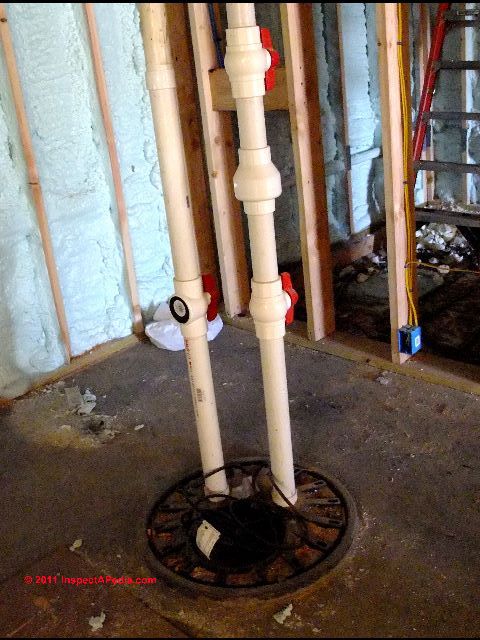
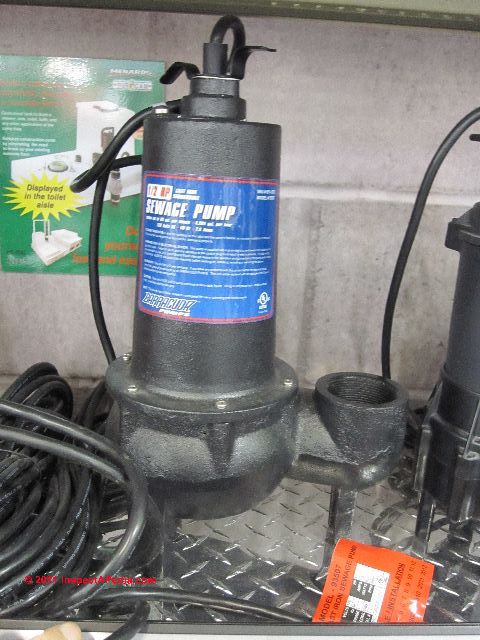
InspectAPedia.com readers report troubles with several types of septic pumps, sewage pumps, and grinder pumps, both for sewage ejector pumps located in the home (such as to pump a basement toilet waste line up to a higher main drain) and for pumps that operate septic or graywater tanks.
Septic pump damage may occur from certain objects that enter building drains regardless of where and how the pump is used, including in-building sewage ejector pumps (shown at left) or pumps used in septic tanks or septic effluent tanks.
Some of the items in this list won't damage the septic tank itself as their volume is small and they don't usually block the septic piping or baffles, but if your septic system or even public sewer connection use a septic pump, grinder pump, or sewage ejector pump, the items listed here can clog and damage or even destroy a sewage pump, leading to costly repairs.
[Click to enlarge any image]
Watch out for the following conditions that cause clogging and even burn up of various types of sewage pumps, grinder pumps, ejector pumps, and septic pumps:
Don't Flush These Items Down the Toilet - They Clog or Burn Up the Grinder Pump
- Ashes such as from a fireplace
- Baby wipes or personal hygiene wipes -
see DISPOSABLE WET WIPE CLOGS - Cat litter
- Chemicals & Drain Cleaners: some of these can corrode sewage grinder pump parts causing costly damage
- Cigarette butts are not biodegradable and should not be flushed into the septic system. And the filters on cigarette butts can clog and destroy septic pumps.
- Clothes dryer sheets used as fabric softener or to make your dry clothes "smell nicer" - the quantity of chemical in these sheets is unlikely to be sufficient to damage the septic tank bacteria, but the synthetic fabric from which dryer sheets are made will not break down in the septic tank.
These items not only add to the solid waste in the septic tank, a dryer sheet might clog the septic tank inlet at the baffle. - Condoms won't clog a pipe but like some other debris, because they are of modest size and are quite flexible, but condoms are (usually) not bio degradable. So we listed condoms, or other latex products such as latex gloves above as "never flush".
A condom in the septic tank will probably join other debris in the tank's floating scum layer, and will be removed at the next tank pump-out. Of course, if the septic tank outlet tee baffles are missing, the condom will join other floating debris on its way out to clog the drainfield, so ask your septic pumper to check the condition of the septic tank baffles when the septic tank is next pumped.
BUT if your system uses a septic pump or grinder pump or sewage ejector pump, this material can clog the pump impeller and cause expensive pump damage or motor burnout. - Cotton swabs (Q-tips®) have been known to clog a drain or two - cotton is not readily biodegradable, though cotton swabs are trivial in volume and are not important in the septic tank itself.
BUT if your system uses a septic pump or grinder pump or sewage ejector pump, this material can clog the pump impeller and cause expensive pump damage or motor burnout. - Cooking oil, fat, grease, lard
- Dental floss - is not biodegradable, though trivial in volume
- Diapers and similar items which are not biodegradable will simply clog a septic system and are very likely to clog building drains
- Disposable wipes - such as baby wipes or personal hygiene wipes, even products described as "biodegradable" or "OK for use in septic systems" may NOT be OK: if your system uses a septic pump or grinder pump or sewage ejector pump, this material can clog the pump impeller and cause expensive pump damage or motor burnout. S
See DISPOSABLE WET WIPE CLOGS - Drywall dust - swept up during building renovations, for example, can clog drains and damage pumps
- Explosive or combustible liquids or materials
- Glass fragments or debris
- Gravel or stones such as from an aquarium
- Hair clippings; incidental body hair that washes down sink, tub, or shower drains may be ok
- Latex condoms, gloves, or similar products - we discuss condoms in septic systems further in the next section of this article.
- Metal fragments or scraps
- Plastic toys, scraps, fragments, plastic-stemmed Q-tips
- Paper towels and facial tissues (Kleenex™) do not break down easily and should not be flushed into the septic system. Toilet paper breaks down quickly and should not be a problem in an ordinary septic tank system.
- Paint and paint waste
- Panty liners should never be flushed down a building drain
- Plastic bags or other plastic scrap or trash of any kind should never be flushed down a building drain
- Rubber gloves
- Sanitary napkins should never be flushed down a building drain
- Tampons should not be flushed down a building drain
- Any other solid, semi-solid objects that do not dissolve readily in water
See WHAT CAN GO INTO TOILETS & DRAINS? for complete details.
Septic & Sewage Pump Damage Diagnosis & Repair Procedures
The following Common Sewage / Septic Pump Problems and sewage pump (septic grinder pump) diagnosis & repair advice is adapted from installation manuals from manufacturers & from other sources.
Table of Septic or Sewage Pump Diagnostic Steps |
||
| Grinder Pump Problem | Probable Cause | Comments |
| Sewage / Grinder Pump Motor will not start or won't keep running |
|
See |
| Sewage / Grinder Pump Motor trips circuit breaker, blows fuse, overheats |
|
|
| Sewage / Grinder Pump Motor short cycling, rapid on-off or too-frequent cycling |
|
The pumping chamber or basin and the pump's pumping capacity must be adequate to handle the maximum anticipated wastewater flow-rate into the system |
| Sewage / Grinder Pump Motor won't stop running |
|
See SEPTIC / SEWAGE PUMP WON'T STOP |
Effluent, Septic, Sewage Pump Clogging Weak pump output flow rate or pump runs but no water output |
|
See SEPTIC / SEWAGE PUMP WAXY CLOGGING - white waxy clog See SEPTIC / SEWAGE PUMP NO-FLUSH LIST - waste or debris clogging See SEPTIC & SEWAGE PUMPS - wrong pump selected See ELECTRIC MOTOR RUN DIRECTION - motor runs backwards See Note 2 below |
| Reduced septic pump lift capacity or flow rate |
|
See Note 2 below |
| Sewage pump cycles intermittently, at odd times, or when no water is being run in the building |
|
Inspect sewage pump pit for leaks into the pumping chamber Inspect sewage pump pit or basin for roof drainage or other un-wanted drainage into the system |
Notes to the table above
- ELECTRIC MOTOR DIAGNOSTIC GUIDE - home
- Vent opening at check valve: Zoeller Pump provides a combined union/check valve, the "Unicheck". The company notes that with this valve is installed, the installer must drill a 3/16" (5mm) vent opening in the discharge line at a height even with the top of the pump.
This discharge line must be cleaned periodically. You should see water squirting out of this opening when the pump is running. - Zoeller Pump Company, "Installation & Service Instructions, 803/805/807 Grinder Pumps", [PDF] Zoeller Pump Co., P.O. BOX 16347 • Louisville, KY 40256-0347, Website: Zoeller.com Retrieved 2016/04/05, original source: http://www.zoellerpumps.com/en-na/product/1242-#documents
- Zoeller Pump Company, "Installation Instructions, Recommended Models, Effluent/Sump/DeWatering & Sewage[pumps]", [PDF] Zoeller Pump Co., P.O. BOX 16347 • Louisville, KY 40256-0347, Website: Zoeller.com Retrieved 2016/04/05, original source: http://www.deanbennett.com/53-install-inst.pdf
See www.zoeller.com/zcopump/TechSupport/authsslisting.htm to find the Authorized Service Station in your area. - Also seeReferences or Citations at the end of this article.
Impact of Acids on Sewage / Septic or Effluent Pumps
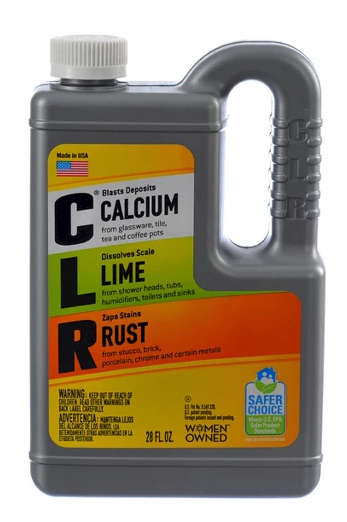
Question: will acidic toilet bowl stain remover harm the septic pump or sewage grinder pump seals?
 2018/06/19 Greg said:
Is the use of CLR to clean a toilet bowl safe for a septic grinder pump?
Reply: not in normal use if sufficiently diluted
Greg,
Your question: effect of using CLR toilet bowl stain remover on a sewage effluent pump or a septic grinder pump is an excellent one.
Nearly all authorities warn that acids or other chemicals might harm a septic system (I agree), and some chemicals may harm the seals in the grinder pump system as well.
However, a review of seven most-widely cited grinder pump and sewage pump advisory papers or instruction sets found that not one of them specified the actual level of acidity that would or would not be harmful to the pumping system.
That leaves us to make a reasonable guess at the answer: sufficiently diluted, an acid-based toilet cleaner should not harm either the pump or the septic system.
I pose that occasional use of a toilet stain remover (often including acids), used as directed, will be diluted enough to avoid such harm. You can reduce the risk of grinder or effluent pump damage further by additional dilution of the acid-based cleaner: try 2 or three additional flushes to dilute and then remove the acidic cleaner from the grinder pump reservoir.
Subsequent normal daily use of the sinks, showers, tubs, and toilets connected to the septic or sewage pump will further dilute any acidic content in the pump reservoir to a harmless level.
Watch out: flushing any acid into a residential sewage grinder pump or septic effluent pump that subsequently remains un-used for days, weeks, or longer, might risk damage to the pump components because in that case the acidic solution may remain in contact with pump parts for a prolonged interval.
Details:
Instructions from CLR for using this product to clean a severely-stained toilet bowl, the company suggests using 5-6 oz of CLR into a toilet bowl that has been emptied of water, then scrubbing the bowl with the solution.
At that level of usage and when further diluted by water as the toilet is flushed, even in the first flush the 6 oz. of solution (hazardous acidic) is diluted in 1-2 gallons of water or more (depending on toilet design and flush quantity).
In even a single gallon flush you are diluting the solution by 6:128 and subsequent flushes further dilute the solution.
In three flushes or 3 gallons total, you have diluted the original acidic CLR cleaner to 1% of its original strength. Even without knowing the actual level of acidity of the product as sold in the container, this is likely to be so dilute as to be harmless to the pump.
The product, used as directed, is in my opinion harmless to a septic grinder pump as well as harmless to a septic system.
For other readers, CLR is a calcium, lime, rust remover "from glassware, tile and coffee pots. It removes lime scale from shower heads, tubs, humidifiers, toilets and sinks. This CLR cleaner also removes rust stains from stucco, brick, porcelain and chrome." contains the following chemicals:
Water CAS 7732-18-5,
Lactic Acid CAS 79-33-4, classified by OSHA as hazardous
Gluconic Acid CAS 526-95-4, classified by OSHA as hazardous
Lauramine Oxide CAS 1643-20-5, classified by OSHA as hazardous
Tripropylene Glycol N-Butyl Ether CAS 55934-93-5,
Blue 1 CAS 3844-45-9,
Yellow 5 CAS 1934-21-0.
CLR is produced by Jelmar, 5550 W. Touhy Ave. Skokie, IL 60077 USA
See the MSDS for CLR at inspectapedia.com/hazmat/CLR-Calcium-Lime-Rust-Remover-MSDS.pdf
The MSDS for CLR includes this
Emergency Overview: WARNING: EYE IRRITATANT. GHS Toxicity Category 2A Causes eye irritation and possible SKIN IRRITATANT GHS Category 3 – on sensitive skin.
DO NOT get in eyes, on skin or clothing. DO NOT mix with bleach or other household chemicals as harmful fumes may result. DO NOT ingest. DO NOT breathe vapor or mist.
Use in well ventilated areas. Keep container closed when not in use.
At SEPTIC PUMP INSPECTION & MAINTENANCE we provide copies of the articles and papers reviewed to form the opinion given above.
Please also see TOILETS, DON'T FLUSH LIST
Watch out: if you are leaving your grinder pump un-used for a prolonged period, we recommend following these instructions
If you plan on being away for several days, replace the wastewater in the tank with clean water to help minimize odors.
First run water from an inside faucet long enough for the grinder pump to start working.
After the pump starts, turn the inside faucet off. The pump will run until the tank is empty and shut off automatically.
This process will cleanse the pump and leave it filled with a minimum of clean water.
Always leave the power to the pump on.
This allows the heating element inside the pump to operate which helps eliminate condensation and freezing. - GRINDER PUMP FAQS for CT [PDF] Groton Connecticut Department of Public Works, retrieved 20178/06/19, original source: http://www.groton-ct.gov/depts/pubwks/docs/Grinder%20Pump%20Website%20info%20the%20hurricane.pdf
Sewage Septic Pump Won't Stop Running
Question: Our sewage ejector pump won't turn off - how do we fix it?
Our ejector sewage pump will not shut off even when there is nothing going into it - what do we do to fix this? Heather.
Reply: Check for and free up a stuck float switch or replace a failed ejector pump float control switch
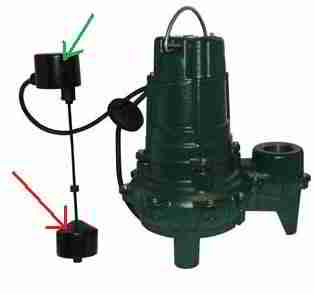
Heather, sewage ejector pumps normally are operated by a float control switch. As wastewater rises in the holding tank when the level is high enough the float switch turns the pump on.
The pump runs until the level of wastewater falls enough to cause the float to fall far enough for the switch to turn off the pump.
So if your sewage pump never turns off, presuming it's properly wired, the float switch is either stuck on debris in the holding tank, or the switch needs to be replaced.
The image at left shows the second very commonly-used type of float control switch, in this case using Zoeller™ pumps as an example.
The red arrow indicates the actual float - on occasion a float may become waterlogged or simply disconnected from its mounting shaft.
The green arrow in our sewer pump float switch example is the actual switch assembly that turns the motor on and off as the float, on its shaft, rises and falls vertically. Image source: plumbingsupply.com [4]
Take a look at the two most common sewage float switch types in our Little Giant™ sketch above and the Zoeller™ sewage pump and control switch image at left. Your switch probably looks like one of these two types.
In a few rare instances I have found homes at which the ejector pump float switch had failed and the owners, rather than replacing the switch, just hard-wired the pump to turn on and off by a manual switch.
This is a bad idea for obvious reasons including inconvenience and the risk that either the pump is left on longer than necessary or left off leading to a sewage backup.
To diagnose the sewage pump control problem it's best to open an inspection port on the holding tank where the ejector pump is located.
It may be possible to spot and remove a object clogging the float switch. Otherwise replacing the float switch is the next step.
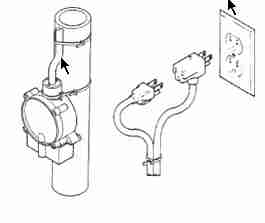
Watch out: in addition to obvious bacterial hazards at sewage pumping stations there are methane gas hazards of explosion and asphyxiation - don't work alone. Also see our list above of things that can clog up or damage a sewage ejector pump.
Is your sewage ejector pump already damaged? Maybe not. Some sewage pump models indicate in the installation and maintenance manual that the pump can tolerate being run "dry". But best practice is to set the float control switch so that the liquid level does not drop below the pump body.
Other sewage grinder pump and ejector pump control switches are illustrated here.
The float and tube type remote float control switch (left) is used on some sewage pumps and sump pump systems.
This switch and and float assembly is also very similar to a mechanical float and switch found as well in water softener brine tanks to control the water level in the tank.
The float moves vertically up and down in a plastic tube. The tube helps protect the float from jam-ups due to debris in the wastewater tank.
Image source: plumbingsupply.com [5]
The Little Giant™ remote float control switch (left) can be used as an auxiliary control / warning device on sewage and sump pump ejector installations to control an alarm.
By mounting this switch at an activation position higher than the normal float switch that controls pump operation, this remote control switch can activate a light or audible alarm to warn building occupants that the sewage system is not being emptied.
Image source: plumbingsupply.com [5]
See SEWAGE PUMPS for more guidance about buying, installing, and adjusting the controls on sewage grinder pumps and sewage ejector pumps.
Question: why is my septic pump using too much electricity?
I don't like the idea of these sewer ejection pumps as they suck electricity, i feel my builder dug the foundation too deep and therefore stuck me with this annoyance on my new home.
It seems to be not working right now after 8months i am an was not pleased to find out this had to be used as i was not told of it until it was put in already. sucks electricity and whatever else. - Dave
Reply: check your septic pump float controls and check pump motor current draw
Dave you can figure out just how much electricity your ejector pump is using either by some careful examining of the electric meter itself or by looking up the specs on your motor.
Normally these motors run only intermittently. I'd be surprised if the ejector pump was using as much overall electricity in watt-hours as your refrigerator, freezer, or air conditioner.
But if your actual tests and measurements show that it is a big electricity user, I'd check the current draw using an ammeter to see if the motor is within spec. A bad or failing motor can draw excessive current, or if a control is not working properly and the motor is running constantly that also would be worth fixing.
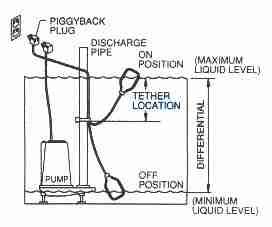
The septic pump float switch at left describes a common sewage pump control method used on Little Giant™ and many other submersible sewage grinder pumps.
This type of sewage pump float switch, also used on lots of sump pumps, swings in an arc between its high and low positions. It's a simple, reliable electric switch, but debris in the holding tank or improper tethering can lead to switch jamming.
Note that by moving the tether position of the float wire in the pumping chamber you can adjust the pump cut-in and cut-out wastewater levels in the holding tank. Sketch courtesy of plumbingsupply.com [4]
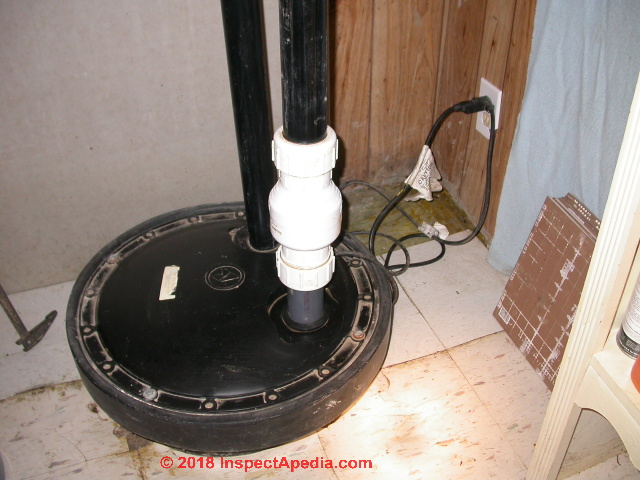
Septic / Sewage Pump Clogs from White or Gray Waxy Deposits
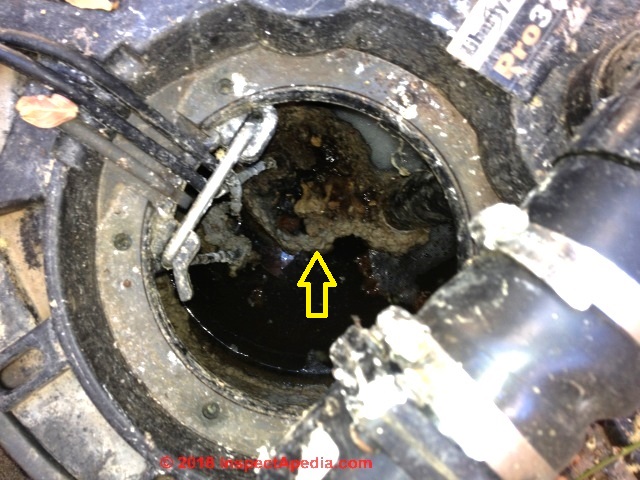 Soft drain stoppages: white waxy, gel-like, or scaly or plaster-like clogs in plumbing drains or that form as blockages in septic or sewage ejector and grinder pumps can be caused by several very different problems.
Here we describe each of the causes and cures for these soft white or gray jelly-like deposits that clog plumbing drain and pumping systems.
We also describe the causes and cures for harder white, gray or tan drain deposits and clogs, and we include notes on some less-common blue, blue-green, and black slime and clogs found in both supply and drain systems.
Detergent or Soap Clogs & Deposits
Question: what is the white waxy stuff that caused my septic pump float switch to stick & clog up leading to failure of my septic pump?
What do you suppose was the large white waxy clumpy substance that I found recently in my septic pump container? The sticky substance was stuck to the sides of the tank (where it was several inches thick).
It was also stuck all over the septic pump, and stuck all over the float switch - .which of course was the problem and the reason for opening the tank.
This accumulation happened over 2 years and 5 months.
thanks. - Rani 8/11/11
[Click to enlarge any image] Photo: white waxy deposit clogging the inlet of a sewage ejector pump - InspectApedia.com photo from an anonymous reader.
Reply: soaps or detergents can form white waxy clogging deposits in drain pipes and sewage or effluent pumps
Rani,
We're not sure. Sorry but our forensic lab no longer accepts sewage slime deposits for analysis and identification, though some larger biological labs and water / sewage testing laboratories can provide that service.
Here are the common causes of white or gray slimy deposits in sewer piping, drains, septic or sewage pumps, and septic tank inlet baffles:
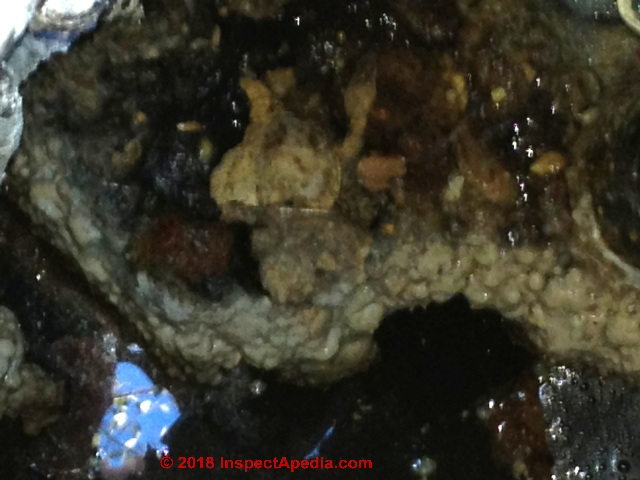
Bio-Slime or Bio-Film Bacterial Growth & Slime Drain & Sewage Pump Clogs
 Some white waxy clogging material found in plumbing systems can be caused by bacterial growth, fungal growth including yeasts, and other organisms forming a waxy slime.
Eboigbodin (2008), and McBain (2003) as well as many other researchers cite the role of bacteria and fungi in the formation of biofilm slimy deposits in water supply and drain piping systems.
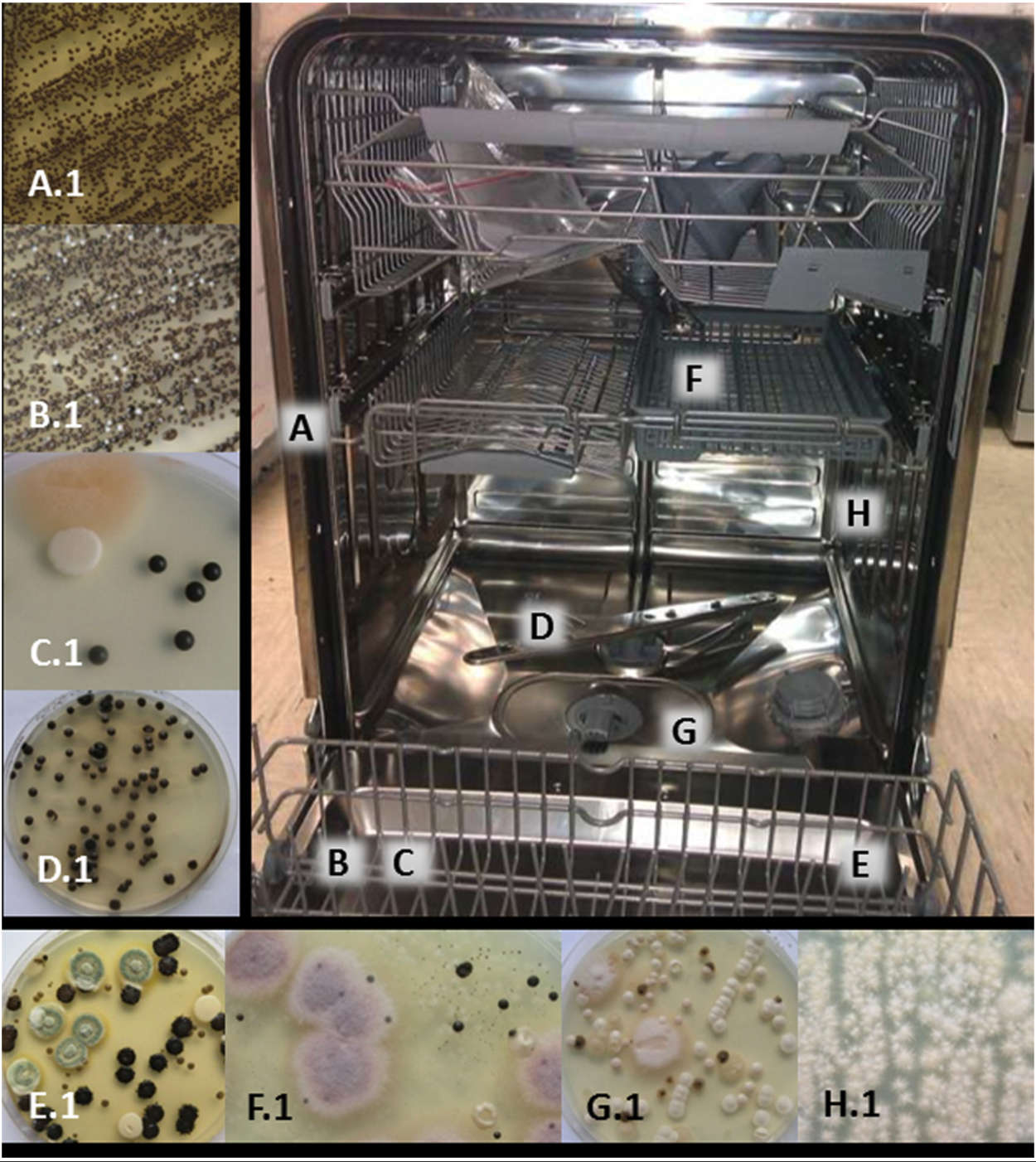
Photo: Zupančič et als. (2016) investigated the diversity of fungi detected in residential dishwashers, cited in detail at the end of this article.
Several factors have been shown to favor biofilm formation in water distribution systems, including the capability of bacteria to resist disinfectants, improper use of disinfectants, the nature and concentration of biodegradable substances, temperature, and plumbing materials. Eboigbodin (2008)
Common among the biofilm organisms are the fungus Fusarium sp. often detected in plumbing drains (Short 2011), Pseudomonas aeruginosa, other bacteria, as well as yeasts such as Rhodotorula mucilaginosa (usually red or orange) or Exophiala dermatidis (a black yeast) spread from dishwashers to kitchen. - Zupančič 2016
... dishwasher waste water contained E. dermatitidis, Exophiala oligosperma and Sarocladium killiense. - Zupančič
Bacterial growth clogging in a drain line, drain trap, or in an ejector pump or sewage pump can be aggravated by extra sources of bacteria such as bacteria forming in air conditioning condensage dispensed-of by dripping it through the condensate drain system into a seldom-used trap or sewage pump chamber.
If this is the cause, cleaning the system with a simple household cleaner or disinfectant can usually remove the problem.
Vinegar, enzyme cleaners and most drain cleaners will remove typical bacterial slime deposits and clogs.
Also see our notes below about the formation of greasy gelatinous blobs formed from waxes and oils.
Detergent Powder Drain & Pump Clogs
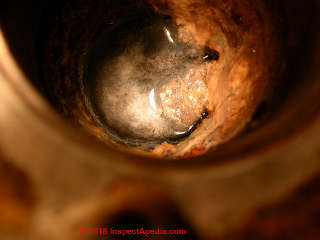 Excessive use of powdered detergent in washing machines or dishwasher & white waxy deposits
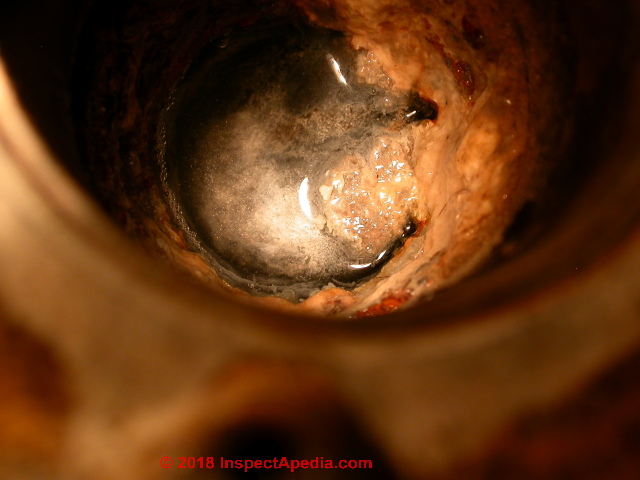
A good guess is that your sewage ejector tank or septic tank that uses a septic pump was clogged by someone who used too much powdered detergents in a clothes washer or dishwasher.
It's well established that using excessive amounts of powdered detergent in a dishwasher or clothes washer can lead to accumulation of a gooey mess that clogs drains or even septic drainfields. Some bar soaps can also form waxy clogs or blockages in plumbing systems and sewage or effluent pumps.
Also see DISHWASHER & LAUNDRY DETERGENTS CONTAINING PHOSPHATES & SURFACTANTS for a discussion of the effects of phosphates & detergents on the environment.
Other waxy gray or white soap deposits
You have provided another important example: excessive detergent use OR using a budget detergent that contains large amounts of clay fillers can clog the pump float control switch or the pump intake in a sewage ejector pump or sewer pump as well.
Some soaps are more likely to cause waxy clogs than others. Soaps are produced by using an alkali to convert fats (animal or vegetable) to a combination of soap and glycerol.
Soaps produced using sodium hydroxide are referred to as "hard" soaps that are more-difficult to dissolve in water, while soaps produced using potassium hydroxide tend to be more-easily soluble and are thus called "soft" soaps.
Soft soaps as well as soaps made from a petroleum base (shower gels, for example) tend not to clog drains.
We discuss detergent choices & recommendations to minimize drain and septic problems in two locations.
Drywall Dust or Plaster Clogs in Drain Systems
Yep it's true, some fools dump plaster or drywall dust and debris down toilets or other drains while cleaning up after a plastering or drywall installation or repair job.
Don't do that. Both plaster and drywall dust will form a hard-to-remove drain blockage in nearby traps or drain lines. While acid-based drain cleaners might remove such blockages more-likely you'll need to use a power snake or other mechanical drain cleaning system.
Grease-Cake Clogging
Fats and oils entering the drain system solidify to form greasy white, gray, or deposits
Other waxy clogging can be traced to soaps and detergents: this second common cause of waxy deposits that clog pumping chambers or piping are fats and oils that were flushed down drains.
These greasy deposits may be white, tan, brown, or even near-black substances that form a gelatinous, greasy, or waxy deposit or blob.
Even if you take care to avoid pouring grease and oils directly into your drains (don't do that), the fats and oils that are deposited on dishes from the normal consumption of a wide range of foods will be sent into the drain system from your kitchen sink or your dishwasher.
For residential drains and pump suffering from fat or oil clogging waxy deposits, plumbing drain FOG (Fat Oil Grease) degreasers (such as Cloroben PT-4) may help dissolve the clog.
See the example MSDS safety sheet for Cloroben PT4, given below. Cloroben PT4 is a plumbing drain cleaner also described as a "flow improver" and "grease control agent" produced and marketed by Hercules. As pointed out by Hughes (1954) often safety has focused first on explosion or fire hazards.
- CLOROBEN PT4 SAFETY DATA SHEET, [PDF], HCC Holdings, Inc. an Oatey Affiliate, 4700 West 160th Street Cleveland, OH 44135, USA, retrieved 2017/02/22, original source: http://www.oatey.com/msds/sds-us--hercules-cloroben-pt4.pdf
- CLOROBEN PT-4 Product Specifications Sheet, [PDF] Op. Cit. http://www.oatey.com/doc/pt4.pdf
Cloroben PT-4 can be used to improve flow of gravel absorption beds around cesspools, drywells, leach tanks and drain field laterals.
Can be used to clean lines to and from grease traps, cleans main lines or soil stacks/vents of apartment buildings, condominiums and hotels or for commercial applications; controls grease caking and fouling in clarifiers, lines and digesters and helps maintain good percolation in aeration basins of municipal waste treatment plants.
Some Hercules products such as Hercules PT-GIO1™ combine grease solvents and "waste digesting bacteria" while Hercules PT-4 (or Cloroben PT-4) is a formula designed to rapidly dissolve FOG (Fats Oils and Grease) using a non-acidic, non-caustic formula that is described as "safe on all types of piping materials when used as directed"
- Hercules PT- and WHAM Product literature: http://www.oatey.com/doc/lcs982greasecontrolwhampt4ptbiocanadapdf081015.pdf (op cit)
- Watch out: Hot water + vinegar diluted 1:1 can help remove grease clogs but risks simply pushing the clog further down the drain/waste piping system where it forms a new, harder-to reach drain blockage.
Watch out: never use industrial metal cleaning chemicals or oil/wax removers in plumbing or septic systems. Details are at DEGREASING SOLVENTS IMPACT on SEPTIC
Also see TOILETS, DON'T FLUSH LIST
And see CHEMICALS to KEEP OUT OF SEPTICS
Mineral Scale Clogged Drains & Sewage or Ejector Pumps
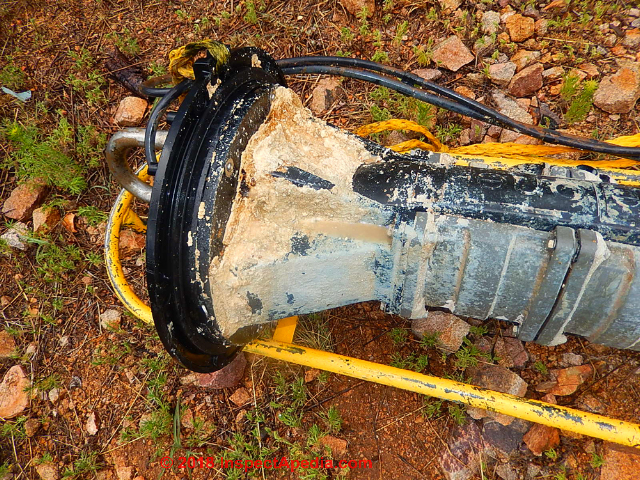
Mineral scale formation can form hard white, gray or orange deposits
If your water is "hard" or high in calcium or magnesium that condition, combined with those types of soap particularly invites the formation of waxy white blobs that clog drains, traps, and septic pumps.
For modest scale deposits pouring vinegar into the trap or sewage pump and letting it sit for a few hours can soften and dissolve the clog blockage.
Watch out: For larger and harder scale formation, a scale removing chemical treatment may work but risks environmental contamination if your building is connected to an onsite waste disposal system - private septic tank and drainfields.
Be sure to review the manufacturer's literature about permitted uses of such chemicals.
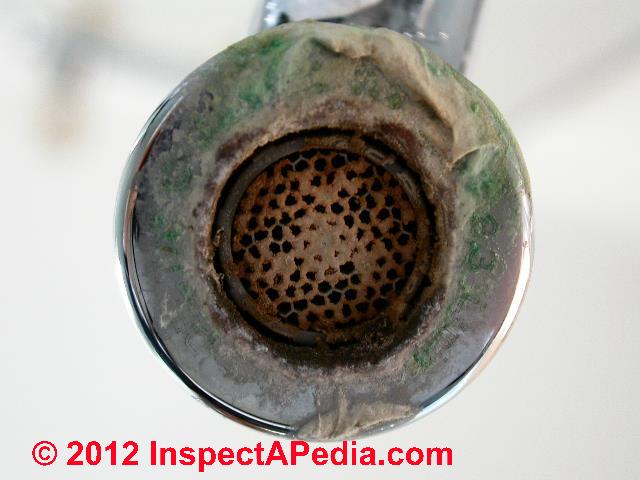
Mineral scale can also clog water supply pipes, valves, and faucet strainers, as illustrated by our photo just below.
See these articles about mineral scale formation, removal, prevention in water supply and drain systems:
HOT WATER PRESSURE IMPROVEMENT
WATER HEATER SCALE DE-LIMING PROCEDURE
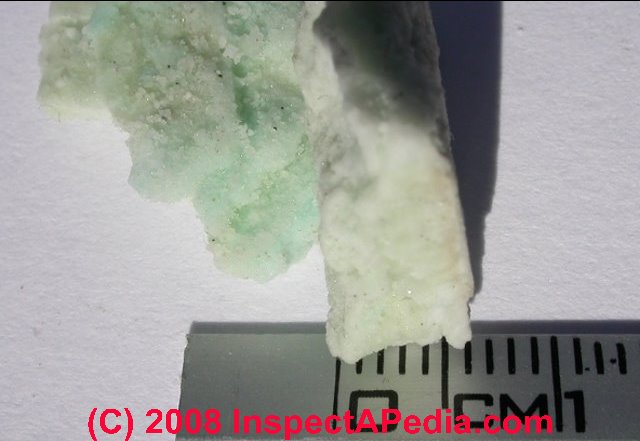
Paraffin or other wax clogs in drains
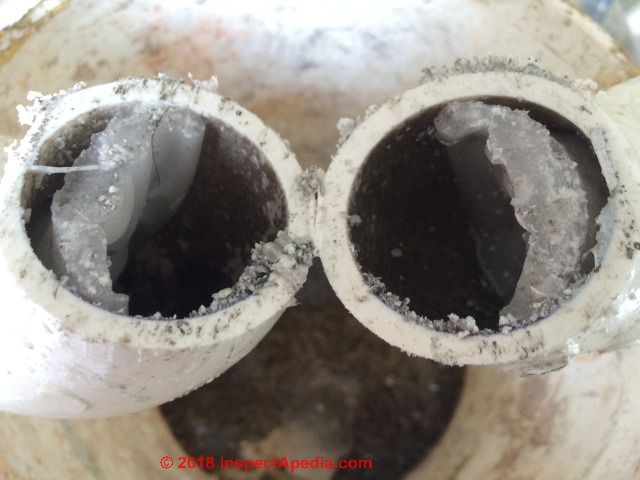
A reader contacted us to discuss the removal of actual paraffin that her daughter had poured into the drain system.
We advised against using very aggressive chemicals because of the hazards involved, the risk of damage to the drain system, and the low chance of success.
Any chemicals we could find that would dissolve paraffin were in our opinion too dangerous for home use.
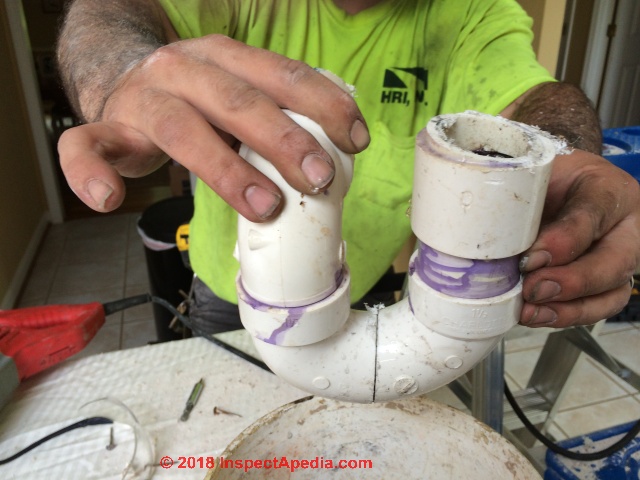
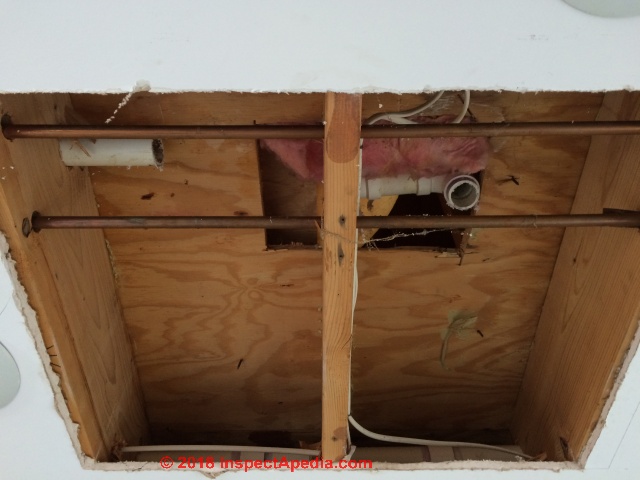
Her plumber cut-out and replaced the clogged trap as well as the most-clogged nearby PVC drain lines and physically removed wax deposits in the downstream drain opening.
See BLOCKED DRAIN REPAIR METHODS for a detailed step by step guide to un-blocking clogged drains. Articles at that page also assist in diagnosing the location and cause of drain blockages.
Also see CLOGGED DRAIN DIAGNOSIS & REPAIR.
Blue Slime Clogs in Supply or Drain Piping
 Blue or blue-green slimy clogs found in a water supply or drain system, particularly at a water heater or in hot water piping may be caused by the combination of an alkaline water supply and the use of an aluminum anode in the water heater tank.
The chemical reaction between the alkaline water and the aluminum surface of the water heater anode forms a gelatinous greenish blue or blue-gray aluminum hydroxide deposit that can block hot water piping and that may even show up in some building drain systems.
If you suspect that your water heater is providing blue-green jelly blobs check the condition of the water heater anode to confirm that source.
Aluminum anodes are used in water heaters to replace the standard magnesium anode where the local water supply is high in sulphur. That's to avoid a problem with the formation of hydrogen sulfide gas in the water heater - a rotten egg smell.
You may need to replace the worn, corroded anode rod in your water heater and you may need to have your water tested and if it's sufficiently alkaline, you may need to install a water treatment system.
See ANODES & DIP TUBES on WATER HEATERS.
Here Carson Dunlop Associates' sketch above shows the location of the sacrificial anode or dip tube on an electric water heater.
Black Bio-Slime Clogs in Supply or Drain Piping
Not discussed in detail here but included for completeness are bacterial or fungal / mold-formed slime deposits that can clog fixtures, faucets, supply piping and drains.
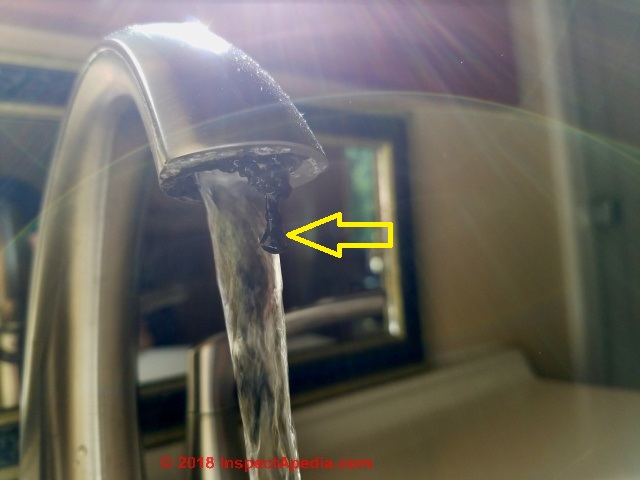
The black blob shown in our photo was not examined in our lab (though I should have done so) but might include Exophiala dermatidis (a black yeast) that we discussed above at biofilm formation.
To clean and remove the black slimy faucet clog/blob shown in our photo above we used a common household spray cleaner first, then removed the faucet strainer to soak it in vinegar to remove a remaining deposit of mineral scale.
Research on the Formation of Biofilms and Greasy Waxy Deposits in Drain Pipes & Pumps
- Bédard, Emilie, Michèle Prévost, and Eric Déziel. "Pseudomonas aeruginosa in premise plumbing of large buildings." MicrobiologyOpen 5, no. 6 (2016): 937-956.
Abstract:
Pseudomonas aeruginosa is an opportunistic bacterial pathogen that is widely occurring in the environment and is recognized for its capacity to form or join biofilms. The present review consolidates current knowledge on P. aeruginosa ecology and its implication in healthcare facilities premise plumbing.
The adaptability of P. aeruginosa and its capacity to integrate the biofilm from the faucet and the drain highlight the role premise plumbing devices can play in promoting growth and persistence.
A meta‐analysis of P. aeruginosa prevalence in faucets (manual and electronic) and drains reveals the large variation in device positivity reported and suggest the high variability in the sampling approach and context as the main reason for this variation.
The effects of the operating conditions that prevail within water distribution systems (disinfection, temperature, and hydraulic regime) on the persistence of P. aeruginosa are summarized.
As a result from the review, recommendations for proactive control measures of water contamination by P. aeruginosa are presented. A better understanding of the ecology of P. aeruginosa and key influencing factors in premise plumbing are essential to identify culprit areas and implement effective control measures. - Eboigbodin, Kevin E., Allyson Seth, and Catherine A. Biggs. "A review of biofilms in domestic plumbing." Journal‐American Water Works Association 100, no. 10 (2008): 131-138.
Abstract:
Several factors have been shown to favor biofilm formation in water distribution systems, including the capability of bacteria to resist disinfectants, improper use of disinfectants, the nature and concentration of biodegradable substances, temperature, and plumbing materials.
To date, most research relating to drinking water biofilms has focused on the materials that make up the distribution system before water enters the consumers— plumbing systems.
However, drinking water should also meet the necessary quality requirements at the point of consumption even though domestic plumbing systems are usually not constructed from the same materials that are used to construct distribution systems.
This article provides a review of the current literature related to the analysis of biofilms found or produced in domestic plumbing systems and highlights the microorganisms identified as well as causes and strategies for control. - Fleming, I. R., and R. K. Rowe. "Laboratory studies of clogging of landfill leachate collection and drainage systems." Canadian Geotechnical Journal 41, no. 1 (2004): 134-153.
- McBain, Andrew J., Robert G. Bartolo, Carl E. Catrenich, Duane Charbonneau, Ruth G. Ledder, Alexander H. Rickard, Sharon A. Symmons, and Peter Gilbert. "Microbial characterization of biofilms in domestic drains and the establishment of stable biofilm microcosms." Applied and Environmental Microbiology 69, no. 1 (2003): 177-185.
Abstract:
We have used heterotrophic plate counts, together with live-dead direct staining and denaturing gradient gel electrophoresis (DGGE), to characterize the eubacterial communities that had formed as biofilms within domestic sink drain outlets.
Laboratory microcosms of these environments were established using excised biofilms from two separate drain biofilm samples to inoculate constant-depth film fermentors (CDFFs).
Drain biofilms harbored 9.8 to 11.3 log10 cells of viable enteric species and pseudomonads/g, while CDFF-grown biofilms harbored 10.6 to 11.4 log10 cells/g.
Since live-dead direct staining revealed various efficiencies of recovery by culture, samples were analyzed by DGGE, utilizing primers specific for the V2-V3 region of eubacterial 16S rDNA. These analyses showed that the major PCR amplicons from in situ material were represented in the microcosms and maintained there over extended periods.
Sequencing of amplicons resolved by DGGE revealed that the biofilms were dominated by a small number of genera, which were also isolated by culture. One drain sample harbored the protozoan Colpoda maupasi, together with rhabtidid nematodes and bdelloid rotifers.
The microcosm enables the maintenance of stable drain-type bacterial communities and represents a useful tool for the modeling of this ecosystem. - Short, Dylan PG, Kerry O'Donnell, Ning Zhang, Jean H. Juba, and David M. Geiser. "Widespread occurrence of diverse human pathogenic types of the fungus Fusarium detected in plumbing drains." Journal of Clinical Microbiology (2011): JCM-05468.
- Zupančič, Jerneja, Monika Novak Babič, Polona Zalar, and Nina Gunde-Cimerman. "The black yeast Exophiala dermatitidis and other selected opportunistic human fungal pathogens spread from dishwashers to kitchens." [PDF] PLoS One 11, no. 2 (2016): e0148166. Retrieved 2018/07/04, original source: http://journals.plos.org/plosone/article?id=10.1371/journal.pone.0148166 Creative Commons Lic.
Abstract:
We investigated the diversity and distribution of fungi in nine different sites inside 30 residential dishwashers. In total, 503 fungal strains were isolated, which belong to 10 genera and 84 species. Irrespective of the sampled site, 83% of the dishwashers were positive for fungi.
The most frequent opportunistic pathogenic species were Exophiala dermatitidis, Candida parapsilosis sensu stricto, Exophiala phaeomuriformis, Fusarium dimerum, and the Saprochaete/Magnusiomyces clade.
The black yeast E. dermatitidis was detected in 47% of the dishwashers, primarily at the dishwasher rubber seals, at up to 106 CFU/cm2; the other fungi detected were in the range of 102 to 105 CFU/cm2. The other most heavily contaminated dishwasher sites were side nozzles, doors and drains.
Only F. dimerum was isolated from washed dishes, while dishwasher waste water contained E. dermatitidis, Exophiala oligosperma and Sarocladium killiense.
Plumbing systems supplying water to household appliances represent the most probable route for contamination of dishwashers, as the fungi that represented the core dishwasher mycobiota were also detected in the tap water.
Hot aerosols from dishwashers contained the human opportunistic yeast C. parapsilosis, Rhodotorula mucilaginosa and E. dermatitidis (as well as common air-borne genera such as Aspergillus, Penicillium, Trichoderma and Cladosporium).
Comparison of fungal contamination of kitchens without and with dishwashers revealed that virtually all were contaminated with fungi. In both cases, the most contaminated sites were the kitchen drain and the dish drying rack.
The most important difference was higher prevalence of black yeasts (E. dermatitidis in particular) in kitchens with dishwashers. In kitchens without dishwashers, C. parapsilosis strongly prevailed with negligible occurrence of E. dermatitidis. F. dimerum was isolated only from kitchens with dishwashers, while Saprochaete/Magnusiomyces isolates were only found within dishwashers.
We conclude that dishwashers represent a reservoir of enriched opportunistic pathogenic species that can spread from the dishwasher into the indoor biome.
Toilet Paper Clogging of Grinder Pumps?
Question: toilet paper clogged our Zoeller grinder lift pump
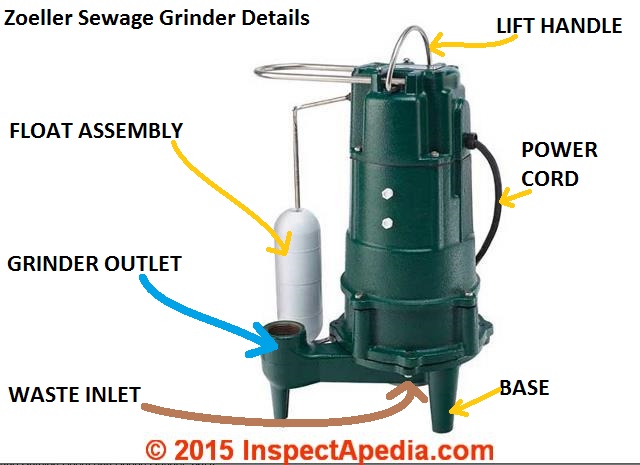
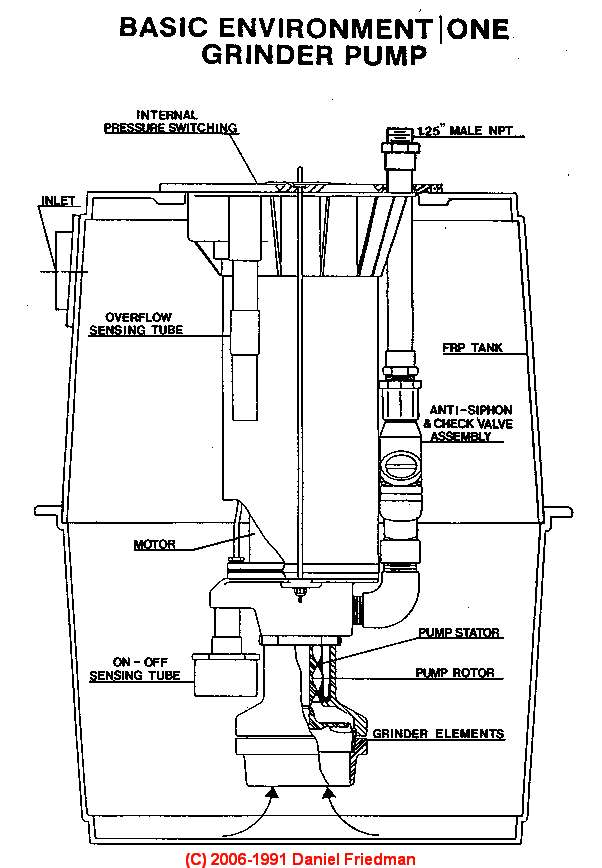
[Click to enlarge any image] Above, main parts of a sewage grinder pump, adapted from Zoeller's Shark series 803-805-807.
2016/04/05 Thomas Guastavino said:
We have a Zoelner grinder lift pump that recently clogged with toilet paper when to wrapped around the impeller. Are there any recommendations for what type of TP is best to prevent these types of problems?
Reply:
Thomas I've been testing toilet paper breakdown rates for almost a decade - one experiment is long-going; my OPINION is that all toilet papers break down just fine in a septic tank itself - changing the paper brand won't reliably fix the problem you encountered.
The grinder pump is going to run before most toilet papers will have separated into small fragments.
So I suspect there's a different problem: the grinder - tampons, or some other stuff can clog up sewage pumps. (Dental floss is one of the worst offenders and it's hard to keep that out of the pump).
But Zoeller indicates quite clearly that their residential sewage grinder pumps, such as the Zoeller Shark 803/805/807 Residential Grinders can handle "all flushable wastes" - to me that means feces and toilet paper but not tampons and probably not dental floss.
Are we sure you have the right pump type and model installed. Sometimes people install a de-watering sump pump or a simple effluent lift pump where a grinder pump is needed.
If you have the right type and model of pump installed, check the pump inlet openings to be sure that there is no damage there.
Zoeller's sewer pump instructions also point out that a role of the pump chamber cover is to prevent debris from entering the pumping chamber from that direction as well.
Zoeller can be reached at
- Zoeller Pumps, 3649 Cane Run Rd. Louisville, KY USA 40211 Phone: +1-800-928-7867 Phone: +1-502-778-2731 Fax: +1-502-774-3624 Email for Product Support: zcotechnical@zoeller.com
BUT NOTE that the company says If you are a homeowner, please contact your local Representative with questions.
Watch out: at SEPTIC & SEWAGE PUMPS we explain that choosing the wrong type of pump, such as installing a simple basin pump or effluent pump (designed to handle primarily liquid waste) on a system where blackwater (toilet waste) is entering the system is likely to lead to pump clogging and failure.
Pump selection and pump types are discussed
at SEWAGE EJECTOR / GRINDER PUMPS
...
Reader Comments, Questions & Answers About The Article Above
Below you will find questions and answers previously posted on this page at its page bottom reader comment box.
Reader Q&A - also see RECOMMENDED ARTICLES & FAQs
On 2022-07-13 by InspectApedia-911 (mod)
@Terry,
A sewage pump should never need priming, it operates by a float and turns on when the sewage level raises the float.
So something is wrong with your installation or equipment.
On 2022-07-12 by Terry
Why does my sewage pump require constant priming?
On 2022-07-08 by InspectApedia-911 (mod) - how to retrieve broken end of Sink Wizard from drain
@Rajan,
I'm glad you recognize that all we have is an opinion since we're not on site and there may be important details that we can't see and don't know about this problem.
I would be tempted to try to fish with a small hooked wire, working very carefully so it's not to push the broken off brush tip further down the drain but to see if I could hook it and drag it back out.
If that isn't successful you might need to call a plumber.
On 2022-07-08 by Rajan
@InspectApedia ,
Thank you for your time to respond with picture of exactly what I was talking about. It is the the hardened bristle tip for tub which broke and got flushed in to the drain. The p-trap can not be accessible due to location of tub .
I let water run in the tub several times and flushed toilet few times with pump working. Only option is to call sewer service contractor to inspect the sump pit while flushing to see any thing comes or look inside. Your expert opinion is much appreciated.
On 2022-07-07 by InspectApedia (mod)
@RajaN,
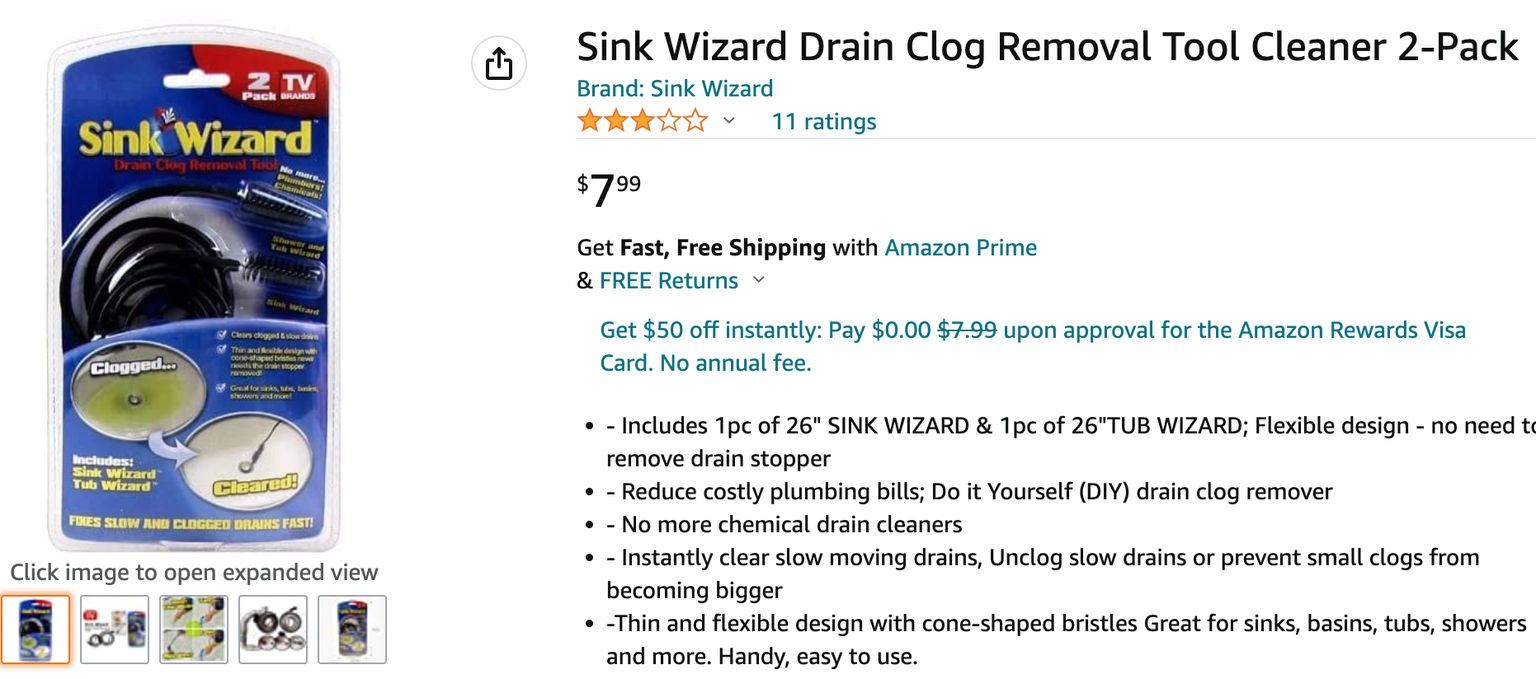
If the tool you refer to is like this one in the photo from Amazon, AND if the entire bristled end broke off and is in the p-trap, you can open the P-trap to try and access it.
It appears to have a metal stem or arm that, if that actually broke off and is inside of a pump, could damage it, although that seems unlikely.
Bottom line: Could you clarify what broke off and fell in?
On 2022-07-06 by RajaN
I have 3 year old Ashland Sewage pump model SW50 working well . I attempted to clean the tub drain which is connected to the sewage pump along with toilet. I was using Sink Wizard with specially hardened bristle tips, when it apparently got broken and bristle tip is gone, it is about 3/4" long.
Because there is no way to get access to p tap if any , will get in the sewer pump and give any problem?. Should I call plumber and sewer service to inspect the sewer tank to retrieve the piece or if it is stuck in the p tap, should I continue use the bath tube so that it will be flushed in to the sewer tank and pumped out without causing any damage to the pump?
I am concerned about the any major damage/ Your expert opinion is greatly appreciated.thank you
On 2022-02-07 by Inspectapedia Com Moderator - grinder pump banging noise
@Cynthia,
I am puzzled too as I don't know exactly how leaving the pump powered off for a time would cause a banging noise when it's plugged back in. I would probably start by visual inspection including looking at how the pump is secured and looking for loose components
On 2022-02-07 by Cynthia
My grinder pump alarm went off yesterday and the light was red I went out and noticed that one of the plugs had been unplugged by a contractor working at my property I immediately plugged it back in and the light went off 10 seconds later but now I have a banging noise that's coming from right underneath with a grinder is I have no idea what it is...
I'll be calling a plumber tomorrow so far everything is flushing and exiting out of the house okay.
On 2021-08-18 by inspectapedia.com.moderator - Will Rid-x damage my pump?
@James Lechel,
No, but you should use the on Page search box just above to find our article on using and recommendations against SEPTIC TREATMENTS AND ADDITIVES
On 2021-08-17 by James Lechel
Will Rid-x damage my pump in my interceptor tank?
On 2021-07-28 by inspectapedia.com.moderator - do I need a grinder pump?
@Al in Readington NJ,
I agree that we don't want to pump solids to the mound.
You need a grinder pump to move wastewater, including solids, out of your in-home pumping chamber out to your septic tank. That 50 gallon pumping station cannot work if all solids remained in such a small space. (Seems obvious; I'm not a sanitary engineer).
The septic tank needs to be sized and designed to give adequate settling time so that only clarified effluent is sent to the mound.
On 2021-07-28 by Al in Readington NJ
I have a septic mound system with a two compartment concrete 1000 gallon tank and my home is below the tank as the property is uphill. All the drains collect into a 50 gallon fiberglass holding tank in the basement and is ejected by a Weil brand single phase 1 hp 230v 1750 rpm grinder pump (yes, grinder pump) the run (I think called total dead head)including all horizontal and vertical distance is approx 60 feet .
My question is, was it appropriate for the builder to install a grinder pump when it seems grinder pump use is almost universally frowned upon in septic systems due to the slurry the grinder makes being difficult to separate into solids and liquid components that septics need to operate effectively without clogging the field.
Should I pull the grinder pump and install a comparably spec’d sewage ejector pump or is there certain situations that might require or benefit from the grinder pump. I can’t get a straight answer from anyone, please help with some advice if you can.
On 2021-07-23 04:06:01.760571 by danjoefriedman (mod)
@MJ,
It might be if it's the wrong pump for the application. For example if you need a grinder pump and you don't have one with the capacity then it may be clogged and destroyed
On 2021-07-22 by MJ
Is it common for an ejector pump to fail after 2.5 years?
On 2021-04-18 by danjoefriedman (mod)
@Joann, the most common source of the problem you describe is the accumulation of fat oil grease or sometimes laundry detergent particularly if you were using powdered detergent and are perhaps using a bit more than is necessary.
On 2021-04-18 by Joann
I have been using sewage pump for lower portion of the property for 3 years. This pump generally takes care of regular use of one kitchen and bathroom. In the last year and a half, it started to have deposits coagulate at the bottom of the sewage pump and every 5 to 6 months, we have to clean it to avoid clogging. What could be the reason?
On 2020-10-21 - by (mod) -
Freddie
If there is no drain blockage and provided that septic tank has the required inlet and outlet baffles, then the answer to your question is yes
On 2020-10-21 by Freddie
If the unfortunate event of a few non-flushable wipes going down the toilet drain has *already occurred*... will pumping the septic tank resolve the potential problems and remove the unwanted material?
Thank you!
On 2020-08-10 by Mark - promoting IUS Float Management Controller for Septic & Sewage Pumps
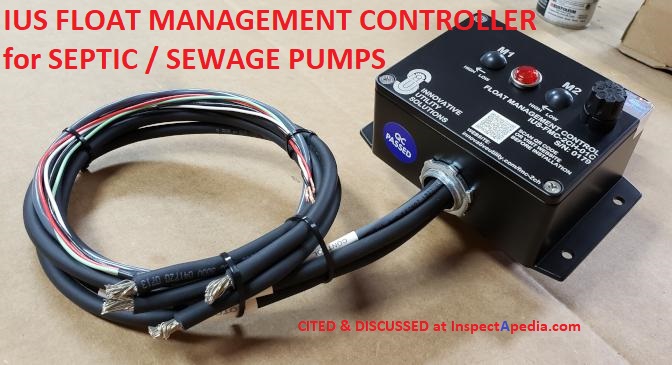 Mark said:
If you keep on having issues with a sewage grinder getting clogged, the Float Management Control from Innovative Utility Solutions, LLC may help eliminate the problem. As has already been stated on this page, many clogs occur when the water level and Off Float drop while the grinder is in the middle of chewing up debris.
The grinder shuts down with a clog in it and can't generate the torque to overcome that clog when it needs to start back up. The Float Management Control keeps this from happening.
- from innovativeutility.com
On 2020-05-10 - by (mod) -
Safe, sure,
Useful, IMO, no.
On 2020-05-10 by Lottie
Is it safe to use Rid-X in a grinding station- pump station
On 2020-01-22 - by (mod) -
Lorretta
I am sorry to have to offer what's an annoying guess but I suspect that if toilet paper is accumulating at all in the sewage ejector pump basin then the wrong type of pump may be installed.
A grinder pump, properly installed, wont' clog and go out of commission simply from disuse for a few days.
IT's also possible that you have the proper pump but not properly installed, or not properly mounted in the basin.
How about asking an experienced plumber to take a look at the installation; and tell me what she says.
On 2020-01-22 by Lorretta
I live in a basement with a sumppump sending waste up to the sewer. Toilet paper hardens on the ball if I am gone for a few days. What can I use to keep waste soft and flowable
On 2020-01-16 - by (mod) -
AC
The number of companies selling septic additives and "cleaners" is nearly equal to the population of Indonesia; at SEPTIC TREATMENTS & CHEMICALS https://inspectapedia.com/septic/Septic_Tank_Treatments.php we describe some of these and explain that they are generally not needed for proper septic TANK maintenance.
However there may be reasons to clean the sewage ejector pump and pumping chamber. Narrowing the search to those products gives some suggestions such as Core Biologic's Ejector Tank Treatment https://www.corebiologic.com/ejectortanktreatmenthh
More suggestions are at SEWAGE EJECTOR / GRINDER PUMPS https://inspectapedia.com/septic/Grinder_Pumps.php our maintenance guide.
On 2020-01-16 by AC
I noticed you said you can run vinegar through the pup/grinder system for cleaning, are there any off of the shelf chemicals that you would recommend that might be a little stronger?
We had our system alarm "go off" about a week ago on our detached dwelling unit (with grinder pump) it turned off after about 3 minutes and after some testing it appears to be in working order.
I did a light snaking off the drains and surprisingly a bunch of dental floss came up (disgusting and concerning all in one) along with some of the "grey matter" you wrote about above.
So I am wondering if there is a product or substance that I can put down the drain periodically that will help keep the system "clean"?
On 2019-09-25 - by (mod) -
Li Realtor
Why are you using Rid-X? See the discussion at SEPTIC TREATMENTS & CHEMICALS
What kind of septic system is installed?
Rid-X won't harm a toilet nor sewage pump but it should not be flushed into an aerobic septic system.
On 2019-09-25 by Laura
Please respond via email if possible ;
Lirealtor72@yahoo.com
Can I put Ridex in the toilet in my basement - there a sewage ejector pump/ when I flush the toilet it whistles
On 2019-06-27 - by (mod) -
Sorry I don't know what a "modad" is. - help me out and I'll be glad to find an authoritative answer to your question.
If you're referring to the aerator pump on an aerobic septic system most of those are designed to run continuously occasionally there's some designs that use a timer. If you leave it off your system is going to a backup or you'll damage the drain field.
On 2019-06-27 by Stephanie
How long can you keep ur modad for ur septic tank un plugged
Septic & Sewage Pump Sources & Manuals
Producers of Septic Pumps, Sewage Pumps, Grinder Pumps, Effluent Pumps are listed
at SEWAGE PUMP BUYERS GUIDE & MANUALS
On 2015-04-08 - by (mod) -
You can remove some grease type sludges with non-caustic treatments such as the Clorben PT product series. I'd check for a sticking control float that is not switching the pump on when it should.
On 2015-04-03 by James Printy
About every two months my alarm in our house waste lift pump goes off and sometimes it doesn't, letting the pit overflow.
A yellow sludge builds up on the float and won't let it ride up to make the switch located on top of cover come on. I have to take out one of the infeed pipes and blasg it off with hot water from our water heater. It's located in the basement and puts out an odor. I'd like to know what I could treat it with to dissolve this sludge without damaging the pump.
We're in a town where if you if you put a house lower than the city sewer and within 300 feet, you have to use a lift pump. Thank you....Jim
On 2015-02-22 - by (mod) -
Could tie trouble be a bad or sticking float switch
.
On 2015-02-16 by Krystal
I have a cajun air septic system and the high water alarm is on and the pump is running but not pumping and i looked inside and the water inside the tank isn't high enough to pump water
On 2014-10-04 - by (mod) -
Michelle
I'd look for two different sorts of problem:
the float switch that turns the pump on and off may be sticking or out of order
the pump impeller may be damaged or partly clogged. Sometimes a clog will separate itself when power is off, the pump can run for a time, then the clog is drawn back.
On 2014-10-04 by Michelle
We moved into our home in May this year, home sits off the road about 200 yards. There is a pit outside with an ejector sewage system. Was inspected prior to moving in and found to be in working order.
Over the summer we noticed an odor outside, opened the cover of the pit to see the water/sewage level almost to the top of the pit about 3 feet deep. The pump was running but not ejecting the sewage.
Cleaned the water and debris out, lifted pump out and placed it back into the pit, Cover for the container that the pump sits in was eaten away.
The pump worked fine and ejected the wast and shut off. Have been keeping and eye on it and now almost daily the container is full, pump is running but not ejecting and I simply unplug it, lift pump couple times and plug it back in, it ejects until pit empty and turns off like it should, however next day it is the same thing, full and running but not ejecting.
Also our electric bill was triple what it should be, any ideas, whats going on?? Please help
On 2014-09-13 - by (mod) - feminine products (Tampons) clog sewage pump
PN
No question that tampons and the like can clog ejector and sewage pumps. Besides posting "Don't flush" signs, which are never 100% effective, one might need to install a pump whose manufacturer says can handle those obstructions. Screens clog.
On 2014-09-12 by PN
We have a small business with several toilets and sinks. Our sewer line runs to a jointly owned pump vault (our sewage and our neighbor's). We have a dual-pump (ejector) system in the vault that pushes the sewage up and down a pressure line (down a side street) to the City's main in a major cross street.
A new business took occupancy of the neighbor building a year ago (we've been here for more than 25 years), and over the past year we've had nothing but trouble with clogged pumps
Typically feminine products and other debris. If this were solely the neighbor's problem, we'd let them suffer through it, but they've made it our problem. Do you have any suggestions of a macerator/grinder that we could place in-line and up-stream from the pumps? And/or is there another solution you would recommend? All suggestions appreciated. Thanks
On 2011-08-17 by Heather
No it's not in the septic tank - it is just for the downstairs bathroom and laundry room and kitchen drain (I live in a bungalow).
The pump shut off last night so I just did a load of laundry now it looks like the pump isn't working at all as the downstairs toilet bowl is complete full. We still cannot figure out how to get the lid off this thing and my husband knows a lot about plumbing but not this sewage pump.
So we are still wondering how to get the lid off this thing. It look similar to the hand drawn picture above which says Basic Environment One Grinder pump.
...
Continue reading at SEPTIC PUMP INSPECTION & MAINTENANCE or select a topic from the closely-related articles below, or see the complete ARTICLE INDEX.
Or see SEWAGE PUMP DAMAGE & REPAIR FAQs - questions & answers posted originally at this page.
Or see these
Recommended Articles
- SEWAGE EJECTOR / GRINDER PUMPS - home
- DISPOSABLE WET WIPE CLOGS
- FREE-STANDING GRINDER PUMPS
- SEWAGE TREATMENT PLANTS, RESIDENTIAL
- SEPTIC SYSTEM PUMPS
- SEPTIC PUMP ALARM SYSTEMS
- SEPTIC PUMP BUYERS GUIDE & MANUALS
- SEPTIC PUMP DUPLEX DESIGNS
- SEPTIC PUMP INSPECTION & MAINTENANCE
- SEPTIC PUMP INSTALLATION
- SEWAGE ODOR SOURCE LOCATION
- SEWAGE PUMP BUYERS GUIDE & MANUALS
- SEWAGE PUMP DAMAGE & REPAIR
- SEWAGE PUMP INTERMITTENT CYCLING
- SEWAGE PUMP ODORS
- SEWAGE PUMPING STATIONS
- WAXY BIOFILM SLIME CLOGS in DRAINS & PUMPS
Suggested citation for this web page
SEWAGE PUMP DAMAGE & REPAIR at InspectApedia.com - online encyclopedia of building & environmental inspection, testing, diagnosis, repair, & problem prevention advice.
Or see this
INDEX to RELATED ARTICLES: ARTICLE INDEX to SEPTIC SYSTEMS
Or use the SEARCH BOX found below to Ask a Question or Search InspectApedia
Ask a Question or Search InspectApedia
Try the search box just below, or if you prefer, post a question or comment in the Comments box below and we will respond promptly.
Search the InspectApedia website
Note: appearance of your Comment below may be delayed: if your comment contains an image, photograph, web link, or text that looks to the software as if it might be a web link, your posting will appear after it has been approved by a moderator. Apologies for the delay.
Only one image can be added per comment but you can post as many comments, and therefore images, as you like.
You will not receive a notification when a response to your question has been posted.
Please bookmark this page to make it easy for you to check back for our response.
IF above you see "Comment Form is loading comments..." then COMMENT BOX - countable.ca / bawkbox.com IS NOT WORKING.
In any case you are welcome to send an email directly to us at InspectApedia.com at editor@inspectApedia.com
We'll reply to you directly. Please help us help you by noting, in your email, the URL of the InspectApedia page where you wanted to comment.
Citations & References
In addition to any citations in the article above, a full list is available on request.
- Our recommended books about building & mechanical systems design, inspection, problem diagnosis, and repair, and about indoor environment and IAQ testing, diagnosis, and cleanup are at the InspectAPedia Bookstore. Also see our Book Reviews - InspectAPedia.
- In addition to citations & references found in this article, see the research citations given at the end of the related articles found at our suggested
CONTINUE READING or RECOMMENDED ARTICLES.
- Carson, Dunlop & Associates Ltd., 120 Carlton Street Suite 407, Toronto ON M5A 4K2. Tel: (416) 964-9415 1-800-268-7070 Email: info@carsondunlop.com. Alan Carson is a past president of ASHI, the American Society of Home Inspectors.
Thanks to Alan Carson and Bob Dunlop, for permission for InspectAPedia to use text excerpts from The HOME REFERENCE BOOK - the Encyclopedia of Homes and to use illustrations from The ILLUSTRATED HOME .
Carson Dunlop Associates provides extensive home inspection education and report writing material. In gratitude we provide links to tsome Carson Dunlop Associates products and services.
 | HOME | ABOUT | ASK a QUESTION | CONTACT | CONTENT USE POLICY | DESCRIPTION | POLICIES | PRIVACY | |
| © 2025 - 1985 Publisher InspectApedia.com - Daniel Friedman | |||||||||