 Sewage Ejector Pump & Septic Pump Maintenance
- POST a QUESTION or COMMENT about how to inspect & maintain septic pumps, sewage grinder pumps, sewage ejector pumps and pump alarm systems
Septic pumps & grinder pumps:
How to inspect sewage grinder pumps or septic pump installations for proper installation, operation, and testing.
This article gives inspection and maintenance advice for Sump Pumps, Sewage Ejector Pumps, Septic Grinder Pumps, Sewage Pumping Stations, & Septic Pump Alarms.
InspectAPedia tolerates no conflicts of interest. We have no relationship with advertisers, products, or services discussed at this website.
- Daniel Friedman, Publisher/Editor/Author - See WHO ARE WE?
Guide to Sewage Ejector Pump Inspection & Maintenance Procedures
 The general name for sewage pumps pumps is sewage grinder pumps if they are intended to grind and move black water or sewage (including solid wastes), or sewage effluent pumps if
the pump is intended only to move clarified effluent, say from a septic tank to a drain field.
The general name for sewage pumps pumps is sewage grinder pumps if they are intended to grind and move black water or sewage (including solid wastes), or sewage effluent pumps if
the pump is intended only to move clarified effluent, say from a septic tank to a drain field.
Some of the common sewage grinder or septic pump brands include ABS pumps, Crane (centrifugal grinders) pumps, Environment One or E/One sewage pumps, Goulds pumps, Hydromatic pumps, Liberty sewage pumps, Little Giant pumps, Myers pumps, Tsurumi pumps, Webtrol sewage pumps, and Zoeller sewage grinder pumps. Several sewage pump manufacturers produce a separate line of commercial or municipal sewage grinder pumps from those used in residential application.
Article Contents
- editing in process
What you see at a building site may indicate a history of problems:
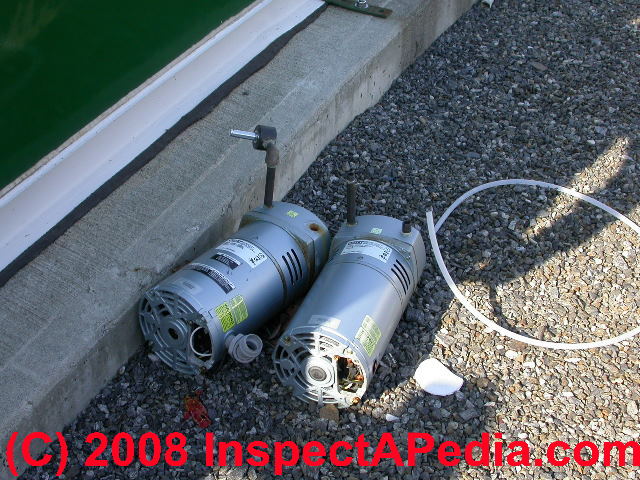
The pumps at page top may have been a misapplication for this municipal lift station ,which may explain why we found these discarded units on the site. Septic pump systems vary by these parameters:
Is the proper pump installed?
Septic pump manufacturers provide a pump selection and sizing table that is used to guide the installer in selecting the proper pump.
We've seen sewage handling systems where the wrong type or wrong capacity of pump was installed, sometimes as an attempt to "save money."
Are modifications to the septic pump system visible ? What do they mean?
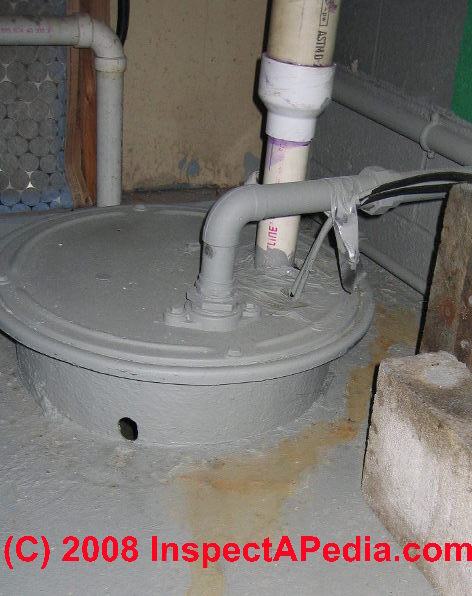
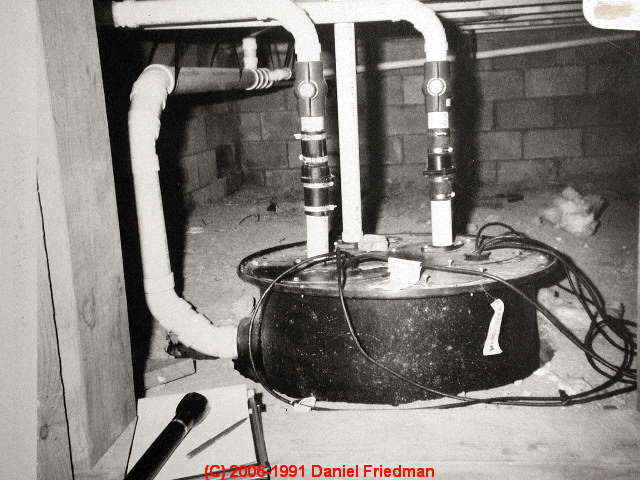
The septic grinder pump above has had a hole cut at floor level to permit other basement leakage to enter the pumping chamber to be pumped away.
Of course any sewage backup will flow back out of this hole into the room, and might prevent the pump alarm from functioning - but then is there a pump alarm installed? From the number of wires entering the tank, probably not.
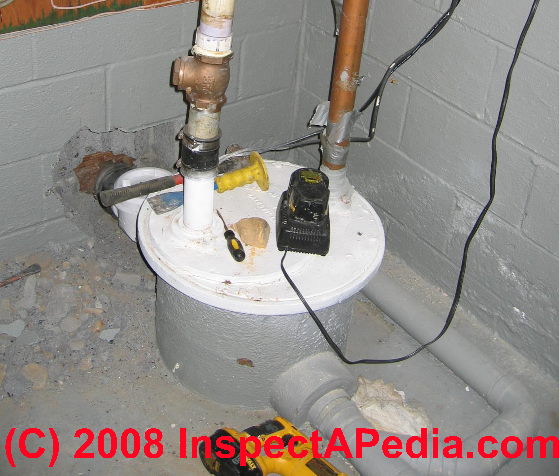
Also we see no check valve (see photo below, brass valve on the left hand vertical outlet pipe).
Also the wiring connections entering the tank are held in place with gray-painted-over masking tape - not particularly reliable.
Sewage Ejector Pump / Grinder Pump Maintenance
Watch out: While at least some ejector pump models can tolerate being run "dry" for some time without damage, the manufacturer(s) recommend adjusting the pump float so that the liquid level in the receiving chamber never drops below the body of the pump motor.
If your sewage pump alarm is sounding
stop using water, stop flushing toilets, turn off the washing machine, dishwasher, etc. right away to reduce the chances of a sewage backup. Details about responding to a sewage pump or ejector pump alarm are
If your sewage grinder pump or sump pump is not turning on and off correctly,
check the holding tank for clogging debris and check the operation of the sewage pump float control switch. Rising wastewater should lift the float that in turn operates a switch that turns on the pump. If the float is stuck by debris, obstructions or anything in the pumping chamber the sewage grinder pump cannot turn on and off as it should.
See details in these articles and in the Q&A sections of each:
of SEWAGE PUMP DAMAGE & REPAIR
and
12 Checkpoints in Sewage Grinder Pump or Septic Ejector Pump Preventive Maintenance, Clog, Damage & Odor Prevention
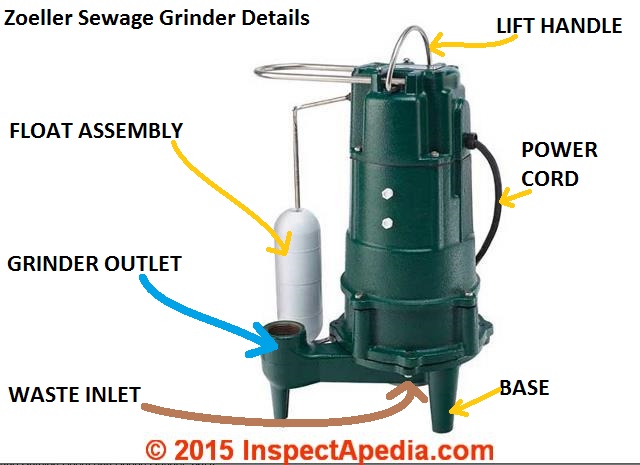
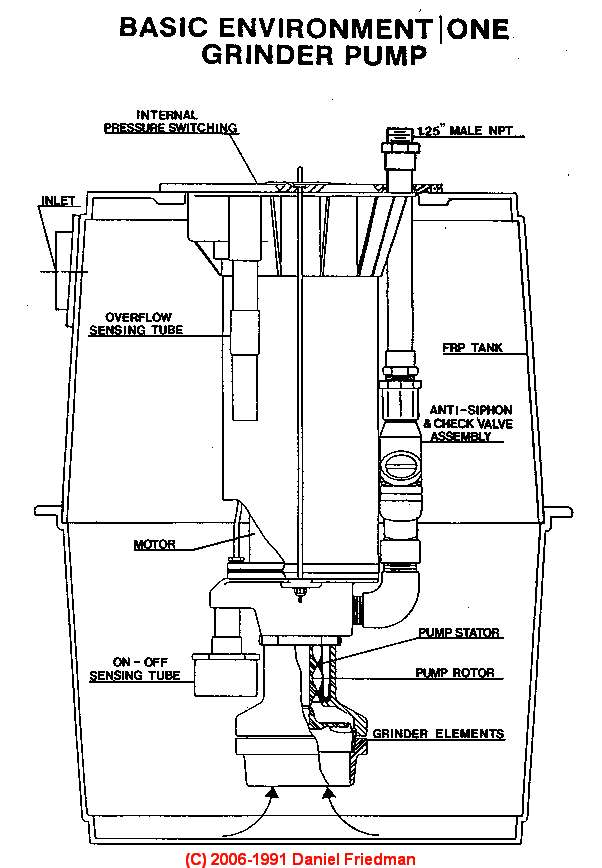
Above, main parts of a sewage grinder pump, adapted from Zoeller's Shark series 803-805-807.
Watch out: Typical grinder pump owners guides warn that you should not try to repair the system yourself. If you're not properly trained and equipped there are health and safety hazards such as risk of electrical shock or fire, or exposure to sewage pathogens that could make you seriously ill.
Watch out: when removing a grinder pump of sewage ejector pump from its station, do not lift the pump by its electrical wiring. Doing so risks damaging the wiring and voiding the pump warranty. Lift the pump by the steel handle or attachment intended for that purpose.
As the sewage grinder pump motor is oil filled, no lubrication or other maintenance is required, and generally will give very reliable service and can be expected to operate for years on normal sewage pumping without failing. However as with any mechanical piece of equipment a preventive maintenance program is recommended and suggested to include the following checks:
- Inspect the grinder pump installation for loose parts, proper float assembly operation, and to assure wiring and electrical connections are sound;
- Confirm that the waste level sensor or float, float arm, and float switches are working and moving freely
- If your grinder pump has an alarm the tech will test that the alarm works, turning on and off when it should in response to waste level in the pumping chamber.
- Clean the pumping chamber of any debris such as fragments of hair, string, tampons etc. that might otherwise clog the inlet to the grinder pump impeller or damage the impeller itself
- Inspect sewage grinder pump motor chamber for oil level and contamination and repair
- Inspect the pump motor and bearings and replace as required
- Inspect the grinder pump motor seal for wear or leakage and repair as required ... [see reference [1]]
- Check the impeller or grinder blades for damage or wear and replace the impeller if needed. Inspect the pump impeller and body for excessive build-up or clogging
- Inspect the sewage grinder pump breather vent (found only on some older outdoor sewage grinder pump models) located on the grinder pump tank side upper edge near the cover: keep this vent open or free of debris or clogs
- Confirm that the pumping chamber cover mounts securely and is not leaking
- After re-assembly, test the grinder pump and assure that there are no leaks or unusual noises nor any blockage in the vent or outlet piping.
- Outdoor sewage grinder pump installations should be protected from surface runoff water to avoid flooding the tank or sending soil and debris into it.
Safety tip: keep fences, plantings, fish ponds or other outdoor features at least two meters away from the sewage grinder pump station to reduce the chances of hitting a buried electrical wire or sending clogging roots into the system. Record the location, depth, and routing of electrical wiring to be sure that future outdoor work does not encounter or damage the system.
...
Things to Keep Out of the Sewage Grinder Pump System to Avoid Clogs or Damage
Watch out: even a sewage grinder pump is not immune from becoming blocked or damaged by mineral debris, septic tank or holding tank debris, or solids that people may flush down a drain such as condoms, wipes, even cotton swabs or perhaps dental floss. We elaborate these trouble sources
at SEWAGE PUMP DAMAGE & REPAIR. Quoting Weinman [1]
The following examples of things to keep out of a sewage grinder pump system are excerpted from that article.
Really? Well not always: a macerating grinder pump or a vortex type sewage pump can handle wipes, tampons, condoms, hair, small pebbles, etc.
- Ashes such as from a fireplace
- Baby wipes
- Cat litter
- Chemicals & Drain Cleaners: some of these can corrode sewage grinder pump parts causing costly damage
- Cooking oil, fat, grease, lard
- Cigarettes, cigarette butts, filters
- Condoms
- Cotton swabs or wipes
- Dental floss
- Diapers
- Explosive or combustible liquids or materials
- Glass fragments or debris
- Gravel or stones such as from an aquarium
- Hair
- Metal fragments or scraps
- Plastic toys, scraps, fragments, plastic-stemmed Q-tips
- Q-tips of any sort
- Rubber gloves
- Sanitary napkins, tampons
A more complete list of things that should not be flushed down drains or into septic systems is organized
at TOILETS, DON'T FLUSH LIST - home.
Sewage grinder pump leaks & odor complaints
This topic is now in a separate article found
...
...
Guide to Sewage Ejector Pump Maintenance & Inspection Checklist
 Inspect the sewage grinder tank for the following:
- Accessibility
to the tank and pump for inspection, pump replacement, or repairs - Alarm system:
if installed, check that the alarm operates if the pump pit level rises above normal
See SEPTIC PUMP ALARM SYSTEMS - Backups or overflows
which may show recent failures: sewage or toilet paper scraps outside the pumping chamber, stains, water lines, odors, occupant report - Check valve on the discharge line
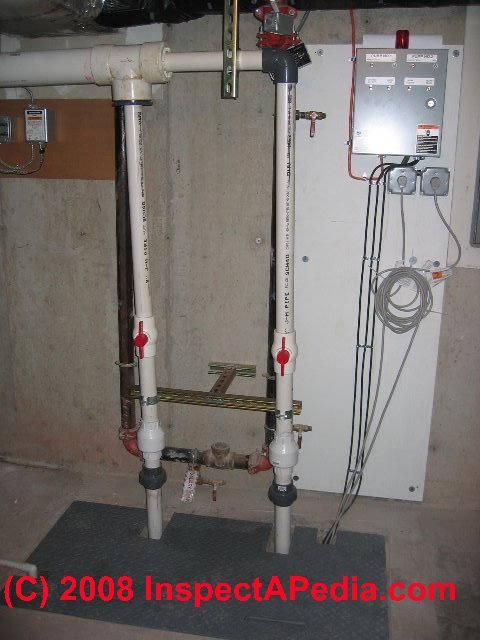
is needed at the discharge line (as we show in the photo above).
Unless a check valve is installed, when the septic pump motor turns off you'll hear a large volume of water running backwards into the pumping chamber from the discharge line, causing the pump to turn on again too soon or even to cycle continuously; the check valve also assures that a sewer main does not back up into a building and flood it through the sewage ejector pump system.
See SEPTIC PUMP INSTALLATION - Clogged grinder pump impeller:
clogging in the impeller (reduced discharge or in severe cases loss of pump output, motor trips on overload)
Clogging in a septic effluent pump often occurs when the wrong pump type has been selected and the pump cannot handle solids entering the system. Clogs also occur if improper materials (dental floss, tampons) are flushed down toilets.
Clogged pumps also occur when a white or gray waxy deposit accumulates, often due to bacterial growth or to use of powdered detergents.
See SEPTIC / SEWAGE PUMP WAXY CLOGGING
See SEPTIC / SEWAGE PUMP NO-FLUSH LIST - Clogged discharge line vent:
required in the discharge line at height of top of pump where some check valves such as Zoeller Unicheck are installed. Normal: look for water discharge from this 3/16" opening when the pump is on and briefly at the end of pump-on cycle - Components missing:
confirm the presence of each of the sewage grinder system components shown
at SEPTIC PUMP INSTALLATION where we illustrate a complete pump installation - Debris in the pump basin:
loose debris, wood, hair, string, etc. will clog and damage the pump. - Leaks, exposed wires, unprotected openings
into the pumping chamber or tank - Odors at the sewage or septic pump:
often caused by improper reservoir seal, a bad check valve, or improper venting.
See SEWAGE PUMP ODORS - Operation check for the sewage or septic pump:
turn on a nearby plumbing fixture to fill the reservoir tank, observe the pump operation, turning on and off normally - Pump opening cover:
for safety the sump pumping basin must have a secure, child-proof cover in place; in some installations the cover must also be gas-tight. - Pump type: has the proper type of pump been installed for the application? Don't install a simple basin pump or effluent pump where pumping sewage and solids is required.
At SEPTIC & SEWAGE PUMPS we explain that choosing the wrong type of pump, such as installing a simple basin pump or effluent pump (designed to handle primarily liquid waste) on a system where blackwater (toilet waste) is entering the system is likely to lead to pump clogging and failure.
Pump selection and pump types are discussed
at SEWAGE EJECTOR / GRINDER PUMPS - Reservoir: damaged ejector/grinder pump reservoir or basin:
the fiberglass or plastic container should be intact, with no cracks, breaks, improper holes, or other damage. Some basins are made of cast iron and use a cast iron lid. The lid should fit securely, be of the proper material, and not be leaking. - Venting of the pumping chamber:
Presence of adequate tank venting. Openings in the pumping chamber or tank itself may discharge odors, dangerous sewer gases, or even bacteria and sewage backup into the room. If a vent is omitted, when the pump is running it will create an unwanted vacuum in the sewage reservoir. - Also see the sewage / septic grinder pump diagnosis & repair tips
at SEWAGE PUMP DAMAGE & REPAIR
...
Continue reading at SEWAGE PUMP DAMAGE & REPAIR or select a topic from the closely-related articles below, or see the complete ARTICLE INDEX.
Or see SEPTIC / SEWAGE PUMP INSPECTION & MAINTENANCE FAQs - questions and answers posted originally on this page.
Or see these
Recommended Articles
- SEPTIC SYSTEM PUMPS - home
- SEWAGE EJECTOR / GRINDER PUMP TYPES
- DISPOSABLE WET WIPE CLOGS
- FREE-STANDING GRINDER PUMPS
- SEWAGE TREATMENT PLANTS, RESIDENTIAL
- SEPTIC PUMP ALARM SYSTEMS
- SEPTIC PUMP BUYERS GUIDE & MANUALS
- SEPTIC PUMP DUPLEX DESIGNS
- SEPTIC PUMP INSPECTION & MAINTENANCE
- SEPTIC PUMP INSTALLATION
- SEWAGE PUMP DAMAGE & REPAIR
- SEWAGE PUMP INTERMITTENT CYCLING
- SEWAGE PUMPING STATIONS
- SEWAGE PUMP BUYERS GUIDE & MANUALS
- SEWAGE PUMP DAMAGE & REPAIR
- SEWAGE PUMP ODORS
- SEWAGE ODOR SOURCE LOCATION
- SEWAGE PUMPING STATIONS
- WAXY BIOFILM SLIME CLOGS in DRAINS & PUMPS
- SUMP PUMPS
Suggested citation for this web page
SEPTIC PUMP INSPECTION & MAINTENANCE at InspectApedia.com - online encyclopedia of building & environmental inspection, testing, diagnosis, repair, & problem prevention advice.
Or see this
INDEX to RELATED ARTICLES: ARTICLE INDEX to SEPTIC SYSTEMS
Or use the SEARCH BOX found below to Ask a Question or Search InspectApedia
Ask a Question or Search InspectApedia
Share this article:Search the InspectApedia website
Need to make a private comment? Email editor@inspectApedia.com. We welcome email with your website content critique, corrections, suggestions or questions. Email is monitored daily but our workload may prevent an immediate reply. For immediate results, we hope you'll first try asking your question using the search box just above.
Citations & References
In addition to any citations in the article above, a full list is available on request.
- The NSFC Products List has an excellent list of design manuals/modules National Small Flows Clearinghouse (NSFC) now (2019/12/13) hosted at http://www.nesc.wvu.edu/ Tel: 304-293-4191 e-mail info@mail.nesc.wvu.edu.
The National Small Flows Clearinghouse (NSFC) was funded by the U.S. Environmental Protection Agency (EPA) to help America's small communities and individuals solve their wastewater problems through objective information about onsite wastewater collection and treatment systems. NSFC products and information are the only national resource of its type, dealing with small community wastewater infrastructure. or by telephone 800-624-8301 - In addition to citations & references found in this article, see the research citations given at the end of the related articles found at our suggested
CONTINUE READING or RECOMMENDED ARTICLES.
- Carson, Dunlop & Associates Ltd., 120 Carlton Street Suite 407, Toronto ON M5A 4K2. Tel: (416) 964-9415 1-800-268-7070 Email: info@carsondunlop.com. Alan Carson is a past president of ASHI, the American Society of Home Inspectors.
Thanks to Alan Carson and Bob Dunlop, for permission for InspectAPedia to use text excerpts from The HOME REFERENCE BOOK - the Encyclopedia of Homes and to use illustrations from The ILLUSTRATED HOME .
Carson Dunlop Associates provides extensive home inspection education and report writing material. In gratitude we provide links to tsome Carson Dunlop Associates products and services.
 |
HOME | ABOUT | ASK a QUESTION | CONTACT | CONTENT USE POLICY | DESCRIPTION | POLICIES | PRIVACY | |
| © 2026 - 1985 Publisher InspectApedia.com - Daniel Friedman | |||||||||