
InspectAPedia® FREE Encyclopedia of Building & Environmental Construction, Diagnosis, Maintenance & Repair |
Question? Just ask us! InspectAPedia
|
 Guide to Heating & Cooling Electrical Power Switches
- POST a QUESTION or COMMENT about the emergency off switch on heating equipment
Electrical power switches & emergency off switches for heating equipment:
This article describes the usual location and function of electrical switches that control power to all types of heating equipment.
We explain the purpose and use of heating system emergency "off" switches, where they are located, how they are used, and wiring requirements.
InspectAPedia tolerates no conflicts of interest. We have no relationship with advertisers, products, or services discussed at this website.
- Daniel Friedman, Publisher/Editor/Author - See WHO ARE WE?
A Guide to Finding & Using Electrical Power Switches to Turn On or Off Heaters for Furnaces & Boilers, Heat Pumps or Electric Furnaces or Air Conditioners
If your building has lost heat,
checking that the heating equipment is actually turned "on" at all of these switches is a first step in diagnosing the problem. This article series answers most questions about central heating system troubleshooting, inspection, diagnosis, and repairs.
We describe how to inspect, troubleshoot and repair heating and air conditioning systems to inform home owners, buyers, and home inspectors of common heating system defects.
Electrical power switches on heating and cooling systems:
where will the power switches be located, how do we know if we have turned on power to the heating or cooling system?
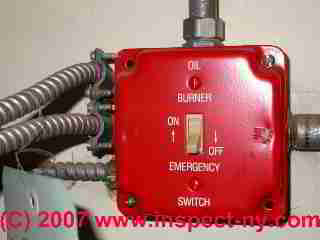
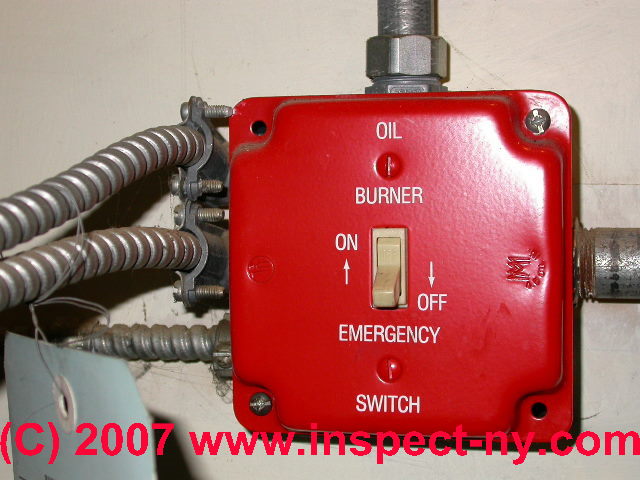
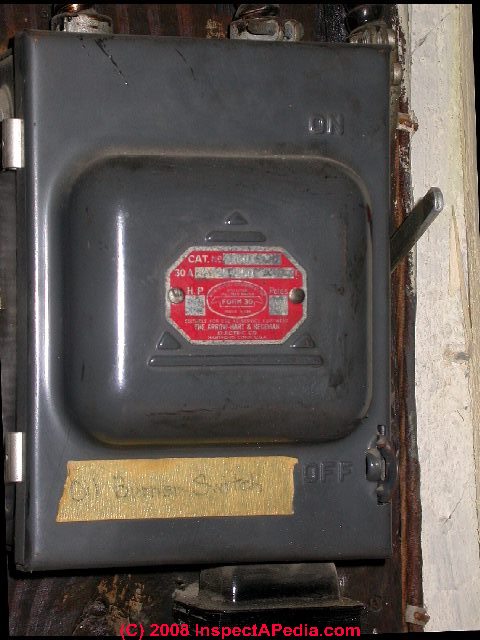
Our page top photo shows a typical emergency off switch for a heating system. Our photo at left shows a fuse box that is used to accomplish the same purpose, though this older switch is more likely to be found near the entry to a basement where heating equipment is located.
Electrical switches that turn off electric power that operates any type of heating system: furnace, boiler, steam boiler, heat pump, electric heat, are required for both safety and for service.
An emergency off switch
for the building heating system should be found outside of the basement or other boiler or furnace room location and accessible so that an occupant can, in an emergency, turn off heat without having to enter a possibly smoky or dangerous area.
A second electrical "off" service switch
should be found on or very close to the heating equipment itself. This second service switch is used by the heating service technician.
A third electrical switch or fuse
turns off power to the heating equipment service at the building electrical panel. If a circuit breaker has tripped or a fuse has blown on the heating equipment's electrical circuit, you may be able to restore heat at the electrical panel.
But for safety reasons it is important to determine why the fuse blew or the circuit breaker tripped. If you replace a fuse or re-set a circuit breaker and the fuse blows or circuit breaker trips again, do not restore electrical power to that circuit - call a service technician to diagnose and repair the problem.
Questions & Answers about the emergency off switch on heating equipment
Question: My mom turns the boiler “service” red switch on and off all the time
My mom turns the boiler “service” red switch on and off all the time and I am worried that it is a danger. She has oil heat that primes a burner and I’m afraid that she is turning it off when the system is still on and demanding heat (programmed thermostat in other apt. units)and that this will create fumes, or some kind of buildup or off gassing.
There is no need for her to do this. She is elderly and is not thinking rationally. Can you advise please? Thank you in advance, Her daughter, K.E.
Reply: What sort of problems may be caused by frequent turning of the oil heat switch "on" and "off"?
A competent onsite inspection by an expert usually finds additional clues that help accurately diagnose a problem or in this case that might indicate whether frequent "on-off" switching of the oil heater emergency off switch has caused an operating problem such as sooting-up of the combustion chamber or oil burner nozzle.
That said, here are some things to consider about using the emergency off switch on an oil fired heating system or oil fired water heater:
Infrequent (once a day or less often) turning on or off of an oil fired heating appliance (heating boiler or water heater, for example) at the service switch like the one you describe would not cause damage to the equipment though, of course, if someone leaves heat off in freezing weather a freeze-up in the building could lead to very costly damage.
Just turning off the oil burner, provided the system has reached full operating temperature, would not be expected to cause a problematic level of fumes or smells in the building.
Watch out: But frequent "on-off" switching of an oil fired appliance when it is in use (calling for heat or calling for hot water) could lead to a more subtle operating problem: it takes about five minutes for an oil fired heating appliance to reach full operating temperature.
Up until that time the system is not running as cleanly as it does at full temperature, it's a bit more smoky/sooty. So if someone keeps turning the system on and off frequently such that it does not sufficiently often reach full operating temperature, the result could be sooting and ultimately a clogged oil burner nozzle, leading to improper operation, inefficient operation, or even in the most extreme case, loss of heat.
Why don't you ask your mom why she's been turning the system on and off to see if you can find another way to ease her concerns.
Reader Comment: advice about oil burner emergency switches & their wiring
2 Feb 2015 NHFireBear said:
NFPA 31 for oil burners requires the "emergency switch" to interrupt the BURNER SUPPLY CIRCUIT, not the appliance power circuit. It is NOT the same as the "service switch" on the unit itself. The switch must be located outside of the room where the burner is installed.
There is no mention of cellar stairs, however, many fire chiefs and inspectors require the "emergency boiler switch" to be located on the upstairs side of the door to a cellar where an oil burner is installed. That way, not only does it allow you to shut off the burner without opening the door, it also signals the firefighters WHICH DOOR goes to the basement.
In a companion article at FIRE SAFETY CONTROLS NHFireBear also elaborated:
The "emergency" oil burner shutoff switch must be wired into the "burner supply circuit", according to NFPA 31. It is different from the "service switch" on the unit, which must be at or near the unit.
As mentioned in the FIRE SAFETY CONTROLS article [and in the article above on this page], the identified "emergency" switch must be located outside the boiler room and generally outside the door to the cellar steps, if the boiler is in the basement.
That way the switch can be turned off without opening the door, and the presence of the switch serves as a marker for which door is the one to the basement.
Many installers simply run the appliance power feed through the "emergency" switch, which means it ALSO turns off any sidewall vents, circulators, fans, thermostats, and other devices powered through the appliance controls -- not just the burner.
The NFPA is presently evaluating whether such an installation is safe, let alone proper, under the existing Code.
Reply:
Thanks NHFireBear - we've added your note here and at FIRE SAFETY CONTROLS.
Really? Indeed it's an interesting point that if we shut off a blower fan on a furnace while the heat exchanger is still quite hot, the result could be a cracked (and thence unsafe) heat exchanger. On the other hand, if there is a building fire, particularly orignating in the furnace or boiler room, we hardly want to keep a furnace blower fan running.
How to Identify, Reset, or Adjust Heating or Air Conditioning System Controls and Switches
If you are looking for the main reset button on heating equipment you'll want to
see COOLING & HEATING CONTROL & SWITCH INDEX - master index to all controls for cooling or heating equipment reset buttons, switches, controls, or see the suggested articles below:
- A/C - HEAT PUMP CONTROLS & SWITCHES - list of controls and switches found on air conditioners and heat pumps
- AIR BLEEDER VALVES for Hot Water Heating Systems: Radiators, Baseboards, Convectors
- AQUASTATS & Heating Boiler Primary Controls: guide to Aquastats for control of hot water heating boilers and tankless coils
- BLUE vs YELLOW COMBUSTION FLAMES - the Blueray history and blue flame vs. yellow flame combustion, flame color & combustion efficiency, & how oil competes with gas as a heating fuel.
- BOILER CONTROLS & SWITCHES - list of controls and switches found on hot water heating systems
- BOILER COMPONENTS & PARTS
- CAD CELL RELAY SWITCH On oil fired furnaces or boilers as flame sensors & safety devices
- Check Valves Guide to check valves and backflow preventers on hydronic hot water heating systems gas or oil fired
- COMPRESSOR DISCONNECT SWITCH
- DRAFT REGULATORS / HOODS GAS HEATERS On gas fired heating equipment, function and safety
- DRAFT REGULATOR, DAMPER, BOOSTER & barometric dampers on oil fired heating equipment
- ELECTRICAL POWER SWITCH FOR HEAT - emergency heat on-off switches and equipment service switches
- EXPANSION TANKS Guide to pressure control and expansion tanks on hydronic hot water heating systems gas or oil fired
- FAN LIMIT SWITCH On hot air furnace heating systems gas or oil fired
- FLUE GAS SPILL SWITCH On gas fired heating equipment sense combustion and protect from blocked flues
- FURNACE CONTROLS & SWITCHES - list of the controls and switches found on hot air heating systems
- GAS PIPING, VALVES, CONTROLS including gas regulator assembly and other controls
- MIXING / ANTI-SCALD VALVES: Guide to mixing valves on hot water heating systems and radiant heat systems
- POWER SWITCHES [& EMERGENCY OFF SWITCHES] to turn on or off heaters for furnaces & boilers, oil & gas fired, heat pumps or electric furnaces or boilers
- RELIEF VALVES - TP VALVES: A guide to temperature and pressure relief valves & safety controls on hot water and steam heating systems
- STACK RELAY SWITCH On oil fired furnaces or boilers as flame sensors & safety devices
- STEAM HEATING SYSTEMS - steam heating system components, switches, diagnosis & repair guides
- THERMOSTATS & HEAT CONTROLS for furnaces & boilers, oil & gas fired, heat pumps or electric furnaces or boilers
- WATER FEED VALVES: A guide to water-feeding/pressure-reducing valves on hot water and steam heating systems
- ZONE DAMPERS: A guide to automatic or electrical zone dampers in heating or air conditioning ductwork
- ZONE VALVES, HEATING: A guide to zone valves for heating zone control on hot water heating systems
The articles at this website describe the basic components of a home heating system, how to find the rated heating capacity of an heating system by examining various data tags and components, how to recognize common heating system operating or safety defects, and how to save money on home heating costs. We include product safety recall and other heating system hazards.
...
Reader Comments, Questions & Answers About The Article Above
Below you will find questions and answers previously posted on this page at its page bottom reader comment box.
Reader Q&A - also see RECOMMENDED ARTICLES & FAQs
On 2020-01-19 by (mod) - writing on red emergency off switch plate covers
Umesh
Thanks for a great question about the red emergency switch plate lettering for Gas vs Oil.
All it means is that when the electrician who installed your gas central heating emergency OFF switch was wiring up the switch she didn't have a red EMERGENCY OFF GAS HEATER switch plate but she did have an EMERGENCY OFF OIL HEATER switch plate.
It's fine as it is, or if you like you can write GAS over the "OIL" letters using a magic marker.
On 2020-01-19 by Umesh
I have gas central heating, but the emergency red switch plate says OIL. What does it mean ?
On 2019-11-25 by (mod) - Regency gas heater wiring & IO Manual
Steve
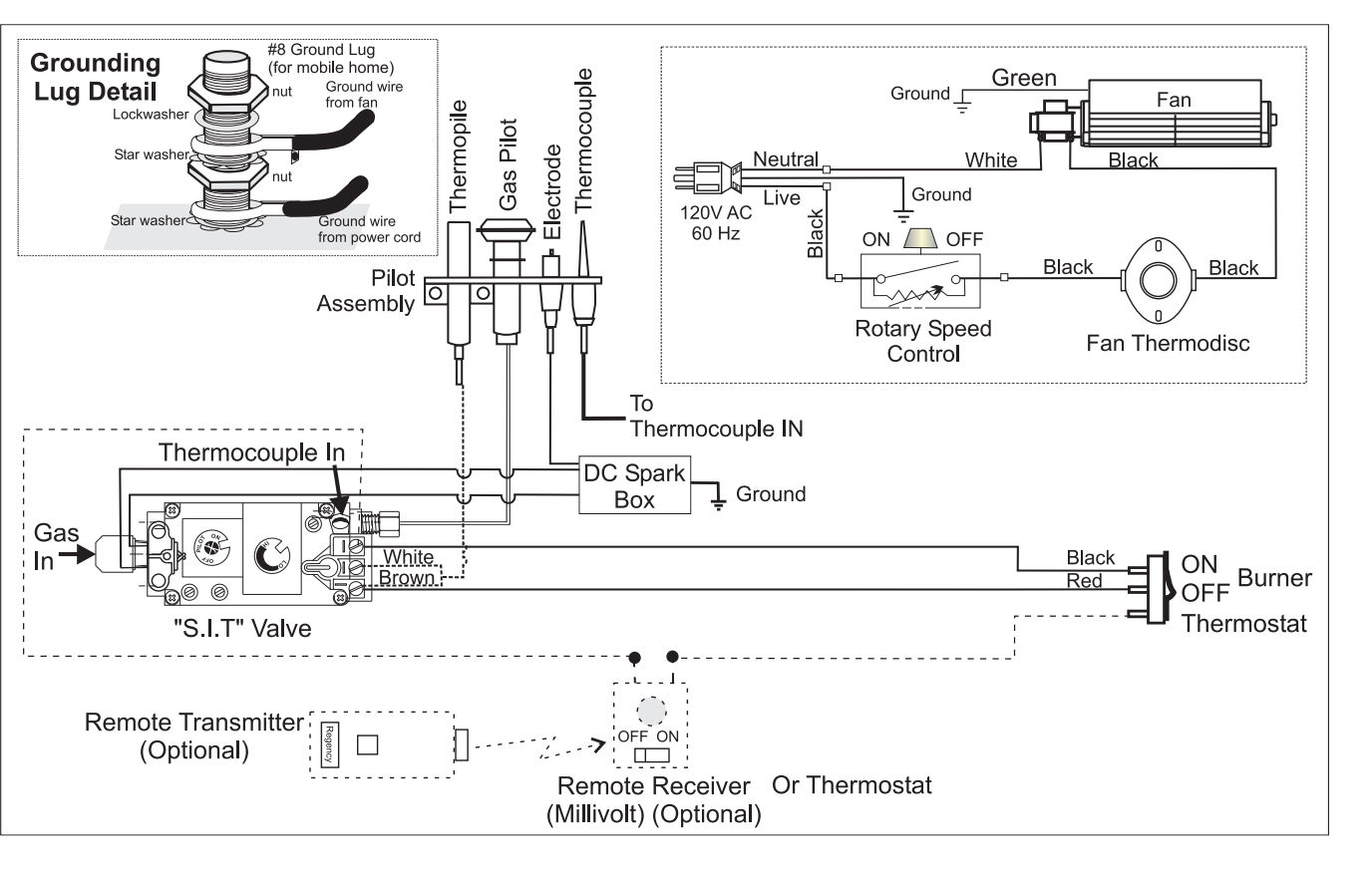
That's an interesting question. I don't know; you'll want to contact the manufacturer, or have your electrician examine the wiring diagram for the heater. We don't know the point at which the remote connects to switches to set heat output levels.
If you don't have it, download the manual for your Regency U39 Gas Heater SERVICE MANUAL [PDF] here
here's the wiring diagram - I do not see a 3-way burner switch; perhaps you have a different model.
Beware that fooling with stove wiring could make your heater unsafe. [Click to enlarge any image]
On 2019-11-25 by steve
if i replace a 3 way burner switch with a 2 way switch on a Regency U 39 gas heater, will that effect the use of the remote or thermostat?
On 2019-10-08 1 by (mod) -
Jeff
Turning a boiler on or off at an electrical switch that is ONLY switching the heater on and off ought not affect the buiding's water supply at all.
I'd need to know more to make a more specific suggestion. For example: is your building served by a private pump and well system? Might you have switched the pump off?
On 2019-10-05 by Jeff
I had no heat and I turned on the emergency oil burner switch, and it worked, but I left it on for hours, now the water has shut off.
On 2019-05-08 by kevin harris
You should never keep the switch to your boiler always open, you can always switch it on and off in my opinion. It also saves you a lot on the electricity!
On 2017-10-17 by (mod) - cost to install an emergency off switch on an electrical circuit for a heating system
Sub
The cost to install an emergency off switch on an electrical circuit for a heating system is going to depend on
- where you live: hourly rates vary widely by geographic area: in the U.S. electricians charge between $40. and $100 /hour
- the time and trouble to route the wire from the circuit to be controlled to the switch location - ranging from short, easy, trivial, all accessible to more difficult fishing of wires through finished walls and ceilings - but you can figure an hour as the absolute minimum and 2 hours as certainly possible
- the materials: wire, electrical box, switch, switchplate: less than $100. U.S.
So I figure the minimum cost is probably going to be around $65 U.S. and more likely twice that, possibly higher
On 2017-10-16 by Subbu
How much does it cost to install an emergency shut off switch at the top of the stairs to the basement?
On 2017-01-21 by (mod) - . Should it remain on or off?
Usually there is a power switch at, or or close to each major component: air handler or compressor/condenser.
The switch is normally ON so that your heat pump can operate.
On 2017-01-21 by Laurel Smith
There is an on/ off switch located on the unit where the filter is located. Should it remain on or off? It's a Carrier heat pump.
On 2016-10-14 by Anonymous
How do I repair on off swich
Question:
(Apr 15, 2012) wanda said:
what would be the problem if you turn on your ac is on auto and your fan in your unit is not running?
Reply:
Could be power is off, or the thermostat is set to a temp higher than the current actual room temp, or an actual equipment problems.
Search InspectAPedia for
"How to Diagnose & Repair Loss of Air Conditioner / Heat Pump Cooling Capacity or an Air Conditioner that is Not Working"
To see a diagnostic procedure
Question: locate the heat emergency off at top of the cellar stairs?
(Aug 27, 2012) Gary H Prince said:
Is the emergency electrical switch required to be located in the living space or can it be located at the top of the cellar stairs?
Reply:
Gary see NHFireBear's remarks in the article above about emergency power off switches for HVAC equipment.
We like to see the emergency switch at the top of the cellar stairs if the equipment is located in the cellar so that in event of a fire no one has to enter that space (which could be unsafe) and so that the fire fighters have a clue about where the equipment is located.
Additional "OFF" switches can be located elsewhere. For example another similarly-marked "Emergency OFF" switch is found right at the equipment and is used by service personnel.
Question: Wall switch for heat off disabled by landlord
(June 9, 2014) xenaon said:
i rent from a bad guy. He shut off the wall switch - which shut off the fan.
Before, if I turned on the wall switch - the AC went on.
Now, it doesn't.
Inside my apt the AC and Furnace breakers are fine. 3 hours later, the bully shut off the gas water tank downstairs - turning the switch horizontal, then setting it to off and vacation, so the pilot light is out.
I cannot relight the pilot - turn on the gas line, hold down the pilot valve - won't light.
I cannot find a way to turn on the Rheem Criterian II gas/AC unit. What else needs to be turned on? Thermostat (Honeywell) does not ignite the AC or fan or heat - but it could not possibly be the thermostat as the person who shut off the fan switch - also turned off the water heater.
Reply:
Xenaon: I'm reluctant to step into the middle of a tenant-landlord dispute: that's a matter for you to take up with your landlord directly, politely, orally and in writing as appropriate or if absolutely necessary, with an attorney.
However it is essential that safety controls in a building are left working properly. So being able to turn OFF heat in an emergency is required for safety (and by model building codes and depending on where you live, local regulations.
The requirement to be able to turn ON heat or to have adequate heat during winter weather is usually spelled out in rental or lease agreements and again, depneding on where you live, by local laws. For example tenants in New York City are protected by New York City regulations managed by the NYC Housing Preservatin and Development department - from which we excerpt the following:
Heat and hot water are required to be provided for all tenants (although based on your lease you may be required to pay for gas, fuel, or electricity to run heating equipment).
Property owners are required to provide hot water 365 days per year at a constant minimum temperature of 120 degrees Fahrenheit.
Between October 1st and May 31st, a period designated as "Heat Season," property owners are also required to provide tenants with heat under the following conditions:
- Between the hours of 6:00 AM and 10:00 PM, if the outside temperature falls below 55 degrees, the inside temperature is required to be at least 68 degrees Fahrenheit; and,
- Between the hours of 10:00 PM and 6:00 AM, if the temperature outside falls below 40 degrees, the inside temperature is required to be at least 55 degrees Fahrenheit.
To see if there are any open heat and hot water violations on your building or to check the status of your heat and hot water complaint, visit HPD ONLINE. - retrieved 3 Feb 2015, original source: http://www1.nyc.gov/site/hpd/renters/important-safety-issues-heat-hot-water.page
...
Continue reading at BOILER CONTROLS & SWITCHES or select a topic from the closely-related articles below, or see the complete ARTICLE INDEX.
Or see these
Recommended Articles
- A/C & HEAT PUMP OPERATING CONTROLS
- AIR CONDITIONING & HEAT PUMP CONTROLS & SWITCHES
- BOILER CONTROLS & SWITCHES
- COOLING & HEATING CONTROL & SWITCH INDEX
- ELECTRICAL POWER SWITCH FOR HEAT
- FURNACE CONTROLS & SWITCHES
- MANUALS & PARTS GUIDES - HVAC - home - Master Index to All Brand Names & HVAC manuals, wiring diagrams, installation and repair guides
- OIL BURNER MANUALS
- MANUALS for HEATING & A/C SYSTEM CONTROLS
- STEAM HEATING SYSTEMS & CONTROLS - home
Suggested citation for this web page
ELECTRICAL POWER SWITCH FOR HEAT at InspectApedia.com - online encyclopedia of building & environmental inspection, testing, diagnosis, repair, & problem prevention advice.
Or see this
INDEX to RELATED ARTICLES: ARTICLE INDEX to HEATING SYSTEMS
Or use the SEARCH BOX found below to Ask a Question or Search InspectApedia
Ask a Question or Search InspectApedia
Try the search box just below, or if you prefer, post a question or comment in the Comments box below and we will respond promptly.
Search the InspectApedia website
Note: appearance of your Comment below may be delayed: if your comment contains an image, photograph, web link, or text that looks to the software as if it might be a web link, your posting will appear after it has been approved by a moderator. Apologies for the delay.
Only one image can be added per comment but you can post as many comments, and therefore images, as you like.
You will not receive a notification when a response to your question has been posted.
Please bookmark this page to make it easy for you to check back for our response.
IF above you see "Comment Form is loading comments..." then COMMENT BOX - countable.ca / bawkbox.com IS NOT WORKING.
In any case you are welcome to send an email directly to us at InspectApedia.com at editor@inspectApedia.com
We'll reply to you directly. Please help us help you by noting, in your email, the URL of the InspectApedia page where you wanted to comment.
Citations & References
In addition to any citations in the article above, a full list is available on request.
- The Steam Book, 1984, Training and Education Department, Fluid Handling Division, ITT [probably out of print, possibly available from several home inspection supply companies] Fuel Oil and Oil Heat Magazine, October 1990, offers an update,
- "Residential Steam Heating Systems", Instructional Technologies Institute, Inc., 145 "D" Grassy Plain St., Bethel, CT 06801 800/227-1663 [home inspection training material] 1987
- "Residential Hydronic (circulating hot water) Heating Systems", Instructional Technologies Institute, Inc., 145 "D" Grassy Plain St., Bethel, CT 06801 800/227-1663 [home inspection training material] 1987
- "Warm Air Heating Systems". Instructional Technologies Institute, Inc., 145 "D" Grassy Plain St., Bethel, CT 06801 800/227-1663 [home inspection training material] 1987
- In addition to citations & references found in this article, see the research citations given at the end of the related articles found at our suggested
CONTINUE READING or RECOMMENDED ARTICLES.
- Carson, Dunlop & Associates Ltd., 120 Carlton Street Suite 407, Toronto ON M5A 4K2. Tel: (416) 964-9415 1-800-268-7070 Email: info@carsondunlop.com. Alan Carson is a past president of ASHI, the American Society of Home Inspectors.
Thanks to Alan Carson and Bob Dunlop, for permission for InspectAPedia to use text excerpts from The HOME REFERENCE BOOK - the Encyclopedia of Homes and to use illustrations from The ILLUSTRATED HOME .
Carson Dunlop Associates provides extensive home inspection education and report writing material. In gratitude we provide links to tsome Carson Dunlop Associates products and services.
 | HOME | ABOUT | ASK a QUESTION | CONTACT | CONTENT USE POLICY | DESCRIPTION | POLICIES | PRIVACY | |
| © 2025 - 1985 Publisher InspectApedia.com - Daniel Friedman | |||||||||