
InspectAPedia® FREE Encyclopedia of Building & Environmental Construction, Diagnosis, Maintenance & Repair |
Question? Just ask us! InspectAPedia
|
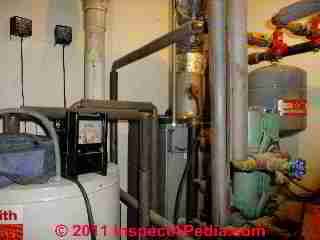 Draft Measurement Guide for Chimneys & Flues
How to measure & how to set or adjust chimney draft
- POST a QUESTION or COMMENT about inspecting and adjusting the barometric damper or draft regulator on oil fired heating equipment
How to measure draft at heating equipment or at chimneys.
This article explains the methods of measurement and proper adjustment settings for draft regulators or barometric dampers on oil fired heating equipment. This article series answers most questions about central heating system troubleshooting, inspection, diagnosis, and repairs.
We describe how to inspect, troubleshoot and repair heating and air conditioning systems to inform home owners, buyers, and home inspectors of common heating system defects.
InspectAPedia tolerates no conflicts of interest. We have no relationship with advertisers, products, or services discussed at this website.
Where & How Do We Measure Chimney Draft or Heating Appliance Flue Draft?
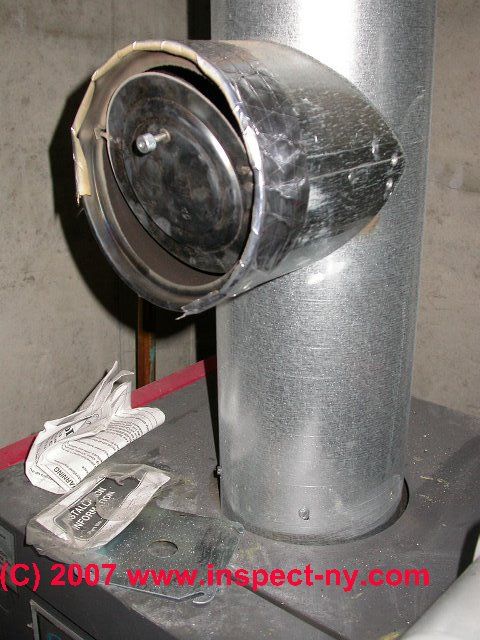
As we explain at our home page for this topic,
DRAFT REGULATOR, DAMPER, BOOSTER,
a barometric draft control, also called a "damper" or barometric damper, is a hinged, weighted door on an opening at a heating flue.
Barometric dampers are used on oil-fired heating appliances (furnaces, boilers, water heaters) to assure constant draft and thus uniform combustion.
[Click to enlarge any image]
Without this regulation (hence the term "draft regulator") as building and outdoor conditions vary (wind, doors open or shut, temperature etc), the draft seen by the heating appliance will vary, making maintenance of proper combustion conditions at the oil burner impossible.
A typical draft regulator is deceptively simple: The hinged door opens or closes to let extra air into the flue to assure that the draft in the flue remains constant at the proper setting needed for proper heating system operation.
Details about draft control for gas fired heating systems, including LP or natural gas fueled furnaces or boilers, are discussed separately
at DRAFT REGULATORS / HOODS GAS HEATERS On gas fired equipment.
Where do we Measure Chimney or Flue Draft & What is the Correct Draft Measurement at Oil Fired Heaters?
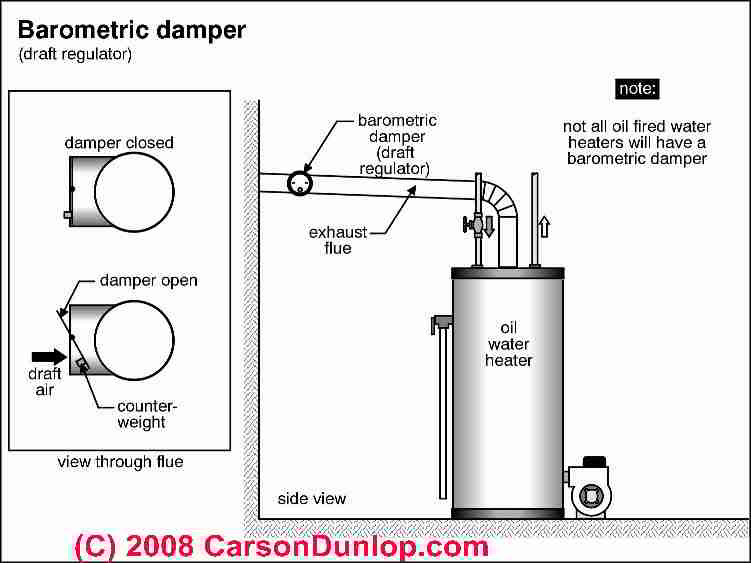
Normally we measure draft at two locations: over the fire or in the combustion chamber where typically we may see -0.02 to -0.03 inches of water column pressure, and in the breech or at the stack pipe (properly, the flue vent connector) measured just a few inches above the boiler or furnace top, and before the barometric damper itself.
[Click to enlarge any image]
Notice that we're using negative numbers for draft measurement - that's because gases in the flue are moving up, up, and away, like superman, and onwards out of the building - away from the heating equipment. The gas pressure in the chimney needs to be less than atmospheric pressure in the boiler room for gases to leave.
This sketch of a barometric damper used on oil fired heating equipment (heating boilers or water heaters) is provided courtesy of Carson Dunlop Associates, a Toronto home inspection, education & report writing tool company [ carsondunlop.com ].
In the breech we want to see about -0.05 inches WC pressure. If the
breech draft is too low the combustion process and venting process may be inadequate, and if the draft measured in the
breech is lower than the draft measured over the fire, the oil burner and combustion chamber are operating under
pressure - which is often a problem on residential heating systems since few of them are designed to work this way. Thanks to reader L. - for correcting our WC pressure data.
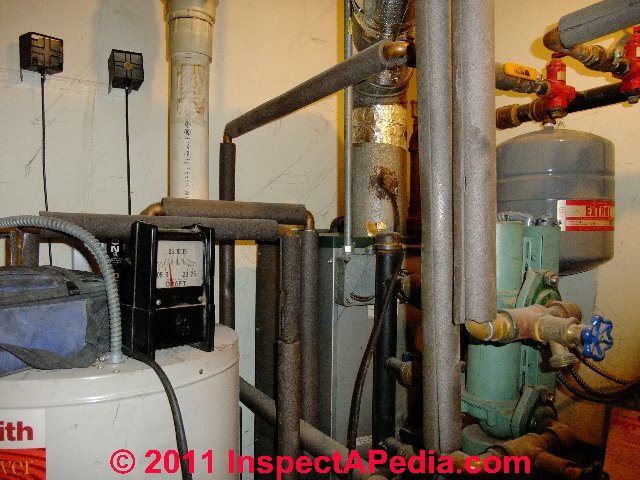
We do not measure draft in the flue vent connector past the barometric damper since the damper is regulating the draft and we're not seeing what the oil burner is seeing at the fire.
Lots of companies make draft gauge measurement devices, including Bachrach™, and including nice little pocket units that anyone can carry.
Our photo (left) shows a traditional Bachrach kit draft measurement gauge in use (green arrow) and its connection to the flue vent connector at the top of a boiler (red arrow) that in this case had no barometric damper installed.
This boiler had a poor draft, a history of sooting problems and a too-short chimney that we were in process of replacing when these photos of draft measurement procedure were made.
At this New York home (photos just above and below) the draft in the breech was running at about -0.02" w.c. - it should have been at least twice that amount.
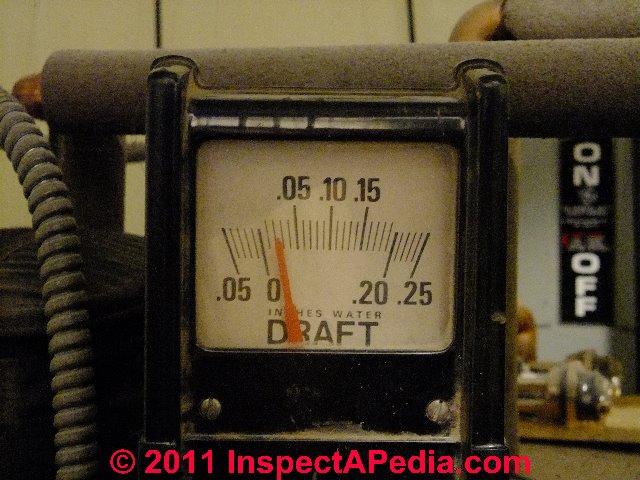
Above you can see that the draft was hovering around 0.02" and below you can see our connection of the draft gauge sensing probe into the flue vent connector just above the boiler top.
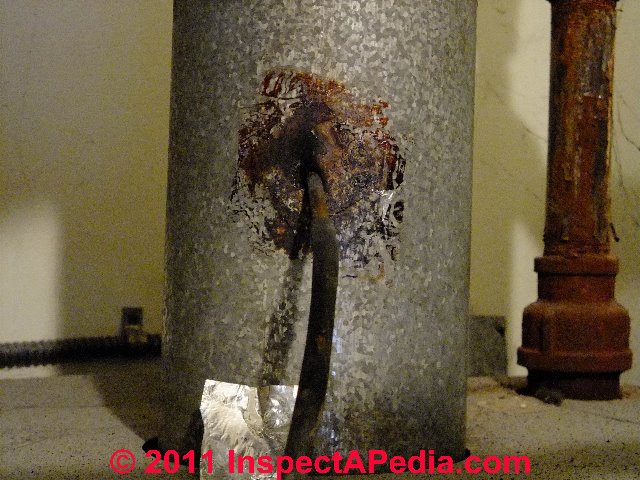
How Much Draft do we Want at an Oil Burner Fired Heating Boiler, Furnace, or Water Heater?
In sum the draft we typically see on oil fired heating equipment is
- - 0.02" to 0.03" water column (w.c.) in the combustion chamber just over the fire
- - 0.04" to 0.06" w.c. in the breech - the flue pipe area between the top of the boiler and the bottom of the barometric damper.
Some oil burner models require higher draft than these numbers, and other oil burner models are actually tolerant of back-pressure in the combustion chamber (positive draft, or draft in the "wrong" direction").
Note: wood stoves, coal stoves, pellet stoves, and catalytic wood stoves have different draft requirements.
See details at
Correcting Inadequate Chimney Draft - extending the flue height
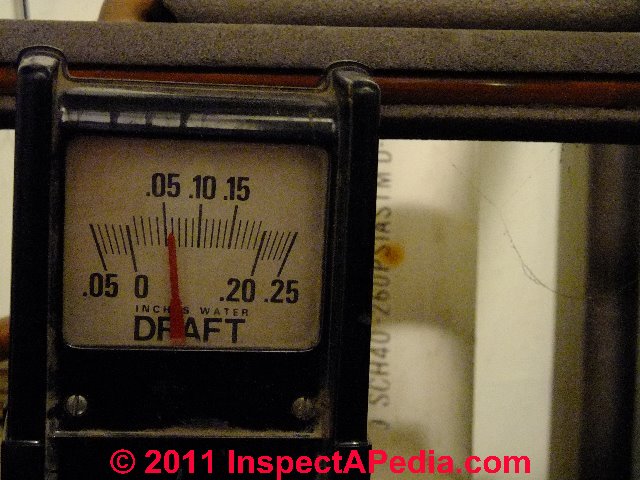
In the heating industry, traditionally draft measurements around -0.02" w.c. are considered "low", and around-0.06" w.c. are "high" draft levels.

After we replaced the too-short chimney with one of proper height, and with a draft regulator (barometric damper) now installed at the boiler top, our measurement showed that we had a good draft in the flue vent connector - almost 0.06" w.c. in the breech (photo above left).
In our chimney replacement photo (above right) the new chimney extending 24" above the roof of a new addition (green arrow) is much taller than the original 20" chimney (red arrow). That's how we got good draft in the new chimney set-up.
See details of diagnosing and fixing chimney draft problems found at
- CHIMNEY DRAFT & PERFORMANCE - diagnose chimney different chimney draft problems
- CHIMNEY HEIGHT EXTENSIONS
What are the recommended draft settings at a draft regulator / barometric damper?
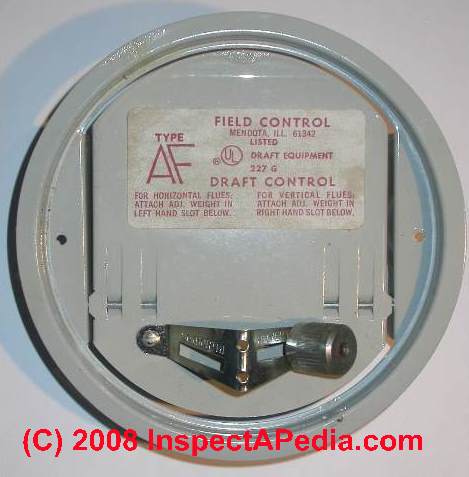
By moving a weight along a scale. You can see a weight and scale in our photo of the Field Type AF Draft Control.
In general, for oil fired heating equipment the draft regulator is set to the lowest draft that gives good combustion and proper oil burner operation. Higher wastes energy.
While the heating equipment is operating at normal temperature, the draft is set to a number specified by the oil burner manufacturer, so we can only give approximate settings in this discussion.
To find the proper weight setting to control the draft regulator, the heating service technician will make three measurements - for oil fired heating equipment
- Draft over the fire (typically set to 0.02" to 0.03" WC over the fire)
- Draft in the breech (always higher than the draft over the fire, and typically around 0.04 - 0.06" WC).
- CO2 measurements (which tells us how complete is the heating oil combustion process) - adjusting the draft affects the rate of combustion air movement into the combustion chamber.
It is the position of the weight along a moveable scale, usually by screwing the weight in or out, or by sliding the weight along a scale (see our photo), that adjusts how far the draft regulator door will open in response to these three conditions described above. It's basically a principle of leverage -the weight is moved closer to or farther out from the axis of rotation of the moving draft regulator door.
So do not change the barometric draft control's weight setting unless you're a trained service technician who knows when, where, how, and why to measure draft at an oil fired heating appliance.
Watch out: other heating fuels and other heater types such as woodstoves, coal stoves, and pellet stoves each will have its own draft setting requirements. Be sure to read the proper instructions that fit the device whose draft you are regulating.
Example: a woodstove using a catalytic combustor may require a draft setting of 0.05" WC
See details at
WOOD STOVE, CATALYTIC PUFF-BACKS
See also PELLET STOVE DRAFT CONTROL
Barometric Damper Weight location & adjustment on draft controls
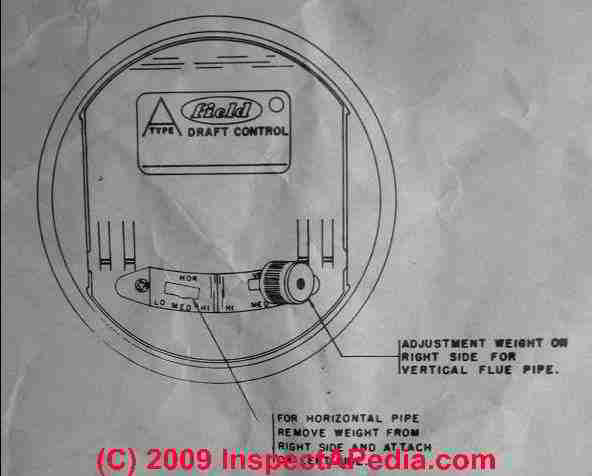
Weight location & adjustment on barometric draft controls: the weight that is adjusted to regulate the operation of the draft control needs to be properly located as well as adjusted.
The weight location switches on most regulators depending on whether the regulator is installed on a vertical flue or a horizontal flue. Field ships their draft regulators with the weight installed in position for a vertical flue.
The adjustment weight is in the right-hand slot when you are facing the control. If the damper is to be installed on a horizontal flue, the weight must be removed from the right-hand slot and attached to the left hand slot as shown in the illustration and sketches above.
Thanks to boiler expert Dirk Faegre for suggesting these additional details.
Because chimney defects also can have a severe effect on draft seen by the heating appliance, readers should also
see details at
- BAROMETRIC DAMPERS
- CHIMNEY DRAFT & PERFORMANCE
- FLUE VENT CONNECTORS, HEATING EQUIPMENT inspection, defect identification, and repair suggestions for the "stackpipe" that connects heating appliances to chimneys and flues.
Antique & Other Draft Indicator Instruments
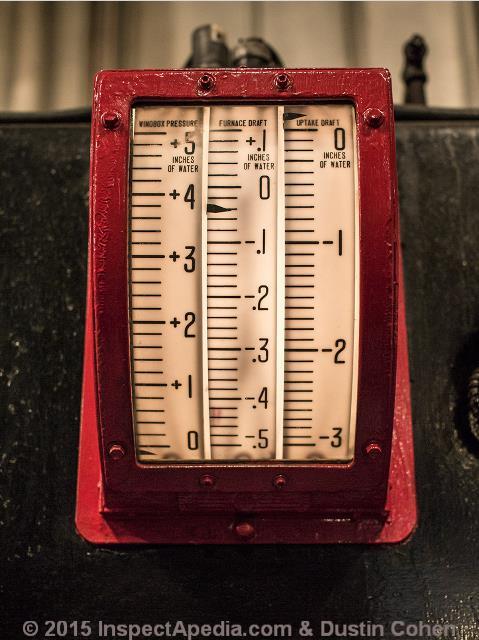
This multi-dial gauge provides critical information used to assure safe and proper function of the oil burners used to heat water to steam in the Pratt Engine Room steam boilers.
From left to right, this gauge measures wind-box pressure, furnace draft and uptake draft. Here the term "furnace" is being loosely applied as these are boilers. (Furnaces heat air, boilers heat water.)
The center gauge or "furnace draft" on most oil burners is measured in the combustion chamber right over the burner and is a critical data point.
Photo provided courtesy of NY photographer / director Dustin Cohen.
At STEAM BOILERS GENERATORS CONTROLS, PRATT we describe the multiple-readings of the draft gauge shown above.
Using the Bachrach Draft-Rite Gauge
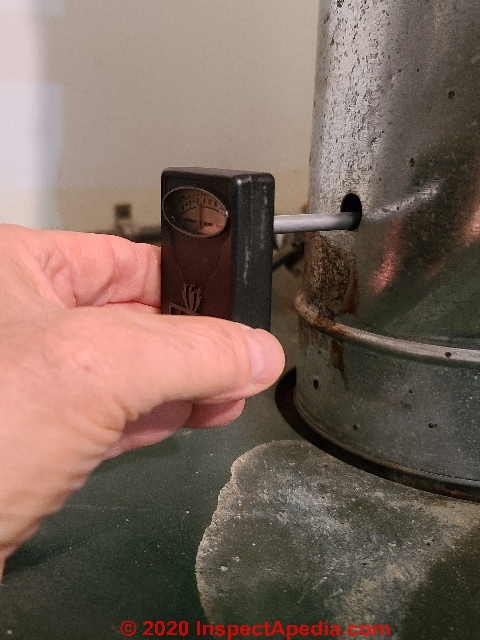
Above: one of my favorite draft tools is this little Bachrach Draft-Rite that fits into a shirt pocket. Here the tool's probe has been inserted into the flue vent connector above a heating boiler. When the hole is much larger than the probe Bachrach advises sticking the probe well into the flue (6 inches).
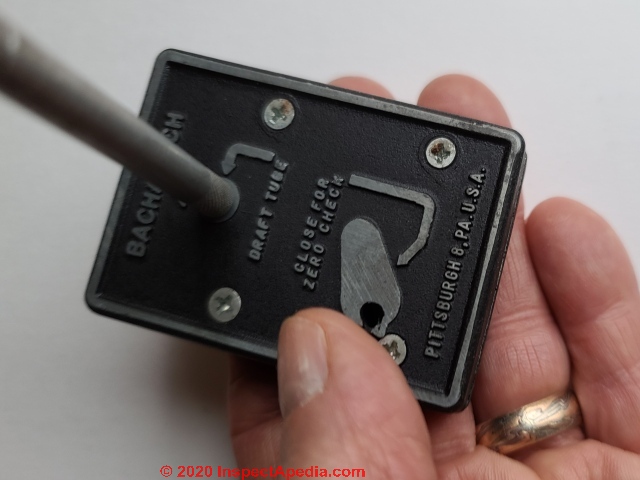
Below: a view of the Draft-Rite showing its zeroing opening covered by my thumb. With the hole covered and the gauge held upright it is turned until its pointer is at zero. At that point you're ready to take a draft measurement.
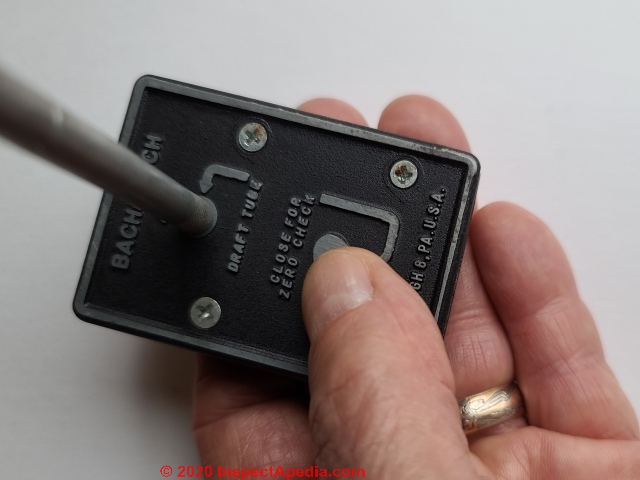
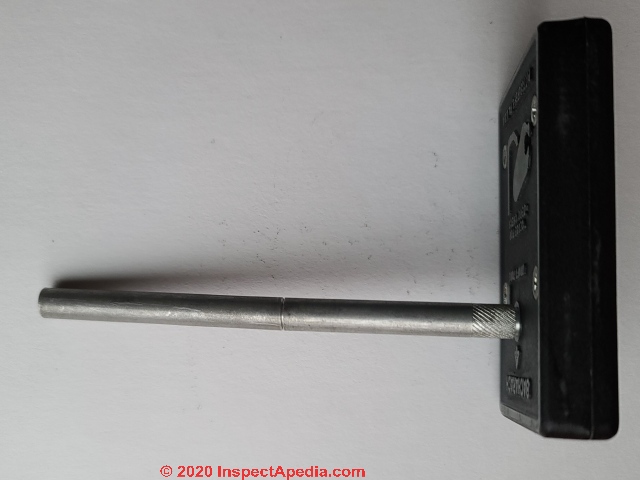
Below: view of this draft measuring tool showing the zeroing opening on its back and the detachable probe that, once assembled and screwed into the gauge back opening, is inserted into the flue vent connector opening or over the fire to measure draft.
Watch out: you would not actually make a measurement with the tool held as shown, as it's got to be upright and leveled with its pointer zeroed first, as shown above.
Below: The Bachrach DraftRite tool assembled, ready for use
Below: an example measurement of draft using the Draft-Rite showing - 0.04" of water or "negative" draft or "updraft. This gauge can measure updraft (on the right-hand scale) as negative numbers or updraft, or the tool can measure downdraft (on the left-hand scale) as positive numbers or pressures.
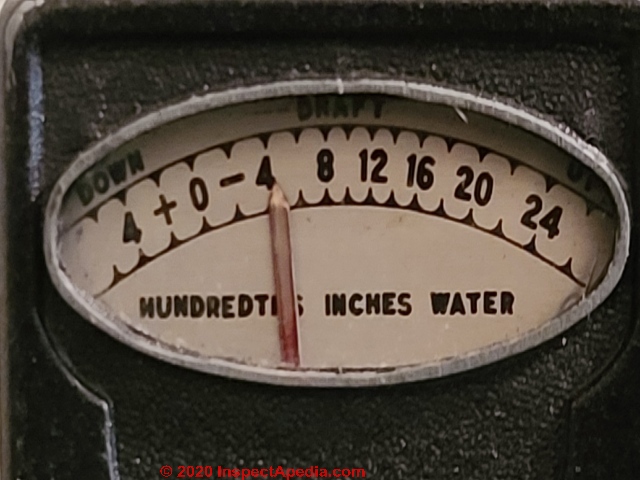
The gauge is reading just over 0.04" of water negative draft or "updraft" in a flue or chimney.
See also these
- BACHRACH DRAFT RITE INSTRUCTIONS [PDF] [From our archives], Bachrach Corporation has offices world wide.
Bachrach Canada: Bacharach, Inc. 10 West Pearce Street, Unit 4 Richmond Hill, Ontario. L4B 1B6, Canada Toll Free: +1 (800) 328 5217 Email: support@bachcan.ca
Bachrach Europe: Bacharach, Inc. Unit D12 & D13 Santry Business Park, Swords Road Santry, Dublin, Ireland Telephone: +353 (1) 284 6388 Email: eutechnical@mybacharach.com eusales@mybacharach.com
Bachrach USA: Bacharach, Inc. 621 Hunt Valley Circle New Kensington, PA 15068, United States Toll Free: +1 (800) 736 4666 Email: help@mybacharach.com
- An example of using the Draft-Rite draft gauge is
at CHIMNEY RESERVE DRAFT MEASUREMENT
Wood Stove Draft Adjustment, Testing & Measurement
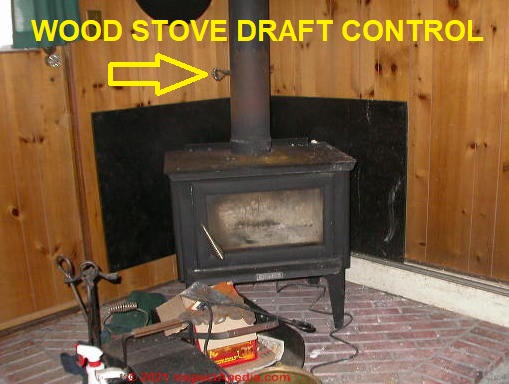 Checking the wood stove draft helps manage the fire's strength, heat, and assures proper exhaust venting.
Wood stove damper control: adjusts the rate of exhaust of combustion gases and smoke from the woodstove up into the chimney. More exhaust = hotter fire and less heat transfer into the room; Less exhaust = slower, smaller fire.
Shown here: our yellow arrow points to the draft outlet control on this wood burner.
A simple empirical test of woodstove draft adequacy is to watch the fire when you close-down or open-up the air inlet control to your woodstove.
Fire is brisk and the only combustion air inlet is through the normal stove's combustion air inlet: this shows that there is a good draft.
Fire doesn't change: If even after watching for a minute or two you see no change in the wood stove fire's height or level of activity when you change the air inlet settings, then look for draft problems and their cause
See details on how to measure, test or adjust the draft at a woodstove
and in that article also see
Draft Measurement & Management for Catalytic Wood-Stoves
 Reader Question: What should the draft be on my catalytic wood stove?
(2021-12-06) JR said:
During a "Back Puffing" event what would the draft measurement be above the flue collar?
And let me also ask, is it unreasonable to expect a catalytic wood stove to work properly with a draft at the collar between .04 and .08 inches of H2O ?
Properly meaning no fumes being pushed out during operation.
Illustration, one of three models of the Blaze-King KE40 catalytic combustor woodstove cited in more detail below.
[Click to enlarge any image]
Reply by Inspectapedia Com Moderator - puff-backs or back-puffing woodstove using a catalytic combustor
@JR,
Short answer: check with what your manufacturer says, or start with 0.05" of water column. You also want to check the operating temperature of your stove and you want to assure that the catalytic combustor remains bypassed until the stove is at proper operating temperature.
In your initial question you asked about draft associated with a "puffback" and we thought you were referring to the explosive force that we describe below, associated with a malfunctioning oil burner.
But from the ensuing discussion it looks as if we're actually discussing a type of "puffing" or "puff-back" that occurs specifically in catalytic-type wood stoves - wood burning stoves that use a catalytic combustor to extract more heat out of the burned-wood than a conventional wood stove.
To have room for a complete and detailed answer, we've moved your question and our reply to a new page now found at:
WOOD STOVE, CATALYTIC PUFF-BACKS
Please review those details and don't hesitate to post any new comments or questions.
Draft Measurement Research, Guides, Standards
- Watch out: because life-safety concerns apply when measuring or adjusting the draft on fossil-fuel appliances and because different fuels and heater types use different settings and even measurement procedures, be sure to see the specific draft measurement articles cited in the sections of the article above
- AHRI, INDUCED-DRAFT FURNACE HEAT EXCHANGER INSPECTION PROCEDURE [PDF], AHRI, Air-Conditioning, Heating, and Refrigeration Institute, 2111 Wilson Blvd, Suite 500
Arlington, VA 22201 USA, Tel: (+1) 703-524-8800,
Canada: AHRI, 2350 Matheson Blvd. East, Suite 101, Mississauga, ON L4W 5G9 Canada,
Email: bteferi@ahrinet.org, Website: http://www.ahrinet.org/Home, Fact Sheet, - API, Instrumentation, Control, and Protective Systems for Gas Fired Heaters [PDF](2013) API, American Petroleum Institute retrieved 2021/12/11 original source: https://docs.google.com/
- Brand, L., MEASURE GUIDELINE: COMBUSTION SAFETY FOR NATURAL DRAFT APPLIANCES USING INDOOR AIR [PDF] (2014) L. Brand
Partnership for Advanced Residential Retrofit
Gas Technology Institute
1700 S. Mount Prospect Road
Des Plaines IL 60018 for U.S. Department of Energy, U.S. Department of Energy
Office of Scientific and Technical Information
P.O. Box 62
Oak Ridge, TN 37831-0062
phone: 865.576.8401
email: mailto:reports@adonis.osti.gov retrieved 2012/12/11, original source: https://www.nrel.gov/docs/fy14osti/61326.pdf
Note: As the procedures in this document illustrate, some approaches to setting draft for heating equipment will use measurements of CO or CO2 or Oxygen levels as a measure of combustion levels - an indirect measurement of adequacy of combustion air and possibly of adequacy of draft.
Abstract excerpt:
This Measure Guideline provides guidance on combustion safety inspection procedures for appliances and heating equipment that use indoor air for combustion and dilution of flue gases in low-rise residential buildings. Appliances of interest in this Guideline include Category I and II gas-fired residential furnaces and other natural draft appliances that are not represented by a code-based categorization approach for venting at this time.
Only natural draft (i.e., nonpositive vent static pressure) gas-fired combustion appliances installed in the living space or in an area freely communicating with the living space, vented alone or in tandem with another appliance are considered here.
A separate Measure Guideline addresses combustion appliances located either within the living space in enclosed closets or side rooms or outside the living space in an adjacent area such as an attic or garage that use outdoor air for combustion and venting.
This document is for building performance inspectors and auditors working in homes where energy upgrades are being conducted. Advanced steps are provided for auditors with special traning or trained heating and cooling technicians. Normal operation of combustion appliances can be affected by building alterations whether or not air infiltration control is included in the package of measures being applied. - CSA/ANSI 3.21-2019 Industrial Gas-Fired Natural Draft Heaters For Installation In Non-Hazardous And Hazardous Locations In Oil And Gas Process Applications
- ORNL, FURNACE AND WATER HEATER VENTING FIELD DEMONSTRATION [PDF] Oak Ridge National Laboratory, retrieved 2022/02/11 original source: https://info.ornl.gov/sites/publications/Files/Pub106745.pdf
- U.S. DOE, COMBUSTION APPLIANCE SAFETY & EFFICIENCY TESTING [PDF] U.S. Department of Energy, retrieved 2022/02/11 original source: https://nascsp.org/wp-content/uploads/2018/02/usdoe_combustionappliancesafetyefficiencytesting.pdf
- WOOD STOVE DRAFT TEST
Reader Comments, Questions & Answers About The Article Above
Below you will find questions and answers previously posted on this page at its page bottom reader comment box.
Reader Q&A - also see RECOMMENDED ARTICLES & FAQs
On 2020-11-11 by (mod) - measure reserve draft
Thomas, please see your question and a detailed reply now
at CHIMNEY RESERVE DRAFT MEASUREMENT
On 2020-11-11 by Thomas Maucione - I want a chart for measuring reserve draft
Chart for measuring reserve draft
On 2019-11-27 - by (mod) -
Tom
The problem is that you might be okay but nobody particularly someone trying to help you from across the Trump wall here in Mexico is going to bet your life on a system they know nothing about.
Your chimney installer is absolutely correct that changing the chimney changes the draft and that in turn could change how your heating system is operating. In a minor case it is operating less efficiently. In the ore serious case it's actually unsafe.
The system needs to be checked asap for safety.
On 2019-11-27 by Tom M
I'm having a new chimney liner installed and I have a 3 year old boiler that was just serviced and had a combustion test.
The chimney installers told me I will need a new combustion test after they install the liner due to change in draft. My furnace company can't get out for about 9 days after the liner. Is that an issue, or should it be tested and adjusted sooner? Thanks
On 2019-02-12 - by (mod) -
Eh
Sorry for the confusion but the fact is there are some draft Regulators that work correctly with the weight above the hinge and other models that work directly with the weight below the hinge.
For that reason it's really important to get the correct installation instructions for the draft regulator brand and model that you are installing. If you give me those details for yours and if you don't have those instructions I will help find them.
On 2019-02-12 by ehw2010
I am glad I found this commentary and photo descriptions. I have a Canadian built Duo-Matic furnace that uses fuel oil, and or wood/coal as a heating source. It is a hot air unit currently utilizing all three fuels.
Somehow I managed to get the damper 180 degrees from where it should be. I had the weights at the top. This may have happened during cleaning. I shifted them to the bottom and now the draft works as it should.
Reader Question: can draft be measured with the burner off?
(Mar 4, 2012) Donald Horvath said:
Can the draft at the breech be measured with burner shut off or running and is that measurement (-5) always the same/
Reply: yes but ...
Sure, you can measure draft in a flue or chimney (provided there is a suitable opening) any time, but let's keep in mind just what you are measuring.
If you measure chimney flue draft when the heating equipment is OFF you are measuring natural convection in the chimney, air leaks or heat loss up the flue, or a temporary condition.
The draft we see at a chimney is affected by temperature, barometric pressure, the chimney top or cap design, chimney condition: leaks, damage, obstructions, and other factors that indeed have some impact on the heating equipment when the burner is running.
But what you are NOT measuring is what the oil burner is seeing when it is running, nor can you properly adjust the oil burner air intake nor the barometric damper itself when the oil burner is off. The burner needs to run and the system reach operating temperatures to make those measurements and adjustments.
Reader Question: how do I measure fireplace draft?
(Oct 22, 2012) fireplace chimney draft said:
How do i measure the draft in my chimney for a fireplace?
Reply:
It is possible to measure fireplace chimney draft by making a suitable test opening into the chimney flue (not a usual practice and not something I recommend). Measuring by waiving an instrument at the fireplace opening or chimney top is in my opinion a waste of time, inaccurate, misleading, not useful.
Question: I adjusted my oil burner's draft myself
(3/3/2014) Steve Harris said:
I don't have a Damper. it's a Rheem with a Becket .I was having soot problems an started opening the shutters an it got better. I have no gages,is there such thing as to much air.6 techs couldn't figure it out I went on line an did it my self.
Reply: DIY draft adjustment on an oil burner fired heating appliance is not a great idea, may be unsafe, wasting fuel
Yes Steve - too much combustion air will have these effects:
1. system runs too hot - potentially dangerous, as a fire hazard
2. system efficiency falls - more and more heat goes up the chimney instead of into the building
"techs couldn't figure it out" is odd; give your service manager a call, discuss the concern, ask for help from an experienced technician. No heating company likes to hear that you messed with the system. Their completely reasonable fear is that you made the system unsafe but that they'll get blamed if something happens.
In the old days we could guesstimate oil burner adjustment (with slow speed 1725 rpm) motors: we'd blow cigar smoke at the air shutter and see it go in = adequate draft. We'd spit on the flue vent connector and see it sizzle (about 450 F which was OK if a teensy hot) - but today's equipment, running at higher speed and higher efficiency, also requires training and tools to set up properly.
And Steve, if there is NO draft regulator installed, that alone indicates trouble, a compromise, a draft problem in the equipment or chimney, and it means that it is impossible to keep the system running at optimum and correct settings all the time.
Question: Using a Dwyer 2300 Draft Gauge to measure chimney draft
(Apr 7, 2015) Chris said:
I have a Dwyer 2300 draft gauge to measure draft in my chimney. Do I do this with the burner running, and hot gasses going out, or cold? I don't want to destroy the gauge.
Reply:
To measure draft the burner must be on and should have run long enough that the flue, chimney, and heater are up to full operating temperature.
The temperatures can be quite hot - depending on your heating fuel. Oil fired heaters can produce temperatures anywhere from 300 to 1200 degF. (normal would be around 450F measured in the breech)
The draft gauge should have a metal probe that can tolerate high temperature.
Otherwise you've got something wrong. In this case you are not using the proper instrument. Simple draft gauges sold for use with heating equipment are probably less precise than the Dwyer 2300 but are designed to include an appropriate stack or flue vent connector probe. Also their scale is optimized for the range of draft for which heating equipment normally operates.
Give Dwyer Instruments a call at 1 800.872.9141
...
Continue reading at CHIMNEY RESERVE DRAFT MEASUREMENT or select a topic from the closely-related articles below, or see the complete ARTICLE INDEX.
Or see these
Recommended Articles
- CHIMNEY DRAFT & PERFORMANCE
- CHIMNEY HEIGHT & CLEARANCE CODE required height of a chimney above the building roof.
- CHIMNEY HEIGHT EXTENSIONS
- CHIMNEY INSPECTION DIAGNOSIS REPAIR - home
- CHIMNEY RESERVE DRAFT MEASUREMENT
- COALSTOVE DRAFT CONTROL
- CREOSOTE FIRE HAZARDS
- DIRECT VENTS / SIDE WALL VENTS
- DAMPERS & DRAFT REGULATOR TYPES
- DRAFT REGULATORS / HOODS GAS HEATERS
- DRAFT INDUCER FANS
- DRAFT MEASUREMENT, CHIMNEYS & FLUES
- DRAFT REGULATOR, DAMPER, BOOSTER
- DRAFT REGULATOR SOOT INSPECTION
- FIREPLACE & WOODSTOVE CONTAMINANTS
- PELLET STOVE DRAFT CONTROL
- WOOD STOVE, CATALYTIC PUFF-BACKS
- WOODSTOVE DRAFT CONTROL
- WOOD STOVE DRAFT TEST
- WATER PRESSURE per FOOT of HEIGHT
Suggested citation for this web page
DRAFT MEASUREMENT, CHIMNEYS & FLUES at InspectApedia.com - online encyclopedia of building & environmental inspection, testing, diagnosis, repair, & problem prevention advice.
Or see this
INDEX to RELATED ARTICLES: ARTICLE INDEX to HEATING SYSTEMS
Or use the SEARCH BOX found below to Ask a Question or Search InspectApedia
Or see
INDEX to RELATED ARTICLES: ARTICLE INDEX to CHIMNEYS & FLUES
Or use the SEARCH BOX found below to Ask a Question or Search InspectApedia
Ask a Question or Search InspectApedia
Try the search box just below, or if you prefer, post a question or comment in the Comments box below and we will respond promptly.
Search the InspectApedia website
Note: appearance of your Comment below may be delayed: if your comment contains an image, photograph, web link, or text that looks to the software as if it might be a web link, your posting will appear after it has been approved by a moderator. Apologies for the delay.
Only one image can be added per comment but you can post as many comments, and therefore images, as you like.
You will not receive a notification when a response to your question has been posted.
Please bookmark this page to make it easy for you to check back for our response.
Our Comment Box is provided by Countable Web Productions countable.ca
Citations & References
In addition to any citations in the article above, a full list is available on request.
- [1] "Instructions for Installing FIELD Type AF Barometric Draft Controls," Form No. 31 DC 30666, Field Corporation, Mendota, IL 61342, web search 04/02/2011, original source: http://www.fieldcontrols.com/pdfs/04592700.pdf, Field Controls, Kingston, North Carolina 28501, Tel: 919-522-3031
- [2] Tjernlund Draft Controls, A Series (single action for oil, solid fuel, and fan-assisted gas burners) and B Series (double action for gas heating appliances), web search 04/02/1011, original source: http://www.tjernlund.com/Tjernlund_8500490.pdf , Tjernlund Products, Inc., 1601 Ninth Street, White Bear Lake MN 55110-6794, Tel: 651-426-2993 or 800-255-4208 website: www.tjernlund.com Email: fanmail@tjfans.com
- Lonny Steinke, Worland, WY USDA kindly corrected erroneous data we published on the proper draft numbers. - October 2008.
- Dirk Faegre, Camden, Maine (207) 232-9494 is a certified BPI energy auditor and certified Envelope technician who kindly suggested draft regulator and flue vent connector inspection defect additions 6 Sept 09
- Our recommended books about building & mechanical systems design, inspection, problem diagnosis, and repair, and about indoor environment and IAQ testing, diagnosis, and cleanup are at the InspectAPedia Bookstore. Also see our Book Reviews - InspectAPedia.
- In addition to citations & references found in this article, see the research citations given at the end of the related articles found at our suggested
CONTINUE READING or RECOMMENDED ARTICLES.
- Carson, Dunlop & Associates Ltd., 120 Carlton Street Suite 407, Toronto ON M5A 4K2. Tel: (416) 964-9415 1-800-268-7070 Email: info@carsondunlop.com. Alan Carson is a past president of ASHI, the American Society of Home Inspectors.
Thanks to Alan Carson and Bob Dunlop, for permission for InspectAPedia to use text excerpts from The HOME REFERENCE BOOK - the Encyclopedia of Homes and to use illustrations from The ILLUSTRATED HOME .
Carson Dunlop Associates provides extensive home inspection education and report writing material. In gratitude we provide links to tsome Carson Dunlop Associates products and services.
 | HOME | ABOUT | ASK a QUESTION | CONTACT | CONTENT USE POLICY | DESCRIPTION | POLICIES | PRIVACY | |
| © 2024 - 1985 Publisher InspectApedia.com - Daniel Friedman | |||||||||