
InspectAPedia® FREE Encyclopedia of Building & Environmental Construction, Diagnosis, Maintenance & Repair |
Question? Just ask us! InspectAPedia
|
 EMF Measurement Sensitivity & Accuracy Problems & Solutions
- POST a QUESTION or COMMENT about how to hold, position, & use EMF field strength measurement instruments to account for variations in sensitivity and accuracy of Instruments for EMF power line and other source surveys
EMF measurement instrument sensitivity & accuracy: this article explains the sensitivity and accuracy of EMF or ELF measuring instruments used for performing electromagnetic field (EMF) or electro-magnetic radiation EMR measurements to measure EMF exposure levels in gauss or milligauss.
We discusses sources of error and variation in EMF measurements and we review and make suggestions for using several low-cost EMF measurement devices to determine the instantaneous electromagnetic field exposure.
InspectAPedia tolerates no conflicts of interest. We have no relationship with advertisers, products, or services discussed at this website.
Sensitivity & Accuracy of EMF Measuring Instruments
 Because RF and EMF measurement tools need to be properly chosen to measure the particular type and frequency of RF or EMF signal that is of interest, be sure to also
see EMF RF FIELD & FREQUENCY DEFINITIONS for a simple explanation of different types of radio frequency (RF) and electromagnetic frequency (EMF) types and where they are found.
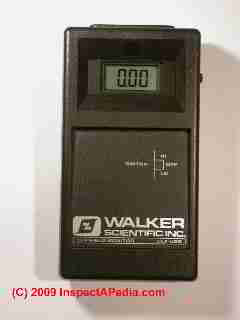
Most hand-held low-cost EMF measuring instruments (see our list at Evaluation of Low-Cost EMF Instruments) can make measurements down to 1 milligauss. Because it is common for us to find background EMF levels of 1-3 milligauss in residential neighborhoods where local electrical power distribution lines and transformers are present, and because some studies examined EMF field strengths down to this low level, a do-it-yourself EMF measurement project should probably avoid using instruments that lack that level of sensitivity.
But as we explain next, an accurate, sensitive EMF instrument is insufficient for making accurate and repeatable EMF measurements.
- Some instruments obtain EMF measurements that are sensitive to the orientation or position in which the instrument is held. Be sure to check that your instrument's readings are consistent regardless of instrument position, use a Tri-field instrument to avoid this source of inaccuracy, or if you prefer, as we do, to be able to see the field shape and source, be sure that your measurement procedure copes with this variation.
We describe the position sensitivity problem in more detail at EMF Polarity & Shape Affect Measurements. We describe how to do so at Recommended EMF Measurement Procedure.
We illustrate the EMF field shape at EMF/EMR Measurement Procedure Overview. - EMF measurements are sensitive to distance from the source of the EMF.
See EMF MEASUREMENT DISTANCE AFFECTS STRENGTH. - EMF measurements are sensitive to interference from local EMF sources that may swamp or distort EMF from a power transmission line.
See EMF LOCAL SOURCES MAY EXCEED POWER LINE STRENGTH for details. - EMF measurements are highly sensitive to hourly and seasonal variations in the load on power transmission lines;
See Time of day & Season Affect EMF Strength for details. - EMF measurements of local EMF sources such as appliances are entirely sensitive to whether or not the appliance is turned on and in-use as well as to variations in electrical current depending on appliance settings.
- Because RF and EMF measurement tools need to be properly chosen to measure the particular type and frequency of RF or EMF signal that is of interest, be sure to also
see EMF RF FIELD & FREQUENCY DEFINITIONS for a simple explanation of different types of radio frequency (RF) and electromagnetic frequency (EMF) types and where they are found. - See Definitions of Gauss vs Milligauss for details about gauss and milligauss and definitions of these terms
 Inconsistency in EMF measurement methods is a problem: In order to permit comparison of measurements (and studies) it is important not only to have line load data
available (for researchers) but also that site measurements are made in a very consistent manner from building to
building.
Inconsistency in EMF measurement methods is a problem: In order to permit comparison of measurements (and studies) it is important not only to have line load data
available (for researchers) but also that site measurements are made in a very consistent manner from building to
building.
To do otherwise would make it impossible to compare conditions at one property with those at another, even if both properties are equidistant from the same power line and even if both measurements were made at the same moment.
Position-insensitive EMF Measurement Instruments - best for the amateur
Some EMF measuring instruments, typically called "tri-field" or tri-position instruments, will give a consistent EMF strength reading in a given location regardless of how you are holding the instrument or where you are pointing it - providing the field strength has not changed between measurements.
We recommend this type of instrument for home use by "do it yourself" emf measurers.
See EMF Polarity & Shape Affect Measurements for further explanation.
Position-sensitive EMF Measuring Instruments - Why and How They are Used
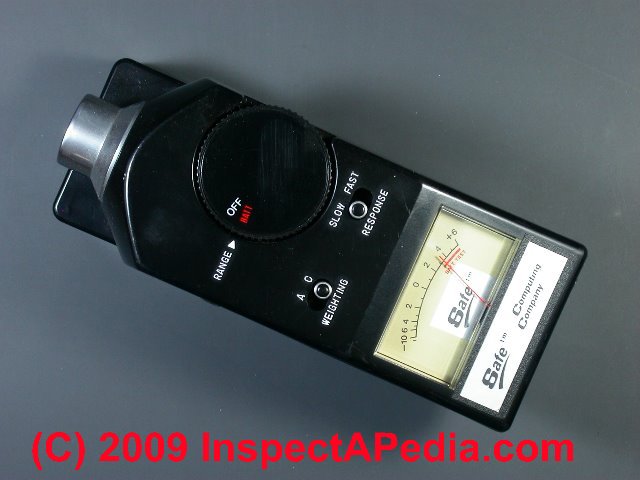
Other EMF measuring instruments such as our Safeco (Photo at left) are very position-sensitive. The spreadsheets we provide allow for collecting EMF measurements on three axes when using an instrument such as this one.
The disadvantage of the instrument is the requirement to make multiple measurements at each location during an EMF survey.
But the advantage of the instrument is that it allows us to see the shape, source, and even orientation of an electromagnetic field at a given location.
For Position-sensitive EMF measurement instruments, three readings are necessary.
- Horizontal (spin through 360 degrees and record highest reading)
- Vertical (same as above)
- Pointed towards suspected source (e.g. distant power line)
To compute the actual point measurement, each of these numbers, once converted to mG, must be squared, the three
squares added, and the square root taken of the sum. This is because the measurement scale is not linear, so a direct
raw average would be incorrect. In the EXCEL worksheet which we provide
at EMF MEASUREMENT WORKSHEET you'll see that provision is made for recording raw data points
as well as the individual mG readings.
See EMF Polarity & Shape Affect Measurements (just below) for further explanation, and
see EMF MEASUREMENT WORKSHEETfor the proper calculation method used to combine multiple position-sensitive EMF measurements into a single field strength number for a location.
Readers should also see Comparing Gauss versus Milligauss Field Strength Measurements where we explain the greater accuracy of low-level EMF readings when using the milligauss scale on an ELF EMF meter.
EMF Polarity and Shape, not just Distance, Affect some EMF Measurements
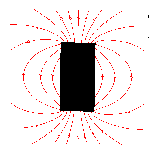 Electromagnetic fields are created around power transmission lines by the passage of high levels
of current through the transmission line wires themselves. A power-line generated
electromagnetic field has polarity and shape, roughly
spherical around a power line.
Electromagnetic fields are created around power transmission lines by the passage of high levels
of current through the transmission line wires themselves. A power-line generated
electromagnetic field has polarity and shape, roughly
spherical around a power line.
The problem of the electromagnetic field having polarity and shape means that some early or low-cost EMF measuring devices will give widely varying field strength measurements depending simply on the physical orientation of the device when the measurement is made - that is, what direction you point the instrument affects its reading.
But don't think that pointing directly towards the power line wires overhead gives the maximum reading.
It may not, due to field polarity. More costly EMF meters have multiple sensors to overcome this defect.
We discuss the problem of electromagnetic field shape, polarity, and instrument testing sensitivity to instrument orientation or position at Sensitivity & Accuracy of EMF Measuring Instruments.
Instead of contacting us with a request to perform EMF Electromagnetic or RF Radio Frequency Field Strength measurements, in most cases it is more economical and convenient for a property owner to purchase their own instrument, making measurements under varying conditions. In this series of articles we describe how to make measurements using a consistent approach and using good documentation.
See Recommended EMF Measurement Procedure for details of how to collect EMF measurement data.
Following good procedure and using instruments properly are two steps towards making accurate, repeatable EMF measurements. But because the signal transmission for RF sources such as radio, TV, or cell towers, the load on a power transmission line is not under control of an individual property owner, and because the EMF strength varies as the power transmission line load varies, it is important to have an idea of that condition as well when attempting to characterize EMF exposure at a specific location.
In contrast, EMF measurements are quite accurate and repeatable at other EMF sources such as close to electrical appliances and service entry cables.
Recommended Articles
- CELL PHONE RADIATION
- DEFINITIONS of EMF RF FIELD & FREQUENCY
- DEFINITIONS of HERTZ, KHz MHz GHz THz
- ELECTROMAGNETIC FIELD EMF ELF & RF DETECTION
- EMF ELECTROMAGNETIC FIELDS & HUMAN EXPOSURE
- EMF CANCER SCARE
- EMF CANCER RISK
- EMF/EMR MEASUREMENT OVERVIEW
- EMF LOCAL SOURCES MAY EXCEED POWER LINE STRENGTH
- EMF MEASUREMENT DISTANCE AFFECTS STRENGTH
- EMF MEASUREMENT INSTRUMENTS
- EMF MEASUREMENT INSTRUMENT ACCURACY
- EMF MEASUREMENT INSTRUMENT USE TIPS
- EMF MEASUREMENT PROCEDURES
- EMF MEASUREMENT STEP BY STEP
- EMF REFERENCES
- EMF SURVEY PROCEDURE
- EMF SURVEY REPORT INTERPRETATION
- EMF WORKSHEET for EMF MEASUREMENTS
- EMF WORKSHEET Example
- EMF WORKPLACE EXPOSURE
- ENVIRONMENTAL HAZARDS at BUILDINGS - home
- ENVIRO-SCARE - PUBLIC FEAR CYCLES
- HAZARD vs RISK
- RF RADIO FREQUENCY DETECTION METERS
...
Continue reading at EMF MEASUREMENT INSTRUMENT USE TIPS or select a topic from the closely-related articles below, or see the complete ARTICLE INDEX.
Suggested citation for this web page
EMF MEASUREMENT INSTRUMENT ACCURACY at InspectApedia.com - online encyclopedia of building & environmental inspection, testing, diagnosis, repair, & problem prevention advice.
Or see this
INDEX to RELATED ARTICLES: ARTICLE INDEX to BUILDING ENVIRONMENT
Or use the SEARCH BOX found below to Ask a Question or Search InspectApedia
Ask a Question or Search InspectApedia
Questions & answers or comments about how to hold, position, & use EMF field strength measurement instruments to account for variations in sensitivity and accuracy of Instruments for EMF power line and other source surveys.
Try the search box just below, or if you prefer, post a question or comment in the Comments box below and we will respond promptly.
Search the InspectApedia website
Note: appearance of your Comment below may be delayed: if your comment contains an image, photograph, web link, or text that looks to the software as if it might be a web link, your posting will appear after it has been approved by a moderator. Apologies for the delay.
Only one image can be added per comment but you can post as many comments, and therefore images, as you like.
You will not receive a notification when a response to your question has been posted.
Please bookmark this page to make it easy for you to check back for our response.
Our Comment Box is provided by Countable Web Productions countable.ca
Citations & References
In addition to any citations in the article above, a full list is available on request.
- Electric Power Lines, Electromagnetic Fields, Cancer Risk, & "Enviro-Scare" - The Normal Curve Cycle of Public Fear About Environmental Issues - online document by DF
- A Procedure for Measuring EMF electromagnetic fields online document by DF
- "Questions and Answers about Biological Effects and Potential Hazards of Radiofrequency Electromagnetic Fields", Federal Communications Commission, Office of Engineering and Technology, US FCC, OET Bulleting 56, 4th Edition, August 1999
" Many consumer and industrial products and applications make use of some form of electromagnetic energy. One type of electromagnetic energy that is of increasing importance worldwide is radiofrequency (or "RF") energy, including radio waves and microwaves, which is used for providing telecommunications, broadcast and other services. In the United States the Federal Communications Commission (FCC) authorizes or licenses most RF telecommunications services, facilities, and devices used by the public, industry and state and local governmental organizations. Because of its regulatory responsibilities in this area the FCC often receives inquiries concerning whether there are potential safety hazards due to human exposure to RF energy emitted by FCC-regulated transmitters. Heightened awareness of the expanding use of RF technology has led some people to speculate that "electromagnetic pollution" is causing significant risks to human health from environmental RF electromagnetic fields. This document is designed to provide factual information and to answer some of the most commonly asked questions related to this topic." - original source: U.S. Federal Communications Commission Office of Engineering and Technology, http://www.fcc.gov/Bureaus/Engineering_Technology/Documents/bulletins/oet56/oet56e4.pdf
CONTINUE READING or RECOMMENDED ARTICLES.
- Carson, Dunlop & Associates Ltd., 120 Carlton Street Suite 407, Toronto ON M5A 4K2. Tel: (416) 964-9415 1-800-268-7070 Email: info@carsondunlop.com. Alan Carson is a past president of ASHI, the American Society of Home Inspectors.
Thanks to Alan Carson and Bob Dunlop, for permission for InspectAPedia to use text excerpts from The HOME REFERENCE BOOK - the Encyclopedia of Homes and to use illustrations from The ILLUSTRATED HOME .
Carson Dunlop Associates provides extensive home inspection education and report writing material. In gratitude we provide links to tsome Carson Dunlop Associates products and services.
 | HOME | ABOUT | ASK a QUESTION | CONTACT | CONTENT USE POLICY | DESCRIPTION | POLICIES | PRIVACY | |
| © 2024 - 1985 Publisher InspectApedia.com - Daniel Friedman | |||||||||