
InspectAPedia® FREE Encyclopedia of Building & Environmental Construction, Diagnosis, Maintenance & Repair |
Question? Just ask us! InspectAPedia
|
 Electromagnetic Field Measurement General Procedures
EMF & RF Exposure Hazard Evaluation
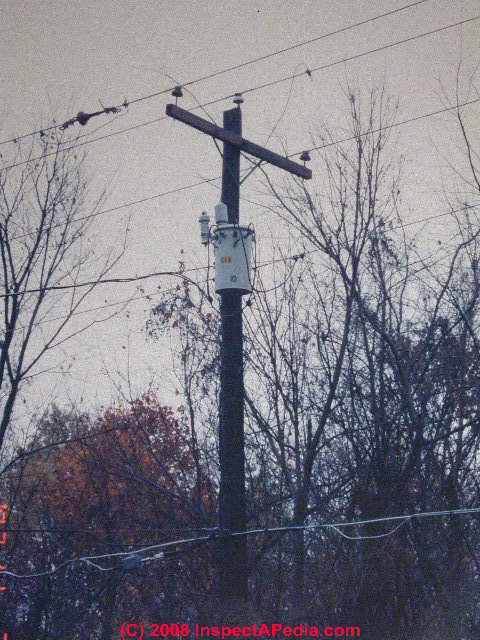
- POST a QUESTION or COMMENT about measuring EMF or RF electromagnetic field and radio frequency field exposure levels
How to measure electromagnetic field exposure levels:
This article on EMF measurements explains the basics of how we can reliably measure the level of electromagnetic radiation or electromagnetic fields (EMF).
InspectAPedia tolerates no conflicts of interest. We have no relationship with advertisers, products, or services discussed at this website.
- Daniel Friedman, Publisher/Editor/Author - See WHO ARE WE?
The Basics of Measuring Electromagnetic Field EMF Exposure Levels
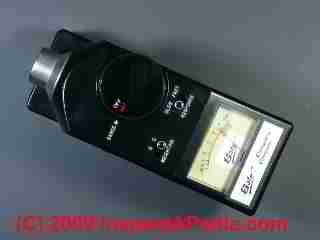
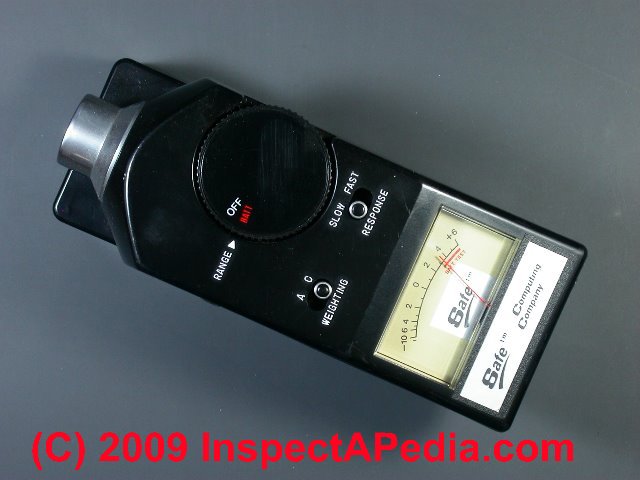
 Our page top photo shows a Safeco™ electromagnetic field measuring instrument. This the EMF readings that this instrument obtains are position sensitive - where you point it makes a difference even in the same spot.
As we explain at EMF RF FIELD & FREQUENCY DEFINITIONS, there is a wide range of electrical field types when arranged by frequency, from lower frequencies emitted by electrical power lines (EMF), AM and FM radio frequencies (radio towers - MF and HF or VHF), cell phones, FM and TV radio frequencies (UHF) and others in the electromagnetic spectrum.
Question: Can I Hire You to Make Site Measurements of Electrical Fields?
I wonder if you test the RF and magnetic fields given off from cell phone towers. We have recently moved into a building that I just found out that the building owners have placed cell phone towers on the roof. I am worried since I have a baby. Please let me know if you service. A.F. - New York City.
Reply:
We no longer offer on-site investigation services for measuring electromagnetic fields, though certainly you can hire local experts who can provide that service, have the necessary equipment, and are trained in its use. But before hiring someone to measure magnetic fields, here are a few things to consider:
First, if your object is personal safety for building occupants, there are other immediate potential hazards that should be attended first, as the absolute risk from other hazards can be very significant. Explicit, competent, documented electrical field strength measurements are more reliable than unsubstantiated opinions based on visual
observation and fear.
No one should be cavalier about people's health, but keeping risks in perspective serves
everyone and helps assure that building owners, occupants, parents focus on the big risks first. Review basic building safety items such as
- Working smoke alarms and CO alarms, properly installed and located
- Safe steps and railings in the building and at its entrances
- Exposure to cigarette smoke
- Exposure to high levels of allergenic or toxic mold
- See BUILDING SAFETY HAZARDS GUIDE and ELDERLY & VETERANS HOME SAFETY
Guide to Hiring Someone to Measure Electromagnetic Field Strengths: EMF
If a building owner or occupant is concerned about EMF or other electromagnetic field strength levels at a property (power lines, cell phone towers, radio transmitter towers, other sources), the local power company or other service providers may be willing to perform site measurements at no charge.
Independent experts provide thorough site profiles for fees ranging from $500. to $2,500. and some include extensive consulting which helps protect realtors from future liabilities and can calm inappropriately frightened buyers or sellers. But below you will read why for many circumstances we do not recommend this approach.
For electromagnetic field testing, whether it is UHF (cell phones), VHF and HF (radio towers), or EMF (power lines), and particularly for EMF testing, unless there is a legal issue that requires that the inspection and test be performed by an independent expert, you may prefer to purchase some equipment and following the procedures we’ve outlined for making an on-site survey of electrical field strengths yourself.
Particularly because the strength of electrical fields can vary enormously depending on the level of use of the emitting system, there is a risk that you hire someone at a high cost whose measurement results by no means tell you the average nor long term level of electrical field exposure at that location.
For a thoughtful, informed person who will read, it’s not technically difficult to use most electrical field measurement devices, and there are these advantages:
- the cost will be a small fraction of bringing in an independent person
- you can repeat the test under different power line load conditions (for EMF) or transmitter use cycles (RF etc). something that makes a big difference in the electrical field strength
- you can take your time and make many readings at different locations and different times of day, month, and year , being careful to be accurate
- if your object is prudent avoidance of EMF exposure (as the science is conflicted for reasons we’ve discussed), then you might find small local sources that need a change, like an electric clock by a bed headboard, or a bed headboard placed on a wall where an electrical service entry cable passes
Hiring an EMF RF consultant compared with doing it yourself
Our own personal ethical views, combined with even the most basic technical understanding of issues around RF and EMF hazards make us very reluctant to recommend hiring an "expert" perform EMF and RF field investigations for homeowners or apartment dwellers in most circumstances. Why?
- Signal strength can be enormously variable at a given location, depending in the case of EMF on the actual current load on the
power transmission lines, and in the case of high frequency RF, on the transmission activity, antenna direction, and other factors.
As a result, momentary or single-point-in-time measurements can be quite misleading.
See EMF Procedures & Causes of EMF Measurement Error & Variation. - Inappropriate expense? On every environmentally fearful topic a quick industry is bred of people who are poorly trained, sometimes unethical, but who
prey on consumer fear to become wealthy - the behind the scenes comments from some of these folks can be very disturbing. Professionals are obligated to proceed responsibly in accepting field investigation assignments, respecting both the client's physical health and their financial impacts as well.
Instead of contacting us with a request to perform EMF Electromagnetic or RF Radio Frequency Field Strength measurements, in most cases it is more economical and convenient for a property owner to purchase their own instrument, making measurements under varying conditions. In this series of articles we describe how to make measurements using a consistent approach and using good documentation.
See Recommended EMF Measurement Procedure for details of how to collect EMF measurement data.
Three Approaches to Measuring RF and EMF Hazards at Properties
For at least these reasons, we recommend one several different different approaches, among which you should choose, or if you can
describe to us a further viewpoint, Contact Us.
- EMF RF Exposure Litigation: If you are involved in or anticipate litigation, then indeed it is appropriate to have a neutral third party professional make a site investigation and to document conditions there.
- Accurate, longer term EMF or RF measurements at low cost: If #1 does not apply, then a more informed site risk profile is one that would collect measurements over time, under different conditions of load, season of the year, transmission activity, supplemented by basic research to identify the particular source nearby and its character.
For example, if it is a power transmission line, the maximum KVA rating of the line and its distance from the building of concern are of paramount interest, even if an instantaneous measurement gives low results. Rather than pay an independent $1800. U.S. or more to perform a single site survey, purchase the appropriate test instruments and make your own measurements, over time.
To assist in this procedure we have provided a series of articles organized
at EMF SURVEY PROCEDURE - Details.
Following good procedure and using instruments properly are two steps towards making accurate, repeatable EMF measurements.
But because the signal transmission for RF sources such as radio, TV, or cell towers, the load on a power transmission line is not under control of an individual property owner, and because the EMF strength varies as the power transmission line load varies, it is important to have an idea of that condition as well when attempting to characterize EMF exposure at a specific location.
In contrast, EMF measurements are quite accurate and repeatable at other EMF sources such as close to electrical appliances and service entry cables.
At Evaluation of Low-Cost EMF Instruments we list a number of tools that are easy to use, but whose accuracy also depends on the actual measurement procedure - where and how measurements are obtained, which is what we discuss in the EMF Survey Procedure article above, and for which we also provide example field data collection sheets.
Approach #2 is likely to cost just a few hundred dollars U.S. at most, and allows longer and more extensive measurements. - If there is a special concern at a property, such as health complaints that appear to be building or site-related but that need
further investigation, then bringing an expert to the site is indeed more likely to be ethically and cost-justified.
Guide to Making Your Own Electromagnetic Field Strength EMF / RF Measurements
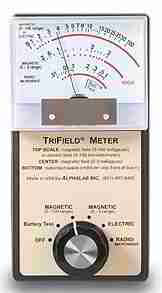 If you're simply curious about finding and measuring local EMF strengths around a home, an alternative might be to
simply purchase an inexpensive electromagnetic field strength measuring device.
If you're simply curious about finding and measuring local EMF strengths around a home, an alternative might be to
simply purchase an inexpensive electromagnetic field strength measuring device.
But before dashing about recording numbers, it is important to understand both the peculiarities of EMF field strength meters and the peculiarities of the size, shape, pattern, and time variation of electromagnetic fields themselves.
Suggestions for using some sample EMF measuring instruments and a discussion of the sources of error and variation in EMF measurements are discussed in more detail at
our Electromagnetic Radiation Field EMF SURVEY Procedure
At Evaluation of Low-Cost EMF Instruments such as the TriField EMF and RF meter shown here we show several different types of EMF measuring instruments and discuss their properties.
Please do not contact us to buy equipment. We do not sell anything. To do so would be a conflict of interest for this website.
These devices are readily available from many electrical equipment and home inspection equipment suppliers.
Instead of contacting us with a request to perform EMF Electromagnetic or RF Radio Frequency Field Strength measurements, in most cases it is more economical and convenient for a property owner to purchase their own instrument, making measurements under varying conditions. In this series of articles we describe how to make measurements using a consistent approach and using good documentation.
See Recommended EMF Measurement Procedure for details of how to collect EMF measurement data.
Following good procedure and using instruments properly are two steps towards making accurate, repeatable RF (radio frequency) or EMF (electromagnetic field) measurements.
But because the transmission from a cell tower, television tower, or the load on a power transmission line is not under control of an individual property owner, and because the RF or EMF strength varies as the power transmission line load varies, it is important to have an idea of that condition as well when attempting to characterize EMF exposure at a specific location.
In contrast, RF or EMF measurements are quite accurate and repeatable at other EMF sources such as close to electrical appliances and service entry cables.
Do not contact us with a request buy RF or EMF measuring equipment. These devices are readily available from many electrical equipment and home inspection equipment suppliers.
See Evaluation of Low-Cost EMF Instruments This article describes several low-cost and reasonably accurate EMF measurement devices that are readily available.
See Radio Frequency RF Detection Meters This article describes several low-cost and accurate radio frequency or RF detection and measurement devices suitable for radio, TV, cellphone, microwave, and similar signals.
Readers who need to measure EMF themselves or who intend to hire someone to do so should also be sure to review our more detailed EMF measurement procedures
at Electromagnetic Radiation Field EMF SURVEY Procedure and also
see EMF Survey Worksheet - Excel Spreadsheet
and EMF Survey Worksheet - Sample & Explanation. or select a topic from the closely-related articles below, or see the complete ARTICLE INDEX.
...
Reader Comments, Questions & Answers About The Article Above
Below you will find questions and answers previously posted on this page at its page bottom reader comment box.
Reader Q&A - also see RECOMMENDED ARTICLES & FAQs
Question:
(Apr 28, 2012) Bert Spencer said:
I need a qualified expert to measure the radiation being emitted by the cellular tower equiptment on the roof of my building into my apartment on the floor underneath. I live at 195 Chrystie St in Manhattan, tel 212 674 3664. Please provide any references, hopefully for local someone/ones local.
(Sept 11, 2014) Stephanie Koell said:
My office is basically a closet converted into an office. On one wall just a few feet from my head is a panel into and out of which are roughly 15 computer chords hooked into modems and router. the chords connect into two strips just above that panel. In addition there is a power strip with three electrical chords plugged into it. A coworker voiced concern that this could be a risky environment in which to work. How can I determine if this is true?
Reply:
Stephanie
First you need to decide if you personally believe that EMF exposure is hazardous; you can read some recommendations in this article sources that generally come down on the side of prudent avoidance not heroics and not panic.
Second you can measure the EMF and RF fields in which you sit. Or hire an expert to do so - taking care that your expert really is one, not just someone waving a meter about....
...
Continue reading at EMF MEASUREMENT STEP BY STEP or select a topic from the closely-related articles below, or see the complete ARTICLE INDEX.
Or see these
Articles About Electromagnetic Fields, Hazards, Measurements
- CELL PHONE RADIATION
- DEFINITIONS of EMF RF FIELD & FREQUENCY
- DEFINITIONS of HERTZ, KHz MHz GHz THz
- ELECTROMAGNETIC FIELD EMF ELF & RF DETECTION
- EMF ELECTROMAGNETIC FIELDS & HUMAN EXPOSURE
- EMF CANCER SCARE
- EMF CANCER RISK
- EMF/EMR MEASUREMENT OVERVIEW
- EMF LOCAL SOURCES MAY EXCEED POWER LINE STRENGTH
- EMF MEASUREMENT DISTANCE AFFECTS STRENGTH
- EMF MEASUREMENT INSTRUMENTS
- EMF MEASUREMENT INSTRUMENT ACCURACY
- EMF MEASUREMENT INSTRUMENT USE TIPS
- EMF MEASUREMENT PROCEDURES
- EMF MEASUREMENT STEP BY STEP
- EMF REFERENCES
- EMF SURVEY PROCEDURE
- EMF SURVEY REPORT INTERPRETATION
- EMF WORKSHEET for EMF MEASUREMENTS
- EMF WORKSHEET Example
- EMF WORKPLACE EXPOSURE
- ENVIRONMENTAL HAZARDS at BUILDINGS - home
- ENVIRO-SCARE - PUBLIC FEAR CYCLES
- HAZARD vs RISK
- RF RADIO FREQUENCY DETECTION METERS
Suggested citation for this web page
EMF MEASUREMENT PROCEDURES at InspectApedia.com - online encyclopedia of building & environmental inspection, testing, diagnosis, repair, & problem prevention advice.
Or see this
INDEX to RELATED ARTICLES: ARTICLE INDEX to BUILDING ENVIRONMENT
Or use the SEARCH BOX found below to Ask a Question or Search InspectApedia
Ask a Question or Search InspectApedia
Try the search box just below, or if you prefer, post a question or comment in the Comments box below and we will respond promptly.
Search the InspectApedia website
Note: appearance of your Comment below may be delayed: if your comment contains an image, photograph, web link, or text that looks to the software as if it might be a web link, your posting will appear after it has been approved by a moderator. Apologies for the delay.
Only one image can be added per comment but you can post as many comments, and therefore images, as you like.
You will not receive a notification when a response to your question has been posted.
Please bookmark this page to make it easy for you to check back for our response.
IF above you see "Comment Form is loading comments..." then COMMENT BOX - countable.ca / bawkbox.com IS NOT WORKING.
In any case you are welcome to send an email directly to us at InspectApedia.com at editor@inspectApedia.com
We'll reply to you directly. Please help us help you by noting, in your email, the URL of the InspectApedia page where you wanted to comment.
Citations & References
In addition to any citations in the article above, a full list is available on request.
- Electric Power Lines, Electromagnetic Fields, Cancer Risk, & "Enviro-Scare" - The Normal Curve Cycle of Public Fear About Environmental Issues - online document by DF
- A Procedure for Measuring EMF electromagnetic fields online document by DF
- "Questions and Answers about Biological Effects and Potential Hazards of Radiofrequency Electromagnetic Fields", Federal Communications Commission, Office of Engineering and Technology, US FCC, OET Bulleting 56, 4th Edition, August 1999
" Many consumer and industrial products and applications make use of some form of electromagnetic energy. One type of electromagnetic energy that is of increasing importance worldwide is radiofrequency (or "RF") energy, including radio waves and microwaves, which is used for providing telecommunications, broadcast and other services. In the United States the Federal Communications Commission (FCC) authorizes or licenses most RF telecommunications services, facilities, and devices used by the public, industry and state and local governmental organizations. Because of its regulatory responsibilities in this area the FCC often receives inquiries concerning whether there are potential safety hazards due to human exposure to RF energy emitted by FCC-regulated transmitters. Heightened awareness of the expanding use of RF technology has led some people to speculate that "electromagnetic pollution" is causing significant risks to human health from environmental RF electromagnetic fields. This document is designed to provide factual information and to answer some of the most commonly asked questions related to this topic." - original source: U.S. Federal Communications Commission Office of Engineering and Technology, http://www.fcc.gov/Bureaus/Engineering_Technology/Documents/bulletins/oet56/oet56e4.pdf
CONTINUE READING or RECOMMENDED ARTICLES.
- Carson, Dunlop & Associates Ltd., 120 Carlton Street Suite 407, Toronto ON M5A 4K2. Tel: (416) 964-9415 1-800-268-7070 Email: info@carsondunlop.com. Alan Carson is a past president of ASHI, the American Society of Home Inspectors.
Thanks to Alan Carson and Bob Dunlop, for permission for InspectAPedia to use text excerpts from The HOME REFERENCE BOOK - the Encyclopedia of Homes and to use illustrations from The ILLUSTRATED HOME .
Carson Dunlop Associates provides extensive home inspection education and report writing material. In gratitude we provide links to tsome Carson Dunlop Associates products and services.
 | HOME | ABOUT | ASK a QUESTION | CONTACT | CONTENT USE POLICY | DESCRIPTION | POLICIES | PRIVACY | |
| © 2025 - 1985 Publisher InspectApedia.com - Daniel Friedman | |||||||||