
InspectAPedia® FREE Encyclopedia of Building & Environmental Construction, Diagnosis, Maintenance & Repair |
Question? Just ask us! InspectAPedia
|
 Diagnose & Fix Chimney Draft & Performance Problems21 causes of inadequate chimney draft, puffing, smoking, fireplace or heater malfunctions
- POST a QUESTION or COMMENT about chimney draft: requirement, combustion air code requirements, chimney repairs, factors that affect chimney draft
Chimney draft troubleshooting:
How chimney location affects chimney draft and performance.
This article describes how the location of the chimney on an exterior wall, imbedded in the wall, or located inside of the building affects chimney draft and performance.
How to diagnose poor chimney draft for a smoky fireplace, woodstove, or heating boiler/furnace. 18 things to check if your chimney has bad draft or your fireplace is smoky. Draft: Thermal Performance of Chimneys - How to correct inadequate chimney draft.
Our sketch of types of chimney placement on a building is courtesy of Carson Dunlop Associates, a Toronto home inspection, education & report writing tool company [ carsondunlop.com ]. These articles on chimney construction, design, troubleshooting, cleaning & repair include description of how to perform a thorough visual inspection of chimneys for chimney safety, draft, chimney fire hazards, chimney collapse hazards and other defects.
InspectAPedia tolerates no conflicts of interest. We have no relationship with advertisers, products, or services discussed at this website.
- Daniel Friedman, Publisher/Editor/Author - See WHO ARE WE?
Chimney Location, Draft & Performance
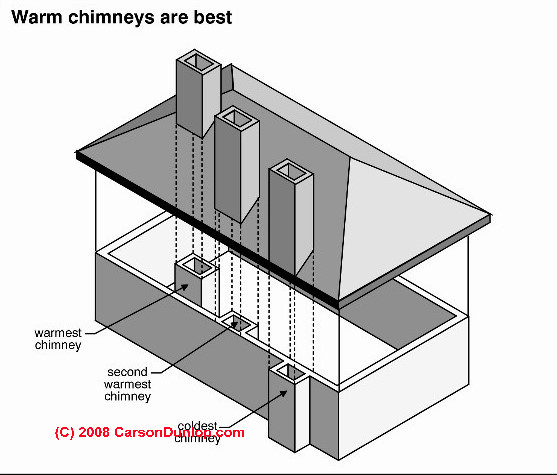
As Carson Dunlop Associates [at REVIEWERS] sketch shows, a warm chimney works best at developing good draft which in turn helps assure that the appliances or fireplaces being vented by the chimney will perform properly.
Construction of the chimney running through the interior of a home was originally done to get the most heat out of the chimney in cold weather.
Even though it is easier to build the chimney on the outside wall of a building, a central chimney provided heat through its masonry to the building interior on all floors.
[Click to enlarge any image]
Draft: Thermal Performance of Chimneys
A chimney's thermal performance provides the "draft" by maintaining a warm interior lining.
The draft is the pressure difference between ambient air and the less dense flue gases within the chimney. The lighter gases are buoyant and rise to be displaced by heavier ambient air.
The chimney must contain the hot gases and protect the surrounding materials against combustion.
Residential masonry chimneys must protect the building while under exposure to 1000°F continuous flue gas temperature although most gas appliances operate with a flue gas temperature of about 300°F and oil burners with a flue gas temperature of about 500°F.
21 Causes of Poor or Inadequate Chimney Draft, Draw, or of Puffing, Smoking Fireplaces & Heaters
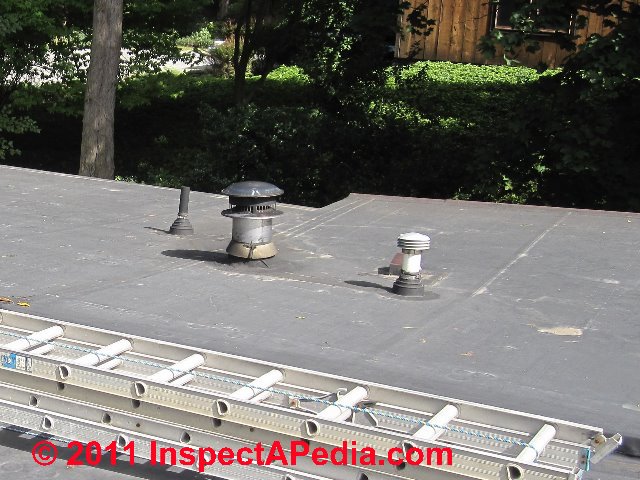
The vertical distance from the top of this chimney to the top of the oil fired heating boiler it serves is less than six feet.
The oil fired boiler has blown soot into the utility room and garage throughout its' life, a constant source of annoyance that probably stems from inadequate total draft even when the oil burner, boiler, and chimney flue are up to full operating temperature.
and CHIMNEY HEIGHT EXTENSIONS.
Also see OIL BURNERS and OIL BURNER NOISE SMOKE ODORS.
We could address this short chimney with a draft inducer fan, but a taller flue would be smart anyway, to get the chimney top higher than the roof surface.
We discuss draft inducer or "draft boosting" fans for heating systems (and maybe for some fireplaces) in detail at DRAFT INDUCER FANS
The articles listed below assist in diagnosing other causes of poor chimney performance.
- Abandoned chimney openings, improperly sealed: Check for unsafe chimney openings at discontinued chimney thimbles for previous wood or coal stove installations
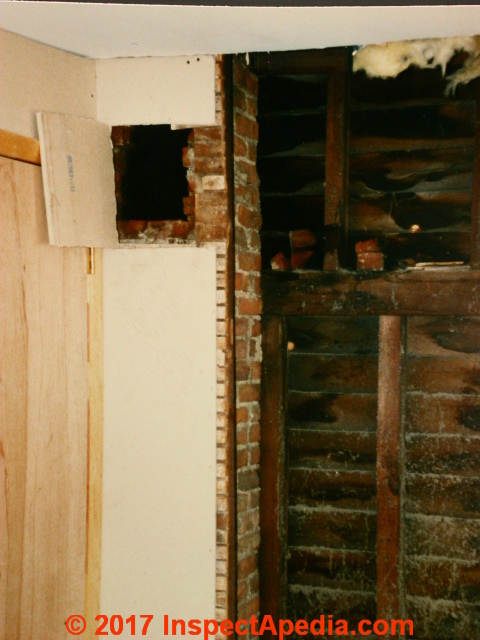
Photo above: During a 1986 restoration of an home in the Bleachery in Wappingers Falls, NY, built ca 1865, the author / renovator wanted to be sure the chimney was in good condition, as the chimney was in active use by a gas-fired heating boiler.
Watch out: improperly-sealed holes in in-use chimneys are unsafe, risking a building fire or dangerous flue gase leaks, even fatal carbon monoxide gas leaks.
We cut away drywall boxing in the chimney at a height where marks on the drywall suggested a previous passage of a wood-stove flue. The chimney thimble had been "sealed" using a clip-in tin pie-plate cover that had rusted away.
In the second photo (below) you can see that I repaired two openings in this brick chimney before boxing it in in preparation for installing finished wall surfaces.
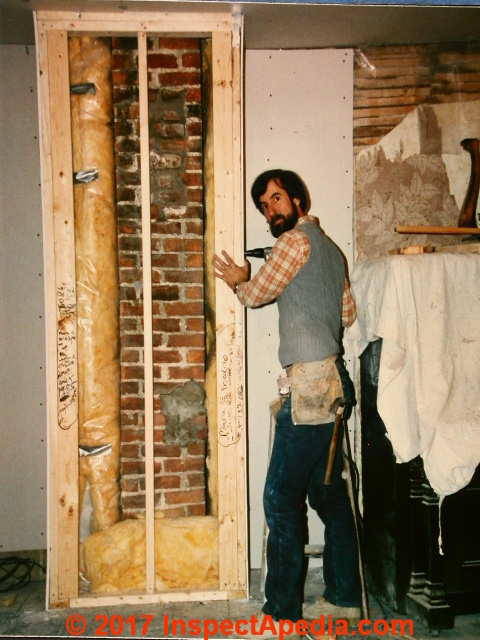 Photo above: the author was boxing in the repaired brick chimney in a home in Wappingers Falls, NY.
- Adjacent chimney flues: Metal chimneys too close to one another can interfere with proper draft.
See ADJACENT METAL CHIMNEY SEPARATION and of course leaks between flues or between a flue liner and the chimney structure (and air gaps) can also cause draft problems, fire hazards, carbon monoxide hazards, other operation and safety concerns. - Ash pit doors & ash pit design defects: masonry or other fireplaces that include an ash pit door are intended to permit the disposal of ashes from the fireplace floor into a fire-safe ash pit below the fireplace.
Shared ash pits among fireplaces can be a source of air leaks and draft defects; ash pit doors that are stuck open may interfere with both fire safety and proper combustion air flow.
Ash pits that are not properly constructed, for example including exposure of the ash pit area to combustible framing, are unsafe and can result in a building fire. - Blocked chimney flues: A chimney will not draw properly if it has been blocked for any reason, such as a birds nest, collapsing flue liner, creosote, or a flue vent connector pushed too far into the chimney at the thimble.
See BLOCKED CHIMNEY AT THE FLUE VENT CONNECTOR
and see EXTENDED TOO FAR INTO CHIMNEY. - Chimney flue size & location: a chimney which has a flue diameter too small will not vent combustion products properly and may be unsafe.
But a chimney flue that is too big may also not vent properly. For example, venting a gas fired water heater into a large diameter masonry flue (perhaps one previously used for a fireplace) may mean that the heater never produces enough heat to establish a good up-draft in the chimney.
One of our clients suffered headaches every October when cold weather approached and her gas fired appliances vented only into the building rather than up through the chimney.
A chimney located on the outside of a building is colder and may have a harder time establishing a good draft to vent small appliances. - Chimney location: an outside flue may be too cold to develop adequate draft for the appliance vented into it.
See CHIMNEY LOCATION & DRAFT PERFORMANCE - Chimney too short: a chimney that is too short in total height may not develop adequate draft and also may be a fire or flue gas release hazard. See our photo above and
See CHIMNEY TOO SHORT and also
see CHIMNEY HEIGHT EXTENSIONS - Chimney too low on roof: such chimneys are not only a fire hazard, they are more likely to be affected by roof shape and may have inadequate draft.
See MASONRY CHIMNEY ROOF CLEARANCE - Chimney cleanout doors: that are missing or left ajar let air into the bottom of the chimney, interfering with development of adequate draft - and are unsafe.
See MISSING CHIMNEY CLEANOUT DOOR - Chimney rain cap:
a rain cap not only avoids water damage to the chimney and flue, a properly-designed and installed chimney cap actually improves chimney draft by avoiding downdrafts from local winds.
See MISSING CHIMNEY RAIN CAP - Combustion air requirements for fireplaces: if a fireplace or heating appliance lacks combustion air it will not operate properly and may be very unsafe, risking production of fatal carbon monoxide gas in some cases.
See WOOD BURNING HEATERS FIREPLACES STOVES for more discussion of combustion air.
Current model building codes such as Chapter 10 of the IRC require provision of a source of outdoor combustion air for masonry fireplaces and some other fireplace designs.
See COMBUSTION AIR DEFECTS for a discussion of inadequate combustion air for heating boilers and furnaces. - Cracked brick chimneys: may have holes that let outside air into the flue, preventing establishment of proper draft - such chimneys are unsafe.
See CRACKED BRICK CHIMNEY SIDES - Cracked masonry block chimneys may let outside air into the flue, preventing establishment of proper draft - such chimneys are unsafe.
See CRACKED CHIMNEYS, MASONRY BLOCK - Dead end chimney flues: are a chimney design highly likely to become blocked.
See DEAD END CHIMNEY FLUE HAZARDS. - Draft Inducers on chimneys:
see DRAFT INDUCER FANS can be installed on heating and fireplace flues as a last resort - but first make sure none of the other causes of bad draft are present - safety hazards may be present.
If there is already a draft inducer be sure that it's actually working properly. - Draft Regulators on chimneys:
see DRAFT REGULATOR, DAMPER, BOOSTER
and
see DRAFT REGULATORS / HOODS GAS HEATERS must be properly installed and working for heating boilers, furnaces, and water heaters to work properly. See these linked-to articles for details about draft, how it works, how it is measured, why it is important for safe appliance operation. - Fireplace design defects: if a fireplace is improperly designed, for example with an improper ratio of fireplace opening to throat size or chimney diameter, the fireplace will not draw properly and will be smoky.
See WOOD BURNING HEATERS FIREPLACES STOVES
and
see FIREPLACES & HEARTHS. Similarly, if the placement of the fire in the fire box puts the burning logs too close to the fireplace front it may not draw well; finally, if the fireplace lacks adequate combustion air it will be a smoky installation. - Flue vent connector length: a metal flue vent connector ("stackpipe") that is too long, especially long horizontal runs, is prone to clogging with debris, rust-through, and other draft problems.
See LENGTH LIMITS FOR A FLUE VENT CONNECTOR - Shared chimney flues: venting too many appliances into a single flue may exceed its capacity and may be unsafe.
Conversely, sometimes we find that a small gas-fired appliance venting into a shared flue vents properly only when the chimney draft is boosted by an oil fired appliance vented into the same opening.
Since it is unlikely that both appliances will always run at once, this is a bad design.
See SHARED CHIMNEY FLUE EXAMPLES
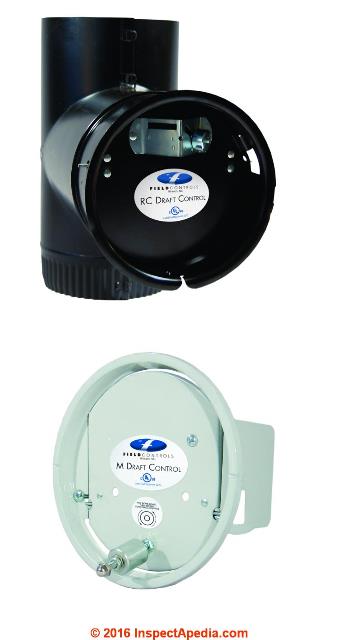
- Improper setting of draft control: If the draft regulator, barometric damper or other draft control is not properly set to provide the draft required by the specific fireplace or heater that is vented into the chimney, the fireplace or heater won't work properly and may be unsafe.
See examples at
DRAFT REGULATOR ADJUSTMENT & SETTINGS - oil fired heating equipment
PELLET STOVE DRAFT CONTROL
WOOD STOVE, CATALYTIC PUFF-BACKS - Split chimneys are not only very dangerous, releasing flue gases, sparks, presenting a fire risk, and risking collapse, they also fail to develop a proper draft. Watch for this dangerous condition when diagnosing poor chimney draft.
See SPLIT OPENINGS in BRICKS, CHIMNEY COLLAPSE
...
Reader Comments, Questions & Answers About The Article Above
Below you will find questions and answers previously posted on this page at its page bottom reader comment box.
Reader Q&A - also see RECOMMENDED ARTICLES & FAQs
On 2020-07-20 by (mod)
Heating service technician or a certified Chimney Sweep will have a draft gauge. It's essentially a simple manometer. Bachrach makes them and other companies.
Use the on-page search box at the top or bottom of any of our pages to find our
article DRAFT MEASUREMENT, CHIMNEYS & FLUES to see details
On 2020-07-18 by lou
what is the simple way to check your draft to see if the draft is correct.
On 2018-09-10 by (mod) -
James
Backdrafting and inadequate draft does need to be corrected and in fact means that the heater is not operating correctly. You probably already understand that. But do you understand that it is unsafe?
The risks are dangerous flue gases venting into the house, possible carbon monoxide hazard, or if it's an oil burner a puff back explosion.
Before thinking about a draft inducer it would make sense to have a trained technician inspect and test the system to see if it needs to be cleaned and adjusted.
Be sure also that you have working smoke and carbon monoxide detectors properly located, installed, and tested. Don't delay because in my opinion your heating system is unsafe.
If there's any doubt in your own mind about safety or backdrafting or fire hazards turn it off
On 2018-09-10 by James Wolf
Two years ago i had my chimney sleaved. Since then im getting a heavy back draft out the sight window of my oil fired boiler. To the point i cant hold my hand there for even a fraction of a second. I would love to get the draft back to what it was. Im wondering if im going to need a draft inducer now or did they sleve it to small.
On 2017-11-15 by (mod) - appeared there was no draw on the chimney at all
Mark,
I'm not sure what's going on but there are plenty of possible explanations such as those in the article above.
I'd look first for the obvious snafus like
- the room is small and tight and there's not enough combustion air entering the space
- the chimney is blocked enroute to the top
- the chimney has an opening somewhere like a cleanout door left open
On 2017-11-14 by mark
hi hetas engineer installed a multi fuel stove without a flue liner as customer had already got a working stove prior but wanted a new one so removed a fully working stove and replaced with a new one
when commissioning it appeared there was no draw on the chimney at all and even kindling did not take very well after more tests we decided to install a flue liner 8mtrs straight from pot into top of vitreous however this has made no difference question is can it be a faulty stove or is it the flue at this point we haven't tested to see if we have 12 pascles on the draw
On 2017-09-27 by (mod) - difference between draft and draw?
Shelly,
Thanks for asking. IF we are talking about a chimney the two terms are essentially synonyms. They both measure the rate of air intake into a chimney or into a heating appliance that of course vents into a chimney.
Draft is typically measured in inches of water column or inches of mercury.
see DRAFT MEASUREMENT, CHIMNEYS & FLUES - https://inspectapedia.com/heat/Chimney_Draft_Measurement.php
On 2017-09-27 by Shelly
what is the difference between draft and draw?
On 2016-10-05 1 by Rob - Mendip Somerton 2 wood burner with a twin wall flue
Hi, Installed is a Mendip Somerton 2 wood burner with a twin wall flue connected to the rear, three 45degree bends and one 135degree t have been used to go around the soffit and above the roof line by 600mm total height 4070mm, the problem is there is no draw on the chimney, I have tried temporarily removing two of the 45degree bends and extending the flue a further 1800mm with no difference.
I have proven the combustion air supply is sufficient (direct from outside).
There is a property approx. 5 meters away and trees approx. 25 meters away and we do live on a hill.
At present I have put a fan boost on top of the chimney as a temporary fix but this isn't the way I wanted to go, I would like to achieve lots of draw from the chimney that can be regulated with the damper that would give good burning temperatures, any suggestions would be extremely helpful ?
On 2016-08-2 by (mod) - When you remove an old heater from an existing chimney and convert that unit to a high-efficiency direct-vent heater
Mike
You raise a more-important safety question than many people realize. When you remove an old heater from an existing chimney and convert that unit to a high-efficiency direct-vent heater instead, and when you leave just a water heater venting into the old and large flue, often the draft in the old chimney will not be adequate to vent the water heater, and the result can be a fatal carbon monoxide gas poisoning hazard at the building - worse than a problem with the water heater itself not functioning properly.
That lack of up-draft may also explain why you're seeing downdrafts of fireplace smoke in the old heater flue, but I suspect that as well you're missing individual flue chimney caps, and/or the two flues - fireplace and old heater flue - are terminating at the same elevation. Try extending your fireplace flue upwards a foot.
And review the draft hazard for the water heater with a qualified chimney sweep or similar expert.
On 2016-08-28 by Mike
3 years ago I had a high efficient (90 plus) furnace installed and this is vented horizontally to outside via a new PVC exhaust. Since this change I now get a down draft of smoke from my fireplace side of the chimney and the other section of chimney now only has water heater.
This use to have a 6" exhaust from the old furnace along with the gas hot water heater, only the water heater remains with a 3" and adapter into a short section ( 12 " ) of the old 6" pipe. What can be done to either increase upward draft or higher temperature in the old furnace side of the chimney.
On 2016-03-21 by (mod) - inline (draft) booster will not make a too-short chimney safe.
No Crystal, an inline (draft) booster will not make a too-short chimney safe. If your homeowners association wants the chimney shorter and that change would make make the chimney unsafe, you need simply to document that with authoritative citations and a comment from your local building or fire department. Search InspectApedia.com for CHIMNEY HEIGHT to read details, codes, authorities, citations for height requirements for different types of chimneys.
On 2016-03-21 by crystal
Hi...i recently installed a woodburning ladera fireplace. Love it but my hoa wants me to shorten the chimney. My installer wont help as it wont be to code. I need options. My stack is 5 feet high. Would a inline booster help. I live in folsom ca.
On 2016-03-07 by (mod) -
Thanks for the question Freddy.
There are quite a few packaged systems to provide air intake through a masonry chimney into a fireplace. I'd look at those kits as it'll be faster, cheaper, and more likely to be properly sized.
For example see http://www.dalsinmfg.com/downloads/Airalator-Consumer.pdf
On 2016-03-07 by freddy R
any ideas on how to bring outside air into a interior located masonry fireplace , I'm the builder and I'm building this house with energy star specification , which mean very little inside air ,not enough air for steady combustion.
Thinking about a cast iron pipe , piped into the f/p then have the pipe run outside thru the roof with an automatic damper, but not sure why the outside air will travel down to the f/p, maybe once the fire starts it will create a draft . Can anyone offer any advice.
Question: poor chimney draft, smoke from first floor fireplace comes out of basement fireplace.
Hi, I am a builder in Georgia. Last year we completely demolished a house except for the basement walls and the existing fireplace. We rebuilt the first floor, added a second floor and extended the existing fireplace. The house is sprayed foam and it is cooled and heated by a geo-thermal system.
The chimney is shared, two separate flu stacks, one coming from basement and the second from the first floor.
When a fire was started on the first floor fireplace, smoke was coming through the basement fireplace. I am guessing we have a negative air pressure causing this.
My fireplace contractor has recommended installing a fan on top of the chimney, my question is
1. Is this a good solution?
2. Do we need to install some kind of system to bring in fresh air to balance the air being taken out? - H.K., Georgia, 1/16/2014
Reply: serious red flags on chimney safety are raised by draft and smoke observations
I'm unsure what you meant by "... extended the existing fireplace" and I'm worried that the "extension" means someone added a fireplace without giving it its own flue.
And I am more confused by "... The chimney is shared, two separate flu stacks," given that you observed that "...When a fire was started on the first floor fireplace, smoke was coming through the basement fireplace"
A competent onsite inspection by an expert usually finds additional clues that would permit a more accurate, complete, and authoritative answer than we can give by email alone, but from your description and observation some serious safety questions and possibly building code violation questions are raised that I'm sure you'll want to get clarified.
Regarding your use of the phrase "shared chimney" - A chimney structure may contain one or more individual flues or passages to vent combustion products. Each of those flues must be properly constructed and intact throughout its passage and cannot communicate with other flues, as such communications or inter-flue leakage is unsafe and also risks draft and fireplace or heating appliance performance and other safety problems.
Heating appliances between floors can never share a chimney flue.
Some building codes in some jurisdictions permit two or more individual heating appliances to be vented into the same flue if those appliances are on the same floor, and some codes/jurisdictions permit oil and gas fired appliances on the same floor to vent into the same flue provided the connections are properly located and installed with respect to one another.
Watch out: When you saw smoke coming out of the basement fireplace in response to starting a fire in the upper floor fireplace this is a significant red flag - as you doubtless recognized. But the problem is far more serious than just a draft defect for the upper fireplace chimney flue.
For smoke to come out of the lower floor fireplace when a fire was ignited on the first floor there must be some flue gas and smoke communication between the two fireplaces - which is a prohibited condition that is unsafe as well as not functional. Such leaks mean that draft is uncontrolled as well as defective, they invite fire spread between building floors, and depending on what other chimney flues exist and appliances are connected to them there is also risk of dangerous flue gas or even carbon monoxide poisoning of building occupants.
So your first order of business is to have an expert, certified chimney inspector examine the chimney and flues to find the defects and hazards.
Now with respect to poor chimney draft and down-flow of smoke between floors, beyond the unacceptable cross-flue leakage I've already cited, I add that cold air falling down a chimney can cause downdrafts but normally as the fire is ignited and chimney is warmed this condition quickly switches to updraft and proper drafting for the fireplace. But a leak between flues, such as an opening between a basement fireplace and first floor fireplace flues that are supposed to be isolated from one another can also cause inadequate draft for both fireplaces.
Once you have found and repaired the unsafe and cross-leaking chimney flues, if draft is still inadequate, a last resort is a chimney top draft inducer fan. I am afraid of fans in fireplace chimneys because of a concern that in event of a chimney fire or other unsafe condition the fan may add to the hazard. (We do see draft inducers on oil fired heating equipment connected to inadequate chimneys on occasion.)
A better solution is to provide outside combustion air - a design that is required for wood burning (and possibly other) fireplaces in modern construction codes.
Finally, with the flues properly intact and separated and isolated from one another, with an assurance that no other chimney or fireplace design or installation safety hazards remain, and with outside combustion air provided for the fireplaces, and with a check of chimney height and clearances, you will want to assure that a properly designed chimney cap is installed both to protect the flue from weather damage and to reduce site-induced downdrafts.
Fireplace ash pit door safety & draft check
Don't forget to include a check on ash pit doors in fireplaces: often I find these doors open to a common ash pit for fireplaces between floors - a possible source of communication between fireplaces if the fireplace ash pit opening doors are not properly constructed, installed, located, and normally closed.
Example Building Code Specification for Fireplace Combustion Air
Chapter 10 of the 2009 IRC Section R1006 defines combustion air requirements for masonry fireplaces.
R1006.1.2 permits installation of listed combustion air ducts in accordance with the manufacturer's listing.
R1006.2 requires combustion air to be taken directly from the exterior of the building or from non-mechanically-ventilated parts of the building (such as ventilated crawlspaces or attics)
The exterior air intake shall also be covered with a corrosion resistant screen of 1/4" mesh - presumably to avoid rodent infestation and nesting that can both block combustion air and form a fire hazard.
This section also states that the combustion air intake shall not be located in a garage, a basement, and shall not be located higher than the firebox.
R1006.3 requires a minimum 1" clearance to combustible material for any combustion air duct for the duct within 5ft of the duct outlet.
R1006.4 requires the duct passageway to be a minimum of 6 sq inches in area and a maximum of 55 sq inches except when listed combustion air systems are used for listed fireplaces.
R1006.5 permits the outlet opening for the combustion air duct to be located in the back or sides of the firebox chamber or within 24" of the firebox opening on or near the floor.
This outlet shall be closeable and designed to prevent burning material from dropping into concealed combustible spaces. Pay particular attention to this rule, as I have on occasion found fireplaces built such that both combustion air passages and ash pit passages included combustible framing - a rather frightening fire hazard in my view.
Question:
(Oct 12, 2012) David said:
How much WC of draft should one look for? Temperature?
(Feb 2, 2013) Lois Gagliardi said:
All of a sudden the piece of metal in the draft move when ever my oil burner turn on, why?
(Feb 19, 2015) John said:
will ice buildup on my chimney cause the furnace to shut down?
Reply:
Watch out: Ice buildup in a chimney flue or vent is unsafe and risks dangerous, even fatal carbon monoxide poisoning, especially with gas fired equipment.
Indirectly, in addition to the risk of death, anything that blocks a flue might also cause flue gas spillage that could shut down a system.
...
Continue reading at DRAFT MEASUREMENT, CHIMNEYS & FLUES or select a topic from the closely-related articles below, or see the complete ARTICLE INDEX.
Or see these
Recommended Articles
- CHIMNEY CLEANOUT DOOR
- CHIMNEY DRAFT & PERFORMANCE
- CHIMNEY HEIGHT & CLEARANCE CODE required height of a chimney above the building roof.
- CHIMNEY HEIGHT EXTENSIONS
- CHIMNEY INSPECTION DIAGNOSIS REPAIR - home
- DIRECT VENTS / SIDE WALL VENTS
- DAMPERS & DRAFT REGULATOR TYPES
- DRAFT REGULATORS / HOODS GAS HEATERS
- DRAFT INDUCER FANS
- DRAFT MEASUREMENT, CHIMNEYS & FLUES
- DRAFT REGULATOR, DAMPER, BOOSTER
- DRAFT REGULATOR SOOT INSPECTION
- GAS PRESSURES LP vs NATURAL GAS
- GAS PRESSURE vs BUILDING HEIGHT
- DEFINE WATER PRESSURE per FOOT of HEIGHT
Suggested citation for this web page
CHIMNEY DRAFT & PERFORMANCE at InspectApedia.com - online encyclopedia of building & environmental inspection, testing, diagnosis, repair, & problem prevention advice.
Or see this
INDEX to RELATED ARTICLES: ARTICLE INDEX to CHIMNEYS & FLUES
Or use the SEARCH BOX found below to Ask a Question or Search InspectApedia
Ask a Question or Search InspectApedia
Try the search box just below, or if you prefer, post a question or comment in the Comments box below and we will respond promptly.
Search the InspectApedia website
Note: appearance of your Comment below may be delayed: if your comment contains an image, photograph, web link, or text that looks to the software as if it might be a web link, your posting will appear after it has been approved by a moderator. Apologies for the delay.
Only one image can be added per comment but you can post as many comments, and therefore images, as you like.
You will not receive a notification when a response to your question has been posted.
Please bookmark this page to make it easy for you to check back for our response.
IF above you see "Comment Form is loading comments..." then COMMENT BOX - countable.ca / bawkbox.com IS NOT WORKING.
In any case you are welcome to send an email directly to us at InspectApedia.com at editor@inspectApedia.com
We'll reply to you directly. Please help us help you by noting, in your email, the URL of the InspectApedia page where you wanted to comment.
Citations & References
In addition to any citations in the article above, a full list is available on request.
- Roger Hankey is principal of Hankey and Brown home inspectors, Eden Prairie, MN, technical review by Roger Hankey, prior chairman, Standards Committee, American Society of Home Inspectors - ASHI. 952 829-0044 - hankeyandbrown.com
- NFPA 211 - Standards for Chimneys & Fireplaces, NFPA 211: Standard for Chimneys, Fireplaces, Vents, and Solid Fuel-Burning Appliances, 2006 Edition (older editions and standards are found at the same bookstore)
- NFPA #211-3.1 1988 - Specific to chimneys, fireplaces, vents and solid fuel burning appliances.
- NFPA # 54-7.1 1992 - Specific to venting of equipment with fan-assisted combustion systems.
- GAMA - Gas Appliance Manufacturers' Association has prepared venting tables for Category I draft hood equipped central furnaces as well as fan-assisted combustion system central furnaces.
- National Fuel Gas Code, an American National Standard, 4th ed. 1988 (newer edition is available) Secretariats, American Gas Association (AGA), 1515 Wilson Blvd., Arlington VA22209, and National Fire Protection Association (NFPA), Batterymarch Park, Quincy MA 02269. ANSI Z223.1-1988 - NFPA 54-1988. WARNING: be sure to check clearances and other safety guidelines in the latest edition of these standards.
- Fire Inspector Guidebook, A Correlation of Fire Safety Requirements Contained in the 1987 BOCA National Codes, (newer edition available), Building Officials and Code Administrators International, Inc. (BOCA), Country Club HIlls, IL 60478 312-799-2300 4th ed. Note: this document is reissued every four years. Be sure to obtain the latest edition.
- Uniform Mechanical Code - UMC 1991, Sec 913 (a.) Masonry Chimneys, refers to Chapters 23, 29, and 37 of the Building Code.
- New York 1984 Uniform Fire Prevention and Building Code, Article 10, Heating, Ventilating, and Air Conditioning Requirements
- New York 1979 Uniform Fire Prevention & Building Code, The "requirement" for 8" of solid masonry OR for use of a flue liner was listed in the One and Two Family Dwelling Code for New York, in 1979, in Chapter 9, Chimneys and Fireplaces, New York 1979 Building and Fire Prevention Code:
- "Top Ten Chimney (and related) Problems Encountered by One Chimney Sweep," Hudson Valley ASHI education seminar, 3 January 2000, contributed by Bob Hansen, ASHI
- Chimney Inspection Checklist, Carson Dunlop, Associates, Toronto, Ontario
- "Rooftop View Turns to Darkness," Martine Costello, Josh Kovner, New Haven Register, 12 May 1992 p. 11: Catherine Murphy was sunning on a building roof when a chimney collapsed; she fell into and was trapped inside the chimney until rescued by emergency workers.
- "Chimneys and Vents," Mark J. Reinmiller, P.E., ASHI Technical Journal, Vol. 1 No. 2 July 1991 p. 34-38.
- "Chimney Inspection Procedures & Codes," Donald V. Cohen was to be published in the first volume of the 1994 ASHI Technical Journal by D. Friedman, then editor/publisher of that publication. The production of the ASHI Technical Journal and future editions was cancelled by ASHI President Patrick Porzio. Some of the content of Mr. Cohen's original submission has been included in this more complete chimney inspection article: CHIMNEY INSPECTION DIAGNOSIS REPAIR . Copies of earlier editions of the ASHI Technical Journal are available from ASHI, the American Society of Home Inspectors.
- Natural Gas Weekly Update: http://tonto.eia.doe.gov/oog/info/ngw/ngupdate.asp Official Energy Statistics from the U.S. Government
- US Energy Administration: Electrical Energy Costs http://www.eia.doe.gov/fuelelectric.html
- IRC Chapter 10 Chimneys and Fireplaces. Chapter 10 contains requirements for the safe con-
struction of masonry chimneys and fireplaces and establishes the standards for the use and installa-
tion of factory-built chimneys, fireplaces and masonry heaters. Chimneys and fireplaces constructed
of masonry rely on prescriptive requirements for the details of their construction; the factory-built
type relies on the listing and labeling method of approval. Chapter 10 provides the requirements for
seismic reinforcing and anchorage of masonry fireplaces and chimneys. This chapter includes the following sections:
- R1001 Masonry Fireplaces 453
- R1002 Masonry Heaters 456
- R1003 Masonry Chimneys 457
- R1004 Factory -built Fireplaces 461
- R1005 Factory-built Chimneys 462
- R1006 Exterior Air Supply 462
- Chimney & Stack Inspection Guidelines, American Society of Civil Engineers, 2003 - These guidelines address the inspection of chimneys and stacks. Each guideline assists owners in determining what level of inspection is appropriate to a particular chimney and provides common criteria so that all parties involved have a clear understanding of the scope of the inspection and the end product required. Each chimney or stack is a unique structure, subject to both aggressive operating and natural environments, and degradation over time. Such degradation may be managed via a prudent inspection program followed by maintenance work on any equipment or structure determined to be in need of attention. Sample inspection report specifications, sample field inspection data forms, and an example of a developed plan of a concrete chimney are included in the guidelines. This book provides a valuable guidance tool for chimney and stack inspections and also offers a set of references for these particular inspections.
- Fireplaces, a Practical Design Guide, Jane Gitlin
- Fireplaces, Friend or Foe, Robert D. Mayo
- NFPA 211 - Standards for Chimneys & Fireplaces, NFPA 211: Standard for Chimneys, Fireplaces, Vents, and Solid Fuel-Burning Appliances, 2006 Edition (older editions and standards are found at the same bookstore)
- Principles of Home Inspection: Chimneys & Wood Heating, in (Principles of Home Inspection), Carson Dunlop, Associates, Toronto, Ontario
- NFPA 211 - 3-1.10 - Relining guide for chimneys
- NFPA 211 - 3-2 - Construction of Masonry Chimneys
- NFPA 211 - 3-3 - Termination Height for chimneys
- NFPA 211 - 3-4 - Clearance from Combustible Material
- NFPA 54 - 7-1 - Venting of Equipment into chimneys
- Brick Institute of America - Flashing Chimneys
Brick Institute of America - Proper Chimney Crowns
Brick Institute of America - Moisture Resistance of Brick - American Gas Association - New Vent Sizing Tables
- Chimney Safety Institute of America - Chimney Fires: Causes, Effects, Evaluation
- National Chimney Sweep Guild - Yellow Pages of Suppliers
- In addition to citations & references found in this article, see the research citations given at the end of the related articles found at our suggested
CONTINUE READING or RECOMMENDED ARTICLES.
- Carson, Dunlop & Associates Ltd., 120 Carlton Street Suite 407, Toronto ON M5A 4K2. Tel: (416) 964-9415 1-800-268-7070 Email: info@carsondunlop.com. Alan Carson is a past president of ASHI, the American Society of Home Inspectors.
Thanks to Alan Carson and Bob Dunlop, for permission for InspectAPedia to use text excerpts from The HOME REFERENCE BOOK - the Encyclopedia of Homes and to use illustrations from The ILLUSTRATED HOME .
Carson Dunlop Associates provides extensive home inspection education and report writing material. In gratitude we provide links to tsome Carson Dunlop Associates products and services.
 | HOME | ABOUT | ASK a QUESTION | CONTACT | CONTENT USE POLICY | DESCRIPTION | POLICIES | PRIVACY | |
| © 2025 - 1985 Publisher InspectApedia.com - Daniel Friedman | |||||||||