
InspectAPedia® FREE Encyclopedia of Building & Environmental Construction, Diagnosis, Maintenance & Repair |
Question? Just ask us! InspectAPedia
|
 Building Safety Hazards & Accident Prevention
for Home Owners & Home Safety Inspectors
- POST a QUESTION or COMMENT about the most common & most dangerous safety hazards in, on, and around residential and light commercial buildings
Safety hazards and accident prevention for homeowners, building inspectors & workers:
Here we list and describe common home & building safety hazards described & illustrated for homeowners, building owners, home inspectors.
We include tables of accident frequency by type or cause, and we discuss and illustrate many common building dangers such as stair falls, ladder safety, electrical and environmental hazards, animal hazards, even encounters with deranged armed occupants in buildings.
But equally important as watching out for the obvious, is our approach to inspecting or working on or in buildings, mechanical systems, and the indoor environment.
InspectAPedia tolerates no conflicts of interest. We have no relationship with advertisers, products, or services discussed at this website.
Catalog of Home Safety Hazards for Safety Inspectors & Building Occupants
Daniel Friedman, Connecticut Association of Home Inspectors Education Seminar - 03/26/2008 (updated to 2018)
Abstract: Accident prevention for home owners and home safety inspectors: the purpose of this free online home safety course and the accompanying home safety hazard checklist at InspectaAPedia.com/home_inspection/Building_Inspector_Safety_Risks.php is to reduce the chance of serious injury or death for home inspectors, other building inspectors, and building occupants.
We review common and high-risk safety hazards in homes.
These risks are of particular concern to the home inspector who may be exposed to more varied and extreme conditions than other visitors to a building or site.
We provide clues for recognizing latent or "hidden" hazards, we set priorities of concern, identify strategies for recognizing safety hazards that may not otherwise be obvious, and and we suggest building inspection and reporting procedures that can reduce the accident rate in buildings.
Article Contents:
- HOME INSPECTION SAFETY HAZARDS - CONTENTS: Catalog of Home Safety Hazards for Building Inspectors, Home Inspectors, & building occupants
- ATTIC HAZARDS
- BASEMENT OR CRAWL SPACE HAZARDS
- BUILDING AIR QUALITY HAZARDS
- ELECTRICAL SAFETY HAZARDS
- EXTERIOR SAFETY HAZARDS
- GAS APPLIANCE SAFETY HAZARDS
- HAZARD SURVEYS
- HEATING SAFETY HAZARDS
- HOSTILE BUILDING OCCUPANT SAFETY HAZARDS
- LIFTING ACCIDENTS
- ROOF ACCESS SAFETY HAZARDS
- STAIR, RAIL & LADDER SAFETY HAZARDS
- SEPTIC TANK SAFETY HAZARDS
- STRUCTURAL COLLAPSE HAZARDS
- TANKS, OTHER DANGERS
- WORKING ALONE, SAFETY HAZARDS
- ATTIC HAZARDS
- SAFETY HAZARDS GUIDE - separate article
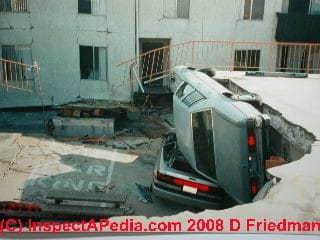
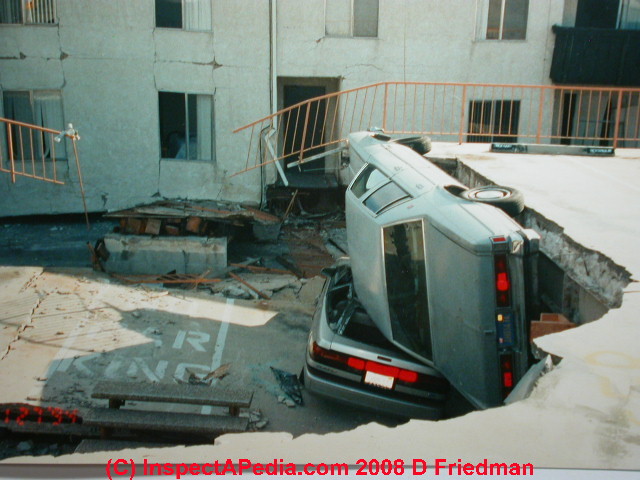
 The range of hazards faced by home inspectors in the course of examining buildings is considerable.
It includes obvious catastrophes such as falling off of a roof or electrocution, and less obvious or less likely events such as structural collapse, exposure to bacterial hazards, fungal hazards, or even physical attack by violent building occupants, biting dogs, sneaky snakes, and pecking parrots.
Home inspectors and other professional building diagnosticians are expected to be observant and attentive to detail. Despite these skills, accidents happen to inspectors.
Ladder falls lead to injuries or death
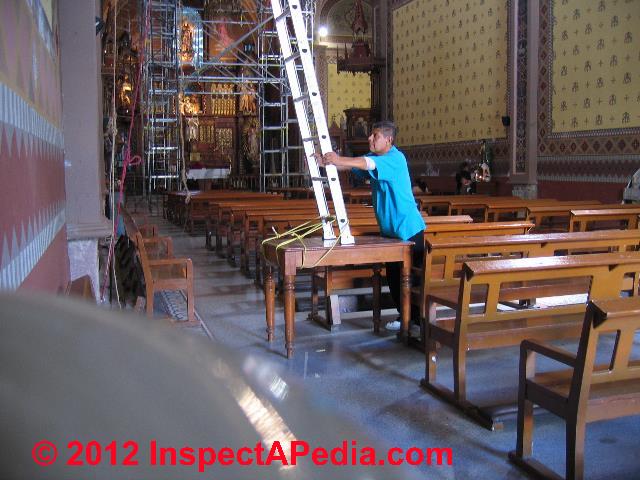
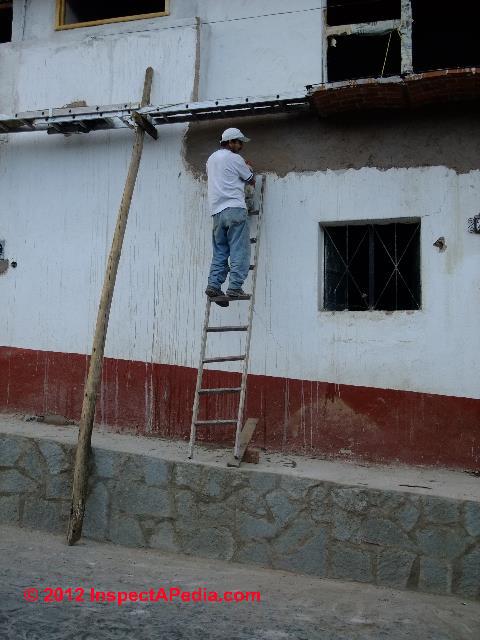
Home inspectors and other building investigators and workers spend a lot of time on ladders. Our photographs (above and left) illustrate some of the crazy things people do to gain ladder access to areas of buildings. Above a worker attempts to steady a ladder placed on a table top. At left, a ladder catapult has been designed and placed into use in Tapalpa, Mexico.
A Canadian home inspector fell to his death during a roofing inspection. He was ascending a high ladder which he suspected was unsafe.
Following a home inspection in New Paltz, NY, Ballinger, a real estate agent who was angry with the results of the inspection, attacked and attempted to kill Steve Vermilye by driving his car off of the pavement, across a sidewalk, crashing into a building wall where Vermilye was walking. Another home inspector was badly injured when an attic fold-down stair fell out of its opening as the inspector was climbing it.
Hazards that an inspector should recognize affect other people too. An aggressive tenant threatened two elderly inspection clients with a rifle and then showered them with stones. An electrical inspector was killed by an electrical arc explosion while removing the cover of an electrical panel. A plumber was killed while leaning over a water pressure tank that, lacking a pressure relief valve, exploded.
We will list some of the more egregious and more interesting of these dangerous building hazards, review accident case histories, and we will illustrate procedures of attention, observation, and hazard recognition that can reduce the chances of accidents during building inspections.
A Brief Account of Accident Theory for Home Owners, Safety Inspectors & Home Inspectors
Basic Causes of Inspection Accidents
General classes of accident during a building inspection can be understood as having two underlying causes:
- Faulty Equipment, Components, Construction: ("hidden" flaw in attic pull-down stair causes stair collapse). Careful observation and training in hazard recognition address this cause of accidents.
- Human Error: (failure to properly place ladder when entering attic causes a bad fall). Training in proper inspection procedures and proper equipment use address this cause of accidents.
People are not rational about safety
We are more afraid of improbable hazards beyond our control (EMF) than we are of probable hazards over which we have control (smoking cigarettes). For example we (DF) have had clients who were very frightened about possible indoor air quality issues in their home.
But we discovered they were heavy smokers. Another smoking client told me that she does not expose her children to cigarette hazards since she does not smoke inside their home. But we discovered that she smokes constantly when in the family car driving with her children.
We do not perceive risk accurately
The risk of falling off of a roof is a hazard. Actually falling off of a roof is an accident.
We are exposed to a wide variety hazards at widely varying risks. Some accidents are more or less likely to occur than we believe. Some accidents are likely to result in greater or lesser degree of injury than we believe. Having a more accurate picture of where hazardous risks lie can help us learn to properly attend accident risks and thus to avoid accidents.
Even an apparently improbable event (being struck by lightning) deserves careful attention in some circumstances (you're on the golf course) if the cost of the occurrence is high (death). Further, the probability of an event (being struck by lightning) varies enormously with circumstances (you're indoors).
Total Risk = (Probability of Occurrence) x (Cost of Occurrence)
The attention we pay to various risks needs to be adjusted continuously as we move through a building from area to area (basement to roof) and topic to topic (plumbing to electrical).
Tune risk recognition to area and system: The home inspector's recognition of risks needs to attend the hazards peculiar to each building area and system.
Educate to improve hazard recognition and to teach safe inspection procedures: The level of inspector technical education affects the inspector's ability to recognize hazards and to reduce accidents.
A Survey of Building Hazards and Accidents By Type of Activity
Falling, Tripping, Slipping Hazards & Lifting Hazards
The accident rate of injury by slipping, tripping, or falling is among the highest facing home inspectors and home owners.
The hazard level varies widely from unlikely: (such as 1/8" difference in an uneven concrete slab on either side of a crack) to severe (such as an improperly placed ladder accessing a high roof on a windy day while reaching far out to one side to photograph a roof defect while standing on an unsecured ladder).
(Drawing used for educational purposes only).

TYPES of ACCIDENTS: NUMBER OF INJURIES SUSTAINED IN THE UNITED STATES | ||||
| CAUSES | FATALITIES | HOSPITALIZED | NON-HOSPITAL | LIFETIME COST (Billion $) |
| Motor Vehicles | 45,923 | 23,028 | 4,803,000 | $48.7 |
| Falls | 12,866 | 783,357 | 11,493,000 | 37.3 |
| Firearms | 31,556 | 65,129 | 171,000 | 14.4 |
| Poisonings | 11,894 | 218,554 | 1,472,000 | 8.5 |
| Fires/burns | 5,671 | 54,397 | 1,403,000 | 3.8 |
| Drownings | 6,171 | 5,564 | 26,000 | 2.5 |
| All others | 28,487 | 696,707 | 35,001,000 | 42.4 |
| Total injuries | 142,568' | 2,346,736 | 54,369,000 | |
| Lifetime cost | $49.4 | $80.0 | $28.2 | $157.6 |
| Percent of total lifetime cost | 31 | 51 | 18 | 100 |
Notes to the table above
1 Cost of Injuries in the United States and the Role of Building Safety, Jake Pauls BUILDING STANDARDS/July-August, 1991
This safety hazard pattern has shifted since about 1996 to reflect significant increases in mortality due to drug overdose and firearms. In fact, by the end of 2011 in the U.S. at least, the New York Times reported that for the first time, the U.S. Centers for Disease Control had found that drug overdoses represented the leading cause of accidental death, overtaing motor vehicle accidents.[2] However falls remains a very high risk and one which receives less attention than it deserves.
"Falls include both falling to another level -- as in falling from stairs, ladders & windows -- or same level falls such as slipping, tripping & stumbling. Deaths from falls were highest in Hungary, the Czech Republic, Norway, Slovenia & Finland -- and lowest in Albania, Mauritius, Bahamas, Argentina & Chile. (Countries listed in order of death rate.)" Reference: Causes of Death, Ben Best
| 2002 ACCIDENT DATA: TYPES OF DEATHS 2 | ||
| ACCIDENT | PERCENT | |
| 1 | Motor Vehicle | 44.3 |
| 2 | Falls | 17.8 |
| 3 | Poisoning | 13 |
| 4 | Drowning | 3.9 |
| 5 | Fires, Burns, Smoke | 3.4 |
| 6 | Medical Surgical Complication | 3.1 |
| 7 | Other land transport | 1.5 |
| 8 | Firearms | 0.8 |
| 9 | Other (non-transport) | 17.8 |
Notes to the table above
2 National Vital Statistics Report, Volume 50, Number 15 (September 2002
Risk of Falls, Burns, Poisoning 3
Falls: The highest risk of injury by falls occurs among the elderly. "Falls represent the most frequent non-transportation related accidents occurring among older adults and are the leading cause of home fatalities for this population. Stairways are particularly hazardous for the elderly.
Other types of falls include slipping in bathtubs and showers, slipping on tile or icy terrain, and tripping over objects on the floor. Falls associated with getting in and out of bed, getting on or off a chair, or using the bathroom are also frequent.
Burns are also common among older people. In fact, burns and other consequences of fire rank second as a cause of death among persons aged 65+. Among activities that lead to burns are cooking, smoking, and accidentally turning on and failing to turn off appliances. Scalds from hot water are also a frequent source of injury, especially in bathtubs and showers.
Poisoning from improper doses of medication ranks third as the most prevalent type of home accidents. [Poisoning fatalities and hospitalizations have increased dramatically in the U.S. recently in association with illegal drug use. --DF]
Older people are especially susceptible to this kind of occurrence as they are likely to be taking several highly potent drugs at one time, to have visual or cognitive disabilities, and to live in environments that are conducive to medication errors (e.g., environments that are poorly lit).
The high rate of home accidents among older persons points to the need to understand the etiology of these accidents so that we can develop design interventions.
The reasons for the high frequency of such accidents are complex but are likely to include the fact that older people spend most of their time at home and that age-related changes in functional abilities make it more difficult for them to complete home tasks.
Moreover, the demands of the home environment are often substantive in that the homes of elderly people tend to be older than those of younger people, more difficult to operate and maintain, and more often in need of repair. As a result, housing deficiencies, such as broken stairs or poor electrical wiring, are more common in elderly housing."
3.. Enhancing the Home Safety of the Elderly: Technological and Design Interventions, Sara J. Czaja, Ph.D. Director of Research Stein Gerontological Institute
Reducing slip, trip, and fall hazards for home inspectors is discussed within individual building area and hazard topics which follow.
Roof Access Hazards - inspector falls to his death
Canadian home inspector fatality, inspector ascending exterior ladder secured to building knew the ladder was unsafe, told his wife he was afraid of it but felt he had to ascend to inspect the roof during a multi-day inspection of a large building.
The ladder came away from the building and the inspector fell to his death. (Ca. 1998)
Hazards to Avoid When Inspecting Roofs
- Ladder placement and use hazards (discussed in detail below)

- Slipping or falling off a steep roof (it's easier to get on than to get off, valleys are easier to walk than an open steep roof slope)
- Slipping or falling off of a slippery roof (wet, wood, slate, loose debris)

- Knocking debris onto a client or bystander below (slates, branches, chimney parts, and also, people holding your ladder should look down, not up, as you descend to avoid roof debris in the eye)
- Falling through a rotted or damaged roof surface, perhaps hidden by a sloppy"roof over" job
- Falling off of a roof or other elevated location indoors or outside due to mis-attention, distractions, bees
Stair, Rail, & Ladder Safety Hazards & Accidents Described and Avoided
Stunning stairs, remarkable railings, loopy ladder tricks.
The author has consulted in depth concerning fall injuries and has performed case studies investigating stair and rail accident and injury lawsuits.
American home inspector injury: inspector ascending or descending an improperly-secured attic stair was badly hurt when the stair came out of its opening and fell. Falling tangled in a stairwell increases injuries.
Lawsuit 1: Missing railings

- Which is worse missing hand railings or loose railings?
Investigation of the stairwell wall found evidence of removed railings tenant falls, no railing-removed by landlord; tenant falls, sues building owner.
Landlord responded to tenant's complaint of loose railing by removing it entirely.
Inspection confirmed that the stairway railings had been removed in one case (photographic evidence of wall modification confirmed separate testimony) and stair railings had been improperly installed (secured only to drywall) in a second case.
Lawsuit 2: Flimsy railings

- Painter falls, grabs bad rail installed by homeowner, falls into stairwell, very very serious injuries, months out of work, unable to return to original work, sues building owner (and their insurance company).
Lawsuit 3: Poorly-constructed exterior stairs

- Lawsuit #3 involved an exterior wooden stair with uneven treads and risers, slippery surfaces, combined with a "handrail" that could not be grasped when the tenant slipped on a stair.
There were also questions about whether or not the stair was adequately lit.

Additional field work for home inspectors can provide useful services to owners, maintenance companies, attorneys:
documenting conditions at a property (see our stair inspection checklist). (Of course the down-side is that you have to talk with and maybe even touch lawyers.)
How to Avoid Stair, & Railing & Ladder Accidents
Note bad steps and rails to yourself and report orally and in writing to your clients
Ladder Hazards at Building Inspections

Ladder angle (OSHA: the horizontal distance from the top support to the foot of the ladder should be approximately one-quarter of the working length of the ladder)
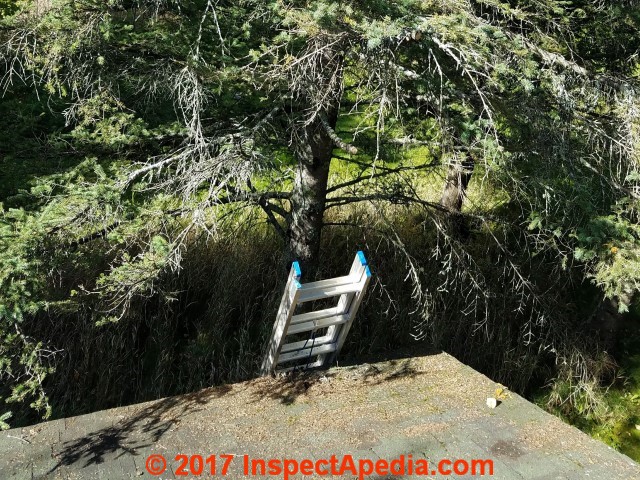
At DEBRIS STAINS on ROOFS I comment that climbing onto this roof in Two Harbors MN in order to remove accumulated debris placed me smack into an area where there was already an accumulation of hemlock needles just hoping they could send me back down to earth in a hurry.
Below: workers in Mexico are using wood scraps to shim the uneven surface below the bottom of a ladder. 
Below: in one of my favorite ladder photos workers in San Miguel de Allende needed a taller ladder than what was at hand, so the ladder was set atop a table. This is not an OSHA-approved ladder procedure.

- Ladder feet improperly placed on sloped, uneven, wet, icy, snowy, un-seen, or other slippery surface are one of the most-common ladder fall hazards.

- Distractions - Bats in the Attic? and other distractions during climbing ladders: people, (client directly overhead while climbing ladder into attic - let's be first honest, second careful, third professional), bees and wasps, birds, bats, pets (more later on biting dogs)
Improperly constructed or installed stairs

- Improper and unsafe stairs or steps - wrong depth, riser height, tread nose, slope, total height
- Unsafe hand railings or stair rails by dimension or angle or gap (child hazards) or non-graspable hand railings along stairs or ramps
- Circular stairs treads: small triangular angled walking area, widely-spaced balusters (fall-through or head traps)
Unsafe attic stairs

- Inadequate securing of stair frame to the framed opening
- Loose or missing hinge bolt hardware
- loose, bent spring arms (spring can slip and strike stair climber in the face)
- folding ladder too long (angled position brakes stair stringer) or too short (hanging stairs)
- damaged or loose treads
- older sliding ladder versions may fall out completely (DF broken leg)
Unanticipated sources of falls during home inspections
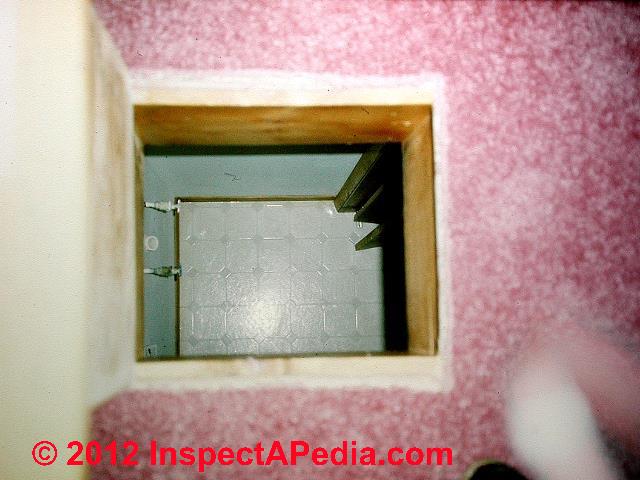 Our photo (left) illustrates a serious safety hazard, especially for curious children: a laundry chute whose opening cover is in the floor of an upstairs hallway. You are looking into the basement through this opening.
- Exterior wooden deck stairs with improperly installed treads, side nailed, no cleats, wooden treads fall, protruding nails rake the inspector's ankle
- Dogs (including culturally-based fear among some Asians who fear them); biting hazards but also fear and falling hazards
- Hidden defects - missing support, rot (realtor stomped-on and fell through deck while demonstrating its structural integrity)
- Hidden structural details: walking on attic floor joists (ceiling joists) with insulation in place, stepping on insulation risks failure to notice that joists change direction = fall through (DF fell into Fox Hill Condos bathroom, occupied)
- Pitched, slippery treads
- Insecure rails (no hazard until you're falling and need to grab the rail)
- Angry bystanders push (realtor pushed clients father down stairs)
- Bees and wasps, bats, etc. - carry an epi-pen?
References for Stair & Ladder Safety for home inspectors
- STAIRS, RAILINGS, LANDING INSPECTIONS, CODES a catalog of stair and railing trip and fall hazards, building codes, and inspection procedures https://InspectAPedia.com/Stairs/Stairs.php
- http://www.osha.gov/Publications/osha3124.pdf
OSHA Rules for Stairs and ladder safety
Slip Hazards (Not Trips or Falls)
- Slipping accidents account for 33% of all reported major injuries (backs, sprains, etc)
- 20% of over-3-day injuries to employees occur as slips
- 50% of all reported accidents to members of the public are from slip or trip hazards
REF: http://www.aachenconsultancy.co.uk/index5.html on work accident claims
Other Attic Hazards For Building Inspectors

- Cuts: cutting your head on protruding roof nails

Falls: stepping or falling through ceilings.
- Watch out for attic joists which change direction, hidden under insulation.
- Watch out for breaking truss chord members when walking on roof truss bottom members covered by insulation. A knot can lead to sudden surprise breakage.
The author [DF], while drilling a guide hole to cut a larger roof opening to install an attic exhaust fan, stood on a truss chord buried in insulation. Not visible was a knot that left the truss bottom chord very weak.
It broke as I pressed my drill against the roof sheathing overhead. I fell through the ceiling into an occupied bathroom at Fox Hill Condominiums.
After straightening up from my own pain and very personal injuries that happened as I passed over the broken truss chord, I found that I was standing on the floor in front of the property owner.
She had no idea that I was working in the common attic space over her head and, in a moment of assumed privacy, was sitting, stark naked, on the toilet. She was more furious than frightened.
It took much pleading and begging to avert a call to the town police and more trips to repair the ceiling.

- Fans, cuts, dust: attic fan hazards
- Watch out for clients turning on fan during inspection - cut hazards and fiberglass hazards

- Pathogens & Dust: breathing fiberglass dust, mold, bird, rodent, squirrel pathogens.
- Wear a respirator in areas like this.
- Watch out for attention-capture errors - distracted by bats, the inspector may miss other hazards or defects
- Shocks: electrical hazards (wires buried in insulation) watch out about grabbing wires, fans, wasps, other hazards when climbing into an unfamiliar attic. See details at SAFETY for ELECTRICAL INSPECTORS
Other Basement or Crawl Space Hazards

- Fear in crawl spaces: being startled while working in a confined space can itself lead to injury from a banged head, cuts, nail perforations, etc. even if the hazard is only imagined. But spiders, snakes, rodents, and in one report, a dead human body can all be suddenly frightening, inviting injury from sudden movement.
- Pathogens: Wet surfaces increase risk of bacterial, viral, or fungal or pathogen hazards, especially if there has been a history of sewage backups or burst drain piping;
- Rodent urine, fecals, dander can be pathogenic or allergenic.
- At least one case of Hanta Virus has been reported in Connecticut. (DF personal conv. with HantaV. expert after becoming sick in a mouse-dusty crawl area)
- Shock hazards in crawl spaces: Wet surfaces increase risk of shock hazards such as when opening electrical panels or touching improperly grounded wiring in basements and especially in crawl spaces. A home inspector reported being badly shocked by contacting a loose electrical wire while crawling in a very tight crawl area.
- Snakes in crawl spaces are a special hazard to home inspectors. Not only may snakes have made a home there but they may even have been deliberately placed in a crawl space in an attempt to control rodents - themselves also a hazard we described just above.
Professional home inspector Dan Haydon described such an incident: - Stuck, Cut, Bitten: Confined spaces can be dangerous (getting stuck, bitten, or frightened by snakes, insects, rodents, bodies, chemicals such as pesticides, injuries & cuts) We discuss animal hazards in more detail below.
Watch out for snakes: I encountered a crawl space with snakes here in AZ not a huge surprise but after I had to leave the crawl space rather rapidly, the home owners informed me that they had them put snakes in the crawl area to take care of a rat problem!! But this leads to a useful lesson for Arizona home inspectors: ask all parties if they know of any "proactive measures for rodent control " that have been applied to the space below the building before you enter such an area.
The snake handlers had to be called out and then the crawl space was ready to be inspected!
That was not an isolated incident.
The author inspected a mold-contaminated reptile vendor's property in Orange County New York. The owner had died. His wife entered a few days after the funeral to feed the turtles, snakes, iguanas. A boa constrictor had found its way into the ceiling, from where it dropped onto her and encircled her neck.
The owner won the battle, escaped the snake, locked the doors and never went in again.
At my [DF] inspection the reptiles were long dead. They had been succeeded by leaks and mold growth enough to make even a suited-up environmental test expert sick.
Other Exterior Hazards for Building & Home Inspectors

- Falls: Septic system, cesspool, other subsidence collapses. We discuss septic collapse, methane, biological, and other hazards in more detail below.
Lifting accidents - back injuries during building inspections
The most common injury associated with lifting is back pain. It is said that up to 5 million working days are lost due to back pain every year.
- Pushing, pulling, moving furniture, etc. produce similar injuries.
- Avoid the need for hazardous manual handling, reasonably practicable;
- Assess the risk of injury from any hazardous that can’t be avoided; and
- Reduce the risk of injury from hazardous manual far as is reasonably practicable.
REF: http://www.aachenconsultancy.co.uk/index4.html
Hazards of Working Alone
New York City worker found dead in duct system after falling through a ceiling and remaining trapped over a weekend.
Watch out: Contractor's ladder blew down, trapped on high roof on weekend (cut hole through to interior)
- Have your cell phone in a pocket (not on a belt) when entering remote or dangerous areas alone (roofs, crawl spaces, even attics)
- Tie up your ladder especially if alone, if on windy days, and when tall buildings with no other egress (saw hole in roof?)
- It's easier to get up than to get down, surfaces to avoid include
Electrical Safety for Inspectors
Here we give some tips on how to inspect the electrical panel, including the risks of relying on test instruments (resistance drops do not equal bad connections).
See details at SAFETY for ELECTRICAL INSPECTORS
Also see HOW TO TURN OFF ELECTRICITY in a building that has been wet or flooded - separate article
Case Histories of Electrical Accidents During Inspections
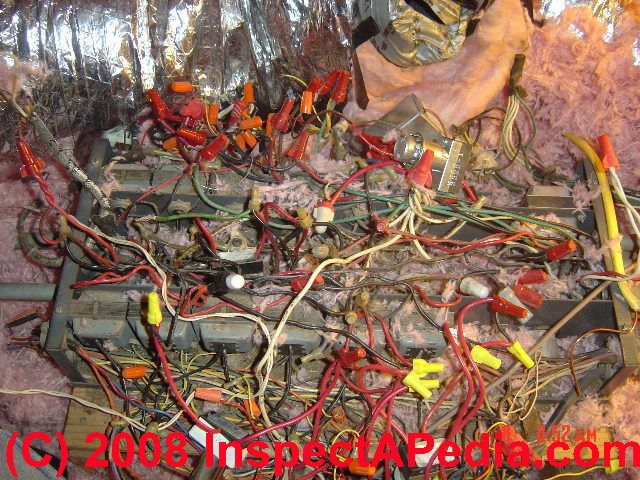
- Electrician in Atlanta killed while removing electrical panel cover explosion
- Homeowner denies unsafe wiring, demonstrates its safety by licking his knuckles, touches simultaneously the armored cable (BX) and a nearby water pipe, gets shocked;
- Realtor instructs tenant to cut and remove harmless zip-cord wiring run in walls, tenant cuts, tenant is shocked, main building fuses blow, curls tenant's hair.
- Rat's nest wiring comment frightens high-heeled client, runs through dark basement, falls, is injured
Examples of What to Watch for at the Service Entry

- Old but still live service entry wiring left on building when new SEC and meter were installed
- Damaged, leaky wiring wets electrical panel components
- Loose meter pans risk screws falling into and shorting electrical components
- Low service entry wires that can be touched from on-roof, outside stairs, building windows
See details at SAFETY for ELECTRICAL INSPECTORS
Examples of What to Watch for at the Electrical Panel

Standing water, wet floors - do not touch electrical components
Loose wires not capped, arcing hazards during inspection
Spring-loaded panel covers may permit bus assembly to move when cover or inner panel face is removed - arc explosion hazard.
- Rust on the electrical panel door may be subtle but could warn of very unsafe conditions inside. Observe exterior rust, open and inspect with extra caution; diagnose rust cause: internal leaks and corrosion vs. area dampness leading to external rust.

- Sheet metal screws in the panel door may pierce live wires during electrical panel cover replacement.
- Mis-wiring or loose connections may short when moved
- Overheating, burn ups, loose wires, other commonly-identified reporting defects
- FPE, Zinsco, Aluminum Wiring - breakers fall out;
- Bakelite fuse holders can disintegrate when pulled from an old panel;
Also see ASBESTOS in PLASTICS - Cartridge fuses can twist or disconnect during removal of fuse pull-out
- Breakers may not reset when turned off manually
- Turning off breakers accidentally during panel cover removal can cause in-building catastrophes such as computer data loss or injury if medical equipment (a home dialysis machine) is in operation. [These warnings are based on actual incident reports -DF]
- Do not rely on "touch" to test for live wiring or shorted electrical panel boxes
- Do not touch, grab, shake, disturb live wires unless specifically trained & equipped to do so [B. Smith, Small Homes Council, erroneously advised home inspectors to test the connection security of SEC connections in the panel by grabbing and shaking them - DO NOT DO THIS-DF]
- One hand behind back during panel inspection
- Block clients from touching live electrical components during panel inspection by positioning your body correctly
References for Electrical Inspection Safety Procedures for Home Inspectors
- See electrical inspection details at SAFETY for ELECTRICAL INSPECTORS
- ELECTRIC PANEL AMPACITY
- ELECTRICAL PANEL FUSED NEUTRAL WIRE HAZARDS
- ELECTRIC PANEL WORKING SPACE
- ELECTRIC PANEL INSPECTION
- https://InspectAPedia.com/electric/Electrical_Inspector_Safety.php
Electrical Safety Hazards and Safe Electrical Inspection Procedures for Electrical and Home Inspectors at Residential Electric Panels
This article includes:- Standards for Electrical System Inspections
- How to use test equipment during electrical inspections
- Electrical safety when inspecting basements, crawl spaces
- Safety advice on touching electrical components
- Follow-up on electrical safety issues
- When to shut down unsafe equipment
- Using DMMs and VOMs Safely
https://InspectAPedia.com/electric/Electrical_Panel_Inspection.phpHow to Inspect Residential Electrical Panels
Other electrical safety and product hazard references
- https://InspectAPedia.com/aluminum/Aluminum_Wiring_Hazards.php Aluminum Wiring Information Website Aluminum Electrical Wiring Hazards and Repairs: in-depth authoritative information, photos, documents including selection of proper vs. ineffective repair methods. E.g.: Ideal 65 "Twister" purple connector fails in field and lab testing with aluminum wire.
- https://InspectAPedia.com/electric/Electrical_Service_Amps_Determination.phpAmpacity of an Electrical Service: How to determine the electrical service size or ampacity entering a building
Circuit Breaker, a bad one fails to trip failure at aluminum bus-to-circuit breaker connection - field report and photographs - https://InspectAPedia.com/fpe/FPE_Stab_Lok_Hazards.phpFederal Pacific Electric (FPE) Stab-Lok Circuit Breaker Panel Hazards Website - Latent fire hazards, in-depth authoritative research, documents, advice on Stab-Lok electric panel and circuit breaker failures and what to do when this equipment is found in buildings.
- https://InspectAPedia.com/electric/Multi-Wire-Electrical-Circuits.phpMulti-wire branch circuit inspection and defects
- https://InspectAPedia.com/electric/Electrical_Panel_Rust.phpRust and Corrosion in Electrical Panels, A Study and Report on Frequency and Cause for Electrical and Home Inspectors at Residential Electric Panels
- https://InspectAPedia.com/electric/Zinsco_Electrical_Panels.phpZinsco Sylvania Electrical Panel Hazards
- "Electrical System Inspection Basics," Richard C. Wolcott, ASHI 8th Annual Education Conference, Boston 1985.
"Simplified Electrical Wiring," Sears, Roebuck and Co., 15705 (F5428) Rev. 4-77 1977 [Lots of sketches of older-type service panels. - "Electrical System Inspection Basics," Richard C. Wolcott, ASHI 8th Annual Education Conference, Boston 1985.
"Simplified Electrical Wiring," Sears, Roebuck and Co., 15705 (F5428) Rev. 4-77 1977 [Lots of sketches of older-type service panels.] - "Electrical Systems," A Training Manual for Home Inspectors, Alfred L. Alk, American Society of Home Inspectors (ASHI), 1987, available from ASHI. [DF NOTE: I do NOT recommend this obsolete publication, though it was cited in the original Journal article as it contains unsafe inaccuracies]
- "Basic Housing Inspection," US DHEW, S352.75 U48, p.144, out of print, but is available in most state libraries.
Electrical System & Wiring Hazard Inspection, Detection, Cause, Remedy, Prevention - Main Electrical Page - https://InspectAPedia.com/lightning/Lightning_Strike_Protection_Systems.php
Lightning Protection Systems Information and Sources of Lightning Protection Systems"Lightning as a cause of death seems to excite a disproportionate amount of interest, associated with the mistaken idea that it is a random, uncontrollable natural event. Lightning is comparable to floods as a storm-related cause of death in the US.
In a given year the chance of being struck by lightning is about one in 700,000 and the chance of being killed by lightning is less than one in 6 million in the United States. But the chance is far less where thunderstorms are infrequent, such as in San Francisco and far greater where thunderstorms are frequent, such as in central Florida.
The chances are far greater for avid golfers who refuse to leave the golf course when a thunderstorm is approaching. A safe location should be sought immediately whenever the sound of thunder follows lightning by less than 30 seconds.
Avoid high places, open areas, bodies of water, metal fences and isolated trees or poles. In a house, avoid contact with plumbing or electrical fixtures. A vehicle can be a safe shelter if the windows are rolled-up and there is no contact with metal surfaces."
-- Ref: Causes of Death - Ben Best
Gas Piping and Gas Appliance Safety
Gas tank or gas piping leaks are a potential explosion or fire hazard. There may also be carbon monoxide or other asphyxiation hazards from equipment malfunctions.

- Detecting gas leaks, appliance safety controls, what to do when a leak is detected, when to shut down unsafe heating equipment.
- Decide the level of risk - where did you smell or detect gas - is it a trace level or is it significant (on entry to an area or outside of a building)
- Report all leaks to all affected parties
- Serious leaks: call the gas company, do not operate anything electrical (even a cell phone) in the building - leave
- The dangers of trying to "turn off" a gas valve?
- The risks of relying on test instruments to find gas leaks.
- we fail to perform an adequate visual inspection
- building conditions change making odors and leaks change
- Examples of subtle, persistent gas leaks
- cracked gas piping fittings, flare fittings
- grooved flare fitting
- leaks at water heater controls
- leaks at gas meters
- improperly vented gas meters indoors
- gas meters in ground contact
- Examples of common low-level harmless gas leaks.
- leak at right side of many DHW heater controls
- trace leaks at outdoor LP gas tank valves & regulators (is the LP gas regulator protected from weather and properly positioned ?)
- Why the gas company likes certain gas leaks.
- Money
- Disagreement with inspectors' findings
Use and rely on these gas leak detection methods in this order
- Smell (unreliable both in variation among individuals and in de-sensitization on prolonged or gradual exposure)
- Visual inspection: leak stains, damaged equipment, exposed piping, unsupported piping, old equipment
- Gas detection instruments: TIF 8800 - review how to set up the instrument for proper use: turn it on outside
of the test area (outdoors), adjust sensitivity to a stable level of ticking; enter the test area;
check suspect piping, connections, flues, equipment; check both high and low air; check gas lines and meters, especially penetrations at walls for burned NG lines.
Use witnesses to equipment response, document findings, inform affected parties orally and in writing. In emergency, follow gas leak emergency procedures: leave the area, do not operate switches, cell phones, anything that might create a spark;
Heating System Inspection & Gas Leak Detection & Reporting References
https://InspectAPedia.com/plumbing/Gas_Controls_Piping_Valves.phpHow to Check Gas Piping, Controls, Regulators & LP Gas Tank Defects
https://InspectAPedia.com/plumbing/Gas_Leak_Detection.phpHow to Identify & Correct LP Gas or Natural Gas Leaks
https://InspectAPedia.com/heat/Heating_Safety_Inspection.php Heating Inspection Safety Guide
Heating System Inspection Safety Hazards
See SAFETY, HEATING INSPECTION
Also see these heating safety-related recall notices
Structural Collapse Hazards

Collapse Accidents and Hazards of Special Risk to Home Inspectors & Home Owners.
Masonry structures such as this carriage house in Saugerties, NY, can be very unstable and risk sudden even imminent sudden collapse, depending on just how it is damaged.
Broken bond courses in brick are a particular concern as are severely-bowed masonry block walls. Discouraged about other inspection defects, SV's realtor kicked the brick foundation asserting that at least the foundation was salvageable. The building collapsed.
Wood framing and sheathing, especially unsafe roof framing or rotted sheathing (Donna Smith fell through roof); this is an argument for inspecting in the attic first but certainly for being alert for old worn roofing or areas of probable leakage, and stepping carefully when walking a roof of any type;
Collapse Hazards for Improperly-Constructed Decks & Stairs

The author inspected this deck and warned of its probable collapse, indicated that it was dangerous, informed the client to "stay off of the deck" until it was repaired.
The client moved into the new home, invited friends to celebrate, partied on the deck, and rode it to the ground as it collapsed.
Six people were hospitalized (none with serious injuries). Children playing below the deck as it collapsed ran to safety.
The author re-inspected the collapsed deck to photograph construction details that led to the structural failure of this component. Litigation was broached.
Septic Tanks, Drywells, Cesspools and their Risks to Home Owners, Occupants, & Inspectors

Inspection Hazards at Septic Systems, Drywells, Cesspools
Collapsing covers over tanks, cesspools, drywells, especially wood, steel, or home-made Collapsing site-built septic tanks, cesspools, drywells.
Particularly dangerous are unsafe covers, home made, rusted steel, wood; cesspools, particularly site-built of dry-laid stone or block, especially if "serviced" by pumping which undermines the walls;
Steel cover cuts lead to severe infections.
Bacterial (sewage) and fungal (mold) hazards for home inspectors may be present if there has been sewage backup.
Methane gas explosions & Asphyxiations at Septics

- Correspondent burned brush in yard, blew up septic tank and nearby buildings were damaged
- Correspondent lit cigarette while pumping septic tank, blew out nearby windows
- Annual sewer gas explosions in cities
- Methane is an asphyxiant as well as explosive

Hand-Dug wells may also have unsafe covers.
Old hand-built septic systems and covers are at extra risk of collapse after:
This home made septic tank next to the foundation and stairs had about 200 gallons capacity; a sump pump (foreground) was used to pump effluent to an uphill home-made drain field.
A manual switch operated the pump; leaky piping sprayed septic-dyed effluent over certain bystanders during the inspection.
Other causes of septic collapse include:
- Pumping or agitating
- Rainfall or rising water table
- Nearby construction, excavation, blasting
- Changes in site drainage - gutter downspout rerouting collapsed a system whose location had been unknown in Poughkeepsie
Long Island Cesspool Collapse Fatality Lawsuit
Case study 2002. System "serviced" improperly (a failing cesspool was rejuvenated by aerating and agitating its bottom), owner walked over system next morning, was buried alive in a collapse.
- Do not pump, agitate, or otherwise disturb clogged, failed, slow cesspools, especially site-built units; the process undermines the structural walls; pumping gives only brief relief anyway
- When a cesspool has failed it needs replacement not pumping.
Other unsafe covers, Septic Fatalities, fatalities in CA; recent report by email of an owner's visitor stepping into the septic tank
The Fatal Hazards of Falling in or Leaning Over Septic Tanks
- Falling-in the Septic Tank or Cesspool: Do not step on and fall into a septic tank or cesspool. Potentially Fatal Hazards of entering, stepping onto or falling into a septic tank
- Entering the Septic tank: Never go into a septic tank - on purpose or by accident unless specially trained and equipped. (Methane asphyxiation in shit)
- Leaning over the Septic Tank Opening - can lead to asphyxiation
More Septic Safety Advice About Site Features: collapsing septics, cesspools, sinkholes and subsidences
- Notice subsidence or other collapse evidence
- Consider age, location, and type of septic system and its maintenance history when assessing risk - no maintenance on an old system means it's materials and conditions are unknown
- Watch where you step, lean, fall, or smoke
- Do not walk suspect site areas alone
- Issue adequate warnings to homeowners
- Mark off dangerous sites - signs: subsidence; bad covers; age; long island cesspools
References for Septic System Safety:
https://InspectAPedia.com/septic/Septic_Tank_Safety.php
Septic & Cesspool Safety Procedures
https://InspectAPedia.com/septic/Sewer_Gas_Odors.php
Diagnosing and Curing Sewer Gas Smells and Septic Tank Odors
https://InspectAPedia.com/sickhouse/sewage.htm
Sewage or Septic contamination in buildings - Investigation, Testing and Remediation
https://InspectAPedia.com/septic/Sewage_Contaminants.php
Residential Septic Tank Sludge and Scum - what pathogens and contaminants do they contain?
https://InspectAPedia.com/septic/Septic_Contaminants_Pathogens.php
Septic system contaminants: identifying water and soil contaminants produced by onsite waste disposal systems
Other Tank & Building Site Excavation or Collapse Hazards

Rusting oil tanks are a possible collapse hazard, though without being full of sewage are perhaps a less odious hazard.
Buried oil tanks or other tanks near a foundation are also a source of water entry, channeling ground water towards the foundation.
Sink Holes, usually known ahead of time by area when based on geological conditions; others occur due to sudden subsidence following plumbing leaks or other site changes.
Oil Tank References
https://InspectAPedia.com/oiltanks/Oil_Storage_Tanks.php Heating Oil Underground & Above ground Oil Storage Tank Leaks, Testing, Problems & Solutions, Home Buyer's / Home Owner's Guide
Building Air Quality and Pathogenic Hazards for Home Inspectors
Visible mold hazards
 Problematic and larger mold reservoirs may be present; risk varies
by extent, history, location of leaks, building materials used, mechanical disturbance of moldy materials, other factors.
Problematic and larger mold reservoirs may be present; risk varies
by extent, history, location of leaks, building materials used, mechanical disturbance of moldy materials, other factors.
How to recognize problem molds and cosmetic molds by visual inspection - is it possible? Learn to recognize obviously cosmetic-only mold infections such as BlueStain.
What level of mold exposure is likely to be a risk to home inspectors? More than 30 sq .ft. of highly-airborne-type mold or even small areas of toxic mold if touched to an open cut or an eye.
Reference:
https://InspectAPedia.com/sickhouse/Cosmetic_Black_Mold.htm Harmless Black Mold.
Invisible mold hazards
When to suspect mold or fungal contamination when no mold is visible:
- Trace actual building leaks by visible stains or by construction details known to make leaks or moisture problems likely.
- Recognize leak-risk conditions increasing the risk of problematic mold.
- Fiberglass insulation exposed to wet basements, crawl spaces, attics, is often a significant but invisible problem mold reservoir.
- Mold growth in building interiors is a leak or water indicator that is important in diagnosing a wide range of building concerns besides just possible mold hazards.
Reference:
https://InspectAPedia.com/mold/Find_Invisible_Mold.php How to Find Hidden Mold
When to Wear a HEPA Respirator
Wear a HEPA (and preferably also an organic vapor filtering double-canister) respirator. Paper dust masks (except the 3M N-95) are ineffective and thus dangerous. Repeated exposure to mold or other allergens can lead to increased sensitization, adult-onset asthma (DF), and even sudden and severe asthmatic attacks and anaphylactic shock (hearing booth client).
- There is visible mold of more than 30 sq ft. or a very mold-suspect area
- You are entering a dusty or dirty attic, basement, crawl space (explain to clients that you have higher regular exposure)
- You are asthmatic, COPD, etc.
Steps to Avoid Mold, Bacterial, Viral Hazards in buildings
- Asthmatics: Do not permit asthmatic or COPD or similarly afflicted clients to enter or disturb moldy materials
- Touching moldy or sewage-contaminated surfaces: Wash hands after touching dirty or moldy surfaces, never ever put a moldy finger into your eye (DF received two reports of lost eyes due to fungal infections) Experts wear eye protection.
- Wash dirty dusty clothing or use disposable Tyvek(R) coveralls if you have to inspect dirty areas
- Beware of walking or crawling in sewage or areas of previous sewage backups and floods; (Wear washable boots or disposable boot covers).
- Rodents: Beware of walking or crawling in areas where there has been a severe rodent problem: urine and fecal waste may be pathogenic (wear a respirator in such crawl areas)
- Reactions: Pay attention to physical responses in yourself and your clients when entering building areas but do not assume that no response means no hazard. (People vary widely in individual response).
References for Mold Problems in buildings
https://InspectAPedia.com/mold/Mold_Action_Plan.php Mold Action Guide: What to do about mold, mildew, and other indoor allergens
https://InspectAPedia.com/sickhouse/IAQ_Investigation.php When to hire a professional to investigate a building for toxic mold
https://InspectAPedia.com/sickhouse/Stains_Not_Mold.php Stuff that is Not Mold or Stuff that is Harmless Mold
https://InspectAPedia.com/mold/Mold_Test_Method_Validity.php Mold Prevention: a guide to mold-resistant construction
How to Respond to Hostility, Weapons, Threats, Biting Dogs, Flitting Bats, Scratching Cats at Building Inspections
Dealing with violent or threatening building occupants, dogs, spiders, snakes, rats, other pests; weapons, threats, realtors. When and how to leave a threatening environment. How to get the inspection done.
Case histories of Violence at Home Inspections
Note: For reasons that will be apparent, I do not have photographs of these encounters.
- Tenant Threatens Buyer: Tenant informs inspector he is going to beat up and then kill whomever is buying the house (seller is making tenant move out); inspector identifies client as friend/assistant; expressed sympathy, was able to complete the inspection; recapped off premises.
- Tenant Attacks Clients: attacked by hostile tenant, brandishes rifle, uses car to throw gravel; left inspection, informed parties, tenant
removed from premises before re inspection; - Realtor Attacks Client: Client attacked by realtor, (realtor tried to push client's father down stairs in Westchester)
- Realtor Attacks Home Inspector with Car: Bollinger vs. Vermilye, New Paltz NY
- Home Owner Threatens Dog: Home owner threatens inspector (and inspector's dog) with pistol.
Steps to Avoid Trouble From Building Occupants
Assess the level of risk, monitor and change the assessment as needed Maintain professionalism, calmness, do not respond to hostility. As a professional guiding clients through a building:
- Protecting the client is your first responsibility
- Protecting yourself is your second responsibility
Bad Animals: Dealing With Biting, Nipping, Inspector-Chewing Dogs

Ask that dogs be off premises or confined in areas not to be entered during the inspection. Same for other potentially dangerous or hard to control pets. Do not permit owner's pets to escape, be lost, injured.
Owner's dog bit DF, giving the death bite; owner denied, child confirmed dog's behavior
Owner's dog biting clients, lured into attic bedroom, leaps out of third floor window during inspection (DF- Newburgh NY)
Owner of snake farm died (toxic mold, respiratory illness), owner operated exotic snake business in premises (DF - Orange County)
Bad People: Leaving the Premises Where Occupants Make Threats
Leave the premises if:
- Occupants (or other parties) verbally or physically threaten anyone in the party
- Occupants manifest weapons or other physical threats
- Biting or threatening dog is not controlled
Contact: owner, realtor(s), attorneys, and if appropriate, police;
Do not return to the property without assurance that the potentially dangerous party is not on and will not be on or at the premises
Q&A session to address reporting concerns, priorities of hazards, hazard recognition for Home Inspectors
Some Q&A Safety Topics for Home Inspectors
What is the Right or Obligation of a Licensed Home Inspector to
- report hazardous conditions, and to whom, and when, and in what form
- turn off visibly unsafe heaters, electrical equipment, flooding or burst piping, etc.
- disable unsafe equipment when there is evidence of owner/handyman override of safety controls
The "last man in the building" is typically held responsible for subsequent catastrophes such as exploding equipment, fires, shocks, collapses. A professional is expected to be able to observe, evaluate, and act appropriately.
Defending Shutting Down Unsafe Equipment
The balance between risk of damage to property, possible fire, explosion, shock, or fatality, versus inconvenience to occupants or risk of freeze-damage:
- Fire and death risks trump convenience in court. Home inspectors are qualified and responsible individuals on a property who, as building professionals, have a duty to protect both clients and occupants where there are, in the inspector's judgment, serious, immediate, safety hazards. (14 million BTUH boiler in a community center with a 2000 BTUH relief valve?)
- Relief valves on tanks - water, water heater, boilers, steam boilers: when might a TP valve be missing but the system "safe"; why drips are potential killers; what is a BLEVE and why do water tanks become rockets?
Determining when a structural defect is an immediate and major hazard
- Broken bond courses. Sudden calamitous collapses.
- How should we report hazards and to whom?
- What is the scope of a licensed professional inspector's responsibility?
Home Safety Checklist & Financial Aid for the Elderly and for Disabled Veterans
Please see ELDERLY & VETERANS HOME SAFETY for the full-text version of this article. A summary is just below.
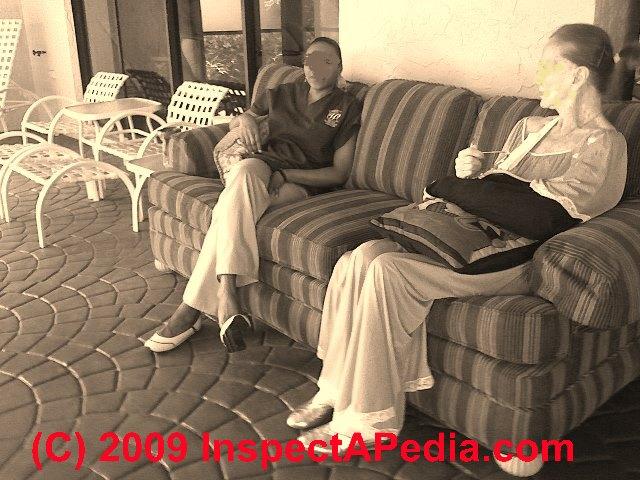 The author's mother, at age 91, fell down carpeted stairs in her home in Boca Raton, Florida. Injuries from falls can be very serious, even fatal to more fragile elderly people.
At 2AM mom decided to carry an armload of clothes downstairs to her washing machine.
Wearing open-heeled slippers with smooth soles, carrying an armload of laundry with both arms full, and stepping down stairs that were poorly designed with narrow treads and thick soft nosed carpeting, she lost a slipper and fell.
Mom's injuries included three broken ribs, an elbow so severely broken that an elbow replacement was required, and multiple lacerations to her head.
The author's neighbor, at age 85, made a wrong turn in an upstairs hallway after using the bathroom late at night.
Dr. S. fell down stairs to a landing, narrowly-missing a fatal fall through a window located at the landing, and while he recovered, his injuries were so severe, both mental and physical, that he had difficulty walking and rarely left his home again until his death years later.
Falls like these are so severe that they can materially affect the length and quality of life for the elderly. Yet the hazards involved could be easily spotted by an experienced home inspector or home safety inspector.
Special Home Safety Inspections for the Elderly or Disabled
In a home safety article "Making Home a Safer Place, Affordably" by Lesley Alderman and appearing in the New York Times (July 2009), Alderman provided some excellent home safety inspection and home safety improvement financing suggestions that we summarize here:
- Occupational therapist:
hire an occupational therapist (an O.T.) to inspect and suggest modifications to the home to meet the specific needs of its elderly or disabled occupants. O.T.'s will consider safety and ease of movement concerns that are not addressed by a home inspector, such as height of chairs and sinks, and grasp-ability of handles. - AARP,
the American Association of Retired People, assisted by the NAHB (National Association of Home Builders) provides a home safety checklist - The Home Safety Council (MySafeHome.net)
provides a home safety checklist via visual tour - Professional home inspectors can provide an economical survey that addresses home safety and more broadly, a home inspector can identify and help prioritize repairs necessary to preserve the building as well as to keep it functioning safely.
These building professionals will consider indirect safety hazards and latent safety hazards affecting all building occupants and that are usually unfamiliar to other safety consultants who may not be building experts. - Examples include safe venting of heating appliances eg: carbon monoxide hazards
- unsafe electrical wiring Eg: aluminum wiring, FPE
- and some other electrical panel brands such as Zinsco,
- improper electrical wiring and shock hazards),
- unsanitary or unsafe septic systems,
- unsanitary drinking water, as well as
- improperly designed steps, stairs, and rails (stair safety checklist).
Special Safety Improvement Financial Aid & Insurance Protection for the Elderly or Disabled
- Long-term care insurance:
the author's mom paid premiums for years for long term care insurance to help assure that she would be able to remain in her home should she become disabled.
But guarding her privacy and independence with fierce determination, Mom had made it extremely difficult for her children, coming to her aid after her fall and injury, to determine if she had kept such a policy in force much less what kinds of care it covered.
Supervised only by her attorney and financial advisor, as her dementia worsened, our mother forgot to keep up payments on her long term care policy, so that after paying fees for many decades, when she needed the insurance protection it had lapsed and could not be recovered. - Durable power of attorney (DPOA):
sometimes the elderly, particularly those living distant from close family, are victimized by local contractors who combine providing over-priced services (a Boca Raton electrician charged our Mom thousands of dollars for changing a few light bulbs).
Be sure that your elderly parent or disabled family member has designated a responsible family member or a reliable local attorney, one who has the client's best interest at heart, and one who will, if it is not a family member, will readily communicate with family members when their parent or other person requires assistance.
Watch out: OPINION: be sure that the attorney actually works in the elderly person's true interest. Some may be more interested in keeping a client happy enough to keep paying their fee while failign to actually protect the client. Our mom's attorney Paul Roman in Boca Raton kept his role as holder of her DPOA a secret from family members, making care arrangements for our mother particularly difficult when she was injured. - Sources of money: financial aid for home safety improvements:
- Department of the aging:
most communities have a local department of aging or elderly who can offer advice and possibly financial assistance for the elderly who need home safety improvements.
The department may function at a city, county, or state level. Check with your local building department or health department if you are having trouble finding an agency in your area, or try the federal government's elder care locator at www.eldercare.gov or call 1-800-677-1116. - Home equity loans, or a reverse mortgage
may be suitable for some elderly homeowners who need funds to make their home more safe or accessible. Check with the bank holding the present home mortgage as well as with other local banks. - Home repair charitable associations
such as Christmas in April USA (community specific, for example this Maryland association - christmasinaprilpg.org/ )
or RebuildingTogether - rebuildingtogether.org/" (also sponsors a Christmas in April program) offer home repair services, sometimes at no cost to the homeowner. - Veterans Administration Benefits: Web: vba.va.gov/VBA/
financial aid for disabled veterans, can provide special equipment needed in the home for vets who qualify (1-877-222-8387). The VA also has a home loans program as well as grants for home improvements and structural alterations needed by veterans.
- Department of the aging:
...
Continue reading at BUILDING SAFETY HAZARDS GUIDE or select a topic from the closely-related articles below, or see the complete ARTICLE INDEX.
Or see these
Recommended Articles
- BUILDING CODES re DANGEROUS CONDITIONS
- BUILDING SAFETY HAZARDS GUIDE
- ELDERLY & VETERANS HOME SAFETY
- GARAGE DOOR & DOOR OPENER SAFETY
- HOARDING HAZARDS
- HOME INSPECTION SAFETY HAZARDS
- HOME INSPECTION STANDARDS
- SAFE DECK CONSTRUCTION GUIDE
- SAFETY HAZARDS & INSPECTIONS
- SAFETY HAZARDS GUIDE - home
- SAFETY: Elderly & Veterans Home Safety
- SAFETY, FIRE Safety Checklist, CPSC
- SAFETY for ELECTRICAL INSPECTORS
- SAFETY, HEATING INSPECTION
- SAFETY RECALLS CHIMNEYS VENTS HEATERS
- SAFETY for SEPTIC INSPECTORS
- SECURITY SYSTEMS
Suggested citation for this web page
HOME INSPECTION SAFETY HAZARDS at InspectApedia.com - online encyclopedia of building & environmental inspection, testing, diagnosis, repair, & problem prevention advice.
Or see this
INDEX to RELATED ARTICLES: ARTICLE INDEX to BUILDING & HOME INSPECTION
Or use the SEARCH BOX found below to Ask a Question or Search InspectApedia
Ask a Question or Search InspectApedia
Questions & answers about the most common & most dangerous safety hazards in, on, and around residential and light commercial buildings.
Try the search box just below, or if you prefer, post a question or comment in the Comments box below and we will respond promptly.
Search the InspectApedia website
Note: appearance of your Comment below may be delayed: if your comment contains an image, photograph, web link, or text that looks to the software as if it might be a web link, your posting will appear after it has been approved by a moderator. Apologies for the delay.
Only one image can be added per comment but you can post as many comments, and therefore images, as you like.
You will not receive a notification when a response to your question has been posted.
Please bookmark this page to make it easy for you to check back for our response.
Our Comment Box is provided by Countable Web Productions countable.ca
Citations & References
In addition to any citations in the article above, a full list is available on request.
- Dan Haydon, is a professional home inspector in Phoenix AZ. Mr. Haydon can be reached at nahidan@msn.com9 July 2009
- [1] "Making Home a Safer Place, Affordably," Lesley Alderman, The New York Times, 18 July 2009 - B-1/B-6
- [2] "Overdosing on Extremism", Kevin A. Sabet, The New York Times, p. A21, 2 January 2011.
- In addition to citations & references found in this article, see the research citations given at the end of the related articles found at our suggested
CONTINUE READING or RECOMMENDED ARTICLES.
Accident Frequency, Place of Occurrence, and Relation to Chronic Disease, Selwyn D. Collins, F. Ruth Phillips, Dorothy S. Oliver
Marguerite Keller, The Milbank Memorial Fund Quarterly, Vol. 33, No. 2 (Apr., 1955), pp. 199-203 doi:10.2307/3348401 This article consists of 5 page(s).
The Denominator Blindness Effect: Accident Frequencies and the Misjudgment of Recklessness, W. KIP VISCUSI
Vanderbilt University Law School; National Bureau of Economic Research (NBER); Vanderbilt University - Department of Economics; Vanderbilt University - Owen Graduate School of Management RICHARD J. ZECKHAUSER, Harvard University - John F. Kennedy School of Government; National Bureau of Economic Research (NBER) October 2002, Harvard Law and Economics Discussion Paper No. 387
"People seriously misjudge accident risks because they routinely neglect relevant information about exposure. Such risk judgments affect both personal and public policy decisions, e.g., choice of a transport mode, but also play a vital role in legal determinations, such as assessments of recklessness. Experimental evidence for a sample of 422 jury-eligible adults indicates that people incorporate information on the number of accidents, which is the numerator of the risk frequency calculation. However, they appear blind to information on exposure, such as the scale of a firm's operations, which is the risk frequency denominator. Hence, the actual observed accident frequency of accidents/exposure is not influential."
http://www.benbest.com/lifeext/causes.htmlCauses of Death, Ben Best
Implementation of Safety and Health on Construction Sites: Proceedings of ... by Amarjit Singh, Jimmie Hinze, Richard J. Coble Published 1999 Taylor & Francis Building sites ISBN 9058090361
- Carson, Dunlop & Associates Ltd., 120 Carlton Street Suite 407, Toronto ON M5A 4K2. Tel: (416) 964-9415 1-800-268-7070 Email: info@carsondunlop.com. Alan Carson is a past president of ASHI, the American Society of Home Inspectors.
Thanks to Alan Carson and Bob Dunlop, for permission for InspectAPedia to use text excerpts from The HOME REFERENCE BOOK - the Encyclopedia of Homes and to use illustrations from The ILLUSTRATED HOME .
Carson Dunlop Associates provides extensive home inspection education and report writing material. In gratitude we provide links to tsome Carson Dunlop Associates products and services.
 | HOME | ABOUT | ASK a QUESTION | CONTACT | CONTENT USE POLICY | DESCRIPTION | POLICIES | PRIVACY | |
| © 2024 - 1985 Publisher InspectApedia.com - Daniel Friedman | |||||||||