InspectAPedia.com InspectAPedia®

Question? Just ask us!

Google
InspectAPedia

Free Encyclopedia of Building & Environmental Inspection, Testing, Diagnosis, Repair

  • HOME
  • AIR CONDITIONING
  • DAMAGE ASSESSMENT
  • ELECTRICAL
  • EXTERIORS
  • HEATING
  • HOME INSPECTION
  • INTERIORS
  • PLUMBING
  • ROOFING
  • SEPTIC SYSTEMS
  • STRUCTURE
  • WATER SUPPLY
  • ENERGY SAVINGS
  • ENVIRONMENT
  • INDOOR AIR IAQ
  • INSULATION
  • MOLD INSPECT TEST REMOVE
  • NOISE
  • ODORS
  • SOLAR ENERGY
  • VENTILATION
  • EXPERTS DIRECTORY
  • CONTACT US


InspectAPedia ® Home

AIR CONDITIONING & HEAT PUMP SYSTEMS

AGE of AIR CONDITIONERS & HEAT PUMPS
AIR CONDITIONER TYPES, ENERGY SOURCES
AIR FILTER EFFICIENCY
AIR FILTERS, FIBERGLASS PARTICLES
AIR FLOW MEASUREMENT CFM

BLOWER FAN OPERATION & TESTING
BOOKSTORE - Air Conditioning "How To" Books

CAPACITORS for HARD STARTING MOTORS
CAPILLARY TUBES
CIRCUIT BREAKER SIZE for A/C or HEAT PUMP
CLEANING & Legionella BACTERIA
CONDENSING COIL
COOLING LOAD REDUCTION by ROOF VENTS
CRITICAL DEFECTS on A/C SYSTEMS

DEFINITION of Heating & Cooling Terms
DEW POINT TABLE - CONDENSATION POINT GUIDE
DIAGNOSE & FIX AIR CONDITIONER / HEAT PUMP
DUCTS - Asbestos
DUCT INSULATION, Asbestos Paper
DUCT INSULATION for SOUNDPROOFING
DUCT SYSTEM NOISES
DUST, HVAC CONTAMINATION STUDY

ELECTRIC MOTOR OVERLOAD RESET SWITCH
EVAPORATOR COIL or COOLING COIL
EVAPORATIVE COOLING SYSTEMS

FAN NOISES

GAUGE, REFRIGERATION PRESSURE TEST

HEAT LOSS (or GAIN) in buildings

INSPECTION CHECKLIST - OUTDOOR UNIT
INSPECTION LIMITATIONS, A/C SYSTEMS

LOST COOLING CAPACITY
LOW VOLTAGE TRANSFORMER TEST

MOTOR OVERLOAD RESET SWITCH
MOLD in AIR HANDLERS & DUCT WORK

OPERATING COST, AIR CONDITIONER
OPERATING DEFECTS, AIR CONDITIONING

REPAIR & DIAGNOSTIC FAQs for A/C
RETROFIT SIZING for A/C or HEAT PUMPS

SYSTEM OPERATION

WATER COOLED AIR CONDITIONERS

More Information

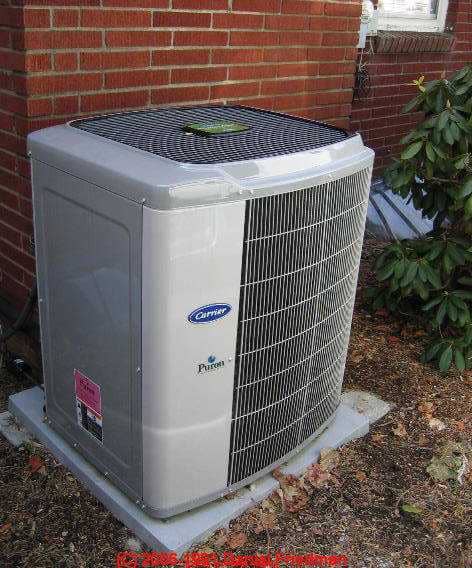
Photograph of  This new compressor was placed directly against
a brick wall. One third of its condenser coil cooling ability was blocked. HVAC Noise Diagnosis & Cure
How to Evaluate Air Conditioner / Heat Pump Compressor, Air Handler, Ductwork Noises
     

  • How to diagnose & repair air conditioning compressor noises from the compressor/condenser, air handler, duct work, filters, or controls
    • Diagnose & repair air conditioning system noises: compressor, fans, air handler, ductwork, Recordings of air conditioner or heat pump noises & sounds
    • Air conditioner buzzing may be just a loose part
    • Air conditioner humming, clanking, buzzing noises can indicate a minor or a serious problem - it depends ...
    • AIr conditioner or heat pump noises may diagnose lost cooling capacity
    • Air conditioner or heat pump noises may predict equipment damage
    • Recordings of A/C or Heat Pump Sounds & Noises: Submit, Listen-to, or Comment on These Sounds
    • AIR HANDLER / BLOWER NOISES
    • COMPRESSOR CONDENSER NOISES
    • DUCT SYSTEM NOISES
    • ELECTRIC MOTOR NOISES
    • FAN NOISES
  • NOISE / SOUND DIAGNOSIS & CURE - separate article
  • Questions & Answers about air conditioning or heat pump system equipment or control or ductwork noises: cause, significance, cure
  • References

Click to Show or Hide Related Topics

  • AIR CONDITIONING & HEAT PUMP SYSTEMS - home
  • A/C COMPONENTS
  • AIR HANDLER / BLOWER UNITS
  • BTU CHART for AIR CONDITIONERS / HEAT PUMPS
  • CLEARANCE DISTANCE, HVAC
  • COMPRESSOR & CONDENSING COIL, A/C
    • BURNED-OUT COMPRESSOR
    • CAPACITORS for HARD STARTING MOTORS
    • CONDENSING COIL REPAIR REPLACE
    • CONTACTOR RELAY DIAGNOSIS & REPAIR
    • CONTROL CIRCUIT BOARD, A/C
    • CRANKCASE HEATERS
        ELECTRIC MOTOR DIAGNOSTIC GUIDE
    • FAN, COMPRESSOR/CONDENSER UNIT
    • HARD STARTING COMPRESSOR MOTORS
    • INSPECTION CHECKLIST - OUTDOOR UNIT
    • INSTALLATION ERRORS, COMPRESSORS
    • LEVELING REQUIREMENTS, COMPRESSOR
    • LONG-ON CYCLING AC COMPRESSOR
    • MOTOR OVERLOAD RESET SWITCH
    • NOISES, COMPRESSOR CONDENSER
    • Pressure Controls & Safety Switches
    • PRESSURE READINGS, COMPRESSOR
    • REPLACING A COMPRESSOR
    • SHORT CYCLING AC COMPRESSOR
    • TIGHT or SEIZED AC COMPRESSORS
  • CONDENSATE HANDLING, A/C
  • CONTROLS & SWITCHES, A/C - HEAT PUMP
  • CONDENSING COIL REPAIR REPLACE
  • COOL OFF HEAT THERMOSTAT SWITCH
  • COOLING CAPACITY, RATED
  • COOLING COIL or EVAPORATOR COIL
  • DATA TAGS on AIR CONDITIONERS
  • DEHUMIDIFICATION PROBLEMS
  • DUCT SYSTEM & DUCT DEFECTS
  • DUCTLESS AIR CONDITIONERS & HEAT PUMPS
  • EDUCATION & CLASSES, HVAC SCHOOLS
  • ELECTRIC MOTOR DIAGNOSTIC GUIDE
  • EXPANSION VALVES, REFRIGERANT
  • FAN, AIR HANDLER BLOWER UNIT
  • FAN AUTO ON Thermostat Switch
  • FAN, COMPRESSOR/CONDENSER UNIT
  • FAN CONVECTOR HEATERS - HYDRONIC COILS
  • FROST BUILD-UP on AIR CONDITIONER COILS
  • GAUGE, REFRIGERATION PRESSURE TEST
  • HEAT PUMPS
  • HUMIDITY LEVEL TARGET
  • MANUALS & PARTS GUIDES - HVAC
  • MINI SPLIT AIR CONDITIONERS & HEAT PUMPS
  • NOISE AIR CONDITIONER / HEAT PUMP
  • ODORS in AIR HANDLERS & DUCT WORK
  • OPERATING TEMPERATURES
  • PORTABLE ROOM AIR CONDITIONERS
  • PRESSURE READINGS, REFRIGERANT
  • REFRIGERANTS & PIPING
  • REPAIR GUIDE - A/C or Heat Pumps
  • REPAIR TOPICS A/C & HEAT PUMPS
  • ROOFTOP A/C / HEAT PUMP
  • SEER RATINGS & OTHER DEFINITIONS
  • SPLIT SYSTEM Ductless Air Conditioners
  • SWAMP COOLERS
  • THERMOSTATS, HEATING / COOLING
  • THERMOSTATIC EXPANSION VALVES
  • WALL CONVECTORS Heating / Cooling
  • WINDOW / WALL AIR CONDITIONERS
InspectAPedia tolerates no conflicts of interest. We have no relationship with advertisers, products, or services discussed at this website.

Air conditioner or heat pump noise diagnosis & cure: this air conditioning repair article discusses the diagnosis and repair of air conditioning compressor noises which range in importance from normal (if annoying squeaks and squeals, to rattling loose bolts and hardware, to costly compressor damage indicating air conditioning compressor or A/C compressors at or near end of their life.

Green links show where you are. © Copyright 2013 InspectAPedia.com, All Rights Reserved. Author Daniel Friedman.

A/C & Heat Pump System Noise Diagnosis & Repair Noises: How to Diagnose Air Conditioner Compressor, Fan, Refrigerant Piping, Ductwork Noises

Start tracking down the cause (and cure) of noises from your air conditioning or heat pump system by listening carefully to determine the location of the sound.

This brief video contributed by one of our readers demonstrates start-up troubles and characteristic buzzing at the outdoor fan-compressor unit. The unit is unable to start.

Some guesses at what the noise means are given below.

Other videos: VIDEO GUIDES at InspectAPedia.com


Possible causes of this particular A/C (heat pump) compressor start-up failure noise include

  1. A seized compressor motor - likely
  2. A bad contactor relay - very possible
  3. A bad start-run capacitor - very possible
  4. Low voltage delivered from the electrical panel to the equipment - possible, less common, can be due to bad electrical connections or to arc-burned aluminum electrical wiring
  5. Low electrical service voltage - possible, less common

In the A/C system noise diagnosis article below we discuss how we approach listening to and interpreting noises coming from an air conditioning or heat pump system. CONTACT US by email to submit your own noise or noise+ video recording or if you cannot find the HVAC noise diagnosis information you need.

If your air conditioning or heat pump system has lost its cooling capacity or won't start see REPAIR GUIDE for AIR CONDITIONERS. See How to determine the cooling capacity of air conditioning equipment if the system seems to be working but is inadequate to cool your building. Contact us to suggest text changes and additions and, if you wish, to receive online listing and credit for that contribution.

First question in diagnosing HVAC system noises is where are the noises coming from?:

  • Ductwork noises: sounds originate in the ductwork, or may be conducted via ductwork from another source, including noise sources not necessarily having anything to do with the air conditioning or heat pump equipment itself. See DUCT SYSTEM NOISES and DUCT VIBRATION DAMPENERS and Duct Insulation for Soundproofing
  • Indoor Air Handler Noises: sounds are coming from the air handler/cooling or "blower" unit located indoors. See Air Handler & Ductwork Noise Diagnosis just below.
  • Indoor Air Conditioner/Heat Pump Noises from a Wall Mounted Split System Unit are discussed at How to Diagnose Noises at Split System Air Conditioner / Heat Pump Indoor Wall-Mounted Unit Noises later in this article.
  • Outdoor A/C or Heat Pump Noises: are the sounds from the compressor/condenser unit located outdoors, see Noises at the Compressor/Condenser & Condenser Fan Unit
  • Other noises: is the noise somewhere else and perhaps from another source having nothing to do with the HVAC system?

Second question in diagnosing air conditioner or heat pump noises & sounds: what does the noise sound like?

  • See our Catalog of AIr Conditioner or Heat Pump Noises by Description of the Sound in the article below

Air Handler & Ductwork Noise Diagnosis & Cure for HVAC Systems

  • Air handler / blower indoor cooling unit noises: see air leaks, bubbling, clicking, duct noises, fan noises and vibration dampener noises and the articles on these problems listed just below.
  • Air leaks in ductwork often make a roaring or hissing sound. See LEAKY DUCT CONNECTIONS and also see VIBRATION DAMPENERS for a discussion of devices used to isolate noises produced by HVAC air handlers such as air conditioners and furnaces.
  • Banging, clanking HVAC systems - see COMPRESSOR CONDENSER NOISE
  • Bubbling or hissing in the refrigerant piping is discussed at REFRIGERANT LEAK REPAIR.
  • Buzzing sounds (also crackling) at electrical components anywhere, including compressor relay switches, electrical connections at any component, and quite seriously, at circuit breakers can be an indication of arcing and an electrical problem needing prompt attention. Also see Electrical System Noises.
  • Clicking noises from relays & controls can be heard at either the compressor/condenser or at the indoor air handler unit: A failing or defective thermostat or to a defective control itself can cause relays to click on and off repeatedly - see CONTACTOR RELAY DIAGNOSIS & REPAIR. Thanks to reader Michael Anderson.

    Clicking, rumbling, ticking, rattling, clang and clunk at startup: loose hardware are detailed too at COMPRESSOR CONDENSER NOISE

    Clicking and ticking sounds at HVAC equipment are also traced to a loose or bent fan blade hitting an obstruction. See FAN NOISES
  • Compressor/Condenser units: see NOISES, COMPRESSOR CONDENSER [just below] for detailed diagnostic help in finding, evaluating, and fixing noisy compressor units. Humming, rattling, explosion noises, bangs, clanks, hissing, squeaks, humming, squealing noises. Complete diagnostics for the HVAC compressor/condenser/fan unit begin at COMPRESSOR & CONDENSING COIL, A/C.
  • DUCT SYSTEM Noises: hisses, whistles, even roars, and occasionally clunk or clank sounds from expanding or contracting metal ductwork. We may trace these sounds to supply ducts, return ducts, registers, to a bad vibration dampener, or other components.

    Animals in the ductwork can make a variety of sounds, depending on the critter: fluttering and clanging (a trapped bird), scratching and gnawing (squirrel, mouse, rat, raccoon), buzzing humming (bees or wasps). See ANIMAL ENTRY POINTS in buildings.

    Blower assembly and fan noises might be transmitted through the air ducts, such as fan squeaking, squealing, rattling. See FAN NOISES

    Return air leaks: Leaks around the return air register are common and sometimes noisy, perhaps due to a poorly-fit air filter or gasket - see RETURN DUCT AIR LEAKS. See Take a look at LEAKY DUCT CONNECTIONS. Also see our more general article on Air Leak Noises

    Supply air leaks: Hisses and whistles in supply air ducts and registers might be present too - see SUPPLY DUCT AIR LEAKS.

    Transmitted duct sounds: Also buzzing, rattling, clanking or other noises originating at the air handler/blower unit may be transmitted into the physical ductwork and thus the building, if the system lacks an adequate vibration dampener - see VIBRATION DAMPENERS.

    Voices in the ductwork? you bet. I still recall the discovery that a girlfriend's parents were monitoring our basement activity when suddenly, out of the air duct by our heads, came her dad's voice: Joanne! Time to come upstairs! HVAC ducts in buildings can transmit sounds between building areas, perhaps more so when air is not moving through the ductwork. So watch out.

    Also see Duct Insulation for Soundproofing when the problem is masking normal HVAC noises transmitted through ductwork.
  • FAN & BLOWER Noises on heating and air conditioning systems may include ticking or clicking (fan blade hitting an obstruction), humming (motor troubles), rattling (loose fan pulley), squeaking (dry fan or fan motor bearings) and other sounds.

    These fan noises are discussed at FAN, AIR HANDLER BLOWER UNIT and at FAN, COMPRESSOR/CONDENSER UNIT - ticking, clicking, humming, squealing, squeaking.

    Also see ELECTRIC MOTOR NOISES and see ELECTRIC MOTOR DIAGNOSTIC GUIDE for help figuring out what may be wrong with the fan motor at either the condenser unit or the air handler unit.

    Also see DUCT SYSTEM NOISES above. At Fan Noise Control we discuss measures for reducing normal fan noises.

    Fan & Blower Unit Articles:
    • FAN, AIR HANDLER BLOWER UNIT
      FAN AUTO ON Thermostat Switch
      FAN, COMPRESSOR/CONDENSER UNIT
      FAN CONVECTOR HEATERS - HYDRONIC COILS
      FAN LIMIT SWITCH
      FAN NOISES
  • Hissing or Screaming A/C compressor - see COMPRESSOR CONDENSER NOISE
  • Humming sounds from HVAC systems are outlined below at COMPRESSOR CONDENSER NOISE and in that article at humming. [Aside: humming on oil fired heating equipment may be a normal sound transmitted to the building via oil piping attachment points. A/C refrigerant piping may also transmit equipment noises if it is not properly routed and mounted.]
  • Rattles at HVAC systems: look for loose hardware, loose fan blades, pulleys, or motor mounts; also possibly loose ductwork.
  • Rumbling or "singing" or siren whining sounds from a fan motor may be due to a broken internal motor part.
  • Screaming or squeals at the A/C or heat pump compressor - see COMPRESSOR CONDENSER NOISE
  • Trumpet or trombone sounds - see COMPRESSOR CONDENSER NOISE
  • Whistling sounds in HVAC duct work or air handlers are often due to air leaks - see SUPPLY DUCT AIR LEAKS and see RETURN DUCT AIR LEAKS. Also see our more general article on Air Leak Noises. Listen for a whistling thermostatic expansion valve - a sign of low refrigerant discussed in detail at Thermostatic Expansion Valve (TEV) or Capillary Tube Installation, Inspection, & Testing Guide

  • Other building noise sources: In case the noise you think is coming from an air conditioner or heats pump actually originates somewhere else, see NOISE / SOUND DIAGNOSIS & CURE
  • For heat pump system noises at the indoor air handler, also see NOISE CONTROL for HEATING SYSTEMS where we describe other heating system noise sources and cures.

How to Diagnose & Fix Noises at the Compressor/Condenser & Condenser Fan Unit

If you hear unusual noise at the air conditioning system, these compressor sounds could indicate the need for a simple service and adjustment requirement. But air conditioner compressor noises might also mean that you face an upcoming costly repair involving replacement of the compressor itself. You should have the system checked promptly by an air conditioning service technician. The following is a list of air conditioning compressor noises and what they may mean about the operation, condition, and remaining life of the cooling system equipment.

  • Banging or Clanking air conditioner / heat pump compressor noises, at least the costly ones, are usually due to a loose connecting rod, piston pin, crankshaft, or other internal part. Since compressors on most modern commercial and residential air conditioning systems are a sealed unit, the only repair is to replace this (costly) part. A similar clanking or banging sound can be caused by loose internal mounts. Examples of banging, clanking, rattling noises from A/C and heat pump systems are found at our Questions & answers section below.
  • Bubbling, hissing, refrigerant leaks: a catastrophic refrigerant leak on the air conditioner or heat pump high pressure side will make a loud hissing sound - but that sound won't continue for any longer than to dump the refrigerant into the atmosphere (something prohibited).

    But a more subtle refrigerant leak that results in low refrigerant can result in refrigerant gas bubbles traveling around in the liquid refrigerant line. You might hear bubbling sounds at the refrigerant piping or see bubbles in the sight glass if your system has one. See REFRIGERANT LEAK DETECTION. Bubbling in the refrigerant liquid line and using the sight glass are discussed at REFRIGERANT SIGHT GLASS.
  • Buzzing noises at the outside fan motor: sounds like a failing motor; check first for loose wiring, arcing connections, arcing or burning at the fan contactor relay switch. The video shown near the top of this page includes a video example of brief buzzing at the fan/compressor outdoor unit. See Buzzing sounds from A/C or heat pump
  • Chattering or rattling noise in the A/C or heat pump compressor motor at start-up on some models of HVACR equipment whose compressor uses a compressor crankcase heater element if the equipment is started-up before allowing 24-hours of power-on time first.

    Example from Carrier: "On 24ANA7 models, starting the compressor without a minimum of 12 hours of crankcase heat prior to initial start--up may result in a compressor chattering noise and possible damage to the compressor." Details about HVACR compressor motor crankcase heaters are found at CRANKCASE HEATERS
  • Clanking or rattling air conditioner or heat pump compressor: the compressor motor mounts have failed and the motor is thrashing around inside the hermetically-sealed compressor motor can. It may look normal from outside, but the clanking sound is coming from inside the sealed unit. The compressor should be replaced.
  • Clicking, rumbling, ticking, rattling, clang and clunk at startup: loose hardware: Air conditioner compressor noise could be due simply to loose hardware such as a loose shipping bolt, tubing, or a broken spring. Does the noise sound like a metallic rattle?

    A visual inspection for loose hardware may help diagnose this condition. Sometimes a shipping bolt may have been left in the unit and could be the source of a rattle. Loose refrigerant tubing or a bend in tubing that carries it too close to the air conditioner frame or case can lead to rattling that is easily corrected with a careful bend.

    Watch out: Beware of both the chance of electrical shock and of injury from moving compressor parts like the cooling fan which can easily chop off a finger. Homeowners should not attempt to open, disassemble, or repair an air conditioner compressor as special training and safety procedures are needed to avoid injury.

    Clicking noises from relays & controls can be heard at either the compressor/condenser or at the indoor air handler unit: A failing or defective thermostat or to a defective control itself can cause relays to click on and off repeatedly or the relay may ultimately buzz - see CONTACTOR RELAY DIAGNOSIS & REPAIR. Examples of clicking noises from A/C and heat pump systems are found at our Questions & answers section below.
  • Hissing or Screaming A/C compressor, also described as "very loud screaming" by some sources [1], may be caused by excessive internal pressures - a dangerous condition. Compressors include a high pressure sensor that should shut the system down if internal pressures are approaching a dangerous level. But if the compressor continues to run and is screaming, turn it off immediately as the system is unsafe.

    Watch out: turn off electrical power to the screaming A/C Condenser / Compressor unit immediately.

    Other more quiet hissing noises from the air conditioner compressor motor may (if the motor is a reciprocating compressor) be due to leaky internal valves.The compressor motor makes a hissing sound all during the time the compressor is running; when the motor stops the hissing dies down fairly quickly as the high side and low side pressures equalize. In this case the condition may not be dangerous, just an inefficient system that is costly to operate.

    Examples of field reports of hissing noises from A/C and heat pump systems are found at our Questions & answers section below.
  • Humming air conditioning compressor motors, fan motors, other electric motors, particularly if the motor is slow to start or does not start at all, may indicate that the starting capacitor needs replacement. See HARD STARTING COMPRESSOR MOTORS and see CAPACITORS for HARD STARTING MOTORS. If the compressor hums and never starts it could also be that the compressor motor has seized. In that case, leave the system turned off and ask for service from a professional.

    Humming electric motors: Note that while many electric motors make a modest and unchanging humming sound when running - a normal condition - any electric motor that is seized or having trouble starting may produce a humming sound at start-up, not just the A/C or heat pump compressor motor. For example fan motors at the compressor/condenser or in the air handler blower unit may hum when they cannot start. A failed motor, failed start/run capacitor, or low voltage are common causes of this humming. See ELECTRIC MOTOR DIAGNOSTIC GUIDE for help with motor diagnosis, and see CAPACITORS for HARD STARTING MOTORS.

    Examples of more humming noises from A/C and heat pump systems are found at our Questions & answers section below.
  • Humming, hard-start compressors, oil leaks: Another source of cooling system compressor noise is a low oil condition in the compressor unit. Low oil may be diagnosed perhaps by observing evidence of compressor oil leakage on or around the unit. Modern residential air conditioning compressors are usually a hermetically sealed unit; it would be abnormal to ever see oil loss around this equipment. (But don't mistake spilled oil from lubricating an electric motor or cooling fan bearing for a refrigerant or compressor oil loss.)

    Checking air conditioner oil level: A few residential air conditioning compressors and many commercial systems provide an oil sight glass to permit a visual check of oil levels. On those units, when the compressor is running the oil level on the sight gauge should read 1/2 to 3/4 full. If adding oil to a commercial unit, be careful not to add too much. Both too much or too little oil can cause compressor noises. On a residential compressor which is usually a hermetically-sealed motor, it is not possible to see the oil level nor to add oil.
  • Squeals, normal A/C compressor: Normal air conditioner compressor squealing: Some compressors emit a high pitched noise during normal operation or just at startup. This noise should be brief and just at start-up, and will probably have always been present on the system if it's normal. Examples of squealing noises from A/C and heat pump systems are found at our Questions & answers section below.
  • Start-up Compressor noises - refrigerant floodback: Air conditioning compressor noise could also be due to refrigerant liquid "floodback" into the compressor crankcase. If this is the problem the noise will appear only at the interval of compressor start-up. That's why it's useful for the inspector or service technician to be right at the compressor unit when the air conditioning system is first turned-on. If this is the problem, a low cost repair might work: a crankcase heater can be installed to address this defect.

    Watch out: a burned-out crankcase heater on an air conditioner or heat pump can permit liquid refrigerant to enter the compressor, destroying the motor by liquid slugging. We explain this further at REFRIGERANT PRESSURE READINGS where we discuss the effects of improper refrigerant charges. We discuss crankcase heaters at CRANKCASE HEATERS.
  • Ticking or loud clicking noises at the air conditioner or heat pump compressor unit fan: the fan blade may be contacting a bent fan screen or a stick or piece of debris that has fallen into the compressor unit; a loose or worn fan bearing permitting the fan blade to wobble might also cause this ticking or clicking fan noise.
  • Trumpet or trombone sounds from the compressor motor at shut-down, possibly loud, may be due to leaky internal refrigerant valves; Meenen [1] asserts this is not a problem as long as a hissing sound is not observed.
  • Overheating, Blocked Coils, & Air Conditioner or Heat Pump Noise? we have had a field report from a reader who explained that a noisy outdoor compressor unit was, according to his HVAC service technician, traced to a blocked, clogged outdoor condensing coil. We speculate that perhaps the compressor was running hot and that correcting air flow across the condensing coil corrected that condition.

    Cooling coils (indoors) or condensing coils (outdoors) can become so blocked that air flow is seriously reduced, possibly also leading to an evaporator or cooling coil icing problem indoors or an overheated, damaged compressor outdoors, or simply loss of cooling capacity of the system.

I have a National comfort Products CPO 2464-B unit which is an air conditioner and gas heating unit combined. The unit is about 5 years old. The air conditioner had become increasingly noisy. I called the party that installed the unit. After spending $90.00 for a service call I was informed the the external coils were dirty, opening up the unit light was not visible thru the coils.

I was advised to use a garden hose and rinse the coils. I did not have that available so I turned the unit on and using a watering can, poured warm soapy water onto the coils. this was done several times. the unit now seems to work properly. I did not see this particular problem described on your website. There may be other means of cleaning the coils but this was all I could think of. - C.A.P., Norristown PA

Also See our Catalog of AIr Conditioner or Heat Pump Noises by Description of the Sound located just below.

Also see NOISE, DUCT VIBRATION DAMPENERS and NOISE CONTROL for HEATING SYSTEMS where we describe duct noises. Fan noises on heating and air conditioning systems are discussed at FAN, AIR HANDLER BLOWER UNIT and at FAN, COMPRESSOR/CONDENSER UNIT. See NOISE / SOUND DIAGNOSIS & CURE for our complete list of building noise diagnosis & repair articles.

How to Diagnose Noises at a Split System Air Conditioner / Heat Pump Indoor Wall-Mounted Unit

Fujitsu has offered some helpful advice in troubleshooting noises that may be heard at the indoor wall-mounted air handler of a split system air conditioner or heat pump. What's particularly helpful is that Fujitsu points out that some noises that people worry about are actually normal and not an indication of trouble. Quoting [3]

  • During operation and immediately after stopping the unit, the sound of water flowing in the air conditioner's piping may be heard. Also, noise may be particularly noticeable for about 2-3 minutes after starting operation (sound of coolant flowing).
  • During operation, a slight squeaking sound may be heard. This is the result of minute expansion and contraction of the front cover due to temperature changes.
  • During Heating operation, a sizzling sound may be heard occasionally. This sound is produced by the Automatic Defrosting operation.

Here are some other noise or sound diagnostic clues for split system air conditioners & heat pumps

  • Bubbling in the refrigerant piping is discussed at REFRIGERANT LEAK REPAIR and may indicate a refrigerant leak, though bubbling sounds on split systems at the indoor wall unit may be normal for some products - see our note below about water noises.
  • Clicking noises from relays & controls can be heard at either the compressor/condenser or at the indoor air handler unit: A failing or defective thermostat or to a defective control itself can cause relays to click on and off repeatedly. - thanks to reader Michael Anderson. A clicking noise might be traced to a failing electrical control in the air handler or outside at the fan-compressor unit, leading to a control switching on and off too rapidly.
  • Sizzling noises from a split system air conditioner / heat pump may be heard at the wall mounted unit when the system is in heating mode. [10]
  • Squeaking noises from a split system air conditioner / heat pump might be heard coming from the wall mounted unit. According to Fujitsu, This is the result of minute expansion and contraction of the front cover due to temperature changes. [10]
  • Water noises, a sound like running water may be heard in the refrigerant or condensate piping of a split system air conditioner or heat pump while the equipment is running and/or briefly during unit start-up as well as for a period immediately after the unit shuts off. While usually we consider the sight or sound of bubbles in the refrigerant piping as an indication of low refrigerant, for some systems this may not be the case and for at least some split system models Fujitsu points out that this sound may be normal. [10] However if you hear bubbling in the refrigerant piping and the system is not cooling properly, indeed there may be an improper charge or refrigerant may be leaking. [10]
  • ...

Frequently Asked Questions (FAQs) about air conditioning system noises: cause, significance, cure.

We sort the reader questions and comments below alphabetically according to description of sounds coming from an air conditioner or heat pump system. But if you haven't already read our more general description of sources and types of air conditioning sounds and noises see the start of this article at AIR CONDITIONING & HEAT PUMP NOISES.

Catalog of AIr Conditioner or Heat Pump Noises by Description of the Sound

Text Descriptions of A/C or heat pump sounds

  • Banging A/C or heat pump
  • Bearing noises in HVAC equipment or motors
  • Buzzing sounds from A/C or heat pump
  • Clanks & clunks sounds from air conditioner or heat pump system
  • Clicking sounds from air conditioner or heat pump system
  • Cyclical or regular noises, or vibrations
  • Fan noises, wobbles, motor hum, depending on speed
  • Groaning, Huffing, wuwuwu sounds from A/C or heat pump system, diagnosis
  • Growling compressor sounds (also see Groaning above)
  • Hissing sounds from A/C or heat pump system
  • Humming sounds from A/C or Heat Pump system
  • Loud noises at startup, then quiet
  • Popping or popcorn noises - turn off the system immediately
  • Rattling & vibration noises from A/C or Heat Pump System
  • Running water sounds in refrigerant piping - floodback or condensate?
  • Silent or just normal sounds from A/C or Heat Pump
  • Singing, rumbling, whining A/C compressor/condenser or blower fan motor noise
  • Squealing air conditioner and heat pump equipment, diagnosis
  • Trumpeting noises from compressor motors on A/C and heat pump systems
  • WaWa, Wow wow, wuwuwu sounds from A/C or heat pump system, diagnosis

Recordings of A/C or Heat Pump Sounds & Noises: Submit, Listen-to, or Comment on These Sounds

  • Intermittent buzzing sound video at the outdoor fan/compressor unit of a heat pump whose compressor motor is unable to start
  • Buzz/Rattle sound, possible liquid refrigerant slugging - 600KB MP3 file - sound occurs about 10 seconds into recording
  • Sanyo split system outdoor compressor unit - 840K .wav file - normal operation, with some air or wind noise at the microphone
  • Sanyo split system indoor cooling unit, wall-mounted - 790K .wav file - normal operation, with some air noise at the microphone

  • Contact Us to submit an air conditioner or heat pump system noise or sound recording for posting, analysis, or to offer a comment about one of the air conditioner/heat pump noise recordings found here

Question: Banging Sounds from A/C Compressor or Heat Pump, Frequent Compressor Replacements?

OK. I just reread the instructions and it looks like I can ask a question. In the past 5 years we have replaced 4 compressors. We just replaced the last one and the fan motor. Every once in a while, the unit would make a repeated really loud banging sound as though some metal piece in the fan was whacking another piece over and over. Today I watched the clock. It is almost at every hour, but not at the same time. Each time the noise lasts 3-4 minutes. The A/C company and their electrician have no clue what this is. Also, the unit often trips the circuit breaker. Not necessarily when this noise comes on. We are incredibly frustrated. Any ideas as what could be causing this? Thank you. - Dina

Reply:

Dina, my OPINION is that if you are replacing compressors 4 times in 5 years something is drastically wrong. I can't guess whether the problem is an innate system design pressure, poor or damaged equipment being installed, or installation errors. But I share your frustration. I think it's time to talk candidly (but without threats or screaming) with the A/C company's service manager and to ask that they send someone who is trained and experienced to help diagnose this problem. And when you're told what problem was diagnosed, if you don't understand the explanation, ask for more help with understanding it until it makes sense.

A fan whacking something is a loose fan blade or broken fan shaft or bent screening around the fan or a stick or junk in the unit - any of which is a serious problem for the fan. If your service tech left the system like that s/he did not do such a hot job.

A unit that trips the circuit breaker is probably drawing high current - which, if the proper breaker has been installed, points to a problem with the wiring or more often the compressor motor on that circuit. A failing compressor motor draws high amps.

I'd also suggest checking out the voltage being provided to the system to be sure that there is not a low-voltage problem from your power source.

Follow-Up:

Thank you so much. Here's the problem. We just changed service companies , because we were not satisfied that the old one was doing a good job. This one decided that the compressor and then the fan needed replacing. They've had two sets of technicians out here and neither could figure out the problem. There is nothing hitting the fan (so they say). The problem is that they are never here when the sound happens, though I did record the sound for them. They said it was nothing like anything they've heard before. They are coming out this morning again and we will see what they can find. Thank you for your "opinion". - Dina

The tech was here again. He noticed that the last guy had installed a booster. He disconnected it to see if it helps. Meanwhile, I'm wondering if the noise has something to do with the unit working harder in the hot weather because I hadn't noticed the noise at all today and it's much more comfortable outside. I guess I won't know until it turns really hot again. - Dina

Even with the booster disconnected, it's still making that banging metal sound. - Dina

Reply:

Dina if the banging clanging is a compressor noise see the article titled NOISES, COMPRESSOR CONDENSER

Question: Bearing Noises in HVAC equipment

Sounds like very loud bering noise on start up and shut down from a 1 year old heat pump compressor - Ray 12/5/11

Reply:

Ray, a bearing noise, often a horrible clanking, banging, or rattling, is generated by a wobbling of a rotating shaft that is no longer evenly supported by bearings that are intended to permit it to rotate with minimal friction. If you hear bearing noises from an A/C compressor motor I suspect that the motor is failing, or that a similar noise is being made by damaged refrigerant valves in the compressor head. But first check that the motor mounts are secure. Sometimes a motor can make a clank or thunk at startup because one or more of its mounts has come loose.

Question: Buzzing Sounds at Air Conditioner or Heat Pump & Buzzing noises after A/C cooling coil change-out, Diagnosis, Repair

I had problems with my central unit freezing up and dripping water on my fan motor.. decided to have a technician change out my coil inside.. when he left my central unit outside starting making noises i never heard before.. my air conditioner kicks on inside first then after a couple of minutes it tries to kick on outside , it makes a loud noise then it runs finally and quiet like a central unit should run outside.. what is causing this all of a sudden, never had problems until he changed my coils out..not calling him back to my house. Bruce McCann

Reply:

HVAC compressor buzzing video: the HVAC noise diagnosis introduction near the top of this page includes a video example of brief buzzing at the fan/compressor outdoor unit along with some possible explanations. Below we discuss several A/C or heat pump compressor noise observations and possible explanations.

Bruce, I am not clear on why a coil freeze-up indoors would lead to changing the outside coil - maybe low refrigerant or improper high side vs low side pressures? In any case, I would indeed give the service tech a call, tell him or her what you are observing, and give the technician an opportunity to return, see what's wrong, and fix it. Most technicians want their work to be correct and successful. Let us know what you're told - it will surely help other readers.

Question: Buzzing sounds from air conditioner

My outside fan motor is running but the unit makes a loud buzzing noise every few minutes or so, the motor was replaced last spring. I sprayed the motor shaft with wd40 just to get me by till I can get another fan motor if that is needed. I do not know if the capacitor was replaced or not. the loud buzz only lasts for a few seconds then stops, I just turned the unit back on, Any ideas on what I can do or a place to find a motor?- Rodney Looney

Compressor started producing a buzzer noise which lasted about 4 seconds then stopped and repeated again. The time between buzzes varied from a 10 to 20 seconds. The noise reminded me of the sound you hear on the radio when they do there check of the emergency broadcast system. - Jim

I have a Trane 4 ton gas pack that is making a intermittent buzzing noise when the compressor operates. We are located in Phoenix, AZ and the noise seems to have started this season when temps heated to 100 and above. Naturally, I'm concerned that this might be compressor noise since the unit was manufactured and installed before the AC season in 1994. Thanks for any suggestions you can offer. Doug

More info:
The unit is on the roof of a flat roof house and the noise is most noticeable when standing below the unit. The noise is a higher frequency buzzing that could be a panel or other object vibrating close to the frequency of the compressor. To my knowledge, I have not been on the roof when the noise occurred, or if it did, I didn't hear it with all the other noise. It seems to occur at various combinations of temperatures. Under some conditions, there is no noise, but other times, such as during a long run when we lower the temp after the sun sets, the noise may start several minutes into the cycle. A few times, I noticed noise soon after starting that only lasted for 20 seconds or so. We run the indoor temps between 85+ and 81 over a 24 hr period using a programmable thermostat.

I have banged and thumped on the case, removed the outdoor fan grill and looked for loose fasteners within the compressor/condenser portion of the case and checked all of the fasteners on the outside of the case to make sure they were tight. I put card-stock shims between joints of panels, etc to prevent any vibration that might occur. So far, nothing has eliminated the noise that seems to occur only under certain combinations of outdoor/indoor conditions.

The noise pattern may be different from when I first noticed it. I checked the pressures, for the first time since we got the house 8 years ago and and added 4 lbs of R-22 to get it back to normal operating conditions at 95F. The performance isn't noticeably different, but the noise pattern may have changed somewhat, while the sound is about the same, when it does occur.

Last winter I removed the top of the unit to oil the indoor fan motor. That is the first time it has been removed since we owned the house. As far as I know, everything was reassembled correctly. My experience is limited to light to medium maintenance of only my own auto/home AC systems for the past 4 decades. I installed a quick start system about 5 years ago on general principals because one worked wonders on similar but smaller gaspack in another part of the house. - Doug

Reply: Buzzing Sounds at an A/C or Heat Pump System May Mean Failing Electrical Parts

Rodney: if you need a new condenser fan motor you should be able to match the original by taking the old one to your local HVAC supplier, or you can probably find a replacement online. I'd be sure you note the motor information and specs from it's data tags or just bring in the old motor to your supplier. Watch out - don't keep replacing motors unnecessarily. A bad fan motor contactor relay or even a loose wire could also cause buzzing in the condenser/compressor unit outdoors. .

Jim: sounds like your compressor is having trouble starting up? Or does it buzz but run ok otherwise?

Doug,

buzzing sounds from an air conditioning component might be a failing electrical component and could involve even a fire risk; I'd try to track down more carefully where the buzzing is occurring. A burned compressor contactor relay, for example, might buzz.

Noise diagnosis is tricky in part because there is some subjectivity in how people describe sounds (buzzing vs humming for example). Taking care to not get whacked by a moving part like a compressor fan, one can sometimes use a mechanic's stethoscope to get right to the source of a sound from mechanical equipment.

Follow up:

Dan,
Thanks for your suggestions. I'm relieved that you didn't point to the compressor as a typical source for noise like mine, but I know I can't rule it out yet. I took a dowel rod up to listen to for any noises, but at 94 deg, it didn't make any abnormal sounds (my wife confirms). I did notice that the top of the condensor at one edge was vibrating and a potential source of noise. I'll check it later. I opened the control compartment and all seemed normal and no loose components there. I would like to be able to listen to the compressor, but there's no way without dueling with the outdoor fan and I would likely lose. I'll let you know if I ever come to any conclusions.

Follow up:

Dan,
A while ago, I wrote about intermittent noise from my roof mounted gas pack. After spending a lot of time on the roof and poking around inside the compressor compartment, I am reasonably certain the noise is coming from the compressor itself. I checked the compressor mounts and they are solid and there are no loose parts to vibrate and cause noise. In the process of pushing the compressor around to see if the mounts were loose, I heard the compressor hit the side of the shell.

I was looking around another site and the owner mentioned that the compressor suspension mechanism can break and cause noise that sounds like a bad bearing.

A friend of mine knows a person in the refrigeration business and after my friend described the problem, he said it sounded like a broken spring in the compressor suspension.

I guess I am going to have to replace the compressor before the start of the next season, if I make it through this one.
Hopefully I will replace it before there is a burnout. Would you recommend installing a filter/dryer even if there is no hard failure? I don't believe Trane installs them in new-build units and there is certainly none in the compressor bay. If the compressor banging against the shell is releasing particles into the system, is there a filter or something other than a dryer that will catch the particles?

The compressor has rotolock connections, and I would like to avoid any cutting/sweating operation if I can reasonably-safely avoid it. Thanks for your help. - Doug

Reply:

Doug:
re: noise is coming from the compressor itself - a failing compressor motor indeed can become noisy;
I would not install a filter/dryer before replacing the compressor because
- an extra cycle of opening the refrigerant piping system risks contamination and also done properly requires vacuuming and cleaning the whole system - it's a bit of a costly procedure to do at that point
- when the compressor is replaced a filter/dryer would normally be installed as part of the job

But if you wait for a failing compressor to burn up the result can be extra contamination in the refrigeration system.

For those reasons I'd ask for an experienced HVAC tech to look at the system, diagnose the problem, and then I'd decide if it were time and better to replace the unit now, or shut the system down and replace it before start of next season.

Follow-Up:

Dan,
Thanks for the tips. All makes sense to me. I will consult with the a dealer that I know, before I do anything. I am inclined to just replace the compressor though, if I can find one at a reasonable cost. I found a new AM Std compressor on eBay that appears to be interchangeable with the one in my unit, but so far, I can't find cross reference data that I trust. I will probably use it lightly until we get into cooler weather (6 weeks)and hope for the best, but prepared to replace the whole unit if crashes. I'll add a filter/dryer if I replace the compressor. Sorry if I didn't make it clear, I wasn't thinking of a two step operation.

I found a video on You Tube that shows disassembly of a compressor like mine. I don't think there is a broken suspension, but I would believe bearing noise. I don't understand how it can be so intermittent. Under certain conditions, something resonates and makes a real racket.
Thanks again for the help. - Doug

Dan,
Regarding installation of a filter/dryer; the filters I have seen on HVAC parts sites are for installation on the suction side. When I installed an AC in my house in '88, I installed a filter/dryer in the liquid line, near the coil as recommended at the time. It seems to me that it makes more sense to filter the liquid entering the TXV than to filter the gas entering the compressor. What am I missing? I purchased the compressor on eBay. It turns out that it was exactly the P/N specified in the parts list for the equipment. The gaspack contained what I assume was an earlier equivalent part. - Doug

Reply:

Doug we see filter dryers installed at both sides of the compressor. It depends ... if a system is thought to be contaminated there are advantages of having a filter at both ends of the compressor motor, and it certainly doesn't hurt. - DF

Question: A/C System Buzzing noises for 2 seconds, bad start/run capacitor?

Outdoor unit makes a buzzing noise for about 2 seconds & stops. Fan never starts turning. I was standing by unit when this happened for the third time & manually started fan turning.
Fan started running on its on, but at a very low speed, nothing like it normally does. Any suggestions? Inside unit seems to work normally. - Hill

We seem to have traced this A/C buzzing noise to a bad start/run capacitor - Hill

Question: Clanking Noises, Clunks, Thunks, Shoes in the Clothes Dryer: Sounds from A/C Compressor

The home A/c unit at start of a cycle sounds as if a pair of shoes are in the dryer, what may cause this noise? - Frank

hi, my ac works good, but it makes a clanking noise. Could one of the bands be loose? - Celia Cisneros

Our compressor makes noise before it gets running. What might this be? - Edison

I'm in Texas in the middle of a record drought\heat. AC is doing pretty good despite the heat (takes it a while to cool back down but it's 108 outside). However, when the system shuts down I do hear a thunk inside, not so much outside. No sound when it starts up. Also, we had a couple of surges a few weeks ago and the fan outside is running a little bit louder. I'm *really* hoping everything is just working harder because of the heat. - Mom

My air conditioner unit outside makes a ungodly noise that just started this morning at 2 am. My husband said he saw that the fan is missing a blade and that is why it is shaking and making the noise I keep hearing when it kicks on. it sounds like an air compressor that my cousin uses when he uses his air tools.. please help me know if this is able to be fixed or should i start buying window units...? ... Now the fan has stopped completely but we can still hear the motor running. Heather

11 yr old air conditioner works fine, but is makes a continuous rattle and a loud clung when shutting off. It's driving me, and I think my neighbors, crazy. - Ruth

Reply: Loose motor mounts, Loose Fan Parts and Ticks, Clanks, Clunks and Vibrations in the Air Conditioner or Heat Pump

Mom: that inside "thunk" sound in your A/C air handler could be a loose blower fan assembly or mount - I'd have someone take a look before it gets bad enough to cause more damage or stop working entirely. Keep us posted - what you find will help other readers.

Heather:
A fan that is wobbling and missing a blade is dangerous, likely to damage the equipment. I'd have shut it off immediately. If the fan problem was local to the blade assembly itself it may be a reasonable repair; if the fan spins off of its shaft and cuts and smashes other components inside the compressor/condenser (assuming we are talking about the outside unit) or inside the air handler/blower assembly (the inside unit) then other damage will need to be examined and repaired. Could be costly if electrical components were damaged or a refrigerant line was cut.

Ruth, rattling and a Clunk when the compressor/condenser shuts off sounds like loose parts, maybe even a loose compressor motor mount or loose fan parts or both. I would have the system checked immediately as the risk is that something comes loose enough to cause expensive or dangerous damage to the system.

Note that if the clanking or rumbling noise is coming from a blower fan motor the cause could be bad fan motor bearings.

Questions: Clicking Sounds, Air Conditioner that won't stop, Rapid Clicking Noises, Humming Click every 20 seconds

Hi. The outdoor compressor of my central air conditioner will not stop automatically. Everything else operates properly. The fan for the outdoor compressor turns on and off properly and all the indoor components operate properly. Any ideas what I can do to fix this? - Bruce

So, the air conditioner in our apartment works perfectly ...turns on when it should, and turns off when it should. The only problem is that when it turns off, there is a really rapid clicking noise that sounds like a metallic plastic noise. If you were to take a circuit breaker, and turn it on and off REALLY fast, you would get an idea of what it sounds like. Other than this, the AC unit functions perfectly fine. Any ideas? Thanks for this awesome site! - Adam

My a/c condenser is not working, the fan blades do not turn, when I lower the indoor thermostat and then go out doors to the condenser pad, I hear " a humming click" approximately every twenty seconds or so, as if the unit is trying to turn on.
What is wrong ? - Hilary

Reply:

Ron:
SPECULATING: if the A/C is not stopping it could be that your thermostat is continually calling for lower temperature than the system can reach, thermostat wires are shorted together, a control board is damaged, or something else that this guessing has not anticipated. Try turning off all power for an hour.

Hilary: if your condenser fan won't run you need a service call. The tech may find a bad start/run capacitor or fan motor, or on occasion a bad control board or switch.

Adam: I'd call a service tech; it sounds as if a relay is not working properly; but first just take a look to see that your fan blade is not wobbling as it slows down; sometimes a loose fan blade can contact something inside the condenser.

Question: rapid clicking noise in air conditioner

So, the air conditioner in our apartment works perfectly ...turns on when it should, and turns off when it should. The only problem is that when it turns off, there is a really rapid clicking noise that sounds like a metallic plastic noise. If you were to take a circuit breaker, and turn it on and off REALLY fast, you would get an idea of what it sounds like. Other than this, the AC unit functions perfectly fine. Any ideas? Thanks for this awesome site! - Adam

Reply:

Adam, if the noise continues as long as the unit is on, I'd look for a loose blower fan whose blades are hitting something, or an obstruction that has fallen into the fan path. There are switches or controls that can also click, but I figure a problem in one of those components means it's going to give up the ghost soon- things will stop running and the system will have diagnosed itself.

Question: Condenser or Blower Fan Noises: rattle, hum, or speed-dependent

Question: we had a power outage this morn, for about four hours, after which previously fine HVAC came back on making an awful racket ...sounded like blades were hitting something, but i shut it down and searched and that was not the case ...bearings? it is chilly hereabout and I am wondering if bearing froze up or some such and that things will get back to normal as day gets warmer...any help greatly appreciated...it is a Trane. - Rattle 1/16/12

Question: Just had the blower motor replaced to our 14 year old Carrier. Now the blower sounds normal when the furnace is on but when the heat pump kicks on it is extremely loud sounding resonating through the house like the washer on it's final spin cycle. The technician said that our motor has two speeds. One for the furnace (lower speed) and one for the heat pump (higher). Funny that the system didn't make these noises before the blower motor burned out. Any suggestions. I read through many of your pages but not being a technician failed to find an exact or suggested cause. Could it be something with the heat pump outside, itself? - Peter 3/22/12

Reply:

Fan rattles are often traced to a bad fan shaft bearing or fan motor mount that's loose; on occasion we also hear a ticking or snipping sound when fan blades are hitting an obstruction (wire, stick, something else) either because something has intruded into the fan blade path, or because the fan blade has come loose on the shaft and is hitting the protective cage or other internal components.

A hum from the fan motor in either compressor/condenser unit or in the air handler/blower unit is often traced to a hard-starting fan motor. Replacing the start/run capacitor can sometimes help cure this trouble.

When a multiple speed or variable speed fan is installed in HVAC equipment, a rattle or noise may show up only at the [more stressful] hire speed, especially if the problem is a rattle caused by a combination of a failed bearing or fan mount and blades that are bent or out of balance.

Question: Growling or Groaning Noises from the Compressor

Question:

Hi, My home compressor is quiet when first started but makes a growling sound for a few seconds every time it starts after. I did add a hard start kit but it still growls. - John

Reply:

John: that growling A/C compressor noise at startup sounds like a hard-starting compressor; when a hard start kit fails to correct the problem, I'm worried that the compressor is shot. A service technician can diagnose the system and answer that question more reliably; typically s/he will start by measuring the amps drawn by the motor as it starts. High amps = end of life.

Question: Hissing Sounds from the Heat Pump or A/C System, Diagnose, Repair

Hissing sound and humming from my AC - It was the capacitor! Thanks! - Bingo

Question: Hissing Compressor noises, ice on the suction line, hissing ssssss sounds from air conditioner

sir i check my out door unit i see the compressor is getting cold and after few minutes the amperes will going up start in 17 up to 20amp.,and it comes sound like noise, yes that was my compressor also, din after few minutes suck line becomes ice and noise coming like ssssssssssssssssssssssssssssssssssssssssss..... - Danny Carumba


Danny: Because SOME A/C compressor hissing noises can be due to dangerous internal over-pressure conditions, I'd ask a service technician to check the air conditioner promptly. Please see our catalog of sources of hissing sounds in air conditioners and heat pumps, described in the article above.

Question: Hissing in "surround sound" after installing a new high efficiency A/C and Heating System

I have a very high pitch hissing sound "surround sound" throughout the whole condo. We did install a new /better/efficient AC/heating system...some original duct and tubing is still in place. The problem is, we can't sleep with this noise! And cannot pinpoint where its's coming from: wall.

I need a professional with GOOD hearing to hear this. We will be putting some sound proofing on the garage back wall that abuts, unfortunately the condo (6 units attached) doghouse. We have had all items on the wall of the doghouse shut off and can STILL hear this high pitch hissing? Any suggestions to what we can do and WHO to contact? Have had 2 electricians, and audiologist, etc. check this but their hearing is not like mine and I do not have tinnitis, because when out and about I hear fine and not the hissing. HELP please. I really don't want to move. - El

Reply: Track down sound source before installing soundproofing around an A/C or heat pump system

El, before installing soundproofing it makes sense to track down the source of the annoying noise - especially since the noise, if abnormal, could indicate failing or even unsafe equipment that needs repair.

We discussed hissing at the compressor condenser unit above at Hissing or Screaming A/C compressor, but not all hissing is due to extreme pressure. An A/C or heat pump compressor (of the reciprocating or piston and cylinder design) that continues to run with damaged internal refrigerant valves may make a hissing noise too. In this case the motor will continue to run, it may not even overheat, but it's wasting electricity and running more than it should. An HVAC tech may diagnose bad A/C compressor valves by noticing that the high and low side pressures equalize very quickly when the motor stops.

Hi Dan ...thank you for responding to my question ....I cannot track down the source...it's Surround sound....everywhere....not emanating from one spot unfortunately! I do live in a condo setting, had the Condo president shut off all electrical items in the doghouse: housing of the electrical, pumps, phone, etc ...shutdown could still hear the noise! It seems no one can hear this ...except my family and none of us are in a business to locate the source.

We do have all underground lights, no poles ....I have tried earplugs even, I don't have tinnitis, because when I am not inside the condo...no problem. Electricians and even PSNH don't seem to hear the very high pitch noise. If I could locate the source: one spot ...I would gladly put a hole there. I think until everyone else's' stuff starts breaking down so we can get a 5 for 1 deal this won't be fixed...and I know at this point the original builder is probably past the taking to court stage. Contractors who worked on these? To pass code IMO ...barely. Any sources or websites you can suggest I'd appreciate. Thank you. EL

I would also like to mention that a Large PSNH box sits at the end of our driveway....they opened it up and changes a plug of sorts (???) not sure what, but also, a lot of underground cables under our particular front yard:PSNH, cable ...etc. it would cost a lot know it would cost a lot , but don't feel we should have to pay since it (source)unknown still ....is the cause. We also, have to contact Dig Safe prior to planting..

.I would think that the cable's, etc. would be way under , at least 4 or so feet...does anyone know building codes on cable depth necessary to pass codes in NH? If so please post here and info. as to contacts:web page , phone numbers, etc...it seems to have increased as far as sound over the past 4-5yrs. We have also had a PSNH person come out to our condo to check our meter and it says with limits of Section PUC 304.02 by NHP Utilities (NHPUC), Chapter PUC 300, rules and reg's for electric utilities .....really ...I feel like I've exhausted my resources and I am not in this field...any thoughts to help? - El.

Reply:

El, beginning at NOISE / SOUND DIAGNOSIS & CURE we organize some approaches to trying to track down odd sounds. To get anywhere with public officials or electricians they will of course need to either hear the sound themselves or confirm it with instruments.

Question: Hissing sound traced to a bad capacitor?

Hissing sound and humming from my AC - It was the capacitor! Thanks! - Bingo

Question: Hissing at compressor/condenser unit in hot weather, heavy load or after 5 minutes

I have a carrier 2000, don't know how many tons it is but here's the problem; I had a few hot days above 100 with abnormally high humidity. I turned on the AC in the early morning when it was relatively cool. It ran for 3 days straight with no issues. Then I noticed the air wasn't cool at all. Just warm and humid. I went outside to investigate... The condenser was making an obnoxious humming and it sounded like the compressor had a blow of valve. It was hissing like it had a leak with a large amount of pressure behind it. I waited a couple days to turn it back on. It started fine the condenser sounded good and the fan started like it should and it was finally pumping out cold air. 5 minutes go by. I hear the loud humming again and the hissing. So here is my question: Is my compressor shot or am I low on freon. Because it will over heat and shut down. Thanks for your help.

Reply:

Aaron: "The condenser was making an obnoxious humming and it sounded like the compressor had a blow of valve. It was hissing like it had a leak with a large amount of pressure behind it." suggests an overpressure at the compressor, perhaps a blocked condensing coil or dryer. Your system needs service, but the compressor is not necessarily shot - let us know what your tech says.

Follow-up:

Dan: Thanks for the tip. By doing some research (and I am no HVAC guy by any means) I found that the compressor would indeed over heat because of too much pressure. I looked at the a coil in the furnace itself and it looked fine. I don't however understand " the dryer" factor. I did wash the outside of the unit before i started it and the air filter is spotless.

Reply:

Aaron: if there is an overpressure at the compressor, a cause is usually a blockage somewhere. I don't know all possible causes, but some examples are

- a clogged condensing coil at the compressor/condenser
- a dryer (canister installed on the system to remove moisture and debris) has become clogged (search our website for "refrigerant dryer" to read about these)
- a refrigerant metering device like a thermostatic expansion valve that is clogged or sticking

Question: Groaning, Huffing, Compressor making Wuw, Wuw, Wuw sounds or wa-wa-wa sounds or wow wow wow sounds or Huffing & Puffing Sounds: examples, diagnosis, repair advice

Question: Thanks for posting this -- it's been helpful to read! My question: The fan runs fine on our AC unit, but the compressor makes a slow, thrummy, WuwWuwWuw sound about every 30 seconds, as if it's trying to start up but can't, and there's no cold air coming out of our vents. I'm not sure if this is the same as the "humming" described above. Is it possible that this is caused by a loose connection or faulty capacitor? Or should I assume that it's something more serious? - Tiny

Question: Ours has a different sound outside: a sort of huffing and puffing. We only hear it after the unit has been running for a long time. Any ideas? - Herbert Lewis

Question: I saw the q&a about the wow-wow-wow sound but no answer other than tell us what you found. I have had it since it was installed but the heat pump tech said it was normal. I know it was not but gave up. Now it's bothering me more. Any new/better answers? The wow cycle period is about one second - in radar search antennas we used to call it "hunting." (for the right speed). There it had to do with control feedback settings, but somehow that doesn't translate to a heat pump unless it means too much coolant. Could that be it? - Dick, 3/11/2012

Reply: Huffing Puffing wawa or wowwow A/C Units - still and open question, how to investigate

Herbert: huffing and puffing is a new one to me: an air conditioner compressor making this noise might be reaching an overpressure condition due to a control failure or blockage - let us know what your HVAC tech diagnoses - it will surely help other readers

Sometimes the wowwow sound is from a compressor that is hard-starting. In that case you are hearing the electric motor trying to start against head pressure (or against a binding internal part), perhaps cycling on and off.

Dick, thanks for the question. We're very serious about developing a dictionary of sounds and their diagnosis and cure; but sometimes, especially by text, I just don't quite know what a sound is or even quite what it sounds like. The wowwow is one of those I'm unsure about in that there are several causes and several sounds that people describe as wowwow wawa. But in this FAQ (just above and continued below) we include some possible explanations and will add others as they crop up.

An on-site an expert might observe something cycling (as you describe) that helps track down the problem. For example, if you used a mechanic's stethoscope and tracked the sound to a specific part that is emitting the sound (probably a compressor or maybe a thermostatic expansion valve, on occasion a fan motor or bearing) then once we know where the sound is coming from, we can dig into what might cause that part to do that. For example a part on a system may be making a sound not because that part is itself defective but due to another control.

Reader follow-up:

The sound is LOUD and must be from the compressor itself and passed along via the tubing.. The compressor is outside on the ground level and it is distracting on the floor above (beach house on stilts).

I have a problem with the "expert" idea - the fellow that installed it said it was normal, and I know it is not. Guess I'll have to call in another installer or service person. Or perhaps you can suggest how I go about finding an expert.

Here are some added steps to take to track down a sound to its exact source - a first step in diagnosing sounds

  • Pick up a mechanic's stethoscope (at your local auto supply store).
  • Go to the piece of equipment, air handler indoors, compressor/condenser unit outdoors, and listen to be sure you're in the right area.
  • Use the rod in the stethoscope to track the sound to a specific part that is emitting the sound (probably a compressor or maybe a thermostatic expansion valve, on occasion a fan motor or bearing.
  • Watch out: there are electrocution shock hazards and cut-off finger hazards or other injury hazards from moving parts and live electrical contacts. While the equipment has to be running if we're going to track down a sound to its emitting part, this process should be performed with great care and by someone with experience to avoid the chances of a serious injury.
  • Then once we know where the sound is coming from, we can dig into what might cause that part to do that. For example a part on a system may be making a sound not because that part is itself defective but due to another control.

Reply: Hard Starting A/C and Heat Pump Compressors May Make Groans, Wuw, and WaWa or Wah-Wah-Wah- Sounds

Tiny, it sounds as if your A/C compressor is indeed having trouble starting; It makes sense to be sure all wiring connections are secure (Watch out for electrocution shock hazards) but I suspect you need a hard-start/run capacitor kit. I would leave the system OFF until it is repaired. And keep in mind that a hard-starting compressor may be at/near end of its life.

Thanks so much for that input. I've been trying to decide whether it's worth having someone come out to check the capacitor, and it sounds like it might be. I'm not really prepared to pay to replace the compressor or the whole unit this summer, especially since I'm up in Canada, so the A/C is more like a luxury than a necessity. Thanks again! - Tiny

Reply: check for bad start capacitor;

I think it's worth checking for a bad start/run capacitor because if that's the problem it's an inexpensive part and avoids someone selling you a compressor condenser unit that you probably didn't need. Also a bad motor winding can cause similar complaints.

Question: Humming Noise from A/C System

I have a 13 year old Armstrong AC, 4 ton, 10 S.E.E.R. in our house. For the past 5 years (ever since we got into the house), the outdoor compressor unit has been making loud humming sound. The sound does not sound like humming if I stand next to the compressor unit outside.

However, inside the house, the sound is of humming. The AC has worked fine - no leaks, cools properly etc. I have had it serviced but every time the service person chalks the noise to age and recommended a new AC w/o any investigation. It could be just age but I'd welcome suggestions things I can check for myself.

I followed the two lines (thin copper line and the larger/covered in black line) running between outdoor and indoor AC units. If I put my ear next to the larger line, I can clearly hear the humming sound along its length as I move from the outdoor AC unit to the indoor condenser unit. I can also feel vibrations/tremors on this larger line.

Would appreciate any suggestions. Thanks - VikI

I have been hearing a humming when my air conditioner is running now for about a week but the air is cool and working o.k. but this is coming from the compressor outside and wondered what it could be??? - Joyce Ballard

There is a humming noise coming from the Heat Pump AC unit when the thermostat is in the cool setting, but the thermostat is set below room temperature (air conditioner not running). If I move the switch on the thermostat to the off position the humming stops in the unit. Do you have any idea what is wrong? Thanks, Don 6/3/12

Hi, I live on the second floor of a condo and hear a loud constant low pitched humming noise coming from inside the wall where the tubing enters the unit from the outside and travels up the wall and across the ceiling to the internal blower. The sound is not present when the heat is on. It is a deep harmonic mmmm sound and has a vibration component. The AC blows cold and otherwise seems to be working. The compressor is 10 years old. - Barbara Rich 4/9/12

Reply: Pinning down the exact humming noise source on HVAC equipment: refrigerant line noise transmission, loose component parts, low voltage transformers, and hard starting -electric motors

A humming noise that you are hearing at the larger refrigerant line (the suction or "low pressure" line) can help you trace the noise to its source: the indoor air handler or the outdoor compressor-condenser. Knowing the source can help track down a detail that may or may not be repairable, such as a loose part, loose compressor mount, or worn out compressor internal parts.

Often pipes transmit vibration into a building chiefly because they are attached to building walls, ceilings or floors that in turn act as a giant speaker cone. If the piping is rubber mounted or cushioned with foam you can often eliminate the noise indoors. (Of course you may still need an equipment repair.)

Watch out: a humming noise coming from an electric motor or A/C - Heat Pump compressor motor that is not actually starting and running is likely to indicate that the motor is unable to start, and is at risk of overheating or damage. Humming from a motor that can't start is sometimes repaired by replacing a bad start/run capacitor, but if the motor is actually failing and seizing, it will need replacement.

Humming sounds are also given out by a low voltage transformer that is headed for failure.

Question: Condenser not working, humming sounds

My a/c condenser is not working, the fan blades do not turn, when I lower the indoor thermostat and then go out doors to the condenser pad, I hear " a humming click" approximately every twenty seconds or so, as if the unit is trying to turn on.
What is wrong ? - Hilary

Reply:

Hilary it sounds as if you are describing a hard-starting or stuck compressor motor. The click you hear may be the the result of the system turning itself off (unable to start) followed by a cool-down interval, and then the system tries again. You need a diagnostic service call and if in luck it could be a a bad start capacitor. Out of luck, a shot compressor. Other problems can also cause the compressor to have trouble starting, such as a bad refrigerant control valve.

Question: Loud Noises at Startup, then Quiet Compressor

hi, i had problems with my central unit freezing up and dripping water on my fan motor.. decided to have a technician change out my coil inside.. when he left my central unit outside starting making noises i never heard before.. my air conditioner kicks on inside first then after a couple of minutes it tries to kick on outside , it makes a loud noise then it runs finally and quiet like a central unit should run outside.. what is causing this all of a sudden, never had problems until he changed my coils out..not calling him back to my house.. Bruce McCann

Reply: Indoor coil freeze up vs outdoor sounds??

I am not clear on why a coil freeze-up indoors would lead to changing the outside coil - maybe low refrigerant or improper high side vs low side pressures? In any case, I would indeed give the service tech a call, tell him or her what you are observing, and give the technician an opportunity to return, see what's wrong, and fix it. Most technicians want their work to be correct and successful. Let us know what you're told - it will surely help other readers.

Question: Air Conditioner or Heat Pump Popping or "popcorn" sounds - Warning!

Question: a/c condenser unit sounds like a popcorn machine only when going off

Question: I just had a new compressor installed outside two weeks ago. In the last few day this unit has emitted loud intermittent "popping" sounds like firecrackers that keep us and the neighbors from sleeping! Cannot see anything obvious and not sure if related to recent repair. It is not a regular pattern or a metallic sound. Recorded for our a/c guy and he thinks a wire is loose and the sound is an electrical contact sound. Ideas? Thanks. Mike C. 9/12/11

Reply:

Watch out: an A/C or heat pump compressor motor that is receiving liquid refrigerant on the suction or intake side of the system can make a popping noise or popcorn noise - and is at serious risk of becoming damaged or destroyed. Liquid refrigerant should be found only on the output side of the compressor/condenser unit not at the compressor intake.

Causes of "liquid flooding" of an HVACR compressor include improper refrigerant charge (too much refrigerant) or a malfunctioning refrigerant metering device at the cooling coil. You should shut off the system immediately and leave it off until an experienced HVAC service tech has diagnosed the problem, hoping that we might avoid destroying the compressor motor.

Other causes of popping or knocking sounds in air conditioners or heat pumps - knocking sounds can mean a bad motor bearing, bad motor mount, or on occasion, a spinning fan blade hitting a component in either the air handler or outside in the compressor/condenser unit.

In automotive A/C systems, condensate dripping onto a hot exhaust manifold can also cause a "popping" sound in some designs.

Watch out: electrical shorts and loose wires can also make a "popping" sound at any electrical equipment. Turn off the equipment to reduce the risk of a fire or dangerous electrical shock.

Any readers with other suggestions please post a "popcorn noise" comment.

Question: A/C or Heat Pump Compressor Rattling & Vibration Noises

Question: We just noticed our outdoor compressor unit running noisier than usual. Not exactly a rattling noise but a louder than usual buzzing type sound. It was constant. So we turned off the AC at the thermostat. and looked around the unit to see if we could see anything unusual. Didn't really know what we were looking for, but didn't see anything unusual.

About 15 minutes later we turned the AC back on and it took about 10 minutes to "kick in" at that time there was only a low humming sound from the compressor. The fan never started. We let it run for about 15 minutes and there was no change. Just prior to noticing the noise in the first place, we realized that it seemed hotter than it should be in the house and the air blowing out of the registers was room temp, not cool. - Kim

Well, I read the story below about the person who was told to rinse off their external coils. so we gave that a try while the AC was turned on. After about 3 minutes of spraying with the garden hose it started up. It sounded smooth, too, no strange noise, except for the water spraying off the fan blades. YAY!

Well Darn it. When we woke up it wasn't running again. I got it started again by spraying with the hose. But the whole system doesn't seem to be blowing as cold as it used to. And my guess is on the next cycle the compressor wont start on it's own again. - Kim

Question: Refrigerant floodback noises - running water or gurgling sounds in the refrigeration piping

I have a 4 ton heat pump that hisses when it shuts down in 40* weather. The frig. lines run in the wall near bedroom. Sounds like freon running back to or from compressor, Only in heat cycle. - richdunegan@gamil.com 12/11/11

Question: Just this morning I noticed when my heat unit/pump was running it sound as if water was draining through pipes. (The out side connections to the pump/inside unit run over head in my laundry room) So far there's been no other issues. Any idea what this could be? Should I be concerned? Once the heat shuts off this draining sound quits. - Ruth 1/25/12

Reply:

Refrigerant floodback noise can occur at any time not just at startup. A severely overcharged system compressor can have floodback when running and this can lead to compressor failure from oil being flushed from compressor or broken valves in reciprocal compressors. - Tommy 1/15/2012

Ruth, also check for running water sounds traced to drain piping that receives air conditioner or heat pump condensate from a condensate pump. Because the condensate pump only runs when its reservoir is filled, the pump on-off cycle will be irregular, but the pump may be sending water into a building drain that, because of its material (plastic) and location (not through sound-insulated space) could show up as a running water or gurgling sound.

Question: Regular cycles of A/C noises every 30 seconds, Vibration Sounds

AC has an intermittent loud vibration that lasts about 15 seconds and goes away. It occurs about every 30 seconds or so. We just had to have freon installed because the unit was running but never able to achieve the set point. We keep it at 76, so it wasn't like we were straining it. My husband is checking to see if it's level right now since we read a comment that out of level can lead to vibration and from there to a refrigerant leak. We obviously had a leak since the gas was at less than half of its required level. - Rebecca

Reply: Cycling or repetitive noises in HVAC compressors

Rebecca: there are several failures that can cause a frequent cycling noise in HVAC compressors such as

- a start/capacitor that is not working or not able to start the motor - the motor may attempt to restart repeatedly until a hard failure occurs

- a thermostatic expansion valve that is improperly adjusted or stuck open can cause a hunting or seeking cycle in which refrigerant is not only improperly metered, but liquid refrigerant can enter and destroy the compressor

I tend not to suspect a thermal overload because usually when electric motors overheat and trip off on thermal overload it takes much longer than 30 seconds for the control to automatically reset.

Reply: Rattling, followed by Low Humming Noises and hard starting compressors

Kim: that humming sound makes me think your compressor is either suffering hard starting or is at end of life and close to seizing.

Question: Silent or normal noise A/C Compressor - still to be replaced?

My AC is blowing warm air. Everything is in working order except the technician found a leak from one of the tubes coming out of compressor closer to the unit itself. He told me that the whole compressor would have to be changed. Is it true? The compressor sounds normal. - Ehab

Reply:blowing warm air ... lost refrigerant; I answered this question just a minute ago - maybe on our refrigerant gauges page? Ask him/her why you need a new compressor instead of a fix of the refrigerant leak and either a recharge, or if your refrigerant is an obsolete R12 or R22, why not use a substitute refrigerant?Note that a compressor may sound normal or even close to silent but be running but may not be pumping refrigerant. If this is the case the unit has broken internal parts and needs replacement. A symptom would be no refrigerant pressure difference between high side and los side lines even with the compressor "running".

Question: Singing or rumbling compressor/condenser unit noises

Sounds like a whining, singing or rumbling sound coming from the compressor/condenser unit fan motor may be due to a broken internal cooling fan motor part or a vibration set up between the fan blade and fan motor/shaft.

Question: Squealing A/C or Heat Pump Compressors

our compressor started squealing intermittently the other night around 1:30am. Did it for about 2 hours but not consistently nor constantly. drove us and the dogs crazy. hasn't done it since. HVAC tech says it was the compressor bearings and can't fix it since its 20 year old unit. I think that's love. what do you say? - Secn

Reply: Normal vs abnormal squealing sounds at A/C compressors Secn: ... "that's love"... is that a new term for B. S. ?? Anyway, there are multiple possible sources of squealing, such as the compressor motor, or even a fan motor. If it's the compressor, it's dead or dying; because the units are hermetically sealed, they're not repairable.

BUT ... as we cited in the article above "Normal air conditioner compressor squealing: Some compressors emit a high pitched noise during normal operation or just at startup. This noise should be brief and just at start-up, and will probably have always been present on the system if it's normal."

In your case it the compressor never squealed before and is noisy now, it's less likely to be "normal" and more likely to mean the unit is nearing end of life. Your choices may be to install a hard-start capacitor to try to keep it going as long as possible, figuring soon it'll need replacement, or to go ahead and replace it now to reduce the risk of being days without A/C during hot weather.

I'd be inclined to limp along until the end of cooling season if possible - the A/C techs will be less busy then.

Follow-Up:

Thanks Dan. yep, wonderful spell check changed from the word I had originally typed to "love". it was a clean word though but B. S. works just as well. hah aha. So, the tech also said it's drawing high amps along with the bad compressor. Would the cap fix this too? He said he can't service anything on it Cruz it is R22 freon and can't be obtained anymore. I know they are moving to the R410a but I still say B. S. - Secn

Reply:

Sorry Secn but high amps draw means the motor is near end of life. The cap may keep it going a while but it sounds like it's bad news. Tech is also right about the refrigerant. You may be able to install a new compressor, evacuating and cleaning the system (better to do it BEFORE a compressor burnup as a burnup contaminates the piping and increases the later repair cost a bit), installing a new compressor and a substitute refrigerant, possibly having to make some other adjustments, but less costly than a wholesale replacement. Keep us posted. - DJF

Question: Wow Wow WaWa or WuW sounds from an A/C or heat pump system

Please see Question Groaning Huffing - earlier in this list.

Question: can you tell us what the attached air conditioner sound recording means?

Attached is a few seconds of the noise made by our Kenmore air conditioner/heat pump, when the propellers start turning, about 10 seconds into the recording. It was much worse in the winter with the heat pump, so we heated with oil only.

It was so bad, the house rattled inside. The compressor and motor were replaced a few months ago, but the noise persisted and the maintenance company gave up after eight visits. When the weather got hot, we decided to give the air conditioner a try.

The air conditioner was working without us noticing any noise but now we can hear it, as you can tell from the recording. What can we do? Your help would be greatly appreciated. - L.G.

Reply:

Honestly, I'm not dead certain, but the sound we heard in your recording sounded like a mix of buzzing and rattling. I've heard sounds similar to this from both a failing crankshaft in a motor and from an air conditioner compressor that was liquid slugged with refrigerant due either to an improper charge or a malfunctioning refrigerant metering device.

I have two suggestions: a technician, using a mechanic's stethoscope, ought to be able to pinpoint this noise to the offending part or motor. If the noise is traced to the compressor motor I suspect my guess above is not far off. It is possible that once the system has been running for enough time the noise may fade as the compressor has pushed the refrigerant out to the high side of the system.

Watch out: liquid refrigerant slugging of a compressor motor is a problem that occurs on the low pressure side of the system where the equipment is designed only to move refrigerant as a gas, not a liquid - liquid slugging of refrigerant at the compressor motor is likely to destroy it.

I hope you've already eliminated more obvious external rattles such as a bad bearing or motor shaft or fan blade ticking against screen or internal component.

At Recordings of A/C or heat pump sounds & noises we have introduced a new HVAC diagnostic feature (thanks to you) where we posted this air conditioner sound recording to permit other readers or experts to offer comments.

...

Ask a Question or Search InspectApedia

Questions & answers or comments about air conditioning or heat pump system equipment or control or ductwork noises: cause, significance, cure.

Ask a Question or Enter Search Terms in the InspectApedia search box just below.

Technical Reviewers & References

Related Topics, found near the top of this page suggest articles closely related to this one.

Click to Show or Hide Citations & References

  • Thanks to AMark Cramer, Tampa Florida, for assistance in technical review of the "Critical Defects" section and for the photograph of the deteriorating gray Owens Corning flex duct in a hot attic. Mr. Cramer is a Florida home inspector and home inspection educator.
  • Thanks to Alan Carson and Bob Dunlop, Carson Dunlop, Associates, Toronto, for permission to use illustrations from their publication, The Illustrated Home which illustrates construction details and building components. Carson Dunlop provides home inspection education, publications, report writing materials, and home inspection services. Alan Carson is a past president of ASHI, the American Society of Home Inspectors.
  • Thanks to reader Michael Anderson, 8 May 2009, for discussing clicking sounds coming from air conditioning equipment.
  • Thanks to Diaz, Domingo I. CIV NAVAIR Bldg.2118, rm. 131: domingo.diaz@navy.mil - Ming Diaz, Great Falls, MD for editing help with the text about discharging air conditioning compressor capacitors - 3/07 DF]
  • Thanks to reader Charles A. Plinton, Norristown, PA, for discussing A/C compressor noise, coil cleaning, and system maintenance - August 2010
  • [1] Scott Meenen, G&S Mechanical Services, email: jsmeenen@toad.net; web search 5/1/11 http://toad.net/~jsmeenen/compressor.html
  • [2] Carrier 24ANA Infinity™ Series Air Conditioners with Puron® Refrigerant, 2 to 5 Nominal Tons (Sizes 24-60) Installation Instructions, Carrier Corporation, [copy on file as 24ana-6si.pdf]
  • [3] Troubleshooting Split System A/C or Heat Pump Noises, Fujitsu General America, Inc., 353 Route 46 West, Fairfield, NJ 07004, Tel: (888) 888-3424, Tel-Service hotline: (866) 952-8324, Email: hvac@fujitsugeneral.com, Email service: servicehvac@fujitsugeneral.com , retrieved 8/30/12, original source: http://www.fujitsugeneral.com/troubleshooting.htm [copy on file as Troubleshooting Fujitsu Ductless Mini-Splits.pdf]
  • Modern Refrigeration and Air Conditioning, A. D. Althouse, C.H. Turnquist, A. Bracciano, Goodheart-Willcox Co., 1982
  • Principles of Refrigeration, R. Warren Marsh, C. Thomas Olivo, Delmar Publishers, 1979
  • "Air Conditioning & Refrigeration I & II", BOCES Education, Warren Hilliard (instructor), Poughkeepsie, New York, May - July 1982, [classroom notes from air conditioning and refrigeration maintenance and repair course attended by the website author]
  • Refrigeration and Air Conditioning Technology, 5th Ed., William C. Whitman, William M. Johnson, John Tomczyk, Cengage Learning, 2005, ISBN 1401837654, 9781401837655 1324 pages
  • Carson Dunlop, Associates, Toronto, have provided us with (and we recommend) Carson Dunlop Weldon & Associates' Technical Reference Guide to manufacturer's model and serial number information for heating and cooling equipment
    Special Offer
    : Carson Dunlop Associates offers InspectAPedia readers in the U.S.A. a 5% discount on any number of copies of the Technical Reference Guide purchased as a single order. Just enter INSPECTATRG in the order payment page "Promo/Redemption" space.

  • NewAir Conditioning SEER - New DOE Air Conditioner and Heat Pump Efficiency Standard
  • [10] Fujitsu Room Air Conditioner, Wall Mounted Type, Heat & Cool Model (Reverse Cycle) [Heat pump units] Operating Manual, Models: ASU18RLXS ASU24RLXS ASU30RLX (indoor & outdoor units). Fujitsu General America, Inc., 353 Route 46 West, Fairfield, NJ 07004, Tel: (888) 888-3424, Tel-Service hotline: (866) 952-8324, Email: hvac@fujitsugeneral.com, Email service: servicehvac@fujitsugeneral.com , retrieved 8/30/12, original source: http://www.fujitsugeneral.com/PDF_06/OperationManual/%28OM%29ASU18-24RLX-30RLX.pdf [copy on file as FujitsuASU18-24RLX-30RLX.pdf]

Books & Articles on Building & Environmental Inspection, Testing, Diagnosis, & Repair

  • Our recommended books about building & mechanical systems design, inspection, problem diagnosis, and repair, and about indoor environment and IAQ testing, diagnosis, and cleanup are at the InspectAPedia Bookstore. Also see our Book Reviews - InspectAPedia.
  • Home Reference Book - Carson DunlopThe Home Reference Book - the Encyclopedia of Homes, Carson Dunlop & Associates, Toronto, Ontario, 25th Ed., 2012, is a bound volume of more than 450 illustrated pages that assist home inspectors and home owners in the inspection and detection of problems on buildings. The text is intended as a reference guide to help building owners operate and maintain their home effectively. Field inspection worksheets are included at the back of the volume. Special Offer: For a 10% discount on any number of copies of the Home Reference Book purchased as a single order. Enter INSPECTAHRB in the order payment page "Promo/Redemption" space. InspectAPedia.com editor Daniel Friedman is a contributing author.

    Or choose the The Home Reference eBook for PCs, Macs, Kindle, iPad, iPhone, or Android Smart Phones. Special Offer: For a 5% discount on any number of copies of the Home Reference eBook purchased as a single order. Enter INSPECTAEHRB in the order payment page "Promo/Redemption" space.

  • GO TO Carson Dunlop's Home Study Course Information - How to Become a Home Inspector: Carson Dunlop's nationally recognized Home Study Course, selected by ASHI the American Society of Home Inspectors and other professionals and associations. This website author is a contributor to this course.
  • GO TO Carson Dunlop's Home Study Course Information - How to Become a Home Inspector: Carson Dunlop's nationally recognized Home Study Course, selected by ASHI the American Society of Home Inspectors and other professionals and associations. This website author is a contributor to this course.
  • GO TO Carson Dunlop's Home Study Course Information - How to Become a Home Inspector: Carson Dunlop's nationally recognized Home Study Course, selected by ASHI the American Society of Home Inspectors and other professionals and associations. This website author is a contributor to this course.
    Building inspection education & report writing systems from Carson, Dunlop & Associates Ltd
  • Carson Dunlop, Associates, Toronto, have provided us with (and we recommend) Carson Dunlop Weldon & Associates' Technical Reference Guide to manufacturer's model and serial number information for heating and cooling equipment
    Special Offer
    : Carson Dunlop Associates offers InspectAPedia readers in the U.S.A. a 5% discount on any number of copies of the Technical Reference Guide purchased as a single order. Just enter INSPECTATRG in the order payment page "Promo/Redemption" space.

  • Complete List of Air Conditioning & Heat Pump Design, Inspection, Repair Books at the InspectAPedia Bookstore.
  • Asbestos HVAC Ducts and Flues field identification photos and guide
  • Fiberglass: Indoor Air Quality Investigations: Fiberglass in Indoor Air, HVAC ducts, and Building Insulation
  • ...
HOME ABOUT CONTACT COPYING DESCRIPTION POLICIES PRINTING PRIVACY © 2013 Copyright InspectAPedia.com