
InspectAPedia® FREE Encyclopedia of Building & Environmental Construction, Diagnosis, Maintenance & Repair |
Question? Just ask us! InspectAPedia
|
 Slippery Stair & Walk Surface Hazards
Coefficients of Friction or Slipperiness of Various Walking Surfaces
- POST a QUESTION or COMMENT about Algae, Ice, Fungus, Wet Surfaces & Other Stair Slip, Trip & Fall Hazards
This article describes and includes illustrations of common causes of slippery walking surfaces on stairs and walkways.
We provide citations of recommended anti-slip or anti-skid steps or other walking surfaces, we define COF - coefficient of friction and SCOF - static coefficient of friction, and we cite recommended COF or SCOF for stairs and walkways.
We provide a table that compares the slipperiness of different walking surfaces & surfaces such as dry versus wet concrete, steel or wood, and algae, snow, ice or water coated walking surfaces.
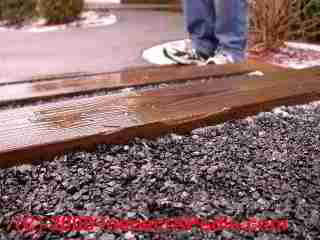
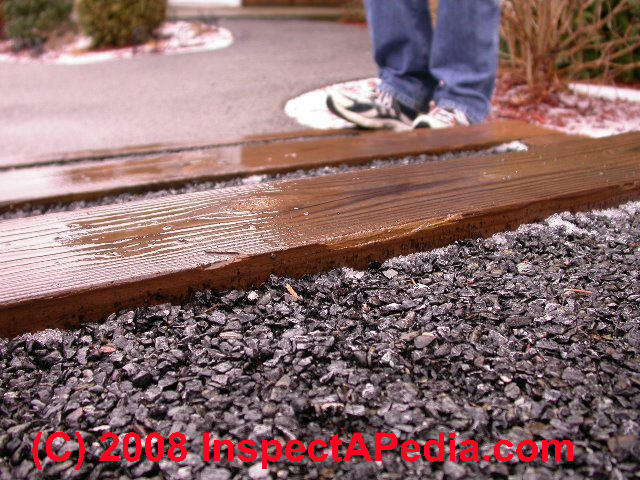
We also provide some stair and walkway maintenance suggestions to reduce slip, trip and fall hazards due to water, algae, snow, ice, etc. Page top photo: wet slippery landscape ties add to the trip hazard formed by the toe-catching design of these exterior stairs.
InspectAPedia tolerates no conflicts of interest. We have no relationship with advertisers, products, or services discussed at this website.
Algae, Ice, Fungus, Wet Surfaces & Other Stair Slip, Trip & Fall Hazards
 Daniel Friedman
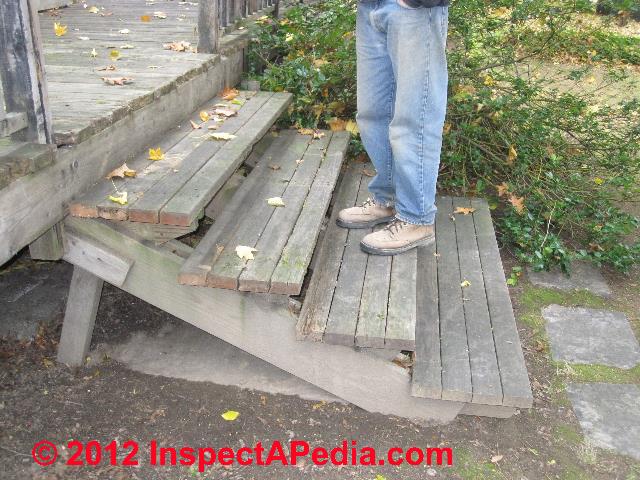
The wooden steps shown in our photograph are improperly constructed with too-narrow treads, loose components, and a flimsy "handrail" made of 1" diameter pipe (too narrow for safe grasp), placed too low, just 24" above the step tread surface.
Entering or leaving this Poughkeepsie New York home is unsafe at any speed, but more-so when the green algae-coated step is also wet, causing it to be incredibly slippery.
Algae on steps & other walking surfaces - trip hazard
Algae growth on steps or decks: green or sometimes black algae grows readily on wood, concrete, or stone surfaces in most climates, particularly where those surfaces are repeatedly wet and especially if the surface is also shaded.
Algae makes these walking surfaces dangerously slippery, particularly when wet - a slip, trip and fall hazard which is widely recognized. [29][30][31][32]
Article Series Contents
- ALGAE on Stair Treads - one of the slipperiest substances known
- COMPARING the SLIPPERINESS of Algae with that of Ice
- TABLE of SLIPPERINESS: COEFFICIENTS of FRICTION for various surfaces and substances - what's the slipperiest surface?
- DEFINITIONS of COF - what is the coefficient of friction
- ALGAE GROWTH - the king of slip and fall
- HOW FRICTION SLIPPERINESS ARE MEASURED
- HOW TO REDUCE ALGAE GROWTH HAZARDS
- SNOW & ICE on WALKING SURFACES - the queen of slip fall injures
- TILED WALKING SURFACE SLIP HAZARDS - DCOF recommendations (separate article)
- WATER SOFTENER RESIN BEADS are SLIPPERY - surprising
The green algae-covered deck shown at above left was inspected by the author who in fact nearly had a bad fall due to wet algae on the deck where the ladder was placed.
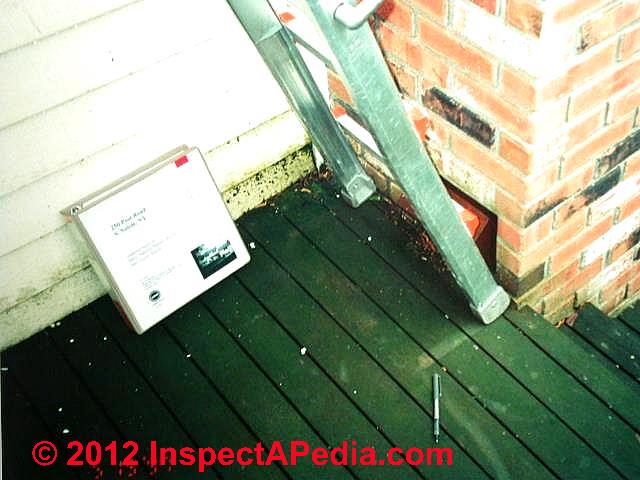
You can see the scrape marks of the ladder feet (where my pen is pointing in the photo, above right) and the good luck that the ladder slippage was stopped by the chimney base. This was my ladder and my slip [DF] that was luckily interrupted - else I'd have unable to write this article.
Algae, when wet, is one of the slipperiest substances known.
It is readily observed that algae growth on wood surfaces may seem harmless when the steps are dry, but when any stair surface, stone, brick, wood, or other, is covered with algae and becomes wet, the surface is extremely slippery, adding significantly to the risk of a serious fall and injury.
Also see ALGAE, FUNGUS, LICHENS, MOSS for images of algae under the microscope.
Algae on Stair Treads vs Recommended Coefficient of Friction (COF) and Static Coefficient of Friction (SCOF) & Dynamic Coefficient of Friction (DCOF)
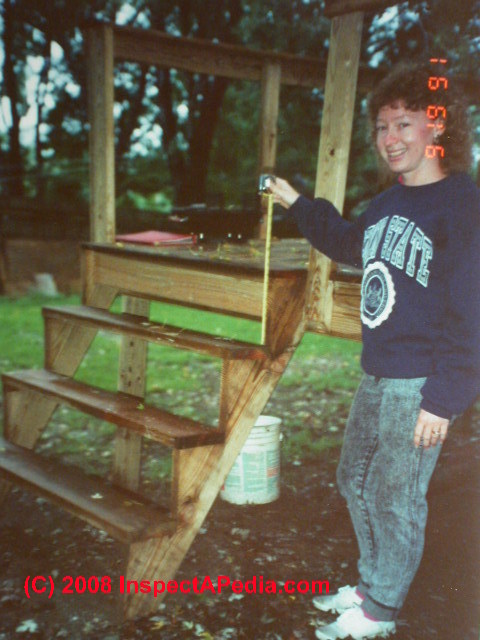
Our photo of horribly-constructed wooden steps up to a deck illustrates that multiple hazards may combine at an individual stairway leading to a fall even by people who have used the stairs many times before.
The stair we show has treads that are too shallow - the tread depth is just a few inches, the step rise too high, there are uneven step riser heights, and there is no bottom stair handrailing. But notice that at the time of our inspection the stair tread surfaces were also wet, adding to the fall hazard.
Stair Tread Anti-Slip or Coefficient of Friction Requirement for Safe Walking Surfaces
Various industry, ANSI, ASTM, OSHA, ADA standards recommend a static coefficient of friction (SCOF) of 0.5 or higher (ADA 0.6 or above) and define surfaces with SCOF of 0.4 or lower as "low traction", i.e. "slippery". [28]
Definitions of Measurements of Friction - Slip Resistance
COF Coefficient of friction - tests giving a numeric value indicating the amount of friction or slip-resistance between two objects or surfaces
SCOF Static Coefficient of Friction - tests the friction of an object that moves from a standing or still position - its "break-away" point.
DCOF Dynamic Coefficient of Friction - (DCOF) tests the friction of an object that is already in motion - kinetic energy.
Model building codes attempt to address the effects of algae, ice, snow, and water on stairs and walkways.
But because building codes & standards cannot anticipate every possible physical cause of slipperiness on walking surfaces or stairways, codes generally do not attempt to address every possible slippery substance that might be present such as algae, ice, snow, water, even spilled oil or food or wet paint on steps.
Since building codes cannot anticipate every possible slip trip and fall hazard, instead codes and standards typically state something like the text shown below.
1009.5.2 Outdoor conditions. Outdoor stairways and outdoor approaches to stairways shall be designed so that water will not accumulate on walking surfaces.
In other than occupancies in Group R-3, and occupancies in Group U that are accessory to an occupancy in Group R-3, treads, platforms and landings that are part of exterior stairways in climates subject to snow or ice shall be protected to prevent the accumulation of same. - IBC (International Building Code) [43]
or
Slippery conditions on stairways must be corrected. - OSHA standard on temporary workplace stairways [42]
Use Glowing Stair Tread Tape to Reduce Fall Hazards
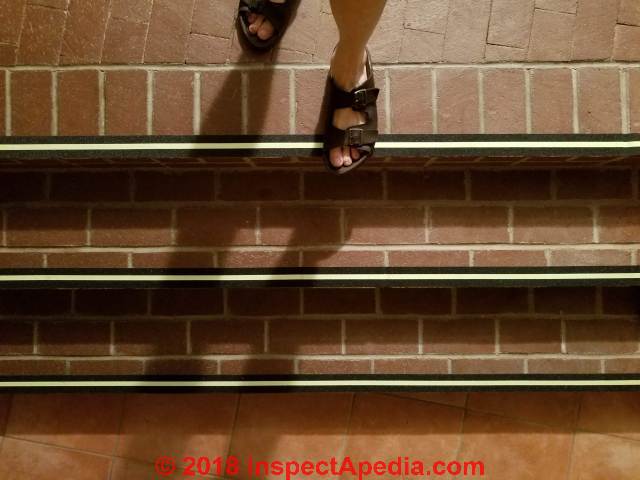
Foster (2014) documented not only the added safety of using a tread-edge highlighter but also the optimal position for the highlight to reduce stair falls.
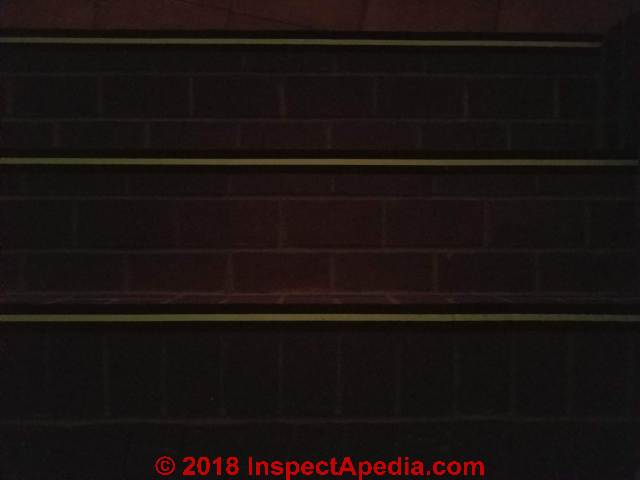
Above: we added and are testing the durability of this glow-in-the-dark non-slip stair tread tape placed along the front edge of these interior stairs made of brick.
Particularly because the upper walking surface is identically-colored brick, at night in low light it is difficult to see the edge of the individual steps.
1003.4 Floor surface. Walking surfaces of the means of egress shall have a slip-resistant surface and be securely attached. - ICC and as adopted by various states throughout the U.S. [44] (Similar provisions are made for ramps in 1010.7.1 and 1010.7.2)
The florescent stair edge non-slip tape glows in the dark making the edges of the steps easier to spot.
Research & Standards for Phosphorescent Non-slip Tape for Steps
- ASTM E2030-04, Guide for Recommended Uses of Photoluminescent (Phosphorescent) Safety Markings, ASTM International, West Conshohocken, PA, 2004.
- ASTM E2072-04, Standard Specification for Photoluminescent (Phosphorescent) Safety Markings, ASTM International, West Conshohocken, PA, 2004.
- Foster, Richard J., John Hotchkiss, John G. Buckley, and David B. Elliott. "Safety on stairs: Influence of a tread edge highlighter and its position." [PDF] Experimental gerontology 55 (2014): 152-158. Retrieved 2018/08/22, original source: https://www.sciencedirect.com/science/article/pii/S0531556514001302?viewFullText=true
Highlights:
We studied if fall risk during stair descent was reduced by using step edge highlighters.
A highlighter placed flush with step/tread edge improved foot clearance precision.
Foot clearance precision was reduced when the highlighter was set back by 30 mm.
Benefits of the highlighter were greater in those with simulated visual impairment. Fall risk may be reduced by using a highlighter positioned flush with the tread edge.
Comparing the Slipperiness of Algae with that of Ice & Other Slippery Walking Surfaces
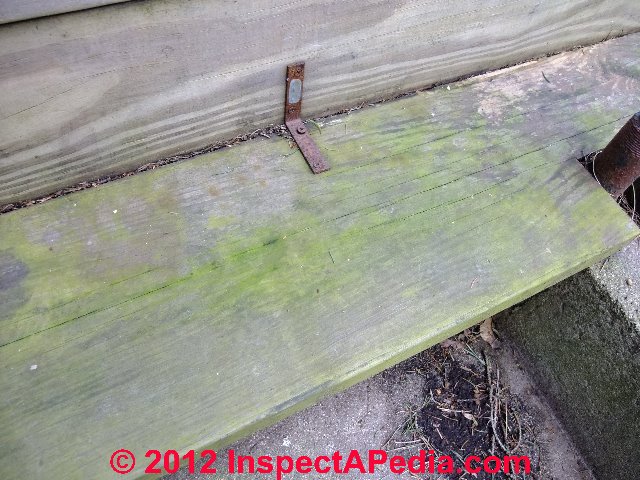
Algal growth (green, brown, black) on a wood walking surface such as a stair, ramp, or deck may feel and look pretty harmless when it's dry (photo at left). But when there is even a modest level of dew, or water the surface can become more slippery than Teflon.
Watch out: Wet algae may be in fact more slippery than ice:
- The COF of kinetic (moving) rubber (say a car tire) on ice is standardized at 0.15.and depending on the material contacting the ice, the COF of ice may appear as low as 0.017 - less than Teflon. [36][37]
- Gourdon et als. showed that algae can have a coefficient of friction (COF) as low as 0.015 - enormously slippery.[32]
How Slippery are Various Stair & Walkway Surfaces?
Table Comparing Coefficients of Friction for Various Walking or Driving Surfaces & Materials Note 1 |
||
Materials / Surface |
Static Coefficient of |
Coefficient of Friction (COF) |
| Algae | 0.015 [32] | |
| Asphalt paving (frost covered) [39][40] | 0.53 - 0.63 | |
| Asphalt paving (dry) [39][40] | 0.72 | |
Ice: Glare ice on asphalt paving (note for icy surfaces the nature of the material below is probably irrelevant in measuring friction) |
0.19 | |
Ice on asphalt paving with sun exposure, not melted [39][40] Ice, wet, on asphalt paving [39][40] |
0.24 | |
| Ice on Steel | 0.03 | 0.03 |
| Ice on Ice | 0.05 - 0.5 | 0.02 - 0.09 |
| Leather on Metal (e.g. a shoe sole on a dry steel stair tread) | 0.4 - 0.56 | |
| Leather on metal, wet or greased [41] | 0.2 | |
| Leather on Oak (shoe sole on an oak stair tread, presumably unfinished and unpolished tread surface) | 0.27 - 0.38 | |
| Marble Floor Tiles [indoors] | <= 0.8 SCOF bare foot |
Note 8 |
| Masonry on Brick (a brick set on concrete) | 0.60 - 0.7 | |
| Recommended Minimum SCOF for walking surfaces (OSHA etc). | 0.5 | |
| Recommended Minimum SCOF for walking surfaces (ADA) [28] | 0.6 [Obsolete?] | |
| Rubber on Ice (tennis shoe on icy step or car tire on icy pavement) [37] | 0.15 | |
| Rubber on wet concrete [41] | 0.45 - 0.75 | |
| Rubber (car tire or tennis shoe sole) on concrete (all surfaces dry, no loose sand, etc) | 0.6 - 0.85 [41] | 0.8 [38] - 1.02 |
Rubber Car tire on wet road [presumably asphalt] [41] |
0.2 | |
| Rubber (tennis shoe or car tire) on dry asphalt [41] | 0.9 | |
Rubber (car tire or tennis shoe sole) on grass (presumably dry) Packed (car driven over) snow or fresh unpacked snow |
0.35 | |
| Skin (bare foot) on metal surface (presumably dry) | 0.8 -1.0 | |
Snow on waxed hickory (similar to snow on a waxed or perhaps poly or painted stair tread) [28] Snow or ice on asphalt [39][40] |
0.04 - 0.4 | 0.04 - 0.4 |
| Snow, wet [41] | 0.14 | |
| Teflon | 0.04 | |
| Recommended for Tile, ceramic |
0.60 4 [Obsolete] >= 0.42 DCOF 6 |
|
| Wood, clean [41] | 0.25 - 0.5 | |
Wood, wet [41] |
0.2 | |
| Wood, waxed [41] | 0.04 | |
Notes to the table above
1. Table - some portions are adapted & expanded from "Friction", the Physics Hypertextbook, retrieved 8/29/12, original source: http://physics.info/friction/2. Friction measures the force between two surfaces that are in contact and measures the resistance to their slipping or tangential motion.
There are two coefficients of friction, static friction (nothing is already moving) (SCOF or Us) and kinetic friction (moving or sliding) (COF or uK).
The measure of friction is independent of the surface area, speed (as long as speed is more than zero), and temperature.
The amount of friction depends on the nature of the surfaces in contact with one another and the force between them (such as the weight of a person whose shoe sole is in contact with a stair tread surface.
The "roughness" of a surface has a minor impact on friction, and friction can be higher between smooth surfaces.
3. The Ice on Ice example in the table above illustrates the reduced amount of friction when movement is present
4. Tile .60 static coefficient of friction (SCOF), determined by the ASTM C1028
5. Tile DCOF AcuTest, ANSI A137.1,
6. ANSI A137.1 (2012) tile walking surfaces for level interior spaces
7. Values of friction coefficient of bare
foot sliding against Massaa tiles were 0.5, 0.43 and 0.4 at normal loads
of 200, 400 and 600 N."
and
A floor with a
friction coefficient
between 0.2 and 0.29 was ‘‘slip resistant
8. Ali, W. Y. "Friction Coefficient of Bare Foot Sliding Against Marble Flooring Tiles." - https://www.kau.edu.sa/ Files/ 320/Researches/56847_27169.pdf
and
Ali, W. Y. "Friction Coefficient of Bare Foot Sliding Against Marble Flooring Tiles." - https://www.kau.edu.sa/Files/ 320/Researches/ 55466_25788.pdf [PDF] files
Algae Appears on Other Building & Surrounding Surfaces: Concrete, Brick, Roofs, Siding
Green or black stains due to algae:
green stains also appear on buildings including on roof shingles, tiles, slates, on building siding, and even on masonry walls, sidewalks, planters, and retaining walls: stone, concrete block, and concrete. If you see flat green stain on a building exterior and that is not producing any plant-like raised growth it is likely to be an algae.
In our photo at below left both the green on the concrete grate-surround and the black on the sidewalk may be species of algae.
Why are they different? Perhaps different genera/species prefer different nutrients in the two pours of concrete, or perhaps because of moisture or other surface differences.
Watch out: on walks, decks, ramps and stairs, algae makes for a dangerously slippery surface, particularly when it is wet.
 ...
... 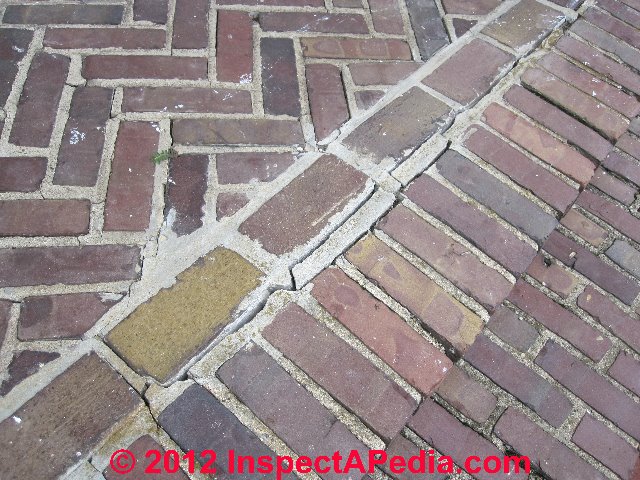
At above right our photo illustrates that bricks used in a stair or walkway may be quite uneven in their ability to host slippery algal growth.
Two bricks in the foreground (above the 2012) have appear to have a modest algae growth while others did not show algae. But of course there are other trip hazards here - loose bricks.
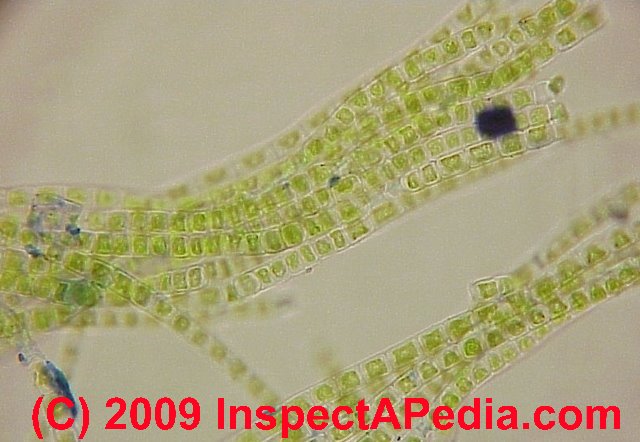
Algae under the microscope
has a distinctive appearance that easily distinguishes it from moss, lichens, and mold, as we show here.
This micro photograph of algae was made in our lab while examining a sample sent to us from our friend and mold lab expert Sue Flappan.
The original algae sample was collected from a concrete sidewalk using simple adhesive tape.
Also see our black or blue-green algae illustrated and discussed near the end of
MOSS on ROOFS where we discuss the mix of moss, lichens, and algae often found on roofs./
How to Reduce the Hazard of Algae Growth on Stairs or Other Walking Surfaces
- Slippery Algae-coated stair tread hazard reduction.
The cedar wood steps shown above were located at a home in the northeastern U.S. in an area of shade and dampness.
The presence of lichens as well as algae illustrate that even rot-resistant cedar decking and steps are not immune to these slippery conditions. - Clean and remove algae growth.
Algae on steps is often green, sometimes black in color.
Algal growth can be removed from outdoor steps using a power washer with or without deck cleaners such as the products described
at STONE, STUCCO & BRICK CLEANING METHODS - Do not direct roof runoff,
downspouts, nor surface runoff onto stair surfaces.
Such water promotes algae or fungus growth on the stair surface and in freezing climates, ice formation.
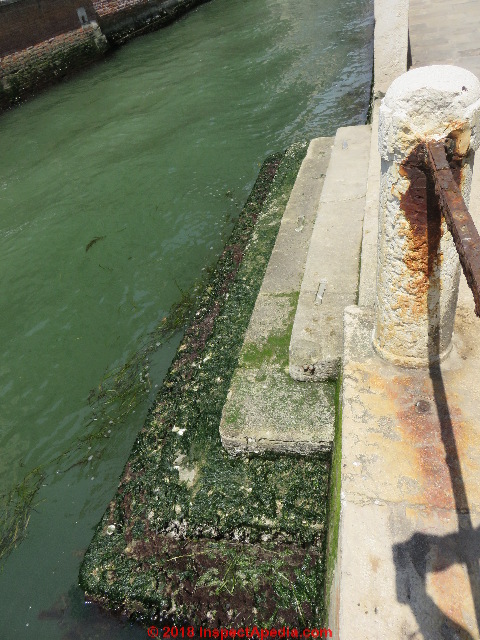
Below: thick algae and seaweed are common on steps and ramps that are under water at high tide. Below our photos of stone steps in Dorsoduro and Canarregio show treacherous stairs in Venice, Italy.
 ...
... 
- Use anti-slip additive in paint
on outdoor stair treads, landings, and entry porches, such as a fine-ground sand powder which is mixed in with the paint. Anti-slip stick-on plastic tread covers are also available.
- Masonry stair treads and entry platforms should be slightly pitched
away from the riser (or away from the building for platforms) in order to drain water away from the riser side of the step - you don't need much pitch to drain, 1" in 45" of run is sufficient and won't violate building code.
Good drainage on a masonry stair (or walk) also reduces damage from frost-related surface spalling and cracking.
Also see STONE, STUCCO & BRICK CLEANING METHODS and
for more algae images and data about algae on buildings
see ALGAE STAINS on ROOFS - Masonry stairs should be protected from frost heaves
by proper gravel, backfill, drainage, and other construction details - Regular stair safety inspections
performed by someone familiar with stair, railing, and safety requirements should discover hazards due to poor maintenance, stair or step or handrail deterioration, loose or worn stair treads or railings, or even bad original design that has gone unattended.
More examples of exterior stair slip fall hazards are
and at EXTERIOR STAIR CONSTRUCTION & CODES.
Ice, Snow or Even Plain Water on Steps Means Very Slippery Surfaces
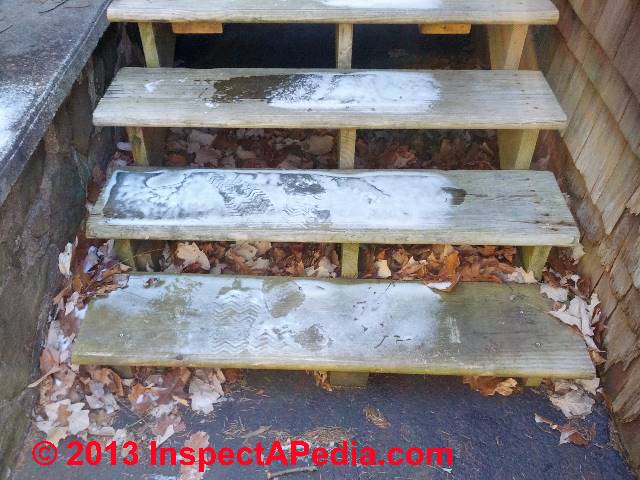
Water atop ice and "black ice" are still more slippery (lower SCOF or COF) than water alone or ice alone on most surfaces.
The ice-covered exterior steps shown just above and found in Poughkeepsie, NY were pointed out to us by Paul Galow.
A very light snow dusting, atop ice on steps or other walking surfaces may be even more dangerous than when the ice was visible, as the hazard may not be noticed by the stair user.
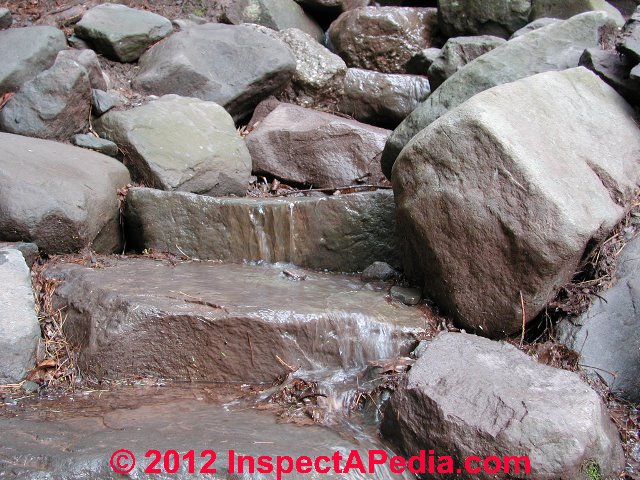
Water means slippery stairs and walks, icy or not.
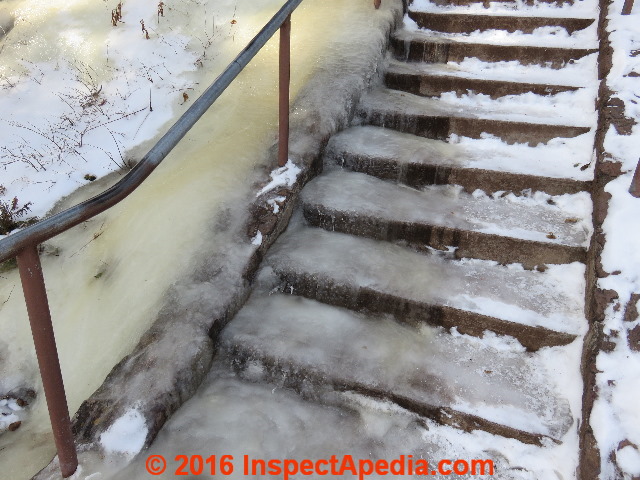
Above: ice-coated steps at Gooseberry Falls, Two Harbors Minnesota. Crampons are required to negotiate this stairway with any hope of avoiding a fall.
In our table of surface slip coefficients of friction (above) we indicated that water on a walking surface significantly reduces the COF or increases the surface slip hazard.
In our photo (below-left) water is running over these stone stairs, combining water, possibly thin algal coatings on some stones, and debris to add to a serious slip hazard.
At below the author tries out stone surfaced stairs in Girona, Spain. Early morning mist left a thin wet coating that made these steps actually more treacherous than the running stone steps on the hiking trail at above right.
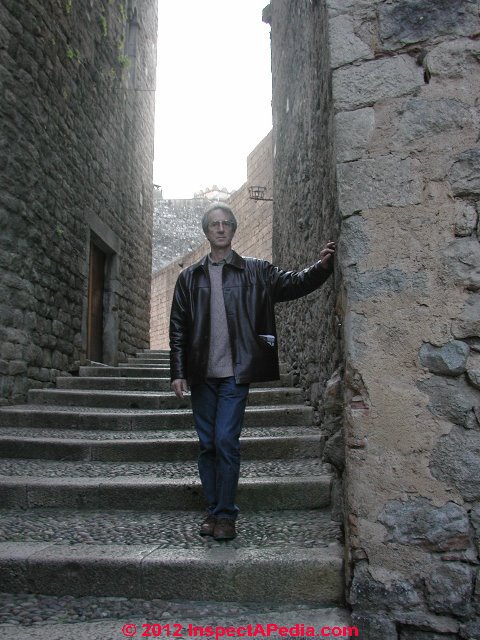
When water is visibly running down the steps on a hiking trail the walker might expect trouble and may walk with more care than a casual stroller or worse, a runner up the Spanish steps shown at above right.
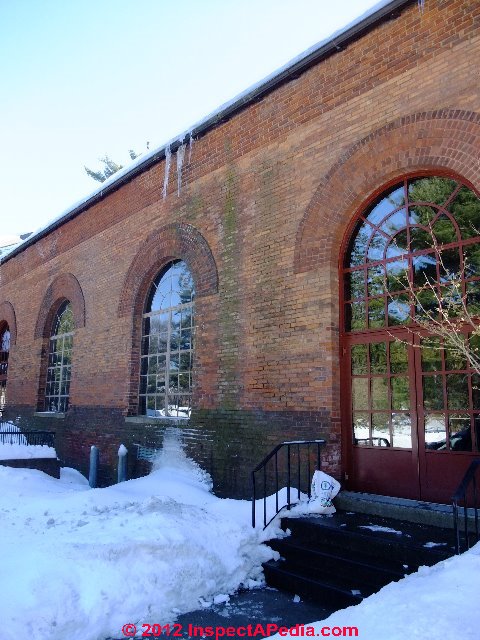
Difficult-to-maintain snow and ice fall on decks, porches, steps, walks
We liked the photo above because it shows both green algal growth down the brick building wall and typical snow and ice conditions at a masonry walk and stair in the Northeastern U.S.
Notice that in recognition that the steps will experience snow melt and then ice re-freezing during the daily temperature cycle, the site maintenance crew have left a bag of ice-melting crystals by the entry door.
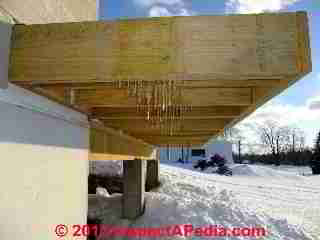
In our of a wooden deck frame shown below (Volition NY), even before construction had been completed we wondered about future ice hazards on the deck shown in our photo at left.
Ice and snow melting and dripping off of roof eaves onto a deck or porch where the water re-freezes can lead to a surprise trip hazard.
Below you can just make out a stone and gravel walkway along side of the building.
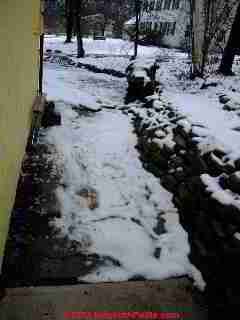
Because shoveling snow off of combined surfaces (flat stones surrounded by gravel) can be difficult these walks may not be adequately cleared and may present a fall hazard more often than other surfaces exposed to winter and freezing weather.
Watch out: using a power snow-blower where loose gravel is present can throw a stone through a window or into an eye.
The owners cleared this walk by hand but later later decided to reduce the risk and hassle of this hard-to-clear stone walkway by installing a roof over the entire walkway.
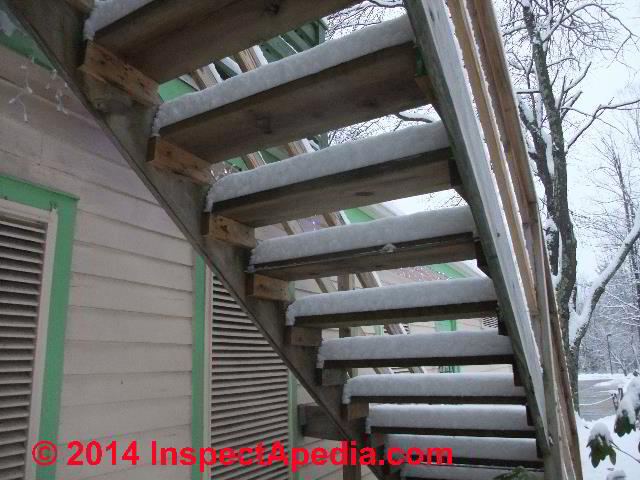
Our photographs below illustrate the range of challenges for snow and ice removal on exterior stairs and walks. At below left is a deep snow-covered main entry stair to the front door of a home in Duluth Minnesota while at below right is an exterior stair with snow on its treads in Hyde Park, New York, both photographed during the winter of 2014.
At SNOW & ICE REMOVAL on WALKS & STAIRS we describe methods for keeping snow and ice off of ramps, stairs and walkways.
 \ ...
\ ... 
Spills of Water Softener Resin Can Lead to a Nasty Fall
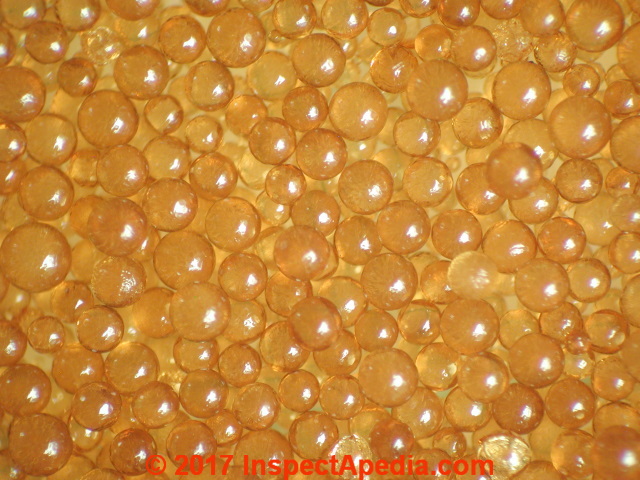
Below we show close-up photographs of Purolite® water softener resin beads that we discuss
at WATER SOFTENER RESIN REPLACEMENT.
The resin particles vary in size but are about 0.4 to 1mm in diameter.
 ...
... 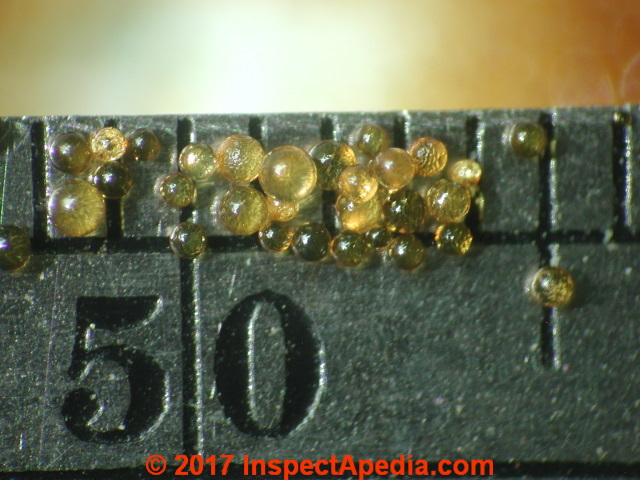
Watch out: Spilling these water softener resin beads on a walking surface will make it about as slippery as wet algae, with a very low static coefficient of friction (SCOF). What that means for normal people is if you step in this stuff you will fall on your you-know-what.
I didn't want to have to visit the mothers of the other workers to explain why they fell off of the rooftop: we took great care to sweep up any spillage immediately and very thoroughly.
More about the hazards of working with these very tiny resin beads are
at WATER SOFTENER RESIN PROPERTIES & SOURCES
History & Methods of Measuring Friction
Reader question: 1/29/14 Carlos Rivera said: Is there a simpler way of measuring the Coefficient of Friction, besides using a Surface Roughness Tester?
Reply:
Carlos, I am not expert on friction measurement - a check with a text will almost certainly list a variety of ways people have measured friction, such as using a combination of known slopes, pulleys, and scales.
A quick look at history shows that around 1500 Leonardo DaVinci experimented with friction measurements using just that approach.
Early work in friction measurement provides the formula relating the dead weight of the move of a block being dragged across a surface and the counterweight used with a rope and pulley to move it.
µ = Ff / N = Mass(dead weight) / Mass(block)
The long list of methods for measuring friction took off from there and include at least
- block and pulley (described above)
- spring balance
- tilted plane (friction angle at which the move begins to move)
- tribometers
Friction & Slipperiness Research
Measurement of friction & walkway or stair falls
- BLACK or GREEN ALGAE STAINS on ROOFS [Web article] - very slippery stuff also causes ugly stains
- Cartwright, David Edgar, and Paul Melchior. Tides: a scientific history. Vol. 7. Cambridge: Cambridge University Press, 1999.
- Cottenden, A. M., W. K. Wong, D. J. Cottenden, and A. Farbrot. "Development and validation of a new method for measuring friction between skin and nonwoven materials." Proceedings of the Institution of Mechanical Engineers, Part H: Journal of Engineering in Medicine 222, no. 5 (2008): 791-803.
- Goodenow, Gary L., Gary L. Kolhoff, and Fraser D. Smithson. Tire-road Friction Measuring System: A Second Generation. No. 37. 1968.
- Hamel, Kathry
Stair design and environmental conditions may play a role in slip accidents on stairs in the workplace, but little is known about the slip resistance requirements on stairs compared to level walking.
Older adults have an increased risk of falling compared to younger adults and may be at greater risk during stair negotiation.
The purpose of this study was to determine whether the ground reaction force profiles and peak required coefficient of friction (RCOF) differed between young and elderly women or between stair ascent, stair descent and overground walking.
While there was a trend towards less risky stair descent behaviour in the older women in terms of their peak RCOF values during stair descent, the increased vertical loading rate in the older women may imply reduced dynamic balance control.
The largest mean RCOF peaks occurred during stair ascent in both young and older women, but there were several overground walking trials in both groups and a few stair descent trials of the young women, which resulted in RCOF peaks greater than 0.5.
These results should be considered when choosing stair surface materials, particularly in occupational and outdoor settings where the tread surfaces may become wet or contaminated. - Hemenway, David, Sara J. Solnick, Christian Koeck, and Joseph Kytir. "The incidence of stairway injuries in Austria." Accident Analysis & Prevention 26, no. 5 (1994): 675-679.
- Jackson, Patricia L., and H. Harvey Cohen. "An in-depth investigation of 40 stairway accidents and the stair safety literature." Journal of Safety Research 26, no. 3 (1995): 151-159.
- Masud, Tahir, and Robert O. Morris. EPIDEMIOLOGY of FALLS [PDF] Age and ageing 30, no. suppl_4 (2001): 3-7. Retrieved 2018/08/22, original source: https://www.researchgate.net/profile/Rob_Morris2/publication/11587628_Epidemiology_of_Falls/links/543d13d50cf20af5cfbfa4a7/Epidemiology-of-Falls.pdf
- MOSS on ROOFS [web article] includes photos & Q&A on algae on roofs - very slippery on metal and EPDM surfaces!
- Roys, M., 2005. Steps and stairs. In Understanding and preventing falls (pp. 53-67). CRC Press.
Abstract:
As an architectural focal point, stairs are often an elegant feature within buildings. At the same time, steps and stairs are highly functional, providing quick, efficient, and permanent means of access between levels.
Stairs vary in size in both their overall scale and in dimensions such as the rise and going (i.e., tread depth) of individual steps (Figure 3.1).
Stairs vary in shape, with straight, spiral, doglegged, alternating, and geometric designs among those found. Stairs vary in the materials from which they are constructed, concrete, wood, metals, stone, and even glass, for example.
They vary in location, and thus function, such as those between storeys in a home, stairs in an office, stairs in a sports stadium or other public building, steps down into a swimming pool, or the assortment of steps and stairs found in an outdoor urban landscape.
Entire books (e.g., Templer 1992) have been written to try to describe this variety and the ways in which people use the range of stairs and steps encountered in everyday life.
This chapter discusses the design of stairs, focussing on those aspects of most importance for falls and their prevention. - Swartz, J. C. "Apparatus for Measuring Internal Friction and Modulus Changes of Metals at Low Frequencies." Review of Scientific Instruments 32, no. 3 (1961): 335-338.
- Templer, J. A. "Human territoriality and space needs on stairs." The Staircase: Studies of Hazards, Falls, and Safer Design (1992): 61-70.
- Van Blovehuysen, Richard, and Fred Schaefer. Internal combustion engine handbook-basics, components, systems and perspectives. Vol. 345. 2004.
Tiled Walks & Stairs: Outdoor Slip & Fall Hazard
Moved to TILED WALKING SURFACE SLIP HAZARDS
Reader Comments, Questions & Answers About The Article Above
Below you will find questions and answers previously posted on this page at its page bottom reader comment box.
Reader Q&A - also see RECOMMENDED ARTICLES & FAQs
On 2021-01-27 - by (mod) - there is help available and solutions to slippery surfaces.
Well-said, Richard;
We welcome comments, criticism, suggestions (not product advertisements) and are happy to cite and link to technical content contributors.
On 2021-01-26 by Richard Campbell
I own a Non-Slip business by adding non-slip treatments to various types of walking surfaces as well as stairs, metal loading docks, bathtubs and more for homeowners and businesses.
What people don't realize, is that there is help available and solutions to slippery surfaces.
On 2020-08-11 - by (mod) -
Bill
I don't understand the question, but in general if walkers might indeed walk on a slippery metal surface imo that's a hazard.
On 2020-08-11 by Bill
is there a hazard if the walking surface (exterior) has a non-slip surface and a metal surface 16" wide is introduced at the same level?
On 2018-04-11 - by (mod) - how to contact OSHA about slip & fall concerns
David
If this is a place of employment, OSHA rules apply; typically guardrails and handrails would be required.
OSHA Consultation Service Area Offices* For workplace safety and health questions or assistance from Cal/OSHA Consultation, call the toll-free assistance number 1(800) 963-9424 or email us at InfoCons@dir.ca.gov. You may also contact the Cal/OSHA Consultation Service Area Office nearest your workplace.
else your local building department sets the local approvals for stairs and rails.
On 2018-04-11 by David Howe
I slipped on icy steps coming out of MILK HOUSE after a farmer cleaner the steps in 19 dergree weather and never informed me or took precautions .
There is no handrails and the landing is washed out grave. what is OSHA code on the?
On 2017-06-08 - by (mod) - hazard of open grate stair treads
M
I think the concern with open grate stair treads is that they catch pointed heel shoes, causing a fall
On 2017-06-07 by Mom
I am considered exterior stairs to connect my first-floor front yard to my basement-level back yard, to run along the side of the house. I am concerned about slip hazards.
Is it acceptable to use metal treads with a grate-like surface, for drainage and traction? I ran across a reference to IBC that said stair treads had to be solid, but I am not sure that was relevant to my situation.
On 2017-02-21 - by (mod) - height requirement for railingds
Typically the requirement for railings is based on the total height above ground between the top of the stairs and the bottom. Often that's three feet. But your local building inspector is a final Authority.
On 2017-02-20 by Elizabeth
How many exterior stepslegally require a railing?
...
Continue reading at RAMP SLIP TRIP FALL HAZARDS or select a topic from the closely-related articles below, or see the complete ARTICLE INDEX.
Or see these
Recommended Articles
- ACCESSIBLE DESIGN
- ADA STAIR & RAIL SPECIFICATIONS
- ALGAE, FUNGUS, LICHENS, MOSS on ROOFS
- ELDERLY & VETERANS HOME SAFETY
- HANDRAILS & HANDRAILINGS
- POOL CONCRETE COOL DECK SURFACES
- SLIP TRIP & FALL HAZARD LIST, STAIRS, FLOORS, WALKS
- STAIR CODES & STANDARDS - downloads
- STAIR DESIGNS for UNEVEN / SLOPED SURFACES
- STAIR PLATFORMS & LANDINGS, ENTRY
- STAIR RAILS, STAIR GUARDS
Suggested citation for this web page
SLIPPERY STAIRS, WALKS, ROOFS at InspectApedia.com - online encyclopedia of building & environmental inspection, testing, diagnosis, repair, & problem prevention advice.
Or see this
INDEX to RELATED ARTICLES: ARTICLE INDEX to STAIRS RAILINGS LANDINGS RAMPS
Or use the SEARCH BOX found below to Ask a Question or Search InspectApedia
Ask a Question or Search InspectApedia
Try the search box just below, or if you prefer, post a question or comment in the Comments box below and we will respond promptly.
Search the InspectApedia website
Note: appearance of your Comment below may be delayed: if your comment contains an image, photograph, web link, or text that looks to the software as if it might be a web link, your posting will appear after it has been approved by a moderator. Apologies for the delay.
Only one image can be added per comment but you can post as many comments, and therefore images, as you like.
You will not receive a notification when a response to your question has been posted.
Please bookmark this page to make it easy for you to check back for our response.
Our Comment Box is provided by Countable Web Productions countable.ca
Citations & References
In addition to any citations in the article above, a full list is available on request.
- Best Practices Guide to Residential Construction, by Steven Bliss. John Wiley & Sons, 2006. ISBN-10: 0471648361, ISBN-13: 978-0471648369, Hardcover: 320 pages, available from Amazon.com and also Wiley.com. See our book review of this publication.
- Decks and Porches, the JLC Guide to, Best Practices for Outdoor Spaces, Steve Bliss (Editor), The Journal of Light Construction, Williston VT, 2010 ISBN 10: 1-928580-42-4, ISBN 13: 978-1-928580-42-3, available from Amazon.com
- Best Practices Guide to Residential Construction, by Steven Bliss. John Wiley & Sons, 2006. ISBN-10: 0471648361, ISBN-13: 978-0471648369, Hardcover: 320 pages, available from Amazon.com and also Wiley.com. See our book review of this publication.
- Paul Galow [Website galowconsulting.com ] - technical consultant on networking, LAN design, applications support. Galow Consulting Services [Website galowconsulting.com ] , 914-204-1749, email: paulgalow@galowconsulting.com
- Eric Galow, Galow Homes, Lagrangeville, NY. Mr. Galow can be reached by email: ericgalow@gmail.com or by telephone: 914-474-6613. Mr. Galow specializes in residential construction including both new homes and repairs, renovations, and additions.
- [3] Stephenson, Elliott O., THE ELIMINATION OF UNSAFE GUARDRAILS, A PROGRESS REPORT [PDF] Building Standards, March-April 1993
- [4] "Are Functional Handrails Within Our Grasp" Jake Pauls, Building Standards, January-February 1991
- [5] Access Ramp building codes:
- UBC 1003.3.4.3
- BOCA 1016.3
- ADA 4.8.2
- IBC 1010.2
- [6] Access Ramp Standards:
- ADA (Americans with Disabilities Act), Public Law 101-336. 7/26/90 is very often cited by other sources for good design of stairs and ramps etc. even where disabled individuals are not the design target.
- ANSI A117.4 Accessible and Usable buildings and Facilities (earlier version was incorporated into the ADA)
- ASTM F 1637, Standard Practice for Safe Walking Surfaces, (Similar to the above standard
- [7] The Circular Staircase, Mary Roberts Rinehart
- [8] Construction Drawings and Details, Rosemary Kilmer
- [9] Falls and Related Injuries: Slips, Trips, Missteps, and Their Consequences, Lawyers & Judges Publishing, (June 2002), ISBN-10: 0913875430 ISBN-13: 978-0913875438
"Falls in the home and public places are the second leading cause of unintentional injury deaths in the United States, but are overlooked in most literature. This book is unique in that it is entirely devoted to falls. Of use to primary care physicians, nurses, insurance adjusters, architects, writers of building codes, attorneys, or anyone who cares for the elderly, this book will tell you how, why, and when people will likely fall, what most likely will be injured, and how such injuries come about. " - [11] The National Institute of Standards and Technology, NIST (nee National Bureau of Standards NBS) is a US government agency - see www.nist.gov
- "A Parametric Study of Wall Moisture Contents Using a Revised Variable Indoor Relative Humidity Version of the "Moist" Transient Heat and Moisture Transfer Model [copy on file as/interiors/MOIST_Model_NIST_b95074.pdf ] - ", George Tsongas, Doug Burch, Carolyn Roos, Malcom Cunningham; this paper describes software and the prediction of wall moisture contents. - PDF Document from NIS
- [12] Slips, Trips, Missteps and Their Consequences, Second Edition, Gary M. Bakken, H. Harvey Cohen,A. S. Hyde, Jon R. Abele, ISBN-13: 978-1-933264-01-1 or ISBN 10: 1-933264-01-2, available from the publisher, Lawyers ^ Judges Publishing Company,Inc., www.lawyersandjudges.com sales@lawyersandjudges.com
- [13] Slips, Trips, Missteps and Their Consequences, Gary M. Bakken, H. Harvey Cohen, Jon R. Abele, Alvin S. Hyde, Cindy A. LaRue, Lawyers and Judges Publishing; ISBN-10: 1933264012 ISBN-13: 978-1933264011
- [14] The Stairway Manufacturers' Association, (877) 500-5759, provides a pictorial guide to the stair and railing portion of the International Residential Code. [copy on file as http://www.stairways.org/pdf/2006%20Stair%20IRC%20SCREEN.pdf ] -
- [17] Steps and Stairways, Cleo Baldon & Ib Melchior, Rizzoli, 1989.
- [18] The Staircase, Ann Rinaldi
- [19] Common Sense Stairbuilding and Handrailing, Fred T. Hodgson
- [20] The Art of Staircases, Pilar Chueca
- [21] Building Stairs, by pros for pro, Andy Engel
- [22] A Simplified Guide to Custom Stairbuilding, George R. Christina
- [23] Basic Stairbuilding, Scott Schuttner
- [24] The Staircase (two volumes), John Templar, Cambridge: the MIT Press, 1992
- [25] The Staircase: History and Theories, John Templar, MIT Press 1995
- [26] >Steps and Stairways, Cleo Baldon & Ib Melchior, Rizzoli, 1989.
- [27] "The Dimensions of Stairs", J. M. Fitch et al., Scientific American, October 1974.
- [28] Stair & Walkway Standards for Slipperiness or Coefficient of Friction (COF) or Static Coefficient of Friction (SCOF)
- ANSI A1264.2
- ANSI B101
- ASTM D-21, and ASTM D2047
- UL-410 (similar to ASTM D-21)
- NSFI 101-B (National Floor Safety Institute)
- NSFI Walkway Auditing Guideline (WAG) Ref. 101-A& 101-B (may appear as ANSI B101.0) sets rules for measuring walkway slip resist
- OSHA - (Dept of Labor CFR 1910.22 does not specify COF and pertains to workplaces) but recognizes the need for a "qualified person" to evaluate walkway slipperiness
- ADA (relies on the ANSI and ASTM standards)
- [29] A. Sacher, International Symposium on Slip Resistance: The Interface of Man, Footwear, and Walking Surfaces, Journal of Testing and Evaluation (JTE), ISSN: 1945-7553, January 1997 [more focused on slipperiness of polished surfaces
- [30] Algae is widely recognized as a slippery surface - a Google web search for "how slippery is algae on steps" produced more than 15,000 results on 8/29/12)
- [31] Slipperiness of algae on walking surfaces, warning, Royal Horticultural Society, retrieved 8/29/2012, original source: http://apps.rhs.org.uk/advicesearch/profile.aspx?pid=418
- [32] Slipperiness of algae: "Watch your step, wet rocks and algae are slippery" Oregon State University warning 1977 retrieved 8/29/2012, original source: http://www.worldcat.org/title/watch-your-step-wet-rocks-and-algae-are-slippery/oclc/663683915
- [33] Coefficient of friction of algae on surfaces [like stair treads]: Delphine Gourdon, Qi Lin, Emin Oroudjev, Helen Hansma, Yuval Golan, Shoshana Arad, and Jacob Israelachvili, "Adhesion and Stable Low Friction Provided by a Subnanometer-Thick Monolayer of a Natural Polysaccharide", Langmuir, 2008 pp 1534-1540, American Chemical Society,
retrieved 8/29/2012,
Abstract: Using a surface forces apparatus, we have investigated the adhesive and lubrication forces of mica surfaces separated by a molecularly thin, subnanometer film of a high-molecular-weight (2.3 MDa) anionic polysaccharide from the algae Porphyridium sp. adsorbed from aqueous solution. The adhesion and friction forces of the confined biopolymer were monitored as a function of time, shearing distance, and driving velocity under a large range of compressive loads (pressures). Although the thickness of the dilute polysaccharide was < 1 nm, the friction was low (coefficient of friction = 0.015), and no wear was ever observed even at a pressure of 110 atm over 3 decades of velocity, so long as the shearing distances were less than twice the contact diameter. Atomic force microscopy in solution shows that the biopolymer is able to adsorb to the mica surface but remains mobile and easily dragged upon shearing. The adhesion (adsorption) of this polysaccharide even to negatively charged surfaces, its stable low friction, its robustness (high-load carrying capacity and good wear protection), and the weak (logarithmic) dependence of the friction force on the sliding velocity make this class of polyelectrolytes excellent candidates for use in water-based lubricant fluids and as potential additives to synovial fluid in joints and other biolubricating fluids. The physical reasons for the remarkable tribological properties of the ultrathin polysaccharide monolayer are discussed and appear to be quite different from those of other polyelectrolytes and proteins that act as thick “polymer brush” layers. - [34] Jinjin Li, Yuhong Liu, Jianbin Luo, Pengxiao Liu, and Chenhui Zhang, "Excellent Lubricating Behavior of Brasenia schreberi Mucilage" Langmuir 2012 28 (20), 7797-7802
- [35] Jason R. Stokes, Lubica Macakova, Agnieszka Chojnicka-Paszun, Cornelis G. de Kruif, and Harmen H. J. de Jongh, "Lubrication, Adsorption, and Rheology of Aqueous Polysaccharide Solutions, Langmuir 2011 27 (7), 3474-3484
- [36] "Coefficients of Friction for Ice", The Physics Factbook™, Glenn Elert, Ed., retrieved 8/29/12, original source: http://hypertextbook.com/facts/2004/GennaAbleman.shtml
- [37] "Coefficients of Friction for Ice", The University of the State of New York Reference Tables for Physical Setting/Physics. New York: The State Education Department, 2002. Op. Cit.
- [38] Serway Physics for Scientists and Engineers 4th edition (p. 126.)
- [39] "How Slippery Is It", retrieved 8/29/12, original source http://www.icebike.org/Articles/howslippery.htm
- [40] John E. Hunter, "Friction Values", The Source, Society of Accident Reconstructionists, Winter 1998. Study of frictional values of car tires involved in collisions on snow or ice covered roadways.
- [41] Frictional Coefficients of some Common Materials and Materials Combinations, The Engineering Toolbox, retrieved 8/29/2012, original source: http://www.engineeringtoolbox.com/friction-coefficients-d_778.html [copy on file as Friction and Coefficients of Friction.pdf ]
- [42] Stairways and Ladders, A Guide to OSHA Rules, OSHA, U.S. Department of Labor, 3124-12R 2003 - Web Search 05/28/2010 original source: http://www.osha.gov/Publications/osha3124.pdf. OSHA regulations govern standards in the construction industry and in the workforce Quoting from OSHA whose focus is on workplace safety and so excludes discussion of falls and stair-falls in private homes:
OSHA estimates that there are 24,882 injuries and as many as 36 fatalities per year due to falls from stairways and ladders used in construction. Nearly half of these injuries are serious enough to require time off the job--11,570 lost workday injuries and 13,312 non-lost workday injuries occur annually due to falls from stairways and ladders used in construction. These data demonstrate that work on and around ladders and stairways is hazardous. More importantly, they show that compliance with OSHA's requirements for the safe use of ladders and stairways could have prevented many of these injuries. -osha.gov/doc/outreachtraining/htmlfiles/stairlad.html
- [43] International Building Code, Stairway Provisions, Section 1009: Stairways and Handrails, retrieved 8/29/12, original source: http://www.amezz.com/ibc-stairs-code.htm [copy on file as IBC Stairs Code.pdf]
- [44] Model Building Code, Chapter 10, Means of Egress, retrieved 8/29/12, original source: http://www2.iccsafe.org/states/newjersey/NJ_Building/PDFs/NJ_Bldg_Chapter10.pdf, [copy on file as NJ_Bldg_Chapter10.pdf] adopted, for example by New Jersey. International Code Council, 500 New Jersey Avenue, NW, 6th Floor, Washington, DC 20001, Tel: 800-786-4452
- Our recommended books about building & mechanical systems design, inspection, problem diagnosis, and repair, and about indoor environment and IAQ testing, diagnosis, and cleanup are at the InspectAPedia Bookstore. Also see our Book Reviews - InspectAPedia.
- In addition to citations & references found in this article, see the research citations given at the end of the related articles found at our suggested
CONTINUE READING or RECOMMENDED ARTICLES.
- Carson, Dunlop & Associates Ltd., 120 Carlton Street Suite 407, Toronto ON M5A 4K2. Tel: (416) 964-9415 1-800-268-7070 Email: info@carsondunlop.com. Alan Carson is a past president of ASHI, the American Society of Home Inspectors.
Thanks to Alan Carson and Bob Dunlop, for permission for InspectAPedia to use text excerpts from The HOME REFERENCE BOOK - the Encyclopedia of Homes and to use illustrations from The ILLUSTRATED HOME .
Carson Dunlop Associates provides extensive home inspection education and report writing material. In gratitude we provide links to tsome Carson Dunlop Associates products and services.
 | HOME | ABOUT | ASK a QUESTION | CONTACT | CONTENT USE POLICY | DESCRIPTION | POLICIES | PRIVACY | |
| © 2024 - 1985 Publisher InspectApedia.com - Daniel Friedman | |||||||||