 Water Piping Foot Valves on Open Water Q&A

- POST a QUESTION or COMMENT about locating, using, diagnosing, repairing, or replacing well pump check valves and foot valves.
Well Foot Valve repair diagnostic questions & answers:
These questions and answers address common problems with well piping foot valves or check valves including their relation to loss of well pump prime.
This article series describes the foot valve used on well piping for water well Pumps & Water Wells: we explain what a foot valve is, how they work, why they are used, and how to diagnose troubles with this special in-well check valve found at the bottom of well piping in some wells.
We provide advice about loss of well pump prime due to bad foot valves and what to do when things go wrong with the check valve.
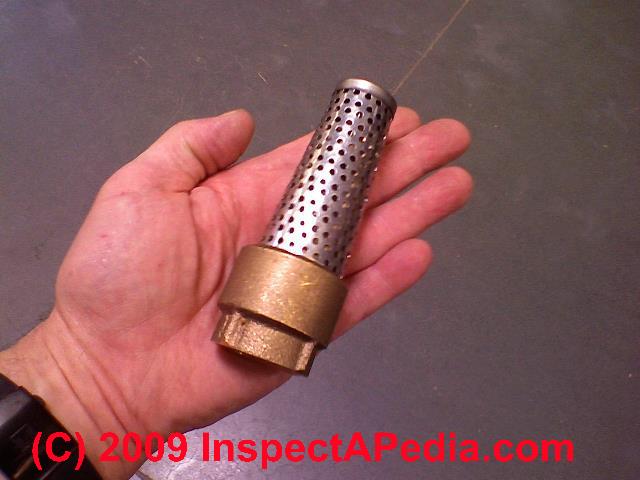
Page top photo: a well foot valve.
InspectAPedia tolerates no conflicts of interest. We have no relationship with advertisers, products, or services discussed at this website.
- Daniel Friedman, Publisher/Editor/Author - See WHO ARE WE?
Foot Valves & Injectors in Ponds, Lakes, Springs & Dug Wells
These questions about foot valves and check valves on well piping were posted originally
at FOOT VALVES - topic home. Be sure to review that article.
Also see our index to all foot valve questions and answers at FOOT VALVE DIAGNOSIS & REPAIR FAQs
...
Tell me where to place the well piping injector on this steep slope setup pulling water up from a stream or lake

I recently purchased a deep well pump to pump water from a shallow stream to my house to irrigate the yard using a garden hose. The stream is about 3 feet deep. The pump: 1.5 HP Deep Suction Well Jet Self Priming Pump – 552 GPH – APM 150(P30). The stream is about 3 feet deep.
I plan to place the pump next to the house, which is about 50 feet above the street with a run of about 75 feet from the stream.
Regarding the injector, it is necessary to place the injector WITHIN the steam with two lines running from the house down to the injector, or may be injector be placed closer to the house (see image) with only one line running down to the stream (see image).
Secondly, if the injector is close to the house, may the foot valve be placed adjacent to the injector or is it better to place it at the end of the line in/near the stream?
Thanks so much for your help. On 2022-09-05 by DENNIS -
by InspectApedia-911 (mod) - is it necessary to place the injector WITHIN the steam with two lines running from the house?
@DENNIS,
Thanks that's an interesting project and a helpful question.
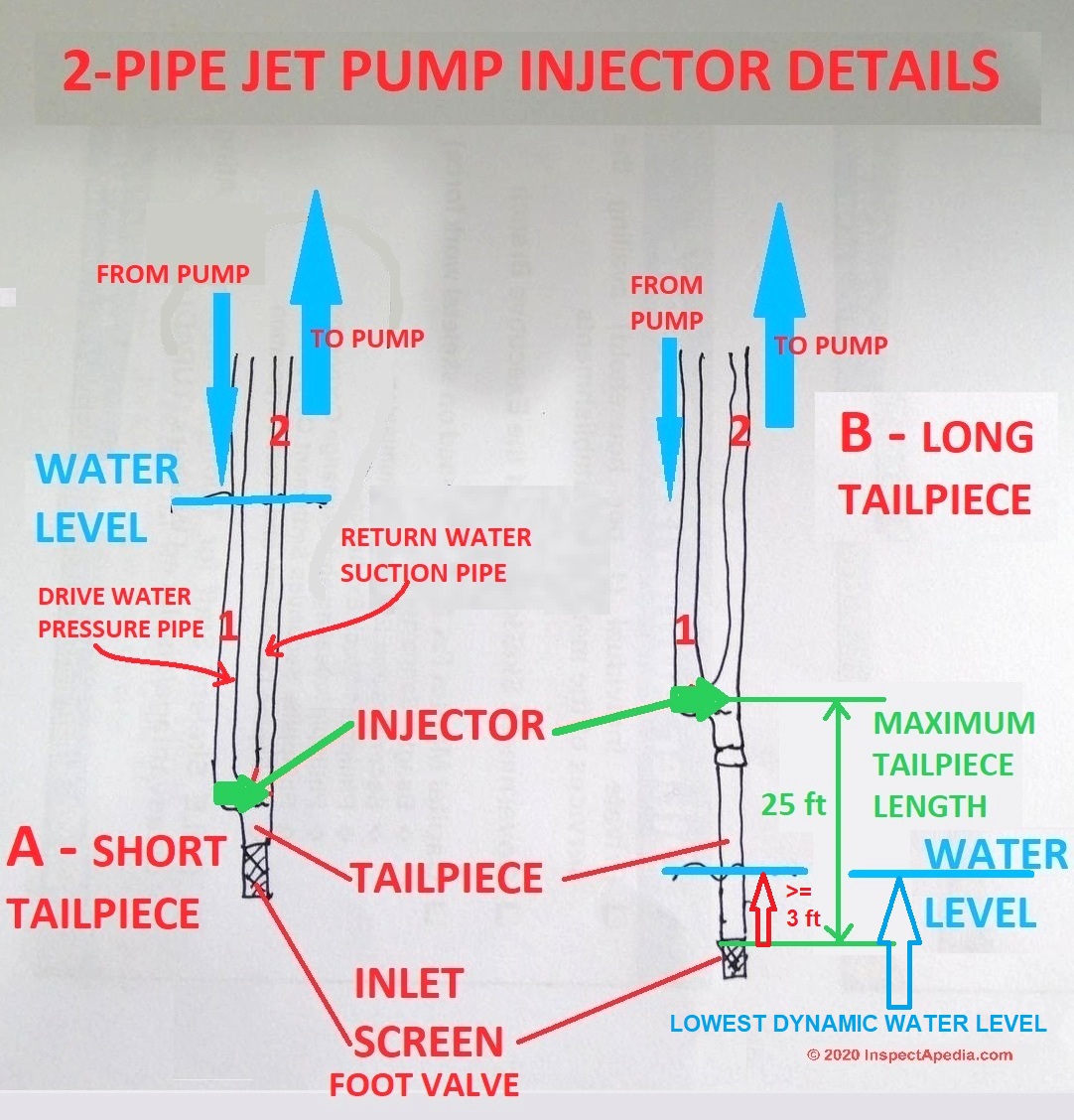
The injector itself does not have to be at the very end of the pair of water pipes in a 2-line jet pump system.
Sometimes a tailpiece, extending down another 30 feet or more feet is used to avoid running the injector "dry" in a low-yield well.
But Watch out: I suspect that the 50 foot "lift" you describe might exceed the permissible tailpiece length for your pump.
Check with your pump's IO manual for the maximum tailpiece length. Typically pump manuals limit the tailpiece to 25 ft. while others a bit longer (Franklin goes to 34 ft).
Here's an excerpt from these FRANKLIN CONVERTIBLE VERSAJET PUMP INSTRUCTIONS [PDF]TWIN PIPE INJECTOR INSTALLATION
Prepare the twin pipe deep well injector for installation into the well as outlined in the instructions (document 106581102) provided with the injector kit (ordered separately).
The foot valve strainer can be installed onto the bottom of a 34’ tail pipe, rather than the bottom of the injector, to prevent over pumping of a low yield well.
Lower the injector assembly into the well. It should be set at least 3’ below the lowest dynamic water level if you are not using a tail pipe below the injector.
The foot valve strainer should be no closer than 3’ from the bottom of the well.
Watch out: as your lift is not straight vertical - from the photo we see there's some horizontal travel - you may need to increase the diameter of the suction line - also discussed in the document we cited above.
Let's look over just what he lift limitations are for the tailpiece length or drop pipe length in a WATER PUMP, TWO LINE JET PUMP INSTALLATIONSpecific details and manuals are at WELL PIPING TAIL PIECE
by Dennis
Thanks for your response. I have visited the links you recommended.
Unfortunately, the Speroni user manual is rather skimpy on details, but the website [dis-allowed link] suggests a "total suction lift up to 35 mt," which doesn't exactly tell me how long the tailpiece may be. In any case, would it work to place the injector within 25 feet of the stream and increase the length of the two lines running between the pump and injector?
Additionally, the injector is "designed" for a 1'' suction line, but based on the information from VersaJet site, it make sense to increase the diameter to 1.5" or 2". If I increase the length of the two lines running from the pump and injector, so I also need to increase their diameter?
Thanks again, Dennisby InspectApedia-911 (mod) - place the injector within 25 feet of the stream?
@Dennis,
I certainly think the 25 ft option is worth trying
For other readers, here is the APM Jet Pump INSTRUCTION MANUAL [PDF] Speroni, Italy, for this electric self-priming jet pump.

...
Can I use a 2 line jet pump in a shallow pond to get irrigation water?
I just replaced a single line Gould Jet Pump with a Two Line Pump (also a Gould, 1/2 HP) to pump water from my shallow pond for irrigation. Is there any reason a two-line pump won't work for this application? How should I use the "return" line?
Is it possible that I could use it to help aerate the pond or drive a fountain? On 2021-07-19 by Brian R. in NH
by inspectapedia.com.moderator - a two line jet pump can pump from shallow depths
@Brian R
A two line jet pump can pump from shallow depths, though it's an unnecessary approach - a bit of over-kill;
But you need BOTH lines used properly or your pump won't work;
The small diameter pipe sends water from the pump down to a foot valve and venturi at the bottom of the well or pond water source; there water squirts through a venturi to send a larger volume of water back up the larger diameter pipe to the 2-line jet pump and thence to the water's final destination - irrigation in your case.
Be sure to read the article above on this page and also your pump IO manual so that you have a clear picture of how a 2-line jet pump works.
...
For a 2 line Jet Pump Installation how far below the surface of the lake should the inlet hose be?
How far below the surface of the lake water should the inlet hose be
Deeper is better or worse?
i.e. does the venturi rely on WATER PRESSURE, i.e the WEIGHT OF WATER IN THE RIVER? On 2021-06-22 by pumped
by inspectapedia.com.moderator (mod) -
@pumped,
Because you describe a venturi I am guessing you're talking about a 2-line jet pump system. A 2-line jet pump uses a venturi valve at the bottom of its pair of water pipes (water down one and more water up the other) to bring up water from the bottom of a well or from a pickup point in a lake or water tank.
A river water pump could also work with a 1-line jet pump as long as the TOTAL vertical lift from pick-up point in the river to end use point is less than 27 ft.
A 2-line jet pump, in comparison, can lift water hundreds of feet.
It is the flow of water through the valve, not the depth of the valve, that allows the system to work.
Putting the pick up point for your river water pump deeper into the water makes no meaningful difference in the pump's ability to deliver water. (At about 30 ft. of depth under water we reach 1 ATM of pressure or about another 14.6 psi. )
But the depth of a river water pick-up for a 2-line or 1-line jet pump can be important for other reasons:
1. the water pick-up point for any water pump system needs to be high enough off the bottom to avoid picking up sand or silt and mud - those will foul the whole water system.In a well that may be 4-10 ft. In a river or lake a similar depth is probably safe though on lake pump systems I've examined in New York, Minnesota, and other US states often permit the pump to sit on the very bottom when the bottom is fully covered by large rocks.
2. in a freezing climate the pick-up point for water needs to be deep enough below the water surface that it won't become encased in solid ice.
3. In a lake or river water pumping pick-up system it's generally better for the pick up point to be more-distant from the shoreline.Particularly in large lakes where distancing from the shore is actually achievable, getting more than 10 meters from the lakeshore reduces the level of shore-sourced bacteria and other pathogens that will be delivered by the water system.
...
Can I use a foot valve as a check valve in a spring house?
I am installing a shallow well pump in my garage and pulling water from an underground spring. The set up requires a horizontal suction pipe from well to pump with 6' of rise total. Approx 80' of horizontal run. On 2018-09-29 by NP
Do I need a special horizontal foot valve for this or will a normal foot valve work?
by (mod) - Yes or use a proper type of check valve at the pump
A foot valve will work but you could also use a check valve at the pump. Either will be just fine.
A foot valve contains an internal spring that will close it to preserve prime when the pump stops.
Check valves are available in various designs, not all of which use a spring to close the valve,
So be sure, if you're putting the check valve on the horiontal water pipe instead of using a foot valve, that it's a check valve designed to work in that position.
Watch out: if your spring house water supply is exposed to freezing temperatures you might want to look at the freeze protection discussion at
...
...
Continue reading at FOOT VALVES - topic home, or select a topic from the closely-related articles below, or see the complete ARTICLE INDEX.
Or see these
Recommended Articles
- CHECK VALVES, WATER SUPPLY, DRAINS, PUMPS
- EJECTORS in WELLS
- FOOT VALVES - home
- PUMP PRIME, REPEATED LOSS
- WATER PUMP INTERMITTENT CYCLING
- WELL PIPING CHECK VALVES
- WELL PIPING LEAK DIAGNOSIS
Suggested citation for this web page
FOOT VALVE INSTALLATION in DUG WELLS & SPRINGS at InspectApedia.com - online encyclopedia of building & environmental inspection, testing, diagnosis, repair, & problem prevention advice.
Or see this
INDEX to RELATED ARTICLES: ARTICLE INDEX to WATER SUPPLY, PUMPS TANKS WELLS
Or use the SEARCH BOX found below to Ask a Question or Search InspectApedia
Ask a Question or Search InspectApedia
Share this article:Search the InspectApedia website
Need to make a private comment? Email editor@inspectApedia.com. We welcome email with your website content critique, corrections, suggestions or questions. Email is monitored daily but our workload may prevent an immediate reply. For immediate results, we hope you'll first try asking your question using the search box just above.
Citations & References
In addition to any citations in the article above, a full list is available on request.
- In addition to citations & references found in this article, see the research citations given at the end of the related articles found at our suggested
CONTINUE READING or RECOMMENDED ARTICLES.
- Carson, Dunlop & Associates Ltd., 120 Carlton Street Suite 407, Toronto ON M5A 4K2. Tel: (416) 964-9415 1-800-268-7070 Email: info@carsondunlop.com. Alan Carson is a past president of ASHI, the American Society of Home Inspectors.
Thanks to Alan Carson and Bob Dunlop, for permission for InspectAPedia to use text excerpts from The HOME REFERENCE BOOK - the Encyclopedia of Homes and to use illustrations from The ILLUSTRATED HOME .
Carson Dunlop Associates provides extensive home inspection education and report writing material. In gratitude we provide links to tsome Carson Dunlop Associates products and services.
 |
HOME | ABOUT | ASK a QUESTION | CONTACT | CONTENT USE POLICY | DESCRIPTION | POLICIES | PRIVACY | |
| © 2026 - 1985 Publisher InspectApedia.com - Daniel Friedman | |||||||||