 Water Cistern FAQs

- POST a QUESTION or COMMENT about using cisterns for drinking water
Water storage cisterns:
This article series describes the use of cisterns as a drinking water supply source including rooftop cisterns, attic cisterns, ground-level and below-ground-level water storage cisterns.
We describe rainwater collection systems and the diversion of rainwater into a storage cistern. We also discuss the acceptability of cistern water supply for HUD financed properties.
InspectAPedia tolerates no conflicts of interest. We have no relationship with advertisers, products, or services discussed at this website.
- Daniel Friedman, Publisher/Editor/Author - See WHO ARE WE?
Cisterns and How to use them for Drinking Water Storage
 These questions and answers were posted originally
at CISTERNS, WATER STORAGE - topic home, be sure to review that article.
Article Index
- CISTERN ALGAE CONTAMINATION FAQs - green, blue, red or pink algae
- CISTERN COLOR FAQs - does it matter?
- CISTERN DAMAGE - cracks, leaks, etc
- CISTERN PUMPS
- CISTERN RAINWATER COLLECTION - TIP BUCKET CONSTRUCTION
- CISTERN SAFETY - open pit, missing covers, etc.
- CISTERN WATER SAFETY FAQs - safe to drink, bathe-in, water plants etc
- CISTERN WATER FILTERS & TREATMENT - for sanitation, contaminants, odors
- CISTERN WINTERIZING METHODS
...
Cistern Water Pump FAQs
Our cistern pump is short cycling: why is it doing that and how do I fix it.
I have a 7000 gal cistern for the house that i haul water to fill. It just started but the pump comes on and goes off in quick sessions. Maybe runs for about 5 secs then goes off then immediately comes back on.
The tank is still pressurized around 40 psi, the pump isn't getting hot, and the tank is full. I did take the little hose that runs to the pressure switch at power point off and the pump comes on till i replace hose. To me that tell me it is working there.
Would like to know why the pump keeps doing the off and on? I know thats not working properly. Any suggestions? On 2016-10-02 by Dan
Answer by (mod) - your pump is short cycling: probably need air in the water tank
Dan
Please see WATER PUMP SHORT CYCLING - home
for the diagnosis and repair of a pump that keeps going on and off.
I need a sensor to turn off the pump when there's no water in the cistern
I have a 1500 gal Cistern 15L x10W x 8H that sometimes runs out of water and the pump keeps running and then I have to buy a new one. Is there a sensor that can be placed on the pipe that is 8 inches from the bottom to tell the pump to shut off On 2018-04-04 by Lee
Solution by (mod) -
Lee
Check with your local plumbing supplier or online - there are many varieties of pump control switches that use a float switch to shut off a pump at low water as well as other types of pump protectors that we describe
...
Cistern Material or Coating Color FAQs
Does the color of my plastic cistern matter?
Does it matter what color the plastic is for a cistern? I have a white one that's above-ground. Any problems with that? On 2018-10-18 by Terry
Answer by (mod) - color affects heat gain and may indicate cistern material that is a clue to its acceptable use
Terry,
My general opinion is no, the color of a plastic cistern is not critical to its use.
There are a few more subtle considerations:
1 The plastic color might tell you something about its chemistry, thus addressing questions about leaching chemicals into your drinking water, and also telling you about the plastic's resistance to UV deterioration when exposed to sunlight - thus the tank life.
See details at PLASTIC RECYCLING CODES, TANKS, TYPES - plastic recycling codes, contaminants, and water storage concerns, including BPA Bisphenol-A, PET, etc.
2 The plastic color affects the solar heat gain for an above-ground or rooftop plastic cistern. Black or other dark colors tend to warm the water more than light or white colors - if anyone cares.
3. The plastic color (actually its composition) could be important to compare with its intended use.
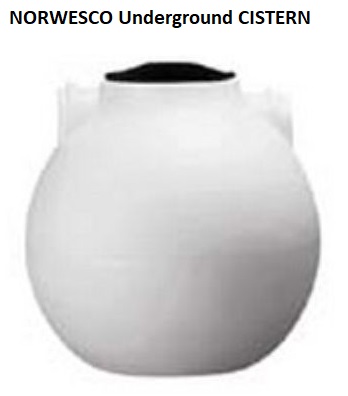
For example there may be specific plastics designed for underground use and others designed for above ground and sunlight-exposed use. Factors include strength, resistance to cave-in (below ground) vs. UV resistance and again, tank life.
Shown below my comment is a Norwesco underground cistern.
Also see this
- Norwesco UNDERGROUND CISTERN INSTALLATION MANUAL [PDF] Norwesco Inc. 4365 Steiner Street P.O. Box 439 St. Bonifacius, MN 55375-0439 TEL. (800) 328-3420 FAX (800) 874-2371 www.norwesco.com
Norwesco produces plastic / fiberglass tanks used in a variety of applications including cisterns and septic tanks.
As will be apparent to readers, both the open top of this cistern and the open casing in the bottom of the dug well are sources of water contamination.
See WELL CLEARANCE DISTANCES for more information about cisterns, well and water source clearances from potential pollutant sources, and possible exceptions that can permit use of cisterns for drinking water supply.
...
Cistern Water Filters & Treatment FAQs
Where do we to install filters for our well and cistern? What do they need to filter?
Where can I get filter for cistern - On 2017-04-28 by Russell
Explanation by (mod) - first test the water to see what treatment or filtration is needed
Russell
You need to first define what's being filtered and whether that's adequate - do that by having your water tested for basic contaminants or for any special contaminants that your local health department or lab tells you have been found in private drinking water sources in your immediate area.
Then you can know what treatment may be needed.
Then to define where the filters get placed get your plumber on site: locate the filter or treatment equipment where it's protected from weather and is readily accessible for service and maintenance; then any plumbing supplier has the cartridges and filter canisters.
Then see our article series on WATER FILTERS, HOME USE to see details.
...
Cistern Tip Buckets for Rainwater Collection Systems Q&A
What is a tip bucket for a cistern and how do I make one?
How to make tip bucket for a cistern? On 2016-06-29 0 by Garry Lewis
Answer by (mod) - "Tip Bucket" is a device for receiving and dumping the first quantity of roof runoff that would otherwise run directly into a cistern
Garry
(and for other readers) as you use it here, "Tip Bucket" is a device for receiving and dumping the first quantity of roof runoff that would otherwise run directly into a cistern to be used to store domestic water for washing, bathing, and perhaps drinking.
In the article above at "Traditional Traditional Water Storage Cistern, Rainwater Collection & Graywater Re-Use", we refer to text and photographs now found in a separate article
at CISTERN CONSTRUCTION GUIDE (live link at the end of this page) where we describe a rooftop rainwater collection system that sends clean roof runoff into a very large masonry cistern built below a home in Guanajuato, Mexico.
In both CISTERNS, WATER STORAGE and at CISTERN & RAINWATER HARVEST SYSTEMS you'll see an elegantly simple tip bucket concept: the first roof runoff can run into the first of a pair of barrels; when that unit is filled water continues into the second barrel; when that unit is filled remaining water runs out of the top of those collectors into the actual cistern.
The water in the barrels contains the dust and debris from the roof and is used for watering plants around the house. That watering operation also empties the tip bucket barrels before the next rain.
A still simpler approach requires human intervention that may be worthwhile depending on water scarcity: baffles at the roof drain opening shunt initial roof runoff onto the ground until the roof has been rinsed; then those baffles are closed to allow water to enter the piping that sends it into the cistern. A simple plastic sink or shower drain cover can even be used for that purpose.
Please take a look at CISTERN CONSTRUCTION GUIDE at because there in addition to the article on how to construct a cistern there are many references to books and articles offering details about various rainwater collection systems and cisterns of different designs that meet different needs.
Finally, the OAS has also published RAINWATER CATCHMENT SYSTEM DESIGNS [PDF] that you should read over.
...
Cistern Damage & Repair Q&A
I'm worried that a cracking basement cistern wall is part of the house foundation
My cistern is in the basement. One of the walls of the cistern is cracking badly and this cistern wall sure looks like it's the load bearing wall of the house. Was this type of construction normal? On 2016-01-06 by Buck
Suggestion by (mod) - Usually cisterns were built independent of the structure
Buck,
Usually cisterns were built independent of the structure but it certainly would not be surprising if one side of a cistern might have incorporated a bearing foundation wall of the home.If the cistern in your case is cracked it must be a cistern that's no longer in use as it'd have leaked out into the basement by now. I'd focus on diagnosing the cause of foundation movement and then repairing the foundation as needed.
I suggest taking a look at FOUNDATION DAMAGE SEVERITY
by Buck - I think I was wrong: the cistern isn't using the house foundation
I forgot to mention that, with a flashlight and a very small dowel, I can see and feel another wall behind the cracked one.
From what I can tell, this wall seems in fine shape. This is a block wall in a 1916 house and yes the cistern is empty. There's been no leakage here.
We've lived here 20 years and discovered this when we pulled up some of the top floor boards on the cistern. The other wall seems to be touching the cracked one.
Suggestions by (mod) -
I'm unclear: is the cistern in use? If not and if the foundation is intact and a separate structure you may not care that the cistern is damaged.
...
Cistern Winterizing Q&A
How do I winterize my spring-fed cistern
i have 3 outdoor covered concrete water cisterns fed by a year round spring.
They drain from the bottom with a series of valves and lines that feed my irrigation system, how do i have winterize it or do I just leave the lines open? will it be OK if i leave the valves and lines open? On 2015-11-04 by watergal
by (mod) - cistern and piping freeze risk
Watergal
Any piping left containing water and left above the frost line in your area is likely to freeze; particularly metal piping is then likely to burst and valves could be be damaged too.If you can drain all above-frost-line piping you may be OK
If you can turn off water at the spring and drain the cisterns and piping that would be the best winterizing approach but if one isn't already there, you'll also need to provide a safe route for any spring water overflow now that it's not being directed into the cisterns.
See detailed advice on freeze-proofing at WINTERIZE A BUILDING
...
Algae Growth in Cisterns
Our rainwater collection system cistern water is turning pink - is that water safe?
We have a food grade 300 gal plastic rainwater collection cistern outdoors.
The water in it is turning pink. Is this dangerous for dog water and/or plants? We don't use it for drinking, but I wonder what is causing this and what can I do about it if it is a potential problem. On 2015-09-18 by Olive Window
Advice by (mod) - Do not assume the cistern water is safe to drink; Test and disinfect the water - you may need algae control.
Olive,
I suggest having a water sample tested before consuming it yourselves or giving it to pets.
The pink could be algae or really something else as I don't know what fell into or entered your container nor what the water you collected has passed over or through.
It may be a simple algae, bacteria, or chemical.But certainly some algal growth is pink. See details at ALGAE CONTAMINATION in CISTERNS
Even on plants I'd not use uncertain water if the plants were producing things I eat.Have the water tested, or drain it all, and in any case you need to clean and sanitize your cistern.
See WATER TANK CLEANING CODES STANDARDS - home
and WATER TESTS for CONTAMINANTS
by Olive Window
By the way, the lid is too small to get into it and I live off the grid, so do not have access to a hose to clean it out.
...
Cistern Water Smells & Odors FAQs
How do we fix a sulfur odor in our cistern water?
I have a plastic liner in my cistern; its 2 years old , we now have a sulfur smell when the water comes in to the house .
The hot water is worse . What do I need to do ? On 2015-06-14
by J
Advice by (mod) - cures for sulfur rotten egg smell in plastic-lined cistern water
Sounds as if there is a sulfur odor - if it's due to bacterial contamination, you need to clean and sanitize the cistern.
See the advice on curing odors in water
at SULPHUR ODOR REMOVAL in WATER
and at
at ODORS IN WATER, CAUSES & CURES.
See the procedures and concentrations of bleach needed at WELL CHLORINATION SHOCKING PROCEDURE
Should we keep our cistern filled? Its water smells.
Do need to keep your plastic cistern filled at all times? Or is it best to let it run low and then fill it.? We haul our water and a we keep our cistern full could that be the cause of having stinky water? On 2015-10-13 by Anonymous
Recommendations by (mod) - empty the cistern and sanitize it
In general it makes sense to occasionally deplete and then sanitize the cistern before re-filling it;
but if that's not practical, such as with large rainwater collection systems, an alternative is to disinfect the water in the cistern or at the point of use.
Watch out: from the little information in your note: that the cistern water smells, it may not be safe to drink without disinfection or other treatment.
Have the water tested for common contaminants with advice from your local water test lab.
How do we fix bad smells coming from a basement cistern
We bought a house built in 1925 and because of a smell we found a cistern that is adjacent to the house and accessed through a door high on the basement wall.
We had intermittent bad odors coming from it so we drained the crystal clear water that was in it and tried to air it out.
After a few days the smell became worse than ever! We do not know what is causing the horrible smell or what to do about it. We have sealed it up at this point-but don't know if that is a long term solution. HELP! (Dec 9, 2011) Nora
Reply:
Nora you'll want to open and inspect the cistern to see if there is a dead animal inside or nearby; inspect the rest of the basement and building foundation and crawl areas for the same purpose.
Then drain the cistern and clean and sanitize it.
See CLEANING & DINSINFECTING WATER CISTERNS AFTER FLOODS & HEAVY RAINS [PDF] U.S. CDC
More details are at WATER TANK CLEANING CODES STANDARDS
and at our home page for this topic at CISTERNS, WATER STORAGE
...
Cistern Water Use Safety FAQs
Tip: See ROOFTOP RAINWATER SANITATION WARNING - rooftop runoff considered unsafe to drink
Is cistern water safe for bathing?
Can one safely bathe with filtered attic cistern water? (Nov 7, 2011) Liz
Reply by mod: attic cistern water may be unsafe
Liz, generally cistern water will be safe for bathing, but from our lab here in Poughkeepsie we can't know what's in your attic cistern.
Watch out: as a speculative example, if bats invaded the attic and pooped or peed into an open cistern that water would be unsanitary. I suggest inspecting the attic cistern for cleanliness, a safe cover, for identification of its water source, and if in doubt, have the water tested for bacteria contamination.
Is the water in our underground cistern safe to drink or use?
We are looking to rent a house with an underground outdoor cistern. My concern is, is this water safe for drinking, bathing, washing dishes, clothes washing, etc. (May 31, 2014) nancy
Reply:
Nancy I have to give more than one answer:
1. usually water stored in cisterns is safe to use for washing and bathing and it may be safe for drinking
2. water stored in a cistern can be contaminated depending on its source: you'd want to test the water for potability and possibly other contaminants and you 'd want to know where the water comes from to form a more reliable opinion
3. Water that smells horrible and is getting worse may be UNSAFE TO DRINK - possibly, e.g. if an animal died in the cistern.
Have your cistern water tested: See WATER TESTS for CONTAMINANTS
What happens to cistern water that causes you to cough and sneeze
What happens to cistern water that causes you to cough and sneeze if you use it in a closed area? On 2018-07-05 by Herb
Suggestions by (mod) - Test your cistern water quality for sanitation & health risks
Herb
that's pretty interesting although it sounds unlikely. You would have to assume that some fine droplets of water are being airborne and you would look for the cause of that.
And you might have your sister and inspected for algae or mold or other contaminants.
Although I almost never see people following the instructions from the manufacturer, many cistern manufacturers recommend that the cistern be emptied and cleaned and sanitized every year.See this CISTERNS in the U.S. VIRGIN ISLANDS - US EPA [PDF] (EPA Website) which discusses cistern water quality. Local copy saved as Cisterns-Virgin-Is-EPA.pdf
Excerpt: If you wish to have your household cistern water quality tested, EPA recommends using a laboratory certified to analyze regulated drinking water contaminants, including oil related contaminants. Please note that EPA does not regulate water quality in cisterns and rainwater catchment systems. EPA does regulate water quality in community drinking water supply systems.A list of regulated drinking water contaminants can be found at EPA National Primary Drinking Water Regulations (EPA Website)
...
Cistern Safety: Open Cistern Hazard FAQs
Cistern Hazard Warning for Home Buyers
Looking to buy a house with an old cistern in the basement. It's no longer a source of water for the house. Will it be an issue for financing? (Oct 28, 2014) concerned buyer
Reply: address open cistern safety hazards right away
Concerned:
Your bank has to answer that question, but
Watch out: in my opinion if there are safety hazards you need to address them immediately in any case. An example would be an unsafe cover over any pit or opening on the property, including the cistern you mention.
See this WATER STORAGE TANK SAFETY CHECKLIST
...
Continue reading at CISTERNS, WATER STORAGE - topic home, or select a topic from the closely-related articles below, or see the complete ARTICLE INDEX.
Or see these
Recommended Articles
- CAULKS, NONTOXIC
- CISTERNS, WATER STORAGE
- ATTIC CISTERNS
- BASEMENT CISTERNS
- CISTERN & RAINWATER HARVEST SYSTEMS
- CISTERN USE ADVICE
- GRAVITY FEED TANKS
- FREESTANDING WATER TANKS
- LARGE CAPACITY WATER STORAGE TANKS
- RAINWATER STORAGE CISTERNS
- HUD FINANCE & CISTERNS
- ODORS IN WATER, CAUSES & CURES
- ROOFTOP WATER TANKS
- WATER TANK CLEANING CODES STANDARDS
- WATER TOWERS
...
Suggested citation for this web page
WATER CISTERN FAQs at InspectApedia.com - online encyclopedia of building & environmental inspection, testing, diagnosis, repair, & problem prevention advice.
Or see this
INDEX to RELATED ARTICLES: ARTICLE INDEX to WATER SUPPLY, PUMPS TANKS WELLS
Or use the SEARCH BOX found below to Ask a Question or Search InspectApedia
Ask a Question or Search InspectApedia
Share this article:Search the InspectApedia website
Need to make a private comment? Email editor@inspectApedia.com. We welcome email with your website content critique, corrections, suggestions or questions. Email is monitored daily but our workload may prevent an immediate reply. For immediate results, we hope you'll first try asking your question using the search box just above.
Citations & References
In addition to any citations in the article above, a full list is available on request.
- In addition to citations & references found in this article, see the research citations given at the end of the related articles found at our suggested
CONTINUE READING or RECOMMENDED ARTICLES.
- Carson, Dunlop & Associates Ltd., 120 Carlton Street Suite 407, Toronto ON M5A 4K2. Tel: (416) 964-9415 1-800-268-7070 Email: info@carsondunlop.com. Alan Carson is a past president of ASHI, the American Society of Home Inspectors.
Thanks to Alan Carson and Bob Dunlop, for permission for InspectAPedia to use text excerpts from The HOME REFERENCE BOOK - the Encyclopedia of Homes and to use illustrations from The ILLUSTRATED HOME .
Carson Dunlop Associates provides extensive home inspection education and report writing material. In gratitude we provide links to tsome Carson Dunlop Associates products and services.
 |
HOME | ABOUT | ASK a QUESTION | CONTACT | CONTENT USE POLICY | DESCRIPTION | POLICIES | PRIVACY | |
| © 2026 - 1985 Publisher InspectApedia.com - Daniel Friedman | |||||||||