 Wood Shingle & Wood Shake Roof Wear Signs & Installation Mistakes
- POST a QUESTION or COMMENT about signs of wear or damage to wood shingle or wood shake roofs
Wood shingle or shake wear, damage, or leak indicators:
Here we discuss the inspection of wood shingle or wood shake roofing for indications of wear, poor installation, or other troubles that affect the remaining life of a wood shingle roof, wood shake roof, cedar shingle or cedar shake roof.
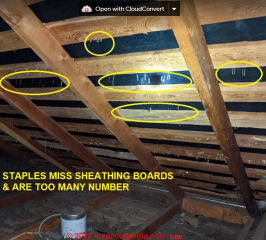
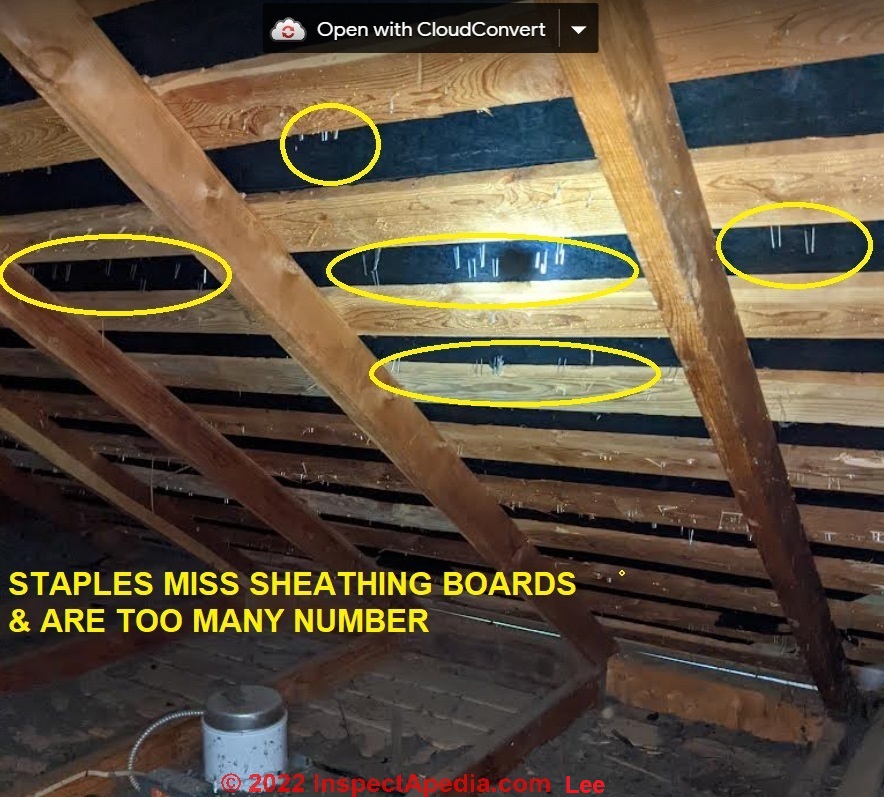
Page top photo: a wood shake roof installed using staples, many of which were nailed to nothing but the roofing felt, and perhaps through two thicknesses of wood shake.
Details about this roof are in our separate article found
at WOOD ROOF INSTALLATION SPECS
InspectAPedia tolerates no conflicts of interest. We have no relationship with advertisers, products, or services discussed at this website.
- Daniel Friedman, Publisher/Editor/Author - See WHO ARE WE?
Examples of Wood Roof Wear or Installation Problems that Limit Roof Life
[Click to enlarge any image]
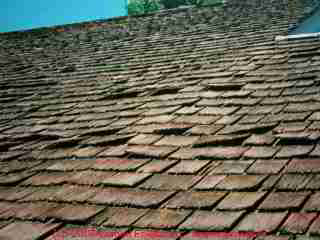
Worn out wood shingle roofs:
Our photo of a worn-out, curling, thin, split wood shingle roof is above - that's pretty easy to recognize.
Wood shingle placement & side lap offset
But take a close look at the new wood shingle roof below.
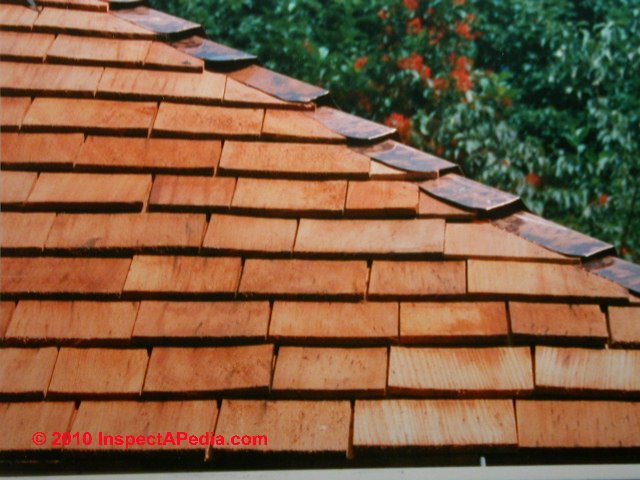
The side lap offset on this roof looks as if it barely complies with the 1.5" offset we want to see - it might be an improper installation, with many shingle butt joints offset by as little as 3/16" over one another. If so, this roof is likely to be leaky and it was not installed according to industry specifications. A closer look is needed.
At Anecdote of a BAD ROOFING CONTRACTOR [web article] we give details about another case of improper nailing pattern for wood shingle roofs.
In three successive courses of wood shingles or shakes, no butt joints should be in direct alignment (joints over joints), and between any two adjacent shingle courses the side lap offset of shingles over the course below should be 1 1/2" or more.
Below, our photo of a curling and splitting wood shingle roof at above right demonstrates early wear and damage that might occur when wood shingles are installed over un-vented solid plywood decking.

Wood shingle side gaps:
Wood shingles are nailed with a 1/4" to 3/8" gap between adjacent shingles to accommodate shingle movement and dimensional change when shingles are wet by rain or melting snow.
Omitting this gap can lead to a buckling, splitting, and failed wood shingle roof. Wood shakes require a still larger gap of 3/8" to 5/8" separation.
More details are at WOOD ROOF INSPECTION GUIDE.
More Wood Shingle Roof Details & Indications of Wood Roof Trouble
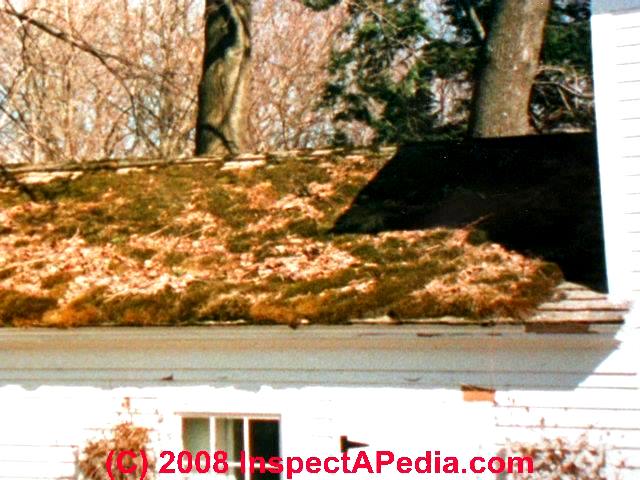
Our photo of a moss-overgrown wood shingle roof is above. Additional examples of moss and lichens growth on roofs as well as discussion of how to remove and prevent this problem are
at ALGAE, FUNGUS, LICHENS, MOSS on ROOFS.

Carson Dunlop Associates' sketch shows an alternative method for providing (some) ventilation under cedar shingles when applied over a solid plywood roof deck. In our OPINION, installing wood shingles over un-vented solid plywood decking cuts the roof life in half, but this vent product might extend wood shingle life.
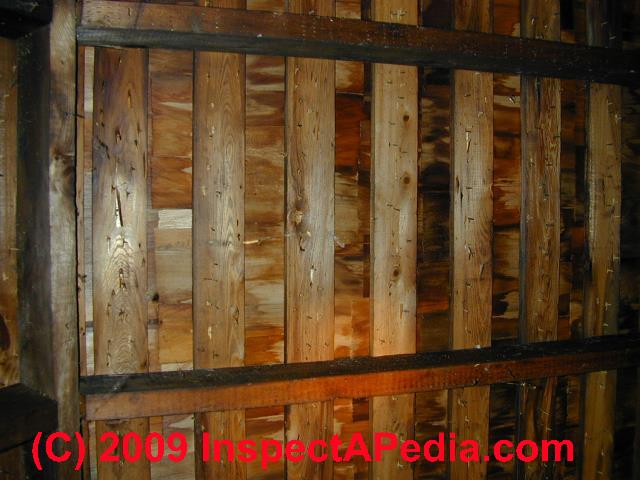
Our photo below shows this traditional wood shingle roof installation at which the shingles were nailed on spaced sheathing, affording good ventilation.
For added details about proper wood shingle or wood shake roof installation,
perhaps the most authoritative source of wood shingle and wood shake information is from the Western Red Cedar Shingle & Shake Bureau (now the Cedar and Shake Shingle Bureau, since not only western red cedar is used for roof shingles).
...
Continue reading at WOOD ROOF MOSS & LICHENS or select a topic from the closely-related articles below, or see the complete ARTICLE INDEX.
Or see these
Recommended Articles
- ALGAE, FUNGUS, LICHENS, MOSS on ROOFS
- WOOD SHAKE & SHINGLE ROOFING - home
- WOOD ROOF COATINGS & FIRE RATINGS
- WOOD ROOF FLASHING DETAILS
- WOOD ROOF HIP & RIDGE DETAILS
- WOOD ROOF INSPECTION GUIDE
- WOOD ROOF INSTALLATION SPECS
- WOOD ROOF LIFE EXPECTANCY
- WOOD ROOF MAINTENANCE
- WOOD ROOF MOSS & LICHENS
- WOOD ROOF SHAKES INSTALLATION
- WOOD ROOF SHEATHING, UNDERLAYMENT
- WOOD ROOF SHINGLE PROPERTIES
- WOOD ROOF WEAR / INSTALLATION DEFECTS
- WOOD SHINGLES, RE-ROOFING WITH
Suggested citation for this web page
WOOD ROOF WEAR / INSTALLATION DEFECTS at InspectApedia.com - online encyclopedia of building & environmental inspection, testing, diagnosis, repair, & problem prevention advice.
Or see this
INDEX to RELATED ARTICLES: ARTICLE INDEX to BUILDING ROOFING
Or use the SEARCH BOX found below to Ask a Question or Search InspectApedia
Ask a Question or Search InspectApedia
Share this article:Search the InspectApedia website
Need to make a private comment? Email editor@inspectApedia.com. We welcome email with your website content critique, corrections, suggestions or questions. Email is monitored daily but our workload may prevent an immediate reply. For immediate results, we hope you'll first try asking your question using the search box just above.
Citations & References
In addition to any citations in the article above, a full list is available on request.
- Mark Cramer Inspection Services Mark Cramer, Tampa Florida, Mr. Cramer is a past president of ASHI, the American Society of Home Inspectors and is a Florida home inspector and home inspection educator. Mr. Cramer serves on the ASHI Home Inspection Standards. Contact Mark Cramer at: 727-595-4211 mark@BestTampaInspector.com
- John Cranor [Website: /www.house-whisperer.com ] is an ASHI member and a home inspector (The House Whisperer) is located in Glen Allen, VA 23060. He is also a contributor to InspectApedia.com in several technical areas such as plumbing and appliances (dryer vents). Contact Mr. Cranor at 804-873-8534 or by Email: johncranor@verizon.net
- Problems in Roofing Design, B. Harrison McCampbell, Butterworth Heineman, 1991 ISBN 0-7506-9162-X (available used)
- Cedar Shake & Shingle Bureau, CSSB, U.S.: Sumas, WA 98295-1178, Tel: 604-820-7700, In Canada:
Cedar Shake and Shingle Bureau #2 - 7101 Horne Street, Mission, BC V2V 7A2 Tel: (604) 820-7700, E-mail: info@cedarbureau.com , website: http://www.cedarbureau.org/
CCSB offers wood shingle installation instructions in the form of a manual - cedarbureau.org/installation/wall_manual/introduction.htm - "Treatment of Cedar Shakes and Shingles," David Flickinger, RRO, p. 74, Professional Roofing, NRCA, October 1999, Rosemont IL.
- Our recommended books about building & mechanical systems design, inspection, problem diagnosis, and repair, and about indoor environment and IAQ testing, diagnosis, and cleanup are at the InspectAPedia Bookstore. Also see our Book Reviews - InspectAPedia.
- Best Practices Guide to Residential Construction, by Steven Bliss. John Wiley & Sons, 2006. ISBN-10: 0471648361, ISBN-13: 978-0471648369, Hardcover: 320 pages, available from Amazon.com and also Wiley.com. See our book review of this publication.
- Decks and Porches, the JLC Guide to, Best Practices for Outdoor Spaces, Steve Bliss (Editor), The Journal of Light Construction, Williston VT, 2010 ISBN 10: 1-928580-42-4, ISBN 13: 978-1-928580-42-3, available from Amazon.com
- The Journal of Light Construction has generously given reprint permission to InspectAPedia.com for this article. All rights and contents are ©Journal of Light Construction and may not be reproduced in any form.
- Architectural elements: the technological revolution: Galvanized iron roof plates and corrugated sheets; cast iron facades, columns, door and window caps, ... (American historical catalog collection), Diana S Waite, available used out of Amazon.
- Building Pathology, Deterioration, Diagnostics, and Intervention, Samuel Y. Harris, P.E., AIA, Esq., ISBN 0-471-33172-4, John Wiley & Sons, 2001 [General building science-DF] ISBN-10: 0471331724 ISBN-13: 978-0471331728
- Building Pathology: Principles and Practice, David Watt, Wiley-Blackwell; 2 edition (March 7, 2008) ISBN-10: 1405161035 ISBN-13: 978-1405161039
- Handbook of Building Crafts in Conservation, Jack Bower, Ed., Van Nostrand Reinhold Company, NY 1981 ISBN 0-442-2135-3 Library of Congress Catalog Card Nr. 81-50643.
- Historic Preservation Technology: A Primer, Robert A. Young, Wiley (March 21, 2008) ISBN-10: 0471788368 ISBN-13: 978-0471788362
- Patio Roofs, how to build, Sunset Books
- Problems in Roofing Design, B. Harrison McCampbell, Butterworth Heineman, 1991 ISBN 0-7506-9162-X (available used)
- Roofing The Right Way, Steven Bolt, McGraw-Hill Professional; 3rd Ed (1996), ISBN-10: 0070066507, ISBN-13: 978-0070066502
- Wood Shingle Roofs, Care and Maintenance of wood shingle and shake roofs, (EC), Stanley S. Niemiec (out of print)
- In addition to citations & references found in this article, see the research citations given at the end of the related articles found at our suggested
CONTINUE READING or RECOMMENDED ARTICLES.
- Carson, Dunlop & Associates Ltd., 120 Carlton Street Suite 407, Toronto ON M5A 4K2. Tel: (416) 964-9415 1-800-268-7070 Email: info@carsondunlop.com. Alan Carson is a past president of ASHI, the American Society of Home Inspectors.
Thanks to Alan Carson and Bob Dunlop, for permission for InspectAPedia to use text excerpts from The HOME REFERENCE BOOK - the Encyclopedia of Homes and to use illustrations from The ILLUSTRATED HOME .
Carson Dunlop Associates provides extensive home inspection education and report writing material. In gratitude we provide links to tsome Carson Dunlop Associates products and services.
 |
HOME | ABOUT | ASK a QUESTION | CONTACT | CONTENT USE POLICY | DESCRIPTION | POLICIES | PRIVACY | |
| © 2026 - 1985 Publisher InspectApedia.com - Daniel Friedman | |||||||||