 Wood Shingle or Shake Roof Flashing Details

- POST a QUESTION or COMMENT about how to install, inspect, troubleshoot & repair roof flashing on wood shingle or wood shake roofs
Flashing details for wood shingle or shake roofs:
This article discusses flashing installation details for wood shingle or wood shake roofs.
This article series discusses best practices in the selection and installation of residential roofing.
Our page top photo shows a wood shingle roof on the historic Mesier Homestead in Wappingers Falls, NY.
Also see the roofing article links listed at the ARTICLE INDEX the bottom of this article and our roofing home page: ROOFING INSPECTION & REPAIR.
InspectAPedia tolerates no conflicts of interest. We have no relationship with advertisers, products, or services discussed at this website.
- Daniel Friedman, Publisher/Editor/Author - See WHO ARE WE?
Flashing Specifications for Wood Shingle / Shake Roofs
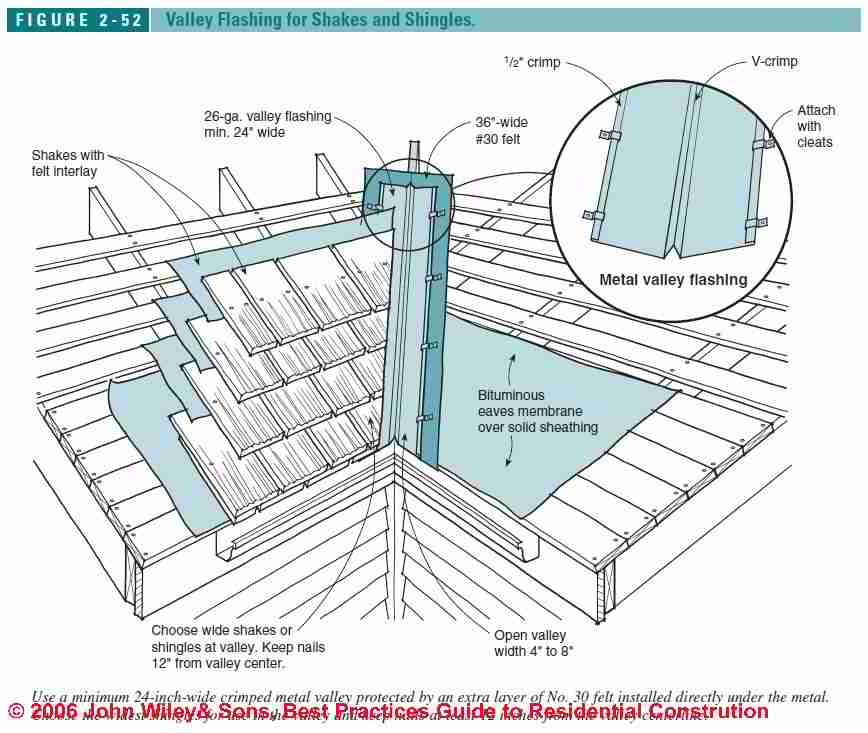 Adapted/paraphrased with permission from Best Practices Guide to Residential Construction (Steve Bliss, J Wiley & Sons) , chapter on BEST ROOFING PRACTICES [Click any image or table to enlarge and add detail.]
Roof flashings should be at least 26-gauge, corrosion resistant sheet metal, preferably painted galvanized steel or painted aluminum.
Copper Flashing and Cedar Roofing?
Copper is a popular flashing material with wood roofs, although some experts caution against using copper in direct contact with red cedar or its runoff, since the soluble tannins in cedar can etch copper and, in extreme cases, lead to perforation of the flashing within 10 to 20 years
(see also “FLASHING WALL DETAILS - Copper,” and “Metal Choices for Metal Roof Systems - Copper”).
Premature wood shingle roof failures have been documented in areas of the eastern United States that are subject to acid rain, leading the Cedar Shake and Shingle Bureau to advise against using copper flashing in areas east of the Great Lakes that are exposed to acid rain.
Another approach endorsed by the Copper Development Association is to design flashing joints with a cant or hem that holds the edge of the cedar shingle slightly away from the flashing. T
he gap prevents water from being wicked into the joint, bathing the copper in the acidic solution.
Valley Specifications for Wood Shingle/Shake Roofs
Wood roofs typically use open valley designs. While the International Residential Code (IRC) only requires the valley flashing to extend a minimum of 10 inches up each side of the valley for shingles and 11 inches for shakes, most contractors install 24- to 36-inch-wide valley flashing based on the area and pitch of the roof planes being drained.
The valley metal should be protected by an extra layer of 36-inch-wide No. 30 felt installed directly under the metal or a layer of self-adhesive bituminous membrane applied directly to the sheathing.
It is best to set aside the widest shingles or shakes for use in the valley to keep nails at least 12 inches from the valley centerline (Figure 2-52) shown above.
Below: wood shingle roof-wall flashing detail and example. Notice also the metal chimney cricket - an important flashing detail that diverts water up-roof from the chimney to the chimney sides.

Chimneys and Skylight Flashing Specifications for Wood Shingle/Shake Roofs
Chimneys on wood shingle or shake roofs are flashed conventionally,
using step flashing on the sides in accordance
with Table 2-16 below.
Use a soldered apron flashing below the chimney and a soldered head flashing at the top. Larger chimneys with significant water flow behind them should have a chimney cricket above.

- - Adapted with permission from Best Practices Guide to Residential Construction (Steve Bliss, J Wiley & Sons) .
Wood Shingle Roofing Materials & Equipment Suppliers
Where to Buy Ridge Vents suitable for wood shake or shingle roofs
- Air Vent/A Gibraltar Company www.airvent.com A complete line of roof ventilation products, including shingle-over and exposed-ridge vents with exterior wind baffles and internal weather filters. Also soffit and drip edge vents and passive and powered attic turbine-type vents.
- Benjamin Obdyke www.benjaminobdyke.com Shingle-over ridge vents. Low-profile Roll Vent uses nylonmatrix. Extractor vent is molded polypropylene with internal and external baffles.
- Cor-A-Vent www.cor-a-vent.com Shingle-over low-profile ridge vents, including Cor-a-vent, Fold-a-vent, and X-5 ridge vent, designed for extreme weather. Corrugated core.
- GAF Materials Corp. www.gaf.com Cobra vent: roll-out shingle-over ridge vent with a polyester-matrix core 102 CHAPTER 2 | Roofing
- Mid-America Building Products www.midamericabuilding.com Ridge Master and Hip Master shingle-over molded plastic ridge vents with internal baffles and foam filter
- Owens Corning www.owenscorning.com VentSure corrugated polypropylene ridge vents; also passive roof vents and soffit vents
- Trimline Building Products www.trimline-products.com Shingle-over low-profile ridge vents, Flow-Thru battens for tile roofs
- Elk Premium Building Products www.elkcorp.com Highpoint polypropylene shingle-over ridge vents
- Tamko Roofing Products www.tamko.com Shingle-over ridge matrix–type Roll Vent and Rapid Ridge (nail gun version) and Coolridge, which is molded polypropylene with external and internal baffles
Venting Wood Roof Underlayments
- Benjamin Obdyke www.benjaminobdyke.com Cedar Breather, a 3/8 -in.-thick matrix-type underlayment designed to provide ventilation and drainage space under wood roofing
More Information about Roofing Materials, Methods, Standards
- Cedar Shake and Shingle Bureau www.cedarbureau.org
#######
- - Adapted with permission from Best Practices Guide to Residential Construction (Steve Bliss, J Wiley & Sons) .
This article includes excerpts or adaptations from Best Practices Guide to Residential Construction (Steve Bliss, J Wiley & Sons) , by Steven Bliss, courtesy of Wiley & Sons....
Continue reading at WOOD ROOF INSTALLATION SPECS or select a topic from the closely-related articles below, or see the complete ARTICLE INDEX.
Or see these
Recommended Articles
- FLASHING on BUILDINGS - home
- WOOD SHAKE & SHINGLE ROOFING - home
Suggested citation for this web page
FLASHING WOOD ROOF DETAILS at InspectApedia.com - online encyclopedia of building & environmental inspection, testing, diagnosis, repair, & problem prevention advice.
Or see this
INDEX to RELATED ARTICLES: ARTICLE INDEX to BUILDING ROOFING
Or use the SEARCH BOX found below to Ask a Question or Search InspectApedia
Ask a Question or Search InspectApedia
Share this article:Search the InspectApedia website
Need to make a private comment? Email editor@inspectApedia.com. We welcome email with your website content critique, corrections, suggestions or questions. Email is monitored daily but our workload may prevent an immediate reply. For immediate results, we hope you'll first try asking your question using the search box just above.
Citations & Reviewers
In addition to any citations in the article above, a full list is available on request.
- Cedar Shake & Shingle Bureau, CSSB, U.S.: Sumas, WA 98295-1178, Tel: 604-820-7700, In Canada: Cedar Shake and Shingle Bureau #2 - 7101 Horne Street, Mission, BC V2V 7A2 Tel: (604) 820-7700, E-mail: info@cedarbureau.com , Web: http://www.cedarbureau.org/
- U.S. Forest Products Laboratory, US FPL, One Gifford Pinchot Drive, Madison, WI 53726, Tel: (608) 231-9200, Email: mailroom_forest_products_laboratory@fs.fed.us608-231-9200, website: http://www.fpl.fs.fed.us/
- Best Practices Guide to Residential Construction, by Steven Bliss. John Wiley & Sons, 2006. ISBN-10: 0471648361, ISBN-13: 978-0471648369, Hardcover: 320 pages, available from Amazon.com and also Wiley.com. See our book review of this publication.
- Building Pathology, Deterioration, Diagnostics, and Intervention, Samuel Y. Harris, P.E., AIA, Esq., ISBN 0-471-33172-4, John Wiley & Sons, 2001 [General building science-DF] ISBN-10: 0471331724 ISBN-13: 978-0471331728ss Catalog Card Nr. 81-50643.
- Historic Preservation Technology: A Primer, Robert A. Young, Wiley (March 21, 2008) ISBN-10: 0471788368 ISBN-13: 978-0471788362
- Wood Shingle Roofs, Care and Maintenance of wood shingle and shake roofs, (EC), Stanley S. Niemiec (out of print)
- In addition to citations & references found in this article, see the research citations given at the end of the related articles found at our suggested
CONTINUE READING or RECOMMENDED ARTICLES.
- Carson, Dunlop & Associates Ltd., 120 Carlton Street Suite 407, Toronto ON M5A 4K2. Tel: (416) 964-9415 1-800-268-7070 Email: info@carsondunlop.com. Alan Carson is a past president of ASHI, the American Society of Home Inspectors.
Thanks to Alan Carson and Bob Dunlop, for permission for InspectAPedia to use text excerpts from The HOME REFERENCE BOOK - the Encyclopedia of Homes and to use illustrations from The ILLUSTRATED HOME .
Carson Dunlop Associates provides extensive home inspection education and report writing material. In gratitude we provide links to tsome Carson Dunlop Associates products and services.
 |
HOME | ABOUT | ASK a QUESTION | CONTACT | CONTENT USE POLICY | DESCRIPTION | POLICIES | PRIVACY | |
| © 2026 - 1985 Publisher InspectApedia.com - Daniel Friedman | |||||||||