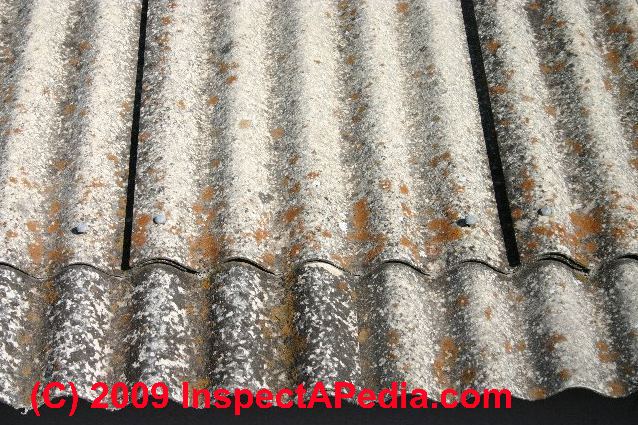
 Asbestos Building Materials

- POST a QUESTION or COMMENT about asbestos building material regulations, standards, & codes
Where is asbestos likely to be found in or on a building?
We provide a summary of the most-common asbestos containing building materials, including assumed asbestos containing building materials (roofing, flooring, insulation, drywall, etc), suspected asbestos containing materials, and assumed asbestos containing materials.
InspectAPedia tolerates no conflicts of interest. We have no relationship with advertisers, products, or services discussed at this website.
- Daniel Friedman, Publisher/Editor/Author - See WHO ARE WE?
Occurrence of Asbestos in Common Building Materials
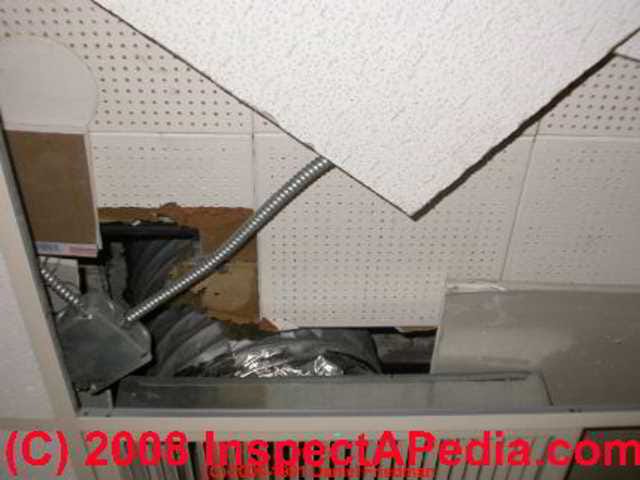 This article describes the most-common locations where asbestos may be found in building s.
Because asbestos was used in thousands of products including many that may appear on or in buildings, this article is not an exhaustive catalog of asbestos products.
For a complete guide to recognizing asbestos-containing materials in buildings see the individual asbestos-containing products described at ASBESTOS IDENTIFICATION IN BUILDINGS
Two other InspectApedia.com articles provide longer lists of asbestos-containing products used on or in buildings and in other products as well:
- ASBESTOS LIST of PRODUCTS - exaustive list of asbestos products
- ASBESTOS PHOTO GUIDE to MATERIALS
- ASBESTOS PRODUCTS BANNED vs PERMITTED U.S. 2023
Asbestos in Ceilings & Textured Paints / Coatings
Asbestos was widely used in some, not all, ceiling tiles. See ASBESTOS CEILING TILE IDENTIFICATION
Asbestos was widely used to provide body in some textured paints used on ceilings and walls. See CEILING PAINT TEXTURED / POPCORN ASBESTOS.
Asbestos in Drywall & Insulating Wall Sheathing
Asbestos was used in joint compound and (generally of less concern) in some gypsum board or drywall products.
Following are references to or examples of some common asbestos-containing building drywall materials discussed in that article series.
Asbestos in Joint Compound, Bondex example:
Bondex manufactured a joint compound that was commonly used on
construction sites during the installation of drywall. From 1961 to 1977, Bondex joint compound contained asbestos. - retrieved 15 June 2015 original source: www.courts.mo.gov/file.jsp?id=54841
[LOIS J. WAGNER, ROBIN G. )
WAGNER and WENDE L. WAGNER, )
Individually and as Wrongful Death )
Beneficiaries of ROBERT WAGNER, )
)
Appellant-Respondent, )
) WD72474 (Consolidated with
WD72482 v. ) and WD72619)
)
BONDEX INTERNATIONAL, INC., and ) Opinion filed: June 19, 2012
SIMPSON TIMBER COMPANY, )
)
Respondent-Appellant, )
)
CONWED CORPORATION, )
)
Defendant. )
Watch out: The Wood Conversion Company who produced Nu-Wood products later became Conwed Cororation. Court documents assert that some Conwed ceiling tiles contained asbestos. - (Wagner v. Bondex, Simpson, & Conwed, 2012)
See details about asbestos in Simpson Lumber Co. products at SIMPSON CEILING TILES
APPEAL FROM THE CIRCUIT COURT OF CLAY COUNTY, MISSOURI
The Honorable Kathryn E. Davis, Judge
Before Division Four: Lisa White Hardwick, Chief Judge, Presiding,
Joseph M. Ellis, Judge and Victor C. Howard, Judge]
Asbestos in Flooring Materials
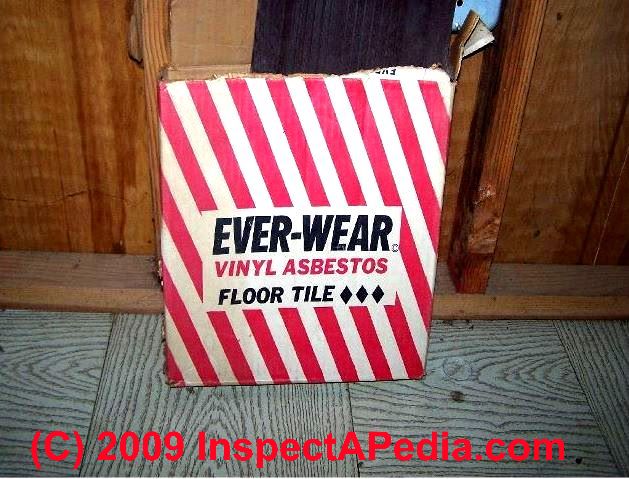
Although not defined strictly as "PACM", both OSHA standards also require asphalt and vinyl flooring material installed no later than 1980 be "considered" and "treated" as asbestos-containing, until the building owner proves the flooring is not ACM.
This includes not only the flooring material, but associated mastics and backings.
See ASBESTOS FLOORING IDENTIFICATION for details about vinyl-asbestos flooring including floor tiles and sheet flooring.
Also see SHEET FLOORING TYPE IDENTIFICATION
Asbestos in Heating Systems or in Portable or Wall Mounted Heaters
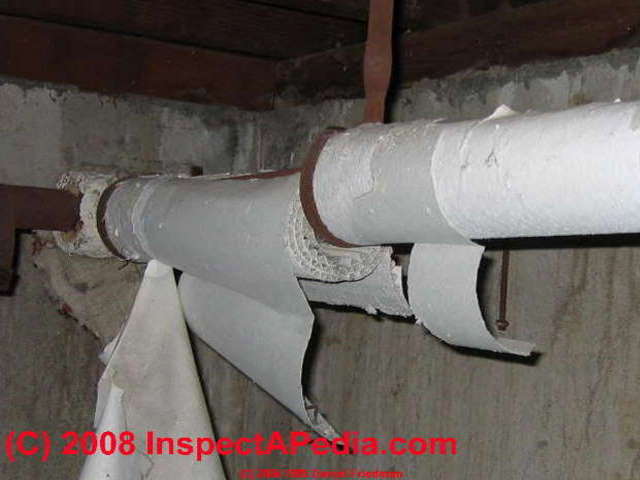
The use of corrugated asbestos paper and asbestos cement on heating and some water pipes and pipe elbows has been widely recognized. Because in poor condition this material is more friable than cementious or vinyl-based building products it has received plenty of attention.
Asbestos was widely used as an insulating material on heating boilers, pipes, and on some forced-air systems, including on the exterior and occasionally the interior of HVAC ducts and (rarely) in the air handler unit of the furnace itself.
See these key articles on heating system and plumbing system asbestos insulation products and locations:
- ASBESTOS in HEATERS - portable or wall-mounted electric or gas heaters
- ASBESTOS AIR DUCTS
- ASBESTOS DUCT VIBRATION DAMPENERS
- ASBESTOS PIPE INSULATION
- ASBESTOS PIPE INSULATION FAQs
- ASBESTOS REMOVAL, Amateur, Incomplete
- ASBESTOS STYROFOAM PANELS
- TRANSITE PIPE AIR DUCT ASBESTOS RISKS
- TRANSITE PIPE CHIMNEYS & FLUES
Asbestos in Insulation used in Buildings
Asbestos was not often used directly as a building insulation material, but a very widely-used loose-fill or pour-in form of vermiculite building insulation from the Libby mine contains significant levels of asbestos.
See VERMICULITE INSULATION asbestos content.
Asbestos was also found, perhaps by cross contamination, occasionally in fiberboard sheathing products but those are generally a wood or cellulose product, not an asbestos product.
See SHEATHING, FIBERBOARD ASBESTOS CONTENT
Asbestos in Plumbing Systems
Asbestos was used in water mains in some cities.
See TRANSITE WATER & SEWER PIPE ASBESTOS RISK
Asbestos in Roofing Materials

The risk of high levels of airborne asbestos from cementious roofing products is probably very low unless the workers are using power equipment like sanders and saws on these substances.
According to NRCA, the National Roofing Contractors' Association, their studies up to February 1992 had not found a single roofing job at which these limits were exceeded, and NRCA reported that in some cases no fiber release was detected.
But it appears that the association may have been referring only to asphalt-based roofing materials, not jobs involving the demolition of other ACRM such as cement-asbestos roof shingles (or "asbestos roof tiles" as some consumers refer to them) which might produce different statistics.
Asbestos in Siding Materials
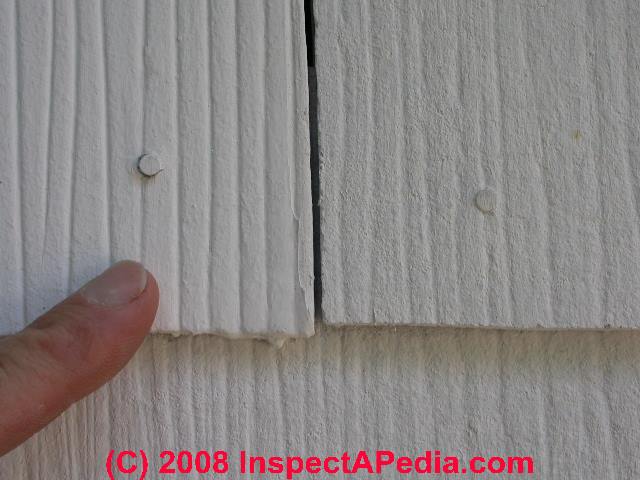
The most common siding material containing asbestos fibers was cement-asbestos shingle siding popular from about 1940 to 1970.
It is possible that other siding materials such as asphalt building siding may contain asbestos fibers as well, particularly if that material was produced during the same years that asbestos fibers appear in asphalt roof shingles.
...
Reader Comments, Questions & Answers About The Article Above
Below you will find questions and answers previously posted on this page at its page bottom reader comment box.
Reader Q&A - also see RECOMMENDED ARTICLES & FAQs
Was asbestos likely to have been used in the concrete entry pad at our front door?
Hey! I have a 1964 home that was built in the downtown area of a small city. The home has a concrete pad at the front door and we were wanting to replace this pad and by doing so, some of the existing 1964 work will need to be Jack hammered. Would there potentially be asbestos in the concrete slab from 1964? Thanks! On 2020-06-27 by Steve
Explanation by (mod) - no
It's possible, but not likely in that for a simple entrance like that, the Mason would have not have had a reason to use an asbestos fiber or additive in the concrete.
Asbestos would have been used in cement or concrete where extra heat resistance was needed. But keep in mind that over a century of use and millions of people making things we can't know for certain what a given individual might have done, so I'm always trying to balance being reasonable in assessing risk with being careful not to say that something was "impossible".
by Steve
If you don’t mind, what would’ve led a mason to use such materials and fibers?
Answer by (mod) -
Steve
At ASBESTOS LIST of PRODUCTS Please use your browser's search tool (usually CTRL-F) hat page for "concrete" to see the various applications of asbestos in cement or concrete.There you'll see that along with a list of research documentation and examples we say
Asbestos in Concrete - asbestos was used in a variety of concrete products as fibre reinforcement, as a filler, and in certain soft concrete products and in insulating cement. .
...
Continue reading at ASBESTOS LIST of PRODUCTS or select a topic from the closely-related articles below, or see the complete ARTICLE INDEX.
Or see these
Recommended Articles
- ASBESTOS DISPOSAL REGULATIONS
- ASBESTOS MATERIAL REGULATIONS
- HISTORY & DATES OF ASBESTOS CONTAINING MATERIAL BANS & REGULATIONS
- COUNTRIES THAT BAN OR REGULATE THE USE OR PRODUCTION OF ASBESTOS
- DEFINITION OF & HANDLING RULES FOR SUSPECT ASBESTOS CONTAINING MATERIALS (SACM)
- DEFINITION OF & HANDLING RULES FOR PRESUMED ASBESTOS CONTAINING MATERIAL (PACM)
- ASBESTOS EXPOSURE LIMITS (PELS) TLVs RBCs & RELs
- MOST COMMON OCCURRENCES OF ASBESTOS IN BUILDING
- WORKER NOTIFICATION of PRESENCE of ASBESTOS or ASBESTOS REMEDIATION
- HISTORY & DATES OF ASBESTOS CONTAINING MATERIAL BANS & REGULATIONS
- ASBESTOS REMOVAL, WETTING GUIDELINES
- ASBESTOS ROOF MATERIALS
- CANADA ASBESTOS REGULATIONS
- CANADA ASBESTOS REGULATIONS, ONTARIO [PDF]
- EPA ASBESTOS MATERIAL BANS -1989 [PDF]
- EPA ASBESTOS MATERIAL REGULATIONS - 1999 Update
- EPA ASBESTOS MATERIALS BANS CLARIFICATION - 2003 [PDF]
- OSHA ASBESTOS ROOF/SIDING REGULATIONS
- TEST KIT for DUST, MOLD, PARTICLES: INSTRUCTIONS - Easy inexpensive dust sampling procedure for any type of dust particles
- U.K. ASBESTOS REGULATIONS
Suggested citation for this web page
MOST COMMON OCCURRENCES OF ASBESTOS IN BUILDINGS at InspectApedia.com - online encyclopedia of building & environmental inspection, testing, diagnosis, repair, & problem prevention advice.
Or see this
INDEX to RELATED ARTICLES: ARTICLE INDEX to ASBESTOS HAZARDS
Or use the SEARCH BOX found below to Ask a Question or Search InspectApedia
Ask a Question or Search InspectApedia
Share this article:Search the InspectApedia website
Need to make a private comment? Email editor@inspectApedia.com. We welcome email with your website content critique, corrections, suggestions or questions. Email is monitored daily but our workload may prevent an immediate reply. For immediate results, we hope you'll first try asking your question using the search box just above.
Citations & References
In addition to any citations in the article above, a full list is available on request.
- Asbestos Laws and Regulations, U.S. EPA
Laws and Regulations
[37] TSCA (15 U.S.C. § 2601 et seq.)
Title 1 - Control of Toxic Substances - § 2605. Regulation of hazardous chemical substances and mixtures, web search 01/2/2011, original source: http://www.gpo.gov/fdsys/pkg/USCODE-
2009-title15/html/USCODE-2009-title15-chap53-subchapI-sec2605.htm
[38] Title 2 - Asbestos Hazard Emergency Response, web search 01/2/2011, original source: http://www.gpo.gov/fdsys/pkg/USCODE-2009-title15
/html/USCODE-2009-title15-chap53-subchapII.htm
[39] Code of Federal Regulations and Federal Register Notices
Code of Federal Regulations
[40] 40 CFR Part 763 - Asbestos (PDF) (96 pp, 588K, about PDF), web search 01/2/2011, original source: http://www.epa.gov/asbestos/pubs/2003pt763.pdf
Subpart E - Asbestos-Containing Materials in Schools
Subpart G - Asbestos Worker Protection
Subpart I - Prohibition of the Manufacture, Importation, Processing and Distribution in Commerce of Certain Asbestos-Containing Products; Labeling Requirements
[41] 40 CFR Part 61, Subpart M - National Emission Standards for Asbestos (PDF) (51 pp, 353K, about PDF) web search 01/2/2011, original source: http://www.epa.gov/asbestos/pubs/40cfr61subpartm.pdf
[42] Federal Register
Federal Register Notices - The Government Printing Office maintains a searchable database of all Federal Register (FR) Notices.
[43] The U.S. EPA also maintains a searchable listing of Federal Register Notices published by EPA. - [44] Asbestos products and their history and use in various building materials such as asphalt and vinyl flooring includes discussion which draws on Asbestos, Its Industrial Applications, D.V. Rosato, engineering consultant, Newton, MA, Reinhold Publishing, 1959 Library of Congress Catalog Card No.: 59-12535 (out of print).
- [55] "Occupational Exposure to Asbestos, Tremolite, Anthophyllite and Actinolite, Section 3 - III. Regulatory History, OSHA, retrieved 1/26/2013, original source: http://www.osha.gov/pls/oshaweb/o wadisp.show_ document? p_table=PREAMBLES&p_id=784, copy on file as OSHA_Regs_HistorySection_3-III.pdf
- [56] "Reflections on OSHA's History", U.S. Department of Labor Occupational Safety and Health Administration January 2009 OSHA 3360, retrieved 1/26/2013, original source http://www.osha.gov/history/OSHA_HISTORY_3360s.pdf copy on file as OSHA_HISTORY_3360s.pdf
- [57] Kazan-Allen. L. United Kingdom Bans Chrysotile. British Asbestos Newsletter, Issue 36: Autumn 1999.
- In addition to citations & references found in this article, see the research citations given at the end of the related articles found at our suggested
CONTINUE READING or RECOMMENDED ARTICLES.
- Carson, Dunlop & Associates Ltd., 120 Carlton Street Suite 407, Toronto ON M5A 4K2. Tel: (416) 964-9415 1-800-268-7070 Email: info@carsondunlop.com. Alan Carson is a past president of ASHI, the American Society of Home Inspectors.
Thanks to Alan Carson and Bob Dunlop, for permission for InspectAPedia to use text excerpts from The HOME REFERENCE BOOK - the Encyclopedia of Homes and to use illustrations from The ILLUSTRATED HOME .
Carson Dunlop Associates provides extensive home inspection education and report writing material. In gratitude we provide links to tsome Carson Dunlop Associates products and services.
 |
HOME | ABOUT | ASK a QUESTION | CONTACT | CONTENT USE POLICY | DESCRIPTION | POLICIES | PRIVACY | |
| © 2026 - 1985 Publisher InspectApedia.com - Daniel Friedman | |||||||||