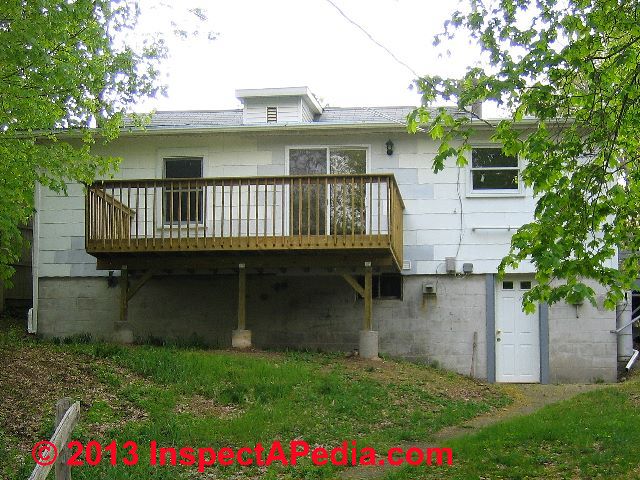
 Design Suggestions for a Simple Deck

- POST a QUESTION or COMMENT about deck construction
Starting point for building a simple deck & basic deck building supplies & tools.
Here we begin designing and building a simple deck by describing the essential deck design decisions to be made, followed by tips for selecting lumber at the lumber yard, along with a list of the tools and materials you will need.
We include links to more-advanced and detailed deck & porch building procedures.
Page top photo: a simple deck built by the author, using concrete piers and posts (outer girder) and ledger board (attachment to house). to comply with zoning we had to make this deck smaller than the width of the house.
This article series describes construction details for decks and porches.
InspectAPedia tolerates no conflicts of interest. We have no relationship with advertisers, products, or services discussed at this website.
- Daniel Friedman, Publisher/Editor/Author - See WHO ARE WE?
Simple Deck Design Starts Here

Design Considerations: Alongside a house, a door onto the deck is a must. If possible, build at an existing door, removing any steps that might hinder construction.
Determine the size and spacing of structural elements for your deck.
Decking is ordinarily laid over joists spaced 16 inches apart, but diagonal decking calls for 12-inch joist spacing.
A railing—mandatory on all decks over 2 feet high and recommended on lower decks—requires the addition of special bridging to keep the posts from twisting the joists they are attached to.
Sketch a plan of your deck that shows all the dimensions. You may need to submit the plan and apply for a building permit; if not, it’s wise nonetheless to confirm with local authorities that the design complies with building codes.
At the Lumberyard
Examine each board individually for defects that can make trouble for you when assembling the deck. Henry Page (Page Lumber, Rte. 55 Poughkeepsie) used to shout at me whenever he'd catch me sorting my lumber before loading it on my truck.
"Ya aint' building furniture!" he'd yell. "Just put it on the truck!".
Still, for a top quality job that goes well, I prefer to avooid curved or twisted planks; they are hard to work with, and the defects can worsen over time, weakening the deck.
And while you may prefer redwood or cedar for the decking, choose posts of pressure- treated southern pine rated for ground contact.
Shopping tip: it may sound obvious but don't rush out and buy framing lumber or decking before you have made a deck drawing, know your plan, and thus know what widths and lengths of lumber are actually needed. It's nice to avoid unnecessary repeat trips to the lumber yard because you find you need to exchange a 10' 2x10 for a 12' 2x12.
Special Materials for Deck Construction
Galvanized joist hangers and a variety of other framing connectors greatly simplify deck construction.
Galvanized joist hangers and other structural connectors such as used to tie the deck girder or beam to the post tops are widely available—as are nails of appropriate diameter and length.
Do not substitute common nails, which will make joints that lack the necessary strength.
Other fasteners should also be galvanized to prevent rust. Redwood decking, however, requires acid-resistant aluminum nails.
Equipment for the Deck Building Job
Besides common carpentry tools, you will need a posthole digger and a water level for a day; consider renting them. Your circular saw must be powerful enough to cut heavy, wet pressure-treated wood. Use a carbide-tipped crosscut blade, and back off if the motor slows.
Before excavating, establish the locations caution of underground obstacles such as electric, water, and sewer lines, and dry wells, septic tanks, and cesspools.
Basic Materials Needed to Build a Deck
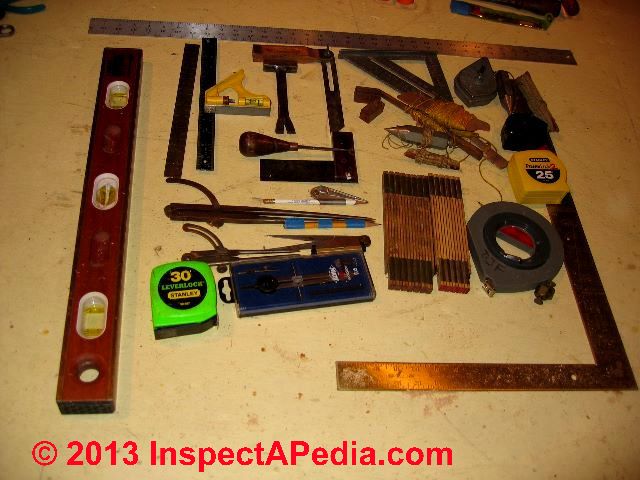
Tools for deck building
- Measuring tape (25-foot,)
- Plumb bob and string
- Posthole digger,
- Carpenter's level (4' is better than 2': longer = more accurate)
- Mortar tub,
- Hoe,
- Trowel,
- Water level (I've had bad luck getting mine to work and often use a long straight piece of lumber combined with a 4' level)
- Circular saw,
- Framing square
- See DECK BUILDING & CARPENTRY TOOLS for details about carpentry tool choices, types, uses.
Materials for deck building
- Mason's cord for use with the plumb bob and to lay out your deck location from the batter boards (more on those later)
- Concrete mix (how much depends on the number and height of deck post piers required)
- 4-by-4 posts (we like 6x6 posts for appearance & added security)
- 2-by-6 or larger framing lumber
- 2-by-4 or 2-by-6 decking, usually 5/4 treated wood; also
see DECKING COMPOSITE PRODUCTS - 2-by-4, rails ? (we use 2x6's for topping deck guardrails; for graspable handrailings don't use 2x lumber unless you intend to use a router to cut grasping grooves
See GRASPABILITY of HANDRAILINGS - 2-by-2 pickets / balusters and 1x lumber (we use 1x6 or 1x4") for batter boards to aid in deck layout
- Galvanized common nails of several sizes for framing connections, 6d, 10d, 12d possibly 16d; exterior-use galvanized, coated, or stainless-steel structural screws if you intend to screw deck flooring to joists
See FRAMING FASTENERS, NAILS, SCREWS - Carriage bolts (1/4 or 3/8 - by 6-inch or longer to through-bolt your built up deck beam and to bolt your ledger board to the house rim joist)
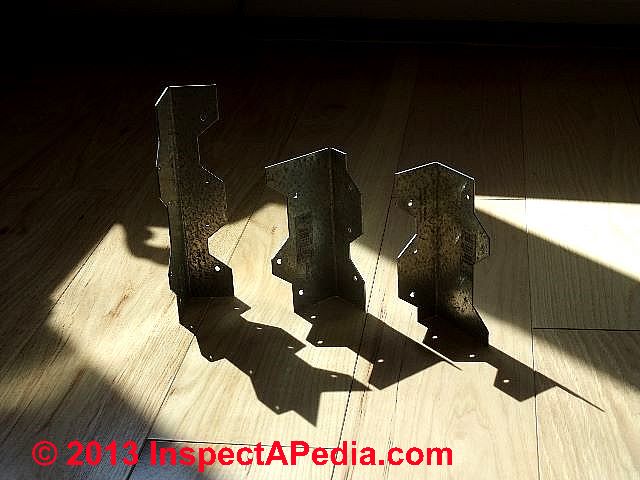
- Framing connectors (photo above left is an example; you'll want joist hangers and connectors to connect posts to girders).
Use the proper size galvanized nails intended for use with framing connectors
See FRAMING CONNECTORS & JOIST HANGERS
Safety Tips for deck building
- Protect your eyes when hammering nails or using a circular saw.
- Wear a dust mask when cutting pressure-treated lumber, and wash hands thoroughly after handling it.
- When using a power saw, watch where your fingers are!
- Watch out: when working on a high deck or porch, during construction before guardrails are in place: it's way too easy to take a step backwards and fall off.
...
Continue reading at DECK PLAN & SKETCH or select a topic from the closely-related articles below, or see the complete ARTICLE INDEX.
Or see these
Recommended Articles
Suggested citation for this web page
DECK DESIGN, SIMPLE BASIC at InspectApedia.com - online encyclopedia of building & environmental inspection, testing, diagnosis, repair, & problem prevention advice.
Or see this
INDEX to RELATED ARTICLES: ARTICLE INDEX to BUILDING DECKS & PORCHES
Or use the SEARCH BOX found below to Ask a Question or Search InspectApedia
Or see
INDEX to RELATED ARTICLES: ARTICLE INDEX to BUILDING STRUCTURES
Or use the SEARCH BOX found below to Ask a Question or Search InspectApedia
Ask a Question or Search InspectApedia
Share this article:Search the InspectApedia website
Need to make a private comment? Email editor@inspectApedia.com. We welcome email with your website content critique, corrections, suggestions or questions. Email is monitored daily but our workload may prevent an immediate reply. For immediate results, we hope you'll first try asking your question using the search box just above.
Citations & Reviewers
In addition to any citations in the article above, a full list is available on request.
- [1] Steve Bliss's Building Advisor at buildingadvisor.com helps homeowners & contractors plan & complete successful building & remodeling projects: buying land, site work, building design, cost estimating, materials & components, & project management through complete construction. Email: info@buildingadvisor.com
Steven Bliss served as editorial director and co-publisher of The Journal of Light Construction for 16 years and previously as building technology editor for Progressive Builder and Solar Age magazines. He worked in the building trades as a carpenter and design/build contractor for more than ten years and holds a masters degree from the Harvard Graduate School of Education. Excerpts from his recent book, Best Practices Guide to Residential Construction, Wiley (November 18, 2005) ISBN-10: 0471648361, ISBN-13: 978-0471648369, appear throughout this website, with permission and courtesy of Wiley & Sons. Best Practices Guide is available from the publisher, J. Wiley & Sons, and also at Amazon.com - [2] Decks and Porches, the JLC Guide to, Best Practices for Outdoor Spaces, Steve Bliss (Editor), The Journal of Light Construction, Williston VT, 2010 ISBN 10: 1-928580-42-4, ISBN 13: 978-1-928580-42-3, available from Amazon.com
- [3] Prescriptive Residential Wood Deck Construction Guide, based on the 2009 International Residential Code, American Forest & Paper Association, Inc., provided by reader Mark Morsching from Everflashing.
- [4] Mark Morsching, Everflashing, Tel: 800-550-1667, Email: everflashing@gmail.com. The Everflashing product comes in G-185 and Stainless Steel and is intended for use with treated lumber with copper in it. Everflashing produces a variety of specialty flashing products including flashings for use with decks at deck ledgers and deck perimeters.
- [2] Manual for the Inspection of Residential Wood Decks and Balconies, by Cheryl Anderson, Frank Woeste (Forest Products Society), & Joseph Loferski, October 2003, ISBN-13: 978-1892529343,
- In addition to citations & references found in this article, see the research citations given at the end of the related articles found at our suggested
CONTINUE READING or RECOMMENDED ARTICLES.
- Carson, Dunlop & Associates Ltd., 120 Carlton Street Suite 407, Toronto ON M5A 4K2. Tel: (416) 964-9415 1-800-268-7070 Email: info@carsondunlop.com. Alan Carson is a past president of ASHI, the American Society of Home Inspectors.
Thanks to Alan Carson and Bob Dunlop, for permission for InspectAPedia to use text excerpts from The HOME REFERENCE BOOK - the Encyclopedia of Homes and to use illustrations from The ILLUSTRATED HOME .
Carson Dunlop Associates provides extensive home inspection education and report writing material. In gratitude we provide links to tsome Carson Dunlop Associates products and services.
 |
HOME | ABOUT | ASK a QUESTION | CONTACT | CONTENT USE POLICY | DESCRIPTION | POLICIES | PRIVACY | |
| © 2026 - 1985 Publisher InspectApedia.com - Daniel Friedman | |||||||||