
InspectAPedia® FREE Encyclopedia of Building & Environmental Construction, Diagnosis, Maintenance & Repair |
Question? Just ask us! InspectAPedia
|
 Flooded Building Foundation Damage Assessment Procedures
- POST a QUESTION or COMMENT about how to assess building foundation damage from flooding
Foundation flood damage assessment:
This article presents a case study by Bob Maltempo, P.E. with comments by Daniel Friedman.
The case demonstrates the inspection, detection, diagnosis, and repair repair recommendations regarding structural damage (or none) to a building foundation wall and floor slab following flooding.
InspectAPedia tolerates no conflicts of interest. We have no relationship with advertisers, products, or services discussed at this website.
How to Identify Flood Damage to a Building Foundation
Visual inspection combined with familiarity with the patterns of cracks and movement in building foundations and their common causes permits a distinction between pre-flood foundation damage, post flood foundation damage, old and new foundation cracks, structural and non-structural cracks.
Our photograph at page top shows a collapsing masonry block foundation.
This type of foundation damage could be caused by floodwaters and earth pressure outside of the foundation wall, especially if the absence of flood vents kept water out of the basement area during the initial period of flooding.
However this same damage can occur due to earth pressure, surface and ground water outside the foundation, and vehicle damage, even in a building which has not been flooded.
Here we provide photos and discuss evidence that can help determine the age and cause of foundation damage.
This case can help a foundation engineer or foundation inspector rule in, out, or leave as possible, a claim for flood damage at a building.
This diagnosis is important not only for purpose of de terming the extent of insurance coverage at a property but also because without an accurate diagnosis of cause, a foundation repair may be unsuccessful, or the damage may simply recur.
Thephoto (below) by by Bob Maltempo,P.E. shows a hairline vertical crack in the exterior of a stuccoed (or parged) concrete block garage wall.
Memorium: Bob Maltempo, P.E. was a licensed professional engineer who performed building inspections and flood damage inspections in Hauppage, New York. We regret to inform readers that Mr. Maltempo passed away on 8 September 2008. Mr. Maltempo was with Cashin Associates in Hauppage Long Island in New York.
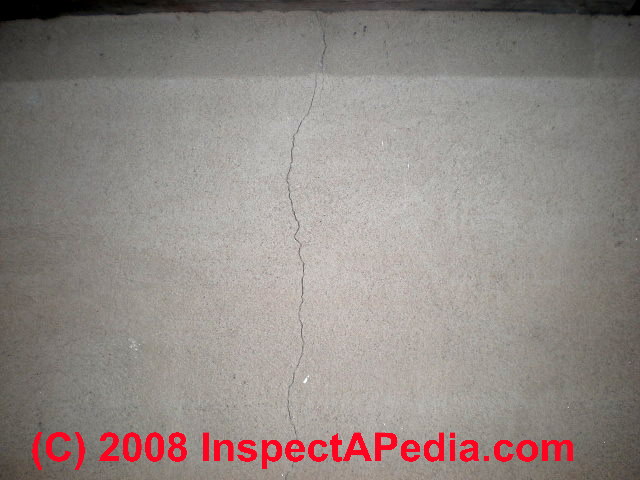 The question was asked: was this crack caused by area flooding, and was repair to the building needed to remedy this condition?
Below we give a detailed list of questions to ask and inspections to make in assessing whether or not a building foundation damage or crack was caused by flooding
A catalog of types of damage that occur in masonry block foundation walls is
at BLOCK FOUNDATION & WALL DEFECTS.
In sum, the building inspector seeing this structure after flooding has occurred needs to:
- Determine if the building was exposed to flood waters, and if so, determine the level of flood water that was encountered.
- Compare flood water levels to the depth of the foundation below grade.
- Look for evidence of damage to the building:
Examine the size, shape, pattern, age, and location of foundation cracks or other evidence of movement (such as tipping or leaning), and relate that evidence to the location of water and earth pressure on the building.
Also relate that evidence to the history of foundation damage, movement, and water entry in the building. - Identify both non-structural cracks or damage (such as a crack in a basement floor slab poured inside of a perimeter foundation)
as well as cracks that involve the structure. - Watch out: Decide if the building is unsafe.
If the inspector is not trained to make this assessment, a foundation engineer of an experienced foundation repair contractor should be consulted if there is evidence of foundation damage or movement that in the inspector's judgment affects the structure and its stability or safety.
Certain types of masonry wall or foundation damage such as broken bond courses in a structural brick wall, can make a building very unsafe and could justify evacuation an immediate temporary support.
See details at BRICK FOUNDATION & WALL DEFECTS. - Decide if the building needs repair, and understand the cause of the damage sufficiently to suggest an effective repair if repair work is necessary.
Fine Vertical Cracks in a Masonry Block Foundation Wall - Caused by Flooding?
Complaint/observation:
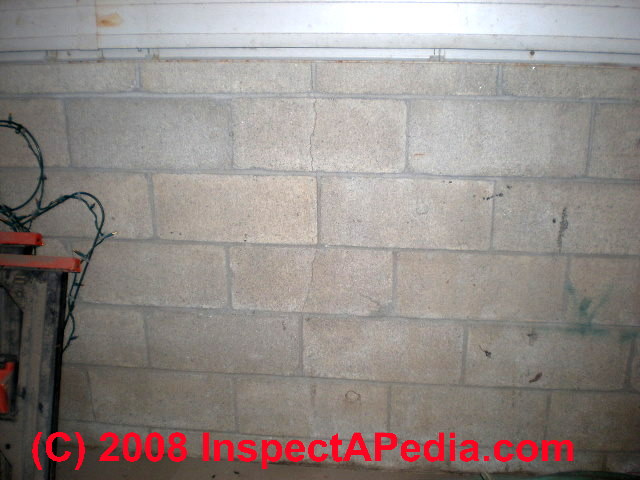
hairline vertical crack in a masonry block garage wall. This photo shows the interior surface of the garage wall in the picture we provided above.
The building owner did not know if these cracks were present before the building had been subjected to flooding, but he posed that the damage was due to flooding and had pressed an insurance claim.
The foundation inspector has multiple obligations: she or he has a general obligation to protect the safety of a building's occupants by being able to recognize if the structure is unsafe and needs repair (if that is within the scope of the inspector's expertise).
The inspector needs to accurately diagnose the cause of the damage, not only for insurance claim purposes, but also because without an understanding of the cause, the need for repair, and the proper repair may not be specified.
Key diagnostic observations:
In this foundation wall there was no bulging, bowing, or leaning observed in the wall. Other walls in the same building were not damaged.
This masonry block foundation crack photo was provided by Bob Maltempo, an engineer who inspected foundations for damage.
Maltempo observed vertical hairline cracks in the masonry block foundation, at regular intervals of this building which was constructed in the 1950's on Long Island in New York
Fine vertical or near-vertical cracks in a masonry block foundation may be caused by shrinkage in the concrete blocks - a condition that occurs shortly after construction. Shrinkage cracks in masonry tend to be uniform in width, top to bottom, but might be more narrow at the crack bottom where the masonry blocks are pinned to a (presumably not shrinking) footing.
Fine vertical or near-vertical cracks in a concrete block wall may also be caused by footing settlement. If that cause is present, careful measurement should find that the wall is not at exactly the same height on both sides of the vertical crack.
Floodwaters around a building, if they press principally on only the wall exterior, can cause a wall to buckle, bend, or lean inwards. These pressures often cause horizontal cracking in a masonry block wall; vertical cracks would be unusual. That pattern of movement was absent from this home.
How would a flood cause a vertical crack in a masonry block foundation wall? Floodwaters or even wet soils around a building might cause footing settlement, particularly in a newer building whose footings may have been placed on poorly-compacted soil. That pattern of movement was also absent from the home.
Since floodwaters would be expected to surround a home built on a relatively flat lot, one would also seek to determine why only one wall of the building was affected. There could be explanations for that asymmetry.
Our opinion was that the cracks in this masonry block wall were chiropractors of masonry block shrinkage, that they were most likely caused by that effect and not caused by flooding.
Cracks in a Garage Floor Slab - Caused by Flooding?
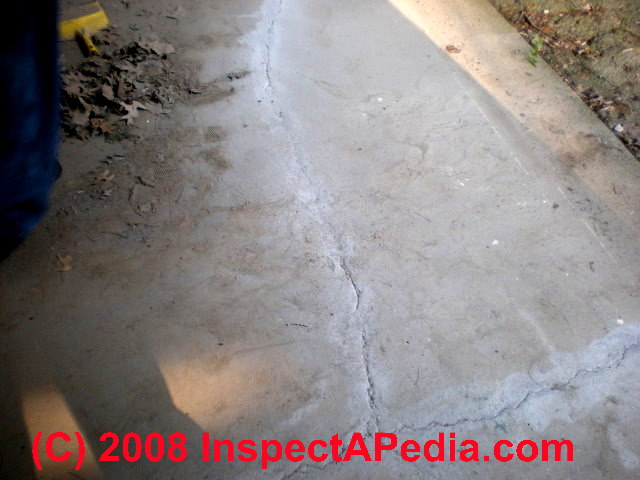
Complaint/Observation:
cracks in a garage floor slab near the entry.
Diagnostic comments:
In this photograph of a cracked garage floor provided by Bob Maltempo, we both concluded that we were not faced with a structural concern. A concrete floor slab poured inside of a perimeter foundation is not normally a structural component in the building.
Significant in evaluation of these floor cracks was their pattern and location.
A close examination of the crack pattern might show a combination of concrete shrinkage cracks combined with subsequent settlement or frost heave damage.
It was significant that the cracks were concentrated at the entry to the home's garage. In New York, a climate that experiences freezing soil conditions in winter, it is common to see cracked garage floors near the garage entry.
That's because of the combination of wet soils, frost heave, and the fact that the coldest part of the slab will be at the garage entry doors.
See FROST HEAVE / EXPANSIVE SOIL CRACKS in SLABS and
alsoSETTLEMENT vs. FROST HEAVE CRACKS
Our opinion was that because of their location, the absence of settlement that might occur following flooding, the pattern which included shrinkage crack patterns, these cracks were due to shrinkage and frost heaves, not to area flooding.
The floor slab could be involved with the building structure if it were poured as a monolithic slab with an integral footing, and cracks in a such a slab would need to be followed to determine if they involved the building footings as well.
Effect of wire brushing cracks on crack diagnosis:
These cracks were interesting because they had been wire brushed by the building owner's son. We're not sure why this step was taken, perhaps it was in anticipation of applying a masonry patch compound. (Wire brushing would be an ineffective preparation step.)
Wire brushing the floor slab cracks over-rode any pre-existing age-wear on the crack edges, it removed upper level dirt, debris, and it removed floor surface discoloration that might have assisted in evaluating the age of these floor cracks.
But the discovery of portions of these cracks that had not been wire brushed, and a close inspection under magnification could still provide diagnostic evidence. It's unlikely that the wire brush process reached to the very bottom of the floor cracks.
Wire brushing of an existing crack would also make it difficult to observe the wear and smoothing of the upper edges of the crack that are caused by years of foot traffic, vehicle traffic, dragging objects over the floor, and similar forces.
Flood Damaged Foundation Analysis Suggestions
Damage and Risk Assessment of Wall & Floor Cracks:
The first priority question is whether or not there is evidence that the cracks observed represent damage to the building that needs repair - that is, are the cracks cosmetic or are they more important.
In the case above there was no evidence of structural movement in the foundation wall and the cracks about 1/16" wide, vertical - a low-threat to foundation walls.
The garage floor was not a structural element (it is not carrying the structural loads); a cracked concrete floor slab might however be considered a trip hazard if cracks are higher on one side than the other by 1/8" or more, and in some areas floor slab cracks can increase the risk of radon gas entry or water entry.
How is the foundation wall constructed?
In the case we describe, as in most older homes, the concrete wall is constructed without internal reinforcement, placed on a poured concrete footing (not visible, but assumed).
Questions about Possible Flooding as a Foundation Damage Cause or Contributor
- What is the crack inventory:
just where on the structure do cracks appear - make a complete list. - What is the location, extent, pattern, and implication
of any building foundation or slab dislocation (or related components such as framing) associated with the cracks under investigation? - What is the evidence of a history of foundation movement and prior repairs to the foundation.
See FOUNDATION MOVEMENT ACTIVE vs. STATIC - What is the extent of vertical dislocation -
"up" or "down" movement?
See VERTICAL MOVEMENT IN FOUNDATIONS
and VERTICAL FOUNDATION CRACKS
and DIAGONAL CRACKS in BLOCK FOUNDATIONS, WALLS - What is the extent of horizontal movement or dislocation -
leaning, tipping, buckling, bowing in the wall?
See HORIZONTAL MOVEMENT IN FOUNDATIONS
and FOUNDATION BULGE or LEAN MEASUREMENTS and also
see HORIZONTAL FOUNDATION CRACKS - How far below grade
is the bottom of the foundation wall - that is, how high on the foundation wall does soil appear outside? - How high did flood waters reach
on the building? If flood waters were high on the building exterior and filled the building, and if receding flood waters left the building with no water inside its basement or crawl areas below grade (this would be unusual), the wet earth pressure remaining outside might damage the foundation wall. - Were flood vents installed
or were there other openings that admitted flood waters to the inside of the foundation wall? - Is the damaged foundation wall in a heated space
or an un-heated space. The presence or absence of heat can help establish the probability of uneven frost damage to a foundation.
See SETTLEMENT vs. FROST HEAVE CRACKS
Comments About Building Foundation Cracking & Building Flooding
Vertical cracks in a masonry block wall are usually from initial shrinkage, and they usually occur near the center of the wall, are fairly uniform in width, and may taper to a more narrow width or no crack at all close to the foundation footing where the footing, particularly if pinned to the wall bottom, holds the bottom of the wall in place.
Vertical cracks in a concrete block wall are usually a low-threat to the structure (if at all) unless the cracks can be tracked to ongoing and/or significant footing settlement, foundation leaning or tipping.
Vertical cracks in the center of a concrete block wall due to earth pressure or flood water pressure would be unusual. Usually this pressure finds it easier to break the concrete block courses at the mortar joints, producing horizontal cracking;
If there is significant wall buckling (see page top photo) step cracks may also appear in the block wall. In a severely bowed concrete block wall the classic pattern is wide horizontal cracks in mortar joints the middle or lower wall leading to step cracks in the mortar joints closer to the wall corners.
Questions About Concrete Slab Floor Cracks and Flood Damage
What is the crack pattern in the slab (breaking vs. shrinkage, for example) and where in the slab do cracks occur (at corners, near a garage entry door, around Lally columns?)
- What is the crack inventory:
just where on the structure do cracks appear - make a complete list of the cracks by location, size, pattern.
See CONCRETE SLAB CRACK EVALUATION and
see SETTLEMENT vs. SHRINKAGE CRACKS - Vertical dislocation:
What is the extent of vertical dislocation on either side of the floor slab crack? More than 1/8" may be a tripping hazard that should be repaired. - Horizontal dislocation:
how wide are the floor cracks; can wide floor cracks be traced to vertical dislocation, heaving, settlement, or more seriously, to movement of the building's perimeter foundation? Is the foundation wall bulged or leaning - if so the significance of the slab cracks pales by comparison but it could be related. - Voids:
By tapping or dragging a heavy chain can we identify voids below the floor slab?
See SINKHOLES & SUBSIDENCES - Amount of fill:
Does the site shape or history suggest that a lot of fill (un compacted?) was used inside of the foundation perimeter before the slab was poured? - Evidence of slab settlement or heave:
Is there evidence of slab settlement on compacted fill? Was the slab pinned to the foundation walls or does it rest on the edge of footings?
Comments about New & Old Cracks in Floor Slabs & Wire Brushed Cracks
- Wire brushing an old floor slab crack
would probably not be capable of smoothing the vertical sides of the crack interior.
So the remaining undisturbed surfaces may be observed for evidence of aging: soiling, discoloration, types of debris other than that left by flooding. - A "new" crack in a poured concrete slab
should show clean new surfaces on the inner side surfaces of the crack interior and should look clean compared to older cracks. - Accumulated debris in floor cracks
may be diagnostic, though it may be removed to some degree by power washing. - Cracks in a garage floor slab closest to the garage doors
are often caused by frost damage, not flooding.
This location is most distant from building heat. Sometimes cracks in the garage floor near the entry will run parallel to a footing which has been poured across the entryway and which extends below the frost line. - Cracks in a floor slab which are discontinuous
along their length and meander, are characteristic of concrete shrinkage that occurs most significantly after the pour as the concrete cures.
The amount of shrinkage in a concrete slab depends on the mix; the location of shrinkage cracks in a slab is affected by the presence or absence of control joints and stress points. - Cracks can occur in a slab due to very high point loading
such as bearing of a Lally column on a floor where a pier was needed. The crack pattern that occurs in these locations includes chipping and crushing along with fractures.
A settling pier below a concrete slab may produce cracks radiating out from the vertical load-bearing column or in a circular pattern around the column base or around the perimeter of its pier below the slab. - Cracks in a concrete floor slab which run towards a foundation wall
but do not continue in the wall itself are not a risk to the structure (excluding monolithic slabs which include an integral footing). - If the slab includes a monolithic poured footing
integral with the floor slab, and if a crack occurred in the slab, continuing out through and breaking the footing portion of the slab, we might observe a crack in the foundation wall above that point;
if the footing has settled over compacting soil so much that the footing has moved down (or heaved up), we could see a related crack in the foundation wall at that location.
Where these cases are absent and the crack is only in the floor slab, the support of the structure (foundation walls) has not become involved.
New Versus Old Foundation or Slab Cracks
Often we find that a long-standing condition at a building is perceived as new by an owner or occupant only after it has been called to their attention for the first time.
A person's anxiety about the newly-observed feature (mold, stains, cracks) can increase their certainty that the phenomenon is a new one even if forensic evidence of the age of the condition is compelling.
...
Continue reading at FLOOD & DISASTER BUILDING DAMAGE REPAIR PROCEDURES or select a topic from the closely-related articles below, or see the complete ARTICLE INDEX.
Or see FOUNDATION DAMAGED, by FLOODING FAQs - questions & answers about flood damaged foundations, posted originally at the end of this page.
Or see these
Recommended Articles
- STRUCTURAL INSPECTIONS & DEFECTS - home
- BUILDING ENTRY for DAMAGE ASSESSMENT
- DRINKING WATER EMERGENCY SOURCES
- ELECTRICAL SAFETY for Flood Damage Inspectors
- FLOOD DAMAGE CLEANUP & REPAIR GUIDE - home
- FLOOD DAMAGE REPAIR PRIORITIES
- FLOOD & DISASTER BUILDING DAMAGE REPAIR PROCEDURES
- FOUNDATION DAMAGED, by FLOODING
- FEMA Regional Office Contact Information & Telephone Numbers
- EXPERTS DIRECTORIES
- HURRICANE DAMAGED BUILDINGS
- MOLD ACTION GUIDE - WHAT TO DO ABOUT MOLD
- MOLD PRODUCTS,INEFFECTIVE
- OZONE MOLD / ODOR TREATMENT WARNINGS
- ROOF DAMAGE, WIND
- SOIL PROPERTIES & BUILDING FAILURES
- WIND DAMAGED BUILDINGS
Suggested citation for this web page
FOUNDATION DAMAGED, by FLOODING at InspectApedia.com - online encyclopedia of building & environmental inspection, testing, diagnosis, repair, & problem prevention advice.
Or see this
INDEX to RELATED ARTICLES: ARTICLE INDEX to BUILDING STRUCTURES
Or use the SEARCH BOX found below to Ask a Question or Search InspectApedia
Ask a Question or Search InspectApedia
Questions & answers or comments about how to assess building foundation damage from flooding
Try the search box just below, or if you prefer, post a question or comment in the Comments box below and we will respond promptly.
Search the InspectApedia website
Note: appearance of your Comment below may be delayed: if your comment contains an image, photograph, web link, or text that looks to the software as if it might be a web link, your posting will appear after it has been approved by a moderator. Apologies for the delay.
Only one image can be added per comment but you can post as many comments, and therefore images, as you like.
You will not receive a notification when a response to your question has been posted.
Please bookmark this page to make it easy for you to check back for our response.
Our Comment Box is provided by Countable Web Productions countable.ca
Citations & References
In addition to any citations in the article above, a full list is available on request.
- Bob Maltempo, P.E. was a licensed professional engineer who performed building inspections and flood damage inspections in Hauppage, New York. We regret to inform readers that Mr. Maltempo passed away on 8 September 2008. Mr. Maltempo was with Cashin Associates in Hauppage Long Island in New York.
- "A Foundation for Unstable Soils," Harris Hyman, P.E., Journal of Light Construction, May 1995
- "Backfilling Basics," Buck Bartley, Journal of Light Construction, October 1994
- "Inspecting Block Foundations," Donald V. Cohen, P.E., ASHI Reporter, December 1998. This article in turn cites the Fine Homebuilding article noted below.
- "When Block Foundations go Bad," Fine Homebuilding, June/July 1998
- Mark Cramer Inspection Services Mark Cramer, Tampa Florida, Mr. Cramer is a past president of ASHI, the American Society of Home Inspectors and is a Florida home inspector and home inspection educator. Mr. Cramer serves on the ASHI Home Inspection Standards. Contact Mark Cramer at: 727-595-4211 mark@BestTampaInspector.com
- John Cranor [Website: /www.house-whisperer.com ] is an ASHI member and a home inspector (The House Whisperer) is located in Glen Allen, VA 23060. He is also a contributor to InspectApedia.com in several technical areas such as plumbing and appliances (dryer vents). Contact Mr. Cranor at 804-873-8534 or by Email: johncranor@verizon.net
- Building Pathology, Deterioration, Diagnostics, and Intervention, Samuel Y. Harris, P.E., AIA, Esq., ISBN 0-471-33172-4, John Wiley & Sons, 2001 [General building science-DF] ISBN-10: 0471331724 ISBN-13: 978-0471331728
- Building Pathology: Principles and Practice, David Watt, Wiley-Blackwell; 2 edition (March 7, 2008) ISBN-10: 1405161035 ISBN-13: 978-1405161039
- Diagnosing & Repairing House Structure Problems, Edgar O. Seaquist, McGraw Hill, 1980 ISBN 0-07-056013-7 (obsolete, incomplete, missing most diagnosis steps, but very good reading; out of print but used copies are available at Amazon.com, and reprints are available from some inspection tool suppliers). Ed Seaquist was among the first speakers invited to a series of educational conferences organized by D Friedman for ASHI, the American Society of Home Inspectors, where the topic of inspecting the in-service condition of building structures was first addressed.
- Building Failures, Diagnosis & Avoidance, 2d Ed., W.H. Ransom, E.& F. Spon, New York, 1987 ISBN 0-419-14270-3
- Domestic Building Surveys, Andrew R. Williams, Kindle book, Amazon.com
- Defects and Deterioration in Buildings: A Practical Guide to the Science and Technology of Material Failure, Barry Richardson, Spon Press; 2d Ed (2001), ISBN-10: 041925210X, ISBN-13: 978-0419252108. Quoting:
A professional reference designed to assist surveyors, engineers, architects and contractors in diagnosing existing problems and avoiding them in new buildings. Fully revised and updated, this edition, in new clearer format, covers developments in building defects, and problems such as sick building syndrome. Well liked for its mixture of theory and practice the new edition will complement Hinks and Cook's student textbook on defects at the practitioner level. - Guide to Domestic Building Surveys, Jack Bower, Butterworth Architecture, London, 1988, ISBN 0-408-50000 X
- "Avoiding Foundation Failures," Robert Marshall, Journal of Light Construction, July, 1996 (Highly recommend this article-DF)
- In addition to citations & references found in this article, see the research citations given at the end of the related articles found at our suggested
CONTINUE READING or RECOMMENDED ARTICLES.
- Carson, Dunlop & Associates Ltd., 120 Carlton Street Suite 407, Toronto ON M5A 4K2. Tel: (416) 964-9415 1-800-268-7070 Email: info@carsondunlop.com. Alan Carson is a past president of ASHI, the American Society of Home Inspectors.
Thanks to Alan Carson and Bob Dunlop, for permission for InspectAPedia to use text excerpts from The HOME REFERENCE BOOK - the Encyclopedia of Homes and to use illustrations from The ILLUSTRATED HOME .
Carson Dunlop Associates provides extensive home inspection education and report writing material. In gratitude we provide links to tsome Carson Dunlop Associates products and services.
 | HOME | ABOUT | ASK a QUESTION | CONTACT | CONTENT USE POLICY | DESCRIPTION | POLICIES | PRIVACY | |
| © 2024 - 1985 Publisher InspectApedia.com - Daniel Friedman | |||||||||