
InspectAPedia® FREE Encyclopedia of Building & Environmental Construction, Diagnosis, Maintenance & Repair |
Question? Just ask us! InspectAPedia
|
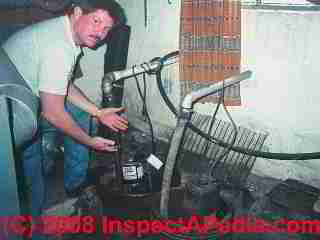 Buying, Installation & Maintenance Guide for Sump Pumps
- POST a QUESTION or COMMENT about this article topic.
Sump pumps:
This article explains how sump pumps are used in buildings, describes the types of sump pumps, and describes how sump pumps should be installed, inspected, and maintained. We explain the difference between a sump pump, simplex and duplex sump pumps, a septic effluent pump, a sewage grinder pump, and an effluent pump.
This article explains the various types of pumps and their purchase, installation, inspection, and maintenance.
InspectAPedia tolerates no conflicts of interest. We have no relationship with advertisers, products, or services discussed at this website.
What is a Sump Pump, how are they installed, used, piped, wired & repaired?
 Sump pumps, which we discuss on this page, are designed to remove unwanted water, such as surface or ground water that leak into a building.
Sump pumps only have to pump water, never solids. Sump pumps are normally used to pump clear liquid, such as ground water from a wet basement sump pit or graywater from a basement laundry sink.
Our sump pump photo (left) is not a wonderful installation, but you can see the pump motor (red arrow), pump float switch (orange arrow), and flexible pump discharge pipe (white arrow) clearly.
The water inlet in tihs case is at the bottom of the pump assembly (blue arrow).
Sump pumps are light-duty and unlike septic or sewage pumps, sump pumps have no ability to pass solid debris other than perhaps fi
What's the Difference Between a Sump Pump, Septic Pump, Sewage Pump or Effluent Pump?
If you are confused between
SUMP PUMPS used to remove ground water and septic pumps used to move sewage or septic effluent then
also see SEPTIC SYSTEM PUMPS.
Typical Sump Pump Installation & Use
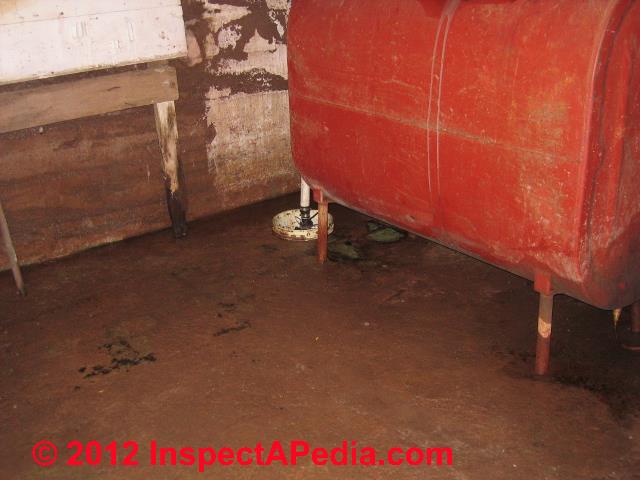
A sump pump is typically installed in a pit at the low end of a building's basement or crawl space floor or in another location where water needs to be removed such as in a boiler pit or an outdoor well pit.
On occasion we find sump pumps installed outside of a building foundation to remove water from around the foundation of a poorly-sited (too low) building which has no natural drainage path to dispose of ground water by gravity.
In a bad building water entry situation
water runs across the basement/crawl space floor into the sump pit where it is pumped away (after already wetting the building and inviting a mold contamination problem).
This condition pertains when water is entering a building through foundation walls, often because the roof drainage or surface runoff are directed right against the building foundation itself.
Keeping gutters and leaders working and correcting outside drainage errors are critical in keeping water out of a building. Doesn't it make more sense to prevent water from coming into a building than to let it in and then pump it out?
In our flooding basement photo at above left, notice that there is a flood-line about half way up that oil storage tank? The little sump pump shown in the white bucket in the center of our photo is never going to handle such a huge volume of water.
And even for modest water entry, the projection of that sump bucket lip above the floor level means water has to rise a few inches in this basement before it can even flow into the sump pit!
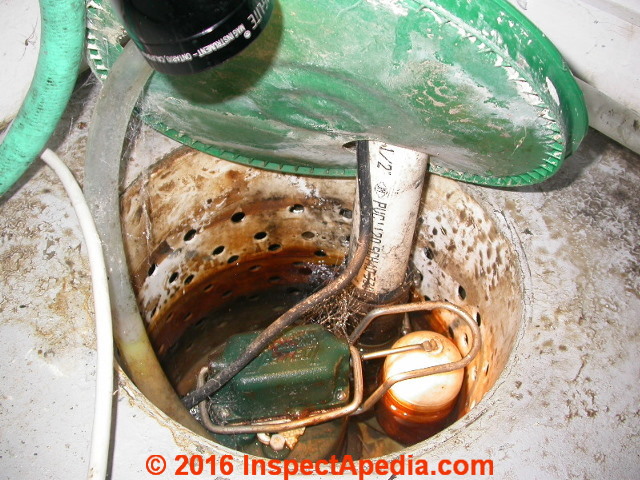
In a good situation,
openings in the sides and bottom of the sump pit (photo at left) , or an under-floor drainage system direct subsurface water into the sump pit before the ground water level rises enough to send water into the building.
Over several years of operation, and partly by pumping a little soil silt as it operates, a sump pump may actually improve the flow of under-floor water into the sump pit, thus reducing building water entry.
Septic pumps, sewage pumps, grinder pumps, and effluent pumps are not sump pumps, and they are discussed beginning
at SEWAGE EJECTOR PUMP GRINDER PUMP .
The distinction among these pump types is important. Choosing the wrong pump can mean a short operating life for the pump, an unreliable system, and unnecessary expense.
There may be some confusion, depending on with whom you speak, because people don't always use just the right terms for construction or septic system parts - and the right sewage pump term, or right septic handling product versus the wrong one can be an important distinction.
Sump Pump Drain Venting
Depending on the lift height and other site conditions there are two sorts of vents one may find on any lift, grinder, or ejector pump or sump pump:
- a small drain hole specified by the manufacturer drains back wastewater from the vertical drain line, below the check valve, into the sump or pumping pit or chamber
- a separate vent may vent the sewage ejector piping to the open air outdoors
Model plumbing codes define a sump vent:
A vent from pneumatic sewage ejectors, or similar equipment, that terminates separately to the open air. - UPC 2006
Two Types of Sump Pump Installations - Simplex and Duplex Pumps
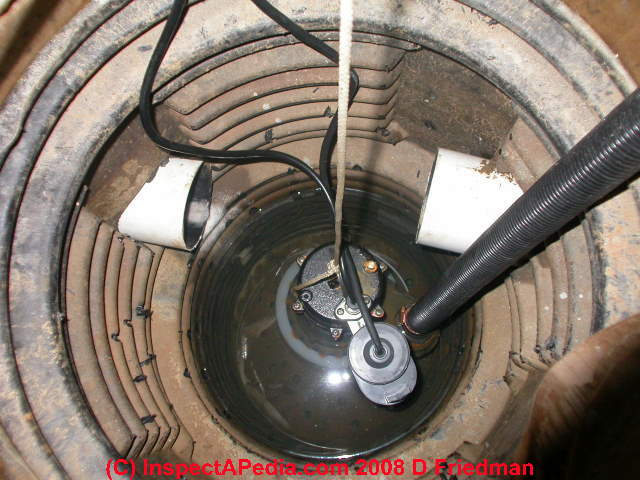
Single submersible or pedestal sump pump:
The photo above is what you're likely to see if your basement has a modern sump pump.
A pedestal type pump must keep its motor out of water and dry. Regardless of which type of pump we select, many installations require that only one single pump be installed.
We discuss the details of submersible and pedestal sump pump types below
at FOUR COMMON TYPES of SUMP PUMPS
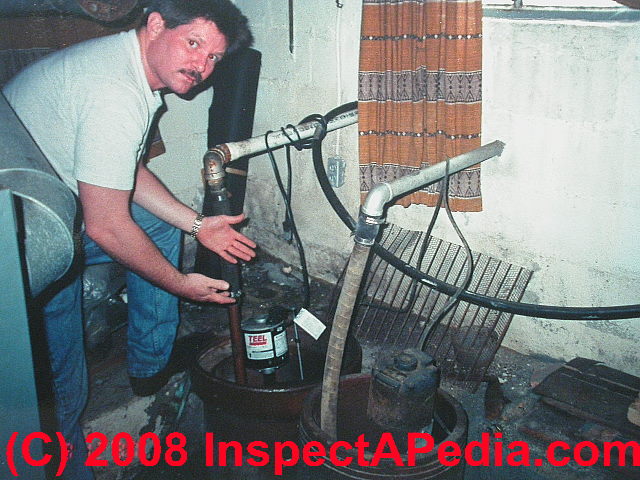
Duplex sump pumps:
The photo just above shows a duplexed sump pump system using pedestal type sump pumps. This was a really wet basement - a single sump pump simply could not keep up. In this installation .
When a building footprint or foundation layout is complex, or where the building is constructed over both basement space and one or more crawl spaces, it may be necessary to install multiple sump pumps to protect these various areas.
In a single large basement whose floor did not slope uniformly to a single low corner, it may be more economical to install two or even more sump pumps in problem areas than to tear up the entire basement floor to install a sub-slab drainage system.
Duplex sump pumps are illustrated and discussed further
at DUPLEX SEPTIC PUMP SYSTEMS
Two Types of Duplex Sump Pump Installations: Alternating and Reserve
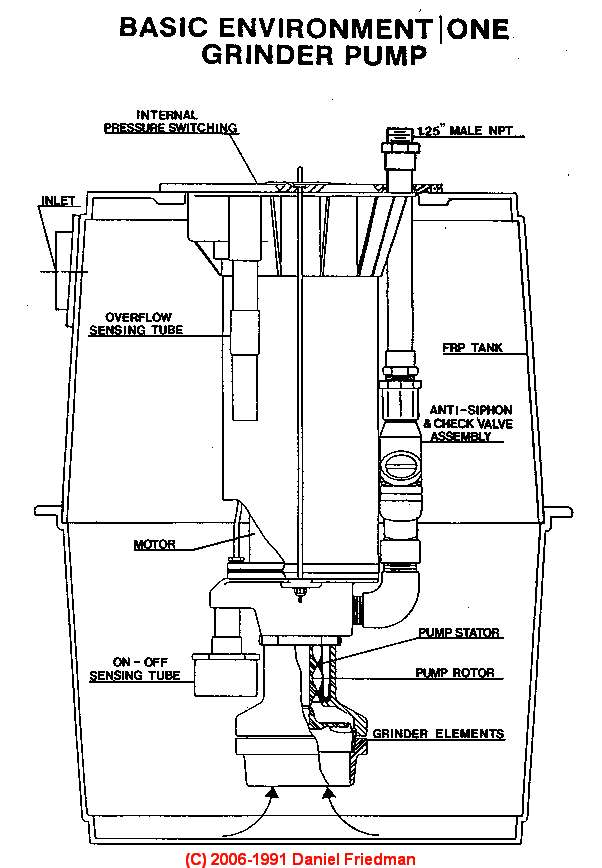
Reserve sump pump backup design:
the backup pump never runs unless the primary pump has failed or is overloaded.
A simple installation provides a pump control float switch that turns on the backup pump only water in the pumping chamber reaches a level above that normally handled by the primary sump pump. This approach provides both pump backup and the ability to handle surges in building water entry loads on the sump pump system.
Alternating sump pump design:
the two sump pumps are installed at the same location but are wired so that the pumps take turns, first one, and next cycle the other pump is turned on by the float switch.
This pump hookup is more common among septic pumping stations than among home sump pump de-watering systems, but it may be appropriate where a large volume of ground water has to be kept constantly out of a building.
An example we've seen was in the basement of a home on Long Island, NY in which the level of the basement slab was so low that flooding from Long Island sound would be nearly constant if the pumps failed.
The alternating sump pump approach has the advantage that both pumps are being exercised regularly, which reduces the chance of the ugly discovery that in the event you have to rely on a backup sump pump which has been sitting idle, waiting its chance to run, has in the interim, died.
Four Common Types of Sump Pumps
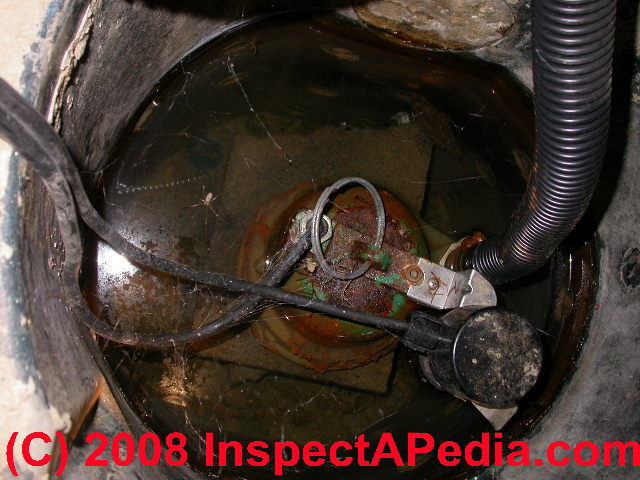
- Submersible sump pumps,
such as shown in the photo , use a motor housed in a water proof enclosure and a separate float that turns the pump on and off.
The sump pump float contains a position-activated switch and is connected to the submersible pump by a flexible wire. Some submersible sump pumps, such as the one shown here at left, use other types of float switches.The submersible sump pump motor is capable of working when entirely under water.
A submersible sump pump uses a float switch intended to turn the pump on when ground water rises in the sump pit (or flows stupidly across your basement and into the pit) where it is discharged to a storm drain or the property surface.
Watch out: for debris or wiring in the sump pit that block movement of the float switch - your sump may fail to turn on.
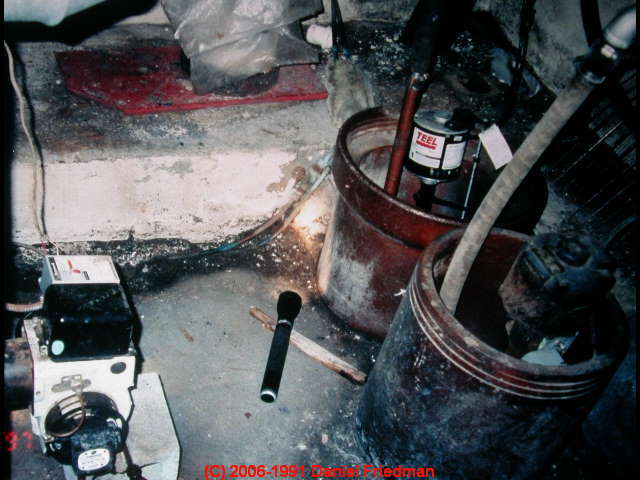
- Pedestal sump pumps,
such as shown in the photo , use a motor atop a pipe inside which the pump turns a shaft which operates the pump impeller.
The pump impeller is located in a bottom pedestal which is under-water. You'll notice that the electric motor that powers the pump impeller is mounted on top a tall shaft that extends well out of the water itself.The float that turns the pump on and off usually looks suspiciously a lot like a toilet tank float, connected to a vertical rod.
Pedestal sump pumps are an older non-submersible type of pump used for removing water from buildings.
As rising water in the sump pit lifts the float, the float lifts the rod and the rod includes an adjustable screw-clamp fitting which pushes on the electrical contact of a mechanical switch to turn the pump on. As the water level drops the float falls and another screw-clamp fitting above the switch turns the pump motor back off.
Watch out: if the pedestal pump is not adequately secured it may tip over and jam its float; if debris or other obstructions interfere with movement of the float and its vertical rod that operates the pump switch, the pump may fail to operate when needed.
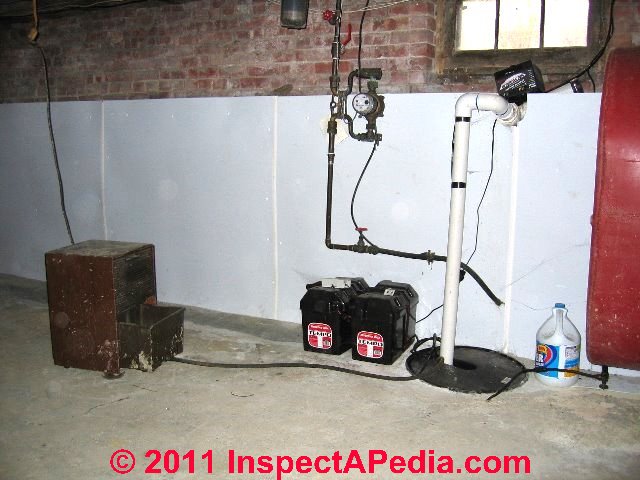
- Battery-backup sump pumps,
use a rechargeable battery which is normally connected to live electrical power in order to remain fully charged. If electrical power fails, the batter can still operate the sump pump. We recommend this type of sump pump at homes where electrical power is frequently lost.
You're most likely to lose electrical power during a storm, which may be exactly when you most-need the sump pump.
The duplexed battery-backup sump pump shown above and immediately below was installed in a converted church in Staatsburgh, New York in a neighborhood subject to recurrent flooding. Note that the owner took advantage of the new sump pit to dispose of condensate from the full-time basement dehumidifier as well.

Above: battery charger for a battery-operated sump pump.
Below: a water-powered sump pump design in a pre-1900 home
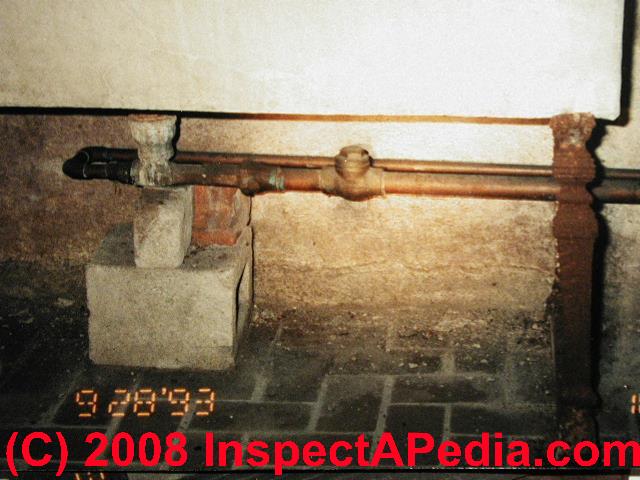
- Water powered sump pumps,
(as shown in the photos above) use municipal water pressure and a venturi fitting to pick up and eject water from a building during flooding. Usually they are turned on manually by opening a water valve near the pump. Water driven sump pumps work only where municipal water is provided.
Water powered sump pumps offer the advantage that the pump can operate when there is no electrical power. At least the older versions of these devices are illegal in many municipalities because their installation constitutes a cross-connection which can back-contaminate public water mains with unsanitary floodwaters.
There may be newer versions that are code-approved: we invite more data and comment on this product.
See CROSS CONNECTIONS, PLUMBING for more details about plumbing cross connections and sump pumps.
Above: the water powered pump at a sink drain - this is an antique unit.
Below: a water or flood alarm (small white "box" on the floor by this ejector pump installation).
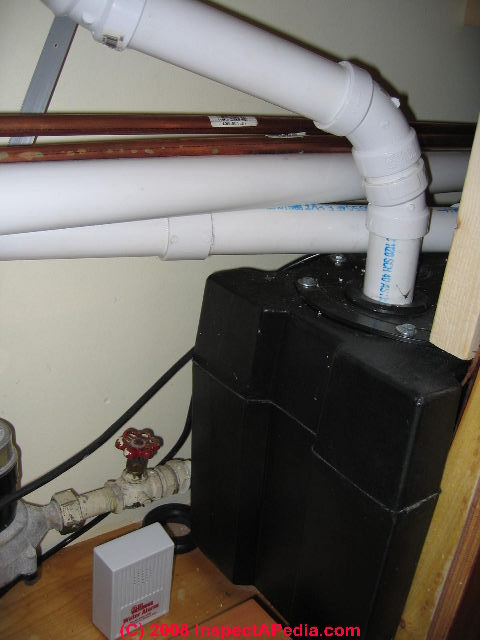
- Water & flooding alarm products
are available in a variety of forms including battery-powered devices and even devices which can turn a light in a home or make a telephone call or inform an alarm company if a building is being subjected to flooding.
Considering the very high cost of flood damage cleanup and mold remediation, we consider flood alarms a great idea for buildings which are often left unattended.
See details about these devices
at WATER LEAK DETECTION & SHUTOFF DEVICES
Below: this Sears backup sump kit includes a flood alarm.
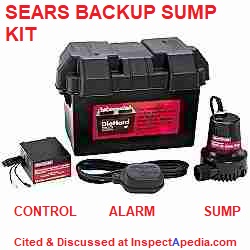
Flood alarm products include a sewer backup alarm built into a sewer backflow preventer valve.
We show one
at SEWAGE EJECTOR / GRINDER PUMPS
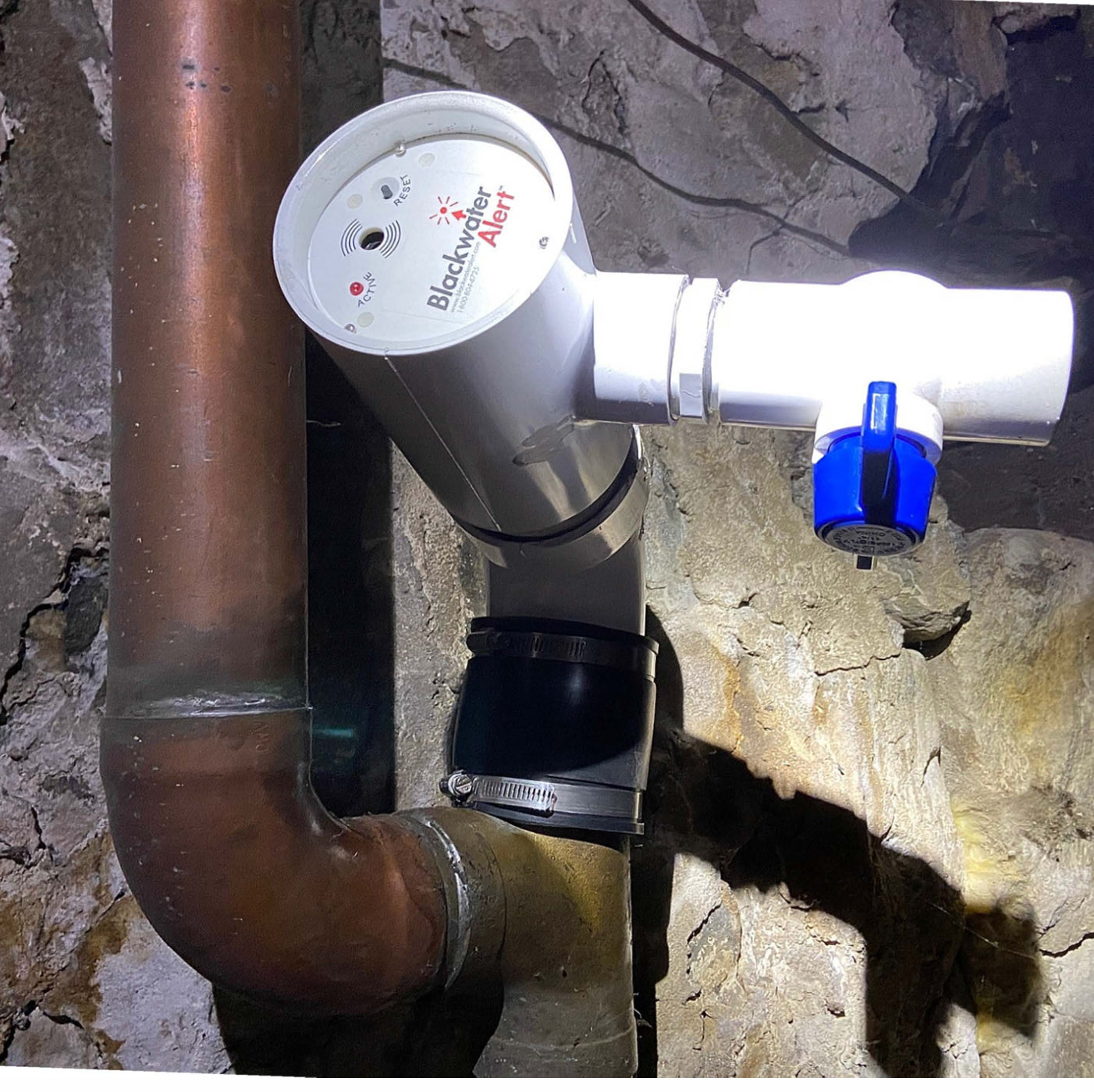
Photo: a Backwater Alert alarm system installed at tne cleanout for a building maindrain, courtesy of Backwater Alert, cited below. [Click to enlarge any image]
See details at SEWER BACKUP PREVENTION
Separately at SEPTIC PUMP ALARM SYSTEMS we illustrate an outdoor-mounted sewage pump alarm system that alerts building occupants if the septic pump has stopped working - hopefully in time to prevent a flood from backing up building drains and toilets.
Where does the sump pump send its Discharge Water?
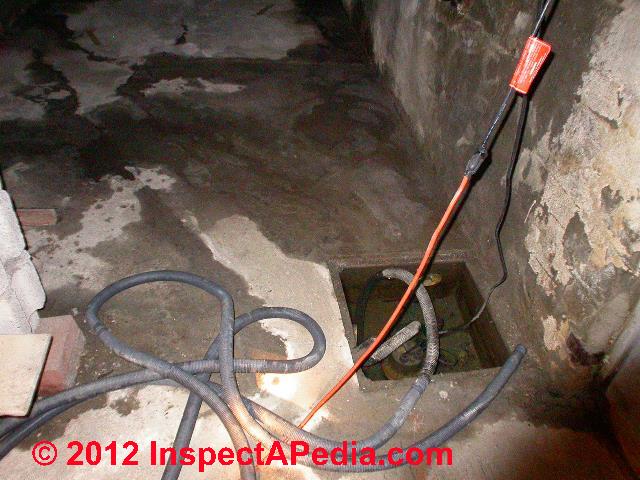
See SUMP PUMP DISCHARGE for details.
- In this photo a temporary sump pump discharge line has been left on the basement floor - no good destination has been assigned to sump outlet hose. If this sump pump is called-on to operate in this condition the building will simply be flooded.
Sump pumps that have been added to an older structure often pump their discharge to the ground surface where it runs to a storm drain or area drainage setting.
If you have such a system be sure that the sump pump discharge empties where it meets these criteria:
- The water leaving the sump pump
should be discharged to a location where it does not flow back towards the building. Otherwise it may simply cycle the same water endlessly, possibly even undermining the building foundation

- Water discharge from a sump pump
must go to a legal destination. In the photo we're emptying the sump pump via a small diameter (Limited flow capacity) to a local storm drain.
This might be legal and fine in the summer for an unusual event, but this is not a reliable, permanent sump pump installation.
As this system was found in Maine, we can expect it to freeze or simply not work in winter or early spring when it may be most needed.
Discharging onto a neighbor, and in some communities, discharging into local storm drains, may be prohibited and are certainly a bad practice. - Sump pump discharge protection needed in freezing climates,
the sump discharge needs to be protected from freezing or the system may not work when most needed.
Below: at the Bethlehem Lutheran Church in Two Harbors MN, if these white PVC pipes are emptying sump pump pits that have to work Minnesota's very cold winter months, additional steps may be needed to prevent freeze-ups.
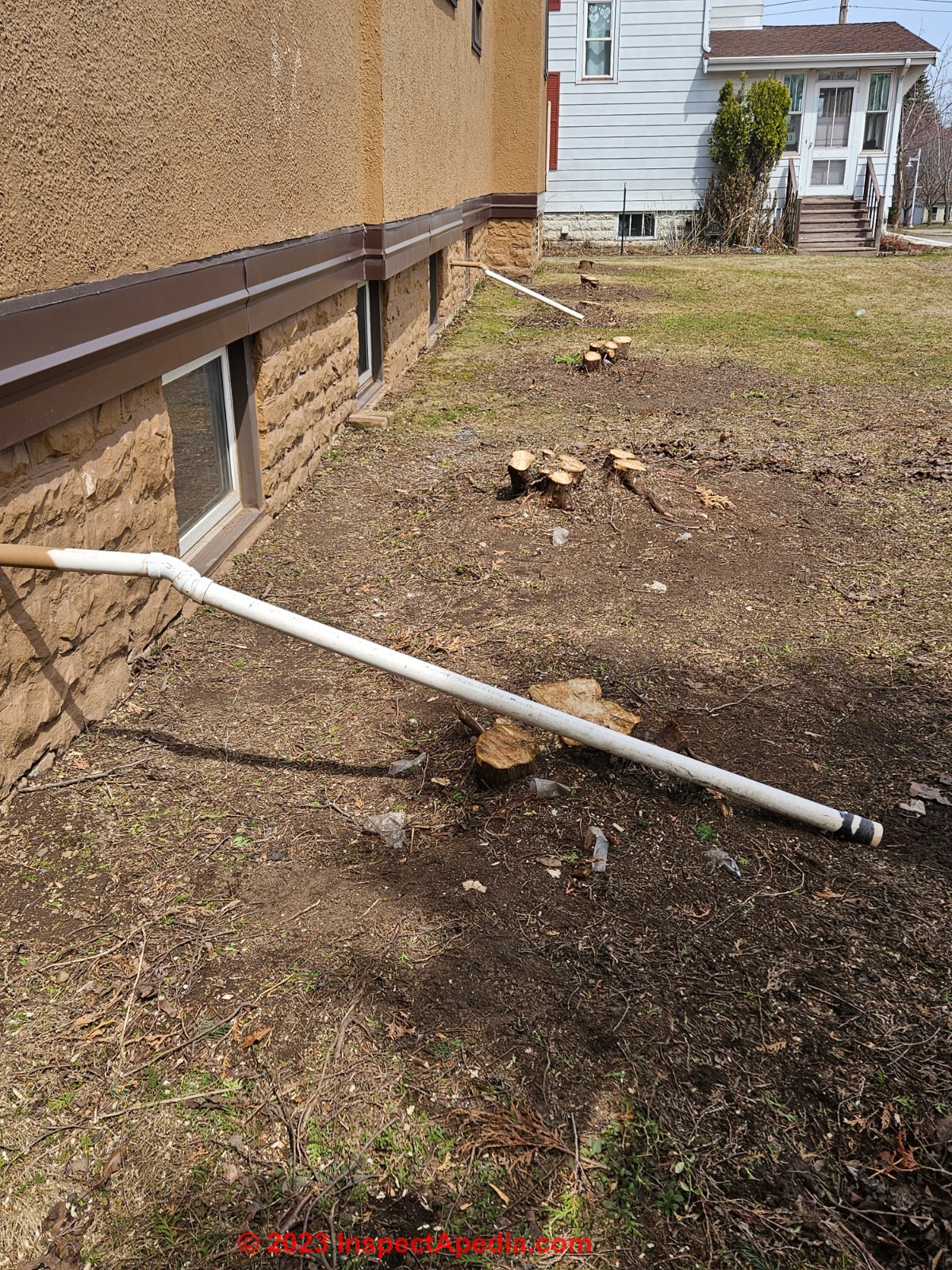
The installation above is discussed in more-detail at WATER ENTRY/DAMAGE PREVENTION WITHOUT GUTTERS
and at SUMP PUMP DISCHARGE we discuss protecting the sump pump discharge from freezing.
How to Calculate the Water Inflow Rate = Calculate the Necessary Sump Pump Capacity
Typically most of us just buy a 1/4 hp or 1/2 hp sump pump and throw it in the pit and see what happens. But you can guesstimate the rate at which water is flowing into the sump pit by knowing the sump pit dimensions and observing how long it takes the pit to fill to a measured depth.
At Static Head of Water in the Well we give details of how to calculate the volume of liquid in a cylinder (if your sump pit is round) using pi (3.14) and the radius (1/2 the diameter of the cylinder) squared.
Volume cylinder = 3.14 x (water height in inches ) x (cylinder diameter in inches /2)2.
Example using an 18" diameter joint compound bucket as a sump pit, and assuming that it takes water 1 minutes to fill the pit to 1 inch..
Volume = 3.14 x (1 inch of water) x ( 18 / 2)2
Volume = 3.14 x 1 x 81 = 254 cubic inches of water rose in the sump pit in one minute
Water in-flow rate to the pit = 254 cubic inches per minute
Convert cubic inches to gallons as follows.
1 cubic foot = (12 x 12 x 12) cubic inches or 1728 cubic inches
254 cu.in. / 1728 = .15 cubic feet.of water flowing into the sump pit per minute
1 cubic foot = 7.5 gallons (U.S. Liquid)
.15 cu.ft. x 7.5 = 1.1 gallons of water flows into the pit per minute
This example let's us state a simple "rule of thumb" for joint-compund bucket-sized sump pits.
One inch of water in an 18-inch diameter joint compound bucket or sump pit = about 1 gallon of water
This means all you have to do is calculate the number of inches that you see water rise in your joint compound bucket sized sump pit in one minute - that's roughly the number of gallons per minute that water is flowing into the sump pit.
Choosing a De-Watering Sump Pump: Typical Pump Capacities in HP, Lift, & GPM Pumping Rate
Sump pumps for residential use range in horsepower from 1/4 HP to xx. Typical sizes are 1/3 HP and 1/2 HP. Prices (2012) run from about $100. to $200. for submersible pump models. Pedestal pumps and light duty sump pumps may sell for less than $100.
Sump pumps are rated for several important factors including horsepower and pumping capacity in gallons or liters per hour - a figure that varies by pump lift height. An individual sump pump's capacity will vary depending on the height to whch it has to lift its discharge water (higher lift means fewer gallons per hour) and other factors such as diameter and number of elbows in the discharge piping.
Watch out: be sure to consider both the anticipated de-watering flow rate you'll need and the pump's lift requirements. Typically if you are pumping out of a basement sump pit to ground level that's more than 5 ft. but less than 10 ft. of lift. But installations that have to lift higher distances and/or pump over longer distances and through multiple piping elbows need a more powerful pump.
Table of Sump Pump Performance Capacities and Typical Ratings for Residential Use |
||||||
| Pump Horsepower | GPM | Capacity/Model | Capacity/Model | Capacity/Model | Capacity/Model | Capacity/Model |
Sump Pump Lift Capcity |
||||||
0 ft. |
5 ft. |
10 ft. |
15 ft. |
20 |
||
Submersible or flat-on-surface sump pumps |
||||||
| 1/4 HP [3] | GPM | 32 | 25 | 10 | ||
| 1/3 HP [4] | GPM | 43 | 34 | 19 | ||
| 1/2 HP [5] | GPM | 93 | 70 | 64 | 36 | |
| Pedestal style sump pumps | ||||||
| 1/3 HP Pedestal [1] | GPM | 50 | 36 | 10 | ||
| 1/2 HP Pedestal [2] | GPM | 60 | 51 | 38 | 17 | |
Notes to the table above
Notes to the sump pump size table: (Note that pump manufacturers offer a wider range of types and capacities of pumps than just the examples listed here. Also pumps of the same HP or capacity may be produced using different materials suitable for different applications and with different durability.)
[1] Zoeller® Old Faithful Pedestal thermoplastic Model 81 1/3HP, maximum "shut off" head: 16 ft.
[2] Zoeller® Old Faithful Pedestal Model 84 1/2 HP , maximum "shut-off" head: 24 ft.
[3] Zoeller Model 49, Watrer RiddrIII
[4] Zoeller Model 50 Series 1/3 HP
[5] Zoeller FlowMate 137, 1/2 HP
* Some manufacturers give sump pumping rates as "total dynamic head/flow per minute dewatering" in gallons per hour instead of gallons per minute. When comparing pumps be sure you are comparing the same units.
Also, among some manufacturers such as Zoeller, some pumps can handle both de-watering jobs and sewage effluent, but the reverse is not the case, that is, models that are designed only for de-watering, such as pedestal and some sump pumps, should not be used for septic system applications.
Inspecting & Troubleshooting De-Watering Sump Pumps
See SUMP PUMP INSPECTION for a detailed sump pump inspection & troubleshooting guide.
Sump pumps on newly constructed buildings
are often connected to the building foundation drain. We consider this a bad practice. It is a rare home more than 20 years old whose footing drains are intact.
If a footing drain discharge itself becomes clogged or damaged, sending the sump pump discharge into that system will not work: you'll simply flood another section of the building foundation, basement, or crawl space, or you may overload the existing foundation drain causing building water entry.
Connecting a sump pump to a municipal sewer drain
is bad practice and illegal in some communities. You're adding to the municipal sewer plant's water overload during wet weather and you may thus be contributing to the discharge of raw sewage from the overloaded municipal treatment facility right into the environment.
Where permitted, we prefer to route a sump pump to a storm drain, or where soil conditions permit it might be discharged to a drywell.
These sump pump dewatering trouble diagnostics may resolve pump capacity questions
If the sump pump motor is running or too frequently, constantly check the following:
- Is water coming out of the pump discharge pipe?
If not, is the pipe clogged, disconnected, or broken? If not, is the pump impeller damaged or clogged? - Does water level drop to the bottom of the pump but the motor keeps running? ,
either the switch is defective (or float stuck) - Does water level in the sump pit fail to drop low enough to shut off the pump?
The pump is unable to keep up with incoming water, or an outlet pipe is damaged, or the pump may be damaged. (Low voltage can make some pumps run with loss of capacity too.) If the water flow rate does not exceed the pumps nominal capacity the problem is in the pump or drain piping.
If the water inflow rate or the pump lift height plus water inflow rate exceed the pump's ability, don't blame the pump. - If the sump pump runs frequently but otherwise normally, every minute or so,
you may be able to improve its operation by deepening the sump pit so that at each pump cycle the pump runs longer, removing more water, but running a bit less often - which is easier on the pump and its life.
Deepening the sump pit also may reduce the tendency of groundwater to come up through the floor at other locations.
Sump Pump Installation Manuals
Watch out: These groundwater or water sump pump manuals are specifically for water-removal pumps or sumps. Note that some septic or sewage pumps can be used as a sump pump in sump installations, but the opposite is not true: a pump designed only to move water can not reliably pump sewage nor other fluids containing solid waste.
- Decko Products, , SUPERIOR SUBMERSIBLE SUMP PUMP IO MANUAL (2008) Models 92250, 92260, 92251, 92255 92257, 92330, 92331, 92335 92337, 92341, 92342, 92351 92352, 92501, 92511, 92507, Supeiror Pump Co., 2301 Traffic St. NE. Minneapolis, MN 55413 USA, 1-800-495-9278 www.superiorpumpco.com retrieved 2021/06/04 original source: https://www.superiorpump.com/Manuals/superior.pump.pdf/Sump%20Pump%20Manual%20Superior%2010-08.pdf
- Flotec SUBMERSIBLE UTILITY PUMP [PDF] (2007) This is a sump type pump not a water delivery pump, Model Series FP0S1300X/FP0S1600X & Series FP0S1100X/FP0S1250X
- Glentronics PRO-SERIES SUMP PUMP INSTALLATION MANUAL [PDF] Models ST1033 & ST1050, (2015) Glentronics, Inc., 645 Heathrow Drive, Lincolnshire, IL 60069 USA Tel: 800-991-0466 retrieved 2021/06/04, original source: https://www.stopflooding.com/assets/2/6/Manual_ST1033-ST1050_6-2015.pdf
- Goulds Pumps, ITT, GOULDS SUBMERSIBLE WASTEWATER DEWATERING, EFFLUENT, SEWAGE PUMP MANUAL [PDF] Goulds Pumps, cited below, - retrived 2021/06/04 original source: https://documentlibrary.xylemappliedwater.com/wp-content/blogs.dir/22/files/2012/07/IM107R12.pdf?_ga=2.37920227.1783282700.1622830300-1132821546.1622830300
Excellet installation & troubleshooting details are in this manual. - Goulds Pumps, ITT GOULDS 1DW SUBMERSIBLE DEWATERING PUMP Brochure [PDF] Op. Cit.
- Goulds Pumps, ITT, GOULDS SUMP PUMP MANUAL Model CV3171 [PDF] (2006) ITT, Gould Pumps, Tel: 1-800-446-8537 website: www.gouldspumps.com - retrieved 2021/06/04 original source: https://www.gouldspumps.com/ittgp/medialibrary/goulds/website/Products/CV-3171/CV_3171_atex.pdf?ext=.pdf
- Goulds Pumps, ITT, GOULDS SUMP PUMPS INSTALLATION & OPERATION MANUAL HSUL series [PDF] - retrieved 2021/06/04 original source: https://www.gouldspumps.com/ittgp/medialibrary/goulds/website/Products/HSUL/hsul_IOM.pdf?ext=.pdf?ext=.pdf
- Little Giant, CHECK VALVES for WASTEWATER LITTLE GIANT [PDF]
- Northern Tool, POWERHORSE SUMP PUMP MANUAL [PDF] Models 50110 & 50131 (shown above) Northern Tool and Equipment Company, Inc. Burnsville, Minnesota 55306 NorthernTool.com Tel: 1-800-222-5381 - retrieved 2021/06/04 original source: https://www.northerntool.com/images/downloads/manuals/50131.pdf
- Wayne sump pumps such as the Wayne CDU800 1/2HP product specifications
- WaterSource WATER SOURCE 1/3 HP SUBMERSIBLE SUMP PUMP MANUAL [PDF] Models #WSSP3 & #WSSPC3 sold at Home Depot and other building supplliers, WaterSource, Tel: 1-800-346-7611, E-mail: sales@watersourceusa.com
- Zoeller sump pumps, such as the Zoeller M53 1/2HP sump pump, the Zoeller 98-0001 1/2HP , the Zoeller 57-0001 M57 high capacity pump, and Zoeller "Old Faithful 81 pedestal pup, Zoeller® Company, Website: http://www.zoellerpumps.com/ , Email: zcotechnical@zoeller.com.
- Zoeller, "Installation Instructions, Pedestal Pumps Dewatering and Sump, 81, 82, 84 Series", Zoeller Pump Co.®, PO Box 16347, Louisville KY 40256-0347, Tel: 800-928-PUMP Website: www.zoeller.com
- Other types of pumps and their manuals can be found
at CONDENSATE PUMPS and
at WATER PUMP & TANK I&O & REPAIR MANUALS - Zurn, CHECK VALVE INSTALLATION INSTRUCTIONS ZURN 700XL [PDF]
- Also see theReferences or Citations found at the bottom of any of the articles in this series
Reader Comments, Questions & Answers About The Article Above
Below you will find questions and answers previously posted on this page at its page bottom reader comment box.
Reader Q&A - also see RECOMMENDED ARTICLES & FAQs
On 2021-07-08 by (mod) - proper placement & orientation for check valve on a sump pump
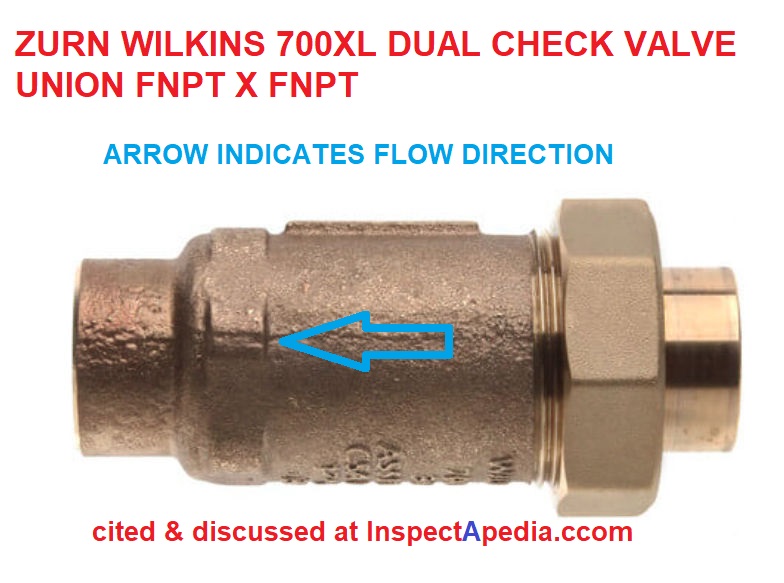 @Larry Smith,
Some check valves can be installed either vertically or horizontally, but ALL are direction sensitive.
Here is an example, the Zurn/Wilkins Model 700XL (photo)
- this particular check valve is used on potable water systems. But any check valve will have a directional arrow somewhere on the valve body.
Check these
CHECK VALVE INSTALLATION INSTRUCTIONS ZURN 700XL [PDF]
Typically there is a directional-arrow cast into the body of the check valve.
For wastewater piping such as your sump pump is handling, take a look at similar instructions from Little Giant (Pumps) in this
CHECK VALVES for WASTEWATER LITTLE GIANT [PDF]
1. Valve may be installed horizontally or vertically. However, when
installed in systems handling solids, valve must be installed
horizontally or at a maximum of a 45° angle. This will guard
against any solids lodging on top of valve flapper and preventing
valve from opening on start-up.
Bottom line: vertical or horizontal sump pump check valve is ok (though it's best to put the check valve where the manufacturer says - as close to the sump as possible )
IF
You install the valve in the right direction (see the flow direction arrow marked on any check valve)
AND
you don't install the valve upside down (which depending on your piping arrangement may violate the flow direction arrow)
On 2021-07-08 by Larry Smith
I want to locate my sump pump check valve as close to where it exits my basement as possible. The only problem is that the pipe goes across the ceiling and then goes down and out. The flow of the water at this location is going down, therefore the check valve would have to be installed upside down. Will this work?
Thanks,
Larry
On 2021-06-04 by inspectapedia.com.moderator (mod)
@Anonymous,
Please find your question and our detailed reply now at
SUMP PUMP RELIABILITY
Thank you for asking a helpful question. We welcome your further comment or questions.
On 2021-06-04 by Anonymous
I have had two minor flood events when a sump pump float switch failed. One source claimed that the constant flexing of the wire broke the the wire. This seems improbable, as common extension cords flex frequently.
float on a rod can fail when scale collecting on the rod, or the rod guides keep it moving.
Cheap floats can leak, become waterlogged, and fail to rise to the occasion.
Then I read about electrical contact sensors -- they use a tiny current to control a relay. The water completes the circuit. There are two types of these: In the single contact type, when the water rises high enough to touch the electrode, the pump runs for a set amount of time. In the second type, you have a pair of electrodes, and the pump turns on when the upper electrode makes contact, and turns off when the lower one loses contact.
But electrodes have problems with scale too, as well as with galvanic corrosion.
What options are there for reliable sump pump control?
(In spring during the melt season, my pump can cycle as often as every 90 seconds.
On 2021-01-11 - by (mod) -
CrisHave you tried cleaning the sump and giving it a shot of bleach? White greasy scum can indeed form in the sump pit;
On 2021-01-11 by Cris
My sump pump has a very foul smell taking over my basement I've tried the DIY advise. No one can help. Thetes also a white waxy substance.
On 2021-01-08 by Grady Galvez
Grady Galvez said:
Thank you for sharing this information. I know a lot of useful information now. But I must be choosing a sump pump which is easy to install.
On 2020-08-19 - by (mod) -
Robert
Before fixing the problem let's try for a diagnosis of what we need to fix. If, for example, the bad smell is because sewage or some other contaminant is entering the sump pit then piping changes won't fix that.
After the pit is emptied and everything cleaned, watch what enters the pit and try the basic snfif test.
On 2020-08-19 by Robert Rascon
Should also say that pvc from pump travels up about 5 ft, takes a short 45%, then up another 5ft to exit.
Horrible smell from submerged sump pump pit. Have cleaned it But still bad. Could new pvc help?
On 2018-11-20 - by (mod) -
Sorry I'm not sure what white material and what while you're asking about.
On 2018-11-16 by peter
my question is: what is the white material on the wall?
On 2017-09-02 by Debra D.
Is there a barrel that the sump pump can be placed into that can sit on the basement floor to receive a pcv pipe bring water IN so I can then pump it up and out?
On 2013-03-11 - by (mod) -
Lisa a battery-operated device typically runs on DC voltage and might not require a ground. Tell us the brand and model number and we can research the installation instructions or you can do that yourself if you prefer.
Watch out: if your battery-operated pump is (as we suspect) operating off oa 12-V automotive type battery the installation nevertheless probably includes a battery charging system that is itself operating at 120V.
Your battery charger (not the pump) that plugs into a wall socket, will use a grounded plug. Make sure that the receptacle into which the plug is inserted has a properly-wired ground too.
DO NOT connect either of your battery's terminals directly to the building's electrical system.
On 2012-10-28 by Lisa
How do you ground a battery operated sump pump?
On 2012-08-26 by Sam
I just saw a home and interested in buying it. I see it has uneven floor with maybe a 1/4 inch crack radiating from the sump pump in 2 directions. would that be setttlement pb or foundation pb? how can you tell?
On 2012-01-18 by Daphne
The pump that I am looking for is to increase the flow of water up hill. The water is travelling up hill by a garden hose. I need something that can attached to the end of the garden hose to increase the water up hill.
Thanks
Question: Does using a sump pump cause foundation undermining & increase of water movement towards the building?
This was the most informative article I've read during my extensive online research on the topic of "Basement Flooding"
For details see BASEMENT WATER ENTRY PREVENTION
Ground water/high water table has been determined the cause of water entry into my basement "pit" area underneath my main sewer trap. We have a Basement Watch Dog Dual Sump Pump with battery backup installed however the constant presence of groundwater in our pit continues to worry us.
Our Staten Island, NY home location is situated where the properties behind, to the left and right of us are elevated. PVC fencing with sealed bottom moulding prevents rain water from cascading over the concrete/paver surfaces; however it is our belief that the groundwater underneath from all three directions have found a hydrostatic relief in OUR PIT! What recourse do we have?
Any advice you can give us would greatly be appreciated. - Joe Apap 09/2011
Reply: increases in water flow towards sump pump, foundation undermine risk, possible solutions
Thanks for the nice note, Joe; we've been working hard on wet basement and wet crawl space information, particularly since recent hurricanes and tropical storms have led to so much flooding.
The question you raise about the effects of a sump pump on soils, water flows, and by implication even the building foundation is an important one.
Increased water flow towards sump pump pit
Indeed sump pumps as basement de-watering systems work better over time precisely because the ultra fine soil particles pumped away open improved water drainage passages towards the sump pit. One of the first sump pump installations I worked on back in 1969 was installed to reduce the entry of water that used to squirt into a basement through its walls during heavy rains. When the sump pump was first installed it did not immediately stop the water entry, though it reduced it.
After just a few years the sump seemed to keep the water table below the basement slab and no more water squirted thorough the basement walls even in wet weather. Of course other conditions could have changed as well.
I have not been able to find data, and I doubt there is reliable data, about the "reach" of sump pump water movement past the building where it is installed.
Surely sump pump water movement reach will be a function of local soil characteristics including particle size, density, water and ground water sources, and frequency of sump operation.
And water tables underground can fool you - they are not level flat but indeed follow terrain contours. Still I would not be surprised if being surrounded by higher properties means you are receiving their surface as well as subsurface runoff.
Sump pumps might undermine a building foundation
I've read a few reports that in areas of fine soils a highly active sump pump may remove enough soil fines to actually cause foundation settlement or tipping. But it may just be urban legend - I've seen reports but no hard data.
Use an intercept drain system to reduce water movement towards and under a building, septic drainfield, or similar concerns
If it's cost justified you could consider a curtain drain around your property. Such a drain, a ditch to an adequate depth and filled with No4 crushed stone and perforated piping led to an outdoor pumping station could intercept water from neighbors and keep it away from your home. Your outdoor pumping station will need to be deep enough to be frost proof and it will need to discharge to an approved destination such as a local storm drain.
Earlier I thought of advising you to ask neighbors to be sure their roof drainage is not aimed at your property, but given the vagaries of people and inconsistent property maintenance, I suspect that's a waste of time.
Also see BASEMENT De-Watering SYSTEMS
...
Continue reading at SUMP PUMP DISCHARGE or select a topic from closely-related articles below, or see our complete INDEX to RELATED ARTICLES.
Or see these
Recommended Articles
- BASEMENT WATERPROOFING
- CONDENSATE PUMPS
- CRAWL SPACE DRYOUT
- FLOOD ALARMS - detect water on floors or in basements or crawl spaces
- GRADING, DRAINAGE & SITE WORK
- GUTTERS & DOWNSPOUTS
- PUMPS USED in BUILDINGS
- SEPTIC SYSTEM PUMPS
- SEWAGE EJECTOR / GRINDER PUMPS
- SUMP PUMPS - home
- APPLIANCE DIAGNOSIS & REPAIR
- BATTERY BACKUP SUMP PUMPS
- CRAWL SPACE DRYOUT
- CROSS CONNECTIONS, PLUMBING
- MERCURY HAZARDS in SUMP PUMP CONTROLS
- PEDESTAL SUMP PUMP GUIDE
- SUMP PUMP DISCHARGE
- SUMP PUMP INSPECTION
- SUMP PUMP MANUALS
- SUMP PUMP RELIABILITY
- SUMP PUMP TYPES
- SUBMERSIBLE SUMP PUMP GUIDE
- SUMP PUMP SINGLE vs DUPLEX
- SEPTIC PUMP DUPLEX DESIGNS
- WATER ENTRY in BUILDINGS
- WATER POWERED SUMP PUMPS
- WATER ENTRY in BUILDINGS - home
- WATER LEAK DETECTION & SHUTOFF DEVICES
- WATER PUMP & TANK I&O & REPAIR MANUALS
Suggested citation for this web page
SUMP PUMPS at InspectApedia.com - online encyclopedia of building & environmental inspection, testing, diagnosis, repair, & problem prevention advice.
Or see this
INDEX to RELATED ARTICLES: ARTICLE INDEX to BUILDING LEAKS & WATER ENTRY
Or use the SEARCH BOX found below to Ask a Question or Search InspectApedia
Ask a Question or Search InspectApedia
Try the search box just below, or if you prefer, post a question or comment in the Comments box below and we will respond promptly.
Search the InspectApedia website
Note: appearance of your Comment below may be delayed: if your comment contains an image, photograph, web link, or text that looks to the software as if it might be a web link, your posting will appear after it has been approved by a moderator. Apologies for the delay.
Only one image can be added per comment but you can post as many comments, and therefore images, as you like.
You will not receive a notification when a response to your question has been posted.
Please bookmark this page to make it easy for you to check back for our response.
Our Comment Box is provided by Countable Web Productions countable.ca
Citations & References
In addition to any citations in the article above, a full list is available on request.
- [1] Personal communication, email, [Anon. for privacy] to Daniel Friedman, 3/7/2012 "Sump Pit Accident" in rental property.
- In addition to citations & references found in this article, see the research citations given at the end of the related articles found at our suggested
CONTINUE READING or RECOMMENDED ARTICLES.
- Carson, Dunlop & Associates Ltd., 120 Carlton Street Suite 407, Toronto ON M5A 4K2. Tel: (416) 964-9415 1-800-268-7070 Email: info@carsondunlop.com. Alan Carson is a past president of ASHI, the American Society of Home Inspectors.
Thanks to Alan Carson and Bob Dunlop, for permission for InspectAPedia to use text excerpts from The HOME REFERENCE BOOK - the Encyclopedia of Homes and to use illustrations from The ILLUSTRATED HOME .
Carson Dunlop Associates provides extensive home inspection education and report writing material. In gratitude we provide links to tsome Carson Dunlop Associates products and services.
 | HOME | ABOUT | ASK a QUESTION | CONTACT | CONTENT USE POLICY | DESCRIPTION | POLICIES | PRIVACY | |
| © 2024 - 1985 Publisher InspectApedia.com - Daniel Friedman | |||||||||