
InspectAPedia® FREE Encyclopedia of Building & Environmental Construction, Diagnosis, Maintenance & Repair |
Question? Just ask us! InspectAPedia
|
 AEROBIC Septic System Costs & Aerobic Septic Failure Rates
- POST a QUESTION or COMMENT about failures & problems in aerobic septic systems
Aerobic septic system or aerobic treatment unit (ATU) failure rates & repair costs: this article discusses Aerobic Septic System Failure Rates & Costs.
This website provides designs and products for aerobic septic treatment units (ATUs) for onsite waste disposal, also called fine bubble aeration systems. We address aerobic septic system design, features, inspection, repair, and maintenance. Product sources are also listed.
InspectAPedia tolerates no conflicts of interest. We have no relationship with advertisers, products, or services discussed at this website.
- Daniel Friedman, Publisher/Editor/Author - See WHO ARE WE?
Aerobic Treatment Unit Failure Rates and ATU Installation & Costs
Failure Rates for Aerobic Septic Systems
Some readers have written expressing concern that they've heard that ATU's have a high failure rate, "as high as 95%".
That number doesn't mean much to me without more specific data, in particular, one would need to know what was meant by "failure" and what was the cause of specific failures of ATUs. Important septic system failures are the failure to adequately treat wastewater or the failure to successfully dispose of it.
ATU Failures due to lack of maintenance:
In the study discussed below, while a high failure rate was reported for ATUs (where failure here means the aerobic treatment system was not treating the effluent satisfactorily), the failures were specifically linked to a lack of proper maintenance.
Every type of septic treatment system requires periodic maintenance and repair, a
nd I expect that every septic system eventually fails and needs extensive repair or replacement. So we could put the septic system failure rate at 100%.
What would be more useful would be a statement of the typical operating cost for various alternative septic treatment systems, the typical component life, and the amount and cost of ongoing maintenance that are required.
NESC, in an issue of their Pipelines magazine (Note 1), cited a 1998 survey conducted in West Virginia which looked at Aerobic Treatment Units to evaluate the quality of their effluent discharge. 419 ATUs were tested for TSS (total suspended solids) and BOD5 (5-day biochemical oxygen demand), and 92 percent of the systems were determined to be producing unacceptable effluent discharge.
The main cause of these aerobic septic system treatment unit failures was attributed to poor or improper ATU maintenance. I suspect that homeowners, accustomed to the tradition of inattention to septic systems until they are visibly failed, simply were performing no maintenance at all.
However with proper inspection and maintenance, ATU's can continue to provide effluent which has been treated better than by a conventional septic tank and drainfield.
For example, of the 419 units, only 85 were selected for chemical tests.
Of the 419 units inspected, field inspectors found (by visual inspection) deficiencies in 272 units (65%). 71% of the 85 units selected for testing were found to have deficiencies.
What was particularly remarkable, while 93% of the ATU's with a visually detectable deficiency were producing unacceptable effluent output, more stunning, another 80% of the ATU's with no apparent deficiencies by visual inspection, were producing unacceptable effluent discharge! (Op. Cit., p. 43).
Here is a description of the study: "Of the 419 ATUs examined, 85 were sampled for additional laboratory analyses, which included BOD, TSS, and fecal coliforms (FC).
Approximately 150 units were tested for chlorine residual and turbidity.
The survey was performed by the Environmental Services and Training Division and the Environmental Microbiology Laboratory, both at West Virginia University (WVU), and six county health departments, and with assistance from the West Virginia Bureau of Public Health.
The project objectives were to survey existing ATUs for proper operation and maintenance and to determine the chemical and microbiological quality of their effluents."
Installation & Operating Costs for Aerobic Treatment Units ATUs
The NESC cites several obvious components in ATU installation and operating costs. Installation costs for an ATU include the cost of the ATU installation, including excavation and electrical wiring, the cost of construction of the post processing facility such as raised bed or sand bed.
See AEROBIC SEPTIC SYSTEM MAINTENANCE COSTS for details about the actual maintenance or operation costs of aerobic treatment units or ATUs.
Operating costs for aerobic septic systems include
electricity for the ATU compressor or air pump, annual inspection and maintenance, usually by contract with the installer, and cost of effluent disinfection if that step is used. One website, www.toolbase.org which has some nice simple summaries of types of septic systems, cites a cost of $3200. to $5000. to install an aerobic treatment unit.
This number cannot possibly be correct for a complete system installation. More likely it is referring to the aerobic treatment unit itself, the tank and aeration system. Add to these the cost of excavation and piping for the sewer line from the building, from the ATU to the absorption system, and the installation of the wastewater absorption system, and you're probably looking at two to three times that number.
It is a bit tricky trying to compare alternative septic system costs.
After all, we choose a particular system because it best fits the limitations of the site. A very limited site that requires installation of an ATU and a raised bed or septic mound system to handle the effluent, such as in a rocky building site in the Northeastern U.S., may involve a total installed cost of $25,000.
This troubling number cannot be compared with the probably lower cost of a conventional septic tank and drain field ($10,000) because the latter simply won't work on the site in question.
What we can say about ATUs is that if regular inspection and maintenance are not performed, the system has a good chance of not working properly.
The cost of electricity to operate the septic aeration system is likely to be trivial, perhaps $4./month. We can also say that the trash tank or primary treatment tank will require more frequent pumping than a conventional septic tank. I expect that septic tank cleaning or tank pumping cost, often $125. to $250. per pumpout depending on location and tank size and effort to access the tank, probably is more significant than the operating cost to supply electrical power to the equipment.
Failures & operating or maintenance difficulties with Aerobic Septic Systems or ATUs
- Criado Monleon, A. J., Knappe, J., Somlai, C., Betancourth, C. O., Ali, M., Curtis, T. P., & Gill, L. W. (2022). Spatial Variation of the Microbial Community Structure of On-Site Soil Treatment Units in a Temperate Climate, and the Role of Pre-treatment of Domestic Effluent in the Development of the Biomat Community. Frontiers in microbiology, 13, 915856. https://doi.org/10.3389/fmicb.2022.915856
Abstract:
The growth of microbial mats or “biomats” has been identified as an essential component in the attenuation of pollutants within the soil treatment unit (STU) of conventional on-site wastewater treatment systems (OWTSs). This study aimed to characterize the microbial community which colonizes these niches and to determine the influence of the pre-treatment of raw-domestic wastewater on these communities.
This was achieved through a detailed sampling campaign of two OWTSs. At each site, the STU areas were split whereby half received effluent directly from septic tanks, and half received more highly treated effluents from packaged aerobic treatment systems [a coconut husk media filter on one site, and a rotating biodisc contactor (RBC) on the other site].
Effluents from the RBC had a higher level of pre-treatment [∼90% Total Organic Carbon (TOC) removal], compared to the media filter (∼60% TOC removal). A total of 92 samples were obtained from both STU locations and characterized by 16S rRNA gene sequencing analysis.
The fully treated effluent from the RBC resulted in greater microbial community richness and diversity within the STUs compared to the STUs receiving partially treated effluents. The microbial community structure found within the STU receiving fully treated effluents was significantly different from its septic tank, primary effluent counterpart. Moreover, the distance along each STU appears to have a greater impact on the community structure than the depth in each STU.
Our findings highlight the spatial variability of diversity, Phylum- and Genus-level taxa, and functional groups within the STUs, which supports the assumption that specialized biomes develop around the application of effluents under different degrees of treatment and distance from the source.
This research indicates that the application of pre-treated effluents infers significant changes in the microbial community structure, which in turn has important implications for the functionality of the STU, and consequently the potential risks to public health and the environment.
...
Reader Comments, Questions & Answers About The Article Above
Below you will find questions and answers previously posted on this page at its page bottom reader comment box.
Reader Q&A - also see RECOMMENDED ARTICLES & FAQs
On 2020-01-18 by Abe - Suspected aerobic pump failure
My pump eats about 40 bucks a month in electricity in Massachusetts.
Is that normal?
Moderator reply:
Please see
AEROBIC ATU SEPTIC OPERATING COSTS
where I have moved our complete Q&A discussion
If you need a new aerobic pump
see AEROBIC SEPTIC AERATOR PUMP SOURCES
On 2019-10-19 by (mod) - experience with Aerator Systems aerobic septic systems: drainfield failure & replacement
 Thank you for that detailed posting, it will be helpful to other readers.
On 2019-10-18 by PTators
We have lived in 3 homes with Aerator Systems, and are getting ready to build a new home where we will install an Aerator system.
Note1: We’ve always had a service contract and done normal maintenance (with one instance of a motor rebuild), with overall good results. However, we just had a major failure — this week — and this is how it played out.
Initially, the alarm on our tank went off. After resetting, it came right back on every time. We turned it off and called for system maintenance. He arrived and after evaluation, said the system wasn’t draining/we had a blockage in the drain field.
He made a recommendation that we get the (concrete) aerator tank pumped, and then get someone out to find the problem.
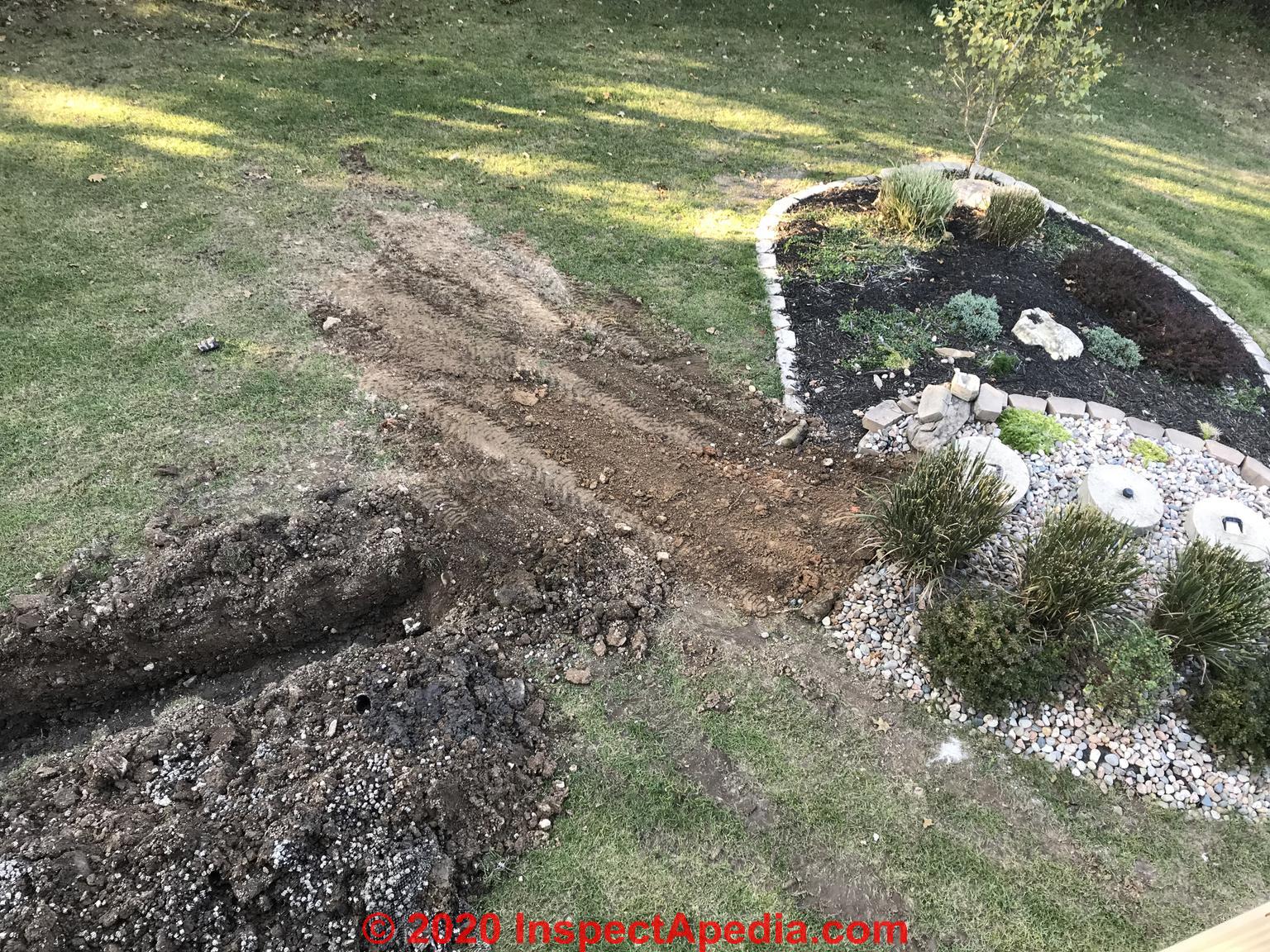
We got the tank pumped, and then called a plumbing service that had a camera they could use to find the blockage. They went as far as they could with the camera, then pinpointed this location above ground so we knew where to start digging.
We dug this area, and found that the “pipe” had collapsed. We couldn’t get anyone out to excavate for at least a week, so rented a small excavator. Bottom line, the remaining line was silted in, so total leach field failure.
The leach field piping used was FRENCH DRAIN PIPE! Inside a poly rock sock (taking the place of gravel and geo textile cloth). Epic failure!
We researched the proper specs for installing a septic leach field, and replaced the entire leach field accordingly, with proper fall, and installing the proper layers - gravel/triple wall leach field pipe/more gravel/geo textile cloth/dirt back fill.
I’m commenting here because I want to make it known that the leach field is just as important as the aerator system. I have no idea how many installers use leach field shortcuts, so be aware. Note2: digging up a leach field can be nasty, but considering this was an aerator system leach field, it wasn’t bad.
On 2018-12-04 by Sean McDonnell
I would like to share my multi-flo ATU. nightmare with everyone. I bought a 3780 sq. ft. 5 bedroom 3.5 bath home in 2016. The home has a multi-flo ATU septic system. I was told this was a great system and such by the inspector and I even paid a company to educate me somewhat on maintaining the system.
After moving into our home we had multiple system failures within weeks mainly because nothing can go into this system other then tp and such without causing problems.
The system we have has only 2 compartments and no trash tank to hold any debris that cannot be processed. I learned this very quickly after pulling baby wipes out of the aerator pump every week for months.
These baby wipes caused the aerator to fail. The replacement aerator was over $500! Then due to the pump failure the filter socks needed to be cleaned twice which is an absolutely foul task. To make matters worse the effluent pump failed within weeks of the aerator pump to the tune of $700.
The filter socks have needed cleaning 3 times since buying our home. This system should never have been installed without a trash tank for one. And I’m also told the system isnt big enough for the size of our family. Are you freaking serious! This is a 5 bedroom house! The system is designed for a family of 3-4 at best.
There should be legislation in place requiring these companies to install systems based on the size of the home because doing anything less is insane. I would advise anyone looking to buy a new home to run as fast as you can away from any home with a multi flo septic system. They are nothing but trouble and will cost you a fortune financially and add an amazing amount of unwanted stress to your life.
I wish I’d never heard of a multi-flo ATU.
I tell every person I know or meet about these horrible problems I have had with this system, and will continue doing so until I die.
So very sincerely, Sean Mcdonnell
From: Peculiar, MO
On 2016-11-29 by TV
Hello, would anyone know how much it would cost to set up on-site treatment (aerobic/anaerobic) for a brewery which discharges approximately 2000 cubic metres of waste water in a year?
On 2016-11-29 by Anonymous
My alarm on my arobi csystem is going off. It says failed air compressor. How expensive to repair
On 2016-05-15 by (mod) -
Matt:
To provide a detailed answer with illustrations and citations we've moved your question and our reply to this article:
BAT MEDIA SEPTIC PLANTS found at https://inspectapedia.com/septic/BAT_Septic_Media_Systems.php
On 2016-05-15 by (mod) -
Noting for other readers that "Bat" refers to "biologically accelerated treatment"
On 2016-05-15 by (mod) - "Jet 1500 Series Bat Media Plant" system.
Matt said:
Sorry, I am referring to the baffles that are on the walls of the aeration tank.
See Jet Inc.'s 1500 Series Bat(R) Media Plants with Model 952 UV Owners' Manual
I am being told if that tank is pumped out those baffles could fall in leaving the company that is pumping tank liable for the repair. Meaning they would have to dig up tank to repair. I was told this is a defect in the design of this "Jet 1500 Series Bat Media Plant" system.
I was trying to research to see if this is true. I have to question if there is truly a design flaw, would there not be information somewhere on what is required to fix it?
Would there not be some sort of warranty for a 6 year old system? Or, am I being fooled by the company I called out to pump my system?
On 2016-05-14 by Matt
I have Jet 1500 Series Bat Media Plant. Was told by guy pumping tank that they wont pump tank with aerator because bat's fall in and its a defect in system. Is this true?
On 2016-02-19 by (mod) - If you turn off the aerator on an aerobic septic system
If you turn off the aerator on an aerobic septic system you will destroy your drainfield, risk sewage backup into the home, and probably violate local regulations.
IF the system is not working as designed it is not treating the sewage and thus is contaminating the environment, starting at your own property. Best to leave it on.
On 2016-02-19 by Cindy
Is it necessary to have this system. Can i just turm it off?
Reader Question: Having an ATU installed, worried.
I am having an ATU unit installed tomorrow. Against my better judgment, but due to wonderful regulations, that was the plan the engineer said we HAVE to have.
Total install for a 500 gallon trash tank, 1000 gallon septic tank, ATU, 176 feet of drainfield piping with Q36 equalizer is $18,519. Just in case anyone was wondering. - Steve Woodward 10/4/2011
Reader Question: ATU performance query
Steve, how is your ATU unit working so far? Was this a replacement for a failed system?
How many people in household for that size. I'm guessing 5 to 6? Are you in the North and if so did you insulate the unit for winter? How big is your lot? Lastly, did you also have a well?
Thanks,
Dawn2nd 1/14/2012
Reader Question: has trouble getting maintenance on Aerobic Treatment Unit ATU
I have lived in my house only one and a half years and I have had nothing but trouble maintance people out monthly costing alot og money I do not have I think this this thing is stupid! - Michelle 4/16/2012
Reply:
Michele, I'm so sorry to read about your difficulty with an aerobic septic system. In fact aerobic treatment units can function to a very high level of treatment of sewage, but indeed independent research about various types of septic system failures confirms that most often, when there are failures in advanced systems and designs, it's because of lack of or improper maintenance.
We could argue that the problem is you haven't found the right maintenance contractor, and certainly that's what needs your attention.
But it is fair to say that an innate problem with the design of some systems in just about any field (computers to zone valves) is that some designs, by their complexity, have trouble finding people who will install and maintain them properly - it could be lodged as a complaint against the designer as well.
Good design of any system includes making it easy to maintain it.
Reader Question: complaints about ATUs & ATU Aerator pump problems, costs, frequency
Stay away from these units with a 10 foot pole, they may work fine if you have 3 people or less in your household, however, that is not guaranteed. They are not designed for family usage. This is the greatest nightmare of my home purchase from 2006, worse than being underwater on your mortgage.
When it rains your toilets don't flush. You have to have it pumped once or twice a year at at rate of $250.00 each time, also, in Florida, you are required to pay a septic maintenance company $200.00 every year, plus $100.00 for a two year permit from the Health Department. Sooner or later everyone will have to acknowledge these systems are a failure.
Charlotte County, Florida got rid of their mandate that all new residences install these units for a reason.
They were also installing these systems on properties without enough room for a big enough drain field during the housing boom.
Do yourself a favor and stay away from these things.
Concerning the above stating the failure is only due to improper maintenance is simply not true, with all respect! I have lived in my home with an ATU since 2006, it has been a pure nightmare, waiting for my county to sewer up my street, slowly they will get to me.
Older septic systems last much longer and do not require so much $$ in maintenance. Either have a sewer or an older septic system, but not an ATU. This was confirmed by the very owner of the septic company that installed my system. She told me they are a life changing headache! - guest 6/27/2012
The aerator pump in my ATU causes so much turbulence in the tank that it stirs the contents in each baffled chamber in the tank and this causes solid particles to flow into the drain field array. This has caused blockages and back ups which require Roto-Rooter style cleaning at the cost of $535.00 per visit.
Three times in 5 years. ATUs are a design nightmare and any county or municipality which requires them should be investigated.
In my opinion there is not enough bang for your buck here when you consider the prohibitive cost. As far as the purity the ATU is supposed to give, it is way over-rated and is overkill.
The old style systems have been working fine for years. When was the last time that a cholera or dysentery epidemic occurred because of a non-ATU style system? - George Kachmar 6/27/2012
Reply:
Guest, and George, thanks for sharing your views about Aerobic septic treatment units. Reports of actual user experience are very very valuable as they bring "real world" considerations and experience in to balance with "theory".
Aerobic treatment units are very widely used in some areas, such as parts of Texas. I imagine that perhaps where there are many users there are more competent experienced service companies and people's use experience may be better.
Our own research finds that studies show that ATU systems can work to a high level of treatment - in the 90% range compared with 40% treatment in a conventional septic tank; but frequent failures of the system occur, usually traced to lack of proper maintenance.
My OPINION is that any product or system that relies on installers or users to do something that most people are not going to do is, at the end of the day, not the best design. We have to design buildings and mechanical systems for what people are going to do (or not do), not what they should do.
Reader Question: Trouble with Clearstream ATU installed in Florida
I built my home in 2007 . I too have the nightmare known as ATU . The builders advice was to get a Clearstream ATU . One of the WORST mistakes I have ever made in my life . The pump only lasted 3 years .
I have already had a circuit board go bad and now the filter housing is cracked . We also have to pay a permit fee with the state and a maintenance contract which also is expensive . Along with that is the hassle of dealing with the Health Department SURPRISE inspections .
THIS IS NOTHING BUT A DISASTER . PLEASE STAY AWAY FROM THESE SYSTEMS AT ALL COST ! - Alan 3/21/2013
Reply:
Alan, thank you for the report of your experience with Clearstream ATUs. Indeed surveys of septic system failures that focused on aerobic treatment units found a high failure rate, but asserted that the problem was lack of maintenance or owners not following the manufacturer's instructions.
Of course if a product is designed to require maintenance that people are going to find burdensome or costly that design might be itself questioned.
Given that Clearstream will perform inspection and basic maintenance for the first two years at no charge, there wouldn't be much excuse for not having had maintenance performed and in turn I'd speculate that therefore the warranty should apply.
In the Clearstream ATU instance, can you tell us what was your experience when you went to the company to ask for assistance or advice?
If you have not done so, you can contact Clearstream, a Texas company, by calling them direct at 800-586-3656 or by writing to Clearstream at Clearstream Wastewater Systems, Inc.
4899 US Hwy 69 South
Lumberton, Texas 77657.
At AEROBIC ATU SEPTIC MAINTENANCE PROCEDURES we quote Clearstream's List of Aerobic Treatment Unit ATU Maintenance Requirements & Schedule. Can you give us any details on how working on each of these was easy or difficult?
Also see AEROBIC SEPTIC SYSTEM MAINTENANCE COSTS
Reader Question: I have been told I need an expensive aerobic septic system. Can I build my own for less cost?
I have a question about aerobic system. I've purchased land and now I have learned that I need aerobic system. I found out this system is very expensive. I am handy and can do some work on my own... I wander if there is anyway I can have alternative system like that for less?
Rob 7/15/11
(June 5, 2014) Ryan said:
I am exploring A.T.U. septic systems. Currently I have a design for a raised bed system and would like to eliminate or significantly reduce the field size by implementing an alternative. This project is new construction and has been determined to have bedrock at 17" (site#1) and 23" (site#2).
Reply:
The cost of installing an aerobic system may be at least as much in the excavation as in the equipment itself; While I agree that there are septic system "add-ons" that add an aeration feature to an existing septic tank to increase the treatment level, but unless it's a multi compartment tank that can handle the increased agitation of sewage in the main tank (caused by the aerator) I think your results may not be nearly as good as you'd hope, and without some extra steps (filtration, settling chambers) you risk ruining the drainfield.
Furthermore, if you are being told that you already need a new system, chances are your drainfield is already shot; I'm not clear where you would save by a system that went only part-way to what you are being told is needed.
Reader Question: repeated pump-outs of our aerobic system and still it's not working
(Aug 23, 2014) Anonymous said:
Our aerobic system has been pumped out twice in the last four months at acost of over a thousand dollars.
It has filled up again after only two weeks
Between a service contract costing a thousand dollars a year and biannual permit of three hundred plu and service calls we are at our wits end
we cannot afford this system it has milked us dry and is still not functioning why are we having somuch trouble with it
Reply: bad septic systems versus bad septic system maintenance: an important distinction
Anon: what's milking you dry is not the concept of an aerobic septic system it's improper maintenance.
Anon
Pumping a septic tank so frequently tells me that most likely your effluent disposal system is not working, you're seeing slow drains or sewage backups and are making the mistake of thinking that pumping the tank is fixing something. It's not fixing anything except helping your septic pumping company's owner pay for his son's bar-mitzvah.
You need an aerobic septic system designer, engineer, or installation contractor - one who actually understands how your type of aerobic system is designed and works - to inspect and diagnose what's wrong. I can't guess if it's a problem with an aerator pump, spray dispersant of effluent, or something else.
A septic tank is normally always "full" of sewage or wastewater; clarified effluent leaves the tank to go to a disposal field or for some aerobic systems to a spray system that distributes treated effluent as a surface spray to irrigate a lawn or grassy area.
Pumping at regular intervals is needed to remove built-up sludge.
See SEPTIC TANK PUMPING SCHEDULE
But pumping a septic tank won't fix a failed drainfield, failed effluent pumping or spraying system nor will it fix an aerator that is not aerating or treating the sewage in your septic tank.
Contact your septic system manufacturer to get the right instuctions for the maintenance of the system and compare those with what your service company has been doing.
Question: aerobic septic system motor runs constantaly
(Feb 2, 2014) Brian said:
Should my motor constantly be running and never shut off?
Reply:
Brian, I'm not sure what to answer, as we don't know what equipment you have installed.
But indeed, there are aerobic septic system designs in which the aerator pump is intended to run constantly.
Question: can I move the aerobic septic system?
(Feb 19, 2014) Jeniffer said:
Can an aerobic treatment system be moved once it is installed on my property? I own a 3 bd rm mobile home and the ceptic company placed it right in back of the house. I hate it there. when you go out the back sliding glass door it is about 6 ft from the house.
The company also broke their back hoe digging the hole so they used my calechie for my driveway to just cover up the ceptic creating a small hill. What are my options?
Reply:
Jennifer, with apology for sounding a bit glib, you can do anything in construction - the question is what will that cost and is it worth it. If you are bothered only by appearance, some grading, seeding, etc. may be what's needed. If the system was not properly installed, then the installer should be on the hook to fix it. Have you asked for an inspection by your local health department?
Question: space required for an aerobic septic system
(Sept 20, 2014) Joe said:
How much land is needed to install? We have a 45' x 100' lot with lots of trees.
Reply:
Joe the answer to amount of land necessary for a septic leach field depends on the type of septic design, soil properties including percolation rate, terrain shape, wastewater load volume, and local property setback requirements as well as other required clearance distances. So a single answer wouldiim sorry to say, not mean much.
Question: convert aerobic to conventional septic system to avoid pumpouts
(Dec 25, 2014) Frank said:
My aerobic system is full of problems. It has to be pumped out every two years. If a septic system has to be pumped out, then it doesn't work.
I've had traditional systems for 20 years that HAVE NEVER HAD TO BE PUMPED OUT. I am planning on converting my aerobic system to a conventional system and just use the existing aerobic tank. Does anyone know if this is possible?
Reply:
Frank all types of septic systems need periodic cleaning;
See SEPTIC TANK PUMPING REASONS
and
see SEPTIC TANK PUMPING SCHEDULE
It is unlikely that you could simply turn off your aerator on an aerobic system and treat it as a conventional septic: the level of treatment and disposal of effluent would be inadequate.
...
Continue reading at AEROBIC ATU FINAL TREATMENT or select a topic from the closely-related articles below, or see the complete ARTICLE INDEX.
Or see these
Recommended Articles
- AEROBIC SEPTIC SYSTEMS, ATUs - home page for Aerobic Septic Systems
- AEROBIC SEPTIC ALARM SYSTEMS - how to silence & troubleshoot
- AEROBIC SEPTIC FILTER CLOGGING
- AEROBIC ATU SEPTIC FAILURE RATES, COSTS
- AEROBIC SEPTIC SYSTEM ATU SUPPLIERS & MANUALS
- AEROBIC SEPTIC SYSTEM MAINTENANCE COSTS
- AEROBIC ATU SEPTIC OPERATING COSTS
- AEROBIC ATU SEPTIC PROBLEMS
- AEROBIC ATU SEPTIC MAINTENANCE PROCEDURES
- HOOT AEROBIC SEPTIC TROUBLESHOOTING
- SEPTIC DRAINFIELD FAILURE CAUSES
- SEPTIC FAILURE CRITERIA
- SEPTIC SYSTEM ODORS
Suggested citation for this web page
AEROBIC ATU SEPTIC FAILURE RATES, COSTS at InspectApedia.com - online encyclopedia of building & environmental inspection, testing, diagnosis, repair, & problem prevention advice.
Or see this
INDEX to RELATED ARTICLES: ARTICLE INDEX to SEPTIC SYSTEMS
Or use the SEARCH BOX found below to Ask a Question or Search InspectApedia
Ask a Question or Search InspectApedia
Questions & answers or comments about septic effluent disinfection systems - chemicals to use and others to avoid using
Try the search box just below, or if you prefer, post a question or comment in the Comments box below and we will respond promptly.
Search the InspectApedia website
Note: appearance of your Comment below may be delayed: if your comment contains an image, photograph, web link, or text that looks to the software as if it might be a web link, your posting will appear after it has been approved by a moderator. Apologies for the delay.
Only one image can be added per comment but you can post as many comments, and therefore images, as you like.
You will not receive a notification when a response to your question has been posted.
Please bookmark this page to make it easy for you to check back for our response.
IF above you see "Comment Form is loading comments..." then COMMENT BOX - countable.ca / bawkbox.com IS NOT WORKING.
In any case you are welcome to send an email directly to us at InspectApedia.com at editor@inspectApedia.com
We'll reply to you directly. Please help us help you by noting, in your email, the URL of the InspectApedia page where you wanted to comment.
Citations & References
In addition to any citations in the article above, a full list is available on request.
- [2] Clearstream at Clearstream Wastewater Systems, Inc. , 4899 US Hwy 69 South, Lumberton, Texas 77657, Tel: 800-586-3656, Website: http://www.clearstreamsystems.com.
- Onsite Wastewater Treatment Systems, Bennette D. Burks, Mary Margaret Minnis, Hogarth House 1994 - one of the best septic system books around, suffering a bit from small fonts and a weak index. (DF volunteers to serve as indexer if Burks/Minnis re-publish this very useful volume.)While it contains some material more technical than needed by homeowners, Burks/Minnis book on onsite wastewatre treatment systems a very useful reference for both property owners and septic system designers. We refer to it often. While Minnis says the best place to buty this book is at Amazon
- In addition to citations & references found in this article, see the research citations given at the end of the related articles found at our suggested
CONTINUE READING or RECOMMENDED ARTICLES.
- Carson, Dunlop & Associates Ltd., 120 Carlton Street Suite 407, Toronto ON M5A 4K2. Tel: (416) 964-9415 1-800-268-7070 Email: info@carsondunlop.com. Alan Carson is a past president of ASHI, the American Society of Home Inspectors.
Thanks to Alan Carson and Bob Dunlop, for permission for InspectAPedia to use text excerpts from The HOME REFERENCE BOOK - the Encyclopedia of Homes and to use illustrations from The ILLUSTRATED HOME .
Carson Dunlop Associates provides extensive home inspection education and report writing material. In gratitude we provide links to tsome Carson Dunlop Associates products and services.
 | HOME | ABOUT | ASK a QUESTION | CONTACT | CONTENT USE POLICY | DESCRIPTION | POLICIES | PRIVACY | |
| © 2025 - 1985 Publisher InspectApedia.com - Daniel Friedman | |||||||||