
InspectAPedia® FREE Encyclopedia of Building & Environmental Construction, Diagnosis, Maintenance & Repair |
Question? Just ask us! InspectAPedia
|
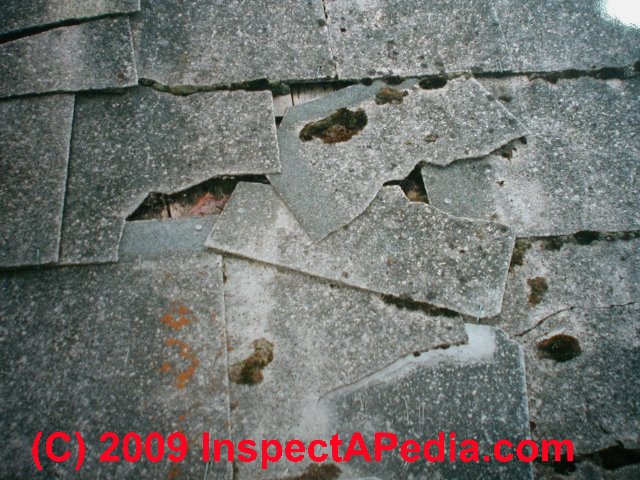
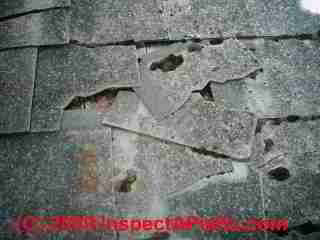 Asbestos Cement Roofing Damage
- POST a QUESTION or COMMENT about cement asbestos roof tiles, shingles, or corrugated panels
Asbestos cement roofing wear & damage signs:
This article provides a photo guide and text that can identify the condition of cement asbestos roofing products like asbestos-cement roof shingles.
Our page top photo shows a cement-asbestos roof that is worn out and leaky. Asbestos cement roof shingles were in popular use in the U.S. from the 1920's (est) through the 1960's (est) and were sold in the U.S. into the 1970's and according to some sources even in the 1980's.
InspectAPedia tolerates no conflicts of interest. We have no relationship with advertisers, products, or services discussed at this website.
- Daniel Friedman, Publisher/Editor/Author - See WHO ARE WE?
Wear Signs On Cement Asbestos Roofs

Discussed here: Indicators of wear and age of cement asbestos roofing materials: shingles, corrugated, sheets. Asbestos Cement or Fiber Cement Failure Class Action Lawsuit & Settlements. Cal-Shake® Roofing Class Action Lawsuit - 1986-1995 Roofs.
Hardi-Shake Roofing Class Action Lawsuit & Settlement. Fiberboard & Fiber Cement Roof Shingle Warranty Claims Companies & Websites.
The mixture of asbestos fibers and portland cement to form a hard material that was was durable and fire resistant is credited to Ludwig Hatschek who, in 1900, came up with the name Eternit associated with a U.S. producer of these products.
The typical life expectancy of an cement asbestos shingle roof was given as 30 years, But we have seen these roofs that were now 50 years old in good condition. Typical roof wear or failure patterns are either failure of the shingle fasteners or broken and falling shingles.
[Click to enlarge any image] Photo: old corrugated asbestos-cement roofing on a farm building located at at Brinstone Farm, in St. Weonards, Herefordshire, UK.
Here are signs of trouble with asbestos-cement roofs:
- Active roof leaks - showing up in the attic or living area
- Broken cement asbestos roofing shingles (at the left of my hand in the photo above), possibly leaving exposed openings or nails - roof leaks (patch with sheet metal if necessary). Do not try walking on an asbestos cement shingle roof - you'll almost certainly break shingles at every step. (Page top photo).
- Freeze-thaw damage: some modern reinforced fiber cement roof shingles are not intended for use in freezing climates and may lack resistance to frost damage.
That's why we don't like leaving moss on shingles. If you are buying replacement fiber-cement shingles to repair an asbestos-shingle roof, check with the manufacturer about the suitability of the product for your location. - Missing roofing shingles, probably leaving exposed roof sheathing and leaks
- Moss growing on the roof: we don't like seeing heavy moss or lichens or even leaves or pine needles on a building roof because these hold moisture which can speed the wearing out process, especially in freezing climates.
Moss or lichens on a roof, especially the moss (lichens are hard to remove) can be reduced using industrial cleaners (like deck cleaner) if the contractor works carefully, or even by light brushing; usually we leave moss or lichens alone on an older roof as we are afraid of causing more damage than good. - Mold and staining on roofs (mildew does not grow on roofs) is a mostly cosmetic concern that can be addressed by light gentle spray cleaning with a mildewcide or deck cleaner; be careful not to cause roof damage by too-aggressive use of a power washer.
You can gradually kill off and prevent future moss or lichens or mold on most roof surfaces by installing aluminum or copper strips along the width of the roof near the ridge. Metal salts washing down the roof seem to kill off moss and lichens and most molds.
You can convince yourself of the efficacy of this trick by simply noticing how often a roof surface is clean of moss and lichens below areas of metal flashing that are washed by rain.
See ALGAE, FUNGUS, LICHENS, MOSS on ROOFS
and
also ALGAE STAINS on ROOFSfor details. - Power washed asbestos cement shingles or corrugated roofing: As we discuss
at POWER WASHING ROOFS we do not recommend power-washing asbestos-cement nor any other roofing.
See BLACK STAIN REMOVAL & PREFVENTIONfor advice on diagnosing, cleaning, and preventing stains on roofing. - Prior repairs using tar, flashing cement - not a durable remedy, leaks likely
- Prior roof leaks showing up in the attic or living area, possibly repaired in a less than durable manner.
- Roof-over or re-cover limitations for fiber-cement roofs: NRCA says that some fiber-cement roofing products may not be suitable for a "roof-over" application; some roofing manufacturers permit roof-overs with their shingles, but the placement of any new roofing material on an old surface which is not smooth risks future shingle breakage, damage, and leaks.
A "tear off" of the old roof is always a better roofing job (and it about doubles the cost). - Slope limitations: beginning in about 1996 the NRCA recommended a minimum slope of 4 in 12 (33%) for these products; use on a low slope means shorter roof life or leaks.
- Underlayment requirements: in snow climates an underlayment is recommended to reduce the chances of ice dam leaks.
See PREVENT ICE DAMS on BUILDINGS - Warranties & Class Actions on Fiber Cement or Asbestos Cement Roof Products -
see WARRANTY & CLASS ACTIONS, Fiber Cement Shingles just below.
For other types of roofing failures, warranties, class actions,
see WARRANTIES for ROOF SHINGLES.
Also
see ASBESTOS IDENTIFICATION IN BUILDINGS.
Asbestos Cement or Fiber Cement Failure Class Action Lawsuit & Settlements
Cal-Shake® Roofing Class Action Lawsuit - 1986-1995 Roofs
How To Identify Cal-Shake Shakes (Cal-Shake, Cal-Slate, Cal-Clay Roofing)
Cal-Shake Shakes are a fiber cement roofing product made to look like wood shakes. Cal-Shake Inc. also manufactured Cal-Slate and Cal-Clay, both of which are included in this settlement. Cal-Shake Shakes were manufactured as shakes and distributed between 1980 and 1995.
Please review the information below to see if you have Cal-Shake Shakes installed on your roof. If you take the steps suggested below and are still having trouble determining whether you have a Cal-Shake Shake Roof, please call 1-866-844-0600.
Here is a CAL-SHAKE CLAIMS FORM [PDF]
- Ask the roofer who installed your roof.
- Review any invoices, statements, or warranty information that the roofer provided you when the roof was installed or may have been provided to you at the time of purchase by the previous owners of the home.
- Review any home-inspection report you may have received upon purchase of your house, which may contain information on the type of roof installed.
- Look for broken shakes to see whether the logo "Cal-Shake" is embossed on the top half of the shake.
You do not have a Cal-Shake Shake Roof if:
The shakes on your roof are made of wood the cement composite shakes on your roof were manufactured by: American Cemwood, NatureGuard, Terra Shake, FireFree®, Hardie Shake, Monier, Owens Corning MIRA VISTA Protex. [
Protex roof slates or shingles are discussed at WARRANTIES for ROOF SHINGLES - Ed.
To be a member of the New Cal-Shake Settlement Class, your Cal-Shake roof must have been manufactured between February 1, 1986 and March 31, 1995.
The date of manufacture is not marked on the Shake, but if your roof was installed within this period you are probably a member of the New Cal-Shake Settlement Class. People whose roofs were installed very early in this time period might have Old Cal-Shake roofs.
- Web Search 07/12/2010, original source http://www.calshakeclassaction.com/ProductIDnew.html
Hardi-Shake Roofing Class Action Lawsuit & Settlement
HardiShake©, MaxiShake©, and Cemwood© produced by James Hardie Building Products (JHBP) and sold as lifetime roofing, were subject of a class action lawsuit for early roof wear or failures that appeared as softening, breaking, chipping, cracking, delaminating, or color changes. This product series was made of a composite fiber cement shingle designed as a mixture of cement, sand, and wood-cellulose fibers.
On February 14, 2002, the Court granted final approval of the Settlement.
If you own or owned a home or structure with JHBP Roof Shakes, you may be entitled to file a claim for monetary compensation.
A proposed settlement has been reached in a class action lawsuit concerning roofing products manufactured or distributed by James Hardie Building Products, Inc. ("JHBP") under brand names such as HardiShake and HardiSlate, among others.
The settlement establishes a program by which claimants can recover the cost of roof replacement, under the terms of the Settlement Agreement.
Please read the Court Ordered Notice and other materials available at this site explaining your rights including how to register to receive a Claim Form.
If you have additional questions, you may call 1-888-780-8579 or email hardieclaims@gardencitygroup.com
- Web Search 07/12/2010, original source http://www.hardieroofingclaims.com/
List of Fiberboard & Fiber Cement Roof Shingle Warranty Claims Companies & Websites
- MASONITE WOODRUF® ROOFING OR MASONITE OMNIWOOD® SIDING LAWSUIT SETTLEMENT NOTICE - PDF file
- Masonite fiberboard Roof Shingles & Siding:
Information about Masonite roofing products is at MASONITE WOODRUF FIBERBOARD ROOFING. Contact information is at: Chicago, IL, 312-750-0900 . Cass action settlements involving masonite hardboard, omniboard, woodruff shingles.
[Watch out: We found the "official" website www.masoniteclaims.com [image] not useful - basically clicking on its links simply present advertisements - web search 09/28/2010] - Cemwood Roof Shakes:
Information about American Cemwood roofing shakes and related products is at AMERICAN CEMWOOD ROOFING.
Contact information is at: American Cemwood - imitation wood shakes crack, swell and discolor.
The American Cemwood roofing settlement includes Cemwood Shakes, Permatek Shakes, Permatek and Permatek II. Cascade Shake, Trieste Tile, Pacific Slate, Permatek II and Royal Shake. Class action settlement site: www.cemwoodclaims.com or for help identifying Cemwood or Permatek shakes on a roof see cemwoodclaims.com/identify.html Claims administrator: 1-800-708-3266. - FireFree Plus fiber cement Roof Shakes:
Re-Con Building Products roof tiles composed of 2/3 Portland Cement and 1/3 wood cellulose fiber crack, swell and discolor. Cass action settlement site: [Watch out: We found the "official" website www.firefreeclaims.com [Image file] not useful -
basically clicking on its links simply present advertisements - web search 09/28/2010 & 03/01/2011]
Re-Con Building Products, Inc., a subsidiary of Stone Mountain Holdings, Inc., went out of business and into receivership in October, 2007.
Also see Fire Free Plus Roofing, 4850 SW Scholls Ferry Road # 203, Portland, OR 97225-1692, Tel: (205) 879-5420 - Also see JAMES HARDIEPLANK® FC SIDING
- George Podrug provided Masonite Woodruf™ roofing information for home inspectors in 1999.

...
Reader Comments, Questions & Answers About The Article Above
Below you will find questions and answers previously posted on this page at its page bottom reader comment box.
Reader Q&A - also see RECOMMENDED ARTICLES & FAQs
Do HardiShakes Contain Asbestos?
Question: I am trying to find out if the old Hardie Shake shingle contained any asbestos?
Reply: Hardie Shakes, Asbestos? Unlikely - Wood Fiber Based Products are Not Asbestos
Modern HardieShake shingles are a [wood-] fiber cement product produced by mixing sand, wood fibers, and cement, rolled to about 1/4" thick and laminated to resist moisture. HardiShake shingle failures manifest as cracked shingles and on older roofs that we have inspected, softening, flaking, and delaminating.
Asbestos fibres would not be expected to be used in wood fiber based products: for example these wood fiber based cementious shingles were designed specifically in search for a replacement for cement-asbestos shingles. So we would not expect to find asbestos in a wood-fiber shingle product.
You should contact James Hardie Building Products in the U.S. or other countries directly for product details, brochures, and installation information.
James Hardie was indeed involved in asbestos liability claims regarding asbestos as we discuss at James Hardie Company, Asbestos, Fiber Cement Siding, & HIstory found in our article
(Asbestos production, distribution, and used in building products, and more obscure, asbestos was used on occasion in certain carpet paddingmade from recycled bags and asbestos waste was used in driveways and garage floors).
Also see CARPETING & INDOOR AIR QUALITY
On 2017-02-23 by michelle - I am not sure what my siding is
I am not sure what my siding is i do not believe it asbestos being that it was installed in 1980s it looks like roofshingles used on sides it has like a backboard of cardboard type material
It has like stones on it gravel grey white orgional ,i painted it with a red cheap barn paint but it washed off partly i need go over it again.keep taxs lower i believe by not looking perfect i poor so to afford it i got stay cheap with only a 8,400 a year income
Been family over 150 yrs .i need know if i can use tar to fill holes and cracked but missing some wind damage.I spent 80.00 paint house myself done allot for it.I know 0 insulation on house at all have heat house room by room feel wind blowing through but i had brand new roof.i wish i had money to reside my house any programs ny state .
Can i use tar to fix holes etc to keep critters out air out.
On 2017-02-23 by (mod) -
Michelle, as the article above is about asbestos cement roofing, you may prefer to see the photos and documentation in our articles on asbestos cement siding (the shingle products are similar)
at
ASBESTOS CEMENT SIDING
You might want to use our CONTACT link to send us photos if your siding is different from the typical asbestos-cement shingles or lap siding.
A backer of cardboard or cellulose won't be asbestos cement, it's more likely an asphalt on hardboard product.
Question: does this roof "sheathing" contain asbestos?
 2018/08/19 Anonymous wrote:
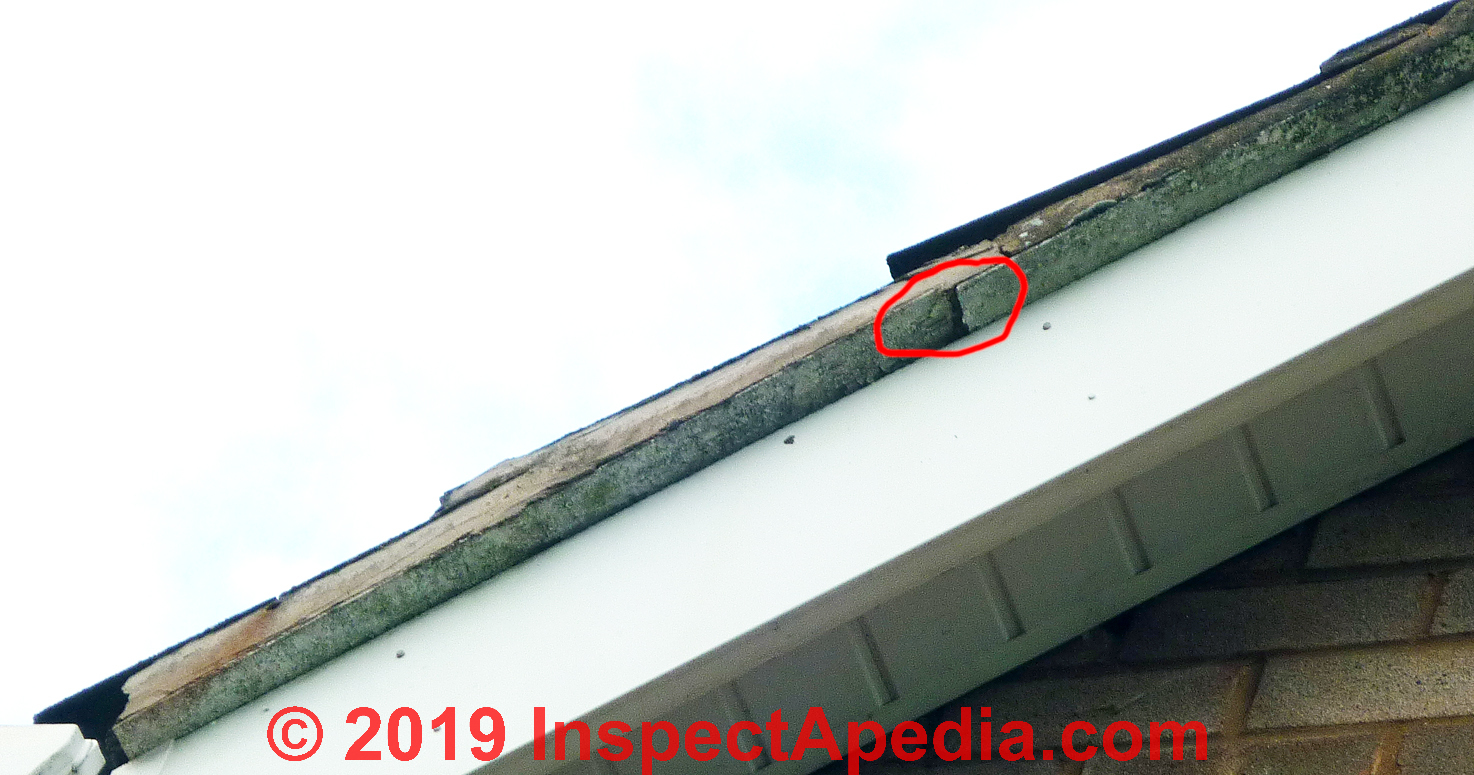
Please could you tell me if you think the roof sheathing in the attached photos is likely to contain asbestos?
Reply:
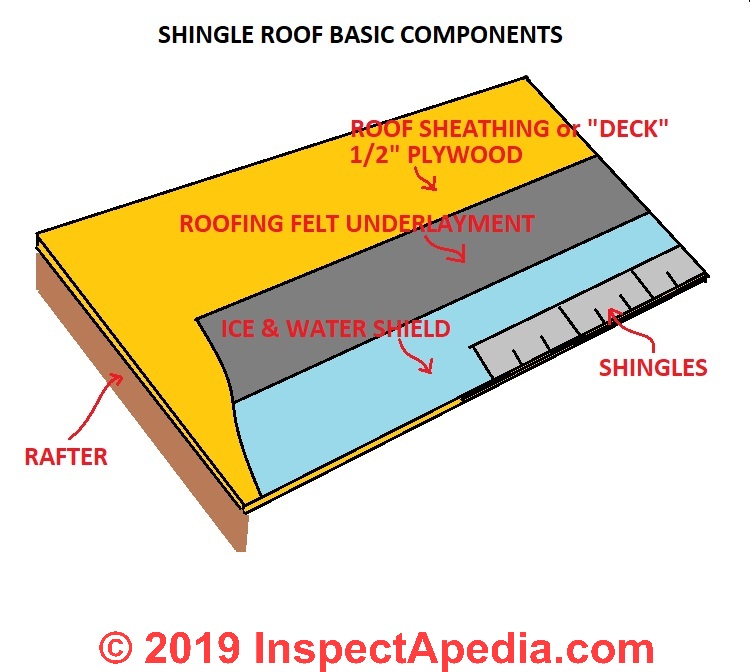
The circled material in your first photo is so thin that I'm doubtuful that it could be actual roof decking; roof decking would be wood (usually) and would be about 1/2" thick.
More likely the material shown is an overhang of fibre cement or asbestos cement shingles that covered the roof as shingles at one time or that was simply installed to provide a drip edge beneath whatever is actually covering your roof surface (we haven't seen that yet so we don't know what's on the roof).
What are the country and city where this building is located and when was it constructed?
Reader follow-up: 1963 home in Shropshire England, asbestos cement roof?
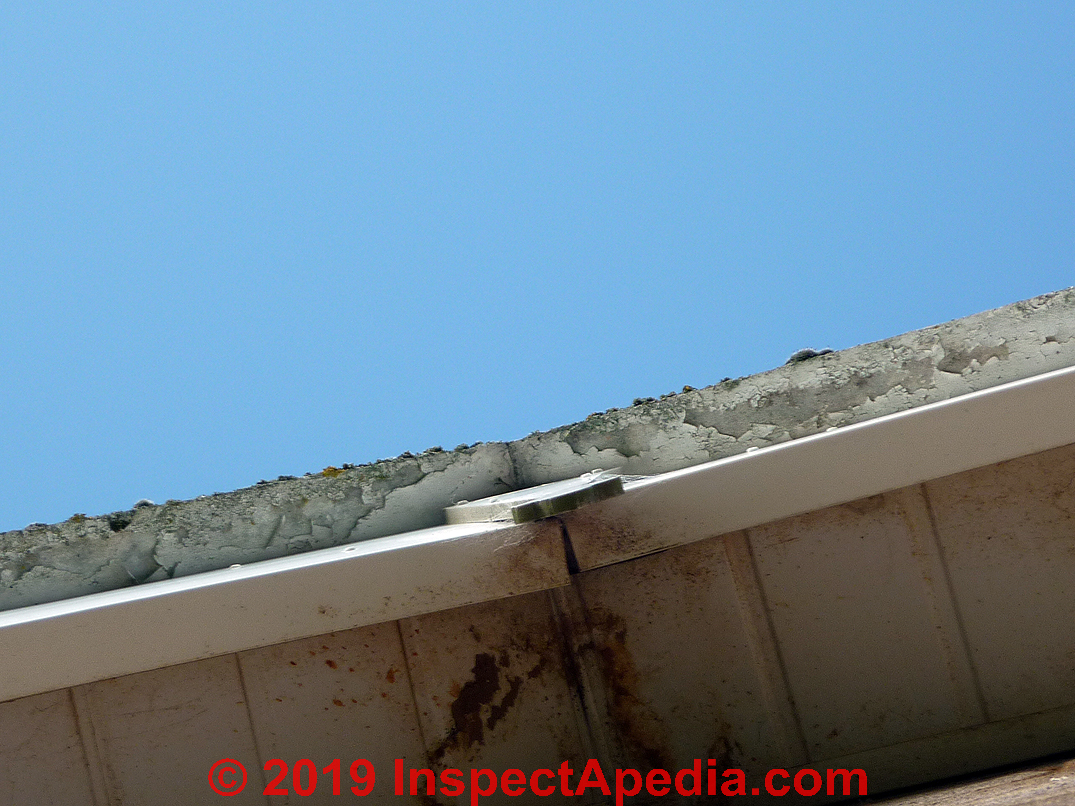 The house is in shropshire in england and was built in 1963.
I am concerned as the paint is flaking off it, is this a danger? i have two young children.
Moderator reply:
**IF** (as I cannot know for certain just from your photo) your home's roof was originally asbestos-cement shingles (is there a view from the attic side?), and IF some portions of that material remain exposed to the weather, then it's possible that there is some shedding of asbestos particles in run-off from the roof onto the soil below.
It would be helpul to see photos of the roof exterior - what is actually on the roof now? And it would be helpful to see what the under-side of this roof looks like from the attic or loft or roof cavity. That might let us know more about the roof construction and covering or shingling materials.
I suspect from your photo that there is an asbestos-cement shingle roof over top of which some other roofing material was later installed.
I suspect from your photo that there remains about a 1" to 1 1 /2" exposure of asbestos cement shingles along the perimeter of the roof and that there is some flaking paint there.
I speculate that the amount of asbestos that would be found on the ground below from that exposure would be beyond detection.
However it's perfectly reasonable to have a contractor prep the undersurface, catching any falling flakes of (lead-? paint) and debris on dropcloths that are then rolled and disposed-of, followed by painting to seal the exposed surfaces.
Watch out: You should NOT have the roof power-washed in an effort to remove loose materials. Doing so can damage the roof and will probably also increase the spread of asbestos onto the ground below, as we explain at
ASBESTOS ROOFING / SIDING POWER WASHING
Watch out: as we warn at OTHER PEOPLE's MONEY if you approach some contractors or consultants with questions like this while expressing both great (and probably inappropriate) fear and at the same time you demand an absolute assurance on their part that there is no risk or that you be given a foolproof risk-free "solution" to your concern, it's going to cost you a lot of money, money spent probably inappropriately and unnecessarily.
FYI this basic roof terminology may be helpful to note the difference betwee roof "decking" or "sheathing" and roof underlayment and roof shingles.
Reader follow-up:
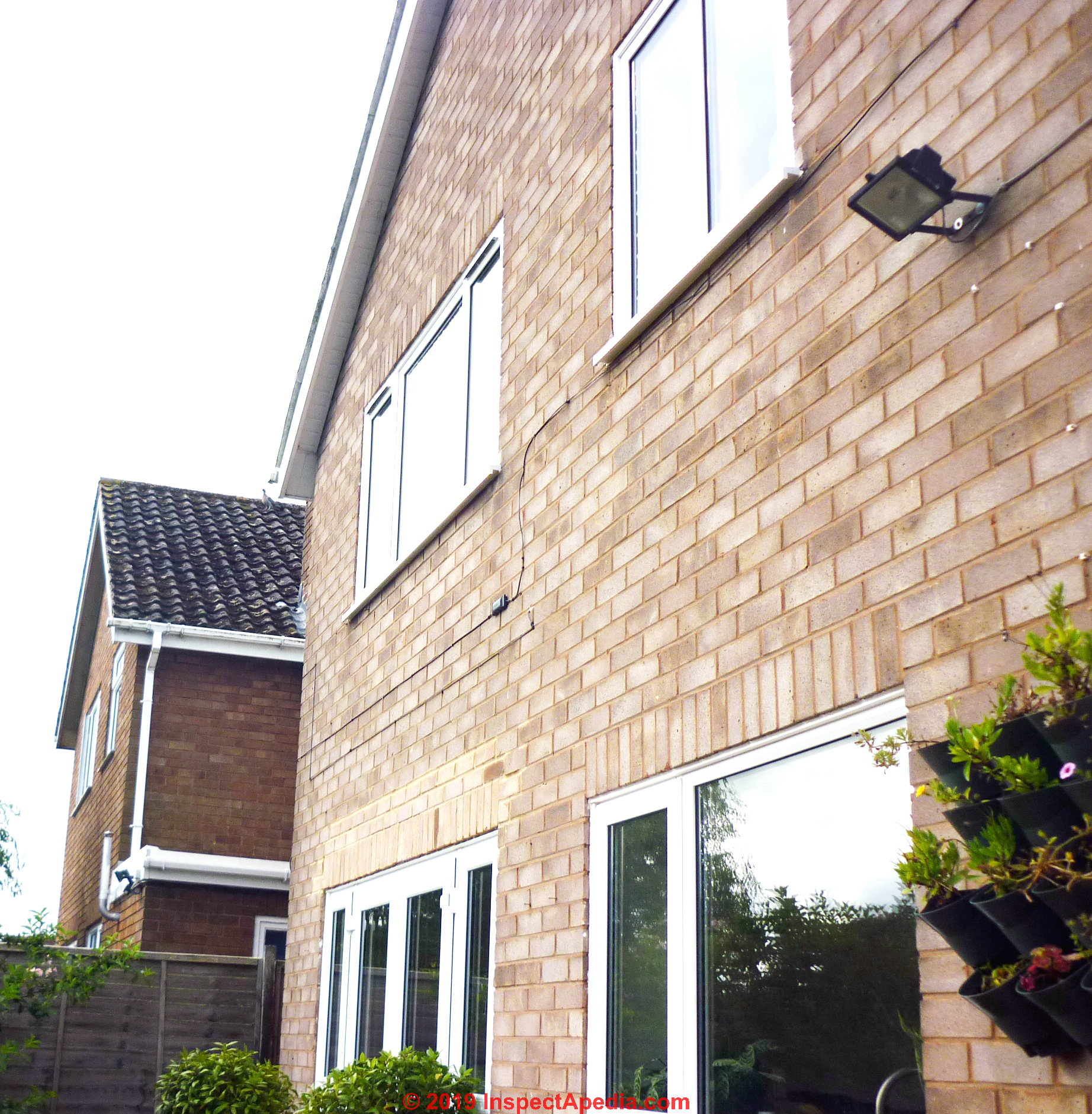
You can see the roof tiles on the attached photo. I have been told that they are just normal concrete tiles? I sent the paint debris off to be tested and it has come back negative for asbestos.
Moderator reply:
Yes those are roofing tiles, not shingles. And it's most-likely they're simply concrete roofing tiles not an asbestos product. See details
at CONCRETE ROOFING.
It's still possible that someone used fiber cement or asbestos cement shingles to form the drip edge shown from below in your earlier photos.
A view of any of that roof from below - from the attic side - if there is access, would be helpful.
So far this doesn't look like anything you should be spending a lot on.
Watch out: keep in mind that old paint may be a lead hazard and that testing the paint for asbestos is not equivalent to testing the fibre cement shingles (if that's what's present below those cement roof tiles) for asbestos.
However the quantity and exposure of material is quite small, even if that is an asbestos cement shingle either used as a drip edge or otherwise installed below the concrete tiles.
...
Continue reading at ASBESTOS CEMENT SIDED HOME RESALE or select a topic from the closely-related articles below, or see the complete ARTICLE INDEX.
Or see these
Asbestos-Cement Roofing Articles
- ASBESTOS & FIBER CEMENT ROOFING - home
- ASBESTOS CEMENT OSHA REGULATIONS
- ASBESTOS CEMENT ROOF & SIDING HISTORY
- ASBESTOS CEMENT ROOF REPAIR
- ASBESTOS CEMENT SHINGLE REMOVAL
- ASBESTOS CEMENT SIDING
- ASBESTOS DISPOSAL REGULATIONS
- ASBESTOS LEFT in PLACE in BUILDINGS - MANAGEMENT GUIDES
- ASBESTOS MATERIAL REGULATIONS
- ASBESTOS ROOFING, CORRUGATED
- ASBESTOS ROOFING / SIDING DUST
- ASBESTOS ROOFING / SIDING POWER WASHING
- ASBESTOS ROOFING WEAR SIGNS
- ASBESTOS CEMENT SIDED HOME RESALE
- ASBESTOS TESTING LAB LIST
- ASPHALT ROOF MATERIAL ASBESTOS
- CORRUGATED CEMENT ASBESTOS ROOFING
- FIBER CEMENT PRODUCT MANUFACTURERS
- FIBER CEMENT PRODUCT STANDARDS
- FIBER CEMENT ROOF SHINGLE ASBESTOS TEST RESULTS
- FIRE RATINGS for ROOF SURFACES
- OSHA REGULATIONS, ASBESTOS ROOFING, SIDING
- SIDING HARDBOARD IDENTIFICATION & CLAIMS
Suggested citation for this web page
ASBESTOS CEMENT SHINGLE WEAR SIGNS at InspectApedia.com - online encyclopedia of building & environmental inspection, testing, diagnosis, repair, & problem prevention advice.
Or see this
INDEX to RELATED ARTICLES: ARTICLE INDEX to ASBESTOS HAZARDS
Or use the SEARCH BOX found below to Ask a Question or Search InspectApedia
Or See
INDEX to RELATED ARTICLES: ARTICLE INDEX to BUILDING ROOFING
Or use the SEARCH BOX found below to Ask a Question or Search InspectApedia
Ask a Question or Search InspectApedia
Try the search box just below, or if you prefer, post a question or comment in the Comments box below and we will respond promptly.
Search the InspectApedia website
Note: appearance of your Comment below may be delayed: if your comment contains an image, photograph, web link, or text that looks to the software as if it might be a web link, your posting will appear after it has been approved by a moderator. Apologies for the delay.
Only one image can be added per comment but you can post as many comments, and therefore images, as you like.
You will not receive a notification when a response to your question has been posted.
Please bookmark this page to make it easy for you to check back for our response.
IF above you see "Comment Form is loading comments..." then COMMENT BOX - countable.ca / bawkbox.com IS NOT WORKING.
In any case you are welcome to send an email directly to us at InspectApedia.com at editor@inspectApedia.com
We'll reply to you directly. Please help us help you by noting, in your email, the URL of the InspectApedia page where you wanted to comment.
Citations & References
In addition to any citations in the article above, a full list is available on request.
- Asbestos products and their history and use in various building materials such as asphalt and vinyl flooring includes discussion which draws on Asbestos, Its Industrial Applications, D.V. Rosato, engineering consultant, Newton, MA, Reinhold Publishing, 1959 Library of Congress Catalog Card No.: 59-12535 (out of print).
- "Handling Asbestos-Containing roofing material - an update", Carl Good, NRCA Associate Executive Director, Professional Roofing, February 1992, p. 38-43
- EPA Guidance for Controlling Asbestos-Containing Materials in buildings, NIAST, National Institute on Abatement Sciences & Technology, [republishing EPA public documents] 1985 ed., Exposure Evaluation Division, Office of Toxic Substances, Office of Pesticides and Toxic Substances, U.S. Environmental Protection Agency, Washington,D.C. 20460
- EPA, ASBESTOS IN YOUR HOME [PDF] - U.S. EPA, Exposure Evaluation Division, Office of Toxic Substances, Office of Pesticides and Toxic Substances, U.S. Environmental Protection Agency, Washington,D.C. 20460
- Michael D. Coday, (817) 781-9982, a for-fee ($1000 - $3000) roofing claims consultant, original source http://www.find-a-roofing-contractor.com/Hardishake-Guaranteed-Replacement.html - web search 07/12/2010
- James Hardie Building Products, James Hardie CustomerLink™ Service Centre, 10 Colquhoun Street, Rosehill NSW 2142, Tel: 13 1103, Outside Australia 61 2 8837 4709, Fax: 1 800 818 819. Hardie has operations in Australia, Asia, Canada, Europe, New Zealand, United States, and the Philippines. The company is a significant producer of fiber cement siding and backerboard. Email: info@JamesHardie.com and Website https://www.jameshardie.com/
- NRCA Roofing and Waterproofing Manual, 4th Ed., available from the National Roofing Contractors' Association.
- "Tips for working with fiber-cement roofing products", Thomas L. Smith, AIA, RRC, Professional Roofing, September 1996
- "About Asbestos Cement Roof Shingles", Ann Johnson, at ehow.com, a nice article about the history of this material - November 2008.
- Asbestos Identification and Testing References
- Asbestos Identification, Walter C.McCrone, McCrone Research Institute, Chicago, IL.1987 ISBN 0-904962-11-3. Dr. McCrone literally "wrote the book" on asbestos identification procedures which formed the basis for current work by asbestos identification laboratories.
- Stanton, .F., et al., National Bureau of Standards Special Publication 506: 143-151
- Pott, F., Staub-Reinhalf Luft 38, 486-490 (1978) cited by McCrone
- Our recommended books about building & mechanical systems design, inspection, problem diagnosis, and repair, and about indoor environment and IAQ testing, diagnosis, and cleanup are at the InspectAPedia Bookstore. Also see our Book Reviews - InspectAPedia.
- In addition to citations & references found in this article, see the research citations given at the end of the related articles found at our suggested
CONTINUE READING or RECOMMENDED ARTICLES.
- Carson, Dunlop & Associates Ltd., 120 Carlton Street Suite 407, Toronto ON M5A 4K2. Tel: (416) 964-9415 1-800-268-7070 Email: info@carsondunlop.com. Alan Carson is a past president of ASHI, the American Society of Home Inspectors.
Thanks to Alan Carson and Bob Dunlop, for permission for InspectAPedia to use text excerpts from The HOME REFERENCE BOOK - the Encyclopedia of Homes and to use illustrations from The ILLUSTRATED HOME .
Carson Dunlop Associates provides extensive home inspection education and report writing material. In gratitude we provide links to tsome Carson Dunlop Associates products and services.
 | HOME | ABOUT | ASK a QUESTION | CONTACT | CONTENT USE POLICY | DESCRIPTION | POLICIES | PRIVACY | |
| © 2024 - 1985 Publisher InspectApedia.com - Daniel Friedman | |||||||||