
InspectAPedia® FREE Encyclopedia of Building & Environmental Construction, Diagnosis, Maintenance & Repair |
Question? Just ask us! InspectAPedia
|
 How to Set Priorities for Preventing Building Heat Loss
- POST a QUESTION or COMMENT about the priority of steps to take when cutting heating bills by reducing building heat loss - priority of fixing air leaks, sealing, caulking, insulating, etc.
This article explains the priorities for preventing heat loss in a building.
In what order should we fix drafts, add insulation, tune up heating equipment to save the most on heating cost. How to measure or calculate heat loss (or gain) in a building.
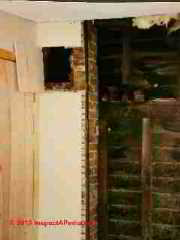
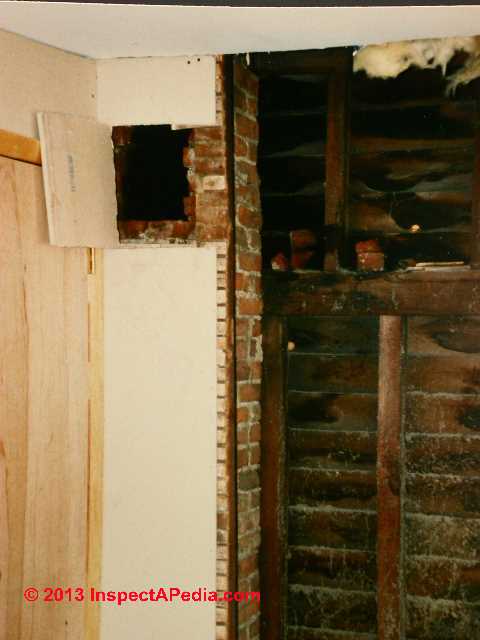
Our page top photo illustrates a large insulation void in the walls of a building renovated by the author (DF). The seller had informed us that the house was "fully insulated". Our repair of this area is shown below.
InspectAPedia tolerates no conflicts of interest. We have no relationship with advertisers, products, or services discussed at this website.
Eight top priorities when working to make a building energy efficient, warm, or cool?
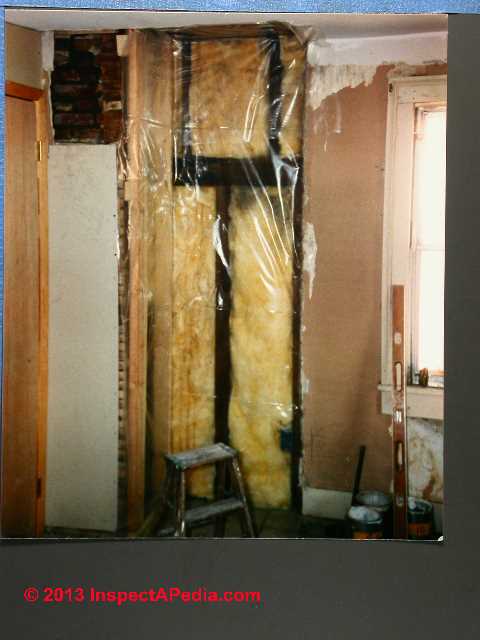 Our house renovation wall photo (left) shows how we insulated the wall cavity that had been found vacant (photo at page top) during building renovations.
If we had not had other reasons to strop the walls in this room (loose falling plaster) we'd have considered blowing-in cellulose insluation - leaving the walls more nearly intact.
Watch out: on this and other older homes we renovated I often found voids in "blown-in" insulated walls where installers had not anticipated wall cavity blockages formed by diagonal bracing or fire stopping.
When the object is to make a building more energy efficient, and before any more sophisticated analyses are performed using thermography, insulation evaluations, or even calculations of areas, "R" values, "K" values, or "U" values (defined below), remember this order of concerns when working for building efficiency.
The order of magnitude of sources of un-wanted heat loss in a building are pretty much this:
1 - Close open windows or doors when a building is being heated or cooled by other than "natural means" (like using fans, summer breezes or evaporative coolers in windows). Where older windows are leaking air but are otherwise in good condition, it may be most-economical to install a high quality, well-installed, storm window.
2 - Investigate and cure leaky windows or doors or other openings that are producing drafts; also check for drafty wall or ceiling vent fan openings such as kitchen fans and whole house ceiling exhaust fans that have been left un-covered during the heating season. See BLOWER DOORS & AIR INFILTRATION - how to measure air leaks, equivalent leakage area (ELA), and air changes per hour (ACH) in a building.
Close other obvious building openings where heated air pours out of the structure, such as the whole-house ventilating fan shown in our photo at left.
Watch out: while it makes complete sense to make an insulated cover for the whole house venting fan shown in our photo, if you forget to remove the fan cover before turning this device back on you are inviting a house fire: if fan blades jam the fan cover and stop the motor it may overheat.
 So don't just throw loose insulating bats over the fan. Some builders construct a lightweight styrofoam cover in hopes that if some fool turns on the fan without removing the cover the fan will blow the cover aside. We like to install a plastic "OFF" lock on the fan switch when a cover is in place.
3 - Top Floor Priorities of placing or improving building insulation: Investigate and make sure that the top floor ceiling or attic floor (or cathedral ceilings) have been insulated, with no insulation voids or areas where insulation was removed or omitted.
See INSULATION INSPECTION & IMPROVEMENT
4 - Wall insulation priority: Investigate and consider installing or adding wall insulation.
5 - Building perimeter insulation: investigate and insulate any other un-insulated building perimeter areas such as the building rim joist or band joist accessed from a basement or crawl space.
6 - Insulate under floors over un insulated crawl spaces (we prefer to make the whole crawl space an enclosed and conditioned space).
7 - Insulate building foundation walls below grade in basements or in conditioned-space crawlspaces.
8 - Investigate the efficiency and state of tune of the building's heating or cooling equipment, including boiler or furnace and the condition of the heating or cooling delivery system (baseboards or ductwork, for example). (Warning: have heating systems cleaned and tuned by an expert before accepting a measurement of the system's efficiency.)
How to Really Foul Up a Radiant Heat Concrete Floor Installation - Mistakes to Avoid
The full text version of this article has been relocated
to RADIANT HEAT FLOOR MISTAKES
where we describe installation specifications for radiant heat flooring in a poured concrete slab along with a detailed report of just how bad a radiant heat floor slab installation can be. The article's conclusions include this insulation advice:
- Insulate below the floor slab
- Insulate the slab perimeter, making sure that the insulation design does not rely on foam placed against the slab perimeter and extending above grade up to siding where it will invite termites or carpenter ants into the structure
- Place the radiant heat tubing at the industry-recommended depth down from the surface of the slab. Typically the maximum depth that tubing should be placed in a concrete floor slab is 2" down from the finished floor surface.
- If you cannot be present at the job site at critical stages in construction, find someone knowledgeable who can inspect for you before the work continues
- If your contractor is an opinionated bully, find someone else as soon as possible, even if his or her other work was good.
...
Continue reading at HEAT LOSS R U & K VALUE CALCULATION or select a topic from the closely-related articles below, or see the complete ARTICLE INDEX.
Or see these
Recommended Articles
- ENERGY SAVINGS in BUILDINGS - home
- AIR CHANGE RATE ACH HEAT SAVINGS
- AIR LEAK DETECTION TOOLS
- AIR LEAK SEALING PROCEDURE
- ENERGY AUDIT, HOW TO USE
- ENERGY SAVINGS MAXIMIZE RETURNS ON
- ENERGY SAVINGS PRIORITIES
- ENERGY SAVINGS RETROFIT CASE STUDY
- ENERGY SAVINGS RETROFIT LEAK SEALING GUIDE
- ENERGY SAVINGS RETROFIT OPTIONS
- ENERGY STAR PROGRAM
- ENERGY USE MONITORING, SOLAR
- HEATING COST SAVINGS METHODS
- HIGH MASS TRADEOFFS, HEATING vs COOLING
- HOUSE DOCTOR, HOW to BE
- TIMERS for ELECTRIC WATER HEATERS
- VENTILATION, BALANCED HEAT COST SAVINGS
- HEAT LOSS INDICATORS where is the building losing heat during the heating season, or gaining un-wanted heat during the cooling season
- HEAT LOSS R U & K VALUE CALCULATION for a guide to calculating heat loss (or gain) rates for buildings and building insulation.
- INSULATION INSPECTION & IMPROVEMENT - home
Suggested citation for this web page
HEAT LOSS PREVENTION PRIORITIES at InspectApedia.com - online encyclopedia of building & environmental inspection, testing, diagnosis, repair, & problem prevention advice.
Or see this
INDEX to RELATED ARTICLES: ARTICLE INDEX to BUILDING ENERGY SAVINGS
Or use the SEARCH BOX found below to Ask a Question or Search InspectApedia
Ask a Question or Search InspectApedia
Questions & answers or comments about the priority of steps to take when cutting heating bills by reducing building heat loss - priority of fixing air leaks, sealing, caulking, insulating, etc. .
Try the search box just below, or if you prefer, post a question or comment in the Comments box below and we will respond promptly.
Search the InspectApedia website
Note: appearance of your Comment below may be delayed: if your comment contains an image, photograph, web link, or text that looks to the software as if it might be a web link, your posting will appear after it has been approved by a moderator. Apologies for the delay.
Only one image can be added per comment but you can post as many comments, and therefore images, as you like.
You will not receive a notification when a response to your question has been posted.
Please bookmark this page to make it easy for you to check back for our response.
Our Comment Box is provided by Countable Web Productions countable.ca
Citations & References
In addition to any citations in the article above, a full list is available on request.
- Vermiculite Building Insulation & Asbestos
- Our recommended books about building & mechanical systems design, inspection, problem diagnosis, and repair, and about indoor environment and IAQ testing, diagnosis, and cleanup are at the InspectAPedia Bookstore. Also see our Book Reviews - InspectAPedia.
- In addition to citations & references found in this article, see the research citations given at the end of the related articles found at our suggested
CONTINUE READING or RECOMMENDED ARTICLES.
- Carson, Dunlop & Associates Ltd., 120 Carlton Street Suite 407, Toronto ON M5A 4K2. Tel: (416) 964-9415 1-800-268-7070 Email: info@carsondunlop.com. Alan Carson is a past president of ASHI, the American Society of Home Inspectors.
Thanks to Alan Carson and Bob Dunlop, for permission for InspectAPedia to use text excerpts from The HOME REFERENCE BOOK - the Encyclopedia of Homes and to use illustrations from The ILLUSTRATED HOME .
Carson Dunlop Associates provides extensive home inspection education and report writing material. In gratitude we provide links to tsome Carson Dunlop Associates products and services.
 | HOME | ABOUT | ASK a QUESTION | CONTACT | CONTENT USE POLICY | DESCRIPTION | POLICIES | PRIVACY | |
| © 2024 - 1985 Publisher InspectApedia.com - Daniel Friedman | |||||||||