
InspectAPedia® FREE Encyclopedia of Building & Environmental Construction, Diagnosis, Maintenance & Repair |
Question? Just ask us! InspectAPedia
|
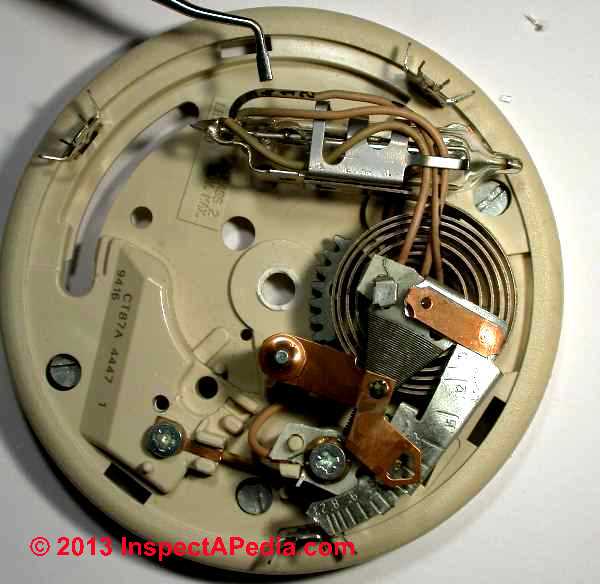
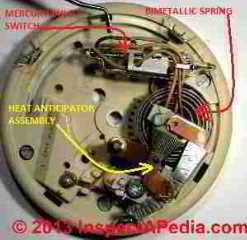 How & Why to Adjust the Heat Anticipator on a Room Thermostat
Heat Anticipator Setting Numbers
- POST a QUESTION or COMMENT about heating thermostat heat anticipators
Thermostat heat anticipator function & adjustment guide.
What Should Be the Heat Anticipator Settings on a Room Thermostat?
Tthis article explains what a heat anticipator is on a wall thermostat, where to find it, what it looks like, how & why we adjust the heat anticipator, & what settings to use.
We list the recommended heat anticipator settings.
We explain how to test the heat anticipator on a thermostat, and we describe the conditions necessary for a heat anticipator on a room thermostat to work properly in the first place. We also explain the difference between the job of the thermostat heat anticipator and the differential settings on a heating system aquastat or similar control.
InspectAPedia tolerates no conflicts of interest. We have no relationship with advertisers, products, or services discussed at this website.
- Daniel Friedman, Publisher/Editor/Author - See WHO ARE WE?
How & Why to Adjust the Heat Anticipator on a Room Thermostat
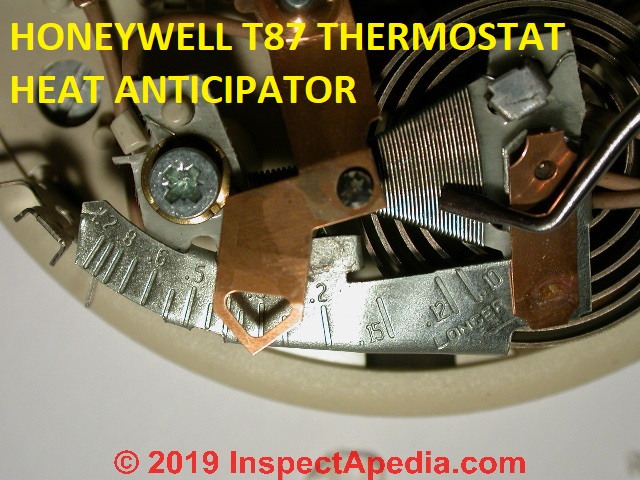
What is a thermostat heat anticipator?
The purpose of a thermostat heat anticipator is to "de-sensitize" the thermostat so that when actual room temperature is hovering close to the set temperature on the thermostat, the thermostat switch won't keep switching the air conditioner or heating system on and off too often - which can damage the equipment.
Properly adjusted a heat anticipator also prevents the room from getting warmer than the thermostat set temperature, and it prevents the heat from shutting off before the room has reached the thermostat set temperature.
In our photo you can see our pointer hovering over fine nichrome wire wound around a triangular piece of plastic (forming a variable heating element) and you can see at center of the photo a flat copper arm which can be moved to slide a contact to different positions along the wound variable resistor.
The triangular pointer on the copper arm in my photo has an opening which helps read the exact position to which the heat anticipator has been set.
[Click to enlarge any image]
Behind the pointer you can see a silver scale with different amp readings which are explained below. Inserting a small tool or pencil point into the open copper triangle allows sliding the antipator lower towards higher or lower numbers.
On this Honeywell T87F heat anticipator scale settings range from 0.10 to 1.2 Amps.
As you'll read in these articles, other thermostat heat anticipators may use different ranges of Amps and many modern digital and programmable thermostats don't use a heat anticipator at all.
The heat anticipator scale:
If you click to enlarge the photo above you can see the amperage level to which this heat anticipator had been set when we took this picture.
Which Way Do I Move the Heat Anticipator Adjustment?
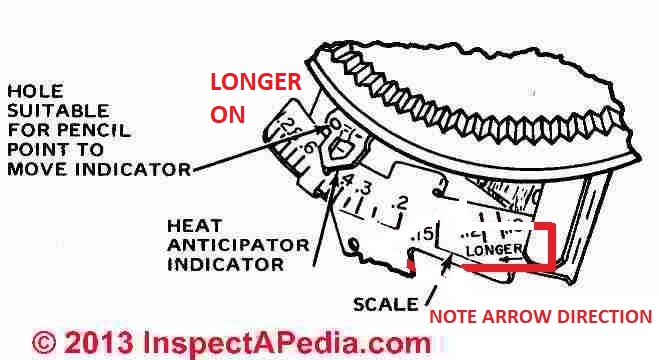
A Honeywell T87 heat anticipator sketch is shown here.
[Click to enlarge any image]
Adjusting the anticipator up or down to higher or lower Amps numbers will lengthen or shorten the heat-on or cooling-on cycle.
Watch out: unless you are having a problem with the thermostat's behaviour, don't fool with the heat anticipator - leave it as it was set by the installer.
But if your heating system is oscillating or "seeking" and flipping the heat (or air conditioner) on and off when room temperature gets close to the thermostat set temperature
OR if heat-on cycles run too long, overheating the room above the thermostat set temp
OR if heat cycles too short and don't bring the room up to the thermostat set temp
THEN yes - the heat anticipator might enjoy being adjusted more properly and you might enjoy the result.
Lower numbers on the Amps scale give a shorter heat-on cycle
The shortest burner-on time will be when the heat anticipator puts out the most heat.
This warms up the thermostat's room temperature sensor and therefore tells the thermostat the room is up to set temperature earliest.
Higher numbers on the Amps scale give a longer heat-on cycle
The longest burner-on time will be when the heat anticipator puts out the least heat, thus does not turn off heat early, thus lets the burner keep running longer .
Really? So why the heck do we see the word "LONGER" at the lower-number end of the heat anticipator scale on some thermostats like the T87?
I think that's where there was room to stamp the word "LON GER" into the steel. But look again more-closely at that arrow inside our red circle.
Notice that ARROW under LONGER? It is pointing to the left towards higher numbers on the scale.
At higher numbers the heat anticipator draws less current so the little heating wire heats up less so the heating system will run longer.
Honeywell's word LONGER and arrow pointing towards higher numbers on the Amps scale tells us that moving the pointed to the left to a higher number should give LONGER HEAT ON time or LESS heat heating of the heat anticipator.
Why?
Take a closer look at the flat-wound nichrome wire heat anticipator and the path of current flow.
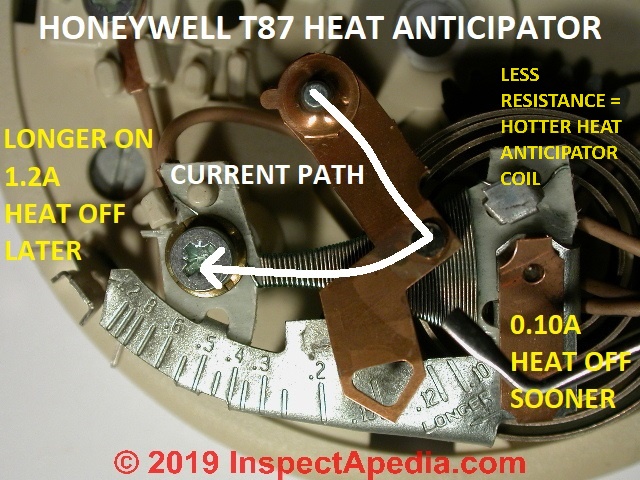
When the pointer is towards the right - lower - towards the 0.1A end of the scale, more current flows through the length of nichrome wire - providing more heat output at the heat anticipator, thus a shorter burner-on time. (Jaffe 1997)
When the pointer is moved towards the left - higher - towards the 1.2A end of the scale, less current is flowing - providing less heat output at the heat anticipator thus a longer burner-on time.
SlantFin: Another Heat Anticipator Example
A less-confusing illustration of a heat anticipator is this SlantFin thermostat - actually manufactured by Honeywell.
Rather than a wind of wire around a triangular carrier (as inthe T87 above) the SlantFin thermostat heat antipator is a single strand of nichrome wire is bent into a circular shape.
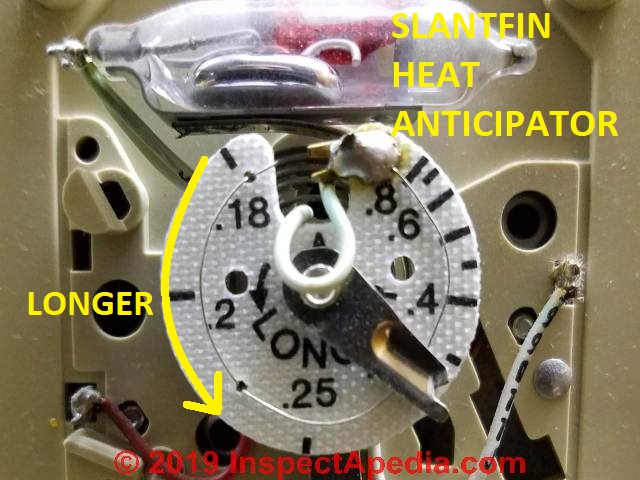
In our photo you'll see that the word LONGER includes an arrow pointing to HIGHER amp readings.
At the lower (shorter heat-on) end of the scale is .18A and at the higher (longer heat-on) end of the scale is 0.8A.
Current flow is through the rivet in the center of the metal pointer, along the length of the metal pointer to its point of contact on the nichrome wire, and then through the nichrome wire to that solder blob that connects the .8A end of the heat anticipator-heater to the white wire.
The longest heating cycle
or heat-on at this thermostat will at the 0.8A current (Amps) end of the scale. The thermostat's bimetalic spring room temperature sensor (behind the white dial) won't be getting much extra warmth from the heat anticipator.
The shortest heating cycle
or heat-on time at this SlantFin thermostat should be at the 0.18 end of the scale - more heat from the heat anticipator, more pre-warming of the bimetallic spring, earlier heat-off.
Watch out: on most heat anticipators there will be both an Amps Scale (initially set to match the measured amperage of the thermostat circuit) AND an arrow telling you which way to move the pointer for a longer heat-on cycle.
Don't simply trust "left or right" on your thermostat - read the scale and notice the arrow. .
Depending on your model thermostat and where the heat anticipator is found, left and right or up and down might be reversed from the images here, and some of the thermostat heat anticipators we examined have only a numeric scale, no arrows, so it's important to follow the manufacturer's instructions.
Below we provide specific heat anticipator setting recommendations as well as a description of which way to move the heat anticipator lever to change the thermostat's behavior to address room temperature overshoot. You will see that Honeywell's own instructions contradict one another depending on the thermostat model.
What Should Be the Heat Anticipator Settings on a Room Thermostat?
If your heating system seems to be working OK, without excessive burner on-off cycling and without troubling room temperature overshoot, leave the heat anticipator alone.
If however you are an installer and want to precisely set up the heat anticipator on a thermostat (if your thermostat has this feature), there are three ways you can choose the initial Amps setting.
The initial settings are intended simply to make sure that we don't send too much or too little current (amps) through the little heating coil or wire that comprises the heat anticipator.
Later we can fine-tune the heat anticipator by setting it further up or down if the room temperature at the end of the heat-on cycle is overshooting (heat is on too long) or under-shooting (heat is not on long enough) the thermostat setting.
- Use the manufacturer's recommended thermostat heat anticipator settings based on printed control circuit data.
The heat anticipator Amps setting should be set to match the current (Amp) rating stamped on the name plate of the primary control that the thermostat is controlling.
Below on this page
at ANTICIPATOR SETTINGS by HEATING CONTROL
we give a table of heat anticipator settings recommended by Honeywell or another manufacturer. - Set the heat anticipator according to the Type of Heating System
Below we include our version of Honeywell's
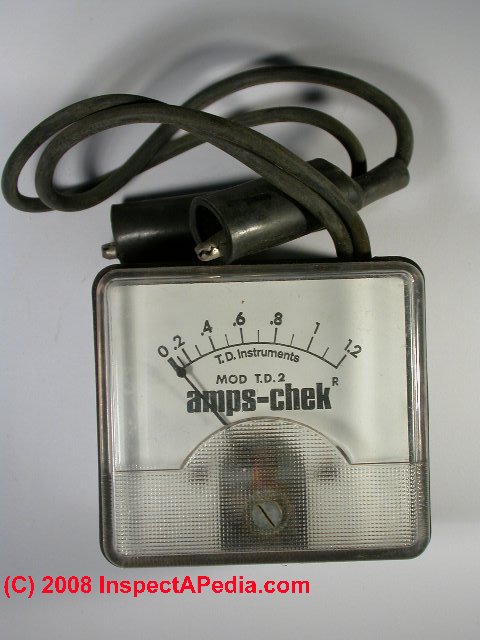
ANTICIPATOR SETTINGS by HEATING SYSTEM TYPE - Actually measure the thermostat circuit's current and set the heat anticipator to match that level.
Details of how to use a mini ammeter to actually measure the heating system control circuit amps are in our separate article found
at HEAT ANTICIPATOR SET & TEST by AMMETER.
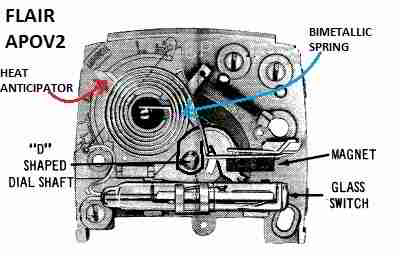
Our sketch above, adapted from a Flair APVO2 two-wire thermostat whose the heat anticipator level and scale (red arrow) on the left side of the device.
Interestingly the company referred to this as a "fixed anticipation" thermostat, but its installation instructions indicated a screw-secured heat anticipator pointer and an amperage scale on the device.
This thermostat was designed for use with zone valves or damper actuators.
Set the Heat Anticipator Based on Type of Heating System
Table of General Heat Anticipator Settings |
|
| Heating System Type | Heat Anticipator Setting Amps |
| Electric heat | 0.3 A |
| Hot Water Heat - radiators, baseboards, hydronic |
0.8 A |
| Steam heat |
1.2 A |
| Warm Air, High Efficiency | 0.8 A |
| Warm air, Standard | 0.4 A |
Notes to the table above - fine tuning the heat anticipator
Forced warm furnaces continue to blow warm air for a minute or so after the thermostat stops calling for heat - in a purge heat from the furnace heat exchanger.
Steam heat radiators have thermal mass and in my OPINION also tend to overshoot the thermostat set temperature but the presumption of the table above is that they don't.
1. Heat on too long: If the furnace stays on beyond the set temperature on the thermostat, move the heat anticipator
DOWN by 0.1 A - lower number = shorter heat-on cycle
Watch out: if you set the heat anticipator too low that causes too much current to flow through the heating coil and will creat too much heat inside the thermostat, shutting the system down too early - before the living space actually comes up to temperature.
This can lead to service calls complaining that the heat never reaches the thermostat set temperature. (Jaffe 1997 cited in REFERENCES)
2. Heat cycle too short: if the furnace shuts off before the set temperature on the thermostat has been reached, move the heat anticipator pointer
UP by 0.1A - higher number = longer heat-on cycle
Watch out: if you set the heat anticipator too high the heat anticipator doesn't draw enough current to heat up, so the heating system shuts off too late - the room overheats.
This too can lead to service calls complaining of overheating beyond the thermostat setting. (Jaffe 1997)
3. Additional heat anticipator settings and details are usually provided on the thermostat installation pamphlet provided by the manufacturer.
Watch out: Honeywell, in instructions for its CT87A,B,J Round Thermostat warns: Never adjust the heat anticipator below 0.3A
Also see HEAT ANTICIPATOR ADJUSTMENT - T87 for more details about how that thermostat heat adjuster is set and why.
Set the Heat Anticipator by Heater Primary Control Amps
Table of Thermostat Heat Anticipator Settings for Honeywell Primary Controls - (60 cycle current) |
|
| Honeywell Control Part Number | Factory Heat Anticipator Setting in Amps |
| Honeywell L8124, Honeywell R8182-D-F,H,J Honeywell R8184G,K,M Honeywell R8185E Honeywell V800A-C Honeywell V801A-C Honeywell V810A-C |
.2 Amps |
| Honeywell RA116, RA117 Honeywell RA816 Honeywell RA817A Honeywell R8184L Honeywell V8254 Honeywell V8280 Honeywell V8292 |
.4 Amps |
| RA817C | .55 Amps |
Notes to the table above
Additional heat anticipator settings and details are usually provided on the thermostat installation pamphlet provided by the manufacturer.
The settings shown here are not likely to be correct for other brands or models of thermostats.
Use a Mini- Ammeter to Set & Test the Heat Anticipator
Watch out: as Honeywell warns thermostat installers:
This thermostat has an adjustable heat anticipator and will operate properly only if this [heat anticipator resistor type] tiny in-thermostat heater is adjusted to match the current of the valve or relay.
Set the heat anticipator to the heating boiler or furnace manufacturer's recommendation,
or if you don't know that number, you can either leave the heat anticipator at its factory setting (recommended) or you can use the heat anticipator setting table above, or finally, you can use a mini-ammeter to actually measure the heating thermostat circuit and to fine tune the heat anticipator setting, as we discuss in detail
at HEAT ANTICIPATOR SET & TEST by AMMETER
For a detailed explanation of how the thermostat heat anticipator actually works
see HEAT ANTICIPATOR OPERATION.
Manufacturers of Room Thermostats Including a Heat Anticipator
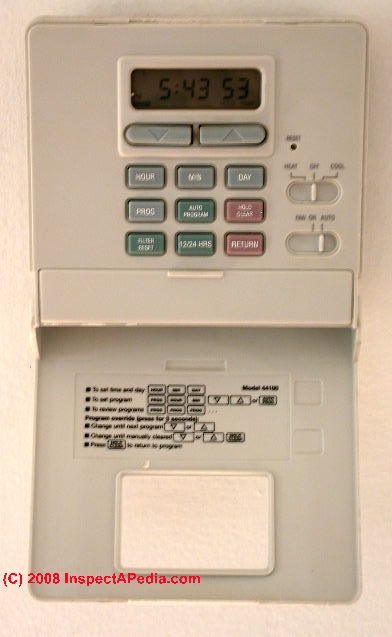 This has moved to HEAT ANTICIPATOR THERMOSTAT SOURCES
What if my Thermostat Does Not Have a Heat Anticipator? Do I need one?
Well you may not need a heat anticipator in your thermostat.
As we discuss in detail
at HEAT ANTICIPATOR THERMOSTAT SOURCES,
for many types of heating system distribution, heat source, and heat controls, you don't need a heat anticipator, while for certain types of heating systems (such as those using heavy cast iron radiators) using a heat anticipator can provide important improvements in heating system operation.
...
Reader Comments, Questions & Answers About The Article Above
Below you will find questions and answers previously posted on this page at its page bottom reader comment box.
Reader Q&A - also see RECOMMENDED ARTICLES & FAQs
On 2020-04-10 by Larry - heat on my heat pump will not turn off
The heat on my heat pump will not turn off when I turn the honneywell thermostat off
On 2020-04-10 - by (mod) -
Larry
Let's step through the diagnostics at HEAT WON'T TURN OFF
let me know how that works for you and don't hesitate to ask follow-up questions
On 2019-10-13 by Rufus - hard to get my heat to stop short-cycling
In my case, I needed to go to an extreme to stop the short cycling, and on my Honeywell moved the anticipator ALL the way to the left, for the longest run time.
I realize that the Honeywell warns not to go below .3 amps, but are there any concerns with permanently keeping it at the 1.2 amps?
Also, some suggest to try to clean the internals of the thermostat when short cycling happens. I wanted to try that, as my Honeywell is 25 years old. It does not look too bad inside actually, but when they say to clean it, what is the reason? Would dust make the heat anticipator not work? And how to clean? With a Qtip? Or just an airduster? What parts specifically?
Some menion the coil, but the coil is not really exposed with a surface area that can be cleaned. Thank you!
On 2019-10-13 - by (mod) -
Rufus
Watch out: If your furnace is short cycling badly I suspect that the problem is NOT with the heat anticipator nor even the thermostat, but something more fundamental and critical, potentially unsafe.
See examples at FURNACE FAN CYCLES DURING HEAT
On 2019-10-14 Rufus - hard to diagnose this thermostat problem - overheating
Thank you Dan. With so many variables it can be hard to diagnose.
The reason I think it is a thermostat problem is because after it started happening I took off the cover to my old 25 year Honeywell and watched it as things progressed. Because it was only blowing for a minute or so, this did not take long, and I would see that the mercury was moving over in the bulb and turning off what I am assuming you refer to as the "call for heat".
I am assuming that if it was the heat exchanger overheating, and the call for turning off the flames is coming from a controller in the furnace (as opposed to the mercury in the bulb moving), that the problem is with the thermostat.
I'm not an expert obviously, but assume if the shutoff was from overheating in the heat exchanger that the mercury in the bulb would remain in the "on" position, and that the only thing that controls the position of the mercury in the thermostat bulb is the thermostat itself?
On 2019-10-14 - by (mod) -
Thank you for the follow-up.
It's easy to rule the thermostat in or out of any heating system malfunction question for simply removing the thermostat and it's wiring from the equation.That means disconnecting the thermostat wires at the heating system and simply connecting or jumping the two thermostat terminals there. That's the same as a thermostat calling for heat.
On 2019-10-14 by Rufus
Thanks Dan, although I am not sure if I could test a fault in a dirty or malfunctioning heat anticipator this way directly, although I guess I could infer it by seeing if the furnace runs a long time by jumping it while in the basement.
Am I correct in my assumption though that if the furnace was turning off the flames quickly because it was overheating the furnace that such a shut down would not be changing the positioning of the mercury bulb in the Honeywell,
and that in that scenario the mercury in the bulb would still be in the "run" position, trying to call for heat, even though the furnance was forced off by the furnace and is waiting to cool down?
On 2019-10-14 - by (mod) -
Rufus
You might see the bulb move as the room temp is changing,
THe best place to watch is right at the furnace: watch the fan limit control dial when the furnace is running. If you see the dial rotate around to the upper limit and then the furnace stops you know the furnace itself is overheating.
Details are at FAN LIMIT SWITCH TROUBLESHOOTING
and also more explanation of that problem is at
FURNACE FAN CYCLES DURING HEAT

On 2019-03-22 by Anonymous - I want our heat to come ON sooner
Our furnace comes on at a 4 degrees difference I want 2 what can I do to change it
On 2019-04-30 - by (mod) -
An adjustable heat anticipator such as we discuss above on this page will NOT fix this problem - that feature only affects how soon the thermostat turns OFF the call for heat.
Instead, you want to look at other factors that affect how your thermostat responds to a drop in room temperature and what can confuse it. Examples include
- Thermostat is mounted on a warm wall near the furnace
- Thermostat is located in direct sunlight
- Thermostat is located close to some other source of heat
Where can I buy a room thermostat that has a heat anticipator?
This discussion moved to HEAT ANTICIPATOR THERMOSTAT SOURCES
WHERE to BUY a THERMOSTAT with a HEAT ANTICIPATOR
The question of whether or not you need or should want a thermostat that includes a heat anticipator feature is discussed
at DO I NEED a THERMOSTAT with a HEAT ANTICIPATOR?
Heat Anticipator Adjustment 101: Simplified anticipator operation, setting, tweaking & Ohms Law
Honeywell's Instructions for Setting the Heat Anticipator and an explanation of heat, resistance and recap of Ohm's law regarding heat anticipators
have moved to HEAT ANTICIPATOR ADJUSTMENT - T87
...
Continue reading at HEAT ANTICIPATOR ADJUSTMENT - T87 or select a topic from the closely-related articles below, or see the complete ARTICLE INDEX.
Or see HEAT ANTICIPATOR ADJUSTMENT FAQs - questions & answers about how and why to adjust the heat anticipator on some room thermostats, posted originally at this page
Or see these
Recommended Articles
- AMPS MEASUREMENT AUTOMOTIVE DC
- AMPS MEASUREMENT METHODS
- BOILER CONTROLS & SWITCHES
- DEFINITION OF AMPS, ELECTRICAL CURRENT
- DEFINITION OF OHMS, ELECTRICAL RESISTANCE
- ELECTRICAL RESISTANCE vs HEAT GENERATED
- FURNACE CONTROLS & SWITCHES
- HEAT ANTICIPATOR ADJUSTMENT
- HEAT ANTICIPATOR ADJUSTMENT - T87
- HEAT ANTICIPATOR EFFECTS on ROOM TEMPERATURE
- HEAT ANTICIPATOR OPERATION
- HEAT ANTICIPATOR SET & TEST by AMMETER
- HEAT ANTICIPATOR THERMOSTAT SOURCES
- HEAT WON'T TURN OFF
- STEAM HEATING SYSTEMS
- TEMPERATURE RESPONSE of ROOM THERMOSTATS
- THERMOSTAT WIRE CONNECTIONS
- VOLTS / AMPS MEASUREMENT EQUIP
Suggested citation for this web page
HEAT ANTICIPATOR ADJUSTMENT at InspectApedia.com - online encyclopedia of building & environmental inspection, testing, diagnosis, repair, & problem prevention advice.
Or see this
INDEX to RELATED ARTICLES: ARTICLE INDEX to HVAC THERMOSTATS
Or use the SEARCH BOX found below to Ask a Question or Search InspectApedia
Ask a Question or Search InspectApedia
Try the search box just below, or if you prefer, post a question or comment in the Comments box below and we will respond promptly.
Search the InspectApedia website
Note: appearance of your Comment below may be delayed: if your comment contains an image, photograph, web link, or text that looks to the software as if it might be a web link, your posting will appear after it has been approved by a moderator. Apologies for the delay.
Only one image can be added per comment but you can post as many comments, and therefore images, as you like.
You will not receive a notification when a response to your question has been posted.
Please bookmark this page to make it easy for you to check back for our response.
IF above you see " Comment Form is loading comments..." then COMMENT BOX - countable.ca / bawkbox.com IS NOT WORKING.
In any case you are welcome to send an email directly to us at InspectApedia.com at editor@inspectApedia.com
We'll reply to you directly. Please help us help you by noting, in your email, the URL of the InspectApedia page where you wanted to comment.
Citations & References
In addition to any citations in the article above, a full list is available on request.
- Jaffe, James S, THERMOSTAT HEATERS [PDF], Fueloil & Oil Heat with Air Conditioning, February 1997
- [1] Proliphix Corporate Headquarters [Website: proliphix.com] , 3 LAN Drive Suite #100, Westford, MA 01886 Phone: +1.978.692.3375 Toll Free (U.S.): 866-IP-LIVING (866.475.4846) Fax: +1.978.692.3378 - Sales: sales@proliphix.com Marketing: marketing@proliphix.com Customer support: support@proliphix.com http://www.proliphix.com/
- [2] "The Nest Learning Thermostat", Nest Thermostat, 900 Hansen Way Palo Alto, CA 94304, Tel: 855-4MY-NEST, Email: info@nest.com, website http://www.nest.com/, retrieved 1/24/2013.
- [3] Honeywell Controls, the company wants you to use their contact form at this web page: http://www51.honeywell.com/honeywell/contact-support/contact-us.html
Honeywell Consumer Products, 39 Old Ridgebury Road Danbury, CT 06810-5110 - (203) 830-7800
World Headquarters, Honeywell International Inc., 101 Columbia Road, Morristown, NJ 07962, Phone: (973) 455-2000, Fax: (973) 455-4807 1-800-328-5111 - [3a] Honeywell Tradeline T87T Universal Thermostat Installation Instructions for the Trained Service Technician", Honeywell International Inc. Honeywell Limited—Honeywell Limitée 1985 Douglas Drive North 35 Dynamic Drive Golden Valley, MN 55422 Scarborough, Ontario M1V 4Z9, 60-0830—4 G.H. Rev. 8-02, retrieved 12/1/2013 Website: www.honeywell.com
- [3b] Honeywell CT87A,B,J Round® Themostat Low Voltage (15 to 30 VAC) Thermostat and Mounting Hardware Installation Instructions, Honeywell International Inc. Honeywell Limited—Honeywell Limitée 1985 Douglas Drive North 35 Dynamic Drive Golden Valley, MN 55422 Scarborough, Ontario M1V 4Z9, 60-0830—4 G.H. Rev. 8-02, retrieved 12/1/2013 Website: www.honeywell.com
- [4] White Rodgers Thermostats and HVAC controls,
Homeowner information: http://www.emersonclimate.com/en-US/brands/white_rodgers/Pages/wr-homeowner-info.aspx
Contractor information: http://www.emersonclimate.com/en-US/brands/white_rodgers/wr_contractor_info/Pages/white-rodgers-contractor-info.aspx
White Rodgers Product Catalog (don't misspell the company's name as White Rogers Thermostats) -
http://www.emersonclimate.com/Documents/thermostats.pdf - Thermostat Catalog - [5] Domestic Central Heating Wiring Systems and Controls, 2d Ed., Raymond Ward, Newnes, ISBN-10: 0750664363, ISBN-13: 978-0750664363
- [21] Trane TCONT800 Series Touch Screen Programmable Comfort Control Ownes Guide, American Standard, Inc., Troup Highway, Tyler TX 75711, January 2005, Telephone: Customer Service: 1-877-3381, website: www.trane.com
- In addition to citations & references found in this article, see the research citations given at the end of the related articles found at our suggested
CONTINUE READING or RECOMMENDED ARTICLES.
- Carson, Dunlop & Associates Ltd., 120 Carlton Street Suite 407, Toronto ON M5A 4K2. Tel: (416) 964-9415 1-800-268-7070 Email: info@carsondunlop.com. Alan Carson is a past president of ASHI, the American Society of Home Inspectors.
Thanks to Alan Carson and Bob Dunlop, for permission for InspectAPedia to use text excerpts from The HOME REFERENCE BOOK - the Encyclopedia of Homes and to use illustrations from The ILLUSTRATED HOME .
Carson Dunlop Associates provides extensive home inspection education and report writing material. In gratitude we provide links to tsome Carson Dunlop Associates products and services.
 |
HOME | ABOUT | ASK a QUESTION | CONTACT | CONTENT USE POLICY | DESCRIPTION | POLICIES | PRIVACY | |
| © 2024 - 1985 Publisher InspectApedia.com - Daniel Friedman | |||||||||