
InspectAPedia® FREE Encyclopedia of Building & Environmental Construction, Diagnosis, Maintenance & Repair |
Question? Just ask us! InspectAPedia
|
 Chimney Types & Materials
- POST a QUESTION or COMMENT about the different types of chimneys, flues, vents: materials & construction
Guide to types of chimneys found on buildings: this article names and describes the various types of chimneys used on buildings.
These articles on chimneys and chimney safety provide detailed suggestions describing how to perform a thorough visual inspection of chimneys for safety and other defects.
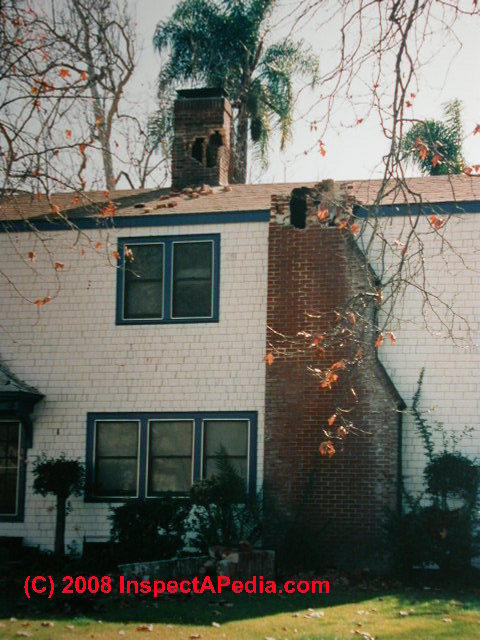
Chimney inspection methods and chimney repair methods are also discussed. Our page top photo shows collapsing brick masonry chimneys taken by the author in Los Angeles, CA following the Northridge Meadows earthquake in 1994.
InspectAPedia tolerates no conflicts of interest. We have no relationship with advertisers, products, or services discussed at this website.
- Daniel Friedman, Publisher/Editor/Author - See WHO ARE WE?
Chimney Types and Chimney Construction Materials
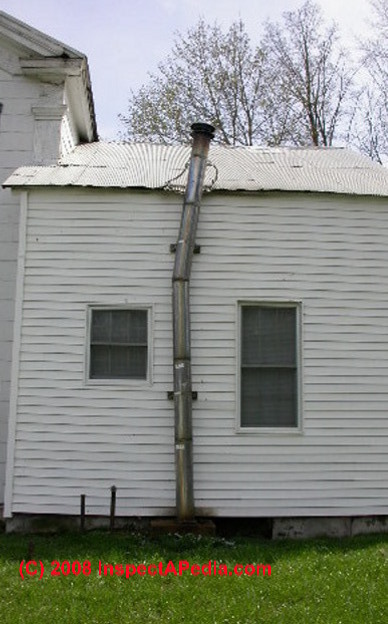
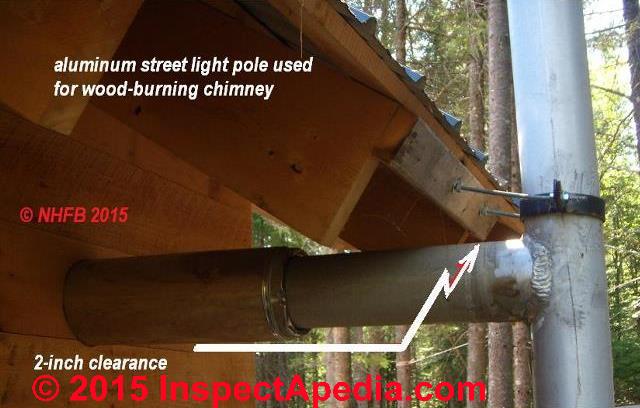 The remarkable chimney shown at left was home made by a building owner who used an aluminum light pole for this purpose.
Watch out: this is not a safe nor approved chimney installation. It's creative, though. The photograph was contributed by frequent InspectApedia.com commentator NHFireBear who remarks:
NH Fire Bear adds wisdom on Chelan's comments
As reader Chelan mentioned in a comment in this article's FAQs, under NFPA 211, single-wall pipe is not allowed for "chimneys" of one- or two-family dwellings, although may be used as connectors, i.e., between the appliance and the chimney, provided it is NOT "galvanized steel pipe" for a solid-fuel-burning appliance connector. NFPA 211:12.4.1.2
Here is a photo of the situation where a person used a surplus light pole, made of aluminum, as a connector and a chimney for a wood stove in a garage, without the necessary 18-inch clearance and no permit. It was later replaced with a proper insulated system with proper clearances when they applied for a permit to use the building as a dwelling.
Points for creativity, but possibly a dangerous thing to do when you're a long way from the volunteer fire station!
See SINGLE WALL METAL VENTS & CHIMNEYS for a discussion of single-walled metal chimneys and vents. Also
see FIRE CLEARANCES, FLUE VENT CONNECTORS - separate article. Flue vent connectors not chimneys but rather single-wall metal pipes used to connect a heating appliance to a chimney.
Article Series Contents
- CHIMNEY TYPES & MATERIALS
- Device Categories vs. Chimney Requirements
- DOUBLE WALL METAL, Type B & Type L Chimneys
- DRAFT HOOD APPLIANCES
- FACTORY BUILT CHIMNEYS
- HIGH TEMPERATURE PLASTIC CHIMNEYS & VENTS
- MASONRY & CLAY TILE CHIMNEYS
- METAL CHIMNEYS & FLUES - topic home, separate article
- MID EFFICIENCY HEATING APPLIANCE VENTS
- NEW CHIMNNEY VENT REQUIREMENTS
- SINGLE WALL METAL PIPE CHIMNEYS & VENTS
- STONE CHIMNEYS, FLASHING, LEAK REPAIR
- T-CHIMNEYS & CHIMNEY TOPS
- TRANSITE PIPE CHIMNEYS & FLUES
Description & Performance Specifications of Types of Masonry and Clay Tile Chimneys
 Masonry chimneys (brick, masonry block, concrete block, cinderblock, concrete or stone chimneys) for low heat (less than 1800oF) in residences shall be
constructed of solid masonry, solid waterproofed modular concrete block or
rubble stone laid with full push-filled head and bed mortar joints.
Masonry chimneys (brick, masonry block, concrete block, cinderblock, concrete or stone chimneys) for low heat (less than 1800oF) in residences shall be
constructed of solid masonry, solid waterproofed modular concrete block or
rubble stone laid with full push-filled head and bed mortar joints.
The thickness shall be a minimum of 4" for brick and concrete block to 12" for rubble stone.
[Click to enlarge any image]
Fire clay flue linings (ASTM C-315) with a 5/8" wall thickness shall line all masonry chimneys. The flue section joints shall be fully bedded in a medium duty non-water-soluble calcium aluminate refractory mortar with a smooth surface inside the flue.
An air space of one half inch to one inch maximum shall separate the flue liner from the masonry with only enough mortar to be used to make a good joint and hold the tiles in position.
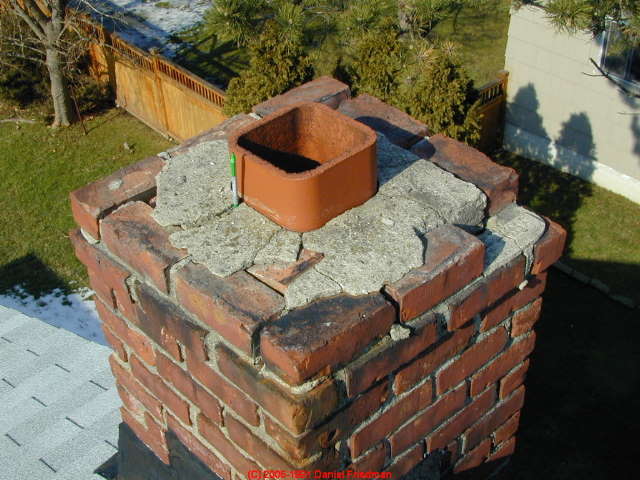
Notice the unlined flue at the top of this page? It is a single wythe or "one brick" thick. If those bricks are less than 4" wide the chimney is not in compliance with modern codes. Its condition is very important since loss of mortar or a chipped brick can be a fire or gas hazard.
Below we define the basic types of chimneys used to vent various types of heating appliances and devices. For more detail about each chimney type, construction, inspection, fire clearances, rooftop height requirements, etc.
See the links listed at the ARTICLE INDEX the bottom of this article or at the end of this section of text.
See complete details beginning
Definitions & Specifications of Types of Factory Built Chimneys
 Several types of factory manufactured chimneys are in use for residential
situations.
Several types of factory manufactured chimneys are in use for residential
situations.
They are a Pre cast Pumice Masonry unit that stacks together, a Form Filled Refractory Cement stack unit, a Stainless Steel Double or Triple Wall air insulated sectional unit and a Combination Air and Ceramic Fiber insulated triple wall unit.
List of Manufactured Metal Chimney Types
Here are links to detailed articles about each of the principal types of manufactured metal chimneys. We name each of these types in text below this list, and discuss each of these in the articles listed.
- FACTORY BUILT CHIMNEYS
- Single-Wall Metal Pipe Chimneys Vents - see the page top warning about these.
- Double-Wall Metal, Type B & Type L Chimneys
- CLASS A CHIMNEYS, MetalBestos™ - separate article
- High Temperature Plastic Chimneys & Vents
- TYPE B-VENT CHIMNEYS - separate article
- TYPE L VENT CHIMNEYS - separate article
- TRIPLE-WALL METAL FIREPLACE CHIMNEYS - separate article
- SUPER CHIMNEYS, 629 CHIMNEYS - separate article
Single-Wall Metal Pipe Chimneys or Vents
Watch out: while single wall metal flue vent pipe connectors are permitted to connect a heating appliance to a chimney, these are technically not "chimneys" but flue vent connectors and they must be installed with proper clearance from combustibles.
Single-wall metal shall be galvanized sheet steel not less than .0304" thick or other approved, non combustible, corrosion resistant material. Limitations require all lengths of single wall vents to be exposed from the draft hood up to the roof or wall thimble.
Actual chimneys can not be constructed of single wall metal flue material.
See SINGLE WALL METAL VENTS & CHIMNEYS for details.
See FIRE CLEARANCES, FLUE VENT CONNECTORS for details about the required fire clearances.
 Double-Wall Metal, Type B and Type L Chimneys
Type B (550oF) metal vents are a pipe within a pipe with air space between the two walls. The inner wall is aluminum to resist corrosion and the outer wall is galvanized steel for strength. Type L (1000oF) metal vents use stainless steel for the inner pipe for higher temperatures.
and TYPE L VENT CHIMNEYS for details
High Temperature Plastic Chimneys and Vents for Gas Appliances
Single wall plastic pipe (450oF) is listed to be used with condensing gas appliances.
[Note: in freezing climates, the pitch of direct-vent appliance vents such as those using plastic vent lines can be critical.
If condensate can be produced in the vent line, the line must be pitched to drain properly - usually inside to a drain - so as to avoid dangerous flue blockage by ice.-- Ed.]
See PLASTIC PLEXVENT ULTRAVENT RECALL
and PLASTIC VENTS Goodman HTPV RECALL. for details about these safety recalls
Chimney and Fuel-burning Device Categories vs. Chimney Requirements
National standards committees organized gas appliances into four categories based upon the flue gas temperatures and pressures.
- Category I is non-condensing, negative flue pressure, draft hood, AFUE 65% - 83%, vents of Type B, single-wall metal or lined masonry chimney. Mid- efficiency, fan assisted appliances are also in this category.
- Category II have negative flue pressure with a lower flue gas temperature and require a corrosion resistant vent.
- Category III is non-condensing, positive flue pressure, AFUE 78% - 83%, vents of air tight high temperature plastic or air tight single wall metal.
- Category IV is condensing, positive flue pressure, AFUE 90%+, vents of air tight high temperature plastic, PVC or CPVC.
New Vent Requirements
Minimum vent sizes for fan assisted appliances to limit condensation and maximum vent sizes to avoid positive vent pressures for fan-assisted appliances are design features of the venting tables.
Draft Hood Appliances
Hot gases rise and draft upward into the chimney. The draft hood allows dilution air to vent and mix with the flue gas which reduces the humidity or dew point and thus reduces chances of corrosion.
The dew point in a gas vent is about 90oF to 130oF.
Mid-Efficiency Appliances
A fan assisted system reduces dilution air in the vent with the following effects on vent performance.
- Vent gas dew point temperatures (or humidity) are higher.
- Less gases flow through the vent.
- There is less airflow through the appliance when the unit is off.
Higher dewpoints requires that the vent warm up above the dew point to stop condensation. However, the lower volume of gases flowing into the vent will make it more difficult to raise the temperature. This results in more condensation in the vent system. Oversized flues, especially on exterior chimneys, never warm up in cold weather.
High Efficiency Oil or Gas Burning Appliances
These systems have positive pressure sealed vent/combustion air control. The vent connectors are plastic pipes usually vented through the sidewalls of a basement or utility room with design limits on the length and number of elbows.
Installation requires reverse pitch on the vents so that condensation can flow back to the float trap drain.
Readers may also want to see the basic chimney definitions at .
...
Reader Comments, Questions & Answers About The Article Above
Below you will find questions and answers previously posted on this page at its page bottom reader comment box.
Reader Q&A - also see RECOMMENDED ARTICLES & FAQs
Question: NFPA 211 (2010) prohibition of single wall metal chimneys in or outside of one and two family dwellings.
(Sept 9, 2014) Chelan said:
NFPA 211 (2010) section 8.1.1 prohibits use of single-wall metal chimneys inside or outside one- and two-family dwellings, so would that be a condition that a home inspector should point out?
Reply:
Chelan, yes, I agree with your surmise as does NH Firebear - see his comments and a remarkable aluminum light pole chimney shown at the top of this article.
Question:
(Nov 27, 2014) Anonymous said:
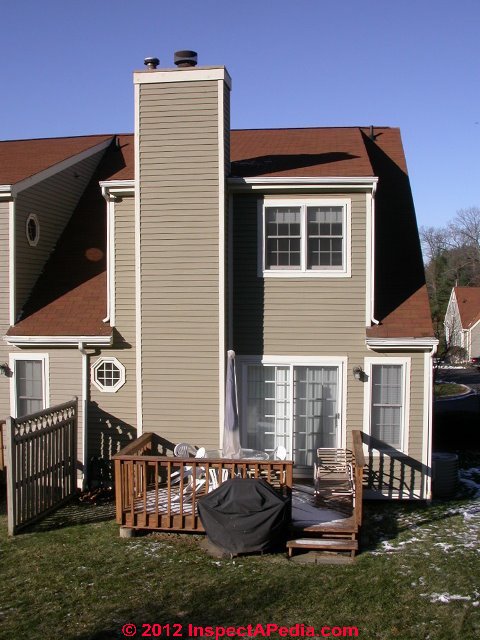
Why is one flue capped off at the top withcement on my double flue chimney?
Reply:
Anon the flue should be capped ONLY if it is not in use - that step keeps animals from making a home therein and also avoids water or rain damage to the flue and chimney.
...
Continue reading at CHIMNEY DEFINITIONS or select a topic from the closely-related articles below, or see the complete ARTICLE INDEX.
Or see these
Recommended Articles
- CHIMNEY INSPECTION DIAGNOSIS REPAIR - home
- CHIMNEY HEIGHT for Types L & Type B Vents
- DIRECT VENTS / SIDE WALL VENTS
- FLUE SIZE SPECIFICATIONS
- MASONRY CHIMNEY GUIDE - home
- METAL CHIMNEYS & FLUES - home
- METAL CHIMNEY INSTALLATION MANUALS
- PLASTIC PLEXVENT ULTRAVENT RECALL
- SINGLE WALL METAL VENTS & CHIMNEYS
- SUPER CHIMNEYS, 629 CHIMNEYS
- TRANSITE PIPE CHIMNEYS & FLUES
- TRIPLE-WALL METAL FIREPLACE CHIMNEYS
- TYPE B-VENT CHIMNEYS
- TYPE L VENT CHIMNEYS
Suggested citation for this web page
CHIMNEY TYPES & MATERIALS at InspectApedia.com - online encyclopedia of building & environmental inspection, testing, diagnosis, repair, & problem prevention advice.
Or see this
INDEX to RELATED ARTICLES: ARTICLE INDEX to CHIMNEYS & FLUES
Or use the SEARCH BOX found below to Ask a Question or Search InspectApedia
Ask a Question or Search InspectApedia
Try the search box just below, or if you prefer, post a question or comment in the Comments box below and we will respond promptly.
Search the InspectApedia website
Note: appearance of your Comment below may be delayed: if your comment contains an image, photograph, web link, or text that looks to the software as if it might be a web link, your posting will appear after it has been approved by a moderator. Apologies for the delay.
Only one image can be added per comment but you can post as many comments, and therefore images, as you like.
You will not receive a notification when a response to your question has been posted.
Please bookmark this page to make it easy for you to check back for our response.
IF above you see "Comment Form is loading comments..." then COMMENT BOX - countable.ca / bawkbox.com IS NOT WORKING.
In any case you are welcome to send an email directly to us at InspectApedia.com at editor@inspectApedia.com
We'll reply to you directly. Please help us help you by noting, in your email, the URL of the InspectApedia page where you wanted to comment.
Citations & References
In addition to any citations in the article above, a full list is available on request.
- Mark Cramer Inspection Services Mark Cramer, Tampa Florida, Mr. Cramer is a past president of ASHI, the American Society of Home Inspectors and is a Florida home inspector and home inspection educator. Mr. Cramer serves on the ASHI Home Inspection Standards. Contact Mark Cramer at: 727-595-4211 mark@BestTampaInspector.com
- John Cranor [Website: /www.house-whisperer.com ] is an ASHI member and a home inspector (The House Whisperer) is located in Glen Allen, VA 23060. He is also a contributor to InspectApedia.com in several technical areas such as plumbing and appliances (dryer vents). Contact Mr. Cranor at 804-873-8534 or by Email: johncranor@verizon.net
- Thanks to Luke Barnes for suggesting that we add text regarding the hazards of shared chimney flues. USMA - Sept. 2008.
- NFPA 211 - Standards for Chimneys & Fireplaces, NFPA 211: Standard for Chimneys, Fireplaces, Vents, and Solid Fuel-Burning Appliances, 2006 Edition (older editions and standards are found at the same bookstore)
- NFPA #211-3.1 1988 - Specific to chimneys, fireplaces, vents and solid fuel burning appliances.
- NFPA # 54-7.1 1992 - Specific to venting of equipment with fan-assisted combustion systems.
- GAMA - Gas Appliance Manufacturers' Association has prepared venting tables for Category I draft hood equipped central furnaces as well as fan-assisted combustion system central furnaces.
- National Fuel Gas Code, an American National Standard, 4th ed. 1988 (newer edition is available) Secretariats, American Gas Association (AGA), 1515 Wilson Blvd., Arlington VA22209, and National Fire Protection Association (NFPA), Batterymarch Park, Quincy MA 02269. ANSI Z223.1-1988 - NFPA 54-1988. WARNING: be sure to check clearances and other safety guidelines in the latest edition of these standards.
- Fire Inspector Guidebook, A Correlation of Fire Safety Requirements Contained in the 1987 BOCA National Codes, (newer edition available), Building Officials and Code Administrators International, Inc. (BOCA), Country Club HIlls, IL 60478 312-799-2300 4th ed. Note: this document is reissued every four years. Be sure to obtain the latest edition.
- Uniform Mechanical Code - UMC 1991, Sec 913 (a.) Masonry Chimneys, refers to Chapters 23, 29, and 37 of the Building Code.
- New York 1984 Uniform Fire Prevention and Building Code, Article 10, Heating, Ventilating, and Air Conditioning Requirements
- New York 1979 Uniform Fire Prevention & Building Code, The "requirement" for 8" of solid masonry OR for use of a flue liner was listed in the One and Two Family Dwelling Code for New York, in 1979, in Chapter 9, Chimneys and Fireplaces, New York 1979 Building and Fire Prevention Code:
- "Top Ten Chimney (and related) Problems Encountered by One Chimney Sweep," Hudson Valley ASHI education seminar, 3 January 2000, contributed by Bob Hansen, ASHI
- Chimney Inspection Checklist, Carson Dunlop, Associates, Toronto, Ontario
- "Rooftop View Turns to Darkness," Martine Costello, Josh Kovner, New Haven Register, 12 May 1992 p. 11: Catherine Murphy was sunning on a building roof when a chimney collapsed; she fell into and was trapped inside the chimney until rescued by emergency workers.
- "Chimneys and Vents," Mark J. Reinmiller, P.E., ASHI Technical Journal, Vol. 1 No. 2 July 1991 p. 34-38.
- "Chimney Inspection Procedures & Codes," Donald V. Cohen was to be published in the first volume of the 1994 ASHI Technical Journal by D. Friedman, then editor/publisher of that publication. The production of the ASHI Technical Journal and future editions was cancelled by ASHI President Patrick Porzio. Some of the content of Mr. Cohen's original submission has been included in this more complete chimney inspection article: CHIMNEY INSPECTION DIAGNOSIS REPAIR . Copies of earlier editions of the ASHI Technical Journal are available from ASHI, the American Society of Home Inspectors.
- Natural Gas Weekly Update: http://tonto.eia.doe.gov/oog/info/ngw/ngupdate.asp Official Energy Statistics from the U.S. Government
- US Energy Administration: Electrical Energy Costs http://www.eia.doe.gov/fuelelectric.html
- Our recommended books about building & mechanical systems design, inspection, problem diagnosis, and repair, and about indoor environment and IAQ testing, diagnosis, and cleanup are at the InspectAPedia Bookstore. Also see our Book Reviews - InspectAPedia.
- Chimney Inspection Checklist, Carson Dunlop, Associates, Toronto, Ontario
- Chimney & Stack Inspection Guidelines, American Society of Civil Engineers, 2003 - These guidelines address the inspection of chimneys and stacks. Each guideline assists owners in determining what level of inspection is appropriate to a particular chimney and provides common criteria so that all parties involved have a clear understanding of the scope of the inspection and the end product required. Each chimney or stack is a unique structure, subject to both aggressive operating and natural environments, and degradation over time. Such degradation may be managed via a prudent inspection program followed by maintenance work on any equipment or structure determined to be in need of attention. Sample inspection report specifications, sample field inspection data forms, and an example of a developed plan of a concrete chimney are included in the guidelines. This book provides a valuable guidance tool for chimney and stack inspections and also offers a set of references for these particular inspections.
- Principles of Home Inspection: Chimneys & Wood Heating, in (Principles of Home Inspection), Carson Dunlop, Associates, Toronto, Ontario
- NFPA 211 - 3-1.10 - Relining guide for chimneys
- NFPA 211 - 3-2 - Construction of Masonry Chimneys
- NFPA 211 - 3-3 - Termination Height for chimneys
- NFPA 211 - 3-4 - Clearance from Combustible Material
- NFPA 54 - 7-1 - Venting of Equipment into chimneys
- Brick Institute of America - Flashing Chimneys
- In addition to citations & references found in this article, see the research citations given at the end of the related articles found at our suggested
CONTINUE READING or RECOMMENDED ARTICLES.
- Carson, Dunlop & Associates Ltd., 120 Carlton Street Suite 407, Toronto ON M5A 4K2. Tel: (416) 964-9415 1-800-268-7070 Email: info@carsondunlop.com. Alan Carson is a past president of ASHI, the American Society of Home Inspectors.
Thanks to Alan Carson and Bob Dunlop, for permission for InspectAPedia to use text excerpts from The HOME REFERENCE BOOK - the Encyclopedia of Homes and to use illustrations from The ILLUSTRATED HOME .
Carson Dunlop Associates provides extensive home inspection education and report writing material. In gratitude we provide links to tsome Carson Dunlop Associates products and services.
 | HOME | ABOUT | ASK a QUESTION | CONTACT | CONTENT USE POLICY | DESCRIPTION | POLICIES | PRIVACY | |
| © 2025 - 1985 Publisher InspectApedia.com - Daniel Friedman | |||||||||