
InspectAPedia® FREE Encyclopedia of Building & Environmental Construction, Diagnosis, Maintenance & Repair |
Question? Just ask us! InspectAPedia
|
 How to repair aluminum wiring: recommended methods
How to Reduce the Risk of Aluminum Wiring
Fires
- POST a QUESTION or COMMENT about how to repair aluminum electrical wiring to reduce the risk of overheated connections or building fires
How should aluminum electrical wiring be repaired?
This article describes the immediate safety steps needed in a building where solid conductor aluminum electrical wiring is installed. This article describes the acceptable methods to repair aluminum wiring, including which aluminum wire connectors to use for safest results.
We describe how to make aluminum to copper pigtail connections using the COPALUM connector or the AlumiConn™ connector as well as how to make aluminum-to-aluminum wire connections and aluminum ground wire connections.
How to reduce the risks associated with aluminum electrical wiring - a practical guide shows which aluminum wiring connectors can be used successfully to connect aluminum conductor wires to copper-wired devices (such as lighting fixtures or fans) and to electrical receptacles ("plugs") or to light switches.
Notes on using the COPALUM connector for aluminum wire repairs - aluminum to copper pigtailing. Notes on using the AlumiConn™ connector for aluminum wire repairs - aluminum to copper pigtailing & aluminum to aluminum wire splices - where to buy and how to install and torque the AlumiConn aluminum wire repair connector. How to splice aluminum-to-aluminum electrical wires.
InspectAPedia tolerates no conflicts of interest. We have no relationship with advertisers, products, or services discussed at this website.
- Daniel Friedman, Publisher/Editor/Author - See WHO ARE WE?
HOW TO REDUCE THE RISK of Fire and Electrical Circuit Connector Overheating in buildings with Aluminum Electrical Wiring
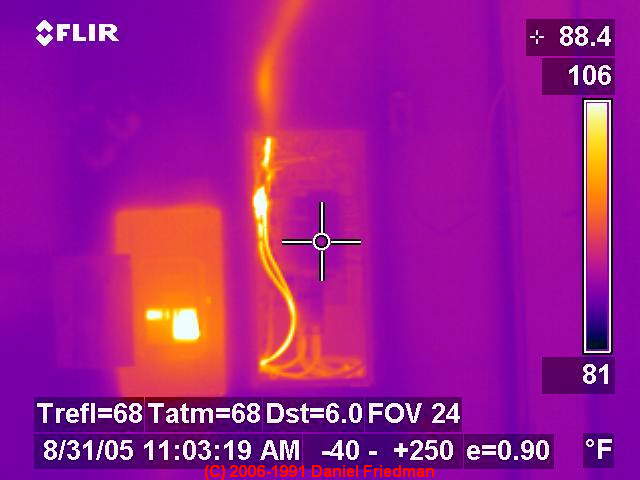
 The page top photograph shows an infra-red photo of an overheating aluminum wiring
connection at an improper aluminum-to-copper "pigtail" splice (courtesy of G. Cohen).
The page top photograph shows an infra-red photo of an overheating aluminum wiring
connection at an improper aluminum-to-copper "pigtail" splice (courtesy of G. Cohen).
Aluminum wire connections can overheat enough to start a fire without ever drawing enough current to trip a circuit breaker, and improper repairs can increase the hazard.
Immediate Actions for Safety of Aluminum Wiring
- See if you have aluminum wiring (solid conductor branch circuit) installed in your home. Aluminum wiring identification tips are
provided at
ALUMINUM WIRING, HOW TO RECOGNIZE - Look for signs of aluminum wiring failure, such as flickering lights, turn off the circuit involved and call a licensed electrician. See U.S. CPSC 516 (linked-to below) for other trouble signs.
Also see ELECTRIC POWER LOSS / FLICKERING LIGHTS- causes of flickering or dimming lights - Install smoke detectors at locations recommended by your local building officials or fire department. Sample smoke detector locations are also provided on instructions that come with the smoke detector.
How to Repair Aluminum Electrical Wiring to Reduce the Hazards - Repair Alternatives & Choices
Once the initial steps above have been addressed, here are the US CPSC recommended choices for safe repair of aluminum wiring:
Aluminum Wiring Repair Method No. 1: Re-wire the Building, Replacing All Aluminum with Copper Wire
Re-wire the Building replacing all aluminum branch circuit wiring with copper, as a "best repair method" for aluminum wiring. However this approach will be the most costly method for aluminum wire repair, requiring snaking new wires throughout the building.
New copper wires are run throughout the building, from the electrical panel to junction boxes, receptacle boxes and to connected devices such as electrical switches, receptacles (outlets or "wall plugs"), etc.
The old aluminum electrical conductors can be left in place in building walls and ceilings, and will be harmless once those wires are completely disconnected from the electrical system.
The re-wire approach to aluminum wiring repair is used principally when other building renovations that require opening building walls, ceilings, floors, make this method practical.
Aluminum Wiring Repair Method No. 2: Copper Pigtailing using the COPALUM Connector
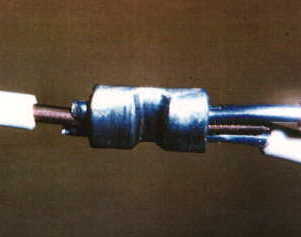
COPALUM Copper-to-Aluminum Pigtailing Use the special AMP (now TYCO) COPALUM connector and special tool to
connect short copper wires to every aluminum wire end in the Building, reconnecting the copper to the
various devices (outlets, switches, lights) and splices.
This "copper pigtailing" procedure is performed by an electrician trained
and licensed by AMP or TYCO to use this COPALUM procedure. The TYCO COPALUM connector method and its pro's and con's are discussed here (below). The installation procedure for this connector is given in TYCO's instructions and is illustrated in precise detail by Aronstein
at PIGTAILING USING AMP "COPALUM" CONNECTORS.
Typically this approach costs about half that of completely re-wiring a home with copper.
Also see ALUMINUM WIRE REPAIR SPLICE SPACE.
A brief US CPSC article COPALUM ALUMINUM WIRE CONNECTORS discusses how
to get these aluminum wire connectors.
TYCO currently leases the crimp tool necessary for making COPALUM repairs, and training is needed to use it properly. For photos of the TYCO COPALUM "Retermination Kit" - the crimping tool used to install COPALUM connectors on aluminum wiring, see
this TYCO COPALUM Tool document. (PDF)You'll see that the tool is large, making work in tight quarters a challenge, especially if the original lengths of wire to be pigtailed are short.
You'll also read in Tyco's DRAFT CONTRACT from TYCO for electricians that TYCO considers "old technology" aluminum wire to be unsafe, but in fact later-installed "new technology wire" performs about the same. Both "old technology" and "new technology" solid conductor aluminum wire alloys varied from manufacturer to manufacturer, some performing better or worse than others.
How to Become a Certified COPALUM Installer for Aluminum Wiring Repairs
The following material is based on information from Tyco Electronics, supplier of the COPALUM connector and crimping tool used for aluminum wiring repair:
Becoming a Certified COPALUM Installer - Certification Procedure
- Review, sign and return the contract for the COPALUM Retermination Program.*
- Contact a participating local Electrical Distributor for availability and delivery of the COPALUM Retermination Tool.
- Contact Tyco Electronics to set up a training date for certification training.
- Certification Card is provided after completion of training for the purchase of product.
*Refer to Terms & Conditions Document concerning contract specifics
Tool Leasing:
Pricing and availability only through a participating Electrical Distributor
- Tooling: Lease only option (Tool is NOT available for sale)
- 3 month minimum lease — Contact a participating Electrical Distributor for pricing.
- Monthly Fee — Contact Electrical Distributor for pricing.
- Certification Training is provided by Tyco Electronics Field Service Specialist.
- Training consists of 2 to 4 hour instruction for tool use & connector application.
- Training Cost - $ 750.00 plus travel & expense (Limited to 6 participants).
Once contractor has tool availability date from distributor, contact Tyco Electronics to schedule training date.
Contact Tyco Electronics customer service for additional information at 800.468.2023.
Contractors can identify distributors in their area by contacting 1-800-527-6686.
See Tyco Electronics for details about COPALUM certification, crimping tool leasing, supplies, training.
Terms and conditions of leasing the COPALUM retermination tool (crimping tool) for aluminum wire repairs includes requiring that the contractor be properly trained in use of the equipment.
Tyco COPALUM Part Numbers
- The Tyco part number for the Tyco COPALUM retermination tool (crimping tool) is 1976330-1.
- The Tyco part numbers for the COPALUM crimp connector itself are 608501-1(Red) & 608502-1(Blue) (two sizes).
Shortcomings of the COPALUM Aluminum Wiring Repair Method
Space limitations in the junction box or receptacle box: These connectors and the copper pigtail wires take up more space in a junction box or receptacle box than the original wires and connectors. at ALUMINUM WIRE REPAIR SPLICE SPACE we discuss options for fitting the COPALUM connector and pigtail wires into electrical boxes where space is tight.
OPINION: Problem for Large Electrical Contractors repairing aluminum wiring: Tyco should make the COPALUM crimping tool available for sale:
Unfortunately, Tyco's "rent-only" option for the COPALUM connector makes aluminum wiring repair service prohibitively expensive for large electrical repair companies who are performing extensive aluminum repair work in large urban areas.
Placing multiple repair tools in multiple repair service trucks with aluminum-wire repair-trained experts, and keeping them there year in and year out in order to be responsive to consumer needs prices this service right out of that market place and has tempted some aluminum repair electricians to make use of alternative repair methods that appear to work (the AlumiConn discussed below) and other aluminum repair methods that have been shown to be ineffective and dangerous.
OPINION: Problem for Small Electrical Contractors repairing aluminum wiring:Tyco should make the COPALUM crimping tool available for short term rental:
A small electrical contractor wanting to become trained, certified, and qualified to perform a small number of aluminum wire repairs faces a different problem. Tyco rents the COPALUM crimping tool for a three-month minimum, converting to a month-to-month lease thereafter.
This will not be economical for a small contractor performing only occasional aluminum wiring repairs.
Aluminum Wiring Repair Method #3 - the AlumiConn™ Alternative has U.L. Listing & Approval
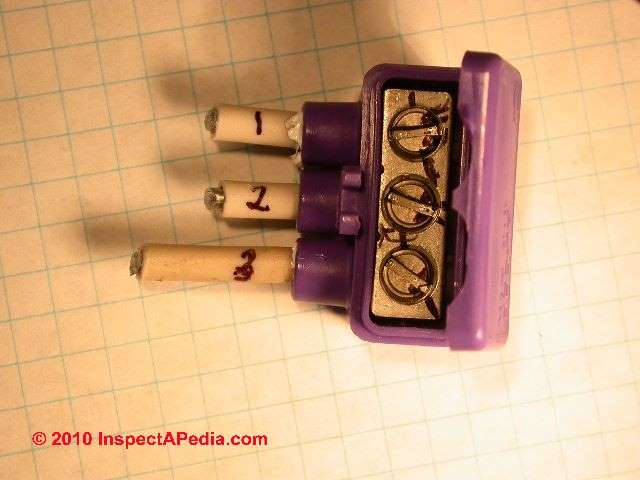 AlumiConn TM aluminum to copper lug connectors[1] [New in 2006, U.L. Listed, 2007 completed independent testing, CPSC recommended 2011] available from King Innovation.
Results of independent testing indicate that this product "... is predicted to have a high probability of failure-free long-term safe performance, PROVIDED THAT THE SETSCREWS ARE CAREFULLY TIGHTENED TO THE MANUFACTURER'S RECOMMENDATION".
AlumiConn TM Purple #95135 aluminum to copper lug connectors [New in 2006, now U.L. Listed, 2007 completed independent testing] available from King Innovation. The AlumiConn connector is now recommended for aluminum wiring repairs - US CPSC.
The AlumiConn™ connector shown here is used to splice a copper "pigtail" wire together with one or two aluminum wires as a step in reducing the fire hazard associated with aluminum electrical wiring.
This connector performs well provided that the wires are properly secured in the connector, and it has been included in the US CPSC recommendations for aluminum wiring repair.
Reference: details of the study and recommendations are on page #6 (the 9th page in the .pdf file) in Dr. J.A. Aronstein's .pdf document version of Reducing the Fire Hazards in Aluminum Wired Homes" May 21, 2007. The test results are completed and will be published in September 2007. (100 connectors cost $285. Lower prices for larger quantities.)
Alumi-Conn where to buy, how to install:
- ALUMINUM WIRE AlumiConn [TEXT BEGINNING JUST BELOW] describes using this device and how it is connected, wired, and torqued.
- ALUMINUM WIRE REPAIR SPLICE SPACE describes steps to gain sorely-needed wiring space when using the AlumiConn (or the COPALUM) connector for the copper pigtail repair method for aluminum wiring, and this article also includes photographs of the steps in a reader's actual field installation experience using the AlumiConn splice connector.
- The actual AlumiConn website is http://www.kinginnovation.com/products/alumiconn/ This site has installation videos, Wire combinations, specification sheets, and other information and assistance in using this product.
- The AlCopStore is an independent website where you can also purchase the AlumiConn™ aluminum wiring connectors
How to Install the AlumiConn aluminum wiring repair connector

Installation instructions for AlumiConn™ for aluminum wiring repair
- AlumiConn INSTALLATION PROCEDURE - technical notes on how to repair aluminum wiring using the AlumiConn™ splice connector for aluminum wiring repair
- AlumiConn Torque settings specified by King, why torque is important in electrical connections & how the necessary torque settings are achieved when installing splices using the AlumiConn™
- AlumiConn TORQUE TESTS describes an independent test comparing torque results using a torque-measuring screwdriver, the SK 73004 torque measuring screwdriver [provided courtesy of King Innovations - Ed] and the manufacturer's alternative torque setting method that involves counting the number of screw turns past first contact.
- ALUMINUM WIRING REPAIR FIELD NOTES - separate article gives detailed practical advice & field experience using the AlumiConn™ connector, such as pigtail wire lengths, and aluminum wiring repair installation time for different boxes & devices.
- ELECTRICAL BOX WIRING SPACE PROBLEMS & aluminum wire repairs can be a problem for either of the approved connectors.
While an exception to the National Electrical Code permits the electrician to omit the pigtail wires from the calculation of total number of wires allowed in a junction box or receptacle box, the connectors and wires needed for pigtailing can make jamming all of these components back into a wall difficult or downright impossible. At - ALUMINUM WIRE REPAIR SPLICE SPACE - how to get more wiring space when retrofitting existing electrical devices & wiring in existing or old work electrical boxes - we discuss solutions to the wiring space problem - ways to gain wiring space for wiring using the AlumiConn™ or COPALUM
- ALUMICONNTM Status Update - CPSC Recommended, is discussed separately here
- ALUMINUM to ALUMINUM SPLICE Connections are discussed separately here
- The AlCopStore - http://www.alcopstore.com/support/installation-instructions/
- BINDING SCREW PROBLEMS - Technical notes on binding and poor wire connections in aluminum terminal blocks & aluminum wire repairs
- King Innovations' AlumiConn website - www.kinginnovation.com/products/alumiconn/ has installation videos, wire combinations, specification sheets, and other information and assistance in purchasing or using this product.
- ALUMINUM WIRING HAZARDS & REPAIRS - home
AlumiConnTM Status Update - CPSC Recommended
Question: Is it OK to Use the AlumiConn™ by King Innovation for Aluminum Wiring Repair
In the section regarding aluminum wiring repair it is not clear to me if the product called Alumiconn by King Innovation is a safe and acceptable alternative to Copalum. I have not been able to find anywhere in the internet any further references to how safe is this product beyond the publication by J. Aronstein last update July 6, 2007. Can you clarify this for me? - J. C., Orlando, FL
[Note: this question and answer was posed in 2009 but has been updated to reflect the 2011 US CPSC recommendations concerning the AlumiConn connector - Ed.]
Answer: Yes, properly installed this is an approved repair for aluminum wiring.
Safety/Usability of the AlumiConn™: 4 Points of Discussion
1. Independent tests:
showed that IF the Alumiconn connector is properly installed (including torquing to the proper torque setting) it performs as well as COPALUM. We have absolute confidence in Dr. Aronstein in this matter - he is fully qualified, experienced, and is an unbiased independent party with no financial connection to the company selling Alumiconn (nor to any one else selling other products).
Here is Aronstein's paper on the topic: Reducing the Fire Hazards in Aluminum-Wired Homes - 5/21/07, (AlumiConn™ info is on p. 9)
The Alumiconn™ is UL listed (UL 486C) as a "pressure type screw connector" (USA) and CSA approved (Canada) for aluminum wiring repairs.
For general information about that listing type, see this UL connector information On the UL listing for wire connectors.
2. U.S. CPSC:
This connector performs well provided that the wires are properly secured in the connector, and it has been included in the US CPSC recommendations for aluminum wiring repair as of approximately June 2011.[2][3]
3. Torque settings for the AlumiConn™:
Reading the UL document we see no mention whatsoever of torque specifications - those are particularly important for this particular connector as it involves tightening a screw in a terminal block to secure the aluminum or copper wire being spliced.
Aronstein emphasized that the connector's acceptable performance relied on using the proper torque settings.
Torque settings are described at TECHNICAL NOTES on Installing or Wiring the AlumiConn™ The "alternative method" described by the manufacturer for tightening the screws produces torque close to or exceeding the actual torque specified numbers (according to some preliminary tests we have done in our lab) - photo at left.
4. UL listing vs CPSC Recommended:
So if you were working for someone else and wanted to install only the CPSC-recommended connectors, you'd use only the AMP/TYCO COPALUM™ method or the AlumiConn™.
In March 2010, prior to the CPSC recommendation of AlumiConn™ connectors for aluminum wiring repairs, we (DJF) presented this information for a group of 50 licensed electricians at
an Aluminum Wiring Repair Methods UPDATE-CLASS [Power Point Presentation]in Dallas TX.
These were trained licensed electricians who are informed and conservative in their practice.
The company's position was that they would not use an connector that was not CPSC-recommended, notwithstanding its UL listing. Indeed, some products carrying a UL listing for aluminum wiring repair have been shown to perform very poorly in the field, such
as CU/AL DEVICES and
the Ideal65® PURPLE TWISTER® connector sold for that purpose.
How to Repair Aluminum-to-Aluminum Wire Splice Connections
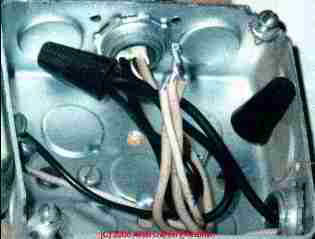
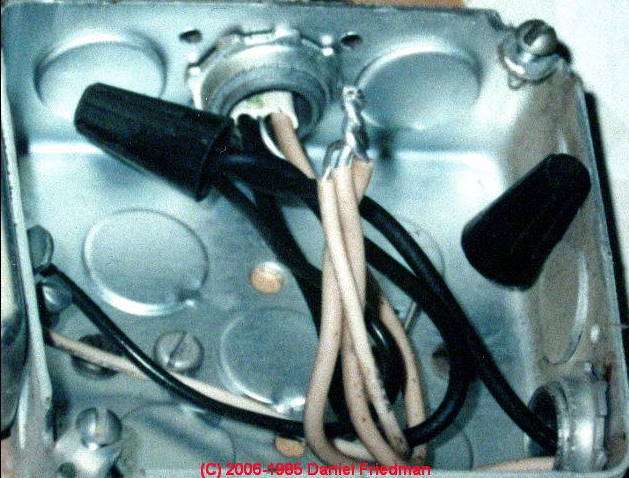
Aluminum to aluminum wire splices also need to be repaired in an aluminum-wired home. These splice connections are typically found in junction boxes (shown below) but may also occur in some receptacle boxes where a device such as a light or electrical receptacle are also wired.
Traditionally these splices were made with twist-on connectors - an approach shown below (left) and one that is unsafe (below right) because of the risk of overheating and a potential for fire.
Our photograph at above left shows aluminum wire spliced to aluminum wire at a connection which had not overheated when we took this photo.
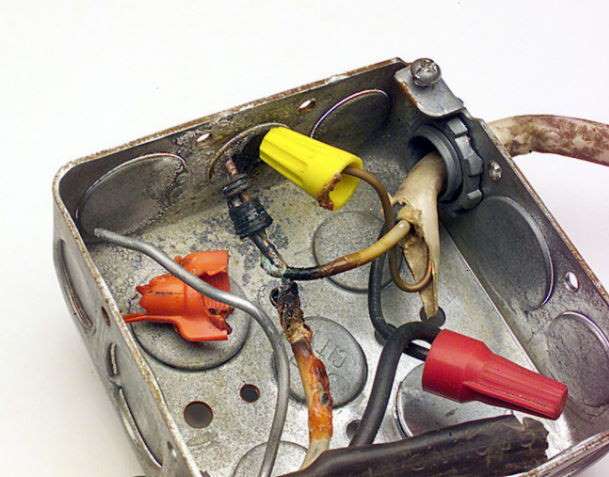
The photograph at left severe overheating and burn-up of an aluminum to copper splice made using a conventional twist-on connector.
Avoid Using Copper Pigtails When Splicing Multiple Aluminum Wires Together
The various "copper pigtailing" methods discussed in articles on aluminum wire repairs (at aluminum-wired devices such as electrical receptacles, switches, and lights) are not the best approach when repairing aluminum-to-aluminum wire splices such as at a junction box in a building (where several aluminum-wire circuits or wires are joined together).
Which Connectors Are Used for Splicing Aluminum Branch Circuit Wires
For the aluminum wire to aluminum wire connector case, use of a splicing connector whose manufacturer specifies that the connector must be used with a combination of copper and aluminum wires together (the COPALUM) makes little sense.
Our photo left shows three aluminum wires connected together (spliced) into an AlumiConnTM device.
For the small aluminum wire sizes such as found in building branch circuit wiring for lighting and receptacles, the AlumiConnTM is probably the best choice if the COPALUM connectors and special crimping tool are not readily available.
The installation instructions for the AlumiConnTM indicate that the connector can be used for splicing solid conductor aluminum branch circuit wires in sizes #12 - #10.
Details are at AlumiConn INSTALLATION PROCEDURE
- ALUMINUM WIRE AlumiConn - recommended
- ALUMINUM WIRE COPALUM - recommended
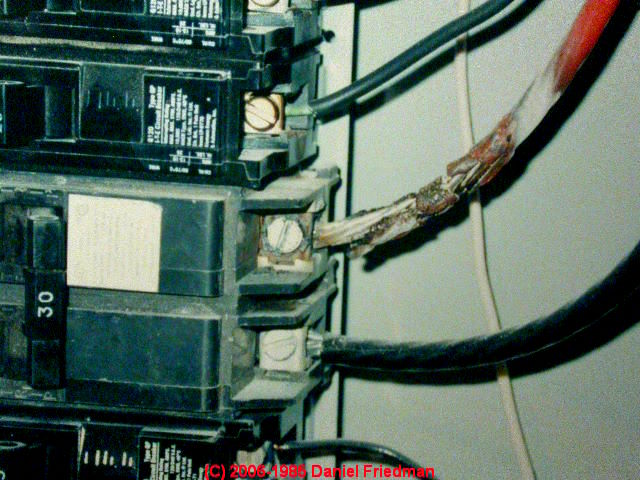
For larger aluminum wire sizes sizes (stranded aluminum wiring such as found at air conditioning compressor circuits, electric range circuits, clothes dryer circuits and other high-amp devices), any of the (UL listed for Aluminum) setscrew type connectors in combination with the inhibitor/abrasion installation technique should suffice.
Since we've seen frequent field reports of overheating at multi-strand high-amp aluminum wired devices such as air conditioning compressors, it is important to address these cases by proper repair methods.
[Note: some air conditioning equipment manufacturers currently recommend use of only copper wiring to feed their equipment - DJF June 2007]
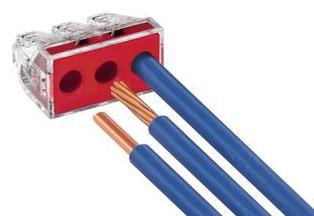
WALL-NUTS [New U.S. product application, Not UL Listed, undergoing testing before UL application] spring-clamp terminal blocks available from Wa go Corporation have is being tested by that company for
a connector for aluminum-to-copper pigtailing for aluminum wiring repair. The company informs us that a similar product
use with aluminum wire conductors has been approved and used in Europe for over 20 years.
The company is conducting further testing before submitting the product to UL to obtain a listing. Significantly, the company indicates that
this connector is suitable for connecting multi-stranded (copper) as well as solid conductor
conductors. If approved by UL and if test results are satisfactory, this product would, in addition to providing
standard solid CU to solid AL connections, address the wiring of a twisted-copper-wire light fixture to a solid conductor aluminum
branch circuit wire.
This connector has not
been recommended, nor recommended against, by the US CPSC, and is currently undergoing testing. Results will be
reported here ASAP. Product description information for the copper to copper wire connection use of this connector is
available at the Wa go website.
Other Approaches to the Repair of Aluminum Electrical Wiring
Other aluminum wiring repair connector products have been sold by various manufacturers, some with good performance and some unacceptable. Descriptions are below. Emergency temporary repairs necessary to keep an essential circuit in service might be possible following other procedures described by the CPSC or by industry experts.
Details about other aluminum wire repair methods that are not recommended are found
at ALUMINUM WIRING REPAIR NOT-Recommended.
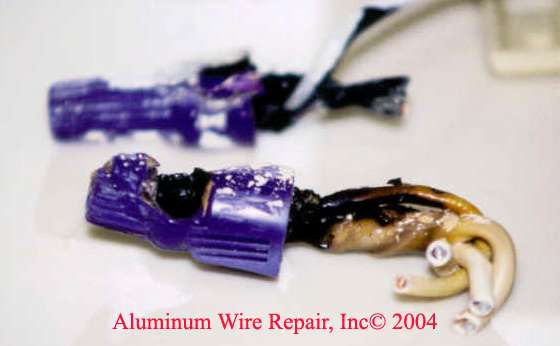 Other methods - not recommended: Warnings regarding other "repair" methods which are not recommended
are discussed
Other methods - not recommended: Warnings regarding other "repair" methods which are not recommended
are discussed
at ALUMINUM WIRING REPAIR, Other Products,
such as the Ideal 65 purple "Twister" aluminum wire splice connector shown in the photo at left (12 connectors cost $49. to $79.)
Note: The instructions for this connector require that it always include a copper pigtail when making aluminum wiring connections - a condition impractical for splicing aluminum-to-aluminum wires.
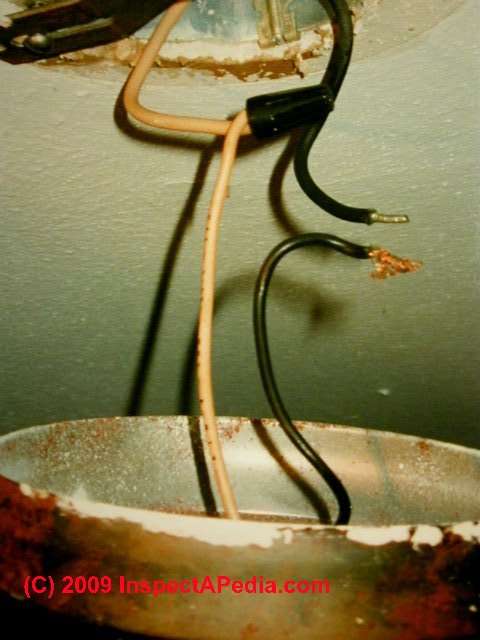
Other methods - also not recommended: include attempts to repair aluminum wiring using receptacles and outlets marked "COALR" (even if these worked, which has not been demonstrated, what about all of the other electrical connections and splices in the building?). COALR and CU/AL devices as a "repair" for aluminum wiring is discussed
at ALUMINUM WIRING REPAIR, OTHER PRODUCTS
- PHOTOGRAPHS FOR RECOGNIZING ALUMINUM ELECTRICAL WIRING hazards are provided at this article on How to Recognize or Identify Aluminum Electrical Wiring in buildings
- REDUCING THE FIRE HAZARDS IN ALUMINUM-WIRED HOMES - 2007 UPDATE, [large .pdf document], Jess Aronstein, Ph.D., 21 May 2007.
This document answers most technical questions about the hazards and remedies of aluminum electrical wiring and includes a report on independent test results of alternative products and methods for repairing aluminum wiring. - ALUMINUM WIRE REPAIR SPLICE SPACE discusses how to fit aluminum-to-copper connectors and copper pigtail wires into electrical boxes where space is limited.
- ALUMINUM GROUND WIRES discusses the importance of including the aluminum electrical ground wire in the aluminum wiring repair procedure.
...
Reader Comments, Questions & Answers About The Article Above
Below you will find questions and answers previously posted on this page at its page bottom reader comment box.
Reader Q&A - also see RECOMMENDED ARTICLES & FAQs
On 2023-08-18 by InspectApedia Publisher
@Lynn,
We're glad to assist - your questions help us see where we need to clarify or add information. Working together makes us smarter.
On 2023-08-15 by Lynn
@InspectApedia Publisher, Thank you so much, and thank you for your patience! You have saved me and probably others a great deal of time and effort :)
On 2023-08-14 by InspectApedia Publisher - Can a modern breaker box made for solid copper be used with CCA wire?
@Lynn,
Yes, indeed.
The statement "copper clad aluminum wire" functions like, performs about as well as, and can be used identically as solid copper branch circuit wiring means exactly that:
Electrical panels or "panel boxes", and electrical devices such as electrical boxes, connectors, switches, receptacles, circuit breakers etc. that are designed for use with solid conductor copper branch circuit wires can indeed be used as well with copper-clad aluminum branch circuit wire.
Let's hope that that more detailed sentence clears up any confusion on this question.
Thank you for the discussion.
On 2023-08-13 by Lynn
@InspectApedia Publisher, Thank you. I think it would help a great deal if it's stated plainly that receptacles, boxes etc made for solid copper can be used with CCA. Many people who are not electricians fix or replace their own receptacles.
Also, I do have another question. This is going to sound like a stupid question after all this, , I think it will be OK but I want to be sure and safe and also will be showing this conversation to an electrician potentially unfamiliar with CCA.
If I buy this mobile I am thinking of having the breaker box replaced- it's pretty old.. Can a modern breaker box made for solid copper be used with CCA wire? I don't think many electricians in this extremely rural area will be familiar with CCA. Many of them just refuse to work on old mobiles.
On 2023-08-13 by InspectApedia Publisher
@Lynn,
Thank you so much for following up on this.
Please do not hesitate to ask questions whenever you need, and particularly, don't hesitate to let me know if you find our information unclear, incomplete, or if you have other suggestions or criticism. Working together helps us both.
DF
On 2023-08-13 by Lynn
@InspectApedia Publisher, Thank you so very much! That makes it very clear. I did read it, saved it and will read it again. Thank you for such an excellent source of information. Your entire site is invaluable.
On 2023-08-12 by InspectApedia Publisher (mod) - copper clad aluminum wiring performs about as well as copper wiring
@Lynn,
Key is this sentence:
All of the sources that we have reviewed and experts whom we've consulted agree the copper clad aluminum wiring performs about as well as copper wiring. It doesn't have the same connection, arcing, corrosion, overheating issues as those aluminum wire.
That means that when making connections to devices or to other solid copper wires, you copper-clad aluminum wire it as if it were copper wire.
For details and so that you understand this topic
as I asked before -
Please read COPPER-CLAD ALUMINUM WIRE inspectapedia.com/aluminum/Copper_Clad_Aluminum_Wire.php
On 2023-08-12 by Lynn
@InspectApedia Publisher,
Oops, now I remember I did see the answer to #5.. I will read that part again. The others I am still not sure of.
On 2023-08-12 by Lynn
@InspectApedia Publisher,
Sorry it took so long to check back..
Thank you, I did read that page but I am still confused about questions 1 and 3. and if it is OK to use a wire nut to connect copper clad aluminum to another copper clad aluminum wire(s). Right now it is connected to regular modern receptacles and switches meant for copper wire.
Should I read that as
1. yes
3. no- just use regular modern receptacles and switches.
4. is it OK to use a wire nut, particularly a modern wire nut meant for copper wire?
5. and I forget if it was mentioned on that page, but is it OK to connect CCA to solid copper of the same capacity? If this particular question is addressed on that page I will recheck and read it again.
Sorry to ask so many questions, but I may be checking the rewiring on it before I have an electrician out to look at it, and I read that page a couple times and couldn't figure it out for sure.
I'm considering rewiring the whole mobile if there are issues with sourcing components etc. I know you can't speak for that particular mobile's wiring, but I'm asking in general for these materials?
On 2023-07-26 by InspectApedia Publisher - repairing copper clad solid aluminum wiring
@Lynn,
This question has come up before, and to which we can answer:
All of the sources that we have reviewed and experts whom we've consulted agree the copper clad aluminum wiring performs about as well as copper wiring. It doesn't have the same connection, arcing, corrosion, overheating issues as those aluminum wire.
Obviously we can't say a thing about the safety of your particular wiring installation because safety depends on so many other installation details. But the wire itself has been found to perform correctly and safely.
Please read COPPER-CLAD ALUMINUM WIRE
and don't hesitate to post any follow-up questions there.
Thanks for a helpful question
Df
On 2023-07-26 by Lynn
Hi, I'm confused about repairing copper clad solid aluminum wiring.
1. Can regular modern switches, boxes and outlets made for copper wire be used?
2. Should it be treated as copper or as aluminum or it's own category?
3. And, do the connectors above need to be used if connecting copper wire to C clad aluminum?
4. Oh... also, is it OK to use a wire nut to connect copper clad aluminum to another copper clad aluminum wire(s)?
On 2022-02-15 by Inspectapedia Com Moderator - difficult to express how truly dangerous aluminum branch circuits are
@Adam ashby,
Thank you for the nice note; you are also welcome to print and hand out hard copies of any of our articles that you or your clients may find useful.
On 2022-02-14 by Adam ashby
This article and the others connected to this page are amazing. Running into a lot of older homes with aluminum branch circuits and it is difficult to express to our customers how truly dangerous this is without making an approved and necessary repair throughout the entire home!
Thank you for taking the time to put this information out there and I look forward to forwarding this to customers when the argue about what repairs "actually" need to be done.
There was a few times throughout reading this that my blood boiled from some of the "incorrect" install examples you gave. Loved the read , and thank you again!
On 2021-12-14 by Inspectapedia Com Moderator - Is there any update from CPSC regarding use of the Wago Pushwire connectors?
@Phil,
Thanks for the reminder.
We too would sure like to see such an update on the CPSC's position on this too but it has not happened.
If you are in fact someone who represents the company that makes the connector about which you posted, the best step to take would be to contact the Consumer Product Safety Commission directly and to provide them with both internal and independent performance and safety tests and studies of the product.
Actual data is really critical in support of these consumer safety and fire safety questions.
All one has to do is look at the instance of certain other products that carry a listing and yet
kept their test data secret and worse,
have been shown in independent testing to be extremely poor performers and to present serious fire hazards.
On 2021-12-14 by Phil
Is the any update from CPSC regarding use of the Wago Pushwire connectors? The Wago websites states that this can be used with aluminum if you follow the proper procedure using Wago "Alu-Plus" paste inside the connector. This would be a much more affordable and accessible option in my area. I would be very interested to here more about it.
(reposted by Moderator without dis-allowed link)
On 2021-10-31 by inspectapedia.com.moderator - don't use a connector that is known to fail
@Ken Dale,
Opinion:
I disagree with your reasoning.
It is precisely in an emergency that could make the difference between life and death or having a building fire or not that one should not want to use a connector that is known to fail.
On 2021-10-31 by Ken Dale
What about using the purple wire nuts for connecting the grounding wires. This would be multiple aluminum wires with a copper pigtail.
I’ll see how the hot and neutral wires can fail in testing, but the grounding wires do not experience overheating because they only carry current in an emergency situation.
Also it is code legal to twist grounding wires together and crimp them without installing any insulating device. The purple wire nuts would make a connection superior to the crimping method.
On 2021-10-18 by inspectapedia.com.moderator - some electricians may ignore advice outside the NEC - but the NEC can't be comprehensive
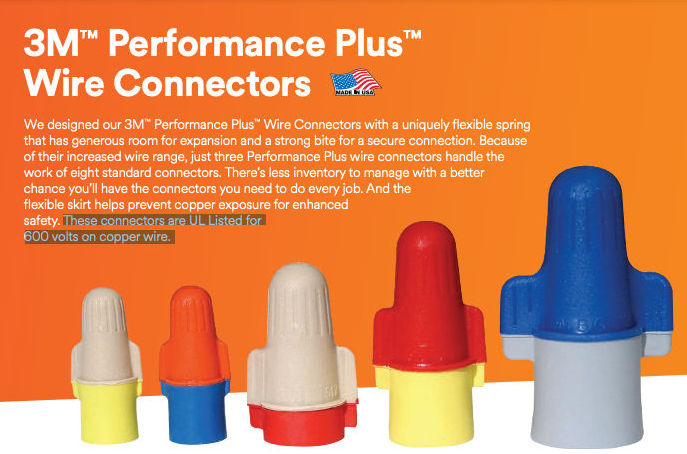 @Anonymous aluminum to copper connector,
This snapshot from 3M's website shows that typical 3M Twist-on connectors are specifically listed for copper wire.
Original source: multimedia.3m.com/mws/media/68624O/3m-wire-connectors-family-brochure-low-res-pdf.pdf
That is, they are NOT listed for use with aluminum nor with aluminm-to-copper.
In my OPINION, today we can divide electricians into two distinct groups. Most are dead serious about safety, knowing that their field involves work that is particularly critical in building life-safety. Those people won't install what's widely known as an an unsafe product - period.
But there are some others who take a different approach and may include the electrician you describe.
It's unfortunate, troublesome, and probably a litany of other words we could tack on: SOME electricians take the position that if it's not in the NEC they don't care and don't have to pay attention. Or it may be in the NEC but only indirectly, so they can duck the provision, as I'll explain by example below.
IMO they are mistaken. But caught in trouble with a complaint, or worse a fire or injury, the electrician is of course looking for a way out.
As a GC You know better than many people, I'm sure, I that the model codes can't anticipate every possible mistake somebody might make in building or mechanical systems.
For example, the U.S. NEC includes a requirement that equipment be installed according to the manufacturer's instructions. So if you don't follow the instructions (usually we just use them to kneel on while working on equipment), you're violating code, even when the specific details in the instructions appear only in the manufacturer's instructions and not in the national electrical code.
In the case you described, the connectors the electrician used are probably not "listed" for use with aluminum wire nor for aluminum-to-copper wire connections.
If so, he or she is in violation of the NEC - absolutely, but indirectly as I explained.
But the Al-CU wire connection problem is worse than that.
At least one major manufacturer (a very big company whose products I generally consider excellent) continues to make and sell a twist-on connector (that's the non-manufacturer-specific name for what you might call a "wire nut" or "connector") listed and sold for aluminum-to-copper wire connections even though independent tests found that those connectors fail, overheat, start fires, at a tremendous rate, even when installed by the manufacturer's very own engineers according to their very own best practices.
Although both their own tests and independent tests show that the product performs very poorly, nevertheless that product has a UL listing.
So for some cases even a twist-on connector that is UL-listed is unsafe and should not be used.
How did that happen?
I sat in a CPSC meeting with independent experts who met with CPSC engineers and with the manufacturer's own engineer and lawyer who defended the product. Their position is "it's listed" and "it met the UL listing test requirements" so it's OK.
When we pointed out that the pertinent standard (UL 486) permitted them to do their own testing and to refuse to share test results with the public - in essence it permits them to certify their own product - the lawyer explained: "If you don't like the standard go change it.".
On the way home my friend [J.A.] - an industry expert - explained that because the folks who write standards have to be experts themselves, the standards writing companies like UL go to industry to find them.
But that can mean that a company or a big manufacturer ends up writing the standards against which their product will be measured.
Sometimes that might not do the best job of protecting the end users, consumers, or building occupants.
If you can get a hold of a box of the specific electrical connectors the electrician used - so we can identify the brand and model - we can read the box and read the instructions provided by the manufacturer. You *might* see a notation - provided on some such connectors - stating that the connector shall NOT be used to joint aluminum nor aluminum-to-copper wire.
Details:
See ALUMINUM WIRING REPAIRS NOT-RECOMMENDED
Bottom line: repair improperly-made aluminum-to-copper wire connections
We are not discussing theoretical or unlikely hazards here, we're discussing a hazard that could injure or kill someone. No one needs panic, but the electrical wiring in the building you describe needs to be corrected to be made proper and safe.
Enormously more-important than fighting with the installing electrician at this point is to be sure that the building owners and occupants know that if copper to aluminum wires for solid conductor branch circuits (typically 15A or 20A circuits such as to lights and receptacles) have been connected using connectors other than the products recommended by the U.S. CPSC for that purpose, then their building is unsafe, and is at abnormally high risk of an electrical fire with the potential for loss or injury to its occupants.
The first priority is to find every such electrical connection and to have them re-made using a connector recommended by the CPSC for that purpose.
Do give our correspondence to your friend and be sure s/he sees
The sources and authority for the recommendation for using only US CPSC-approved aluminum-to-copper connectors are given at
ALUMINUM WIRING REPAIR METHODS - [ this page ]
An additional thought:
If by connecting copper to existing aluminum wired circuits the electrician was significantly-extending the existing circuits those circuits may now be overloaded - itself improper but also increasing the risk of a aluminum-to-copper connection over-heat and fire.
Also see
On 2021-10-18 by Anon - does the NEC that prohibits connecting Aluminum wire directly to copper wire ?
I am a General Contractor. A lawyer friend has a case where the old apartment complex structure was remodeled recently (in Los Angeles).
Whoever did the electrical work connected new Romex lines to existing aluminum runs… typically with Red wire connectors.
He is asking me what NEC address this issue.
I told him I did not have this memorized but would try to find out from someone more knowledgeable than myself.
On 2021-10-18 by inspectapedia.com.moderator - code in the NEC that prohibits connecting Aluminum wire directly to copper wire ?
@Anonymous aluminum to copper connector,
Thank you for the question.
There is no NEC provision that prohibits the use of aluminum wire, and in fact multi-strand aluminum wire is still used in service entrances and in some high-amps applications.
The sources and authority for the recommendation for using only US CPSC-approved aluminum-to-copper connectors are given at
ALUMINUM WIRING REPAIR METHODS
(this page)
and in
REPAIRING ALUMINUM WIRING, US CPSC Pub. No. 516
https://inspectapedia.com/aluminum/Aluminum-Wiring-Repair-US-CPSC-Pub-516.php
It would be most helpful if you'd tell us why you ask.
Frankly in our OPINION, no one with any sense would deliberately make aluminum-to-copper connections without using the proper connection as doing-so risks fire, injury, or in the worst case, death for the building's occupants.
Considering how long this hazard has been known and how much has been published about it, one would be surprised to find an installer seeking a code approval to install wiring in a way that's known to be unsafe.
Perhaps we have misunderstood the point the question, so we will appreciate hearing more from you .
On 2021-10-18 by Anonymous aluminum to copper connector
I have been told there is a code in the NEC that prohibits connecting Aluminum wire directly to copper wire. Might you be able to tell me what that code reference is? Thank you.
[Re-posted by moderator from private email]
Question: Certifications for aluminum wire repair electricians?
A question related to aluminum wiring came up the other day and I was wondering if you could weigh in on this or at least add some perspective?
Is there a physical certification document that an electrician would be able to supply to confirm that they are certified to install COPALUM connectors
Is certification needed or is this covered as part of their licensing? Also are COPALUM connectors and crimps only sold to certified electricians? Is it standard practice for the client to purchase them for the electrician or is this something the electrician would source and provide? - Anonymous by private email 2021/02/23
Moderator reply:
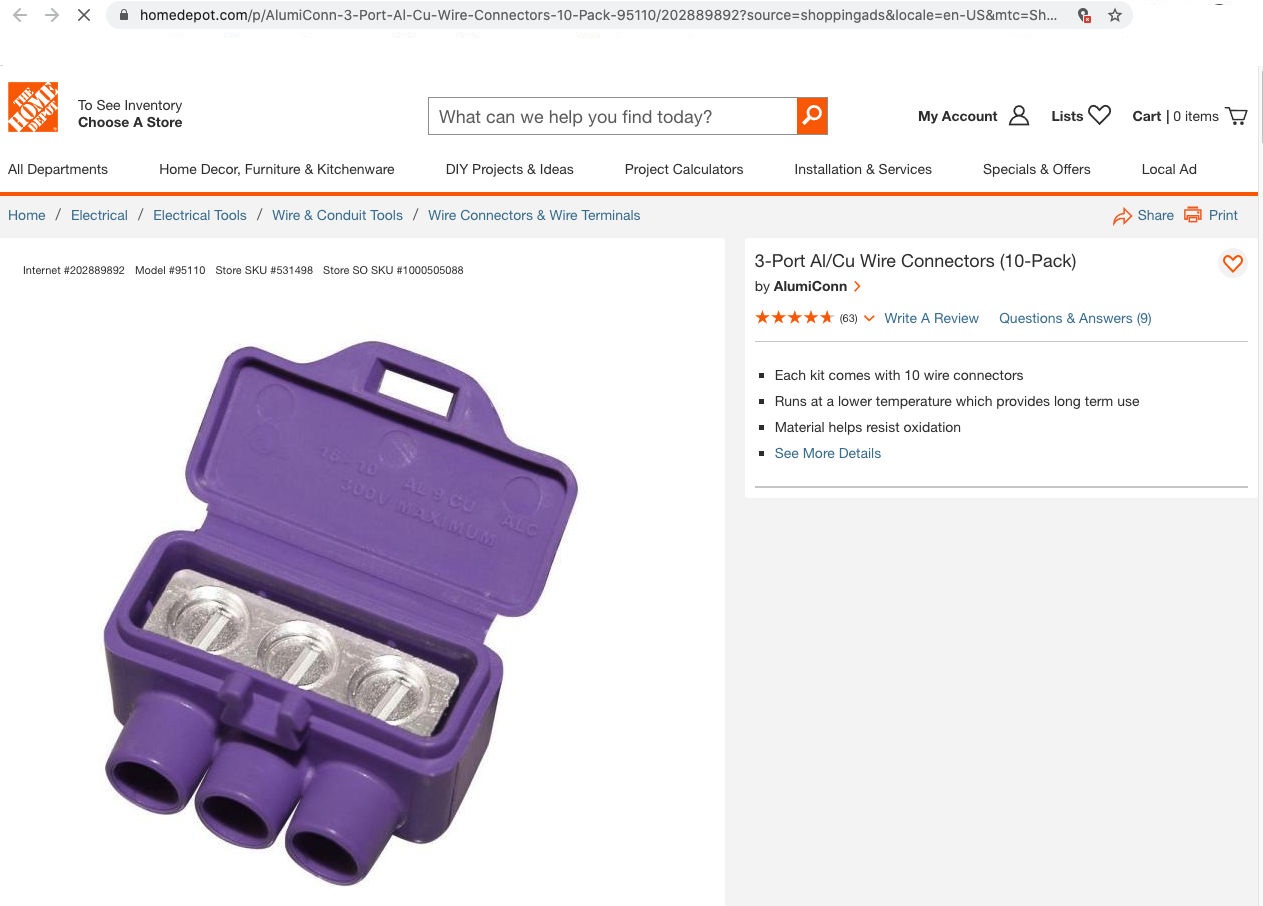 Below are my opinions, offered in reply to your questions. The illustration shown here is of the AlumiConn connector for aluminum wire "pigtailing" repair, sold by Home Depot and advertised online.
[Click to enlarge any image]
1. Certification Document for Repaired Aluminum Wiring:
While there may be local, state or provincial requirements, there is no national standard nor official "document" certifying that an electrician is qualified to perform aluminum wiring repair. Nor am I aware of state or provincial - level documents of that sort.
And there is no direct supervision of the electrician's work by an aluminum wiring repair expert.
At InspectApedia.com's listing of aluminum wire repair ELECTRICIANS all that I've been able to do is to ask electricians to assert that they are familiar with proper aluminum wiring repair procedures and that they use only the two US CPSC-recommended devices, the Amp COPALUM crimp connector or the AlumiConn terminal block.
If the electrician follows the instructions of those two manufacturers then many of the proper Al wire repair details will have been followed.
Watch out: A red flag that might spot an electrician whom we'd not want to perform aluminum wire repairs would be an electrician who uses twist-on connectors or relies on receptacles or switches stamped CO/ALR, or an electrician who performs only partial "repairs" such as only addressing the connectors in receptacle boxes and not those in the electrical panel or in junction boxes.
2. Certification of aluminum wiring repair electricians: same as above in point #1.
There is no relationship of which I'm aware between the licensing process for electricians and expertise in aluminum wiring repair.
And in fact in some communities a lay-person, who is not a licensed electrician, is permitted to perform electrical wiring tasks so long as she obtains a permit and has the work inspected by a local electrical code compliance inspector. Having done such work myself I can absolutely assure you that no code compliance inspection is ever exhaustive; rather the inspectors take a sampling approach, often at several stages of the electrical job.
3. Who can buy the AMP COPALUM, the AlumiConn or other Aluminum wire "repair" devices?
Anybody can buy "aluminum repair" devices, including some that we know perfectly well are not reliable, such as CO/ALR-stamped electrical receptacles and switches.
Many of these are available both from online vendors and from building suppliers such as Home Depot and Lowes as well as at many local hardware stores and electrical suppliers. Nobody at the register in such stores asks to see your electrician's license when you buy such devices. Nor have I found any regulations limiting the sale of those devices.
4. Who buys aluminum wire repair devices for the Al wire repair job:
it is likely that the electrician buys or has already bought the devices needed for this or other electrical work, though she may, depending on the contract, bill the client for parts and materials separately from time.
On 2021-02-19 - by (mod) -
Anon:
I agree that when you have solid conductor aluminum branch circuit wiring in a house built in the 1950s, it's likely that the Al circuit was added, and is not original.
If you've made certain that there is only one aluminum wire circuit then you're almost home free, but ALL such circuits need to be found and repaired properly using one of the two approved/recommended connectors, the AMP TYCO CRIMP or the AlumiConn described at ALUMINUM WIRING REPAIR METHODS https://inspectapedia.com/aluminum/Aluminum_Wiring_Repair_Methods.php
Just running a new copper ground at such a circuit is unsafe and inadequate as it leaves the unsafe hot and neutral wires in use. Leaving those connections un-repaired risks a house fire.
On 2021-02-19 - by (mod) -
Re-posting from private email:
I have a 1950's era house. One circuit is giving me trouble, which appears to be due to gimpy or broken ground leads in the cables. I've proven that between two junction boxes that are easily accessible, and I strongly suspect it between a number of other pairs of boxes as well.
This is the only cable in the house with an aluminum ground lead, as opposed to copper, and I'm suspicious that after 70 years that aluminum lead may be broken or cracked in inaccessible places. (I could confirm the breaks elsewhere with an ohmmeter, but haven't gone quite that far with my troubleshooting as yet.)
I'm tempted to replace the cabling of this entire circuit with all-copper Romex, but that would be a difficult job.
Pulling a single wire for the ground alone would be a great deal easier than pulling a 3- or 4-wire cable to replace the ground and the hot and neutral (and in a couple cases, the switched) lines as well.
Can you tell me whether it is acceptable to run a ground line separate from (but parallel and close to) the existing cable to provide a good ground to the several junction boxes involved? - Anonymous
On 2017-12-29 - by (mod) -
Josh
All electrical wire connections must be made inside of an accessible gang box.
On 2017-12-29 by Josh
I am considering a bathroom remodel. My house was built in 1972 and has aluminum electrical wiring.
It is not easy to remove the aluminum wiring completely for this project but I was thinking that since I am gutting the bathroom, I can cut the wiring at the point where each branch circuit enters the bathroom and use Alumiconn connectors to change them to copper then complete all bathroom wiring with new romex.
Would building code prevent this or mandate that all AlumiConn connections be made within a gang box? If so can I simply add a gang box to run all aluminum wiring to then place behind a cover plate? Thanks.
Question: what would it cost to install one AlumiConn™ wiring repair connector?
(Sept 15, 2014) stan covington said:
Price to do one alumiconn connector
Reply:
Stan, you may be asking a trick question. It's typically $60. + for a licensed electrician to walk in the door. The cost of the connector is trivial in comparison and can be found at the AlumiConn store links we give in the article above.
WATCH OUT: fixing just one aluminum wire connection is dangerous - that is, leaving others unattended not only risks a subsequent overheat and fire but may give occupants a false sense of security that the safety problem has been dealt with when it has not - leading to people taking extra risks or ignoring dangerous warning signs. Don't do it.
...
Continue reading at AlumiConn INSTALLATION PROCEDURE or select a topic from the closely-related articles below, or see the complete ARTICLE INDEX.
Or see these
Recommended Articles
- ALUMINUM WIRING HAZARDS & REPAIRS - home
- ALUMINUM WIRING IDENTIFICATION
- ALUMINUM WIRING REPAIR METHODS
- ALUMINUM WIRING REPAIR ELECTRICIANS
- ALUMINUM WIRING REPAIRS NOT-RECOMMENDED
- REDUCE THE AL WIRE RISK: DETAILS
Suggested citation for this web page
ALUMINUM WIRING REPAIR METHODS at InspectApedia.com - online encyclopedia of building & environmental inspection, testing, diagnosis, repair, & problem prevention advice.
Or see this
INDEX to RELATED ARTICLES: ARTICLE INDEX to ELECTRICAL INSPECTION & TESTING
Or use the SEARCH BOX found below to Ask a Question or Search InspectApedia
Ask a Question or Search InspectApedia
Try the search box just below, or if you prefer, post a question or comment in the Comments box below and we will respond promptly.
Search the InspectApedia website
Note: appearance of your Comment below may be delayed: if your comment contains an image, photograph, web link, or text that looks to the software as if it might be a web link, your posting will appear after it has been approved by a moderator. Apologies for the delay.
Only one image can be added per comment but you can post as many comments, and therefore images, as you like.
You will not receive a notification when a response to your question has been posted.
Please bookmark this page to make it easy for you to check back for our response.
IF above you see "Comment Form is loading comments..." then COMMENT BOX - countable.ca / bawkbox.com IS NOT WORKING.
In any case you are welcome to send an email directly to us at InspectApedia.com at editor@inspectApedia.com
We'll reply to you directly. Please help us help you by noting, in your email, the URL of the InspectApedia page where you wanted to comment.
Citations & References
In addition to any citations in the article above, a full list is available on request.
- AlumiConn website - www.kinginnovation.com/products/alumiconn/ has installation videos, Wire combinations, specification sheets, and other information and assistance in purchasing or using this product.
- [1]AlumiConn [Website: AlCopStore.com ] ™ AlCopStore.com
223 Salt Lick Road, #279,
St. Peters, MO 63376
Tel: 866-826-2256, Fax: 636-754-0500, Email Sales: pking@AlCopStore.com, Email General Inquiry: info@AlCopStore.com - [2] "Repairing Aluminum Wiring," [As updated 2011] U.S. Consumer Product Safety Commission Publication available online
- [3] "Record of Commission Action, Commissioners Voting by Ballot", CPSC Publication No. 516, Repairing Aluminum Wiring (original version op.cit.), (Briefing package dated March 15, 2011), Quoting:
The Commission voted unanimously (5-0)·to approve republication of CPSC Publication No. 516, Repairing Aluminum Wiring, with the explicit recognition that the COPALUM and AlumiConn connectors currently are the only products that meet the agency's standards to prevent aluminum wire fire hazards
Copy on file as /aluminum/Pub516_Alumi_Conn.pdf - [4] Dr. Jess Aronstein, protune@aol.com is a research consultant and an electrical engineer in Schenectady, NY. Dr. Aronstein provides forensic engineering services and independent laboratory testing for various agencies. Dr. Aronstein has published widely on and has designed and conducted tests on aluminum wiring failures, Federal Pacific Stab-Lok electrical equipment, and numerous electrical products and hazards. See ALUMINUM WIRING BIBLIOGRAPHY and see FPE HAZARD ARTICLES, STUDIES for examples.
- [5] "The Influence of Corrosion Inhibitor and Surface Abrasion on the Failure of Aluminum-Wired Twist-on Connections", Aronstein, J.; Campbell, W., Components, Hybrids, and Manufacturing Technology, IEEE Transactions on Volume 7, Issue 1, Mar 1984 Page(s): 20 - 24
- "Aluminum Wiring: Understanding the Problem and Its Solutions", Hartford Insurance Company - NOTICE: this information contains technical errors and some obsolete information. We include the document reference as an indication of insurance companies who are aware of aluminum electrical wiring hazards and costs. Local copy.
- 05/21/2007 Reducing the Fire Hazards in Aluminum-Wired Homes, [.pdf document], Jess Aronstein, Ph.D., 21 May 2007. This document answers most technical questions about the hazards and remedies of aluminum electrical wiring and includes a report on independent test results of alternative products and methods for repairing aluminum wiring. Some of the sections of this very thorough document are listed below:
- WANTED: Aluminum Wiring Field Reports, Photographs, Samples, & Failure Cases & Data for ongoing study on frequency and severity of occurrence of problems. If you have experienced any problem, or symptom of possible problem with aluminum electrical wiring, or have repaired or replaced it, please contact the InspectApedia Editor All information is confidential. Study results will be provided to the U.S. Consumer Product Safety Commission and to the electrical industry. Real life aluminum wiring field failure reports can be seen at Aluminum Wiring Failures in Residential Properties: Field Reports & Pictures.
- Our recommended books about building & mechanical systems design, inspection, problem diagnosis, and repair, and about indoor environment and IAQ testing, diagnosis, and cleanup are at the InspectAPedia Bookstore. Also see our Book Reviews - InspectAPedia.
-
 The Home Reference Book - the Encyclopedia of Homes, Carson Dunlop & Associates, Toronto, Ontario, 25th Ed., 2012, is a bound volume of more than 450 illustrated pages that assist home inspectors and home owners in the inspection and detection of problems on buildings. The text is intended as a reference guide to help building owners operate and maintain their home effectively. Field inspection worksheets are included at the back of the volume. Special Offer: For a 10% discount on any number of copies of the Home Reference Book purchased as a single order. Enter INSPECTAHRB in the order payment page "Promo/Redemption" space. InspectAPedia.com editor Daniel Friedman is a contributing author.
Or choose the The Home Reference eBook for PCs, Macs, Kindle, iPad, iPhone, or Android Smart Phones. Special Offer: For a 5% discount on any number of copies of the Home Reference eBook purchased as a single order. Enter INSPECTAEHRB in the order payment page "Promo/Redemption" space.
- In addition to citations & references found in this article, see the research citations given at the end of the related articles found at our suggested
CONTINUE READING or RECOMMENDED ARTICLES.
- Carson, Dunlop & Associates Ltd., 120 Carlton Street Suite 407, Toronto ON M5A 4K2. Tel: (416) 964-9415 1-800-268-7070 Email: info@carsondunlop.com. Alan Carson is a past president of ASHI, the American Society of Home Inspectors.
Thanks to Alan Carson and Bob Dunlop, for permission for InspectAPedia to use text excerpts from The HOME REFERENCE BOOK - the Encyclopedia of Homes and to use illustrations from The ILLUSTRATED HOME .
Carson Dunlop Associates provides extensive home inspection education and report writing material. In gratitude we provide links to tsome Carson Dunlop Associates products and services.
 | HOME | ABOUT | ASK a QUESTION | CONTACT | CONTENT USE POLICY | DESCRIPTION | POLICIES | PRIVACY | |
| © 2025 - 1985 Publisher InspectApedia.com - Daniel Friedman | |||||||||