
InspectAPedia® FREE Encyclopedia of Building & Environmental Construction, Diagnosis, Maintenance & Repair |
Question? Just ask us! InspectAPedia
|
 Diagnose & Repair Air Conditioner Compressor Hard Starting
Hard start capacitors & other solutions
- POST a QUESTION or COMMENT about diagnosing and fixing hard-starting A/C or heat pump compressors
This air conditioning repair article explains procedures for the diagnosis and repair of hard-starting air conditioning compressors.
If your air conditioner or heat pump compressor motor won't start or has trouble starting, humming at start-up for example, it may be damaged and at or near end of life.
Here we explain how to diagnose air conditioner start-up problems, Air conditioner stutters or makes noises at start-up, When to install a hard-start air conditioner repair kit with starting capacitor, Hard starting can indicate end of air conditioner life, or it may be just a small repair.
But a common repair performed to try to get such motors running and to keep them in use longer is the installation of an air conditioner or heat pump "hard start" kit - a start capacitor or a start/run capacitor that helps get the motor spinning. First it's useful to diagnose the cause of the compressor's hard-starting trouble.
InspectAPedia tolerates no conflicts of interest. We have no relationship with advertisers, products, or services discussed at this website.
- Daniel Friedman, Publisher/Editor/Author - See WHO ARE WE?
Diagnose & Repair Air Conditioner Compressor Hard Starting or Intermittent Running or Stuttering
 First let's describe several A/C or heat pump compressor motor start-up problems:
- Stuttering or on-off at startup:
A "hard starting" compressor may stutter or begin to cycle-on then stop, then restart. If a compressor is frequently tripping the circuit breaker (or blowing the fuse) which protects its circuit, compressor and wiring diagnosis and repair are needed.
Also check: the start relay and all electrical wiring connections to the compressor motor. Loose wires or a bad start relay can also explain stuttering or "on-off" at compressor motor startup. (Thanks to Texas Red and his HVACR Technician for this tip.)
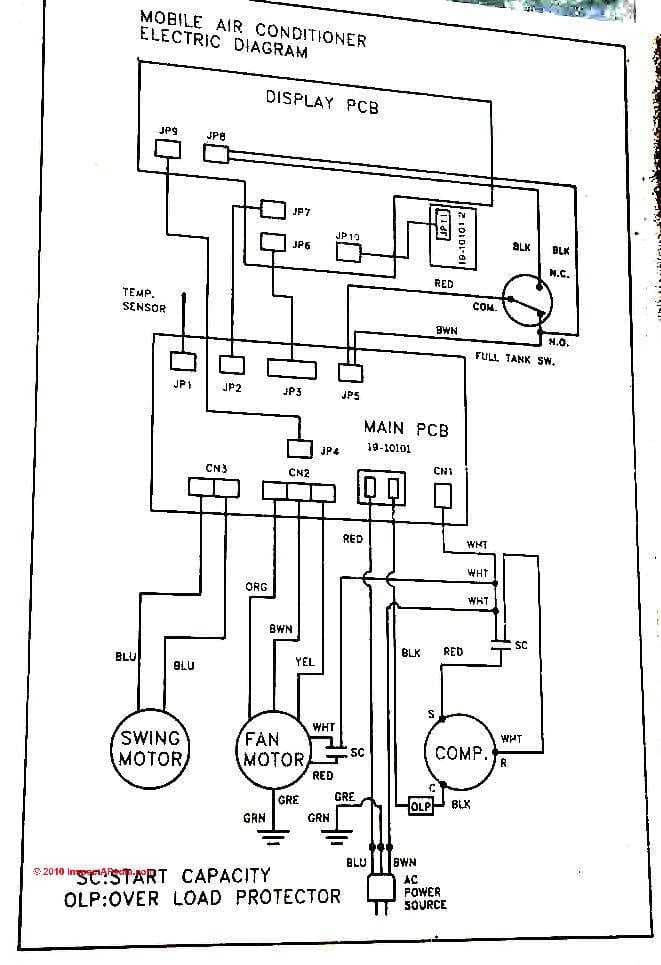
[Click to enlarge any image] At above/left, a simple AC wiring diagram showing the start/run capacitor connections. - A/C Compressor starts, runs just briefly, then shuts off:
this condition too may be solved by adding a starting capacitor, but watch out: it may also be a sign of a compressor near end of life.
See CAPACITORS for HARD STARTING MOTORS. As reader S.W. wrote:
I had a curious condition whereby the compressor would run for a period of time...at least 5 minutes but usually longer, then suddenly shut down. The condenser fan which is essentially in parallel with it across the line continued to run. I tried to determine what sort of [overload] was in the Copeland U9X CR28K7 compressor.
It appeared that the OL was opening but I didn't determine why. The compressor was not drawing excessive current and the house seemed to stay at the thermostat set point. I was been unable to obtain any details on the construction of the Copeland compressor. ...
The problem was resolved - a simple matter of adding a hard start kit. Apparently the compressor increased slightly in start friction over the last year or so which made the problem appear intermittent. - Low line voltage:
Abnormally low line voltage may also be causing a compressor to "hard start". Air conditioner supply voltage is typically checked using a VOM (voltage ohms meter) right at the air conditioner service disconnect box near the compressor/condenser unit.
Voltage should be within 10% of the required number (on the compressor/condenser data tag). A service technician may also check line voltage again at the compressor terminals when the compressor has reached normal operating state to be sure that there is no voltage drop. - Starting an air conditioner against compressor head-pressure:
When an air conditioning compressor has been running long enough to reach its normal operating condition, it has pumped refrigerant to a high pressure condition in the compressor head.
When an A/C system compressor is running and is unexpectedly shut off, perhaps by a human testing a thermostat or switch, if the system is immediately turned back on, some compressors, particularly older window and wall units, may be unable to re-start against this high head pressure.
Watch out: Simply waiting for pressures to equalized may be all that's needed. But that can take anywhere from fifteen minutes to three hours. If you turn the system back on too soon there is a risk of liquid slugging damage - liquid refrigerant enters the compressor and damages the piston, head, or most-likely bends a valve. That can destroy the compressor motor.
So if the compressor is not starting in this condition we simply turn it off and wait. If this problem is happening often, a service technician may install one of several versions of "hard start kit". - Do not just install a larger fuse
or circuit breaker as doing so risks a fire or equipment burn up.
Do not bypass fuses such as by installing copper tubing in place of fuses as some A/C service people recommend.
This is a crazy electrical hazard risking fire, shock, and equipment burn-up.
If new circuit breakers are to be installed to replace an older fuse-protection on an air conditioning circuit, the electrician should remove any obsolete, unused electrical equipment or devices to avoid future confusion or possible shock hazards. - A "hard start kit"
is basically a capacitor which gives an extra electrical "jolt" to the compressor motor to get it moving. A starter relay may also need to be installed or replaced. Some air conditioning compressor brands do not usually need a hard start kit. GE, Trane, and Manurope are examples that do not usually take this kit.
See CAPACITORS for HARD STARTING MOTORS for photos, wiring diagram, and installation instructions for air conditioner compressor, fan, blower, refrigerator motor, freezer motor, or other electrical motor starting booster capacitors.
- Bad air conditioner starting capacitor
: your air conditioning compressor may already have a starting capacitor installed, but the starting capacitor itself may have failed. While electric motor starting capacitors can fail in a variety of ways that may not be obvious without performing some electrical tests, on occasion the failed starting capacitor may be visually obvious.
Most electric motor or compressor starting capacitors used on air conditioning equipment are in a round cylindrical shape. The two ends of the cylinder should be flat. If your starting capacitor is visibly bulged at its end(s) or anywhere else, or if it looks split or burned, it's almost certainly damaged and needs replacement.
Watch out: other problems can cause the starting capacitor to fail, and some starter capacitor failures may not be visibly apparent. If your starting capacitor is replaced and fails again, further diagnosis of the failure source is needed.
See CAPACITORS for HARD STARTING MOTORS where we explain how to select, install, or test an electric motor starting capacitor.
There we also comment that in addition to hard starting or a non-starting air conditioner or heat pump compressor motor, a bad starter capacitor can also disable the fan in the outdoor compressor/condenser, or the blower fan in the indoor air handler unit.
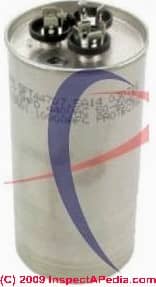
Thanks to reader George Fazio for this air conditioner start-up diagnosis suggestion and for the photo of an un-damaged starter capacitor (above left). - Tight or Seized Air Conditioner Motors
can be hard to start and may make a "humming" noise while trying to start-up and the compressor motor may fail to start at all, eventually tripping the circuit breaker or blowing the circuit fuse.
It might be possible to get a slow or hard-starting tight or even seized AC compressor motor going again -
see TIGHT or SEIZED AC COMPRESSORS for more details on how this is done.
But in any case such a compressor is probably near the end of its life. - End of air conditioning compressor life
may be near: A compressor which has difficulty starting might be fixed by installing a "hard start" kit, but depending on the reason for hard starting it's possible that the entire compressor will have to be replaced soon. On a more optimistic note, some hard start kit manufacturers assert that installing a "hard start kit" on a compressor will extend its life.
By assisting the compressor in starting at up to ten times faster than normal, Kickstart® hard start devices significantly reduce the amount of damaging heat that is generated in the motor windings with each and every start.
Over time, this reduced stress on insulation, wiring, and other critical components of the compressor has the effect of increasing its reliability and extending its useful life." -- www.kickstartoem.com
...
...
Continue reading at CAPACITORS for HARD STARTING MOTORS or select a topic from the closely-related articles below, or see the complete ARTICLE INDEX.
Or see HARD STARTING COMPRESSOR MOTOR FAQs - questions & answers posted originally at this article
Or see these
Recommended Articles
- COMPRESSOR / CONDENSER REPAIR - home
- BURNED-OUT COMPRESSOR
- CAPACITORS for HARD STARTING MOTORS
- COMPRESSOR / CONDENSER DIAGNOSTICS
- COMPRESSOR / CONDENSER INSPECTION CHECKLIST
- COMPRESSOR MOTOR INSULATION
- COMPRESSOR MOTOR REPLACEMENT
- CONTACTOR RELAY DIAGNOSIS & REPAIR
- CONTROL CIRCUIT BOARD, A/C
- CRANKCASE HEATERS
- FAN, COMPRESSOR / CONDENSER UNIT
- HARD STARTING COMPRESSOR MOTORS
- MOTOR OVERLOAD RESET SWITCH
- NOISES, HVAC SYSTEM DIAGNOSIS - home
- REFRIGERANT FLOODBACK, LIQUID SLUGGING
- TIGHT or SEIZED AC COMPRESSORS
- ELECTRIC MOTOR DIAGNOSTIC GUIDE tests to diagnose electric motors
Suggested citation for this web page
HARD STARTING COMPRESSOR MOTORS at InspectApedia.com - online encyclopedia of building & environmental inspection, testing, diagnosis, repair, & problem prevention advice.
Or see this
INDEX to RELATED ARTICLES: ARTICLE INDEX to AIR CONDITIONING & HEAT PUMPS
Or use the SEARCH BOX found below to Ask a Question or Search InspectApedia
Ask a Question or Search InspectApedia
Try the search box just below, or if you prefer, post a question or comment in the Comments box below and we will respond promptly.
Search the InspectApedia website
Note: appearance of your Comment below may be delayed: if your comment contains an image, photograph, web link, or text that looks to the software as if it might be a web link, your posting will appear after it has been approved by a moderator. Apologies for the delay.
Only one image can be added per comment but you can post as many comments, and therefore images, as you like.
You will not receive a notification when a response to your question has been posted.
Please bookmark this page to make it easy for you to check back for our response.
IF above you see "Comment Form is loading comments..." then COMMENT BOX - countable.ca / bawkbox.com IS NOT WORKING.
In any case you are welcome to send an email directly to us at InspectApedia.com at editor@inspectApedia.com
We'll reply to you directly. Please help us help you by noting, in your email, the URL of the InspectApedia page where you wanted to comment.
Citations & References
In addition to any citations in the article above, a full list is available on request.
- Modern Refrigeration and Air Conditioning, A. D. Althouse, C.H. Turnquist, A. Bracciano, Goodheart-Willcox Co., 1982
- Principles of Refrigeration, R. Warren Marsh, C. Thomas Olivo, Delmar Publishers, 1979
- Refrigeration and Air Conditioning Technology, 5th Ed., William C. Whitman, William M. Johnson, John Tomczyk, Cengage Learning, 2005, ISBN 1401837654, 9781401837655 1324 pages
- In addition to citations & references found in this article, see the research citations given at the end of the related articles found at our suggested
CONTINUE READING or RECOMMENDED ARTICLES.
- Carson, Dunlop & Associates Ltd., 120 Carlton Street Suite 407, Toronto ON M5A 4K2. Tel: (416) 964-9415 1-800-268-7070 Email: info@carsondunlop.com. Alan Carson is a past president of ASHI, the American Society of Home Inspectors.
Thanks to Alan Carson and Bob Dunlop, for permission for InspectAPedia to use text excerpts from The HOME REFERENCE BOOK - the Encyclopedia of Homes and to use illustrations from The ILLUSTRATED HOME .
Carson Dunlop Associates provides extensive home inspection education and report writing material. In gratitude we provide links to tsome Carson Dunlop Associates products and services.
 | HOME | ABOUT | ASK a QUESTION | CONTACT | CONTENT USE POLICY | DESCRIPTION | POLICIES | PRIVACY | |
| © 2025 - 1985 Publisher InspectApedia.com - Daniel Friedman | |||||||||