
InspectAPedia® FREE Encyclopedia of Building & Environmental Construction, Diagnosis, Maintenance & Repair |
Question? Just ask us! InspectAPedia
|
 Supply Duct Air Flow Increase
How to
find & fix HVAC duct leaks & restrictions
- POST a QUESTION or COMMENT about the causes & cures of weak air flow in central air conditioning or warm air heating systems
How to correct weak air flow at air conditioner or heat pump or warm air heating air supply registers:
Air conditioning or heating duct air flow improvements. This article describes the causes of inadequate cool or warm air from air conditioning or heating ducts and suggests how to increase air flow to improve system operation. Sketch provided courtesy of Carson Dunlop Associates, a Toronto home inspection, education & report writing tool company [ carsondunlop.com ].
InspectAPedia tolerates no conflicts of interest. We have no relationship with advertisers, products, or services discussed at this website.
- Daniel Friedman, Publisher/Editor/Author - See WHO ARE WE?
Fix Weak Air Flow in HVAC Systems
Article Contents
- CAUSES OF POOR SUPPLY OF AIR AT HEATING OR COOLING SUPPLY REGISTERS
- OTHER OEM SOURCES OF VARIATIONS IN AIR HANDLER BLOWER AIR DELIVERY RATES IN CFM
- WEAK COOL OR WARM AIR SUPPLY: Causes of Reductions in the Air Flow, Air Quantity, or Air Speed in HVAC Ductwork
- OTHER CAUSES OF INADEQUATE SUPPLY AIR from Air Conditioning or Heating Air Duct Systems
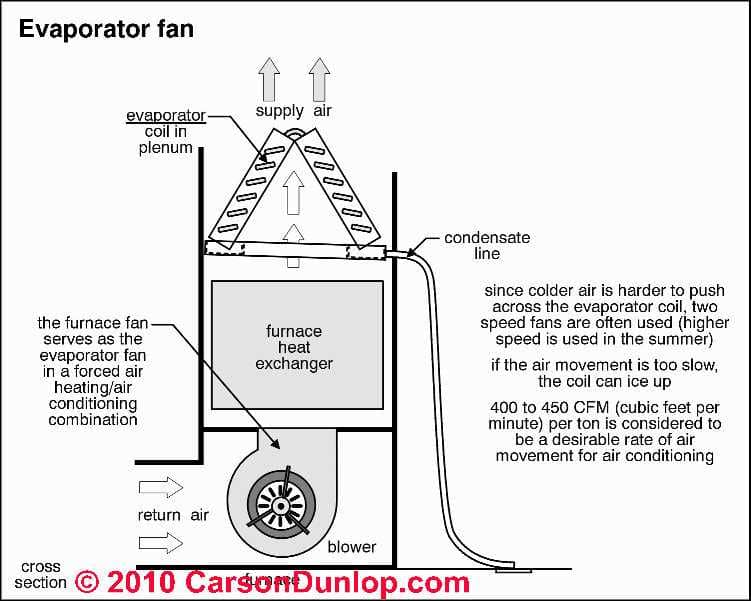
Carson Dunlop Associates' sketch points out that the (typical) desirable rate of cool air flow in an air conditioning system is around 400 to 450 cubic feet per minute.
Causes of Poor Air Flow in Air Conditioning or Heating Systems
Residential fpm Target = blower fan air speed: 400-450 cu ft/min.
An HVAC system that is simply not capable of moving enough cubic feet of air per minute will not be able to adequately cool or warm the occupied space. Higher air speeds are needed during the cooling season.
See details about various air flow rates in ducts and through HVAC equpment for both residential and commmercial installations
at AIR FLOW RATES in HVAC SYSTEMS
[Click to enlarge any image]
Minimum Evaporator Blower Air Speed of 350 CFM per Ton of Capacity
While recommended air speeds will vary by manufacturer and air conditioner or heat pump model, typically, as Whirlpool recommends that all air conditioning or heat pump models should run no less than 350 CFM per ton of cooling capacity. [17]
See AIR FLOW MEASUREMENT CFM for details on how to measure air flow.
The illustration also points out that if air flow is too slow across the cooling coil, that component may become ice or frost-blocked.
See FROST BUILD-UP on AIR CONDITIONER COILS for details.
Other OEM Sources of Variations in Air Handler Blower Air Delivery Rates in CFM
Evaporator unit blower air speeds vary considerably by manufacturer and model. For example Whirlpool's WGPH45 heat pump system product literature describes varying blower air flow speeds in CFM depending on which motor speed electrical tap is connected, giving CFM (cubic feet per minute) air speeds ranging from 545 CFM up to 2200 CFM. [17]
Air flow rates across the evaporator coil in the air handler are generally given in "dry coil" speeds and without considering the reduction in air flow caused by the air filter (about 0.8" H2O). When the cooling coil is wet with condensate the air speed drops further.
Wet coil pressure drop is approximately 0.1" H2O, for two-row indoor coil; 0.2” H2O, for three-row indoor coil; and 0.3” H2O, for four-row indoor coil. [17]
Weak Cool or Warm Air Supply: Causes of Reductions in the Air Flow, Air Quantity, or Air Speed in HVAC Ductwork
Here are causes of inadequate air flow rate through the HVAC duct system, including conditions that slow the speed of movement of air through the duct system as well as other HVAC duct system defects.
For our complete list of HVAC duct system inspection, diagnosis, and repair topics
see DUCT SYSTEM DESIGN SIZE & DEFECTS.
 Air filter dirty, damaged, collapsed, blocked: an air filter or any other item that has been sucked into the duct system will block air flow and can risk a fire if drawn into the blower assembly fan,
are perhaps the most common cause of unsatisfactory airflow in an HVAC system.
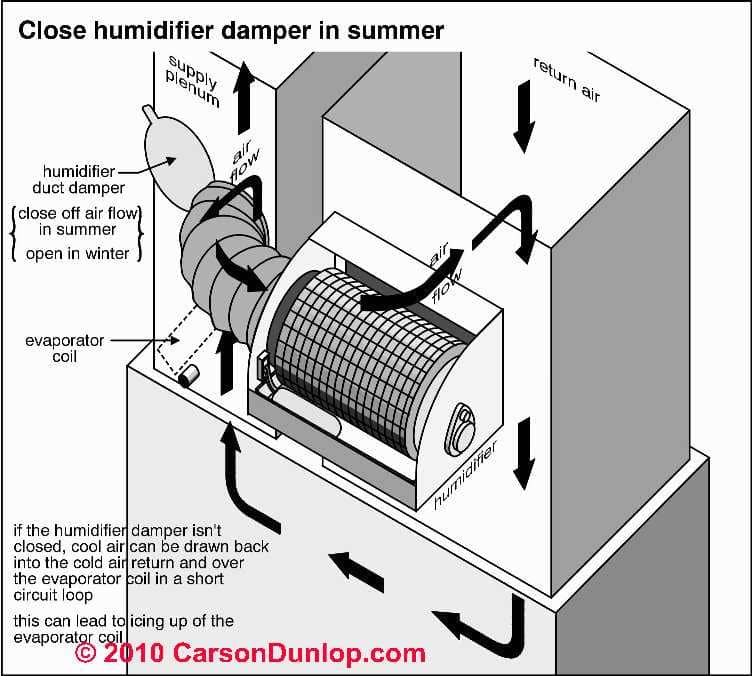
Air leaks from unconditioned space into the air supply system mean that cool air is diluted in summer or warm air is diluted in winter.
The sketch at left illustrates a common diluting air leak that can reduce the effectiveness of air conditioning during the cooling season: a humidifier intended for winter use that short-circuits return air right over into the supply air duct without passing it through the cooling coil.
Sketch at left courtesy of Carson Dunlop Associates, a Toronto home inspection, education & report writing tool company [ carsondunlop.com ].
Air Registers Located Outside the Room (return air) mean that if the room door is closed and not under-cut, both heating and cooling capacity in that room will be reduced.
To understand the effect of a room that has only air supply registers and no return registers when the room door is shut, just imagine the air conditioning or warm air heating system having to blow air into a pressurized space.
Lower-cost new central air conditioning systems and retrofit air conditioning systems often provide supply ducts to the various rooms served but install just one or two central cool air returns.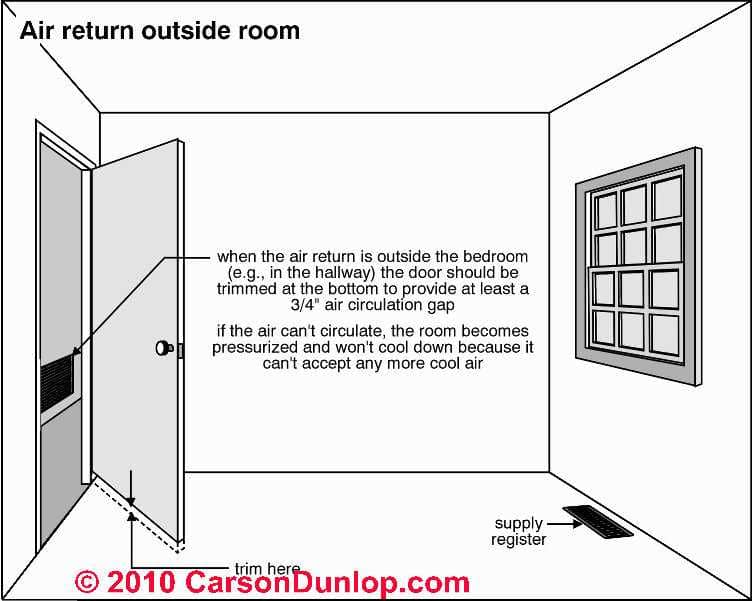 Try leaving a door ajar to see if you can observe stronger air flow out of the supply registers in the room. If this makes a noticeable difference, other than leaving the door open you can improve heating or cooling by one of these means:
- undercut the door bottom by an inch or 1.5 inches to allow more air flow through that opening
- install a through-wall register higher on the wall that lets warm room air flow out to the central return register during the cooling season, or both high and low through wall registers to improve air flow during both heating and cooling seasons.
Close the high register during heating and close the low register during cooling. Details are provided by more sketches later in this article.
Sketch at left courtesy of Carson Dunlop Associates, a Toronto home inspection, education & report writing tool company [ carsondunlop.com ].
Balance of air flow among different building areas may have been subverted by occupants in one or two areas.
Particularly in commercial spaces or buildings that use the area above a suspended ceiling as a giant return air plenum, people who have moved or removed a suspended ceiling panel to improve air conditioning or heating over their immediate area have un-knowingly subverted the air flow balance in the entire system.
If you see ceiling panels out of place or are surprised to see some air supply registers closed, check for these problems.
See BALANCING AIR DUCT FLOW for details.
Blower Fan: dirty blades on a squirrel cage blower assembly fan significantly reduce the blower fan's ability to move air into the HVAC system from the return-air side as well as reducing its ability to push conditioned air into the occupied space.
Watch out: it is not obvious to a novice, but even a small amount of dust and dirt that begins to fill the curvature of the blades of a squirrel cage type blower fan will reduce the air flow rate. The fan spins and looks fine, but the loss of that curve means that the blades are not picking up and moving air.
See DIRTY A/C BLOWERS for details.
Blower fan speed control operating problems on a dual-speed fan can cause the air flow to be weak during the cooling season. On combination heating and air conditioning systems we often install a two-speed fan, intending to operate the blower fan at a higher speed during the cooling season. But if the fan control does not switch to the higher speed when the air conditioner is on, the air flow may be inadequate.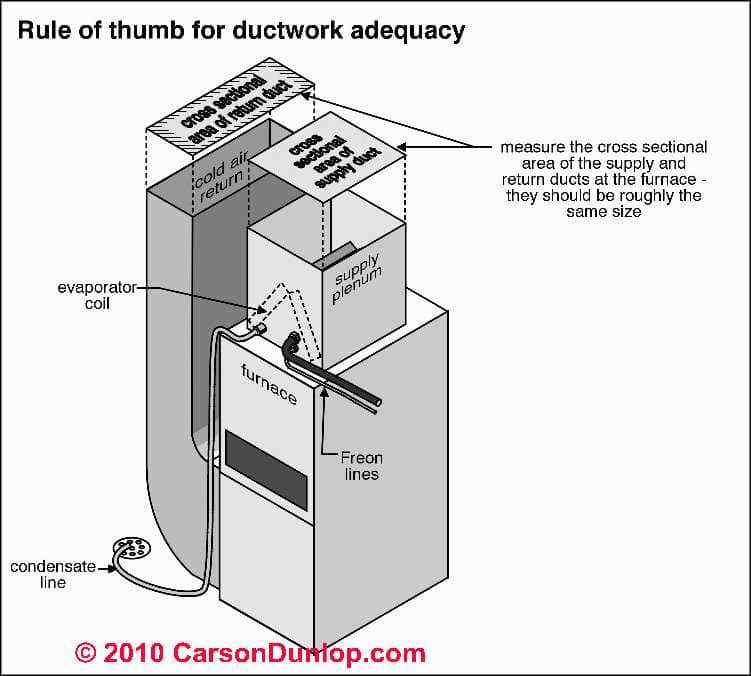 Also see BLOWER FAN OPERATION & TESTING.
Cooling coil dirty, dirt-clogged, or damaged: if the cooling coil (evaporator coil) in the air handler is dirt-clogged air flow through the system will be reduced.
See DAMAGED COOLING COIL
and DIRTY COOLING COIL / EVAPORATOR COIL
Ductwork too small or duct sizes mismatched between the air handler, supply plenum, return air plenum, blower assembly, cooling coil. See the sketch at left: the cross sectional areas of the supply ducts and return ducts at the furnace or air handler should be about the same size.
See UNDERSIZED RETURN DUCTS.
Ductwork sizes not properly matched on a retrofit add-on of air conditioning to an existing warm air heating system, or during A-coil replacement in an existing air conditioning system can result in improper or poor air flow.
See ADDING A/C: RETROFIT SIZING.
Sketch at left courtesy of Carson Dunlop Associates, a Toronto home inspection, education & report writing tool company [ carsondunlop.com ].
 Fire damper that has become stuck in the closed or partly-closed position interferes with proper airflow through the system
See FIRE & SMOKE DAMPERS, AUTOMATIC.
Also check for a stuck or inoperative automatic zone damper if your HVAC duct system uses those devices to control air flow among building areas.
See ZONE DAMPER CONTROLS.
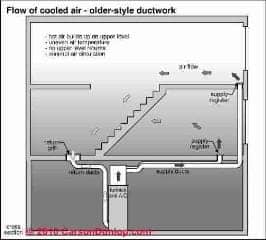
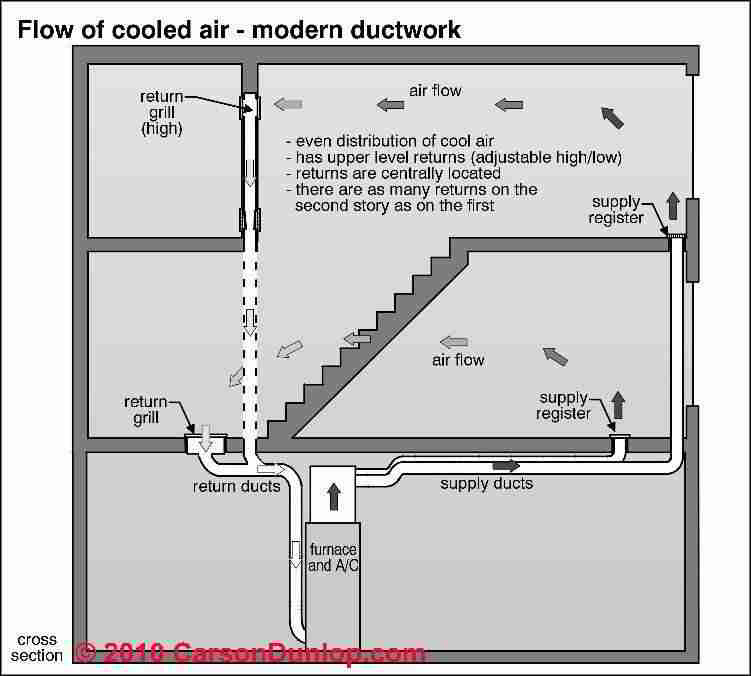
Floor air supply registers for cool air in an older-style duct work air conditioning system reduce cooling capacity if there is not proper return air flow.
Cool air supply ducts located in the floors can result in a build-up of warm air in that area of the building and difficulty in providing adequate cooling capacity.
As our sketch (left) illustrates, it is more difficult to push cool air upwards into the upper floors of a hot building than it is to cool the lower floors, since the more dense, cool air, by weight, tends by convection (or "gravity" if you prefer) downwards rather than upwards in a building.
Sketches provided courtesy of Carson Dunlop Associates, a Toronto home inspection, education & report writing tool company [ carsondunlop.com ].
Flex duct defects: Collapsed sections of flex duct block or stop airflow in either supply or return air systems
See DUCT ROUTING & SUPPORT (see our photo, above-left).
Frosted or Iced-over cooling coil in the air conditioner air handler is a common cause of reduced air flow or complete loss of air flow during the cooling season. A dirty air filter or low refrigerant charge could be at fault.
Watch out: this same problem occurs "in reverse" - that is, besides air flow blockage due to frost or ice formation on the cooling coil due to a refrigerant, refrigerant flow, or similar operating problem, low air flow through the duct system for any reason (dirty filter, crushed ducts, dirty blower fan, for example) can itself cause coil frost or ice formation.
So cause and effect can be confused without further diagnosis.
See FROST BUILD-UP on AIR CONDITIONER COILS
Insulation loose in air ducts: Collapsed duct interior insulation blocks air flow and can cause air handler overheating, risking a fire.
See FIBERGLASS DUCT, RIGID CONSTRUCTION
Leaks in the supply air duct system are a very common HVAC duct defect that results in poor heating or cooling air flow.
See LEAKY DUCT CONNECTIONS.
Also see these defective duct materials that may lose insulation and also may develop leaks:
- ALLOY SYSTEMS FLEXDUCT
- ATCO Rubber Products FLEXDUCT
- GOODMAN GRAY FLEXDUCT
- GRAY FLEXDUCT FAILURES - home
- OWENS CORNING FLEXDUCT
- OWL FLEXDUCT
Oversized furnace: causing short cycling & other air flow problems;
see details at FURNACE OVERSIZE PROBLEMS
Return air flow inadequate: insufficient number, size, or less than optimum location of return air inlets and ducts significantly reduces the air conditioning or heating air flow in HVAC systems.
Details are at RETURN AIR, INCREASE
and at RETURN AIR REGISTERS & DUCTS.
Also see UNDERSIZED RETURN DUCTS.
Watch out: if the supply air flow at air conditioning or heating supply registers seems weak, most experts suggest first checking for a dirty air filter, dirty blower fan, or leaky, crushed, disconnected, or damaged ductwork. But if the supply air has always been weak throughout the system, don't forget that inadequate return air can be the root cause of the problem.
More Causes of Inadequate Supply Air Flow from Air Conditioning or Heating Air Duct Systems
Combination Heating & Cooling Air Duct Systems:
How to adjust for summer cooling vs. winter heating:
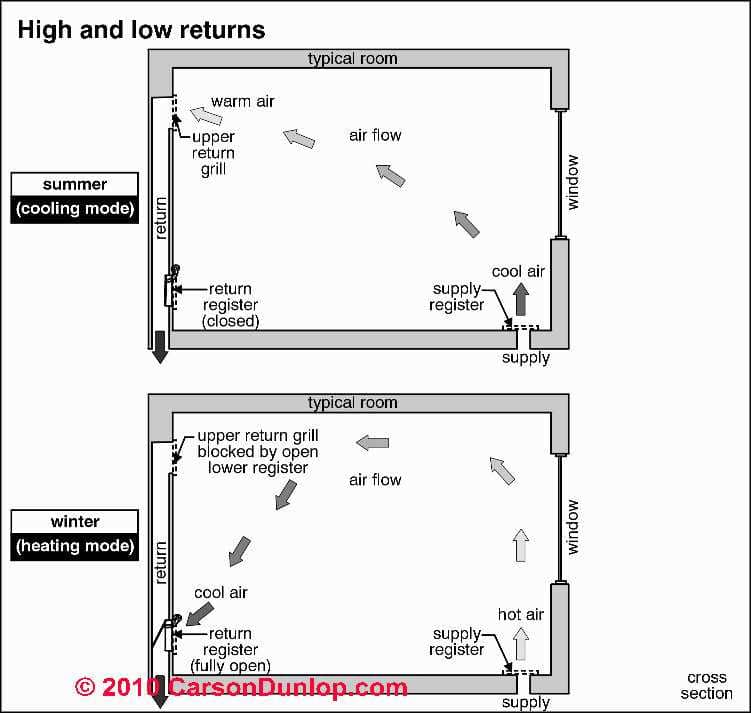
As Carson Dunlop Associates ' sketch (left) explains, the high air returns on building walls help cool a room during summer, but in winter we prefer to close these off and instead open low air returns near the building floor.
[Click to enlarge any image]
In summer we want to draw warm air from high in the room back into the cooling system.
In winter we want to draw chilly air that collects lower in the room near the floor back into the heating system.
Watch out: this return air register adjustment technique only works in rooms for which return air duct inlets have been installed both near the ceiling and near the floor.
Loose blower fan belt or pulley:

For air handlers whose blower fan is operated by a motor, belt, and pulley system, a loose pulley or worn, slipping drive belt can significantly reduce the air flow in the system (and may also make horrible squealing noises).
Sketch at above left courtesy of Carson Dunlop Associates, a Toronto home inspection, education & report writing tool company [ carsondunlop.com ].
Return air inlets: Return air inlet grilles that are obstructed with dirt, debris, or furniture or that are improperly located or are just too small mean that because the heating or cooling system is "starved for air", the supply air flow into occupied spaces will also be reduced.
See
RETURN AIR REGISTERS & DUCTS
Transite air ducts: Crushed or collapsed transite duct
See TRANSITE PIPE AIR DUCT ASBESTOS RISKS
Zone dampers that are stuck partly closed obstruct air supply into that building area, or if stuck "open" when the zone damper should be closed, airflow to other building areas will be reduced.
See ZONE DAMPER CONTROLS
 Also see UNDERSIZED RETURN DUCTS.
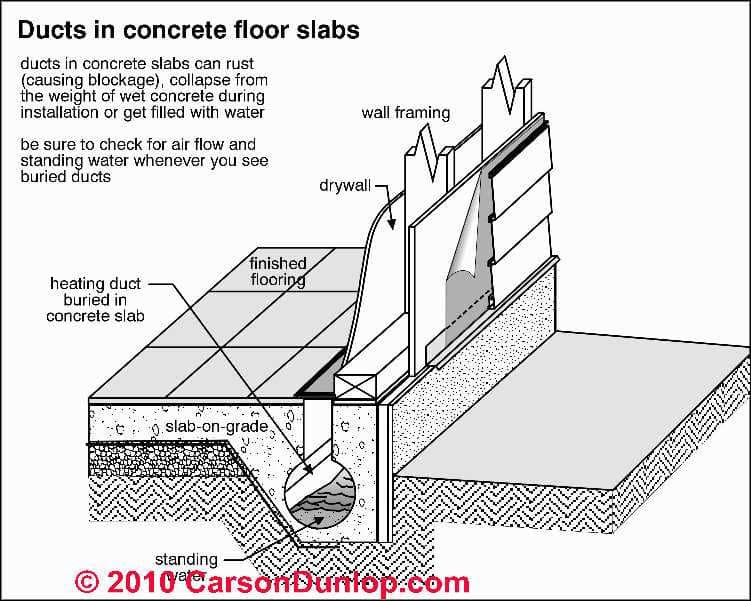
HVAC air ducts located inside concrete slab floors invite flooding, mold, insects, and where transite - cement asbestos - ductwork was used, asbestos particle contamination or collapsed ductwork.
See ASBESTOS DUCTS, Transite Pipe for details.
Sketch at left courtesy of Carson Dunlop Associates, a Toronto home inspection, education & report writing tool company [ carsondunlop.com ].
How to Improve Cool Air Flow from Floor-Level Air Conditioning Supply Registers
How can I improve cold air delivery from my air conditioner?
Older Florida home with air handler under house in crawl space. Air is ducted to floor registers. Not very efficient as cold air doesn't rise much. House has a flat roof no attic space to get up into. Any thoughts on how to improve? - D. (Anon).
This Q&A has been moved to a full article on this topic. Please
See COOL AIR SUPPLY IMPROVEMENT
See WARM AIR SUPPLY TEMPERATURE & IMPROVEMENT for suggestions to improve the air flow and temperature at forced warm air furnace or heating systems.
Basics of Proper Heating & Cooling Air Duct Design
The following air conditioning & heating duct design notes are excerpted from a typical furnace installation manual, in this case (York 2002).
The duct system must be installed in conformance with ASHRAE/NFPA 90, Standard for Installation of Warm Air Heating and Air Systems and other applicable local codes. Failure to adhere to proper duct system design standards can reduce airflow, resulting in reduced system performance and possible furnace damage.
Consideration should be given to the heating capacity required and also to the air quantity (CFM) required if A/C is to be installed along with the furnace or at some future time. These factors can be determined by calculating the heat loss and heat gain of the home or structure.
If these calculations are not performed and the furnace is oversized, the following may result:
1. Short cycling of the furnace.
2. Wide temperature fluctuations from the thermostat setting
.3. Reduced overall operating efficiency of the furnace.
The supply and return duct system must be of adequate size and designed such that the furnace will operate within the designed air temperature rise range and not exceed the maximum designed static pressure. These values are listed in the table below.
Additional information, values and data necessary for heat loss, heat gain and duct system design may be found in the ASHRAE HANDBOOK OF FUNDAMENTALS or in other nationally recognized publications recognized by municipal, state, provincial and federal code authorities.
If possible, it is recommended that the supply air duct attached to the furnace be provided with a removable access panel. The opening should be accessible when the furnace is installed in service and should be large enough that smoke or reflected light may be observed inside the casing to indicate the presence of leaks in the heat exchanger. The cover panel for this opening should be attached in such a manner as to prevent leaks.
Shared Duct System for Heating & Air Conditioning
1. When a single (common) duct system is used, one of the following methods shall be used:
a. A plenum type cooling coil must be installed on the air discharge side, or
b. A blower-coil type cooling coil must be installed in parallel with and isolated from the furnace, or
c. A self-contained A/C unit must be in parallel with and isolated from the furnace.
2. If two duct systems are used as could be the case with a coil-blower or a self-contained A/C unit, the furnace and A/C unit should be controlled by a single combination heating and cooling thermostat which will prevent the furnace and A/C unit from operating simultaneously.
Return Air Ducts
The return air ducts to the furnace must have a total cross sectional area of not less than two square inches per 1000 BTUH of furnace input rating for heating operation. If air conditioning is to be installed with the furnace, or if it may be added at a later time, larger return air ducts may be required, depending on the capacity of the air conditioner and the airflow required.
- ASHRAE / NFPA 90, Standard for Installation of Warm Air Heating and Air Systems
- YORK G8C / FG8 UPFLOW / HORIZONTAL AUTOMATIC IGNITION FURNACE INSTALLATION MANUAL [PDF] (2002) Unitary Products Group, 5005 York Drive, Norman OK 73069 USA retrieved 2019/11/03
...
Continue reading at AIR FLOW TOO WEAK or select a topic from the closely-related articles below, or see the complete ARTICLE INDEX.
Or see these
HVAC Return Air Improvement Articles
- AIR FLOW IMPROVEMENT, HVAC
- AIR FLOW MEASUREMENT CFM
- AIR FLOW TOO WEAK
- AIR LEAK NOISES
- AIR LEAKS in RETURN DUCTS
- AIR LEAKs in SUPPLY DUCTS
- BALANCING AIR DUCT FLOW
- BLOWER LEAKS, RUST & MOLD
- COOL AIR SUPPLY IMPROVEMENT
- DIRTY A/C BLOWERS
- DIRTY AIR FILTER PROBLEMS
- DIRTY COOLING COIL / EVAPORATOR COIL
- FROST BUILD-UP on AIR CONDITIONER COILS
- FURNACE OVERSIZE PROBLEMS
- INSULATION BLOCKED COOLING COIL
- LEAKY DUCT CONNECTIONS
- REGISTER & DUCT LOCATION
- RETURN AIR, INCREASE
- RETURN AIR REGISTERS & DUCTS - home
- SLAB DUCTWORK
- UNDERSIZED RETURN DUCTS
- AIR FLOW RATES in HVAC SYSTEMS
Suggested citation for this web page
AIR FLOW IMPROVEMENT, HVAC at InspectApedia.com - online encyclopedia of building & environmental inspection, testing, diagnosis, repair, & problem prevention advice.
Or see this
INDEX to RELATED ARTICLES: ARTICLE INDEX to HVAC DUCT SYSTEMS
Or use the SEARCH BOX found below to Ask a Question or Search InspectApedia
Ask a Question or Search InspectApedia
Try the search box just below, or if you prefer, post a question or comment in the Comments box below and we will respond promptly.
Search the InspectApedia website
Note: appearance of your Comment below may be delayed: if your comment contains an image, photograph, web link, or text that looks to the software as if it might be a web link, your posting will appear after it has been approved by a moderator. Apologies for the delay.
Only one image can be added per comment but you can post as many comments, and therefore images, as you like.
You will not receive a notification when a response to your question has been posted.
Please bookmark this page to make it easy for you to check back for our response.
IF above you see "Comment Form is loading comments..." then COMMENT BOX - countable.ca / bawkbox.com IS NOT WORKING.
In any case you are welcome to send an email directly to us at InspectApedia.com at editor@inspectApedia.com
We'll reply to you directly. Please help us help you by noting, in your email, the URL of the InspectApedia page where you wanted to comment.
Citations & References
In addition to any citations in the article above, a full list is available on request.
- [1] Thanks to Mark Cramer, Tampa Florida, for assistance in technical review of the "Critical Defects" section and for the photograph of the deteriorating gray Owens Corning flex duct in a hot attic. Mr. Cramer is a Florida home inspector and home inspection educator.
- [2] Thanks to Jon Bolton, an ASHI, FABI, and otherwise certified Florida home inspector who provided photos of failing Goodman gray flex duct in a hot attic.
- [3] Air Diffusion Council, 1901 N. Roselle Road, Suite 800, Schaumburg, Illinois 60195, Tel: (847) 706-6750, Fax: (847) 706-6751 - Email: info@flexibleduct.org - www.flexibleduct.org/ -
"The ADC has produced the 4th Edition of the Flexible Duct Performance & Installation Standards (a 28-page manual) for use and reference by designers, architects, engineers, contractors, installers and users for evaluating, selecting, specifying and properly installing flexible duct in heating and air conditioning systems.
Features covered in depth include: descriptions of typical styles, characteristics and requirements, testing, listing, reporting, certifying, packaging and product marking.
Guidelines for proper installation are treated and illustrated in depth, featuring connections, splices and proper support methods for flexible duct. A single and uniform method of making end connections and splices is graphically presented for both non-metallic and metallic with plain ends."
The printed manual is available in English only. Downloadable PDF is available in English and Spanish. - [4] Engineering toolbox properties of water - http://www.engineeringtoolbox.com/water-thermal-properties-d_162.html and email: editor.engineeringtoolbox@gmail.com web search 09/16/2010
- [5] Owens Corning Duct Solutions - www.owenscorning.com/ductsolutions/ - provides current HVAC ductwork and duct insulating product descriptions and a dealer locator. Owens Corning Insulating Systems, LLC, One Owens Corning Parkway, Toledo, OH 43659 1-800-GET-PINK™
- [6] "Flexible Duct Media Fiberglas™ Insulation, Product Data Sheet", Owens Corning - see owenscorning.com/quietzone/pdfs/QZFlexible_DataSheet.pdf
"Owens Corning Flexible Duct Media Insulation is a lightweight, flexible, resilient thermal and acoustical insulation made of inorganic glass fibers bonded with a thermosetting resin." - [7] Modern Refrigeration and Air Conditioning, A. D. Althouse, C.H. Turnquist, A. Bracciano, Goodheart-Willcox Co., 1982
- [8] Principles of Refrigeration, R. Warren Marsh, C. Thomas Olivo, Delmar Publishers, 1979
- [9] Refrigeration and Air Conditioning Technology, 5th Ed., William C. Whitman, William M. Johnson, John Tomczyk, Cengage Learning, 2005, ISBN 1401837654, 9781401837655 1324 pages
- [10] Carson Dunlop, Associates, Toronto, have provided us with (and we recommend) Carson Dunlop Weldon & Associates'Technical Reference Guide to manufacturer's model and serial number information for heating and cooling equipment ($69.00 U.S.).
- [11] Air Conditioning SEER - New DOE Air Conditioner and Heat Pump Efficiency Standard
- [12] FlowKinetics LLC, 528 Helena Street Bryan, Texas 77801 USA, Tel: (979) 680-0659, Email: inform@flowkinetics.com, Website: www.flowkinetics.com, "FKS 1DP-PBM Multi-Function Meter Pressure, Velocity & Flow User’s Manual", web search 07/16/2012, original source: http://www.flowkinetics.com/FKS_1DP_PBM_Manual.pdf [copy on file] and "FKT Series Flow Measurement And Pressure Acquisition System User's Manual" http://www.flowkinetics.com/FKTSeriesManual.pdf [copy on file]
- [13] Histoire de l'Académie royale des sciences avec les mémoires de mathématique et de physique tirés des registres de cette Académie: 363–376. Retrieved 2009-06-19.- Pitot Tubes, Henri Pitot (1732)
- [14] Wikipedia Web: https://www.wikipedia.org/ provided background information about some topics discussed at this website provided this citation is also found in the same article along with a " retrieved on" date. NOTE: because Wikipedia entries are fluid and can be amended in real time, we cite the retrieval date of Wikipedia citations and we do not assert that the information found there is necessarily authoritative.
"Pressure sensor", retrieved 7/16/2012 - [15] "GE Zoneline® Owners Manual and Installation Instructions, Heat/Cool Model 2900, Heat Pump Model 3900", General Electric Corporation, [copy on file].
- [16] "GE Zoneline® Owners Manual and Installation Instructions, Heat Pump Model 5800", General Electric Corporation, [copy on file].
- [17] "Whirlpool WGPH45 Packaged Heat Pump, Product Specifications", Whirlpool Corporation, [copy on file]. Website: www.whirlpoolcomfort.com
- [18] N Lu, YL Xie, Z Huang, "Air Conditioner Compressor Performance Model", U.S. Department of Energy, August 2008, [copy on file as PNNL-17796.pdf] Available to the public from the National Technical Information Service, U.S. Department of Commerce, 5285 Port Royal Rd., Springfield, VA 22161 ph: (800) 553-6847, fax: (703) 605-6900 email: orders@ntis.fedworld.gov online ordering: http://www.ntis.gov/ordering.htm
- Our recommended books about building & mechanical systems design, inspection, problem diagnosis, and repair, and about indoor environment and IAQ testing, diagnosis, and cleanup are at the InspectAPedia Bookstore. Also see our Book Reviews - InspectAPedia.
- Complete List of Air Conditioning & Heat Pump Design, Inspection, Repair Books at the InspectAPedia Bookstore.
- In addition to citations & references found in this article, see the research citations given at the end of the related articles found at our suggested
CONTINUE READING or RECOMMENDED ARTICLES.
- Carson, Dunlop & Associates Ltd., 120 Carlton Street Suite 407, Toronto ON M5A 4K2. Tel: (416) 964-9415 1-800-268-7070 Email: info@carsondunlop.com. Alan Carson is a past president of ASHI, the American Society of Home Inspectors.
Thanks to Alan Carson and Bob Dunlop, for permission for InspectAPedia to use text excerpts from The HOME REFERENCE BOOK - the Encyclopedia of Homes and to use illustrations from The ILLUSTRATED HOME .
Carson Dunlop Associates provides extensive home inspection education and report writing material. In gratitude we provide links to tsome Carson Dunlop Associates products and services.
 | HOME | ABOUT | ASK a QUESTION | CONTACT | CONTENT USE POLICY | DESCRIPTION | POLICIES | PRIVACY | |
| © 2024 - 1985 Publisher InspectApedia.com - Daniel Friedman | |||||||||