
InspectAPedia® FREE Encyclopedia of Building & Environmental Construction, Diagnosis, Maintenance & Repair |
Question? Just ask us! InspectAPedia
|
 Find, diagnose & fix problems in building components, structure, mechanical systems
Cure indoor environmental complaints / hazards
Got a Question? Ask in the
SEARCH BOX found on all of our pages
Current
HOT TOPICS
DIAGNOSTIC GUIDE A/C or HEAT PUMP - A/C or Heat Pump not working?
DISASTERS: BUILDING INSPECTION & REPAIR - Advice for Hurricane, Flood, Storm & Fire Damage Assessment, Safety, Emergency Services
WILDFIRE DAMAGE PREVENTION for HOMES - Wildfire building damage prevention
FLOOD DAMAGE REPAIR PRIORITIES- what to do first if your home or business has been flooded
Search InspectApedia
 InspectAPedia.com® - is a free online encyclopedia of building construction, new or remodel/repair, maintenance or mechanical system or indoor environment troubleshooting.
This website is for building owners, occupants, renters, contractors, and building professionals including architects, engineers, and building inspectors.
We provide free building construction, inspection, testing, diagnosis, repair, & problem prevention advice, covering all residential & light commercial building components, materials, & mechanical systems.
Whether your building is brand new or hundreds of years old there will always be things to diagnose, fix, maintain, or indoor environment problems or air quality problems related to the building's condition.
Here you will find illustrated, detailed, in-depth research on finding, diagnosing, testing, correcting, & preventing building defects, energy conservation, & indoor environmental hazards.
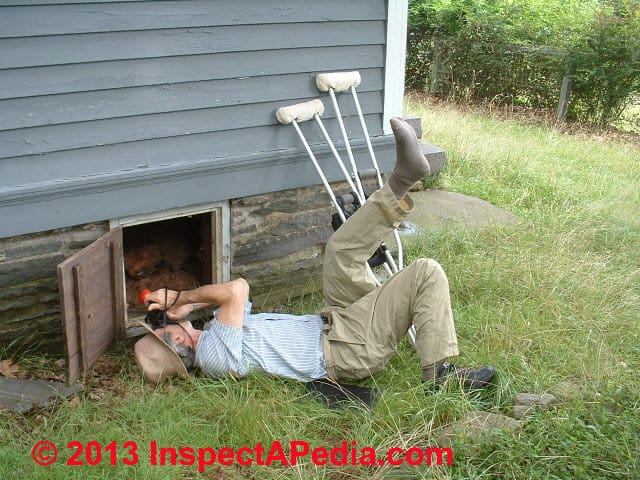
Photo above: when his knee was broken, the InspectApedia publisher demonstrated that building crawl spaces should be inspected no matter how difficult the access may be. In that case the editor got help from another inspector, Arlene Puentes. [Click to enlarge any image]
We provide authoritative, un-biased research on building failures & education course material on building failures & building environmental inspection testing, diagnosis, & repair.
Researching and publishing since 1986, InspectApedia tolerates no conflicts of interest. We have no relationship with advertisers, products, or services discussed at this website. InspectAPedia, always FREE to our readers, is supported only by ads placed on our pages by Google. See WHO ARE WE?
Up Front: Smoke, Fires, Building Fire Protection, Indoor & Outdoor Air Quality
 Climate information from the U.S. government that shows that the world is heating up faster and severe storms are occurring more-frequently than many people realized and that emphasizes that every community, rural or urban, will be seriously affected.
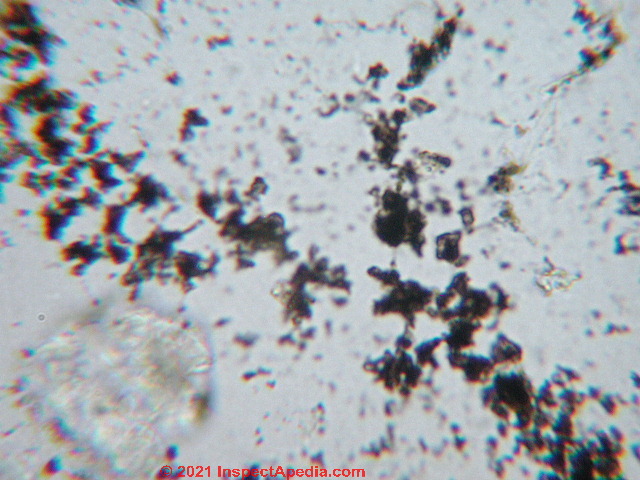
Photo: microscopic view of soot particles. [Click to enlarge any image]
The U.S. EPA has painted what the Times calls a "grim picture" of what lies ahead, whether your concern is sudden deep freeze, heavy snowfall, smoke and unsafe air, wildifires, lyme disease, access to safe drinking water, or even adequate electricity.
How to Reduce Indoor Wildfire Smoke & Soot Hazards in Buildings
Here are 4 key steps you can take to reduce the level of smoke or other airborne particles inside your building:
- Close the windows and doors
Avoid ventilating the building with outdoor air when that air is unusually heavily contaminated with smoke and debris. You'll fare better by closing the building and doing what you can to filter its indoor air.
An exception: some fresh air ventilation systems incorporate both an air-to-air heat exchanger and an air filter. Those, equipped with a HEPA filter, might permit filtered fresh-air ventilation for your building.
See VENTILATION, BALANCED - Filter indoor air:
If your building has forced air heating or central air conditioning, turn the system fan from AUTO to MAN or ON so that the blower fan runs continually
See BLOWER FAN CONTINUOUS OPERATION - Continuous HVAC Blower Fan Operation for Optimum Indoor Air Quality - Clean air filters:
Be sure that the air filter(s) in your air handling system are clean, or replace them if they're dirty and are not a washable type.
If you don 't know where your air filters are,
See AIR FILTER LOCATION
To improve your air filter's effectiveness
See AIR FILTER OPTIMUM INDOOR - Cascaded & Optimal Air Filters for IAQ . We recommend using HEPA-rated filters as those perform best at removing small airborne particles. - Portable air cleaners:
If your building doesn't have air conditioning or forced air heating, you can still add free-standing portable air cleaners to reduce the level of indoor articles in sleeping areas and close the door to those rooms when using the air cleaner.
While no portable air cleaner can remove the actual source of indoor air pollution, especially in a closed room of a size within the air cleaner's or "air purifier" rated capacity, these machines can reduce the level of ariborne particles.
See details at AIR CLEANER PURIFIER TYPES. - Wear an N95-rated or KN95-rated face mask even while indoors.
Every unbiased expert agrees that wearing an N95 mask is important for protecting respiratory health such as during the COVID epidemic or in serious wildfire smoke conditions.
Really? Well yes but ... some people who have limited lung capacity may find wearing a face mask or a true respirator difficult. Experiment. Wear an N95 mask for an hour and see if it helps you to breathe more comfortably.
Here are some of our other articles that can help with current wildfire & smoke pollution across Canada, the U.S. and extending to northern Mexico.
- AIR FILTER CLEANER EFFECTIVENESS
- AIRBORNE PARTICLE SIZES & IAQ -
- INDOOR AIR QUALITY IMPROVEMENT, KEY STEPS- Key Strategies for Improving Indoor Air Quality
- OZONE MOLD / ODOR TREATMENT WARNINGS
- ROOF VENTILATION, FIRE RESISTANT - Fire & Ember Resistant Ridge & Eaves Vents
- SOOT HAZARDS in BUILDINGS - Breathing soot is unsafe & soot on surfaces might indicate dangerous building conditions
- Bolstad-Johnson, Dawn. The HIDDEN HAZARDS of FIRE SOOT [PDF] AIC News 35, no. 5 (2010): 1-5.
Excerpts:
Smoke is the result of incomplete combustion, which produces tiny particles of carbon in the air. When deposited, these particulates are identified as soot. Put simply, the particle size of smoke residue on a surface can present a respiratory hazard.
The particle size of soot is approximately 2.5 microns, a size that is associated with deep lung penetration. Particles that are approximately 10 microns or larger get trapped in the upper respiratory tract. Particles that are 5 microns or smaller can make it down to the lower lung where the gas exchange occurs in the alveoli.
In order to offer some perspective on the size of these particles, the dust you see flying in the light coming through a window is about 40 microns in size. Airborne soot present within the breathing zone of workers is too small to be seen with the naked eye and can easily be inhaled.
...
Typically, soot is representative of what has burned, but may include byproducts that at first seem unrelated to the original material. For example, hydrogen cyanide is a byproduct of burning wool. When wood burns it can produce manganese and benzene.
As many products as there are in the world, there are an equal number of byproducts produced in a fire. Each fire is different based on the contents of what has burned during the event. Organic and inorganic materials produce different types of smoke residue or soot.
These residues may be present on surfaces that conservators may be tasked with treating. Burnt organic material produces soot that is hard to see and often has a very pungent odor. This is known as protein smoke. It can discolor paints and varnishes. Protein smoke can disperse over large areas and attach itself to everything. - ASHRAE, PLANNING FRAMEWORK for PROTECTING COMMERCIAL BUILDING OCCUPANTS from SMOKE DURING WILDFIRE EVENTS [PDF] ASHRAE, retrieved 2023/06/20, original source: ashrae.org/file%20library/technical%20resources/covid-19/guidance-for-commercial-building-occupants-from-smoke-during-wildfire-events.pdf
- Javins, Tom, P.E., Gail Robarge, Emily Gibb Snyder, Gregory Nilsson, Steven J. Emmerich, PROTECTING BUILDING OCCUPANTS FROM SMOKE DURING WILDFIRE and PRESCRIBED BURN EVENTS [PDF] US EPA, who republished this article from ASHRAE, the ASHRAE Journal, March 2021 pp. 38-43, retrieved 2023/06/20, original source: epa.gov/sites/default/files/2021-05/documents/ashrae_journal_article_march_2021-tagged.pdf
This article contains 10 specific suggestions for protecting building occupants from wildfire smoke.
Excerpt:
ASHRAEGuideline 44P, Protecting Building Occupants from Smoke During Wildfire and Prescribed Burn Events, will provide HVAC and building measures to minimize occupant exposures and health impacts from smoke during wildfire and prescribed burn smoke events.
This column summarizes the planning framework for Guideline 44P, which is being shared by the guideline committee to provide immediate information on this pressing issue while the committee continues work on the complete guideline.
Other Topics at InspectApedia.com
To find information about your topic or question, we recommend using the InspectApedia SEARCH BOX found at the top or bottom of any our our web pages.
Or see these EXAMPLES of TOPICS FOUND at InspectApedia.com
...
Continue reading at ABOUT INSPECTAPEDIA.COM or select a topic from the major website topics found at the menu along the top of this page or choose among our policies and site background articles from the More Reading links below.
Or try the InspectApedia SEARCH BOX found in the page top menu or near the bottom of any InspectApedia page.
InspectAPedia tolerates no conflicts of interest. We have no relationship with advertisers, products, or services discussed at this website.
Suggested citation for this web page
InspectApedia.com - online encyclopedia of building & environmental inspection, testing, diagnosis, repair, & problem prevention advice.Or see this
InspectApedia.com General Information
There are more than 20,000 topics found in this building & indoor environment encyclopedia. For more detailed help, use the SEARCH BOX found on any InspectApedia page to ask a question or search this website.
- InspectAPedia.com © - Website Home Page
- ABOUT InspectApedia.com ©
- ACCURACY & PRIVACY POLICIES
- ARTICLE CONTRIBUTORS & REVIEWERS - author & reviewer credentials
- ARTICLE PROPOSAL GUIDELINES
- CITATION FORMAT GUIDE
- CONTACT InspectApedia.com
- CONTENT USE POLICY
- DIRECTORY LISTING & LINK EXCHANGE INSTRUCTIONS
- EDITORIAL & PRIVACY POLICIES
- HISTORY OF INSPECTAPEDIA
- WEBSITE ACCURACY & RELIABILITY - un-biased, accurate, human-expert researched information provided with no conflicts of interest
- WEBSITE & AUTHOR CREDIBILITY
- WEBSITE COPYRIGHT VIOLATION POLICY - This website's content is © protected
- WEBSITE DESCRIPTION
- WEBSITE POLICIES - InspectApedia
Website Security
InspectAPedia.com® is a secure website providing SSL support. Access our website also supports references to InspectApedia.com and to https://www.inspectapedia.comWe also own but place no content at: http://www.inspectipedia.com®
References to http://inspectapedia.com URLs are converted to https://inspectapedia.com in order to provide a safer connection for our readers.
Similar names like inspectopedia, inspectopia and inspectahpedia are other websites with whom we have no relationship: beware of mistaking these names for our correct website name: InspectAPedia.com®
Additional protection from malware and plagiarism is provided for our readers by Sitelock, Comodo, and Copyscape.

Website Content Use
 - Plagiarism Detection Service In Use; the design and content found at InspectAPedia.com® are 100% © Copyright protected, All Rights Reserved.
Contents of this website may not be copied except in hard copy printed form as described at WEBSITE CONTENT USE POLICY
Ask a Question or Search InspectApedia
Try the search box just below, or if you prefer, post a question or comment in the Comments box below and we will respond promptly.
Search the InspectApedia website
Note: appearance of your Comment below may be delayed: if your comment contains an image, photograph, web link, or text that looks to the software as if it might be a web link, your posting will appear after it has been approved by a moderator. Apologies for the delay.
Only one image can be added per comment but you can post as many comments, and therefore images, as you like.
You will not receive a notification when a response to your question has been posted.
Please bookmark this page to make it easy for you to check back for our response.
Our Comment Box is provided by Countable Web Productions countable.ca
Citations & References
In addition to any citations in the article above, a full list is available on request.
- Our recommended books about building & mechanical systems design, inspection, problem diagnosis, and repair, and about indoor environment and IAQ testing, diagnosis, and cleanup are at the InspectAPedia Bookstore. Also see our Book Reviews - InspectAPedia.
- In addition to citations & references found in this article, see the research citations given at the end of the related articles found at our suggested
CONTINUE READING or RECOMMENDED ARTICLES.
- Carson, Dunlop & Associates Ltd., 120 Carlton Street Suite 407, Toronto ON M5A 4K2. Tel: (416) 964-9415 1-800-268-7070 Email: info@carsondunlop.com. Alan Carson is a past president of ASHI, the American Society of Home Inspectors.
Thanks to Alan Carson and Bob Dunlop, for permission for InspectAPedia to use text excerpts from The HOME REFERENCE BOOK - the Encyclopedia of Homes and to use illustrations from The ILLUSTRATED HOME .
Carson Dunlop Associates provides extensive home inspection education and report writing material. In gratitude we provide links to tsome Carson Dunlop Associates products and services.
 | HOME | ABOUT | ASK a QUESTION | CONTACT | CONTENT USE POLICY | DESCRIPTION | POLICIES | PRIVACY | |
| © 2024 - 1985 Publisher InspectApedia.com - Daniel Friedman | |||||||||