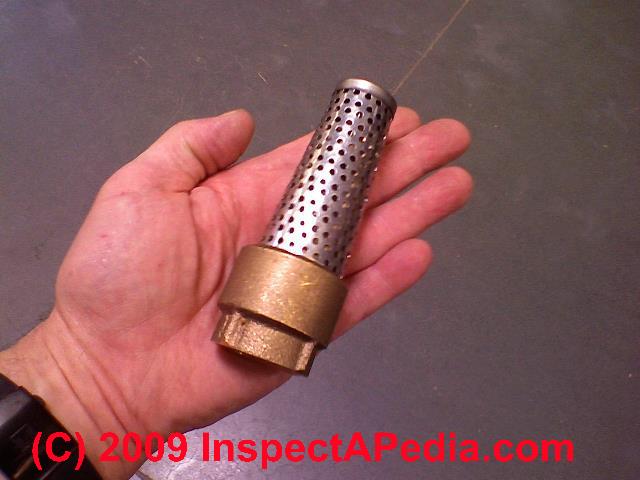
 Well Piping Foot Valve Diagnostic FAQs-2

- POST a QUESTION or COMMENT about locating, using, diagnosing, repairing, or replacing well pump check valves and foot valves.
Recent Well Foot Valve repair diagnostic FAQs:
These recent questions and answers help troubleshoot problems with well piping foot valves or check valves including their relation to loss of well pump prime.
This article series describes the foot valve used on well piping for water well Pumps & Water Wells: we explain what a foot valve is, how they work, why they are used, and how to diagnose troubles with this special in-well check valve found at the bottom of well piping in some wells.
InspectAPedia tolerates no conflicts of interest. We have no relationship with advertisers, products, or services discussed at this website.
- Daniel Friedman, Publisher/Editor/Author - See WHO ARE WE?
Foot Valve Troubleshooting Q&A set #2

These recent questions about foot valves and check valves on well piping were posted originally
at FOOT VALVES - topic home. Be sure to review that article.
Also see our index to all foot valve questions and answers at FOOT VALVE DIAGNOSIS & REPAIR FAQs
Article Index
- FOOT VALVE FAILURE NOT INDICATED - Examples of problems that do NOT point to a foot valve failure
- FOOT VALVE RETRIEVAL / REMOVAL FROM THE WELL
- FOOT VALVE FAILURE DIAGNOSIS: TEST PROCEDURE - How do we know if the foot valve is leaking ? (It may also be jammed or clogged)
...
How to Retrieve a Foot Valve From the Well
How do you get the foot valve or a broken foot valve out of the well?
How do you pull out a broken foot valve out of the well ? On 2017-10-11 by Anonymous
Advice by (mod) - solutions for two cases
From your question I don't know which of two situations you might face:
- If the foot valve itself is not working and needs to be repaired but and it is still attached,
as normal, to the end of your well pipe, to get at the foot valve the well is opened and the well pipe pulled up out of the well, bringing the foot valve with it. - If the foot valve has actually broken off or fallen off of the end of the well pipe
then, luckily, there are special tools that can be lowered down into the well to grab and retrieve the broken part.
See complete details about tools used to fish something out of a well as we describe them at WELL PIPE RETRIEVAL TOOLS
We have a failed check valve at the bottom of the well, can't pull it: pump jammed in the casing
My well is 800 feet deep. I have started having problems that indicate the foot valve/check valve at the bottom of the well has failed. I had a well company come out to diagnose the problem and they agree. However, when they tried to pull the pump, it is apparently jammed or wedged into the casing.
They told me the only way to fix this was to drill a new well, but I don't have the $20K they said it would cost.
At the time the problem resolved itself (jiggling the pipe when trying to pull it may have helped) but now the problem is back. Can I dig a pit around the well head, cut the casing and install another check valve nearer the top of the well? I would have a well company do this if it is possible.
I could install the check valve inside the house, but then the outside hydrant would not work. The well is about 11 years old. (Aug 28, 2012) Chet
Reply:
Chet:
It is dangerous for me to second-guess someone more experienced and who was on the scene, but surely everyone realizes that losing a pipe, well, tool, or other stuff down a well happens all the time, including jamming (usually because someone made a mistake).
Before rewarding the guys who jammed your pump in your well, call some other well drillers to find someone who has experience with retrieving lost pipes and pumps - there are special tools and procedures for this process.
Search InspectApedia for "Submersible Well Pumps for Drinking Water Wells " to read about how to fish a lost pump out of a well.
Also see WELL RETRIEVAL TOOLS
...
How to Test the Foot Valve for Leaks
I think the Foot Valve is Leaking: How can I Test It?
Myers hp100d 3/4 jet pump mounted directly to 4 inch well casing via a (packer? Valve). U sure depth, number of lines. Has a regulator on top of pump. 1 year ago installed a filter at pump output due to red dirt. Been running fine until now. Pump lost prime yesterday.
Found pump running. Replace lightning burnt pump pressure switch.
Started pump finally primed and pumped. Pump ran up and fluctuated at 45 and no cut off. Backed cutoff pressure to 40 and all seemed well.
Cut off cut on at 20.
Things looked good. fine overnight. I filled the horse trough in the morning.
Bam! Water stops - the pump lost prime. Called a well guy. He swears it due to filter placement.
And re-primes the pump, leaves, 5 minutes later the pump loses prime again.
I understand the chance of a stopped filter cycling pump but the filter is changed often and new at this time. Placement was due to not wanting sediment in tank. I just don't think his assessment of the losing prime due to filter is accurate.
Could it be foot valve, back pressure regulator, pump? What should I check next or is it truly filter placement. With pump mounted to well casing would I expect one line to a foot valve or two too a jet valve and foot? On 2017-09-20 by Ric
How to Test the Foot Valve for Leaks
I don't know where the filter in question is located, but if it's on the outlet side of your pump that would not explain lost well pump prime. A clogged filter might cause rapid short on-off cycling of the pump though.
We give details at WHAT CAUSES LOST WELL PUMP PRIME - what can cause loss of water pump prime? Here is a
Summary of Indications of a Leaky Foot Valve
Slowly fill the pump cavity until water comes out of the air relief hole on top of the pump.
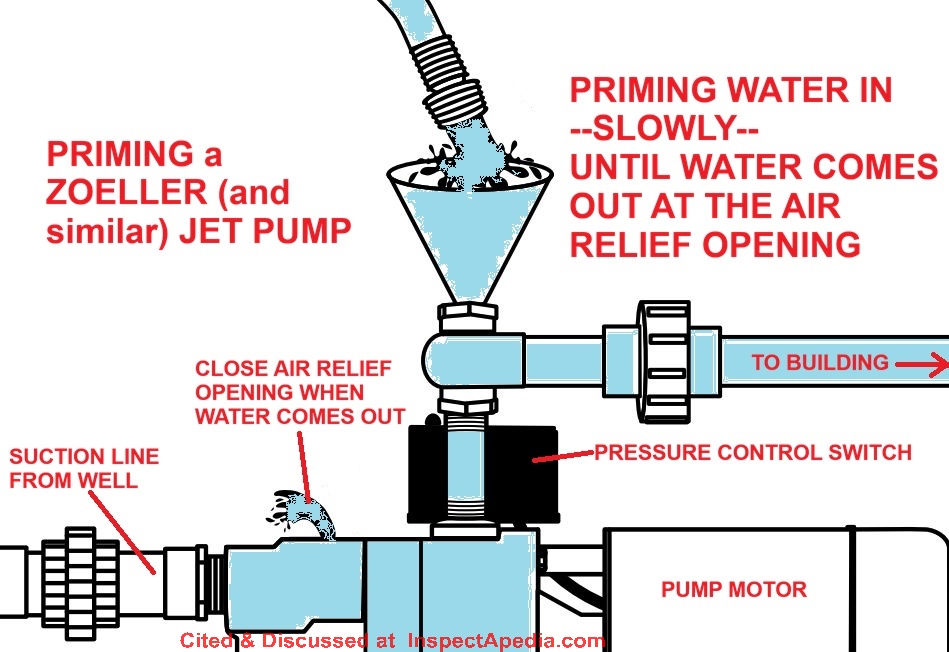
- Proof or a "test" to prove that there is a bad foot valve or a similar leak somewhere in the well piping:
Here we are excerpting from complete detailed step by step instructions at PRIME the PUMP, HOW TO - prime using the priming plug on the pump assembly -.-
You'll see that the most basic evidence of a leaky foot valve or other leak in well piping is that when you slowly pour water into the well pipe it keeps falling, no matter how much you pour in.
You first remove the air vent, if there is one, on your pump, then pour in priming water until the pump is filled, then replace the air relief plug and continue adding water to the pump cavity until water reaches the top of the priming plug [opening].
Check to be sure that water in the cavity stays constant. If water level goes down it could indicate a leak in the foot valve, check valve, or suction pipe.
Now to make sense of this you of course need to know the actual volume of water needed to prime the pump. That's the amount of water needed to fill both the water pump and the pipe that extends down into the well, as we detail
at WATER VOLUME NEEDED to PRIME THE PUMP
- Pump loses prime when left with electrical power off:
If the pump was working and delivering water with no problem but after being left with electrical power OFF for any length of time it can not deliver water, then most likely the pump has lost prime.
We often discover this problem after some other event has left the pump without power, such as an electrical power outage or perhaps someone turning off electrical power to the building for a time.
The most common cause then is a bad foot valve or for a shallow well pump with only a check valve at the pump, a bad check valve.
Other possible causes are a leak elsewhere in the system from the pump body itself through any of the well piping lengths or connections that let water leak out when the pump is left OFF. - Intermittent pump cycling on and off:
When electrical power is left ON to the pump and the pump runs from time to time when no water is being used, that's a good hint that there's a leak somewhere, often a bad foot valve.
Details are at WATER PRESSURE INTERMITTENT LOSS
If your well piping and foot valve show any of these three failure signs then the last step requires that you
- Pull the well pipe up out of the well to inspect and replace the foot valve.
While you're at it inspect the condition of the well pipe itself and any connections, and replace anything that doesn't look sound.
If this procedure does not work, then there's a different problem to find, perhaps a damaged pump impeller (from running the pump dry).
More help is at WATER PRESSURE LOSS DIAGNOSIS & REPAIR
And at WELL PIPING LEAK DIAGNOSIS
...
Foot valve Diagnostics: Examples of Trouble that does NOT point to the Foot Valve
Diagnose loss of all water: is bad foot valve ?
Three times in the past month we have woke up with no running water. We prime the pump and all is good for a while.
I don't see any indication of a leak in the house and I'm hoping there are some other things we could check before having to consider looking at the foot valve since the previous owner has it partially buried under a gravel driveway and the ground is frozen. Thanks in advance! On 2018-01-30 by Mike
by (mod) - if you're priming the well that points to a bad foot valve
Mike,
Try turning the water off into the building. If with the water into the building shut off you see the pressure in the tank falling then we have either a leak in well piping or a leak at the foot valve or check valve.There are other causes for intermittent loss of water pressure - if you search this website using the search box above for that phrase you will find those other diagnostic suggestions.
by Mike: Problem solved: Pump pressure switch was not turning on at the CUT-IN (Low pressure) Setting - due to corrosion
After doing some more investigation I found it was the pressure switch not turning on when reaching it's low pressure setting. Replaced the switch which had corroded quite badly over the years and presto everything is back to normal. Hope this might help someone else.
by (mod) - Pressure switches usually fail from debris clogging or burned contacts or corrosion
Thank you for the follow-up, Mike. That will help other readers.
Sometimes a pressure switch won't turn on because debris clogs its sensor port. On occasion that same silt or rust debris can clog the tube conducting water pressure to the switch.
The symptoms, loss of water pressure, can be similar to loss of prime, but it's pretty easy to distinguish the two. With water turned off to the home if we see water pressure continue to drop we know there is a leak in well piping or a leaky foot valve.
Pump Pressure Control Switch is Not Responding to Changes in Water Pressure
I didn't draw any water since the last post and this morning it was still showing 50lbs. Now I drew water and this time the tank emptied and the water stopped flowing BUT the pump didn't cycle on for about 5 seconds, then it kicked on and water and pressure was normal.
Now I may be chasing multiple issues. Possible leaking foot valve or well pipe and /or a faulty or partially blocked pressure switch ? On 2018-04-30 by Brian: It's 90' deep, twin pipe, ejector, foot valve. In the house it's a 3/4 hp pump,pressure regulator into a 36gal tank.
No sign of leaks around the pump but haven't pulled the pit cover to look in yet.
It's been holding steady at 50lbs since my last post. Will see how it behaves in the morning. On 2018-04-30 by Brian:
by (mod) - pressure doesn't fall = no leak; I suspect debris clogged pressure switch
Brian:
If pressure does not fall when no water is being used, that argues against a leak in well piping or a leaky foot valve.
However several causes of odd pump on-off operation can be intermittent, including
- a debris-clogged pressure control switch (try tapping on the switch when you're running water, pressure falls below the cut-in, and the switch doesn't turn on the pump)
- a sometimes-sticking foot valveby Brian: problem solved: clog was in the pump fitting to which we connect the pressure switch tube
Well I solved this current issue. Changed the pressure switch and the problem was still there. I then removed the pressure line completely between the pump and the switch and it was open BUT the fitting on the pump was clogged.
Cleaned out the fitting and got water flowing through it , flushed it out, re-installed the line and now the last issue is resolved. I will monitor and see if any of the early issues crop up again.
Thank You all for the helpful replies.by (mod) - usual results of clogging at the pressure control switch on a pump
Way to go, it sounds like you found a problem that can be hard to track down. Do keep us posted as if you wanted something else it will help other readers.
Usually a clog in the fitting or tube that conducts water pressure to the pressure control switch results in a switch that doesn't turn on or off when it should.I'm not clear on how that would be connected to causing air in the water supply piping.
We can't get water pressure above 10 psi: is this a bad foot valve?
Well pump kept losing prime. It is an MSD 6 jet pump. Replaced it with recommended replacement MSD-7 same horse power and fit flanges on well casing.
New pump is supposed to cycle up to 50psi. Primed per procedure in manual. started pump. Max pressure being observed is 20 psi.
Checked new pump for leaks above ground. Well to initial contact through pipe to pump with something is 21 feet..
Did not check out side of interior pipe. Well casing is 2 in. tried this morning and now max pressure is about 10 psi.
I foot valve is issue how difficult would it be to replace? seems a 20--25 foot pull is 2 and 1/2 PVC pipes (10 ft each) On 2017-04-19 by john
by (mod) No, here's why this is not a foot valve problem
John,
If your well pump is not losing prime, and if water pressure in the system does not fall when no water is being run, so I do not suspect that the foot valve is the problem.Also the fact that you get water, into the building tells me it's not a foot valve or lost prime problem.
So more likely there is a problem with a leak in the well piping, or low voltage, or damage to the pump or pump impeller.
The foot valve sticks open and we lose prime: Do I need a new foot valve?
Using a shallow well jet pump to supply nutrient to hydroponics system in greenhouse. system pumps from a reservoir using a 1" PVC pipe with a foot valve on the pickup end. every day I have had to un-stick the foot valve and re-prime the pump. the pump loses prime and continues running and heats up the pumping chamber and starts leaking at the connections.
Have to re-teflon. MY question is what causes the foot valve to stick and/or do i need to find a different foot valve. On 2017-04-16 by Randy Caver
by (mod) what causes the foot valve to stick? First try cleaning it and raising the foot valve a couple of feet.
Randy:
It sounds as if either the foot valve is bad or it is located in an area where there is just too much crud, algae, sand, dirt getting drawn into the valve.Can you take a look at the pick-up point where the foot valve rests?
I would pull the foot valve, clean it, and if it moves freely and looks undamaged, try raising it a couple of feet higher above the bottom of the well so that we're avoiding picking up dirt or mud.
Our lake water pump loses prime, air discharge, pump keeps running
We bought this house on a lake it had been sitting for 2 years. It has a shallow well. The first week the pump started acting up it kept cycling and got hot.
I shut it off a few hours later I turned it back on and it started working,
Several weeks later when we would turn on the water at any faucet it would blow a lot of air then one morning the pump was running but not shutting off and was to hot to touch, i shut it down I replaced the pressure switch, then it seamed to work OK for a couple days and
Now i have to prime it with about 5 gal. of water to get to build up pressure and sometimes it still wont start and i have to wait a couple hours and then it will start when I prime it still with several gals. of water, then one person can take a shower and it will recover OK but if we don't run water within an hour then it looses its prime and starts getting hot. please help (Aug 13, 2012) Pump will lose its prime and pump won't stop
Reply: the problem may be an air leak above-ground, not the foot valve
The fact that the pump worked again after you left it turned off for a time could mean that the pump was so hot that it was shut off by a built in thermal reset switch intended to protect the pump motor.
Unfortunately running a pump "dry" can also damage the impeller so that it loses pumping power and eventually stops drawing water at all.
I think your pump is continuing to overheat.
I would look for a leak in well piping as it sounds as if your pump is drawing in air from the above ground length of well piping or perhaps there's an air leak right at the pump itself.
Water runs back into driven point well & pump keeps running - can I add a check valve and leave the bad foot valve?
 Hi, I have a 2-inch point driven shallow well. Recently once the pump is primed, when the pump isn't running, the water will run back down into the well. I believe the foot valve is no longer working.
It takes about 3-4 minutes for the pump to refill the lines, but only 2-3 minutes for the water to run back down into the well when the pump shuts off.
So the pump is pretty much running constantly.
I am wondering if I could put a check valve in the line between the pipe that goes into the ground and the pump.
Will that work instead of replacing the foot valve which is at the bottom (I believe) of the well? Thanks in advance On 2018-08-01 by Ellen
Answer by (mod) - a driven well would not use a foot valve; look for a check valve at the pump
In a driven well, Ellen, usually the check valve is right at the pump; if not you may be able to add one there, just as you suggest. That may work because by definition a driven point well is quite shallow - allowing an above-ground checkvalve to hold.
by Ellen
Thanks danjoefriedman for the confirmation, I am going to give that a try and hopefully it works for me.
Answer by (mod) -
Keep us posted, Ellen - as that may permit further comment and may also help other readers
by Ellen
Hi I have another question for you
as I was looking at my well set up trying to figure out what size check valve to buy I realized I have two lines that go between the well pump and the pipe that goes into the ground. Would the check valve go on the line on top? Or the line below? The two lines appear to be two different sizes
I added a pic that I hope shows up [see both Ellen's sketch and her photo above on this page]. Thanks again!
Answer by (mod) -
Ellen
Your system looks as if a two-line jet pump was converted, using an external venturi (the green fitting) to function as a one-line jet pump system.
The check valve, if y ou can squeeze one in to this crowded installation, would fit on the smaller of the two pipes of your pump.by Ellen
We haven’t tried what you suggested yet. My son was over last night and took a look at the system and is a little worried about the process.
My son is a carpenter and what I consider a jack of all trade but his knowledge is limited in the well area. He thinks my well is deeper than I do and he isn’t sure a check valve will solve the issue
. I was told today by the realator (whom I bought the house from 15 years ago) that it is a point well.
The system does have a jet pump. My son found a pic of my system and suggested I forward to you to make sure we are on the same page before I invest in parts. I am hoping we are on the same page. :) thanks
Thanks! I see the pic showed up, on it's side :) so the check valve would go in the bottom pipe that look red and currently to the right.
Yes, it is a tight fit so hopefully we can put one in. Thanks again. I will keep you posted.
by (mod) - Ellen uses a driven point well
Ellen
Driven point wells are never very deep since they are constructed by pounding a pipe into the soil. Typically 25 feet or less, with a 1-line jet pump; a check valve is usually right at the pump.
If your well uses two pipes and a two line jet pump it's probably a deep well, not a driven point well.Ellen
Driven point wells are never very deep since they are constructed by pounding a pipe into the soil. Typically 25 feet or less, with a 1-line jet pump; a check valve is usually right at the pump.
If your well pump uses two pipes and a two line jet pump it's probably a deep well, not a driven point well.
...
...
Continue reading at FOOT VALVES - topic home, or select a topic from the closely-related articles below, or see the complete ARTICLE INDEX.
Or see these
Recommended Articles
- CHECK VALVES, WATER SUPPLY, DRAINS, PUMPS
- EJECTORS in WELLS
- FOOT VALVES - home
- PUMP PRIME, REPEATED LOSS
- WATER PUMP INTERMITTENT CYCLING
- WELL PIPING CHECK VALVES
- WELL PIPING LEAK DIAGNOSIS
Suggested citation for this web page
FOOT VALVE DIAGNOSIS & REPAIR FAQs-2 at InspectApedia.com - online encyclopedia of building & environmental inspection, testing, diagnosis, repair, & problem prevention advice.
Or see this
INDEX to RELATED ARTICLES: ARTICLE INDEX to WATER SUPPLY, PUMPS TANKS WELLS
Or use the SEARCH BOX found below to Ask a Question or Search InspectApedia
Ask a Question or Search InspectApedia
Share this article:Search the InspectApedia website
Need to make a private comment? Email editor@inspectApedia.com. We welcome email with your website content critique, corrections, suggestions or questions. Email is monitored daily but our workload may prevent an immediate reply. For immediate results, we hope you'll first try asking your question using the search box just above.
Citations & References
In addition to any citations in the article above, a full list is available on request.
- In addition to citations & references found in this article, see the research citations given at the end of the related articles found at our suggested
CONTINUE READING or RECOMMENDED ARTICLES.
- Carson, Dunlop & Associates Ltd., 120 Carlton Street Suite 407, Toronto ON M5A 4K2. Tel: (416) 964-9415 1-800-268-7070 Email: info@carsondunlop.com. Alan Carson is a past president of ASHI, the American Society of Home Inspectors.
Thanks to Alan Carson and Bob Dunlop, for permission for InspectAPedia to use text excerpts from The HOME REFERENCE BOOK - the Encyclopedia of Homes and to use illustrations from The ILLUSTRATED HOME .
Carson Dunlop Associates provides extensive home inspection education and report writing material. In gratitude we provide links to tsome Carson Dunlop Associates products and services.
 |
HOME | ABOUT | ASK a QUESTION | CONTACT | CONTENT USE POLICY | DESCRIPTION | POLICIES | PRIVACY | |
| © 2026 - 1985 Publisher InspectApedia.com - Daniel Friedman | |||||||||