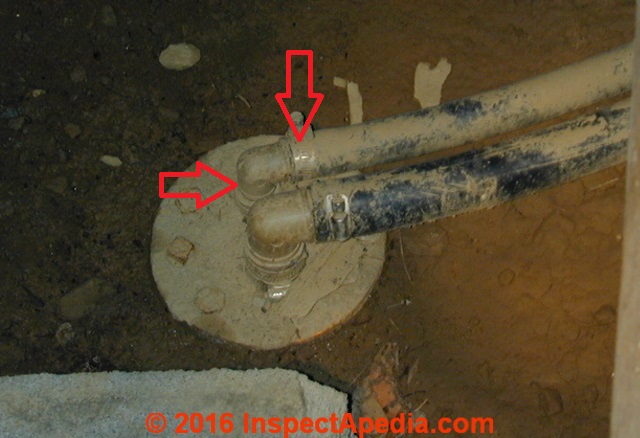
 Loss of Well Prime, Intermittent Pump Cycling, Check Pump Suction
- POST a QUESTION or COMMENT about how to troubleshoot & repair loss of well pump prime - recurrent well prime loss
Q&A on how to prime the well pump & how to diagnose & fix repeated loss of well pump prime:
This article series describes how to prime a water pump to restore water pressure to a building.
InspectAPedia tolerates no conflicts of interest. We have no relationship with advertisers, products, or services discussed at this website.
- Daniel Friedman, Publisher/Editor/Author - See WHO ARE WE?
Repeated Loss of Pump Prime - How to Check Pump Suction Lift Q&A
These questions and answers about troubleshooting a pump that keeps on losing prime were posted originally at PUMP PRIME, REPEATED LOSS - be sure to review that article.
Also see our index to all Q&A about priming a pump at WATER PUMP PRIMING DIAGNOSTIC FAQs
...
Tip: See CAUSES of LOST WELL PUMP PRIME
Pump ran intermittently and had to be re-primed after power outages - now it cycles every 5 minutes
Hello, I have a Goulds J+ 2 line pump setup with a galvanized tank in our basement, drawing from a well approximately 100' away. I don't know the depth of the well.
Last winter we began noticing the pump running from time to time with no water being used in the house (maybe once every 10 or 12 minutes).
During several power outages, the pump lost prime and had to be re-primed. I found, though, that after re-priming it would cycle less frequently. It went back to normal over the summer, not cycling at all unless water was turned on in the house.
Now the cycling condition has returned, currently running for a minute every five minutes.
Do you know if this pump has an internal check valve? If not, might adding a check valve between the pump and the well fix this situation?
Or should I just assume the problem is the foot valve? Basically, it's below zero outside and I would like to avoid pulling my well lines. On 2018-01-05 by Michael Updegraff
Reply by (mod) - Find and fix the leak; how to check your pump's suction lift
Losing prime during power outage usually means there is a leak in well piping or a bad foot valve. Since the replacement of a foot valve requires pulling the piping, that's the time to inspect the pipe too to assure it's not damaged and leaking.
A leak certainly sounds like the root problem here, and your description suggests that the leak has gotten much worse.
The Goulds J+2 is a convertible pump that can be used on either shallow (one line ) or deep (2 line) wells. I can't tell from your note which type of well you have.
The Goulds RJ-JS R2 series do not use an internal check valve (based on looking at the parts list for this pump series)The Goulds JRS, JRD, JB, HSJ and some other models pumps do use an internal check valve.
SO we need to know the pump model from your pump's data tag.
Here is the GOULDS WELL PUMP MANUAL [PDF] that should cover your Goulds J Pump
That document discusses check valves - it doesn't sound as if the pump itself includes a valve. I excerpt:
Shallow wells:On sand points or driven wells you can install an in-line check valve near the well head or at the pump and use the well casing as the suction pipe. The closer the check valve is to the well the easier the system will prime.
The company offers these helpful pump diagnostic procedures:CHECKING SUCTION LIFT ON A SHALLOW WELL [using a vacuum gauge]
A vacuum gauge indicates Total Suction Lift (vertical lift + friction loss) in inches of mercury (Hg.).
One inch (1") on the gauge = 1.13 feet of total suction lift (based on a pump at sea level).
Practical suction lift at sea level is 25' or 22" Hg. Deduct 1 ft. for each 1000 ft. above sea level.
Install the compound vacuum/pressure gauge in the 1 ⁄8" hole in the shallow well adapter or the 1 ⁄8" hole between the suction and discharge pipes on a dedicated shallow well pump.
This is the same hole that is used to connect an air volume control.
Interpreting the vacuum gauge readings:
High Vacuum (22" or more)
- Suction pipe buried in mud
- Foot valve or check valve stuck closed
- Suction lift exceeds lift capability of pump
Low Vacuum or 0 vacuum
- Suction pipe not submerged
- Suction leak (check joints and especially unions)
Gauge needle fluctuates rapidly
- Gaseous well
- Air leak in suction line
- Well producing less than pump capacity (throttle a ball valve in suction line do not exceed 22" Hg.) to ...
by Michael Updegraff - could the AVC (Air Volume Control) be the problem?
Thank you for your response! It's a Goulds J5 pump, set up in deep-well configuration (2 lines).
This might be an odd idea, but could the air volume control be the issue?We've noticed it dripping intermittently, and we definitely hear a squeaking/bubbling noise through it between pump cycles. If the internal diaphragm has a leak, couldn't the suction line from the pump be releasing system pressure?
by (mod) - where is the check valve on a pump and well system?
So the check valve is the foot valve, or for very deep wells there can be several check valves on the riser pipe.
A leaky AVC will lose the air charge in the pressure tank and can lead to pump short cycling but it'd have to be a heck of a leak to lose well prime.
I'm not familiar with a failure in the AVC that would cause loss of well prime.
It's common for an AVC to make noise at each pump on/off cycle as it's admitting air to the pressure tank.by Michael Updegraff
Yeah, the AVC was a hopeful shot in the dark. I replaced it and eliminated the dripping problem, but we're (of course) still cycling (ableit less frequently, for some reason).
I'd love to put the issue off until springtime when it isn't 0 degrees F outside, the thought of pulling well piping right now is not a pleasant one. I've seen a fix with shallow-well setups that involves putting a check valve right next to the pump when the foot valve malfunctions, but I'm guessing there is no way to do such a thing with a 2-line deep well setup?
Maybe I could simply install a valve on each line just before the pump and shut the whole system down at night (including killing the pump at the breaker) so we don't have to listen to the regular cycling. Any ideas?
by (mod) - adding a check valve to stop loss of pump prime? avoid pulling the pipes?
Michael
If the intermittent cycling is half an hour or an hour apart you're not burning up the pump you're just wasting some electricity.
With a two line jet pump if you lose water out of the piping, as can happen if there is a combination of power outage (pump never comes on to keep pressure in the system) and a well piping leak, you will lose prime, lose water pressure, and will have to re-prime the pump.
You could install check valves (in the right direction) on both the up and down water lines, but if there is a leak below that point you may still lose prime.
Watch out: So turning off the system at night risks loss of prime too.
At the very least I would visit and tighten every readily-accessible pipe connection to see if that helps.Sometimes on plastic piping I add a second stainless steel hose connector at each joint where I suspect one of them (don't know which) is leaking.
...
...
Continue reading at PUMP PRIME, REPEATED LOSS or select a topic from the closely-related articles below, or see the complete ARTICLE INDEX.
Or see these
Recommended Articles
- FOOT VALVES
- WELL PIPING CHECK VALVES
- WELL PIPING LEAK DIAGNOSIS
- WATER PUMP PRIMING PROCEDURE
- WATER PRESSURE LOSS DIAGNOSIS & REPAIR - home
Suggested citation for this web page
PUMP PRIME LOSS CHECK PUMP SUCTION LIFT at InspectApedia.com - online encyclopedia of building & environmental inspection, testing, diagnosis, repair, & problem prevention advice.
Or see this
INDEX to RELATED ARTICLES: ARTICLE INDEX to WATER SUPPLY, PUMPS TANKS WELLS
Or use the SEARCH BOX found below to Ask a Question or Search InspectApedia
Ask a Question or Search InspectApedia
Share this article:Search the InspectApedia website
Need to make a private comment? Email editor@inspectApedia.com. We welcome email with your website content critique, corrections, suggestions or questions. Email is monitored daily but our workload may prevent an immediate reply. For immediate results, we hope you'll first try asking your question using the search box just above.
Citations & References
In addition to any citations in the article above, a full list is available on request.
- In addition to citations & references found in this article, see the research citations given at the end of the related articles found at our suggested
CONTINUE READING or RECOMMENDED ARTICLES.
- Carson, Dunlop & Associates Ltd., 120 Carlton Street Suite 407, Toronto ON M5A 4K2. Tel: (416) 964-9415 1-800-268-7070 Email: info@carsondunlop.com. Alan Carson is a past president of ASHI, the American Society of Home Inspectors.
Thanks to Alan Carson and Bob Dunlop, for permission for InspectAPedia to use text excerpts from The HOME REFERENCE BOOK - the Encyclopedia of Homes and to use illustrations from The ILLUSTRATED HOME .
Carson Dunlop Associates provides extensive home inspection education and report writing material. In gratitude we provide links to tsome Carson Dunlop Associates products and services.
 |
HOME | ABOUT | ASK a QUESTION | CONTACT | CONTENT USE POLICY | DESCRIPTION | POLICIES | PRIVACY | |
| © 2026 - 1985 Publisher InspectApedia.com - Daniel Friedman | |||||||||