 Procedure to Set Room Thermostat Accuracy & Calibration

- POST a QUESTION or COMMENT about heating, air conditioning, and heat pump thermostat installation and wiring
Room thermostat calibration & accuracy guide: this article explains why a room thermostat may not be responding correctly to the actual room temperature.
Factors that affect the room thermostat's behavior include is location in the building, for some models how level the thermostat was installed, the thermostat's heat anticipator adjustment, even dust and debris in or on the thermostat.
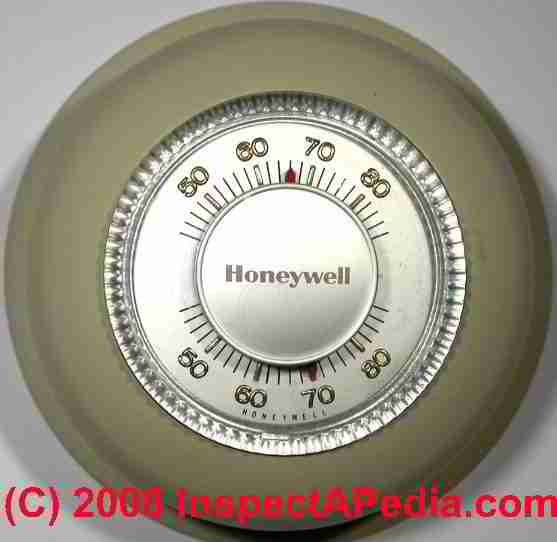
Page top photo: older Honeywell T87 thermostats must be level on the wall or the thermostat set temperature will be inaccurate.
InspectAPedia tolerates no conflicts of interest. We have no relationship with advertisers, products, or services discussed at this website.
- Daniel Friedman, Publisher/Editor/Author - See WHO ARE WE?
Room Thermostat Accuracy, Calibration & Adjustment
Article Contents
- WHERE TO MOUNT THE THERMOSTAT - avoid locations that interfere with the thermostat's ability to accurately sense room tempearture
- DOES the THERMOSTAT HAVE TO BE LEVEL? - sometimes
- THERMOSTAT ACCURACY & CALIBRATION STEPS - and ways to deliberately fool your thermostat
...
Where to Locate & Mount a Room Thermostat & what spots to avoid
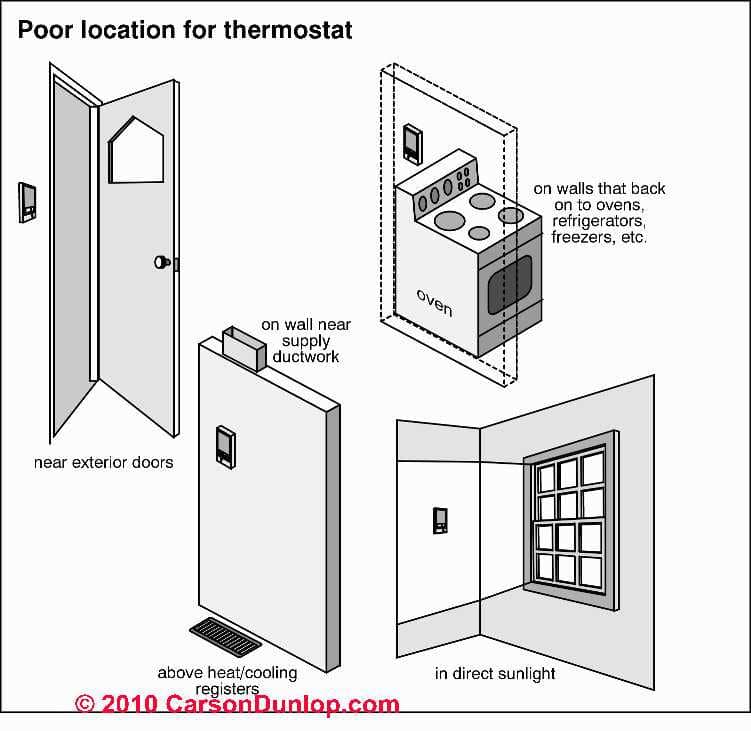 Locate the room thermostat at about chest height on an interior wall, in a location where the thermostat won't be affected by drafts or other unusual temperature conditions.
Good thermostat locations:
- in a living room or dining room,
- about five feet from the floor on an interior wall and
- in a position where the thermostat will be in natural air circulation (not dead air space)
- but where the thermostat will not be exposed to strong drafts from windows, doorways, or from a heating or cooling air supply register.
As Carson Dunlop Associates ' sketch (left) explains, there are a number of places where you should not locate the room thermostat.
Bad Room Thermostat Locations
As illustrated by Carson Dunlop Associates's sketch above, don't locate the room thermostat in these locations:
- on an exterior building wall (exposed to outdoor temperature effects)
- where drafts from an exterior door will affect its reading
- above or in the line of airflow from a heating or cooling air supply register
- in direct sunlight
- on a wall shared with a hot space such as a kitchen or boiler room
- in a kitchen, bath, or entry hallway
- in an alcove, behind an open door, behind furniture
- next to concealed pipes or air ducts
- Also, do not place heat-emitting devices such as lamps or small appliances close to the thermostat. Their heat may affect its operation.
Details about these conditions that interfere with heating or air conditioning thermostat accuracy and control are
at TEMPERATURE RESPONSE of ROOM THERMOSTATS - things that interfere with heating or cooling system room thermostat accuracy.
Even when your room thermostat is properl-located and even when a warm-air heating system is operating normally, some rooms or areas within some rooms may be uncomfortable as heat may be distributed unevenly.
Air stratification during the heating season can leave warm air collected near the ceiling with air nearer the floor uncomfortably cool. Solving this problem by turning up the thermostat or moving it lower on the wall can "work" but is likely to increase heating costs unnecessarily.
Details are at WARM AIR STRATIFICATION INDOORS
...
Does the Room Thermostat Need to be Level on the Wall?
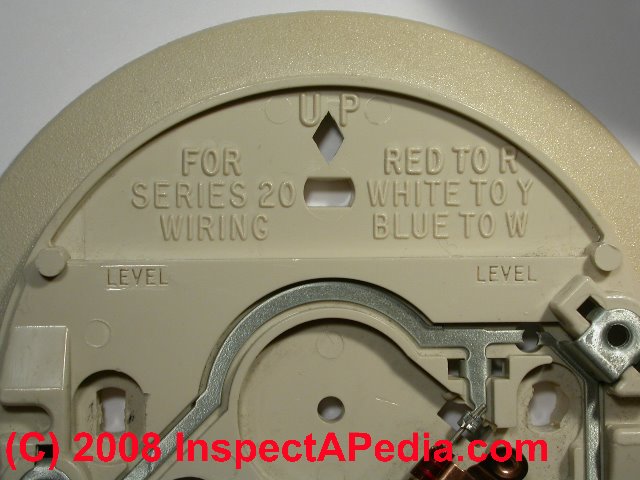
Yes for Older Mercury Bulb Switches
It's important to mount mercury-bulb thermostats as level as possible since otherwise you're putting the thermostat out of accurate temperature calibration.
That's because the coiled bimetallic spring has to move that mercury bulb to a tipped position to turn the heating or air conditioning system on or off in response to room temperature.
When we found a thermostat that did not heat a room accurately to the called-for temperature, we'd take a look to see if it was installed out of level before looking further.
Because the "set" range on these thermostats may have had a lower-end of 55 deg .F.,
when we wanted the thermostat to maintain a building at a temperature lower than the minimum that the thermostat dial provided,
we just tilted the whole thermostat backing plate on the wall in the proper direction to shift the operating range of the switch.
No for Newer Solid State, or Digital Room Thermostats
Newer thermostats that rely on other sensor and switch designs do not have this sensitivity to being out of level and some (such as the 3M-22 thermostat) note in their installation instructions that the thermostat does not have to be level.
These thermostats use solid-state THERMISTORS in ROOM THERMOSTATS to measure room temperature. The thermistor, unlike a mercury bulb, doesn't have to be dead level to sense room temperature accurately, however other mistakes such as dust or debris can still interfere with the thermistor's accuracy.
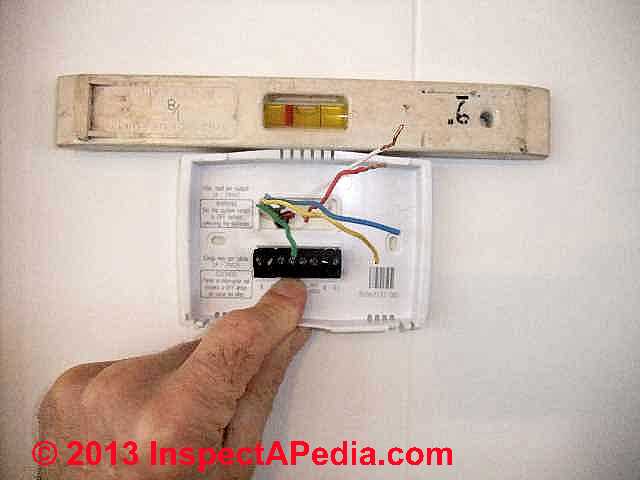
Our photo below illustrates the red (R) and white (W) wire connections in a simple two wire heating control thermostat hookup using the Honeywell RTH2300/RTH221 series programmable wall thermostat.
Here is a copy of the HONEYWELL RTH2300/RTH221 Series Programmable Thermostat OWNER'S MANUAL [PDF]
Because some controls are used in common on hot water heat, hot air heat, and steam boilers, readers should see these other articles:
see BOILER CONTROLS & SWITCHES
If your building uses warm air heat,
see FURNACE CONTROLS & SWITCHES.
If your building uses steam heat
Reader Question: the A/C blower is not working properly in response to the thermostat
A friend's a/c unit has the blower fan that will only work in auto, it will not work on manual.
On the other hand, even when you turn the unit from cool to off, the blower still remains on.
The only way the blower will turn off, is to turn the fan to manual.
He changed the thermostat, and the unit will cool to the desired temp and kick off, but you can't turn the fan off on your own unless you turn it to manual. Anyone ran into this before? - John
Reply: check thermostat wiring connections against the schematic for your unit and see these standard wire color codes
The wiring to the unit depends on if you have a heat pump, or straight a/c unit. It also depends on how the installer has wired the thermostat. With the heat pump, the red is power, the yellow is for cooling, the white is for heat, the green is for the fan, the orange is for the reversing valve, and the blue is usually always common.
Again, you will have to check to see how the installer has ran the wires from the thermostat. If you have a a/c only unit outside, you will only have a red wire, and a white wire coming form the inside unit, to the outside unit. These will go on the contactor to send 24 volts to the coil to pull the contactor in.
These are the traditional wiring schematics, again, check the thermostat to see if this is the case with yours. - Bryan
Also see THERMOSTAT WIRE CONNECTIONS where we provide lists and tables of color codes and wire connections for thermostats in various uses.
...
Room Thermostat Accuracy & Calibration
Question: How do I Calibrate my Thermostat
How to calibrate the thermostat? My temp reads 4 degrees lower than my set temp,in AC mode. - NC
Reply:
NC
Calibrating wall thermostats:most modern wall thermostats do not provide an adjustment that will calibrate the TT to the actual room temperature (and most of them are quite accurate).
OLDER round Honeywell and other TTs that use a mercury bulb sensor can be tipped slightly on the wall - changing the TT out of level will change its calibration, since on those models a blob of mercury in a moving bulb rolls to connect or disconnect the two TT wires.
But take a look at other factors that might make your thermostat inaccurate, including
- its location:is air from the A/C blowing right on to the TT,
is the TT on an exterior wall,
is the thermostat exposed to direct sunlight
and also check that the thermostat openings are not blocked by dust or debris
Finally, some thermostats include an adjustable heat anticipator that could be improperly set -
Question: how do I fix a thermostat that I have to set lower than the level of heat I want?
My traditional honeywell simple dial-type thermostat on the wall has two pointers and two temp. scales.
However I have to set it on 60 degrees to get heat temp to 70 degrees.
What can I do? It was working fine until my condo changed the air/heating system this summer. - Jeannette 1/23/2013
Reply: check these reasons for a room thermostat that keeps calling for heat
Jeannette,
On most two-scale room thermostats, one scale reads the current or actual room temperature while the other scale is the set temperature - and is adjustable. When you move or adjust the thermostat to call for a different room temperature you will see the scale pointer move to your new setting on the "set" scale.
Remember that a thermostat is just an "on-off" switch that turns heating or cooling ON or OFF in response to the actual room temperature and the desired or "set" temperature you've specified. Make sure that your thermostat is properly set - to "Heat" mode with the fan switch set to "Auto".
You are describing having to set the thermostat lower (60F) than the desired temperature (70F) to get the proper level of heat in your home. In other words, you say that the room gets too hot - hotter than you asked-for. Here are some things that would cause that problem:
- The thermostat or its wires have been damaged
and are not reliably signaling the heating system primary controller. I wouldn't normally place this guess first, but as you think the problem began after someone worked on the system it's worth a check. Look for a loose connection or intermittent short in wiring.
For example if two thermostat wires short together that's the same as constantly calling for heat. - The thermostat is being blocked from properly sensing room heat.
That could be due to movement of the warm air supply registers to a new, more distant location, or more often, due to furniture, drapes, or even dust and crud that block the air inlet openings around the thermostat that allow it to sense room temperature.
Dust can also interfere with moving parts in older spring-type thermostats.
See TEMPERATURE RESPONSE of ROOM THERMOSTATS for details. - The thermostat is tilted out of level.
If the thermostat is an older mercury-bulb type then it needs to be level on the wall. - The thermostat is located on a cold outdoor wall
or where cold air blows on it; if your thermostat was not moved and is on an interior wall and in a draft of cold air, this isn't likely to be the cause of the problem you describe. - The primary controller on the heating system is not working properly;
on occasion we find that the primary control on a heating system, for example an internal relay, is sticking and keeps heat on even after the thermostat has said "enough".
This is easy to check. When the heat is on and running and the thermostat is set to say 68F, when the room reaches 68F (measured at the thermostat on its scale), just disconnect the thermostat wires right there at the thermostat.
If heat keeps running (more than a couple of minutes if you have warm air heat), something else is wrong.
Primary heater controls are discussed in different InspectApedia articles depending on what type of heat you have.
See BOILER COMPONENTS & PARTS for hot water heating systems. If your building uses warm air heat,
see FURNACE CONTROLS & SWITCHES.
If your building uses steam heat
see STEAM HEATING SYSTEMS. - There is some other problem we haven't thought-of.
See HEAT WON'T TURN OFF - Stop Unwanted Heat for more help with this problem
Keep us posted, what you learn will help other readers.
Question: heating thermostat seems to show wrong temperature
My heater's thermostat is showing wrong temp. At off setting , it shows the room temp at about 80 when it feels like 60 degree in the house. I tried removing and putting batteries again but doesn't solve the problem. Do I need to replace it? - P. 1/2/2013
Reply:
You might, but first check the thermostat's room temperature reading (not its SET temperature reading) against the actual room temperature - use a room thermometer; Then be sure the thermostat is set to HEAT mode and make sure that the SET temperature is above room temperature.
Then heat should run until the sensed temperature at the thermostat turns it back off; See the next Q&A for more details.
Question: why do we have to turn our heat up higher than previously just to get warm
Our heating and air unit is roughly 8 or 9 years old. When we first moved here (6 years ago) we kept the air set on 73-74 during the summer months. We were comfortable.
Now, we have to keep it up to 79-80 and we still feel like the house is too cold. We had the unit checked out last year ( because we started having double and triple utility bills) and the guy said it was fine.
Could this be thermostat problems? I don't really feel that the unit runs more than it should though. - Rachel 8/22/12
Reply:
Rachel,
First, are we looking at the same outdoor temperatures as previously? If not, if it's colder now than previously, the problem could be with your home's rate of heat loss - bad insulation, leaky windows &c.
If weather conditions are the same, then we have some other questions to ask: you don't say if your heat is from hot water or forced warm air. In either of those systems, even if the equipment is running as before, you could have a simple maintenance problem like a clogged air filter or air bound radiator that's the problem. I'd need to know more.
Important Dip Switch Settings on the back of a Honeywell CT87K4446 thermostat
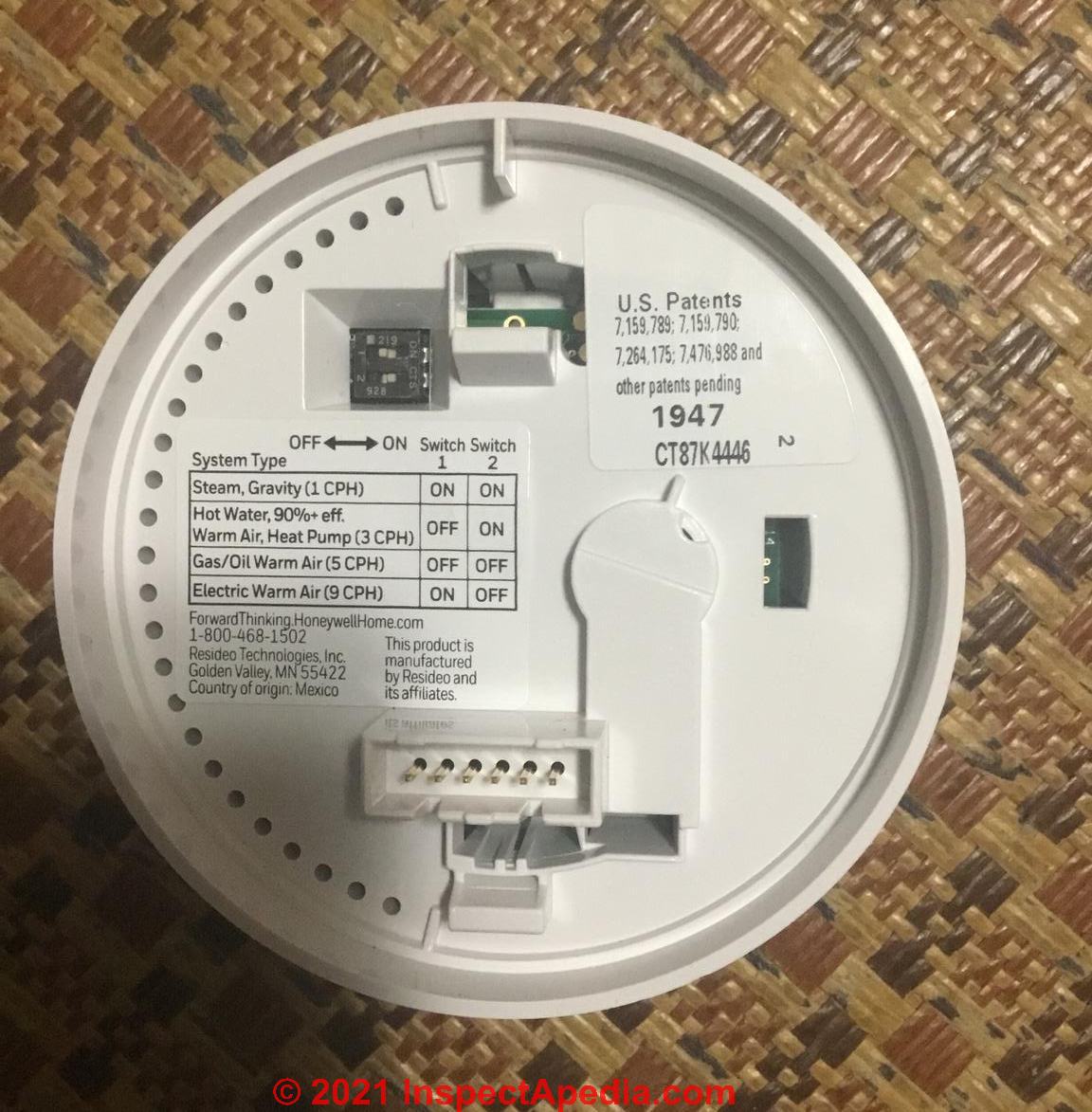
Do you know the mystery of the Honeywell CT87K4446 manual heat on round thermostat or similar models?
My father help his friend who is a building owner in New York City to replace a thermostat which the tenant broke off, the hydronic heat and domestic water are offer by the modulating boiler of LAARS Endurance EPB.
The landlord preferred simple heat-only non-digital thermostat for easy use.
So my father purchased Honeywell CT87K4446 for replacement. After installing the thermostat, turn the dial all the way up, the boiler didn't work, no heat, but the boiler didn't show any error or diagnostic info.
Thereafter, the landlord called three heating technicians, and replaced the thermostats twice, spent five hundred fixing the problem. The technicians always condemned the defective thermostat wires or bad thermostat which is brand new.
Finally dig out the problem the thermostat is too simple to pay attention to set up the tiny switch at the back correctly, which is default to steam boiler system.
In my insight, the thermostat is working as switch, why the switch setting will affect the boiler operation? On 2021-01-29 by Vincent
- by (mod) -
That does indeed sound odd. I guess it's possible that there was an incorrect Connection in the thermostat or that one of the wires is damaged and when pushed back into the wall is opening up and therefore breaking the connection
by Vincent
I think this solution probably also applied to the reader Jessica's comment which is posted on Nov 28, 2020
Reply by (mod) -
The heat type ONLY affects the equivalent of a heat anticipator in the unit - it won't or ought not affect the simple on-off function on a call for heat; I'd have wanted a careful check of the TT wires and connections.
I HAVE fund however on some of the newer TTs that the screw terminal does not make good electrical content with some older very small diameter thermostat wires. I had to address that in some installations.
Honeywell and Nest thermostats wont' turn on my heat
I thought my old Honeywell mercury based thermostat went out, as when I touch the red and white wires together the propane "Heat-n-Glo" fireplace furnace turns on.
I have tried two thermostats, Nest E and Honeywell CT87K with no luck.
The nest troubleshooting said no power was reading from red wire...but why does it work simply by touching wires together? The Honeywell fails to trigger as well. What am I missing? On 2020-11-29 by Jessica
Reply by (mod) -
1. Check that the batteries are good and are properly inserted
2. Check for a loose, broken, or shorted thermostat wire
3. Check for a bad transformer that is not delivering power to the thermostat
...
Thank you to our readers for their generous comments
Ara Lowel said:
I found this blog to be very resourceful and well written. On 2019-08-07
...
...
Continue reading at TEMPERATURE RESPONSE of ROOM THERMOSTATS or select a topic from the closely-related articles below, or see the complete ARTICLE INDEX.
Or see THERMOSTAT CALIBRATION FAQs - questions & answers about thermostat accuracy and calibration posted originally in this article
Or see these
Recommended Articles
- HEAT ANTICIPATOR ADJUSTMENT
- HUMIDITY RESPONSE, NEST THERMOSTATS
- TEMPERATURE RESPONSE of ROOM THERMOSTATS
- THERMISTORS in ROOM THERMOSTATS - very accurate temperature sensors in modern room thermostats
- THERMOSTAT CALIBRATION
- THERMOSTAT INSTALLATION & WIRING MANUALS
- THERMOSTAT WIRING OPENING SEAL - how to improve the accuracy and response of a wall themostat by sealing wall leaks
Suggested citation for this web page
THERMOSTAT CALIBRATION at InspectApedia.com - online encyclopedia of building & environmental inspection, testing, diagnosis, repair, & problem prevention advice.
Or see this
INDEX to RELATED ARTICLES: ARTICLE INDEX to HVAC THERMOSTATS
Or use the SEARCH BOX found below to Ask a Question or Search InspectApedia
Ask a Question or Search InspectApedia
Share this article:Search the InspectApedia website
Need to make a private comment? Email editor@inspectApedia.com. We welcome email with your website content critique, corrections, suggestions or questions. Email is monitored daily but our workload may prevent an immediate reply. For immediate results, we hope you'll first try asking your question using the search box just above.
Citations & Reviewers
In addition to any citations in the article above, a full list is available on request.
- [4] Azel Technologies Inc., P.O. Box 53138 10 Royal Orchard Blvd. Thornhill, Ontario, Canada L3T 7R9 Ph: 905-223-5567 Fax: 905-223-3778 Email: info@azeltec.com, Website: www.azeltec.com.
- [5] Honeywell Controls, the company wants you to use their contact form at this web page: http://www51.honeywell.com/honeywell/contact-support/contact-us.html
Honeywell Consumer Products, 39 Old Ridgebury Road Danbury, CT 06810-5110 - (203) 830-7800
World Headquarters, Honeywell International Inc., 101 Columbia Road, Morristown, NJ 07962, Phone: (973) 455-2000, Fax: (973) 455-4807 1-800-328-5111- Honeywell product model numbers & instruction Manuals: see http://yourhome.honeywell.com/home/Applications/FindYourModelNumber.aspx
- [6] White Rodgers Thermostats and HVAC controls,
Homeowner information: http://www.emersonclimate.com/en-US/brands/white_rodgers/Pages/wr-homeowner-info.aspx
Contractor information: http://www.emersonclimate.com/en-US/brands/white_rodgers/wr_contractor_info/Pages/white-rodgers-contractor-info.aspx
White Rodgers Product Catalog (don't misspell the company's name as White Rogers Thermostats) -
http://www.emersonclimate.com/Documents/thermostats.pdf - Thermostat Catalog - [7] White Rodgers 1F90 Low Voltage Digital Comfort-Set thermostat Installation Instructions, PN 37-3654, White-Rodgers Division, Emerson Electric Co., 9797 Reavis Rd., St. Louis MO 63123
- [8] "Automatic Oil Burner Controls - Thermostats", Domestic and Commercial Oil Burners, 3rd Ed., Charles H. Burkhardt, McGraw Hill, 1969 (and later editions), ASIN B0000EG4Y8
- [9] Thermostat wiring color codes & conventions, Thanks to reader " Helpful Pointers" Regarding 24V T, 10/7/2012
- [10] Domestic Central Heating Wiring Systems and Controls, 2d Ed., Raymond Ward, Newnes, ISBN-10: 0750664363, ISBN-13: 978-0750664363, Quoting from Amazon.com:
This unique A-Z guide to central heating wiring systems provides a comprehensive reference manual for hundreds of items of heating and control equipment, making it an indispensable handbook for electricians and installers across the country. The book provides comprehensive coverage of wiring and technical specifications, and now includes increased coverage of combination boilers, recently developed control features and SEDBUK (Seasonal Efficiency of Domestic Boilers in the UK) boilers ratings, where known.
In addition to providing concise details of nearly 500 different boilers fuelled by electric, gas, oil and solid fuel, and over 400 programmers and time switches, this invaluable resource also features numerous easy-to-understand wiring diagrams with notes on all definitive systems. Brief component descriptions are provided, along with updated contact and website details for most major manufacturers. - [11] Proliphix Corporate Headquarters [Website: proliphix.com] ,
3 LAN Drive Suite #100
Westford, MA 01886
Phone: +1.978.692.3375
Toll Free (U.S.): 866-IP-LIVING (866.475.4846)
Fax: +1.978.692.3378 - Email: sales@proliphix.com or Customer support: support@proliphix.com Website: http://www.proliphix.com/ - quoting from the company's website:
All Proliphix Network Thermostats come with our free Uniphy Remote Management Service. This unique offering lets you monitor and control your HVAC systems by simply pointing your Browser to our secure Proliphix Web Site. Enjoy the convenience of programming a thermostat from any location, using a simple graphical interface. No computer equipment or software is required.
And since Proliphix takes care of the network configuration for you, you’ll be up and running in no time.
We’ll even proactively monitor your thermostats and send you an immediate email or SMS message when an HVAC problem is detected. - [12] "Heating Control Handbook for the Installer and Service Man,Oil Burner, Gas Burner and Stoker Controls", Honeywell Corporation, March 1949 [copy on file as HoneywellControlsHandbookSA1399-2-1949.pdf] . Some of the controls discussed in detail here include the
- Honeywell T1 and T11A = Series 10
- Honeywell T21A (T2) = Series 20
- Honeywell T847A = Series 80
- Honeywell RA117A (RA1) = Series 10
- Honeywell LA101A = Series 10,
- Honeywell LA419A (LA4) = Series 40
- V155A = Series 10, V435A = Series 40, V575A = Series 50, V835A = Series 80
- [13] Trane TCONT800 Series Touch Screen Programmable Comfort Control Ownes Guide, American Standard, Inc., Troup Highway, Tyler TX 75711, January 2005, Telephone: Customer Service: 1-877-3381, website: www.trane.com
- In addition to citations & references found in this article, see the research citations given at the end of the related articles found at our suggested
CONTINUE READING or RECOMMENDED ARTICLES.
- Carson, Dunlop & Associates Ltd., 120 Carlton Street Suite 407, Toronto ON M5A 4K2. Tel: (416) 964-9415 1-800-268-7070 Email: info@carsondunlop.com. Alan Carson is a past president of ASHI, the American Society of Home Inspectors.
Thanks to Alan Carson and Bob Dunlop, for permission for InspectAPedia to use text excerpts from The HOME REFERENCE BOOK - the Encyclopedia of Homes and to use illustrations from The ILLUSTRATED HOME .
Carson Dunlop Associates provides extensive home inspection education and report writing material. In gratitude we provide links to tsome Carson Dunlop Associates products and services.
 |
HOME | ABOUT | ASK a QUESTION | CONTACT | CONTENT USE POLICY | DESCRIPTION | POLICIES | PRIVACY | |
| © 2026 - 1985 Publisher InspectApedia.com - Daniel Friedman | |||||||||