 Room Thermostat Calibration FAQs

- POST a QUESTION or COMMENT about heating, air conditioning, and heat pump thermostat installation and wiring
Room thermostat calibration & accuracy questions & answers:
Q&A on the accuracy of room thermostats and on how to calibrate or adjust thermostat accuracy.
This article series explains why a room thermostat may not be responding correctly to the actual room temperature.
These FAQs explain how to cope with factors that affect the room thermostat's behavior include is location in the building, for some models how level the thermostat was installed, the thermostat's heat anticipator adjustment, even dust and debris in or on the thermostat.
InspectAPedia tolerates no conflicts of interest. We have no relationship with advertisers, products, or services discussed at this website.
- Daniel Friedman, Publisher/Editor/Author - See WHO ARE WE?
Thermostat Accuracy, Calibration & Adjustment FAQs
 Recently-posted question & answers about room thermostat accuracy and calibration. These questions and answers were posted originally
at THERMOSTAT CALIBRATION - be sure to review the diagnosis and repair advice given there.
My AC is running 2 degrees higher than what I have it set on.
My AC is running 2 degrees higher than what I have it set on. It's a relatively new system.
The maintenance guy came out and checked the freon, said it was down from 70 to 60. He topped it off, and said it would take a couple hours to cool down. This was 16 hours ago. It went down to 70 at 2 a.m. but is still running. It just went back up to 71.
Could it be the thermostat or the inside unit needing cleaned? The inside unit is over 30 years old, and very dirty on the outside. On 2011-05-31 by GVirgilio -
Reply by (mod) -
Virgilio:
Iif your A/C unit is capable of cooling the room down to within two degrees of the thermostat even when you set it to a lower temperature, say 66 degF, then indeed it sounds like a slightly inaccurate thermostat and not a serious issue.
You can try vacuuming off any dust from the thermostat.
Details are at THERMOSTAT CALIBRATION
But if your A/C system cannot cool room temperature down below 70 degF no matter what, and if this is a CHANGE from how it used to perform, you could have a refrigerant leak (and/or improper charge), or a blocked air filter, or some other more serious cause.IF this is the case, take a look at our diagnostic advice found in the LOST COOLING CAPACITY article whose link is found at the left of these pages.
Air conditioner cools down to below the thermostat set temperature
Hi. For some reason, our dual zone unit keeps cooling the downstairs zone to well below the set temperature -- when set at 79, very cold air is still blowing though the thermostat reads 71. Cold air still blows even with both thermostats turned to "OFF."
Not sure what is causing this, but I am sure it's gonna cost me $700/month if I can't get the air to shut off.
Any thoughts would be greatly appreciated! On 2012-06-26 by EL
Reply by (mod) -
El: I'd have someone check the thermostat wiring. For example if thermostat wires are shorted together it's as if it continues to call for cooling (or heating in heat mode).
Other checks include the unit's control board and checks for a bad temperature sensor or a stuck contactor relay switch,
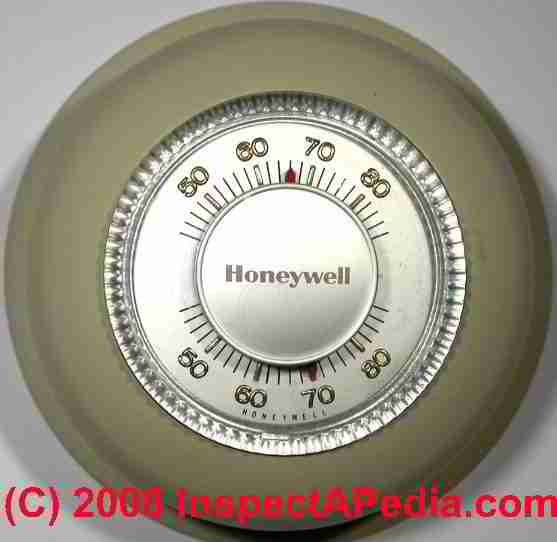
How to change a mercury bulb thermostat's operating range or calibration by tilting or rotating it on the wall
I have an older honeywell mercury thermostat in the garage, and I would like it to heat lower than the 50F lower dial limit.
You indicate in your Thermostat Accuracy and Calibration article that you did this by adjusting the level by tilting the thermostat backing plate “in the proper direction”.
I am thinking this proper direction to let it get a bit colder would be to tilt or rotate it to the right (clockwise) slightly, but I just wanted to double check. Can you confirm? Thank you. On 2020-02-01 by Holz
Answer by (mod) -
Thanks for the question, Holz.
I'll take a stab, but the caveat is that depending on the specific Honeywell round T87 type wall thermostat the mercury bulb doesn't always tilt in the same direction;
I pull the cover, turn the heat up or down, see which way the bulb tilts, then rotate the thermostat so that turning the heat down to say "50", the lowest on the thermostat, I've rotated the thermostat further so that "50" is really about "40" F.
You're right that that's almost clockwise to "fool" the thermostat into thinking it's warmer in the room than it really is, but pull the cover and look at your TT directly to see how the bulb is moving when you move the dial.Tilting Thermostat
Hi, I am still playing with it. Thanks for the information. It hasn’t been cold enough in the garage this winter so that I can get a good accurate reading. So, not sure if I am heating higher or lower than the set point with the clockwise tilt!
Reply by (mod) -
Try rotating the thermostat so that when you set the tt to 50 deg you're about 5 clockwise.degrees
Why does my thermostat turn the heat on in summertime?
My thermastat is heating my home ... why did ot turn on the ... it is Summer On 2019-07-31 by Deb -
Sorry - I'm asking why did it turn the heat on in the house - it is Summer
Reply by (mod) -
If the set temperature on your thermostat is below the actual indoor temperature then the heat should not run.
If it is running I suspect thermostat wires are shorted together somewhere or there's a bad relay or control board in the heater.
What if we can't find a problem with an inaccurate thermostat? Can I calibrate it to use my heat pump instead of backjup propane heat?
The outdoor temperature on my thermostat reads 20 degrees lower than what it really is outside, which will not allow my heatpump come on and uses the propane instead.
Can I calibrate this or is something up in the wiring. It has been off by 4 or 5 degrees in the past but when I looked to turn on the heat for the first time this year, it has increased the differance. On 2018-10-13 by Scott
Reply by (mod) -
If an inspection of all of the thermostat error causes outlined at THERMOSTAT CALIBRATION shows no external cause for the inaccuracy such as bad location, bad connections, I'd replace the control.
Heat won't turn on unless we set the thermostat way up past 80 degF
Heat won't come on. If we turn up past 80 it will come but takes a long time to go off. Forced air gas heat. 1990 Thermostat and furnace. On 2017-10-26 by Judy
Reply by (mod) -
It may be a bad thermostat, but before replacing it I have a couple of questions for you.
When the heat has come on but takes a long time to go off is that because the room is not reaching the temperature set on to the thermostat? if so it's possible that you have a problem with warm air delivery such as a blocked furnace filter or disconnected ductwork.
Those problems wouldn't explain why the heat doesn't come on but they might explain why it takes a long time to go off.
before replacing the thermostat I would also check for a loose connection or loose wire at the thermostat or at the other end with a thermostat wires connect to the heating equipment.
If you don't find a problem with the wiring I would replace the thermostat
What's the red or blue wire for? Instructions for Source 1 Thermostat Wiring
I previously had a Source1 tstat. Battery powered. No issues. I decided to upgrade to a programmable tstat. I went with the honewell TH9320.
The wiring was the same W to white, Y-yellow, and G- green. I hooked up the Red to R (previously it was hooked to the RC-RH loop).
There was an additional blue wire that was not used, but I needed now for the 24volt power. I hooked it up on the control board.
Now, as soon as i connect the tstat, the blower kicks on. I have it set to auto. Even if i turn it off, it still runs.
Only way to turn off the blower is to disconnect the tstat or unplug the blower. I turned the temp up to 80 in my house. the tstat read 73, and stayed running. (this is the AC).
Do these units take time to sync, or anything? Should i let it run longer? Or is my tstat defective?
I hooked my old source1 back up and it is fine. turns on and off when temp is reached. On 2017-09-18 0 by Marc
Reply by (mod) -
Marc,
First, did you confirm what the blue wire is doing in your wiring harness?In the Honeywell TH9320 installation manual, as I read the wiring instructions they expect the blue wire to be operating a reversing valve - for heat pumps. And in setup you are to "In Setup, set changeover valve to O or B."
Red wire: Usually the R (red) wire or Rc wire is the power source to the thermostat and carries 24VAC.
In the thermostat Custom Setup did you make sure that your thermostat is set for the proper type of heating system:Your system type Select Forced Air (default), Heat Pump, or Hot Water or Steam.
Each option offers different choices on the following screens.
Your forced air heating system type Select how your forced air system is powered: Gas/Oil (default) or Electric.
Efficiency of your heating system Select Standard Efficiency Forced Air (default) or High Efficiency Forced Air.
Your heating system type If you selected Hot Water or Steam on “Your system type,” select the specific heating system here.
Note: Touch the orange Help button on any screen for more information.
46 Changing system setup System Setup Options (concluded) Screen Title Settings and Options Number of cooling stages
Select 1 Stage (default) or 2 Stages.
If you are unsure, note which wires are connected: ‘Y’ wire only (1 stage) or ‘Y’ and ‘Y2.’
Number of heating stages Select 1 Stage (default) or 2 Stages.
If you are unsure, note which wires are connected: W’ wire only (1 stage) or ‘W’ and W2.’
Your fan control Select whether your thermostat (default) or heating system controls the fan.
Type of changeover valve
If you selected Heat Pump on “Your system type,“ select whether it uses a cooling changeover valve (default) or heating changeover valve.
If you are unsure, note which wires you have connected.
Number of heat pump compressor stages
elect 1 Stage (default) or 2 Stages.
If you are unsure, note which wires are connected: ‘Y’ wire only (1 stage) or ‘Y’ and ‘Y2.’
Your backup heat No or Yes (default) you can determine whether you have backup heat.
Also see wiring details, guides, manuals for your thermostat
at at HONEYWELL /RESIDEO HVAC CONTROLS & MANUALS
and our simplified thermostat wiring procedures given
at THERMOSTAT WIRING & MANUALS, HONEYWELL
Followup by Marc - I found the missing blue wire - needed for converting from a 4-wire to a 5-wire thermostat
Thank you for ALL of that information. I really appreciate the quick response. The blue wire was tucked within the wall, and not hooked up to anything on the blower end. I used it as a common on both ends.
When i tried to run just the red wire to R or RC, the blower kicked on, but i was not getting the tstat to display.
That's when I learned the tstat required a common hookup. This setup is a forced air. No heat pump, hot water or steam.
My original tstat was only using 4 wires. my new one required 5.
My apologies for my lack of knowledge. I am not experienced in any way HVAC. My forced air system is gas.
I will look more in depth at the setup options. When i initially looked, it didn't look like there were a lot of config options. I may have overlooked it. Thank you again.
How do I make my Honeywell RHT2300 thermostat agree with my accurate measurement of room temperature?
I just replaced an old mercury thermostat with a new Honeywell RHT 2300. So of course the new thermostat is dust free and has new batteries.
The thermostat is installed in an ideal location away from any drafts, direct sun, direct ventilation air flow etc.
Our house has single stage gas heat and central air. Currently we are in the AC Mode time of year.
I have a Certified Lab Quality Mercury-In-Glass ( MIG ) thermometer hanging very close and just above the new Honeywell. After many hours of time to allow both to normalize
The Honeywell reads 69F and the MIG reads 74F.
As the thermostat changes to a new preset temp this 5F differential follows.
Is there an adjustment to the Honeywell that I can do to bring the thermostat into calibration with the accurate MIG.
Yes or No ?
If no? . . . it would not take much of a design change to make calibration possible. Not good to make a product designed to measure and control something . . . without any sense of accuracy ? On 2017-04-17 by Jim McGovern
by (mod) - replaced an old mercury thermostat with a new Honeywell RHT 2300
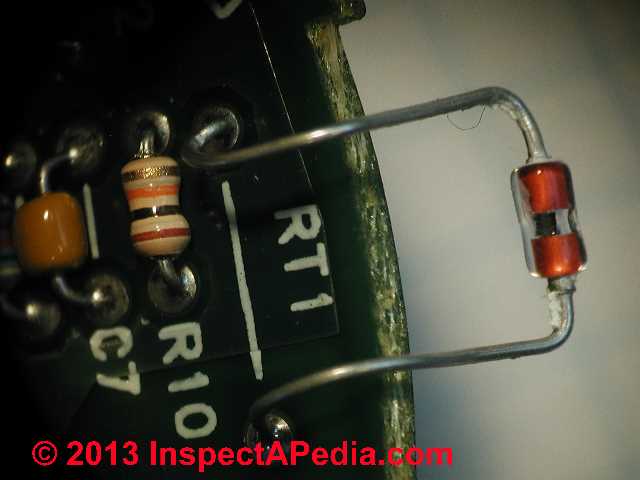
I'm surprised at so much difference. The thermistors used in modern thermostats including the Honeywell RTH 2300 series that we've installed are highly accurate - to less than a degree.
See THERMISTORS in ROOM THERMOSTATS at for details.
Is it possible that your new RTH is affected by the wall temperature or air currents in the wall cavity that don't affect our mercury thermometer?
E.g. a large wiring opening in drywall can blow warm or cool wall cavity air into the thermostat by natural convection.
Don't forget to be sure you're reading the actual temperature on the thermostat, not the set temperature. You probably have the manual but if not it'sat
in our library as a free PDF downloads of Honeywell / Resideo cotnrols found
at HONEYWELL /RESIDEO HVAC CONTROLS & MANUALS
[Dead Link in 2005 - ed] = https://customer.honeywell.com/resources/techlit/TechLitDocuments/33-00000s/33-00100EF.pdf
There are not any adjustments that would re-calibrate the temperature sensing response/temperature-display of your Honeywell TT.
Or you could ask Honeywell what they think but I'll bet they'll say you've got an air bubble in your Certified Lab Quality Mercury-in-Glass thermometer.
Honeywell Customer Care is at 1-800-468-1502.
What's the actual accuracy of ordinary home thermostats used with hot water heat?
What is the temperature uncertainty of ordinary commercial home thermostats used for controlling a hot-water circulating system? On 2017-04-04 by Henry
by (mod) re: temperature uncertainty of ordinary commercial home thermostats
Nice question, Henry.
As my smart home inspector educator Mark Cramer (Tampa FL) says, "... well, it depends"
That is to say it depends on the thermostat technology.
Older mercury bulb type round Honeywell wall thermostats were in my experience accurate to about 2 degrees or more of precision, and most "thermostat accuracy" complaints we found to be due to the thermostat installation location such as in sun, draft, or on a hot or cold wall.
Newer home thermostats usually use a thermistor that is very accurate, to a tenth of a degree 0.1 C ( 0.18F) or +/- 0.2C (0.36F) for some versions, but temperature sensing accuracy of thermistors too can be subverted by- dust and debris covering the thermistor sensor
- location in sun, draft, or on a warm or cool wall or other surface, as I cited above.
By thermostat accuracy or thermistor accuracy as I discuss here, I mean the accuracy with which the temperature sensor measures the room air temperature where the thermostat or thermistor is located.
Naturally the temperature sensed at a wall-mounted thermostat will rarely be identical to the air temperature or surface temperatures measured elsewhere in that room much less in that building.
See THERMISTORS in ROOM THERMOSTATS at https://inspectapedia.com/electric/Thermistors.php for more details about accuracy ranges of thermostats using these and similar devices.Generally new thermistor-based room thermostats are accurate to +/- 0.1C or +/- 0.18F or in some models +/- 0.2C or +/- 0.36F
Please see THERMISTORS in ROOM THERMOSTATS for details about accuracy ranges of room thermostats and thermistors using these and similar devices.
See also TEMPERATURE RESPONSE of ROOM THERMOSTATS for an explanation of things that "throw off" the accuracy of a room thermostat.
Thermostat located below the HVAC air supply register doesn't control room temperature properly
My electronic thermostat is set on 72 degrees for my electric heat. The thermostat will reach 72 degrees and turn the unit off, as expected.
The main rooms in my apartment are ranging from 60-66 degrees (I'm using separate temperature gauges and nowhere in the apartment ever reaches 70-72 degrees).
Using just my hand, I've noted the the air coming from every vent is not even warm. I'm considering purchasing a gauge to get an accurate reading on the air temp coming from the vents.
The outside temperature has been in the 20s and 30s.
NOTE: Based upon what I've read on your page I've noted that the thermostat is located immediately below the heating and cooling air supply register.
Please advise me if you have any suggestions regarding how to resolve this problem. Thank you. On 2017-01-07 by Kat A.
by (mod) re: importance of room thermostat settings & location on accuracy
Kat
Once your electric furnace has turned OFF then air should stop blowing out of the supply air vents. If it doesn't then I suspect either a blower control switch problem or a thermostat that has a manually-set FAN-ON switch in the ON position.
I agree that the thermostat location can throw off its calibration if it's getting hot or cold air from another source, but that wouldn't explain cold air coming out of the vents.by Kat A.
Thank you for your response, but I don't think I explained myself well. Please let me try again.
1. Set thermostat for heat with fan set on auto to 72 degrees.
2. Observe manually that air from supply vents is barely warm, almost cold. (I have not measured the temperature split yet, although I've been thinking that should be my next step).
3. Heat runs. When air stops blowing thermostat reads 72 degrees.
4. However, indoor digital thermometers located in all 4 rooms of the apartment read from 64-66 degrees.
5. Experiment: I increased the thermostat setting from 72 to 80 degrees. The air blew for one hour and When the air stopped blowing the thermostat read 75 degrees. The temperature range in the apartment, based on the 4 indoor digital thermometers had only gone up to 66-68 degrees.by (mod) re: difference between the temperature sensed by a room thermostat and other room temperature measurements
Let's separate a couple of things.
It is very common for thermostat to read a temperature that's different than thermometers that you might Place elsewhere in the same room. In fact even a thermometer held close to the thermostat may give a different temperature because the thermostat may be affected by the temperature of the wall on which it is mounted.
Separate, we have the problem that the air coming out of your Forest warm air supply registers is not warm enough.That's tough to diagnose without knowing a lot more about your system. For example is it an electric furnace. If so I suspect that some of the sequencers or heatig elements are not working. But there are other problems that can cause cool air out of warm air heat Supply registers.
For example a fan velocity that is too high, or an undersized furnace, or air leaks or other damage to the ductwork itself.
For example if you have air ducts that are poorly insulated and running through a cold area the air will be chilled before it comes to the supply register and we might hear the complaint that you have stated.
So I think you need to look through the duct system and you need to look at the furnace itself to see whether the air leaving the furnace is hot or warm.
My wall thermostat is level but room temperature is much lower than what the thermostat says
My thermostat on the wall is levelled. The temperature of the room that is shown on the thermostat is much lower on my thermometer.
I got a floor heater in the meantime because I was cold. If the super of the building do not come to fix it I will contact the owners of this building because it's starting to be cold out and I pay a high rent for this apt so it should be looked after asap. On 2016-10-22 by James
My wall thermostat reads a higher temperature than an adjacent digital thermometer
I noticed that my wall thermostat which is at least 5 degrees higher than my digital thermometer which is next to it. I was told to buy a digital thermometer to make sure that it is the right reading since I had another thermometer but is not digital. What is the cause of this. The room temperature shows 77 on my thermostat and my digital shows 72.
I know the temp in the room is not 77 but I'm cold. What to do? On 2016-10-22 by Suzanne
by (mod) re: Mistakes or inaccuracies when measuring & comparing room temperature to the thermostat's temperature reading or setting
For both Suzanne and James,
Measuring temperature say near the center of a room will usually give a different reading than the temperature reported by the wall-mounted thermostat. In the article above we list typical reasons for that. For example a thermostat mounted on a wall near a heat source or in sunlight or well away from drafty windows or doors will think that the room is warmer than you-do.
A simple solution is to set the thermostat up to a higher temperature until you're comfortable in the room.
To reduce heating costs you'd look for and fix the main points of heat loss such as drafty windows.
Thermostat is calling for heat when we set it on COOL
Thermostat set on cool. When it goes on, it will run and run and the thermostat air reading goes up rather than down.
We turn the thermostat Off and the temperature reading gradually goes down to the correct air temperature. On 2016-07-23 by Sandra
by (mod)
Sandra
It sounds as if your air conditioner is not cooling - perhaps the compressor is not operating or the cooling coil is blocked by ice or debris;
Or if your system is a heat pump it may be in HEAT mode rather than COOL mode.
If a review of just how you've set the thermostat doesn't correct the trouble I would leave the system off and ask for repair from an HVAC service technician.by Sandra
The AC is definitely cooling the area. We have a separate thermometer and it shows the temperature going down, even below the thermostat setting.
The problem is that the thermostat itself seems to be generating heat when the AC is running and the thermostat temperature reading goes up when in reality the air temperature is going down.
by (mod) re: problem with thermostat generating its own heat
I was confused: you said that when the A/C system runs "the thermostat air reading goes up" - which I took to be an increase in temperature - which would not be cooling.
Thermostats, some models anyway, include a very tiny heater (a heat anticipator) that works in *heating* mode (not cooling) to prevent the room from overheating at the end of a heat-on cycle - by turning the heat off a tiny bit early.A defective thermostat or one that's mis-wired might be itself overheating.
Or if your thermostat is a line-voltage unit (120V) - which would be unusual in a residential set-up - there could be a more dangerous wiring error.
I'd check the thermostat wiring for improper connections, loose connections, short circuits and if that's all OK I'd replace the thermostat.
A/C does not cut off when the thermostat senses that the room is at the desired temperature
A/c does not cut off when reaching desired temp. Keeps running and running. It seems the thermostat itself is generating heat which makes it keep running. On 2016-06-24 by Dan
Reply by (mod)
Try disconnecting the thermostat wires at the thermostat end - if the unit keeps running next disconnect them at the control end - that'll eliminate the problem of shorted wires. as well as a bad thermostat or thermostat location.
See AIR CONDITIONER / HEAT PUMP WON'T STOP detailed diagnosis and repair suggestions
Diagnose erratic thermostat response to room temperature changes
I installed a Honeywell non-programmable electronic thermostat to replace a mechanical TT.
No problems for the first 30 days, but now when TT heat temp is set (e.g. 68), it does not send signal to engage furnace until room temp display reaches 64 (and sometimes 61, and then sometimes at the expected 67 degrees.
The thermostat's response to temperature is very sporadic and non consistent). Any suggestions as to problem source? Thanx On 2016-01-06 by Jaffthau@yahoo.com
by (mod)
If you can rule out a loose connection, dirt or debris blocking air flow to the thermosat, or having located the thermostat where it is being fooled by sunlight or another warmth source, I suspect the thermostat is defective.
At a time when the heat is set to 68 and the room temp is below say 65, take a look at what room temperature the thermostat thinks it is sensing. If the thermostat's read of actual room temp is well below the set temp and if at that point it's not turning on the heat, if the other problems I cite are not present (such as a loose wire) the unit is probably bad.by Jaffthau@yahoo.com
Thanks, 'll swap out the TT and hope for the best. Great service you guys offer, especially helpful to novices like me. Happ New Year!
Heat cycles on and off when I turn the thermostat above 70 degF
The temperature in the house reads 68. When I turns the thermostat up to 72 the furnace runs then shuts off and then starts running again. When I turned it down to 70 it runs and shuts off properly but still reads 68 in the house. On 2015-10-15 by Tom. tpjshel@yahoo.com.com
by (mod)
Watch the fan limit control at the furnace - it may be overheating and shutting off at high limit. Check for a dirty air filter or blower.
Thermostat never shuts off the air conditioner
We have changed our thermostat in this new house we moved to the RTH2300. I'm hoping since you know about it you can help me.
I have the settings programed to 72 yet we are getting a continuous AC flow until the thermostat shows 59 yet the compressor (Model: FADC-024JAS) nor the blower (Model: ?) ever shuts off.
So I think the thermostat is never telling the system to shut off. I am tasked to figure out why so please help ASAP or mom will kill me when she sees our new bill! Andrewsistrunk@gmail.com On 2015-08-17 by Andrew Sistrunk
by (mod)
Andrew,
Indeed the 5-2 Day Programmable Thermostat - RTH2300B1012 by Honeywell is one I personally like and have installed. I've not had the trouble you describe.
I would check first for improper thermostat wiring and second for a short between the cooling wires in your thermostat circuit.
Furnace short cycles after I replaced a "booster assembly"
I recently replaced the booster assembly on my furnace. The lowest temperature setting on my thermostat is 45. I use to set it at this when I left the house.
Now I set it at that and come home with the furnace running for about 3 minutes, shutting off for a minute, then back on for a few minutes again.
If I set it above 55 degrees, it runs normally. Could this be the new part or the digital thermostat going bad at the same time? (Feb 4, 2015) Tyler
Reply:
I tend, Tyler, to be slow to assume double-faults though of course it's possible.
You're seeing heater short cycling - possibly this article will help
Heating thermostat seems to show wrong temperature
My heater's thermostat is showing wrong temp. At off setting , it shows the room temp at about 80 when it feels like 60 degree in the house. I tried removing and putting batteries again but doesn't solve the problem. Do I need to replace it? - P. 1/2/2013
Reply:
P
You might, but first check the thermostat's room temperature reading (not its SET temperature reading) against the actual room temperature - use a room thermometer;
Then be sure the thermostat is set to HEAT mode and make sure that the SET temperature is above room temperature. Then heat should run until the sensed temperature at the thermostat turns it back off; See the next Q&A for more details.
Why do we have to turn our heat up higher than previously just to get warm
Our heating and air unit is roughly 8 or 9 years old. When we first moved here (6 years ago) we kept the air set on 73-74 during the summer months. We were comfortable.
Now, we have to keep it up to 79-80 and we still feel like the house is too cold. We had the unit checked out last year ( because we started having double and triple utility bills) and the guy said it was fine. Could this be thermostat problems? I don't really feel that the unit runs more than it should though. - Rachel 8/22/12
Reply:
Rachel,
First, are we looking at the same outdoor temperatures as previously? If not, if it's colder now than previously, the problem could be with your home's rate of heat loss - bad insulation, leaky windows &c.
If weather conditions are the same, then we have some other questions to ask: you don't say if your heat is from hot water or forced warm air. In either of those systems, even if the equipment is running as before, you could have a simple maintenance problem like a clogged air filter or air bound radiator that's the problem. I'd need to know more.
...
...
Continue reading at THERMOSTAT CALIBRATION - topic home, or select a topic from the closely-related articles below, or see the complete ARTICLE INDEX.
Or see these
Recommended Articles
- HEAT ANTICIPATOR ADJUSTMENT
- HUMIDITY RESPONSE, NEST THERMOSTATS
- TEMPERATURE RESPONSE of ROOM THERMOSTATS
- THERMISTORS in ROOM THERMOSTATS - very accurate temperature sensors in modern room thermostats
- THERMOSTAT CALIBRATION
- THERMOSTAT WIRING OPENING SEAL - how to improve the accuracy and response of a wall themostat by sealing wall leaks
Suggested citation for this web page
THERMOSTAT CALIBRATION FAQs at InspectApedia.com - online encyclopedia of building & environmental inspection, testing, diagnosis, repair, & problem prevention advice.
Or see this
INDEX to RELATED ARTICLES: ARTICLE INDEX to HVAC THERMOSTATS
Or use the SEARCH BOX found below to Ask a Question or Search InspectApedia
Ask a Question or Search InspectApedia
Share this article:Search the InspectApedia website
Need to make a private comment? Email editor@inspectApedia.com. We welcome email with your website content critique, corrections, suggestions or questions. Email is monitored daily but our workload may prevent an immediate reply. For immediate results, we hope you'll first try asking your question using the search box just above.
Citations & References
In addition to any citations in the article above, a full list is available on request.
- Our recommended books about building & mechanical systems design, inspection, problem diagnosis, and repair, and about indoor environment and IAQ testing, diagnosis, and cleanup are at the InspectAPedia Bookstore. Also see our Book Reviews - InspectAPedia.
- In addition to citations & references found in this article, see the research citations given at the end of the related articles found at our suggested
CONTINUE READING or RECOMMENDED ARTICLES.
- Carson, Dunlop & Associates Ltd., 120 Carlton Street Suite 407, Toronto ON M5A 4K2. Tel: (416) 964-9415 1-800-268-7070 Email: info@carsondunlop.com. Alan Carson is a past president of ASHI, the American Society of Home Inspectors.
Thanks to Alan Carson and Bob Dunlop, for permission for InspectAPedia to use text excerpts from The HOME REFERENCE BOOK - the Encyclopedia of Homes and to use illustrations from The ILLUSTRATED HOME .
Carson Dunlop Associates provides extensive home inspection education and report writing material. In gratitude we provide links to tsome Carson Dunlop Associates products and services.
 |
HOME | ABOUT | ASK a QUESTION | CONTACT | CONTENT USE POLICY | DESCRIPTION | POLICIES | PRIVACY | |
| © 2026 - 1985 Publisher InspectApedia.com - Daniel Friedman | |||||||||