 Flooring Materials 1900-1949

- POST a QUESTION or COMMENT about how to identify brands & types of vinyl & vinyl-asbestos floor tiles & sheet flooring & about the asbestos content of these products
This page provides a guide to identifying
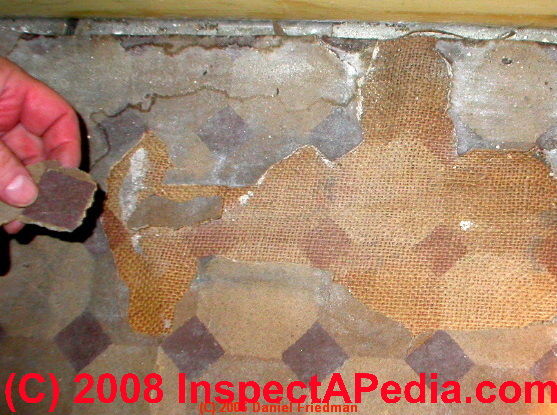
Page top photo: jute or burlap-backed Linocrusta, an early form of sheet flooring widely used in Europe and North America.
InspectAPedia tolerates no conflicts of interest. We have no relationship with advertisers, products, or services discussed at this website.
- Daniel Friedman, Publisher/Editor/Author - See WHO ARE WE?
Older Flooring & Floor Covering Materials
Article Contents
- OLDER FLOOR COVERINGS 1900 - 1949
- EARLY ASPHALT PLANK FLOORING in US POST OFFICES 1930
- ASBESTOS in FLOORING 1900 - 1930
- OLD FLOORING IDENTIFICATION ARTICLES & CATALOGS - up to 1949
...
Older Floor Coverings - 1900 - 1949
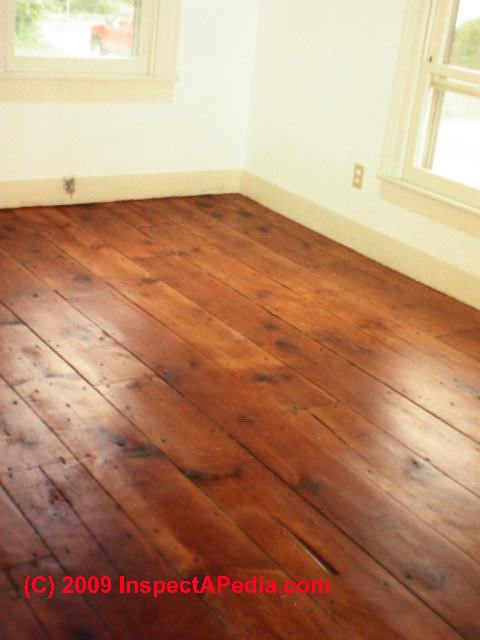 Above: a wide board heart pine floor in an 1860's home in "the Bleachery", Wappingers Falls, New York, restored by the author (DF).
We removed a layer of carpeting that was installed over a layer of linoleum to expose these boards that were then carefully stripped ofa coating of milk paint, cleaned, lightly sanded, and coated with a clear finish.
Older "modern" building floor coverings are traced to the turn of the last century.
In our CORK FLOORING article we trace these through the history of Armstrong Cork and Tile Company.
By 1909 Armstrong had begun producing linoleum. "Corkboard led to fiberboard, fiberboard led to ceiling board, cork floor tile led to linoleum that ultimately led to vinyl floor coverings, in both tile and sheet vinyl forms.
Here are more sources of older floor coverings in popular use before 1949:
- Armstrong Cork & Tile Co., HOW TO LAY & CARE FOR LINOLEUM 1914 [PDF] 2nd Ed., Armstrong Cork & Tile Co, Linoleum Department, Lancaster PA
- Armstrong Cork Co., Armstrong LINOLEUM PATTERN BOOK 1921 [PDF] - retrieved 2024/10/26, original source: https://ia801708.us.archive.org/19/items/armstrongslinole00arms/armstrongslinole00arms.pdf [Copy on file as Armstrong-Linoleum-Pattern-Book-1921.pdf ]
- Armstrong Cork Products Co., Hazel Dell Brown, The Story of Five Dream Kitchens 1935 [PDF] (1935) retrieved 2024/10/26 original source: https://archive.org/details/TheStoryOfFiveDreamKitchens
- Armstrong Cork Co., Armstrong's QUAKER and SETANDARD RUGS and FLOOR COVERING 1939 [PDF]availble at Building Technology Archive - Internet Archive - [Copy on file as Armstrongs-Quaker-And-Standard-Rugs-And-Floor-Covering-1939.pdf ]
- Armstrong Cork Co., Armstrong Floors and Wall Coverings for Homes and Public Buildings - 1939 [PDF] op. cit., original source: https://ia800502.us.archive.org/18/items/Sweets1939812Cat36/Sweets19398-12%20Cat%2036_text.pdf
This catalog covers all of the company's flooring products and materials as well as other products such as bulletin boards, wall coverings, and flooring underlayments. - Armstrong's LINTOILE CATALOG 1954 [PDF] - op. cit. [Copy on file also as Armstrong's-Linotile.pdf]
Excerpt: Armstrong’s Linotile® is a beautiful resilient floor that offers ease of maintenance and durability unmatched by any other resilient ffooring material.
Manufactured exclusively by Armstrong since 1914, Linotile is a flooring of proved quality.
It is produced essentially from the same raw materials as linoleum, but a series of manufacturing processes make it a completely different flooring with dis- tinctive qualities all its own. - ARMSTRONG SHEET FLOORING 1940 - 1980 [Web Page]
- A. S. Boyle Company, Beautiful floors woodwork and furniture : their finish and care (ca 1925) [PDF] - Internet Archive cited below.
- CORK FLOORING [Web Page]
- FLOOR TILE HISTORY & INGREDIENTS [Web Page]
- FLOORING MATERIALS, AGE, TYPES [Web Page] - all ages and all flooring materials
- LINCRUSTA CEILINGS & WALLS [Web Page]
- LINOLEUM & OTHER SHEET FLOORING [Web Page] - 1900 to present
- TABLE of FLOORING MATERIALS & AGES [Web Page] - all ages and all flooring materials
More older Armstrong flooring products and catalogs can be found at
- Building Technology Archive - Internet Archive [Web- source of many older Armstrong flooring catalogs researched for this article series
...
Early Asphalt Plank Flooring - 1930s - U.S. Post Offices
Where to find antique US Post Office Plank Flooring Pattern Tiles
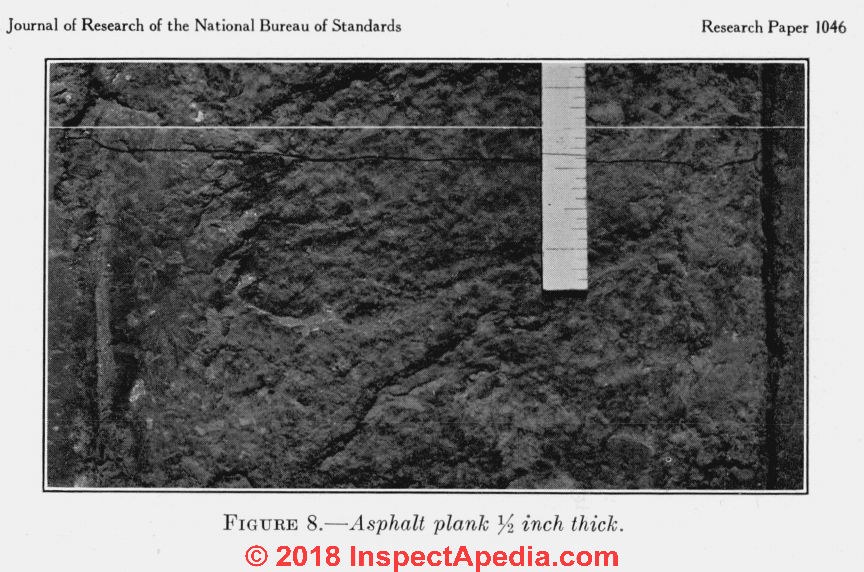 I am trying to locate a source for 12"x24"x1/2" asphalt plank flooring that was used in United States Post Office all aver the US in the sixties, seventies and eighties. - 2015-03-31 by gary jastad
Answer by (mod) - asphalt plank flooring used in United States Post Offices 1937-1980
Gary
Black asphalt-based plank flooring was in use in U.S. post offices well before the years you give - 1960-1980 in thicknesses of about 1/2 inch.
I found research describing that flooring product in use in Post Office work rooms in 1937.
Use our CONTACT link at page bottom to find my email, send me some sharp photos, and I will research the flooring.
Asphalt plannk is not currently used in new construction (AS-503-2010)
See these research papers on asphalt plank flooring
- Emley, Warren E., Carl E. Hofer, TEST of FLOOR COVERINGS for POST-OFFICE WORKROOMS [PDF] U.S. Department of Commerce, National Bureau of Standards, Research Paper RP1047, November 1937, retrieved 2018/12/03, original source: https://nvlpubs.nist.gov/nistpubs/jres/19/jresv19n5p567_A1b.pdf
Abstract:
Twenty kinds of floor coverings were tested to learn their relative suitabilities in the workrooms of post offices.
The 20 samples included 8 of wood, 5 of concrete, 2 each of asphalt, magnesite, and rubber, and 1 of linoleum.
The test consisted in the continuous operation of t wo post-office platform trucks around a track. The trucks have steel wheels and were loaded to 1,000 and 1,500 pounds, respectively.
The results are shown by photographs taken after 60,000 passages of the truck. The results show that maple, linoleum, or perhaps rubber should give satisfactory durability in this service.
Excerpt:
Asphalt specimen 7 was made of blocks 5 by 12 by 2 inches set in }f inch of mortar.
Specimen 8 was asphalt plank, }f inch thick. The surfaces of both block and plank roughened quite readily under this treatment, and for this reason they could not be kept clean by sweep ing.
The plank showed considerably more wear than the block. - Levin, Harold L. WATERPROOF FIBROUS PRODUCT [PDF] (1930) U.S. Patent 1,785,357, issued December 16, 1930.
Excerpt: In another run, where an asbestos product was desired, the stock was composed of 20 to 25 parts of low grade asbestos fibre, parts of asphalt dispersion containing about 50% asphalt, and 40 to 45 parts of mineral fines in the form of an impalpable asbestos dust.
To this stock was added the necessary amount of precipitating agents such as sodium silicate and alum, as above described. - Rankin, Albert I. COMPOSITE COATING MATERIAL [PDF] (1930) U.S. Patent 1,778,727, issued October 21, 1930.
Excerpts: This invention relates to composite coat iug materials having an asphaltic or bituminous … upon floors and other surfaces which have been levelled and smoothed as well as upon floors …
For the filler I may use ground stone, slate, slag, cinders, clay, asbestos, etc. or any of the other suitable ground materials commonly employed as fillers in paints and molded products, and the proportion of filler to the bituminous or other base and cementing material may be from 1 part of filler to 1 part of cementing base in the richest mixtures to 10 parts of filler to l of cementing base in the leanest mixtures. - HANDBOOK AS-503, STANDARD DESIGN CRITERIA [PDF] (2010) June 17, 2010 Chapter 2 - Architectural [PDF] APWU, American Postal Workers Union, AFL-CIO, retrieved 2018/12/03, original source: https://www.apwu.org/sites/apwu/files/resource-files/AS-503%20Standard%20Design%20Criteria%2006-10%20%283.65%20MB%29.pdf
Excerpts:
The Standard Design Criteria is organized into four modules:
• Module 1 - Criteria that is common and applicable to the two primary facility types (MSBD & SSBD).
• Module 2 - Criteria that is unique to the facility type (MSBD or SSBD).
• Module 3 - Criteria for special facility types other than the two primary facility types.
• Module 4 - Criteria for those special components that at times may be a part of any of the facilities.
Useful note: Use of asphalt plank is no longer allowed in new construction.
...
Asphalt / Asbestos in Flooring - 1900 - 1930
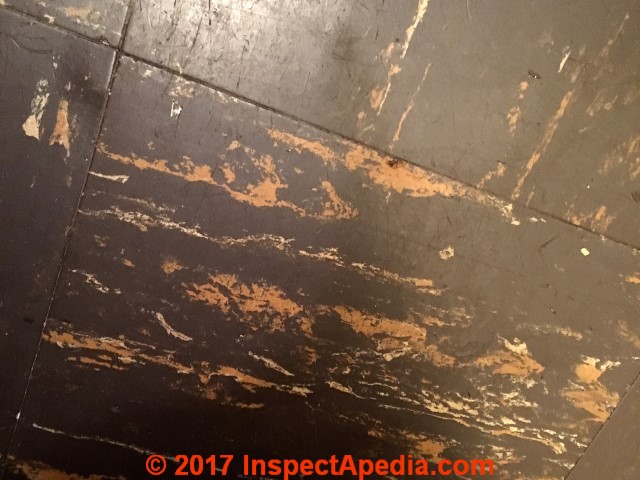
Photo above: By the 1940s an alternative to linoleum and Congoleum were asphalt based floor tile like those in our photo, though the first publicized asphalt tile installation was decades earlier in 1920 in New York City's Western Union office.
Asphalt based flooring materials are described in quite a few U.S. patent disclosures with a surge of activity in the 1920s. A few examples are given here.
- Abraham, Herbert. Asphalts and allied substances: their occurrence, modes of production, uses in the arts and methods of testing. D. van Nostrand, 1918.
Excerpt: … A laboratory was erected to investigate the uses of this asphalt, which was marketed in France under the name “Rock asphalt mastic," and used for surfacing floors, bridges and … - Bartlett, Francis A. FIBROUS COMPOSITION of MATTER [PDF] (1926) U.S. Patent 1,598,636, issued September 7, 1926.
Excerpt:
My improved composition consists of a filler such as sawdust, wood flour or ground 2 cork, or other finely divided vegetable matter; a fiber such as asbestos, hair, or other fibrous material; a base such as Portland cement, sand or other cheap material; a preservative such as asphalt, coal tar, oil or the like; a binder preferably of water glass having the consistency of molasses; water-proofing consisting of a coating of asphalt and asbestos put on over the surface of the composition after same has hardened in the cavity; and re-enforcing consisting of iron rods, bolts, wire, rope, or other material (used only in large cavities).
The composition more or less specifically consists of sawdust. 4 to 16 parts; asbestos cment. (asmaII quan- 1 part; Porfland c tity)' as half or tar, Isutficient to thoroughly sa ura e anc coat all the particles of the filler and the fibrous material); water glass. (sufficient to make the compomplastic, sticky mass which can be worked readily but will hold its shape). - Hannam, George C., and Julius W. Schede. FLOORING TILE [PDF] (1927) U.S. Patent 1,637,301, issued July 26, 1927.
Excerpts:
Specifically stated our improved composition is as follows: Pounds. Gilsonite asphalt 25 Vegetable pitch 25 Asbestos fiber 120 Coloring matter. . Asbestos fiber, and it is well within our invention to employ other fiber which may be found to give good results.
A tile-composition, comprising gilsonite asphalt, vegetable pitch, and asbestos fiber, in substantially the proportions of twentyfive pounds of asphalt, twenty-five pounds :of pitch, and one hundred and twenty pounds of asbestos fiber, in which mixture coloring matter is incorporated. - Hannam, George C., and Julius W. Schede. "Flooring tile." U.S. Patent 1,637,302, issued July 26, 1927.
- Loomis, Chauncey C. FLOORING [PDF] (1928) U.S. Patent 1,682,530, issued August 28, 1928.
Excerpt:
This invention relates to floors, and has for its object the provision of an improved flooring and method of laying same.
So-called mastic floors have hitherto been 5 aid by mixing a solution of bituminous material in an organic solvent such as naphtha with a suitable filler such as asbestos or fine then troweled over a wood, concrete, or steel.
The resulting paste is then troweled over a wood, concrete, or steel floor or foundation and the solvent is allowed to evaporate. Alternativey the bituminous material may be melted by appli cation of heat and the filler mixed in. - Ross, Joseph. Waterproofing engineering for engineers, architects, builders, roofers and waterproofers. John Wiley & sons, Incorporated, 1919.
Describes the history of waterproofing beginning with the Egyptians who used asphalt, perhaps mixed with an asbestos filler to waterproof the foundations of the pyramids. - Shively, R. R. "An investigation of composition flooring." Industrial & Engineering Chemistry 8, no. 8 (1916): 679-682.
Excerpt: … asbestos, and colored with different inorganic colors, is made into a “mortar” by the addition of a solution of magnesium chloride; the material is then applied to the floor … with asphalt, ... - Wager, Samuel Tobias. "The Water-Proofing of Solid Steel-Floor Railroad Bridges." Transactions of the American Society of Civil Engineers 79, no. 2 (1915): 306-335.
Excerpt: … asbestos felt with asphalt mastic instead of brick or reinforced concrete. This is probably allowable with asbestos … felt, or fabric treated with asphalt, will draw the asphalt out of the felt and …
...
Identification Catalogs for Older Armstrong & Other Brands of Asphalt Asbestos Flooring
Prior to the development of linoleum sheet flooring, floor coverings were made of painted canvas.
Canvas floor coverings were succeeded by more-durable linocrusta, linoleum, and cork flooring in tile form.
The first use of linoleum as a floor decking was on British naval ships.
The composition of that surface combined asphaltic bindersand an asbestos filler, mixted togehter and rolled out in sheets a rubber milling machine.
Below: an antique cork floor tile installation in the U.S.
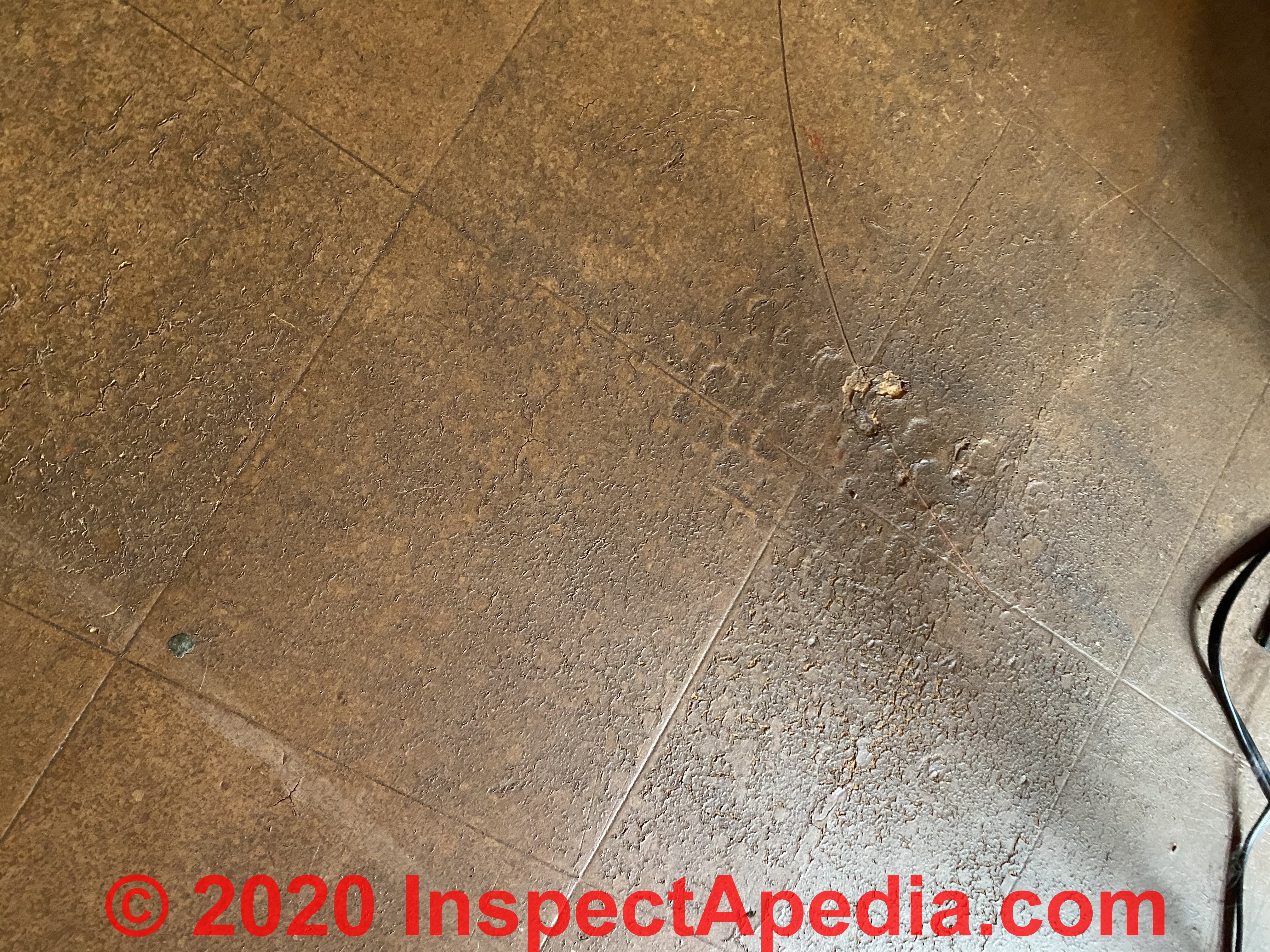
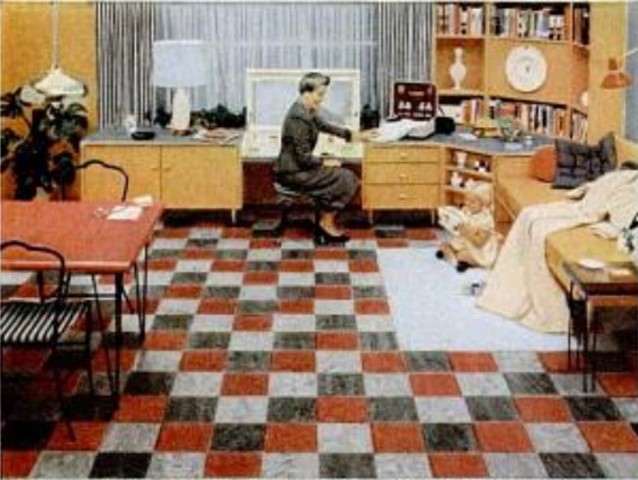
In our CORK FLOORING article give this micro-history of the evolution of floor covering materials that were used over older wood board floors as well as over concrete.
By 1909 Armstrong had begun producing linoleum. "Corkboard led to fiberboard, fiberboard led to ceiling board, cork floor tile led to linoleum that ultimately led to vinyl floor coverings, in both tile and sheet vinyl forms.
Sources of identification images & catalogs for older floor coverings in popular use before 1949
- Armstrong Cork & Tile Co., HOW TO LAY & CARE FOR LINOLEUM 1914 [PDF] 2nd Ed., Armstrong Cork & Tile Co, Linoleum Department, Lancaster PA
- Armstrong Cork Co., Armstrong LINOLEUM PATTERN BOOK 1921 [PDF] - retrieved 2024/10/26, original source: https://ia801708.us.archive.org/19/items/armstrongslinole00arms/armstrongslinole00arms.pdf
- Armstrong Cork Products Co., Hazel Dell Brown, The Story of Five Dream Kitchens 1935 [PDF] retrieved 2024/10/26 original source: https://archive.org/details/TheStoryOfFiveDreamKitchens [Copy on file as Armstrrong-5-Dream-Kitchens.pdf ]
- Armstrong Cork Co., Armstrong's QUAKER and SETANDARD RUGS and FLOOR COVERING 1939 [PDF]availble at Building Technology Archive - Internet Archive - [Copy on file as Armstrongs-Quaker-And-Standard-Rugs-And-Floor-Covering-1939.pdf ]
- Armstrong Cork Co., Armstrong Floors and Wall Coverings for Homes and Public Buildings - 1939 [PDF] op. cit., original source: https://ia800502.us.archive.org/18/items/Sweets1939812Cat36/Sweets19398-12%20Cat%2036_text.pdf
This catalog covers all of the company's flooring products and materials as well as other products such as bulletin boards, wall coverings, and flooring underlayments. - ARMSTRONG LINOLEUM LINOWALL CATALOG 1939 [PDF] Armstrong Cork Company, Lancaster PA, retrieved 2018/02/07 describes Armstrong's linoleum, linowall, and asphalt tile flooring.
The Armstrong Cork Co. building products listed by this catalog include:
Armstrong floors: Linoleum, Linoflor, Mastic Armoflor, Quaker Rugs, Quaker Floor Covering, Standard Rugs
Armstrong standard floor coverings: Asphalt tile, Linotile (Oil-Bonded), Rubber tile, Monocork, Cork tile, Cork Carpet
Armstrong wall finishes: Linowall, Monowall, Cork Tile, Temlok De Luxe Interior Finish, Temwood, Blocked Temwood, Temboard, Temboard De Luxe
Armstrong insulation: Corkboard, Temseal Insulating Sheathing, Temlok Insulating lath. - Armstrong's LINTOILE CATALOG 1954 [PDF] - op. cit.
Excerpt: Armstrong’s Linotile® is a beautiful resilient floor that offers ease of maintenance and durability unmatched by any other resilient ffooring material.
Manufactured exclusively by Armstrong since 1914, Linotile is a flooring of proved quality. It is produced essentially from the same raw materials as linoleum, but a series of manufacturing processes make it a completely different flooring with dis- tinctive qualities all its own. - ARMSTRONG SHEET FLOORING 1940 - 1980 [Web Page]
- A. S. Boyle Company, Beautiful floors woodwork and furniture : their finish and care (ca 1925) [PDF] - Internet Archive cited below.
- CORK FLOORING [Web Page]
- FLOOR TILE HISTORY & INGREDIENTS
- FLOORING MATERIALS, AGE, TYPES [Web Page] - all ages and all flooring materials
- LINCRUSTA CEILINGS & WALLS
- LINOLEUM & OTHER SHEET FLOORING [Web Page] - 1900 to present
- TABLE of FLOORING MATERIALS & AGES [Web Page] - all ages and all flooring materials
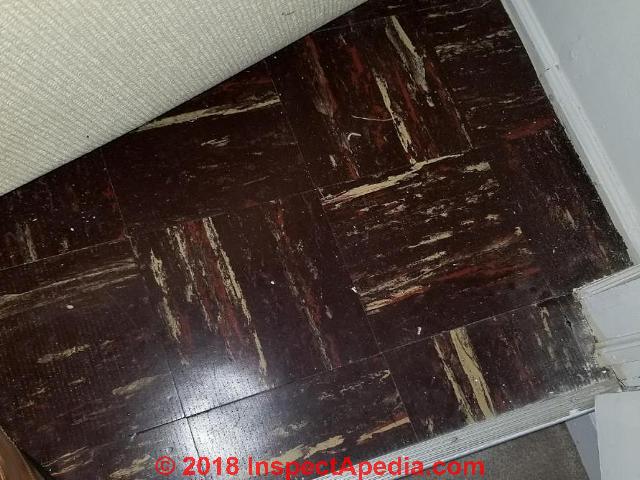
Thanks to reader anonymous, 2018/08/09.
This floor was in remarkably good-condition, has been left in place, and by the current home owner, is kept covered by carpeting.
Below: this floor, found in a U.S. home builty in 1947, is probably Armstrong Asphalt Asbestos Cedar No. B-918. However you will also see similar flooring by Kentile - for which we include a link just below.
By 1940, 5% of floor coverings sold in the U.S. were asphalt tile. -- Rosato
Below, courtesy of the same reader, we see a spatter-pattern floor tile typicaly sold by Kentile and some other manufactuers in the 1950s. Thanks to Anon. 2021/03/27
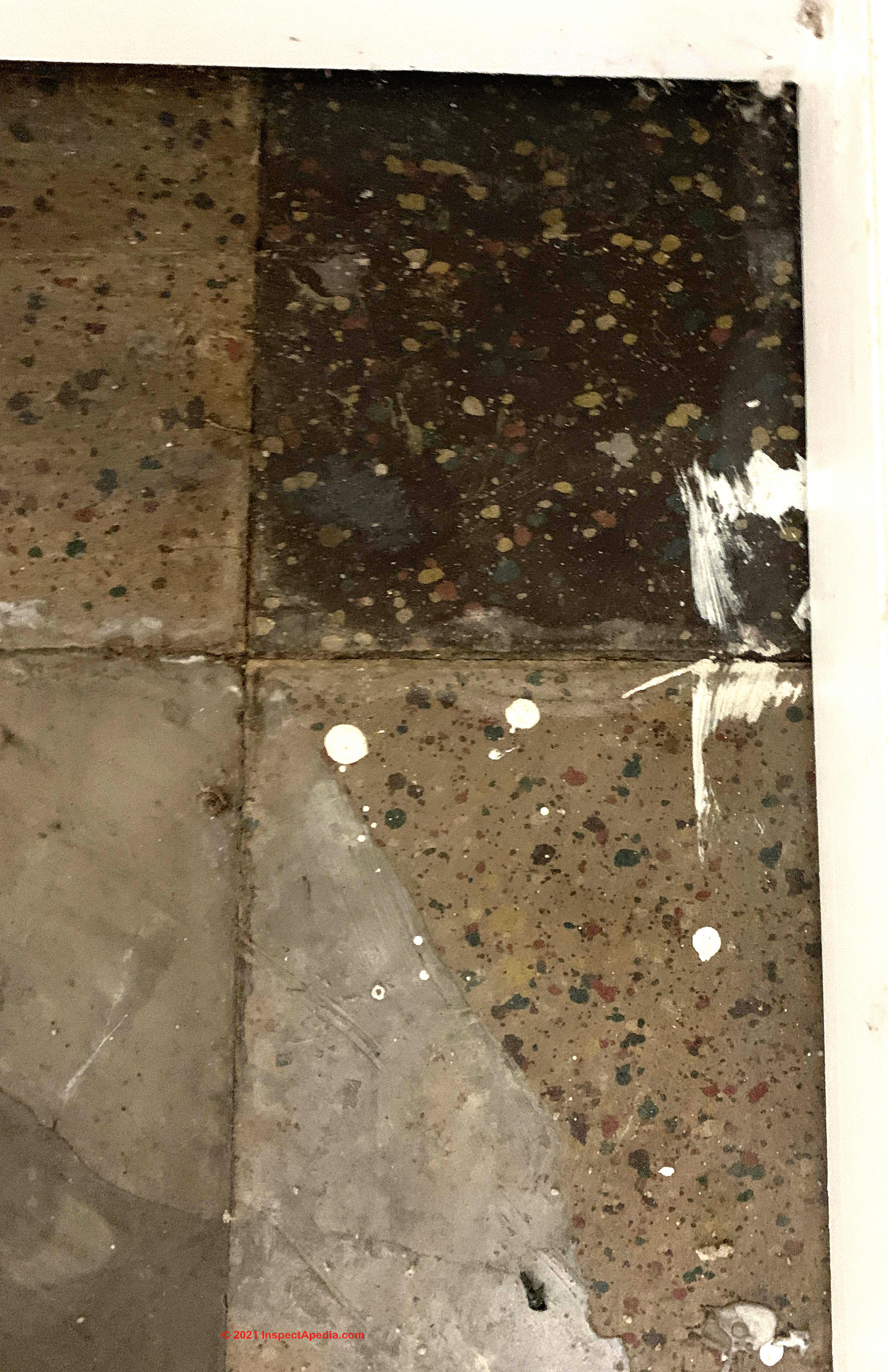
See other examples of these 1940s and 1950s floor tile patterns
at KENTILE FLOOR COLORS & PATTERNS KEY
More older Armstrong flooring products and catalogs can be found at
- Building Technology Archive - Internet Archive - source of many older Armstrong flooring catalogs researched for this article series
...
Reader Comments, Questions & Answers About The Article Above
Below you will find questions and answers previously posted on this page at its page bottom reader comment box.
Reader Q&A - also see RECOMMENDED ARTICLES & FAQs
This Linoleum over hardwood floor in a 1929 home will be tested for asbestos
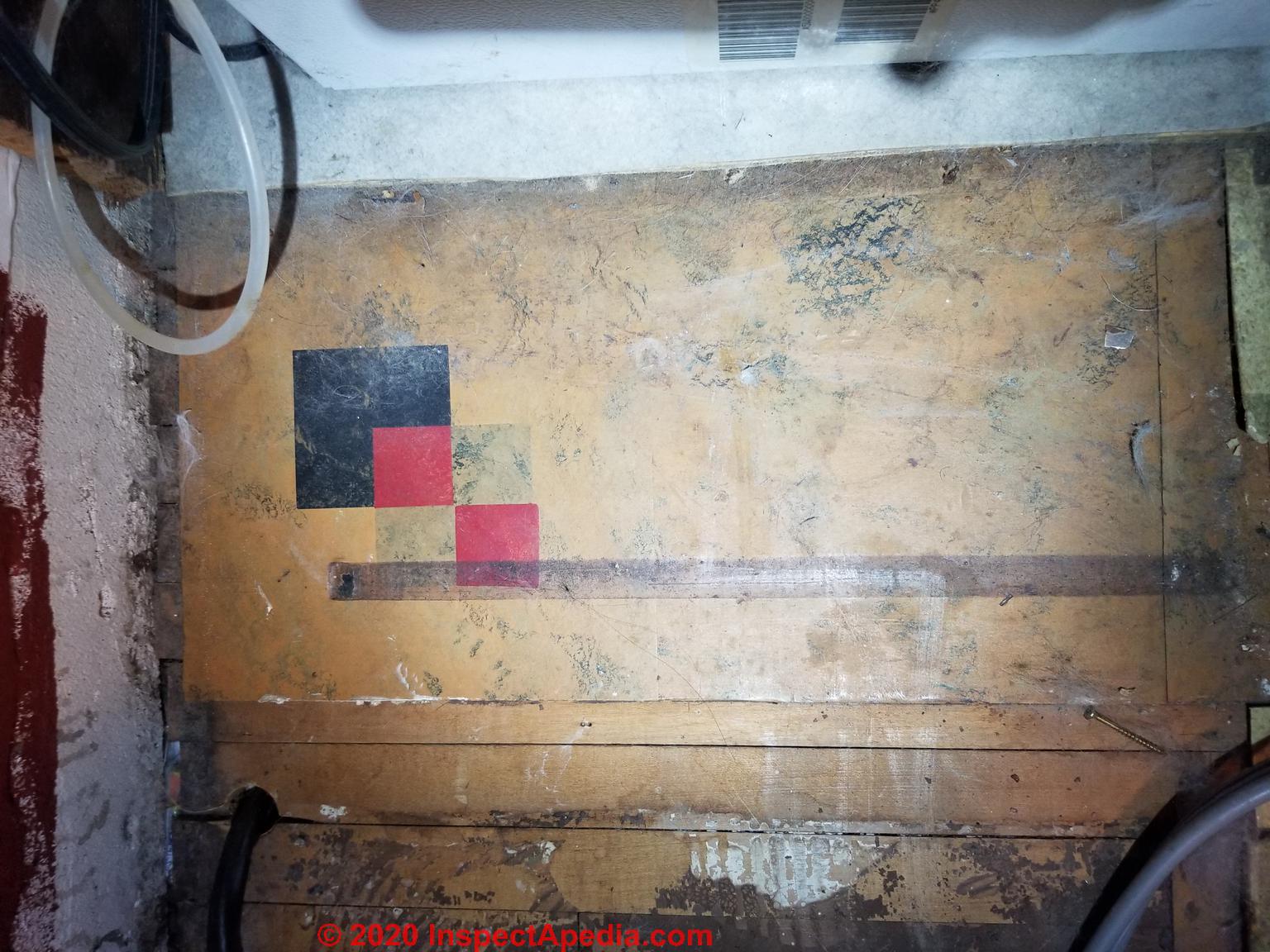
I plan to get the flooring [shown above] and adhesive tested, but is this recognizable as any certain manufacturer? House was built in 1929, not sure when the updates happened.
Original floor is hardwood, pictured is the first layer on top of the hardwood. It's got a red backing, and a black interior. - On 2020-11-13 by Jared -
Reply by (mod) - older linoleum, ca 1930-1950
Jared
That looks like 1930s or 1940s linoleum; there were multiple manufacturers (such as Armstrong, Congoleum, others) with a still-longer list depending on the country where your building is located.
A good place to start is at RESILIENT SHEET FLOORING ID GUIDE
or you may also want to click right to LINOLEUM & OTHER SHEET FLOORING - above on this page -- where I will re-post your question so as to invite comments from other readers who may recognize your floor pattern.
There we include links to several early sheet flooring and linoleum catalogs where you might spot your exact flooring pattern.Note that some asphalt-felt-backed sheet flooring does contain asbestos, at least in the felt backer.
...
Continue reading at FLOORING MATERIALS, AGE, TYPES or select a topic from the closely-related articles below, or see the complete ARTICLE INDEX.
Or see these
Recommended Articles
- ASBESTOS FLOORING IDENTIFICATION GUIDE INDEX - all brands, all years
- ASBESTOS FLOOR TILE IDENTIFICATION COLOR KEY - identify floor tiles based on main color
- ARMSTRONG SOLARIAN NO-WAX FLOORING HISTORY
- CORK FLOORING
- DOES THIS FLOOR CONTAIN ASBESTOS? - 5 easy questions to tell if your FLOOR probably contains asbestos -
- FLOOR COVERINGS: 1900 - 1949 - older types of floor coverings, sheet linoleum, congoleum, & tiles
- FLOOR TILE HISTORY & INGREDIENTS
- FLOOR TILE IDENTIFICATION PHOTOS - starting point
- FLOOR TYPES & DEFECTS - home
- FLOORING MATERIALS, AGE, TYPES
- LINOLEUM & OTHER SHEET FLOORING
- RESILIENT SHEET FLOORING ID GUIDE
Suggested citation for this web page
FLOOR COVERINGS: 1900 - 1949 at InspectApedia.com - online encyclopedia of building & environmental inspection, testing, diagnosis, repair, & problem prevention advice.
Or see this
INDEX to RELATED ARTICLES: ARTICLE INDEX to ASBESTOS HAZARDS
Or use the SEARCH BOX found below to Ask a Question or Search InspectApedia
Ask a Question or Search InspectApedia
Share this article:Search the InspectApedia website
Need to make a private comment? Email editor@inspectApedia.com. We welcome email with your website content critique, corrections, suggestions or questions. Email is monitored daily but our workload may prevent an immediate reply. For immediate results, we hope you'll first try asking your question using the search box just above.
Citations & Reviewers
In addition to any citations in the article above, a full list is available on request.
- [8] Resilient Floor Covering Institute, 1030 15th St. NW, suite 350, Washington D.C.
- [9] Inspiring Interiors from Armstrong 1950s from Armstrong, [Paperback], Schiffer Publishing (March 1998), ISBN-10: 0764304585, ISBN-13: 978-0764304583
- [11] Asbestos products and their history and use in various building materials such as asphalt and vinyl flooring includes discussion which draws on ASBESTOS, ITS INDUSTRIAL APPLICATIONS, ROSATO 1959, D.V. Rosato, engineering consultant, Newton, MA, Reinhold Publishing, 1959 Library of Congress Catalog Card No.: 59-12535 (out of print).
- [12] Congoleum Corporation, "Company History", Congoleum Corporation, Department C, P.O. Box 3127, Mercerville, NJ 08619-0127 1-609-584-3601, web-search 03/14/2011, original source: http://www.congoleum.com/history.html
- [21] Thanks to reader Matt Abel, Design Services Department, Strongwood Log Home Company, 711 Shadow Road, Waupaca WI 54981, Office (715) 258-4818, Toll Free (866) 258-4818, www.gostrongwood.com "Begin your journey home.." for vinyl asbestos floor photos, October 2010.
- [22] Thanks to reader Meryl Silvers for hexagonal floor tile photos showing a possilbe Kentile product that contained asbestos. October 2010.
- [23] Thanks to reader N.H. for providing a photo of 1970's era vinyl asbestos floor tile that we identify as most likely Armstrong Solarian Devonport white.
- [24] M.B. provided photographs of Congoleum linoleum flooring from a 1960's Tampa Florida home.
- [25] L.R. provided photographs of Armstrong Palimino Beige and Pecan Beige asphalt asbestos floor tiles, floor tile packaging and identification details, along with asbestos test lab results. Personal correspondence with DF, 10/22/2012
- Richa Wilson, Kathleen Snodgrass, EARLY 20TH-CENTURY BUILDING MATERIALS: RESILIENT FLOORING [Very large PDF], Richa Wilson, Intermountain Regional Architectural Historian Kathleen Snodgrass, Project Leader, United States Department of Agriculture Forest Service, Technology & Development Program, August 2007, 7300-0773-2322-MTDC. Contact Kathie Snodgrass at MTDC: Tel: 406–329–3922, Email: ksnodgrass@fs.fed.us or Richa Wilson, author; USDA Forest Service, Intermountain Region, 324 25th Street, Ogden, UT 84401. Phone: 801–625–5704; fax: 801–625–5229: e-mail: rwilson@fs.fed.us
- In addition to citations & references found in this article, see the research citations given at the end of the related articles found at our suggested
CONTINUE READING or RECOMMENDED ARTICLES.
- Carson, Dunlop & Associates Ltd., 120 Carlton Street Suite 407, Toronto ON M5A 4K2. Tel: (416) 964-9415 1-800-268-7070 Email: info@carsondunlop.com. Alan Carson is a past president of ASHI, the American Society of Home Inspectors.
Thanks to Alan Carson and Bob Dunlop, for permission for InspectAPedia to use text excerpts from The HOME REFERENCE BOOK - the Encyclopedia of Homes and to use illustrations from The ILLUSTRATED HOME .
Carson Dunlop Associates provides extensive home inspection education and report writing material. In gratitude we provide links to tsome Carson Dunlop Associates products and services.
 |
HOME | ABOUT | ASK a QUESTION | CONTACT | CONTENT USE POLICY | DESCRIPTION | POLICIES | PRIVACY | |
| © 2026 - 1985 Publisher InspectApedia.com - Daniel Friedman | |||||||||