
InspectAPedia® FREE Encyclopedia of Building & Environmental Construction, Diagnosis, Maintenance & Repair |
Question? Just ask us! InspectAPedia
|
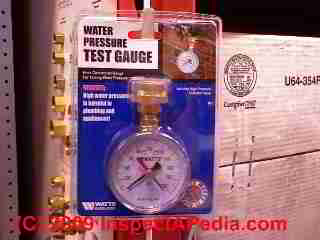 How to Measure Water Pressure & Flow in a Building
- POST a QUESTION or COMMENT about how to accurately measure water pressure & water flow rate in buildings
How to measure municipal or well water water pressure at a building: this article describes how to measure water pressure and water flow in buildings in order to diagnose bad pressure or bad water flow.
The process of water pressure problem diagnosis and the costs of the repair are explained. We explain the difference between measuring static water pressure (nothing running) and dynamic water pressure.
We explain the difference between water pressure, and water flow rate, and we describe how to measure water flow rate in a building.
InspectAPedia tolerates no conflicts of interest. We have no relationship with advertisers, products, or services discussed at this website.
- Daniel Friedman, Publisher/Editor/Author - See WHO ARE WE?
How to Measure Building Water Pressure: Definitions of Static Building Water Pressure & Dynamic Water Pressure
 Distinguishing between static water pressure, dynamic water pressure, and water flow rate can help diagnose water problems in a building.
Here we explain these concepts and we describe how to measure water pressure and flow at a property where either municipal water supply or a private well and pump water supply is in use.
Article Contents
- DEFINITION of STATIC WATER PRESSURE
- DEFINITION of DYNAMIC WATER PRESSURE
- DEFINE WATER PRESSURE per FOOT of HEIGHT
- MEASURE WATER SYSTEM PRESSURE & PRESSURE MAXIMUM
- MEASURE MUNICIPAL WATER SUPPLY PRESSURE
- MEASURE PRIVATE PUMP & WELL WATER PRESSURE
Definition of Static Water Pressure
Static water pressure is the pressure shown anywhere on the water supply piping system when no plumbing fixtures are running.
Typically on a municipal water supply the static water pressure in the building will be 30-60 psi, depending only on the setting of the water pressure regulator - the regulator determines static water pressure in the building.
On a private well and pump water supply system water pressure varies between 20-40 psi or 30-50 psi depending on the equipment installed and the pump pressure control switch settings.
See WATER PRESSURE CONTROL SWITCH ADJUSTMENTS
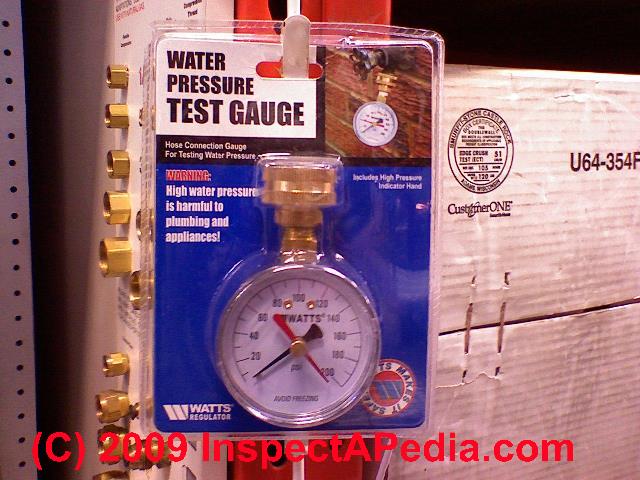
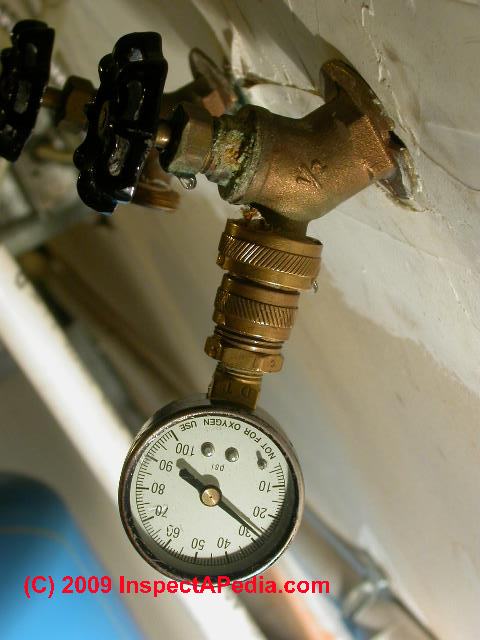
Our photo (left) shows a simple and inexpensive home-made water pressure measuring gauge that we attached to the cold water faucet for a washing machine hookup. Building suppliers also sell water pressure gauges with the same fittings to attach the gauge to a hose or faucet hookup (see our page top photo).
To measure static water pressure, attach a pressure gauge anywhere in the building on water supply piping. Make sure that no plumbing fixtures are running, and if the building is served by a well and pump system, make sure that you have run water until the pump starts running, then turn water off.
The pressure read on the gauge with all fixtures "off" is the maximum static water pressure at the building.
Definition of Dynamic Water Pressure
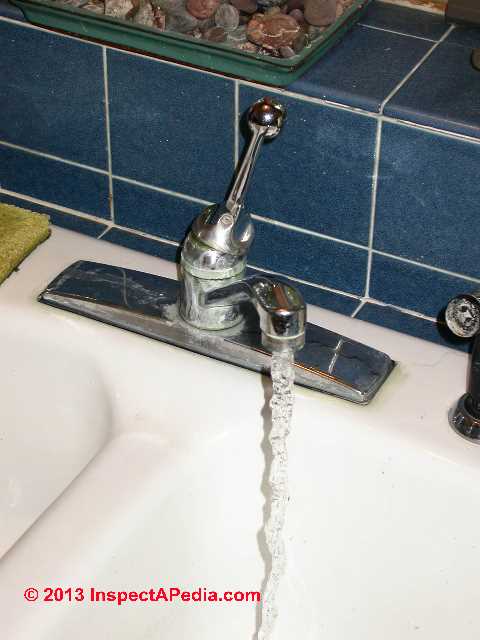 Dynamic water pressure (as used in this article) is the pressure shown anywhere on the water supply piping system when one or more plumbing fixtures is drawing water. You can see that the more fixtures that are running, the lower the dynamic water pressure will be.
Technical note: Our use of this term dynamic water pressure is not the more rigorous term used in fluid dynamics.
By "dynamic water pressure" as used here here we simply mean that if you put a pressure gauge on a hose bib, laundry faucet, etc. while water is running elsewhere in the building the measured pressure is ambiguous.
Similarly, in a pump and well system, if you make a pressure measurement at any time other than at the point that the well pump cuts on or off the results can be confusing if not ambiguous.
On a municipal water supply system the dynamic water pressure and flow seen in a building will drop to a number lower than the static water pressure but will normally remain steady when you turn on one or more plumbing fixtures.
On a pump and well water supply system the dynamic water pressure and flow seen in the building will drop to a lower number than the static water pressure, and will also vary as the pump cycles on and off.
Example of variation in building water pressure:
- Incoming building water pressure is 80 psi at the street-side of the pressure regulator.
- The pressure regulator is set to 60 psi and installed on 1/2" diameter building water supply piping
- The building has four apartments and in each apartment simultaneously people are running multiple plumbing fixtures, drawing water out of the system so fast that ...
- The dynamic building water pressure drops to 20 psi when all of these fixtures are operating. Even though the pressure regulator is set to 60 psi, when water flow in the building exceeds the capacity of the incoming water main to deliver water at that pressure, the in-building water pressure will drop to a lower number.
A solution to this problem may be the installation of
a WATER PRESSURE BOOSTER PUMP.
On a pump and well water supply system when multiple plumbing fixtures are operating, the dynamic water pressure will fall to a lower number and will hover there once the quantity of water being drawn causes the pump to turn on and stay on - that is, when you are running water fast enough that the pump cannot "get ahead" of the water draw out rate.
How much pressure is exerted by water per vertical foot of pipe or lift or rise?
Water weight, volume, pressure and volume ratios
Reader question: 3/3/2014 Rob Cunningham said: What is the water pressure per foot, I know it is 2.? per foot but I don't remember the the formula.
Reply: basic data about water weight, volume, pressure relationships - basic hydraulics of water
The pressure of water is usually stated in psi or pounds per square inch. Here are some water volume, weight & pressure basics:
What is the weight of a cubic foot of water?
The weight of a cubic foot of water: cubic foot of water weights about 62.42796 pounds (at 32 °F).
This weight can also be expresses as the pressure that would be measured at the bottom of a cubic foot of water.
At the bottom of the cube of water, each square inch of the base of a 12"x12"x12" cube of water will exert a pressure of (62.4796 / 144 sq.in) = 0.433 pounds per square inch or psi.
How many gallons are in a cubic foot of water (or anything else) ?
The number of gallons in a cubic foot: a cubic foot of water is about 7.48 U.S. gallons
Since 1 cubic foot = 12x12x12 cubic inches = 1728 cubic inches, we can calculate that one cubic foot of water contains (1728 cubic inches per cubic foot / 231 cubic inches in a gallon ) = 7.481 gallons.
How much does a gallon of water weigh?
1 U.S. gallon of water contains 231 cubic inches and weighs about 8.3454 pounds
SInce 1 cubic foot of water contains 7.48 gallons and 1 cubic foot of water weighs 62.4 lbs., we calculate (62.4 / 7.48 = 8.3554 lbs)
What is the weight of a litre of water?
1 liter of water weighs 2.204 pounds
How to Translate the Height of a Column of Water to Pressure or PSI
Since water is virtually non-compressible, its density doesn't vary by height. And we can ignore width or diamater of the water pipe or well casing too. Only the height of the column of water matters.
The pressure exerted by a vertical column of water inside of a well casing or a pipe, measured at the bottom of that column, is determined as follows:
The pressure of a column of water is about 0.434 psi per foot of column height
We calculated this psi above by dividing the weight of a cubic foot of water by the number of square inches in the bottom of the cubic foot: (62.4796 / 144 sq.in) = 0.433 pounds per square inch or psi.
That's for water at 32 °F. If warm the water up it will weigh a little less - the actual weight of water varies slightly by temperature as its density varies by temperature and possibly also by the effect of impurities in the water.
1 ft of water produces 0.433 psi of pressure at the bottom of that column [re-stating the information just above]
So the formula for the psi pressure of a column of water is
PSI of water pressure at the base of a column of water of height H in feet = H x 0.433
Examples:
- If your well has a static head of 100 feet, the water pressure at the bottom of that static head would be 100 x 0.43 = 43 psi.
- If the vertical distance from the pitless adapter to the point at which water enters a two line jet pump system foot valve in the well is 100 feet, the water pressure or static head pressure that the pump has to overcome will be 100 x 0.43 = 43 psi (if we presume that the rest of the piping in the system from foot valve to pump and pressure tank is horizontal.)
Do we need to convert the weight of water to pressures per foot in a well pipe or inside the well casing?
No. Using the formula given just above,
PSI of water pressure at the base of a column of water of height H in feet = H x 0.434
This formula is accurate regardless of the pipe, casing, or well shape or diameter. Height matters, but not diameter.
We can calculate the water pressure at the bottom of any vertical height. But for water inside of a well or well casing, we need to be sure that we are calculating correctly by counting only the height of the column of water, not the total height that for most wells (except artesian wells) will include an air space above the top of the column of water.
The size or volume of water inside of a well or well casing when the well is at rest (not in use) and has fully recovered from any recent use (the well has re-filled from its water source) is defined as the static head.
At WELL DYNAMIC HEAD & STATIC HEAD DEFINITION we show how to calculate the volume of water in a cylinder of various diameters. Recapping:
PSI of water pressure at the base of any column of water of height H in feet = H x 0.434
Thanks to reader Gary A Sale for pointing out confusion in an earlier version of the text above. - 4 Dec 2014
Other water conversions weights & measures converting a U.S. gallon
1 Gallon (U.S.) = 3.785x10⁻³ m3 = 3.785 dm3 (liter) = 0.13368 ft3 = 4.951x10⁻³ yd3 = 0.8327 Imp. gal (UK)
At sea level the atmospheric pressure on earth, on the top of the water and on us = 14.7 psi. The "container size" as reader GaryASale pointed out, is not a factor. If we ignore the very small variations over our height and assume we're standing, we're being pushed-in on all sides by air at 14.7 psi. (more or less).
Let's dive down to about 33 feet below sea level in sea water. Water pressure is now 2 atmospheres or 29.4 psi (little enough to be safe from getting the bends even if we hold our breath a long time or swim around using a SCUBA tank).
Diving down just 33 feet below the surface of the ocean exposes the SCUBA diver to a second atmosphere's worth of pressure, referred to in SCUBA training as 1 ATM (since we start counting at 0 at sea level). But of course you're now under water, so you're experiencing water pressure, not air pressure, on the outside of your body.
Articles relating height of a column of water or gas, building height, water pressure, chimney draft, gas pressure include
- DRAFT MEASUREMENT, CHIMNEYS & FLUES
- GAS PRESSURES LP vs NATURAL GAS
- GAS PRESSURE vs BUILDING HEIGHT
- GAS PRESSURE FLOW INADEQUATE
- WATER PRESSURE MEASUREMENT and in that article DEFINE WATER PRESSURE per FOOT of HEIGHT
Measure Water System Pressure to Check for Thermal Expansion Leaks & TPR Valve Drips
 Really? Ok so "static" water pressure is not perfectly static even if no water is running in a building. Why?
At RELIEF VALVE LEAKS we explain that when no water is being run in a building water pressure will still change depending on what the water heater is doing.
This is particularly true if your hot water is made by a water heating tank or cylinder - where a reserve of some significant number of gallons or litres of hot water is being maintained, and it's not particularly true if your hot water is made by a demand type system such as a tankless coil or a tankless water heater.
See HOT WATER PRESSURE EXPANSION RATE - for an explantion of just how much pressure increase to expect when heating water.
When no water is being run and the water heater raises the temperature of water inside the water heater or water cylinder tank, thermal expansion of the heated water will increase the water pressure in the entire system.
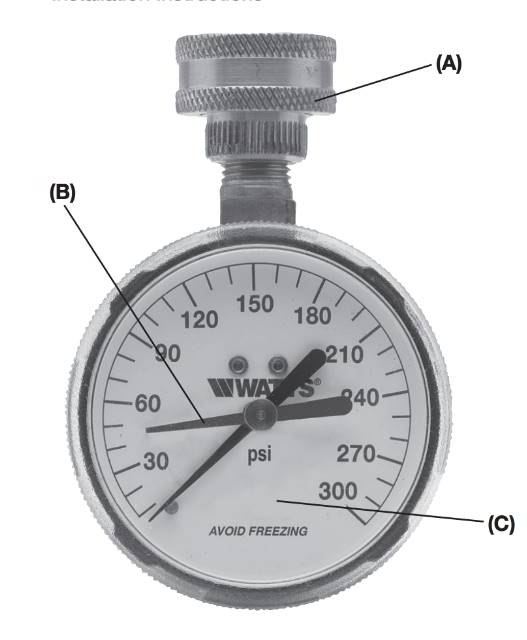
Purchase a water pressure gauge that includes a "telltale" - a second pressure indicating needle that is pushed upwards to show higher pressure when the acutal moving pressure-indicating needle moves. When pressure in the system falls, the telltale indicator is left at its "high pressure" mark.
The water pressure test gauge shown at left has this needed feature. This is a Watts Model 276H300 water pressrue test gauge.
"A" marks a 3/4" FPT fitting designed to permit the gauge to be installed on a hose bibb.
"B" marks the "high reading" indicator, showing the highest pressure that the gauge has seen during a test period (typically 24 hours).
"C" marks the gauge dial face giving pressure in psi. Other pressure gauges are available in common pressure readings that you may require such as Pa or pascals. The gauge's indicating meter is sitting on the pin at 0 psi in this image.
You'll also find this type of gauge on hydronic heating boilers but those gauges are not so easily adapted for monitoring a building's water system pressure. Where do you find one of these telltale water pressure gauges: at your local plumbing supplier.
These water pressure test gauges cost less than $15. USD. Ask for any of these water pressure test gauges. If you are shown a different brand or model be sure that it includes a high-pressure indicator needle so that you don't have to stay up all night in your sleeping bag watching the gauge's pressure readings as they change.
Typically the gauge will include an external re-set knob or button to allow you to re-set the maximum pointer to zero before the gauge's next use.
All of the water pressure test gauges listed below include a "Maximum Pointer" feature that will record the highest pressure reached. These are sold at your local plumbing supplier, at Grainger.com, and at other online vendors.
- Boshart Industries Water Test Gauge PG25-WTG300MP
- Duro Water Pressure Gauge # 18C829 or #18C830
- LDR 020 9645 Pressure Test Gauge
- Watts Water Industries pressure gauge model 276H300
- Watts Model DP IWTG water pressure test gauge
To monitor the operating pressure range of your system to see the effects of hot water on its pressure (and maybe to explain a leaking TPR valve), simply install a water pressure gauge on to a hose bibb that's easy to see such as at your washing machine or at an outdoor hose bibb. Leave the gauge in place for 24 hours.
How to Measure Municipal Water Pressure
Static municipal water pressure
may vary at different times of the day depending on what pressure is being delivered by the municipal supplier. In some communities municipal water pressure varies little while in others the variation can be significant.
To measure municipal water pressure in a building, use a water pressure test gauge like the home made water pressure test gauge shown above or the store-bought water pressure gauge shown at page top.
Install the water pressure gauge at a convenient outside hose bibb or to the drain connection on a water heater, or at a washing machine hot or cold water hose connection point.
If the building water pressure gauge reading is below 60 psi
leave the gauge in place for two days, checking it frequently for different pressure readings, because water pressure may vary by time of day or by the plumbing fixtures in use in the building.
An advantage of the store-bought Watts water pressure test gauge over the home-made version is that the special Watts test gauge includes a high-point red indicator needle that will record the highest water pressure sensed by the gauge during the test period, even if you did not happen to be looking at the gauge when that condition occurred.
Since your water pressure measurement itself could be inaccurate,
see WATER PRESSURE GAUGE ACCURACY where we explain causes of false high water pressure readings and false low water pressure readings.
For pressure gauge repair or replacement
see WATER TANK PRESSURE GAUGE.
How to Interpret Your Municipal or City Water Pressure & Flow Measurements
If your dynamic water pressure is too low on a municipal water supply system you can boost building water pressure by installing a pressure booster pump and water tank.
See WATER PRESSURE BOOSTER PUMP.
Also see our discussion of parallel water pressure reducing valves found
at WATER PRESSURE REDUCER / REGULATOR.
If your municipal or city water pressure is always too low, perhaps below 30 psi,
see WATER PRESSURE LOSS DIAGNOSIS & REPAIR.
For more help figuring out why your municipal water pressure is too weak,
see MUNICIPAL WATER PRESSURE DIAGNOSIS and
then see MUNICIPAL WATER PRESSURE IMPROVEMENTS.
Also see WATER PRESSURE VARIATION CAUSES.
Watch out: If the building water pressure gauge reading is ever found at 80 psi or higher, you will want to install a water pressure regulator at the point where water supply enters the building.
Watts produces a Watts Governor 80™ used for this purpose, but other manufacturers also produce a wide variety of water pressure regulators.
If your building already has a water pressure gauge installed, it may be defective or it may be set too high. If your static water pressure is too high on a municipal supply,
See WATER PRESSURE REDUCER / REGULATOR.
Also see WATER PRESSURE CONTROL SWITCH ADJUSTMENTS
At HOT WATER PRESSURE EXPANSION RATE we discuss how we measure water pressure and how temperature changes affect water pressure in a closed water heater tank or heating boiler.
How to Measure Private Pump & Well Water Pressure
Static well water pressure depends on the setting of the pump controls. You can try reading the water pressure shown on the pressure gauge that is usually installed at the pressure tank or near the pump pressure control switch.
Watch out: dirt or debris in the small diameter pressure switch mounting pipe at your water pressure tank, or a failing pressure gauge itself can give inaccurate water pressure readings.
Particularly if your water pressure gauge reading does not rise and fall smoothly as the water pump turns on and off, you may want to replace the gauge and/or make an independent water pressure reading using the water pressure test gauge we have described just above.
Since your water pressure measurement itself could be inaccurate,
see WATER PRESSURE GAUGE ACCURACY where we explain causes of false high water pressure readings and false low water pressure readings.
How to Interpret Your Private Well Water Pressure & Flow Measurements
If your well water pressure is always too low, perhaps below 30 psi,
see WATER PRESSURE LOSS DIAGNOSIS & REPAIR.
Also
see WATER PRESSURE VARIATION CAUSES.
If your dynamic well water pressure is too low on a private pump and well system you may be able to boost water pressure by adjusting the pump pressure control switch.
See WATER PRESSURE CONTROL SWITCH ADJUSTMENTS
Also, because poor water flow rate from a private well system is often due to a limitation of the well's flow rate,
see WATER PRESSURE LOSS DIAGNOSIS & REPAIR.
Watch out: If your well water pressure is too high,
see WATER PUMP CONTROLS & SWITCHES and see WATER TANK SAFETY.
Measure Water Flow Rate in a Building - Bucket & Stopwatch
This topic has moved to WATER FLOW RATE MEASUREMENT - live link given just below.
Watch out: measuring "flow rate" at any faucet or fixture served by a well pump system will be inaccurate and will reflect pump capacity, piping restrictions, fixture restrictions, and even actual well flow rate variations where pump protection tailpieces or similar devices are installed.
Measuring flow rate at a fixture does not measure the well's true flue rate.
...
Reader Comments, Questions & Answers About The Article Above
Below you will find questions and answers previously posted on this page at its page bottom reader comment box.
Reader Q&A - also see RECOMMENDED ARTICLES & FAQs
On 2020-07-03 by RICHARD DALE WATTS
I live in oildale ca.And family owns watts valve world wide.
As a child I would want water after grade school, standard jr. High short for standard oil
.None of the water works up the road for miles.
There was one cold water place next to a coke mec. At 63 its still that way. I hope to change that with help.
On 2020-04-17 by Pressure Variation - Why would the high reading ever approach ~ 100 PSI if the regulator is doing it's job?
Use Watts Pressure Measurement - static is ~ 40 PSI. After 2 days of monitoring the high reading is ~ 100 PSI.There is a pressure regulator installed correctly right behind the gate valve from the supply (from the street). I replaced the regulator ~ 3 yrs ago. Why would the high reading ever approach ~ 100 PSI if the regulator is doing it's job?
On 2020-04-17 - by (mod) -
Press
Where are we measuring water pressure, and on what kind of system with what equipment?
Municipal water supply
vs
Well water pump and tank supply
Heating boiler
Other equipment?
I am guessing we're talking about municipal water supply, with a pressure regulator at the incoming supply, and no water pressure tank.
In that case if you're seeing water pressure in the building above what you had when you first installed and adjusted the water pressure regulator, then the regulator is not working and probably needs replacement.
Note that some pressure regulators will malfunction if their internal parts become debris clogged, so if that's your case you might first try cleaning yours.
Keep me posted. Post a photo.
...
Continue reading at WATER PRESSURE VARIATION CAUSES or select a topic from the closely-related articles below, or see the complete ARTICLE INDEX.
Or see WATER PRESSURE MEASUREMENT FAQs questions and answers posted originally at this article
Or see these
Recommended Articles
- TREADLE PUMP CAPACITIES & USE - separate article
- WATER FLOW RATE CALCULATE or MEASURE - how much water is delivered at a plumbing fixture
- WATER METERS, RESIDENTIAL
- WATER PRESSURE GAUGE ACCURACY
- WELL FLOW RATE - how much water can we get out of the well?
- GAS PRESSURES LP vs NATURAL GAS for a discussion of the effects of gravity on building piping system flow rates or pressures.
- WELL DYNAMIC HEAD & STATIC HEAD DEFINITION - well water volumes, calculations of how much water is in a well
Suggested citation for this web page
WATER PRESSURE MEASUREMENT at InspectApedia.com - online encyclopedia of building & environmental inspection, testing, diagnosis, repair, & problem prevention advice.
Or see this
INDEX to RELATED ARTICLES: ARTICLE INDEX to WATER SUPPLY, PUMPS TANKS WELLS
Or use the SEARCH BOX found below to Ask a Question or Search InspectApedia
Ask a Question or Search InspectApedia
Try the search box just below, or if you prefer, post a question or comment in the Comments box below and we will respond promptly.
Search the InspectApedia website
Note: appearance of your Comment below may be delayed: if your comment contains an image, photograph, web link, or text that looks to the software as if it might be a web link, your posting will appear after it has been approved by a moderator. Apologies for the delay.
Only one image can be added per comment but you can post as many comments, and therefore images, as you like.
You will not receive a notification when a response to your question has been posted.
Please bookmark this page to make it easy for you to check back for our response.
IF above you see "Comment Form is loading comments..." then COMMENT BOX - countable.ca / bawkbox.com IS NOT WORKING.
In any case you are welcome to send an email directly to us at InspectApedia.com at editor@inspectApedia.com
We'll reply to you directly. Please help us help you by noting, in your email, the URL of the InspectApedia page where you wanted to comment.
Citations & References
In addition to any citations in the article above, a full list is available on request.
- Brian Boman, "Chapter 21, Hydraulics", University of Florida, Indian River Research & Eductation Facility, 2199 South Rock Road, Fort Pierce, Florida 34945-3138 Tel: (772) 468-3922, Email: bjbo@ufl.edu, retrieved 3/3/2014, original source: http://irrec.ifas.ufl.edu/citrusbmp/ Water%20and%20FL%20Citrus/21%20Chap21.pdf
- Dultmeier, "Flow Data, Water Through Hose", Dultmeier Sales, Nebraska: 13808 Industrial Road, Omaha, NE 68137, Tel: 800 228-9666 and in Davenport IA, (800) 553-6975, Email: sales@dultmeier.com, Website: http://www.dultmeier.com/, Retrieved 3/3/2014, original source http://www.dultmeier.com/pdfs/tech-library/02Water8.pdf
- Watts, 815 Chestnut Street, North Andover, MA, USA 01845-6098, web search 09/18/2010 Watts Regulator Corporation, 815 Chestnut Street, North Andover, MA, USA 01845-6098, provides pressure and temperature relief valves, water pressure test gauges, water pressure regulators, backflow preventers, check valves, and other plumbing and heating controls and supplies. Website: http://www.watts.com/
- Watts Backflow preventers - 978-688-1811
- Watts Control valves - 713-943-0688 for example Watts pressure reducing valves, original source: http://www.watts.com/pages/learnAbout/reducingValves.asp?catId=64
- Watts Drainage products - 828-288-2179
- Watts Potable water PEX plumbing - 978-688-1811
- Watts Water safety controls - 978-688-1811
- Watts Water quality & conditioning products - 352-465-2000
- Engineering toolbox properties of water - http://www.engineeringtoolbox.com/water-thermal-properties-d_162.html editor.engineeringtoolbox@gmail.com web search 09/16/2010
- SI Metric.co.uk provides tables and constants for the properties of water - web search 09/16/2010 original source: http://www.simetric.co.uk/si_water.htm
- Thanks to reader E.B. who, by private email pointed out a typographical error in the calculations above. 2017/02/11
- In addition to citations & references found in this article, see the research citations given at the end of the related articles found at our suggested
CONTINUE READING or RECOMMENDED ARTICLES.
- Carson, Dunlop & Associates Ltd., 120 Carlton Street Suite 407, Toronto ON M5A 4K2. Tel: (416) 964-9415 1-800-268-7070 Email: info@carsondunlop.com. Alan Carson is a past president of ASHI, the American Society of Home Inspectors.
Thanks to Alan Carson and Bob Dunlop, for permission for InspectAPedia to use text excerpts from The HOME REFERENCE BOOK - the Encyclopedia of Homes and to use illustrations from The ILLUSTRATED HOME .
Carson Dunlop Associates provides extensive home inspection education and report writing material. In gratitude we provide links to tsome Carson Dunlop Associates products and services.
 | HOME | ABOUT | ASK a QUESTION | CONTACT | CONTENT USE POLICY | DESCRIPTION | POLICIES | PRIVACY | |
| © 2025 - 1985 Publisher InspectApedia.com - Daniel Friedman | |||||||||